The rationale for what is known as “orthodox”, “Western”, or, more accurately, “biomedical” medicine, is very materialistic. It’s focussed on the physical, and has been since the morbid anatomists of the 15th and 17th century Parisian hospitals began conducting post-mortem dissections and claimed that disease was what you could see, touch, and measure. This reduction of human suffering to physical components was a new phenomenon which was dramatically captured by Rembrandt in The Anatomy Lesson of Dr Tulp.
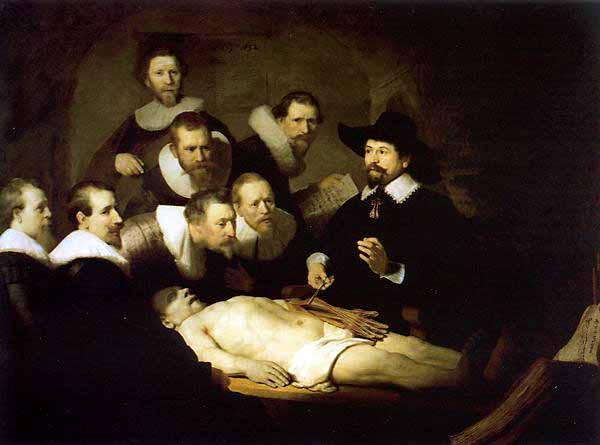
This combined with Bichat‘s concept of “the lesion” focussed the attention of doctors and scientists on smaller and smaller parts of the human body. The development of the microscope knocked the morbid anatomists off their dominant chairs by showing that disease was not just what you could see and measure with your own eyes, but was actually a disturbance of, and within, cells. Further technological developments allowed smaller and smaller components of human beings to be studied and measured, and this has continued up to the present day, to the extent that “diagnosis” has become the art of interpreting machine-generated measurements of body components and even an examination of DNA.
But human beings are complex adaptive systems, and the more complex a system, the less you can understand it by only examining its parts. Pain cannot be understood by a simple consideration of neural pathways, cell receptors and short chain proteins. Depression cannot be understood by a simple measurement of serotonin levels. And health cannot be understood by adding up a whole list of biological metrics.
As Mary Midgely said,
One cannot claim to know somebody merely because one has collected a pile of printed information about them.
However, most of our interventions are devised within this materialistic and reductionist framework.
Most surgical interventions are intended to remove diseased, or “abnormal” tissue. Most non-surgical interventions involve the use of drugs – manufactured molecules intended to interact with molecules within the human body.
In many cases, this approach pays off. In managing acute, life-threatening disease it is very effective. You are less likely to die in the middle of heart attack, an asthmatic attack or an epileptic fit now than you would have been fifty years ago. The problem lies with chronic illness, where this approach is not nearly so effective. The chances of having heart disease, asthma or epilepsy is greater now than it was fifty years ago, and there are still no cures. There are no known treatments which will cure these chronic problems.
Maybe this is partly because the more chronic the problem, the more unique, the more personal, the experience and its manifestation. Maybe we need a different approach because whole people cannot be understood as mere sums of their parts.
We need to put molecules and materialism into their most useful contexts and not assume that they present the only truth.
We need to design health care around whole people, not bits of them. Let’s have Person Sized Medicine.

 Heroes Not Zombies
Great post!
Duane Sherry
Dallas, Texas
Hear, hear!
“The chances of having heart disease, asthma or epilepsy is greater now than it was fifty years ago, and there are still no cures.”
Why is this, Doc? Is it because incidences of these (and other) diseases are actually increasing, or is it that the diagnostic techniques we have now are more effective than they’ve been in the past? Did we ALWAYS have a zillion kids with ADD, but we just didn’t know it, or are we getting better at telling what’s what? (Or, of course, there’s the third option of the idea that we’re creating these conditions BECAUSE we can detect them – a sort of Heisenberg Principle thing..)
thanks duane and kat!
mrschili, the short answer is we don’t know! Don’t think anyone thinks it’s all down to detection however.
One theory is that as we get better at making acute diseases non-fatal (infections, trauma and so on) then more people survive to experience chronic diseases.
You mention ADD, and that, actually, is a different case, and may well have something to do with more “detection” – there are a number of diseases which are either invented, or exaggerated, by drug companies who need to create markets for their drugs.
good……
[…] Person sized Medicine vs Molecule sized Medicine Removing the problem versus treating the whole complex adaptive […]
[…] imbalance, to being a physical disease which could be seen, touched and measured in the body (see The Anatomy Lesson of Dr Tulp) That too turns out to be way too simplistic an understanding. Humoural theory was indeed a […]
[…] pretty sure one of my first choices would “The Anatomy Lesson of Dr Tulp” (which happens to be one of my all time most viewed […]