Feeds:
Posts
Comments

Archive for May, 2020

Have you ever watched birds take off from, and land on, water?

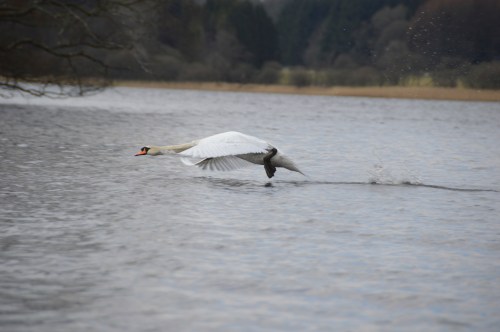
These two photos were taken on the Lake of Menteith in Scotland a few years ago. They make a nice pair of images. As swans swim around on the lake you don’t really hear much noise. They’re pretty famous for gliding over the surface, apparently effortlessly. (You can’t see that their legs are paddling like mad below the surface)

But when they take off and when they land, boy, do they make a lot of noise! They splash and clatter as their huge wings beat the air.

It strikes me that these transitions, as the swan moves from the air to the water surface, and vice versa, are times of huge effort. Yet they do both with an astonishing grace.

Look at the first photo where a swan is taking off. It looks elegant and stylish. Streamlined even. Straight as an arrow. As it just leaves the water it continues to move parallel to the surface for a few beats before it soars up into the sky.

Then the second photo where one is landing also has a certain elegance, but not the same elongated, streamlined form. It’s long neck has an arched shape which gives the whole creature the appearance of a crescent or a bow.

An arrow as it takes off, and a bow as it lands.

Today is the end of the “confinement” in France. The Charente, where I live, is one of the “departments verts” (green regions) which means the virus isn’t so present in the population (it’s not been that present here since the start of the outbreak, probably not least because this a rural, less densely populated part of the country), and the pressure on the health services locally is not great. The government are using an interesting measure which picks up, to some extent, aspects of both of those criteria – the percentage of patients presenting at hospital who have suspected Covid-19 symptoms. The lower that percentage, the less active the virus is deemed to be, and, of course, the less need for hospital care. The government have also been at pains to say that this is the beginning of the “deconfinement” – just the start of an easing of restrictions.

We landed in lockdown (confinement) very abruptly at the beginning. It was announced one evening, that from midnight that night all the restaurants, bars and cafes would close, and within a couple of days, the full lockdown was in effect. Take off out of lockdown (deconfinement) seems to be much more gradual.

I’d expected to feel quite different this morning, but I don’t. The fact that there have been high winds and heavy rainfall since overnight last night is one of the reasons why I’m feeling not much has changed. It’s not that tempting to go out today! But the other is, that in Cognac, like most towns this size in France, the market and the shops are closed all day every Monday. So, there’s not much point in going into town today to see how it feels. Tomorrow might be different.

I’m very aware that this is now a transition phase. My life, although restricted for the last couple of months, has attained a certain stability and quiet calm. Now the limits have been pushed out a bit. I can go out without the need to print a permission slip to show to any policeman who might stop me, and I can travel freely up to 100 kilometres from home. I’m pretty sure I don’t want to use all the freedoms I’ve got now, though. For example, I could make a trip to the big city – Bordeaux. But do I want to get on a tram with a lot of other people and walk down much busier streets, whilst all the restaurants and cafes are still closed? I don’t think so. And I still can’t leave the country (although, frankly, I have zero interest in an airport and flight experience for now!), and I can’t yet drive to other parts of France. The beaches, museums, cinemas and theatres are all still closed too. So, it’s France, but not France as we know it, Jim.

I’m wondering if I, and the rest of the country, can transition with as much grace and elegance as these swans. Or is there going to be a lot of noisy flapping around? Especially if this is just the first transition in a whole wave of transitions to come.

How is it in your part of the world?

Read Full Post »

I showed you a photo of a wounded rock the other day to illustrate how whatever impacts our lives changes us forever. Here’s another similar image. This time it’s a tree.

Look at the shape of this tree! What’s happened here? It’s quite extraordinary. I’ve never seen such a dramatic “folded” form within a tree. What caused this? We’ll never know.

But it’s changed this tree forever. This astonishing fold is way more than the twists and turns in a ordinary day. Perhaps for that reason it makes me think it’s relevant to this time of pandemic and physical distancing where our societies, our lives, have closed up.

I’m sure we are all preparing to write the next chapter of our stories, but, first of all, it seems, we’ve closed the book. At least while we close our eyes and rest.

The time will come, soon, maybe, when we pick up the book again, open it up to the page we last read. Will the next chapter be a continuation of the story so far? With the same characters, the same plot, the same themes? Maybe not.

Maybe the characters will have changed. Some will have grown in importance, some will have shrunk. Yet others will have disappeared.

I suspect this twist in the plot is a big one.

Time to re-consider, re-evaluate, and make new choices. We might have thought we had a good idea of the way the plot was developing but, whoah! we weren’t expecting this!

Exciting, huh?

Or just plain scary?

What do you think? There’s no getting away from it. The story is going to change now. There’s no going back. Just forward. Maybe we’ll pull some of the characters and themes out of the story so far and develop them in completely unexpected ways. Maybe there’ll be some equally dramatic twists ahead. I think it’s up to us. You and me, and everyone we know.

What shall we create now? What shall we say? What shall we do?

Read Full Post »

It might be Spring time in the Northern Hemisphere but this pandemic has the feel of autumn to me.

One way I think of the cycle of seasons is – Spring is the time of life emerging anew, Summer is the time of flourishing and growth, Autumn is the time of harvesting and paring down, and Winter is the time of conservation and hibernation.

Oh, sure, there is SO much more I could say about the seasons and that wee synopsis is only one particular perspective, but it’s the one which comes to my mind when I look at this photo.

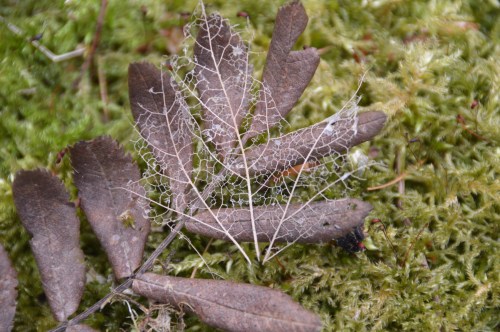
This is clearly an autumn photo. You can tell that from the browned and fallen leaves. It’s late autumn, I’d say, because some of the leaves are pared right back to their skeletons.

This skeleton leaf intrigues me. You’ll have read my thoughts on the two basic structures which Deleuze and Guattari describe – the “arboreal”, or “tree-like” branching kind, and the “rhizomal”, or networking, web like kind. Well, this little skeleton leaf reveals both. The larger fibres are clearly arboreal, branching into ever thinner, smaller strands. But between them, the smaller fibres make webs. If you look carefully you can see that. The smallest fibres create networks with multiple connections and nodes.

“And not or” – my favourite moto.

The underlying structures of Nature are both.

That’s what caught my attention when I looked at this photo, but that led on to thinking about this time in our world when it seems to me everything has been pared back. This paring back has revealed something – the underlying structures and frameworks of our societies.

I wonder if you see the same thing? What has this closing down, this minimising, this paring back, revealed to you?

Here are two of the things it has revealed to me.

  1. The importance of the Feminine. Now, when I’ve talked about this before I’ve been at pains to be clear I’m not talking about gender. I’m talking about the two great flows of reality to which we attach our myths of the Masculine and the Feminine. What do I mean by that? Simply, and concisely, for now, I mean the “Provide/Protect” energies and the “Nourish/Nurture” ones. I’m going to push this simplistic thought a step further – we have seen a shift in focus from Production to Care. I know this is too simplistic and that there is also a huge emphasis on “protection” too just now. I also know that a lot of what we call “production” isn’t really very productive (I’m looking at you, you people who drive the financialisation of everything, producing wealth from wealth in computers and papers, rather than from the soil, and the physical reality of the world). But bear with me for a moment……this crisis is revealing what every society needs to function, and who the people are who do that work….and I want to focus on the feminine here, because it’s mainly women who are carers, nurses, teachers, cashiers and cleaners – most of whom are vastly under-recognised, and poorly paid. (Yes, I know there are lots of important, even “essential” jobs which men do – including all the ones above, but also ones where men seem more prevalent than women – delivery drivers, power workers, waste and water workers etc). But none of that takes away from the main point I want to make which is I hope what has been revealed will lead to real change – change which values people and relationships more than consumption, change which values women more, change which values caring more, change which values “essential workers” more. “And not or”, for me, means we need both of these flows – the Masculine and the Feminine, the Provide/Protect AND the Nourish/Nurture, but we need to shift the balance.
  2. The failure of neo-liberalism. The idea that we are all selfish individuals ready to fight everyone else to grab the biggest share of everything for ourselves and “the market” is “self-regulating” which will, if left unregulated, deliver the best of all societies, has, I believe, been found wanting. None of our countries have entered this pandemic prepared. Hospitals have been closed, Public services have been cut massively, and the poor and vulnerable have been forced into ever more precarious lives. So, there’s my second hope – that a new economics and new politics will emerge – a more sustainable, healthy one. I hope we’ll see a shift away from mindless growth for growth’s sake, to choosing to grow better ways of living together in our one, small, shared planet.
  3. Thirdly, I’d like to see a shift in emphasis away from hierarchies and “arboreal” centralised systems to more networked, “rhizomal” communities of relationships. It seems the centralised, command and control, “just in time” structures have been found wanting – despite claims they are the “most efficient”, and that ordinary people and communities adopting personal hygiene and physical distancing behaviours have shown their strengths. My third hope, then is for a resurgence of community, local, devolved, and diverse structures of society. “And not or”, remember, I think we need both. We just need to shift our balance.

Read Full Post »

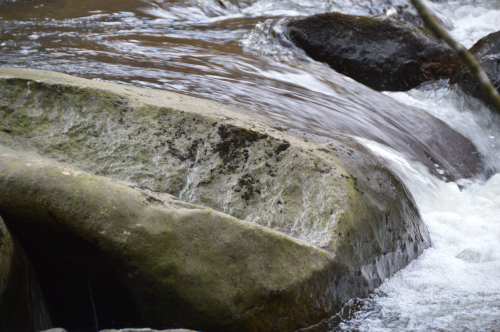
This is a photo I shared with many patients and students over the course of my career. I saw this rock, a long, long time ago, just down from a waterfall in woods in the Scottish Highlands.

How did this rock come to have such a shape? It’s as if it had been struck by a Viking axe! What’s even more interesting is that it will never “heal”. That cleft, that wedge in the body of the rock, will never disappear.

It’s pretty common to think of healing as the complete resolution of something. We think of a cut, or a broken bone, and imagine that once it has healed, the skin or bone will return to how it had been before, forgetting somehow that all injuries leave scars. We think of infections as “self-limiting” – that is, once they have gone, they are gone. The body returns to some prior condition. We talk of “defeating disease” and use a lot of war imagery to suggest we can remove it (whatever “it” is) from our bodies, “defeat it”, and then it will be gone…for good. Job done.

But Life isn’t like that.

And neither is healing.

We don’t go backwards. Injuries, infections, traumas and diseases of all kinds change us. Even when we make a “complete recovery”, our lives have now changed. Something is altered….in the body and in the psyche. Whatever we encounter, whatever we have to “deal with”, becomes part of our story. Every event, every experience, changes our lives forever.

So, what are we to do with these wounds?

It would be nice if we could just ignore them. And in many situations they are minor enough for that to be a reasonable strategy. But the bigger impacts can’t be ignored, they can only be denied. That’s never a great strategy.

Maybe we could fill in the gap. Fill that wedge with prozac-a-filla or something like that. Would that work? Unfortunately, suppressing, and hiding the wounds tends not to work for very long. All those “anti-” medicines that we use – antibiotics, antihypertensives, antacids, anti-inflammatories, antidepressants etc combined with opiates and other sense-numbing drugs, don’t actually directly promote healing at all. They just “take the edge off” things….for a bit. You think antibiotics cure infections? I’m afraid not. They can do a very important job. They might even save your life. But what they do is kill bugs. The inflamed, swollen, and damaged tissues in your body need to heal. The antibiotics don’t do that. It’s your ability to self-repair that does. And antibiotics don’t stimulate the self-repairing functions of the body.

So what do we have to do?

Take a look at the photo again. See the river rushing by the rock? I think of the life force when I see that. The wound has become part of our internal landscape now. The illness, the experience of it, the memory of it, the impact it had on our psyches and our lives, is part of who we are now. It’s an integral part of our story. But life continues. We adapt. We find new ways to live and to thrive with this changed landscape. We evolve our inner environment.

I’m not saying we shouldn’t use our modern medicines. They can reduce our suffering and even, sometimes, save our lives. But they don’t directly help us to heal. We still need to recover, repair and adapt. How much of “Medicine” or our “Health Service” is directed towards that life-long, important issue of healing?

I hope that, whatever the answer to that question, the answer will be “a lot more in the future”.

Our lives are not going to be the same once this coronavirus pandemic is over. How are we going to heal? How are we going to adapt? How are we going to live differently?

Read Full Post »

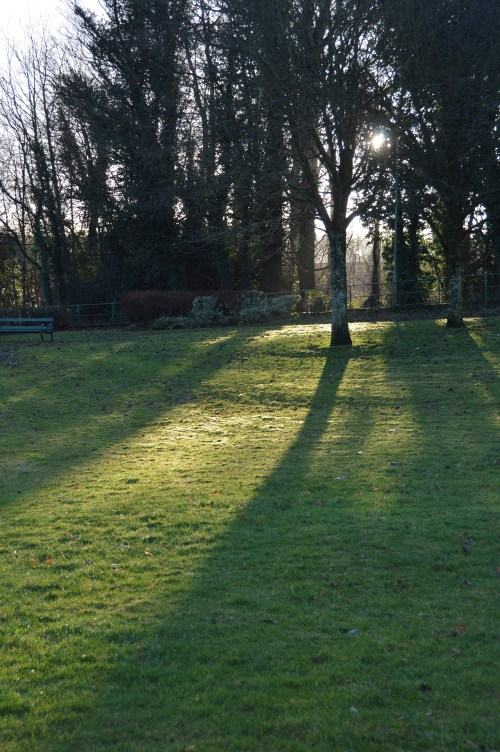
I took this photo at noon one January 1st.

You might think its pretty much just a photo of some grass, so, hold on, let’s look more carefully, and consider the contexts. If it was simply a photo of a patch of grass it wouldn’t be particularly interesting but what caught my eye wasn’t the grass, it was the interplay of shadow and light.

Despite it being noon, the Sun is still pretty low in the sky. Well, it’s taken in the wintertime in Scotland, so that’s normal. But, normal or not, the effect of the low sunlight streaming through the trees is spectacular. The angle of the light makes the shadows SO long and the spaces between the trees show frosted grass sparkling brightly.

I love the forms and the patterns of the shadows, the light, the frost and the grass. It takes all of them together to create the scene.

Here’s another scene –


This is a huge puddle which is there more often than it’s not in this particular field. I once saw swans swimming on it! But today, what makes this image so beautiful is the trees and their reflection. Without the trees, the clarity of the light and the stillness of the water, this just wouldn’t be the same. It has echoes of the previous photo but it’s completely different. However, both photos were taken within minutes of each other, the flooded field lying just a short walk along the road from the shadowed park.

I’m struck by how important the contexts are in these photos. If I’d “abstracted” just one element in each – a grassy patch, a section of the puddle, a single tree – I’d lose all the context. It’s the interplay of all the elements which makes these images more than the sum of their parts.

Life is like that.

When we focus too narrowly, when we consider only a part in isolation, we achieve only a partial understanding. It’s the whole experience, in all it’s contexts and environments, with the story which holds them together, and the remembered subjective experience of being there which makes them so unique, so particular to me.

So, if I am to share any of that with you, I need to show you, and tell you, at least some of the contexts. That way, you’ll come closer to experiencing what I experienced.

That was my everyday working reality. Every single patient who came to see me had a unique story to tell. If I were to understand them I had to hear their story. I had to try to have some experience of their experience, to feel what they were feeling, to know what they knew, if I was to understand, diagnose and help them.

But it’s the same for all of us. If we are to understand anyone, friend, relative, colleague, stranger, we have to hear their story, and try to experience some of their experience.

It’s always partial. It’s never fixed. It’s never completely knowable. But there’s no substitute.

Read Full Post »

I reckon a lot of us have a fascination with water. Little children love to play with water, whether its in a sink, a pool, or at the beach. Pretty much all children can spend hours filling up brightly coloured plastic pails with sea water and pouring it into holes they’ve dug in the sand.

I’ve certainly always had a fascination for water. One of the few experiments I actually remember from schooldays is “a little goes a long way” where we put a few crystals of potassium permanganate into a big trough of water and watched with amazement how quickly the entirety of the water turned purple.

Learning about the “water cycle” of nature, where water evaporates from the sea, forms clouds in the sky, falls as rain on the mountains and runs down the rivers back to the sea, was probably my first encounter with the idea of cycles and ecosystems.

But ice – now isn’t ice just completely fascinating? Not simply because it expands in volume as the water freezes, which is counter to our instincts (which tell us that heat expands things and cold shrinks them). But because it is utterly beautiful.

The town of Aix-en-Provence is partly famous for all its fountains. I can’t remember how many it has, but there are a lot. These photos I’m sharing today are all taken one day in winter on the Cours Mirabeau in the centre of Aix. They remind me that just when I think I’ve seen all the shapes which frozen water can make, one day, I discover something new to me.

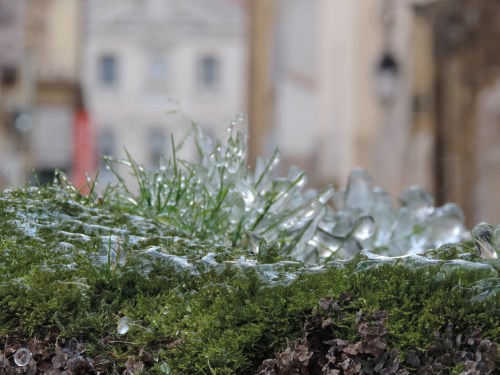
At first glance that image at the top of this post is typical of a frozen fountain. There are many long dangling pointy icicles. (Poetic, huh?).

But, look more closely and you’ll see something pretty weird.


On top of the moss the water has formed ice which looks more like jelly than anything else. It actually still looks liquid, but, you can see, it isn’t. It’s frozen. Not in a smooth level way, like you’d expect to see when water lies in a puddle or pond, but undulating, almost like frozen waves, but smooth waves, not spiky ones. It’s really not like anything else I’ve ever seen. When you imagine water lying on top of moss, you think it would have a level surface, just like a puddle would. So, it should freeze like that – level. But this didn’t.

Here’s another close up.

Look at the shape of this! These tiny stalagmites of ice are so rounded. Not at all spiky or pointy like the stalactite forms higher in the fountain. How does water form into shapes like that? And, if you look at the left hand side of this image, you’ll see that frozen flow appearance I showed you in the previous photo.

Wonder.

That’s what images like these provoke in me.

A sense of wonder…..that combination of curiosity and amazement tipping over into astonishment.

This is the “émerveillement du quotidien” which I love so much – that “everday wonder”. Makes life all the more special I find.

Read Full Post »

I’ve mentioned several times how much, in the years gone by, that I enjoyed looking out from my flat in Cambusbarron towards Ben Ledi. Here’s another one of many photos I have from that time.

What grabbed me about this view?

The beauty.

That’s the short answer. I find it utterly beautiful. The pale blue sky, the grey and pink clouds (“Caravan” reference in there for those of you who know 😉 . The shape of the mountain with its snowy peak, the surprisingly warm shades of the uncovered hillside. The low lying mist in the mid ground with just a row of trees appearing through it, and the familiar farm in the foreground.

But there’s more.

Yes, there are the birds flying past, which bring some life to the scene. But I mean the shape of the mist. Look at it! You’d expect mist just to fade out as it rose, but this mist, for some reason, has fashioned itself into a peak, that looks for all the world like an echo of Ben Ledi itself.

So what engages me about this image is every single element, plus how the whole adds up to a lot more than the sum of the parts.

I adore discovering these symmetries and they challenge my day to day perception that water changes quickly and that mountains never change. The most dynamic part of the scene is the birds in flight, creatures whose unceasing change (movement) keeps them flying through the invisible air. But the next most dynamic part is the water in three of its forms – mist, snow and clouds. Every one of those forms is changing moment by moment, but that’s not nearly so easy to spot as the movement of the birds. Then there is the mountain. The mountain which changes moment by moment in appearance as the Sun changes his angle and casts shadows from the ever-changing clouds. But the mountain changes too. In its substance, shape and form. Maybe it takes millennia to be able to spot that, but doesn’t everything have its own innate pace?

So, here’s the core paradox of this image – stillness and movement.

At first glance, this is an incredibly peaceful, quiet, static scene. But it doesn’t take much to see there is nothing static about it.

I love that.

Read Full Post »

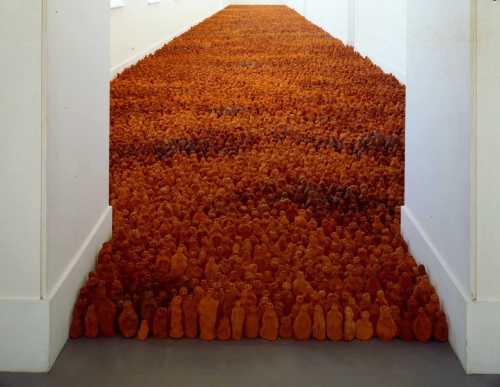
Anthony Gormley’s “The Field” is an installation which made a lasting impression on me. I saw it many, many years ago in Inverleith house in the Royal Botanic Gardens, Edinburgh.

When I first looked into the room and saw all these terracotta creatures I thought, how amazing, look at all these wee guys, all the same! Then I started to look more carefully and realised that they were not all the same. In fact, Gormley hadn’t made all these models himself. He’d invited hundreds of people to each make their own one. So every one of them was unique.

That image stayed with me because I thought this was an essence of the work of a doctor. Every patient would present me with features which they had in common with other patients who had the same diagnosis, but every one them was unique. I had to juggle with the opposites of sameness and difference every day.

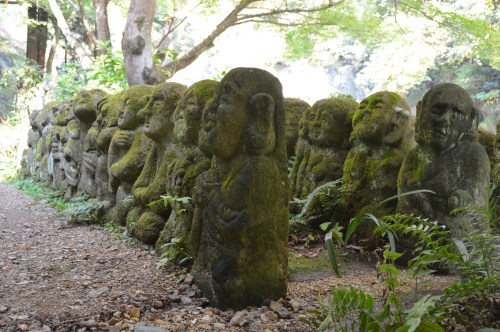
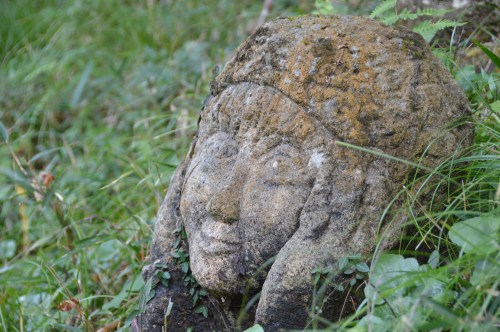
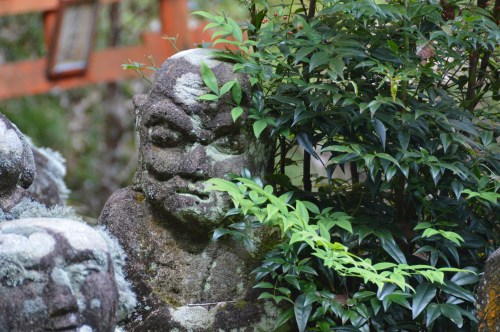
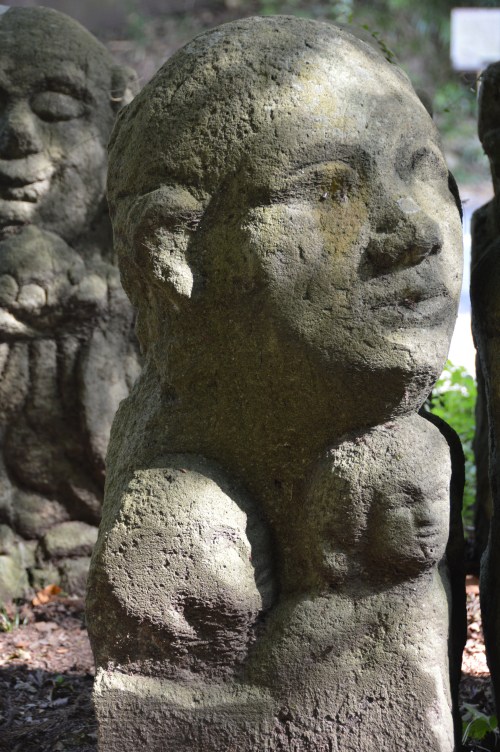
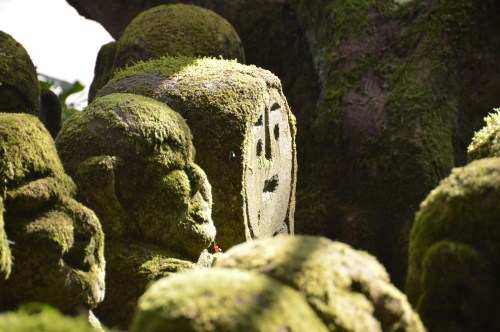
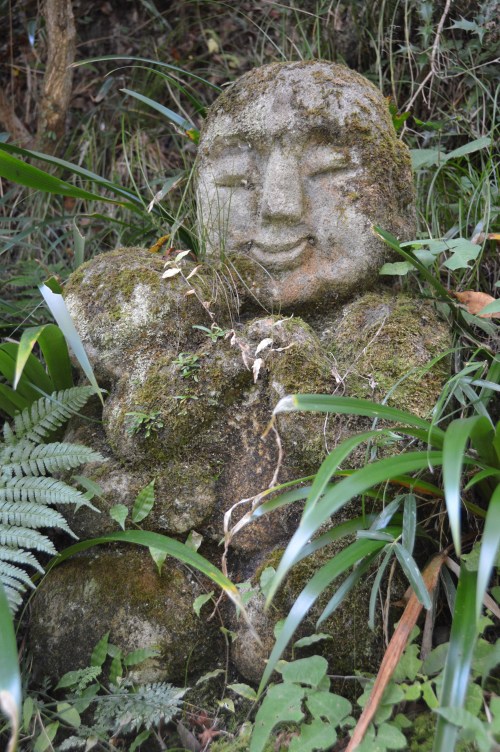
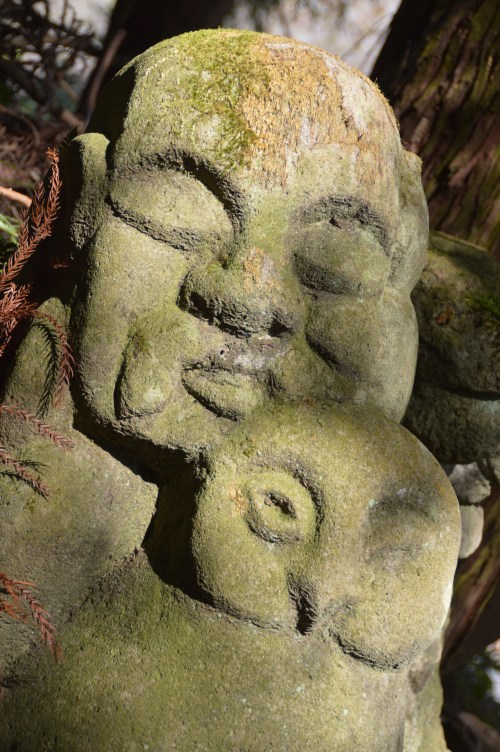
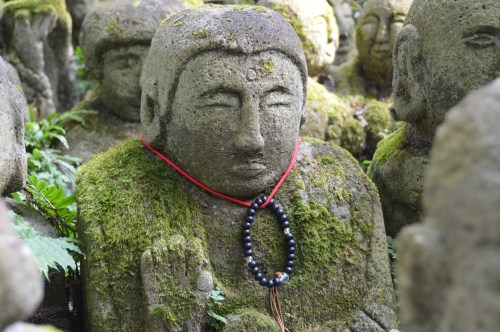
Years later I visited Otagi Nenbutsu-ji Temple on the edge of Kyoto. In the grounds there I found something similar to Anthony Gormley’s “The Field”. Under the direction of an artist dozens of people had created their own stone sculptures. Again, at first glance, they looked the same, but, quickly you can see that every single one of them is unique.


Look at some of them….I bet you find a favourite or two

Read Full Post »

This is a spider web, but doesn’t it look spooky?

It looks like the big hole in it is an eye socket and the central lower part looks like a beak, or a nose.

I see a mask when I look at this.

And a pretty disturbing mask at that!

I think this is a bit like one of those drawings you look at which at first glance might be an abstract pattern, but once you’ve seen a face or something in it, you just can’t unsee it ever again.

It really can be hard to see something “as if for the very first time” when you’ve already seen it and “made up your mind” what it is you can see.


Read Full Post »

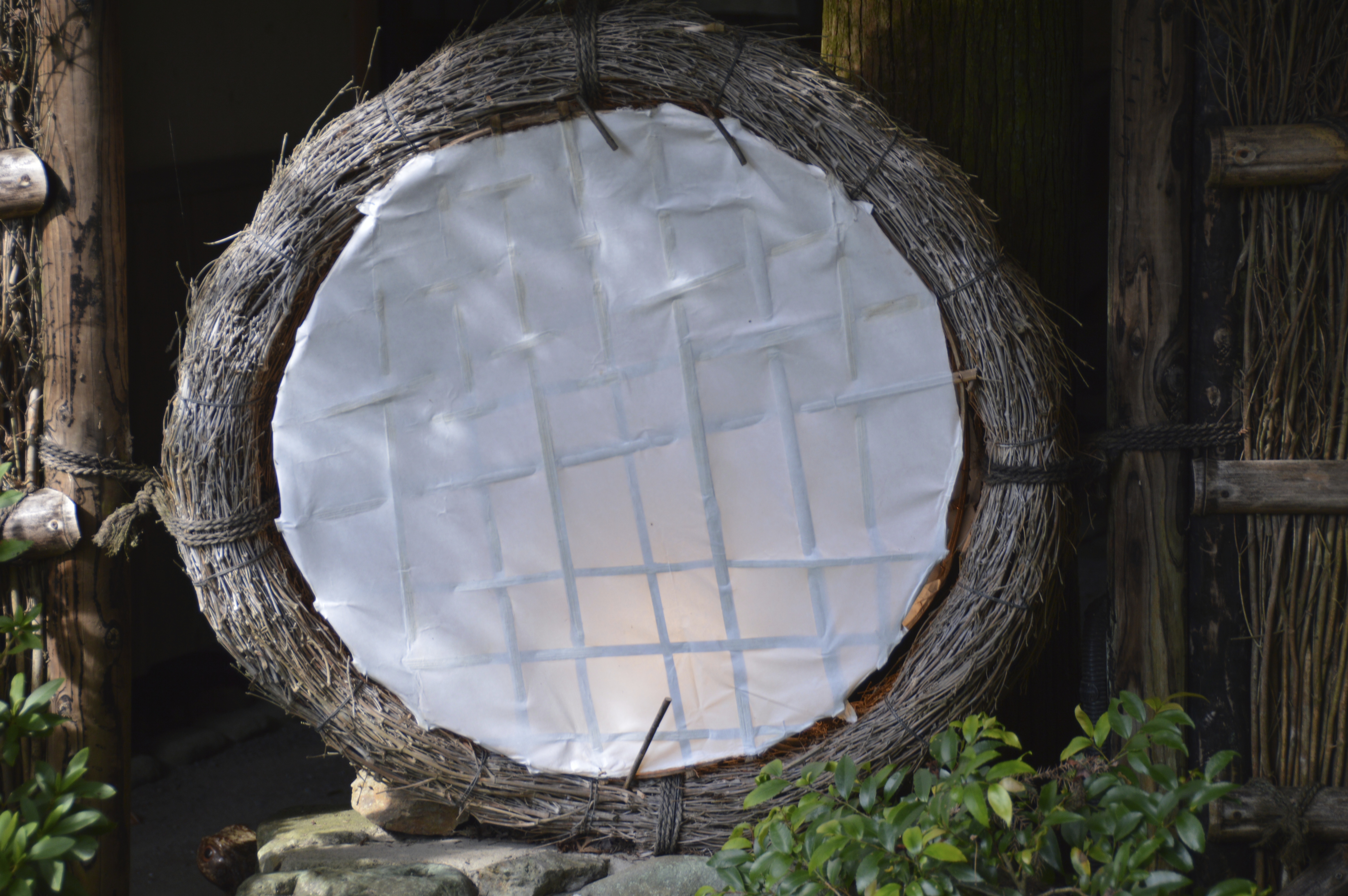
The light filtered through the paper caught my eye.

It’s soft and pleasing. It drew me to it. Then when I looked more carefully I saw the matrix of stalks criss-crossing behind the paper, and that changed my perception of it again. Then I noticed the woven circular frame. From first glance, to detailed inspection, I find this utterly beautiful.

I was thinking about it today as I contemplated it again and I remembered a book I read decades ago – The Lens of Perception, by Hal Bennett. I must say I don’t remember the details of the book all these years on, but the central metaphor did stick with me. The author proposed that we don’t see the world directly. We see it through a series of lenses, or filters, each of which is coloured by certain values and beliefs. It was quite an imaginative way of exploring how culture and social conditioning profoundly influences our perception and experience of the world.

Using a different metaphor, in these days of social media we read about “echo chambers” where we only read the messages and information put out by people who closely share our pre-existing beliefs and our prejudices. As the world divides into separate echo chambers people lose the ability to communicate with each other. Differing views are described as, at best, dissent, and, at worst, as betrayal. This is a powerful way of enforcing conformity. Divide and rule. Hardly a new idea is it?

However, it isn’t easy to see what filters or lenses we are using. Well, it seems easier to see which ones other people are using than our own ones anyway. (And what was that old Bible teaching about taking the plank out of your own eye before trying to remove the splinter from someone else’s?)

It’s not impossible though, and I suspect there are at least two very different ways to do it. One is to take the time to reflect on our pre-occupations. Have you ever done the “Morning pages” exercise promoted by Julia Cameron? Quite simply it is writing continuously without stopping until you’ve filled three A4 pages. It’s a stream of consciousness form of writing. You do it every morning for thirty days. Whenever I have done it I don’t read what I’ve written until the end of the thirty days. Each time it’s been a revelation. I find themes, phrases, and issues recurring over and over again. I find preoccupations I either didn’t know I had, or which I, at very least, didn’t know I held so strongly.

There are other ways to explore your values and beliefs but they all involve a conscious effort to describe them.

The other major way is to “phone a friend” as they say in the famous game show.

Robert Burns, my national poet, said –

“O, wad some Power the giftie gie us
To see oursels as others see us!
It wad frae monie a blunder free us,
An’ foolish notion.”

A wish to be able to see ourselves as others see us.

Well, there’s only one way to do that – other people.

This is where it gets tricky. Because to do this you need a friend or colleague who you trust. You need someone who won’t judge you. There’s no point jumping into somebody else’s echo chamber and challenging everyone there to find out what they think about your views! I suspect you know the answer to that before you even begin.

No, I think you have to start by sharing at a very personal level. But the trouble with that is, those others who you trust are likely to be seeing the world through the same filters and lenses as you do in the first place. I know they say “opposites attract” but I’ve always found that applies more to magnets than it does to people. However, there is no substitute for dialogue when it comes to clarifying what beliefs, values and world views you hold most dear.

Can we promote dialogue? Surely we can.

How do we escape the echo chambers, but criticise and challenge our views safely? I don’t know any way to do that which doesn’t involve non-judgemental engagement. It’s the key that opens the door.

Is there a non-judgement lens or filter?

What would the world look like when viewed it through that one?


Read Full Post »

« Newer Posts - Older Posts »