Feeds:
Posts
Comments

Archive for the ‘from the consulting room’ Category

DSCN4411

In Michaei Foley’s Life Lessons from Bergson he describes the philosopher’s ideas about the “self”
Bergson constantly distinguished between two selves, meaning two levels of process – a superficial self whose reactions are socially conditioned and a deep, intuitive self capable of empathy and free will…..This deep self is always in danger of being misrepresented by the categorizing self, dismissed as irrelevant by the utilitarian self and snuffed out as a threat to popularity by the social self
It’s interesting that nobody has ever found “the self”.
We talk about the benefits of “self-confidence” but what is this “self” we have confidence in?
We talk about the benefits of having “self-awareness” but who, exactly, is aware of this “self”?
Whatever you think about the concept of the “self”, I think it’s pretty clear there is no fixed entity called the “self”….no unchanging thing.
I often found the concept of a “community of selves” to be a more useful model when working with patients. People often identify much more closely with one aspect of their personality, or with one role in life, than they do with their other ones. For example, I fully identified with my doctor self while I was at work, and yet in other times and places my dad-self, or husband-self, or my teacher-self would feel much more prominent.
So, I’m quite taken with Bergson’s two selves – the superficial and the deep.
I especially like his description of the deep, intuitive self as being capable of empathy and free will, whilst the superficial self is more reactive, more subject to the pressures and influences of others.
Read the last sentence of that passage from Foley’s book a second time….
Our deep, intuitive self is constantly interacting with our superficial self, but look at the potential “misrepresentation” of the deep self – by the “categorising self” (…our left hemisphere?), by our “utilitarian self” (….makes me think of evolutionary biology) and by our “social self” (…with all that pressure to conform and fit in)

Read Full Post »

image

Reality no longer appears essentially static, but affirms itself dynamically, as continuity and variation. What was immobile and frozen in our perception is warmed and set in motion.

Those are the words of Henri Bergson, quoted in Michael Foley’s excellent “Life lessons from Bergson”.

I love that. The experience of life as dynamic, “warmed and set in motion”.

Life isn’t “frozen and immobile” to me, and that’s why I am wary of categories and labels. I’ve always resisted being put into a box, defined by one or two of my characteristics. When I think of that I recall the adage of the General Semanticists – “judgement stops thought”. So often fixing someone or something into a category or type stops us from really seeing, really understanding.

Reducing an individual to a type diminishes them in all senses of the word.

Every patient I ever encountered was unique, presenting experiences and stories unique to them. To reduce them to diagnostic categories, or to types of any sort, blocked my understanding of them. Everyone always has more to reveal, more to share, more to experience and be understood.

Michael Foley says he came back to Bergson’s work after dismissing it decades earlier. His way back is interesting. It’s not the same as mine. My first encounter with Bergson came when I was reading Deleuze but I didn’t find him easy. I later stumbled into complexity theory and, in particular, the idea of complex adaptive systems. At that point I remembered some of Bergson’s ideas and went back to explore his writings further. Michael Foley’s path was through his encounter with “process philosophy” and with particle physics –

I learned from twentieth century philosophy of mind that memory and the self are processes rather than fixed entities – and suddenly this connected with the theories of particle physics, which claim that at the heart of matter there are in fact no particles but only processes…….everything is process…and everything is connected to everything else.

In the process view nothing is fixed, nothing is final and no circumstances ever repeat in the same way.

This strikes me as very true. Dan Seigel, one of the founders of Interpersonal Neurobiology, worked with colleagues to come up with a definition of the mind. What they concluded was that ” the mind is a process of regulation of energy and information flow. ”

The mind is not an entity or a thing, it’s a process.

The body is not a fixed entity or thing either – it’s a dynamic ever changing network or community of cells.

Disease is not a thing either. That really startled me when I read that once I was a practising doctor. As a medical student I picked up the view that disease was pathology and pathology was the changed organs or cells. Once I became a GP I encountered dynamic, hard to pin down illnesses that certainly couldn’t be reduced to pathological entities. Hearing that disease was a process not an entity was liberating for me.

I will return to some of the issues raised by this thinking in other posts but let me finish this one by returning to the title, because once we gain the insight which shifts our attention from entities to processes we discover diversity – we find out that variation is a key characteristic of Nature and of Life. But I think we find out something else too – that the universe, the world, and our lives are not completely random, chance, accidental phenomena. Instead there is continuity. We are in a process of continuous creation and emergence. We are who we are in our networks of family, nature, society and the world. We emerge from the past, as the past encounters and interacts with the present. Our future doesn’t contain just anything you could ever imagine. It emerges from here and now, from that flowing river of life and connections.

Continuity and variation. Just like the flow of a river. Just like the natural history of a plant, an animal, or any other living organism.

Read Full Post »

image

Out walking in the vineyards the other day I noticed this plant with its strikingly unusual flowers and its little red berries.

It’s “dulcamara”, which is a plant I know from my homeopathic studies. Its fuller name is “solanum dulcamara” which helps us to realise it is from the same plant family which other “solan…” plants belong to. That family is the Solonacaeae family.

The Solonacaeae family is a fascinating one to explore if you want to look at the relationships between the plant and human worlds. Some of them are staple foods – potatoes and tomatoes for example. But others are hallucinogenics – belladonna, hyoscyamus and stramonium being striking examples. Witches were said to make up a paste which included some of these hallucinogens and applied it to their skin with a stick – the origin of the “flying sick” perhaps?

In fact a lot of these plants can be poisonous to humans and I often wonder how human beings first got the knowledge to enable them to distinguish between the nutritious and the poisonous – trial and error? Sickness and health? Life and death?

If you are at all interested in looking into “ethnobotany” this is a good family to start with!

Read Full Post »

DSCN4180

The thing that’s always bothered me about reductionist science is how quickly it becomes so abstracted from the world that it no longer usefully models the world.

Human beings, as living organisms, are complex adaptive systems. We are inextricably embedded in multiple contexts, physical, social, and cultural. You can’t truly understand a human being when you consider them isolated from the air they breathe, the food and water they eat and drink, the extensive web of relationships they live in, from family, friends and colleagues, to the networks of production of goods and services.

We are dynamic, open systems. That is, change is the constant of our nature, and there is a permanent flow of energy, information and substances between ourselves and the world in which we live.

A team of researchers in Montpellier has just published an interesting study beginning to try to examine and understand how chemicals in our environment bring about changes in our bodies.

They examined forty common chemicals which are found in the environment and in human bodies. Each of these chemicals has been tested on its own as part of state regulatory processes. Each one on its own has effects on the body, but not large effects (according to the studies). But of course, in the real world they don’t exist in isolation, so what happens when more than one of them is present at the same time?

As the researchers said, one and one normally make two, but when they studied the effects of the different pairs of these forty chemicals (780 variations of pairs in total) they found that sometimes one and one made fifty, or even a hundred. What they mean by that is that as they work together two chemicals don’t have a simple additive effect. Instead their combined effect can be many, many times greater than simple addition would suggest.

There’s an obvious reason for this. As complex adaptive systems, the cells in a human body are connected in a non-linear way, not a simple, linear one.

This study examines the effects of these particular chemicals on a particular receptor in a cell, (“pregnane X” receptor). They looked at this because chemicals have been shown to affect hormone systems within the human body causing widespread changes in the immune and inflammatory systems by interacting with such receptors, potentially setting off chronic metabolic and physiological disturbances in a person.

There study showed that one particular pairing of chemicals worked together as a kind of double key i.e. neither chemical could fit the receptor site, but when the two types of molecule combined they made the shape of a key which resulted in a much better fit to the receptor. So, singly, they produced little activity in the cell, but together their effect was multiplied 50 to a hundred fold. (The two they highlight are a pesticide and chemical from the contraceptive pill)

This is a small study only looking at the effects of pairs of chemicals in a set of forty, and only looking at the effect on a single receptor site. They point out that there are over 150,000 man made chemicals in our environment.

I’ll say that again.

There are over 150,000 chemicals in our environment.

Not just 40.

How many combinations can there be? How many combination effects might there be? Besides this particular one they have demonstrated. And the receptor site they studied is only one of many such sites in human cells.

A bit scary, huh?

They say they would now like to study the effects of pairs of 1600 prescribed drugs.

Are you a little surprised that we know so little about the real world effects of the presence of combinations of chemicals and medicines in the human body?

Well, thank goodness, we are beginning at least to explore real life complexity and stop pretending that single agents can be sufficiently studies in isolation.

Read Full Post »

I moved to France last November, so this has been my first summer in the Charente. Before moving here I lived for many years in a top floor apartment on the edge of Stirling in Scotland. We had fabulous views of the mountains and the volume and light in the flat, created in an 1830s textile mill, was fantastic.

Moving to France gave us the chance to live in a traditional Charentaise “long house” with a garden and a “potager” (a vegetable plot).

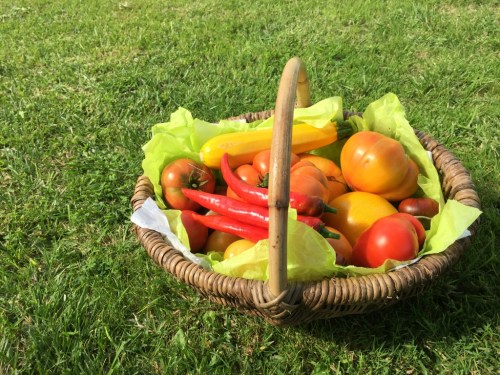
Here’s a photo of yesterday’s harvest. We don’t have a large potager, but look at this!

What a photo can’t convey however is taste. The taste of vegetables straight out of the garden is something else. The yellow courgettes are a relevation to me. I could really take or leave courgettes up till now. These fresh yellow ones are like something I’ve never tasted before.

We’ve tried a range of varieties of tomatoes this year and they sure would all fail the supermarket standards of shape and size but, wow, what the supermarkets are missing out on! Turns out flavour trumps size and shape by a long, long way. I didn’t know tomatoes could taste this good. I didn’t know tomatoes could taste this different!

Finally, look at the huge, red chilli peppers. For some reason, fresh chilli peppers are not easy to find in this part of the world, and we were advised that whilst they might grow outside here, they wouldn’t have much taste. The advice was correct in that they sure do grow outside here. Our chilli pepper pland has produced these beauties in abundance, and there are many, many more just waiting for a bit more sun to turn this glorious red. But the advice was definitely wrong about taste. They could blow your head off! Zinging with spice!

My general theory of a good diet has been pretty similar to Michael Pollan’s food rules – “eat food, mainly plants, not too much”. But one of the things he misses in those rules is flavour. And is there any better reason to eat something than that it delights your palate?

So, what I’d add in is, try to eat food which has traveled as short a distance as possible from where it grew to your plate. When you do that, you get the following –

  • food which is the freshest it can be
  • food which has had the least amount of processing
  • food which has the greatest variety of sizes and shapes
  • food which is most likely to be seasonal

I reckon that, depending where you live, you might not manage this “rule” – let’s call it “advice” – too often, but you know what they say – “every little helps”.

Oh, the other thing I think that Michael Pollan’s food rules miss out on is where you eat and who you eat it with. There’s more to food than “fuel” or measurements of constituents – so much vitamin whatever, such a percentage of protein, fat, carbohydrate, and so on – food’s to be enjoyed, savoured and shared, as well as digested!

Read Full Post »

out there

The skies above this part of the world are often very clear so I’ve taken to star gazing at night when I can. Wherever I point the telescope it shows me more stars than I ever knew existed. It’s hard not to be humbled by the immensity of it all. But what struck me last night as I looked at the stars was how much I didn’t know.

It’s not a new thing for me to wonder about what I don’t know. I remember years ago reading an article in the British Medical Journal about medical education saying that all the best ongoing education starts with saying “I don’t know” – yet that was the one phrase we were all terrified to say as we our teachers singled us out to ask us questions on teaching ward rounds or in the lecture theatre. It’s a phrase which brought shame and condemnation. If you didn’t feel an idiot before you said it, you sure did afterwards! So, it was refreshing to read the opposite – to read the idea that only if you could say “I don’t know” could you open up the chance to learn something.

Many, many years later I came across the works of Montaigne, and was delighted to find that one of his most used phrases was “Que sais-je?” (not exactly I don’t know, but “what do I know” – still a humble admission of the limits of personal knowledge).

Throughout my career, although I practiced as a holistic doctor and was fortunate enough to work for much of my life in a service which prioritised time spent with patients, I often found myself saying to patients that even if they’d told me things they’d never told another soul (and that was a common remark made by patients), I thought it took a lifetime to try to really know yourself, let alone another person, so although I was about to share some insights with them about what was happening in their life, those insights were limited by the small amount I knew about them. You see, how much you know is always a relative term, but it surely is always (in the bigger scheme of things) a small amount.

When I posted yesterday about the Japanese lantern I had to check out on wikipedia just what those lanterns were and yet again I was faced by having to say to myself that I didn’t know enough about botany.

Strange that that awareness and the sharing of it is still something which comes with a discomfort, because, really, I believe that the world would be a much better place if we were all more aware of the fact that what we don’t know is always so much more than what we do know.

While I was writing this, Hilary (who didn’t know what I was writing about) read out a quote to me –

The problem with the world is that the intelligent people are full of doubts, while the stupid ones are full of confidence.

……Charles Bukowski

Earlier today, what provoked me to write this post was reading the following quotation from Parker Palmer on the Brainpickings site

What I really mean … is be passionate, fall madly in love with life. Be passionate about some part of the natural and/or human worlds and take risks on its behalf, no matter how vulnerable they make you. No one ever died saying, “I’m sure glad for the self-centered, self-serving and self-protective life I lived.”

Offer yourself to the world – your energies, your gifts, your visions, your heart – with open-hearted generosity. But understand that when you live that way you will soon learn how little you know and how easy it is to fail.

To grow in love and service, you – I, all of us – must value ignorance as much as knowledge and failure as much as success… Clinging to what you already know and do well is the path to an unlived life. So, cultivate beginner’s mind, walk straight into your not-knowing, and take the risk of failing and falling again and again, then getting up again and again to learn – that’s the path to a life lived large, in service of love, truth, and justice.

I couldn’t agree more.

Read Full Post »

a little galaxy
In 1911 Frederick W Taylor published the “The Priniciples of Scientific Management”. This approach to work had a profound influence, leading to the use of the term “Taylorism” to capture the essence of his message. It’s a message which still holds sway today. In fact, the term “Taylorism 2.0” is being used to describe the modern form.

It’s clear that Taylor’s idea of science was not that curious, exploratory discipline based on wonder, but the desire to control – the desire to produce pre-determined outcomes through systems created by measuring what could be measured.

Right there, in that text is his declaration of intent – one which chills me every time I read it!

In the past the man has been first; in the future the system must be first

If there was one thing I would say to try to improve health care, for example, it would be put the human beings first, and the system second – the system and the management created to deliver the system, should, in my opinion, be the servants of those human beings who are caring for, and trying to help, the other human beings (the patients).

Is it any wonder that professional satisfaction amongst doctors is so low when they’ve signed up to something they probably didn’t understand was “Taylorism 2.0”

So what is this “Taylorism 2.0”?

I first came across it in an article about workers in a French supermarket internet-ordering section. Let’s call it “click and collect” – in the UK, there are now many “click and deliver” services from supermarkets, but in France, the delivery bit doesn’t seem to have taken off yet. Instead you can order your shopping online, then you go to the “Drive” and pick up your order.

But what happens between clicking on the items you want on the web catalogue and finding your shopping at the counter in the “Drive” building of the supermarket?

Well, you have staff who are called “pickers” – they go round picking the products off the shelves  – either of a supermarket (often a “hypermarket”), or from a warehouse (more commonly the former so far) – and collecting them into boxes ready to be handed to the customer when they turn up at the “Drive” counter.

These pickers are managed not just according to the principles of “Taylorism” – which involves measuring whatever can be measured and setting the targets and goals to be achieved i.e. the time taken to get a particular item from the shelf, the number of items an individual “picks” in an hour, in a shift, or whatever. As the article made clear every aspect of the job which could be measured was measured and monitored. Each picker has a portable device strapped to their wrist and receives the instructions for what to pick next from the computerised control office. The device shows exactly where they are at all times of the day, and measures the time taken for each and every action. What can’t be measured and monitored this way is the interaction between the staff and customers, so that is controlled by teaching them scripts which they have to learn by heart and stick to – you’ll know the kind of thing – “have a nice day”, “happy to be of service”, “thank you for waiting” and so on….

What takes all this measurement and control to the next level is not just the introduction of the new technologies which allow better monitoring and measuring, but the introduction of game theory.

Yes, you read that right. Game theory. The big new addition is “gamefication” – or how to introduce principles from cognitive behavioural psychology and game theory to get the most out of the workforce.

Just to give you a taste of this, it can include awarding points for numbers of items picked and delivered, numbers of customer orders completed, shortest times taken to get frozen goods from the shelf to the customer and so on. The points are fed back to individuals and teams and the scores are ranked. So an individual can see instantly at all times their best times, their highest number of order completions and so on….which inspires them to try to always get personal bests. But more than that, the team, or all the members of a particular shift will get collective scores and be ranked against other teams, other shifts or even other stores across the country – an enormous expansion of the “employee of the month” idea.

There can be a number or rewards attached to the rankings as extra incentives.

There’s a lot more involved than this but maybe this introduction will give you an idea.

So, what’s this got to do with health care?

Again, just as an example, let’s look at one particular system – the application of “QOF” (“Quality Outcomes Framework”) points in Primary Care in the UK.

General Practitioners have a substantial amount of their income pegged to their “QOF” points – these are points allocated for achieving particular targets on management-set protocols, mostly they related to the numbers or percentages of patients in a practice who have been entered onto particular disease registers, who have been asked about smoking habits, have had a BP check and so on, or the numbers of percentages of patients with specific conditions who have been prescribed the recommended drugs.

Not only does this prioritise the things in health care which can be measured at the expense of things which can’t (like communication skills, empathy, creation of therapeutic alliances, depth of understanding, caring etc) but it gamefies the whole system by awarding points, ranking individuals and practices, and rewarding points with income. So the doctors motivate themselves to try to achieve what the management want them to achieve.

Welcome to Taylorism 2.0 – where the system comes first – more now than ever before.

Read Full Post »

I graduated from Edinburgh University, with my medical degree, in 1978. The next four years were my foundational training to become a General Practitioner (I still think “Family doctor” is a nicer title).

Here’s four of the core teachings which I received.

Don’t practice “a pill for every ill”.

There was an assumption that drugs should only be prescribed if you thought they were really necessary. If you issued a prescription at the end of every consultation you weren’t practising good medicine.

Underlying this teaching was to prescribe as sparingly as possible.

If you refer your patient to a man with a knife, he’ll use it.

There were two aspects to this teaching – firstly, that you shouldn’t refer a patient to a hospital consultant unless you expected that doctor to treat the patient with their particular specialist skills. Secondly, a specialist was likely to try to treat your patient using only the particular specialist skills they had.

Underlying this teaching was to refer to secondary care as sparingly as possible.

Don’t arrange an investigation/test unless you think the results are likely to change what you otherwise propose to do.

I was taught that most diagnoses could be made on the basis of a good medical history supplemented with relevant clinical examination. Tests were only for when you couldn’t do that.

Underlying this teaching was to test as sparingly as possible.

The doctor is the drug.

This was a big one. Back in the 1980s Balint’s teaching still influenced General Practice, and Balint proposed that one of the most powerful therapies a doctor could offer was him or herself. The doctor-patient relationship was the most important part of therapy. Active listening, understanding, compassion, care and good communication were the core daily tools, employed with a sound knowledge of the natural history of diseases, the risks and harms of various potential treatments, and the ability to help patients to understand what they were experiencing, what this illness meant in their lives, and what they might do cope and to become well.

Underlying this teaching was to pay as much attention to, and to spend as much time with, each and every patient as was possible.

Read Full Post »

Orangerie

Here’s a shot of one of Monet’s water lilies paintings in the Orangerie in Paris. Look at the size of it, and stand back and see it as a whole.

Now walk towards it and look at part of it close up.

Monet

Isn’t that amazing?

How different the details look from the whole painting! In fact, one of the things which makes such a big impression on me in the Orangerie is just this difference – how does a human being manage to create such a fabulous, whole image which works the way this work by placing small brush-fulls of paint one after the other.

It’s this kind of art which often comes to my mind when I think about the need to understand anything in its details and at the same time in its wholeness.

Recently, BBC Two, made an episode of “Trust me I’m a doctor” focusing on the question of is it possible to reduce your cholesterol level through diet. For the programme the presenter look at three different approaches – sticking to a low fat diet, not changing the diet but adding daily oats, and not changing the diet but adding daily almonds. As an extra, he, himself, did all three (referred to as the “portfolio diet”).

What happened?

A number of interesting things – including significant levels of reduction of cholesterol in many of the volunteers – the biggest effect being in the presenter himself (I’ll return to that later)

In the almond eating group they concluded there was no over all change – because the average of the group showed little change. In fact, this averaging out effect obscured the reality of what happened – some people in that group experienced a drop in their cholesterol level, but in some it actually increased.

For me, this is one of the most interesting findings.

First of all it shows how averaging out and taking only whole group effects obscures the reality of what happens for individuals.

Second, it shows that you can’t take a simple, linear approach to the complexity of a human being – you can’t just add a bit of this or subtract a bit of that and see the same specific effect in every single person. We are all different. And that uniqueness extends to the different results of the “same treatments” (including elements of the diet) in different people. I think the kind of reports which suggest that some particular foodstuff is “bad” or “good” are pretty much always over-simplistic – to the point of being nonsense.

Third, it shows how the “same treatment” can have directly opposite effects in different individuals. We find the same with many forms of treatment – what has a certain effect in some, can induce the exactly opposite effect in others.

So, this part of the programme confirmed for me that we are all different and if we want to help individuals we must always, but always, pay attention to individual experience – it’s no good saying “this works but that doesn’t” based simply on statistical interpretations. Ultimately we have to come back to the reality of a human being’s experience.

The other striking element for me is what the presenter did himself – this “portfolio” diet – which actually consisted of taking a balanced and combined approach.

Time and again when I read about diets I find myself thinking about Michael Pollan’s food rules – “Eat food. Mostly plants. Not too much”.

There are no magic bullets.

Not drugs. And not specific foods.

Read Full Post »

Out of our depth


“The current practice model in primary care is unsustainable. We question why young people would devote 11 years preparing for a career during which they will spend a substantial portion of their work days, as well as much of their personal time at nights, on form-filling, box-ticking, and other clerical tasks that do not utilize their training. Likewise, we question whether patients benefit when their physicians spend most of their work effort on such tasks. Primary care physician burnout threatens the quality of patient care, access, and cost-containment within the US health care system.”

I came across that passage recently in an article entitled “In Search of Joy in Practice“, published in the Annals of Family Medicine. In a strange kind of synchronicity, I read it the same day I read the reports of new guidelines for GPs in England which are intended to reduce the number of deaths from cancer. NICE, the English healthcare guideline factory, claimed –

There are 10,000 more deaths from cancer in the UK every year than the average in Europe as a result of diagnosis that may come too late for effective treatment. Half of those lives could be saved, the National Institute for Health and Care Excellence (Nice) said, if patients and their doctors used the guidance, which has taken three years to develop, on symptoms that could warn of one of 37 cancers. GPs will also be able to order more tests than at present, which should speed up a diagnosis.

Let’s set aside the arguments about whether or not earlier diagnosis of cancer does actually lead to “saving lives” which remains a contentious claim. This 378 page guideline which took a team of “experts” three years to put together gives GPs guidelines based on the symptoms which their patients might present to them. It argues throughout that with a “positive predictive value” of 3% or more, the presence of a particular symptoms should lead to the GP sending the patient for specific tests to exclude particular cancers.

I’m not a statistician but as I understand it a “positive predictive value” is pretty much the likelihood that what you are predicting will come true – in other words, it’s extremely unlikely that anyone with these particular symptoms has cancer.

But it’s not the statistics which bother me most about this guideline – it’s the fact that they have chosen to assume that symptoms are the signposts of disease – they aren’t. It just isn’t that simple. Maybe NICE isn’t aware of Kurt Kroenke’s extensive research on symptoms over the years (google him if you want to explore more). Time and again he has shown that symptoms are no such thing with from 30 – 85% of patients presenting with particular common symptoms never going on to demonstrate any related pathology at all.

Symptoms, used in some tick box fashion, are no substitute for a proper clinical history and examination. Interestingly, Kroenke has also shown that

about 75 percent of information useful in making a diagnosis comes from the patient’s history – the story you tell your doctor about what’s been going on. Another 10 to 15 percent comes from the physical examination. Tests provide the least useful source of information.

…yet the basis for this NICE claim about saving lives from earlier diagnosis of cancer, is based on GPs referring for more tests.

But let me get back to where I started with this post – which is the impact such a numbers-based, algorithmic bureaucracy has on professionalism and job satisfaction.

Honestly, when I read the details of this particular guideline I began to wonder if it was guidance for doctors who had skipped medical school – are there really doctors out there who don’t get suspicious when a patient presents with bleeding from the bowel, unexplained weight loss, change of bowel habit and loss of appetite? Yet, NICE claims this guidance will be of “educational value”! Seriously, only if you skipped medical school first time around!

We are drowning our doctors in numbers.

We need to return to the values of good, caring doctor-patient relationships based on continuity of care and sufficient time to do a proper quality job with each and every patient. Human being based values, not numbers based ones. Let’s build an NHS on those principles and see what happens to doctors’ job satisfaction, patients’ experience of health care, and individual lifetime experiences of health.

As the author of the text I quoted at the beginning of this post said – “the current practice model in primary care is unsustainable”. We need to change direction.


Read Full Post »

« Newer Posts - Older Posts »