Feeds:
Posts
Comments

Archive for the ‘from the living room’ Category

I came across a discussion about identity recently, and as identity politics and populism seems to be to the fore in many countries these days, it got me thinking – who am I, really?

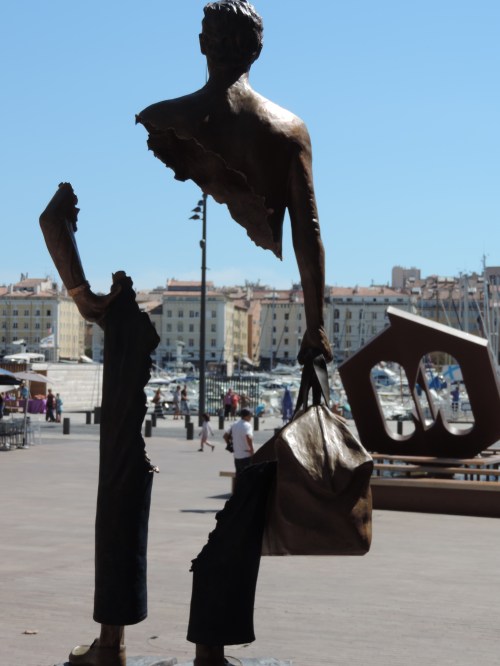
A few years ago I was in Marseille and these incredible sculptures were installed around the “Vieux Port”. They really grabbed my attention. Here’s just one of them (see the photo at the start of this post) showing what I immediately perceived as a person. He’s not all there, of course, but we fill in the gaps to make him whole, don’t we? Well, it struck me that that’s what we do all the time.

At least once a week in my consulting room a patient on their first visit, after telling me their story over the course of an hour, would say “I’ve never told anyone what I’ve just told you. Never.” And they’d often add “I feel you know me so well”. It was good feedback, and it reassured me I was on the right track and had established a good therapeutic relationship. But I often thought, “Actually, I only met you an hour ago, and I think it takes a lifetime to get to know someone. I think we can spend most of our lives with a partner but we never really completely know them. I’m still getting to know myself, for heaven’s sake, and I suspect I’ll be doing that for the rest of my life”. Sometimes, I’d say that out loud, but other times, I’d just think it. I think it still.

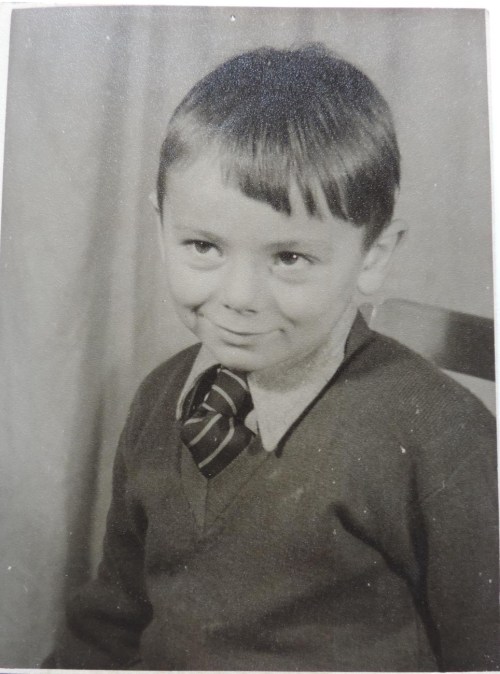
Here’s me at Primary school –
And here’s me about sixty years later –
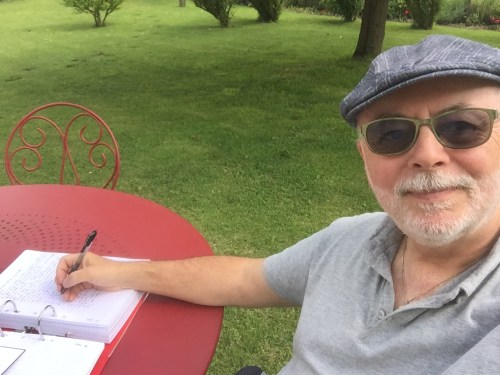
Is this the same person?

From my perspective it certainly is! I have the experience of a continuity of Self. I know these are both photos of me, but, boy, have I changed!?

So, who am I, really?

Am I this body?

It’s pretty obvious, even from just those two photos, that this body has changed a lot over the decades. Our bodies are made up of over 30 trillion cells (a number too big for us to imagine, and that’s just an estimate because nobody has been able to count them). Almost all of these cells live much shorter lives than I have done. Some cells live only a few days, other weeks or months, and only a minority last a full lifetime. So, it’s pretty certain that only a minority of the cells in this body I have now are the same ones I had in that earlier photo.

Interesting choice of verb there…..”had” – do I have a body? If so, who is this “I” who has this body? I’m tempted to say, no, I don’t “have” this body, I “am” this body. But there’s the trap, huh? Because if the body is always changing, am “I” always changing too? Where does my sense of continuity of being come from? And I am more than my body aren’t I?

What more am I?

Scientists have discovered and put forward at least three other elements of identity by studying genetics, the “the human microbiome” and epigenetics.

For a while the “Selfish gene” idea gained a lot of traction. “The Human Genome Project” was completed in 2013 and there were great claims for it at the time – a bright new future of “personalised medicine” based on your gene sequences was heralded. Some claimed it would lead to the elimination of a host of diseases. Richard Dawkins, whose book entitled “The Selfish Gene”, popularised the idea that our essence, our core, the “real” “I” wasn’t the body, it wasn’t the mind, it was the double helix spirals of gene sequences….our DNA.

Things haven’t turned out the way the great gene believers imagined however. It seems we can’t be reduced to the level of chains of little molecules. We are more than that. What more?

Well, next up was an exploration of the cells which are part of us but aren’t us – all the bacteria, viruses and other micro-organisms which live on and in our bodies but don’t have the same DNA as we do. It turns out there are at least as many of them as there are “our own” cells. “The Human Microbiome Project” was launched four years after the end of “The Human Genome Project” and by 2016 a lot had been discovered, but it’s still not enough to pin down who we are.

Have these projects helped me to answer the question “Who am I, really?” Not really, but it does make me deeply aware of the fact that I’m not so much an object as some scientific models have suggested. I’m certainly not a fixed entity. Instead, it seems I’m a constant, lively, energetic flow of cells.

It makes me think I’m more like a river than a stone! I’m certainly not like a machine.

But wait, it gets more complicated yet – following on from the discovery of the “genetic codes” researchers discovered that not all the genes are active all the time. In fact they switch on or off all the time. They’re more like music than they are computer code. What presses the keys to play the tunes? What determines which genes are expressed, and when? It seems a whole host of “environmental factors” are involved. You aren’t determined by your genes. They only represent some kind of potential. Whether they become active or not depends on the life your live – the environment you live in and the events and experiences of your life.

We don’t know what all the factors are, or how they work….. “The Human Epigenetic Project” anyone? Well, what do you know? There IS “The Human Epigenome Project“! A consortium exploring at least one of the links between genes and the environment.

So, if my body isn’t all there is to me, if my genes aren’t all there is to me, if my microbiome isn’t all there is to me, then what else is there?

My thoughts? My feelings? My memories, dreams and imaginings? The stories of my life?

Tick “all of the above”. (There are volumes of books which have been, and are still to be, written on each of these)

But there’s a vivid red thread running through all these observations – connections.

Who I am, really, will never be answered by considering myself in isolation. It seems I am a flow. Constantly changing, constantly receiving materials, cells, energies and information from the world in which I exist, constantly sending out materials, cells, energies and information, and constantly changing myself and the world in the process.

My story is not just my story. It’s our story. You and me. Every relationship, every encounter, every exchange, shapes, changes and moulds me, and, you, and the planet we live on.

That excites me.

It’s a new story. It’s the story of evolution, of emergence, of connections, contexts and change.

The answer to “Who am I, really?” won’t be found by looking at smaller and smaller parts. It’ll be found in experiences, in performances, in events, in relationships and interactions. It’ll be found in the unique stories that only I, and only you, can tell. It’ll be found in what we share and how we relate.

Identity is fluid, relative and dynamic.

Maybe we should think of it more as what we share, than what divides us.


Read Full Post »

Maps…..representing the world by making maps is one of the most characteristic skills we humans possess.

We don’t just draw maps on paper, but we make them inside our heads. Dan Seigel, who wrote “Mindsight” says we create three particular maps in the most forward part of our brains – the prefrontal cortex. He says we make a “me map”, a “you map” and a “we map”. He means we have an image, a pattern, or some other form of representation in our minds by which we recognise ourselves, the people we meet, and the relationships we have with them. These maps do more than allow us to recognise ourselves and others, they enable us to navigate our way around them. They help us predict, plan and choose which actions to take.

I don’t know about you but I LOVE maps. There’s something magical about them. I love to see maps over the ages which reveal how we have come to make sense of the world. So, when I was in Tordesillas, Spain, earlier this year I was delighted to find a whole host of astonishing maps in the Museo del Tratado de Tordesillas.

Look at this one, pictured above, it’s part of the Quesques Abraham map, otherwise known as the Catalan Atlas, from 1375. These first couple of sections depicts the world around the Mediterranean. You’ll probably recognise the British Isles, the Iberian Peninsula, the land we now call Italy, the North of Africa and so on. It’s pretty fascinating but it’s typical of the kind of geographical maps with which we are familiar. I think the Catalan Atlas gets even more interesting in the next set of panels –

This is the world to the East of the Med. The physical structures are way less recognisable, and that’s largely due to the fact that the world to East of the Med wasn’t known very well in those days. In fact, this section of the map is drawn from stories. It’s drawn from the stories of Marco Polo and other explorer/adventurers who travelled in the East and then wrote their travel journals, and from stories told in religious texts and passed down in various oral traditions.

I don’t think I’ve seen a map created that way before.

A map made from stories!

But then, I thought, isn’t that exactly what we do when we create these “inner maps”? The “me map”, the “you map” and the “we map” that Dan talks about?

So, I wonder……what stories do I draw on to create my “me map”? What stories do I draw on to create the various “you maps” and “we maps”? The stories of our encounters? The stories of other peoples’ encounters? Wow! What an idea!

I think I’m off to explore that further…..I wonder what those maps look like, and what stories created them?

Read Full Post »

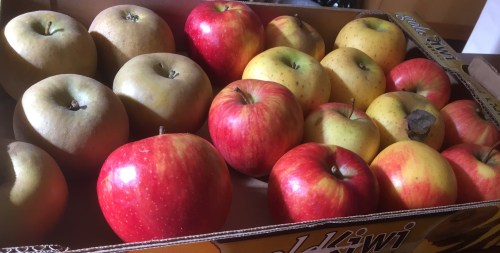
One of the things I love about living here in Cognac is the availability of different, fresh, locally produced food. I popped into one of the market-style shops here this week and discovered it was “Fete du Pommes” week – a celebration of apples. Because, of course it’s autumn now here and apples are available in abundance. I know I can go into one of the big name supermarkets and select a plastic bag of shiny “perfect” same-size, same-shape apples of a big name variety (“Pink Lady” anyone?) which have been shipped here all the way from the Southern Hemisphere but look what I can get when I go local instead?

I selected four different varieties, none of which I’ve heard of before, and placed them in the cardboard box from the stack at the entrance. Even within each of the many varieties available I could choose big apples, small apples, round apples, wonky apples! What a delight!

Diversity is a core feature of Nature.

There are no two of us the same. The Universe celebrates diversity by bringing to life millions and millions of unique plants, creatures and forms.

Nature abhors mono-cultures. They die out, taking the richness of the soil with them.

I delight in the diversity of human beings. During my four decades of work as a clinical doctor I looked forward to the start of each week when the next patient in the door would tell me an utterly unique story, one I’d never heard in my life before.

I wonder if it’s possible to respect uniqueness and diversity if Clinical Practice is determined by guidelines and protocols for patients who are even more diverse than the locally grown apples in the market.

There’s a beauty in diversity, as you can see from my photo, but it’s a fundamental tenet of reality too….

Read Full Post »

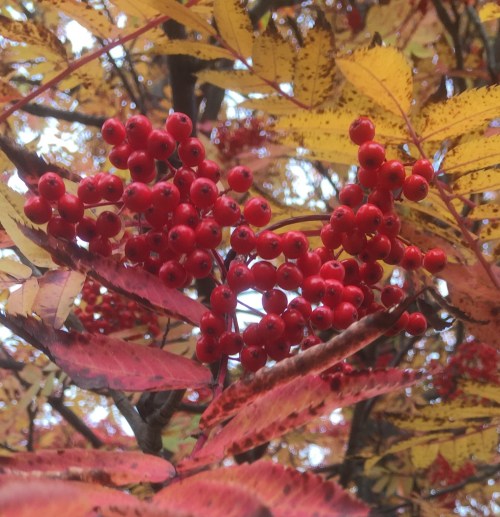
Walking through Princes Street Gardens in Edinburgh recently I was stopped in my tracks by this stunning display of Rowan berries.

What a colour!

What an abundance!

It felt like the tree was saying “Here’s a gift from me to you”.

I know, you’ll be saying berries are the way trees spread their seeds. It’s not altruism. And while I’m not going to anthropomorphise here, I think there is a Life Key on display here.

How to survive and thrive?

Give.

Make an unconditional offer.

Express yourself as fully and as beautifully as you can.

And you will thrive.

Yes, these berries are there to tempt birds to come and eat them so that the seeds of the plant can be dispersed helping it to reproduce and to spread. But berries are just part of a cycle of Life. They are an essential part of the cycle of Life. If these trees all stopped producing berries yet another species would disappear from our beautiful planet.

Are they the end of a process? A coming to fruition? Yes. But aren’t they also a beginning? The start of an adventure? The launch of the NEW, of the next generation?

Seriously, isn’t this a Life Key?

That to live (by which I mean to survive AND thrive) we have to give. Not hold back, negotiate, set limits and conditions, but give – wholeheartedly, unconditionally, joyfully and abundantly.

Because that’s what makes Life so beautiful, so amazing….that’s what makes others stop in their tracks and connect. That’s what weaves us into the Web of Life.


Read Full Post »

When I opened the shutters this morning I saw mist. OK, so I saw more than mist, but the mist was pretty dense. It was hiding all the surrounding vineyards, and, normally, I see vineyards straight ahead, to my left and to my right. I knew, of course, that the vineyards were still there. John O’Donohue came to mind, talking about the imagination and how we can’t see the mountains when they are hidden by the fog, but that we still feel their presence, still know they are there……

“You know it’s there, but you cannot see it with the eye. This is a wonderful living metaphor for the imagination. Around every life are these adjacencies–these huge, invisible presences that you can’t pick up with the human eye, but that you can connect to viscerally and affectively through the power of imagination. This is the threshold where polarities can enter into conversation with each other, and take us to new levels of complexity, differentiation, and integration.”

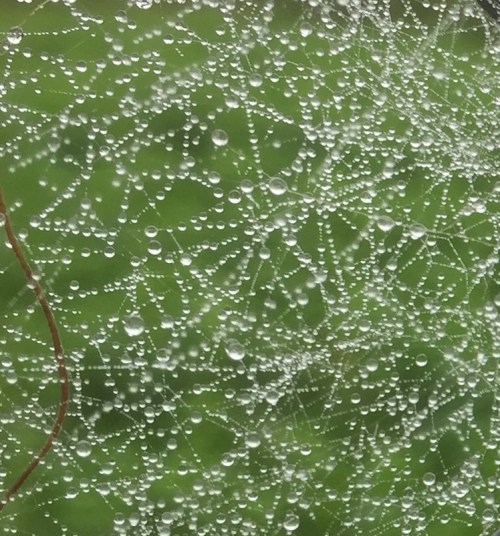
Then I noticed, directly opposite the front door, a sparkling jewel of a spider web adorned with water droplets. I find those serendipitous gifts of Nature irresistible.

Look at it! Just look at it! As far as I know (and correct me if you know better) spider webs are made by single spiders. These little creatures don’t work in teams. So ONE spider must have created this astonishing, complex web. Just look at the number of filaments, look at the junctions, the nodes, the points where the threads meet. Maybe this web was there the day before but because there were no water droplets on it, I didn’t notice it. Or maybe it’s the result of a single night’s work. Either way, I would have completely missed it, had it not been for two more phenomena – water and light.

Let’s start with the water. Where did this water come from? It wasn’t rain. It wasn’t a hose-pipe. It appeared, right out of thin air. We call it dew. Don’t you think dew is gorgeous? Whether its on a patch of grass, delicately outlining some petals or leaves, or adorning the work a spider. How incredible that it exists, invisibly, in the air, and that when the temperature and wind conditions are right, it precipitates out onto the surfaces, revealing itself.

Water reveals itself as thick mist, draping over the landscape like a heavy, dense, grey curtain. But it isn’t heavy, and it isn’t dense. When it reveals itself on the surface of flowers, leaves and spider webs, it reveals itself as droplets. Look at that image again.

How many different sizes of droplets are there? How many droplets are there? I guess that, theoretically, you could measure them, count them, add them up and tabulate them, but, well, hey, life’s too short. I just stand there, transfixed, in awe of them. Each one a tiny lens, showing me the world around it upside down.

I look at this and I think about the Milky Way which arched over my house last night, forming a dense, white carpet of stars stretching from one horizon to the other. You know what it’s like when you look at the Milky Way on a clear night. The longer you gaze at it, the more stars you see. The closer you look, the more the carpet dissolves into individual stars…..a bit like these individual droplets on the web.

It’s easy to get lost in the Milky Way.

It’s easy to lose yourself in a water adorned spider’s web, shining, sparkling, with the light which begins to penetrate the fog.

A couple of hours later, and this phenomenon has gone. The fog has receded into the invisibly watery air. The droplets have evaporated, leaving the thin threads of the webs harder to see.

You’d think that the sunlight would make the world clearer. But somehow, this morning, it was the fog, and brief appearance of the air’s water, which made the world much clearer, by reminding me, as the fox reminded the Little Prince , that

“What is essential is invisible to the eye”

And, oh, how wonderful it is, when what is invisible is revealed.

Read Full Post »

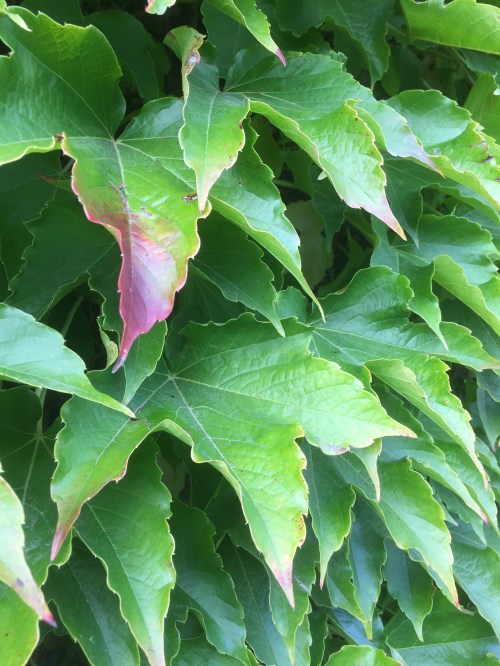
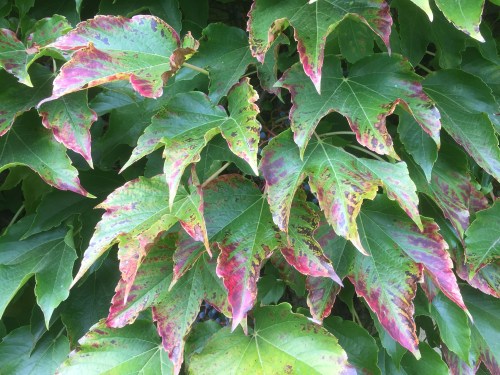
I’ve been away visiting family in Scotland. When I returned to the Charente today I noticed that the Boston Ivy in the garden is just beginning to change colour. I also read today that the clocks go back this coming weekend….the end of “summer time”. So, I’m very aware that we are on the cusp of a seasonal change.

Has anyone every asked you which season is your favourite one? And, maybe, why?

I don’t have a favourite, but I do have a particular affinity for both Spring and Autumn because those are the seasons where I am most aware of change. I have a notion that Life is about change. We change constantly throughout our entire lives. We move constantly throughout our entire lives. Every breath we take changes us, and changes the world around us. I love to see change occur right before my eyes. I delight in the appearance of blossom and of buds in the Spring, and the leaves which go from green to red, brown or gold in the Autumn.

I find that the model of reality described by complexity science helps me to understand why things are the way they are. In complex systems, like our planet, the entire system tends to move towards “far from equilibrium” points. It doesn’t sit quietly, static and unmoving. We live on a dynamic Earth speeding through a dramatically dynamic Universe.

As complex systems move towards those edges it experiences “phase changes” and “bifurcation points” – the times and places where change becomes more dramatic, and places where it can go one way or another.

Autumn feels like one of those zones to me – a time and a place where change becomes more obvious, more widespread, and more dramatic.

That excites me!

Read Full Post »

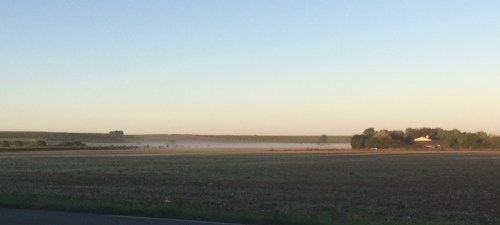
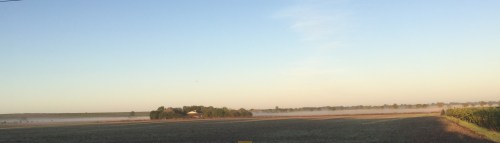
As I was driving into Cognac early in the morning I noticed this ribbon of low mist lying on the fields just in front of the vines.

I pulled over and took a couple of photos.

When I look at them again I’m drawn into the flow of wonder, to awe, to transcendence.

I begin by wondering how the air is full of water even when the sky is blue and there’s no hint of dampness to feel. How this invisible water condenses to become visible and lies along the face of the earth for a short while before evaporating back into the invisibility of the air.

I find that amazing.

I’m reminded of the writings of the physicist, Carlo Rovelli, who described how what we see as solid substance looks as if it is made of molecules when you look closer with a microscope, how those molecules look like separate atoms joined together once you examine them even more closely. How, with the ability to look inside atoms, once considered “indivisible”, the fundamental building blocks of reality, we discovered many other smaller “particles”, right down to protons, electrons, neutrons, which, in turn seemed to be made up of even smaller “quarks”. But that now we can see even closer and what we see is……nothing. What we see are waves and particles shimmering and sparkling into, and out of, existence.

That fills me with awe.

That provokes the sense that reality is all One, that the so called boundaries and barriers are artificial, transient, insubstantial, and in that moment I feel a dissolving of the Self, a feeling of One-ness with the Universe, a moment of transcendence.

Read Full Post »

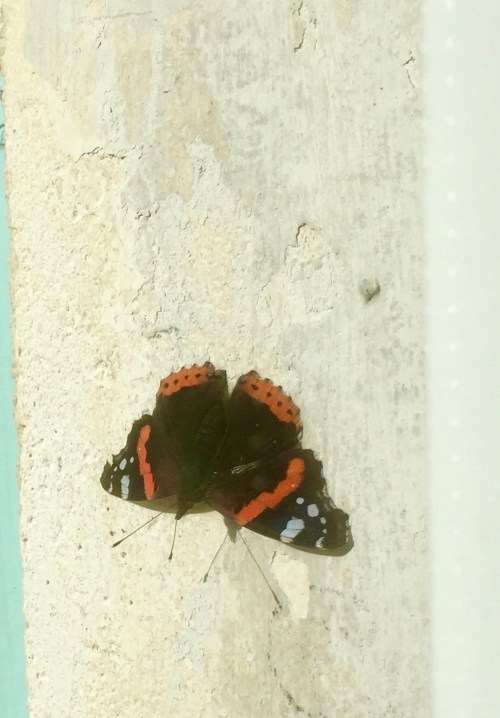
When I looked out of my window the other day I saw a butterfly sunning itself on the wall. I carefully took my phone out of my pocket and photographed it through the glass. Then I opened the window carefully to try for a better shot, and the butterfly flew off. Gone.

So, here’s the photo I took. It’s not going to win any wildlife photographer of the year awards but look carefully…..you can see the shadows of the butterfly’s antennae.

Isn’t that amazing?

Maybe I’ve seen this before but as far as I can remember this is the first time in my life that I’ve seen the shadows of a butterfly’s antennae.

I’m struck by the sense of delicacy and fragility in this image. A butterfly’s life is not a long one, but a butterfly’s shadow is even shorter! A cloud just has to pass over the sun and the shadow has gone. The butterfly just has to do what butterflies do….flit off somewhere else….and it’s gone.

This sense of impermanence coupled with the delicacy of the tiny slim antennae of the small fragile butterfly combine to make this a very special moment.

It’s one of those intense fleeting experiences of “first and last”. It’s the first time I’ve seen this, and could be the last – both in general terms, and, of course, this is the one and only opportunity to see this specific, this unique butterfly in this particular place at this particular time.

Life if full of these moments. If only we can be aware of them.

Here’s something else I think about this…..in the midst of all this impermanency,  all this transience, all this fragility, I see the vibrant, colourful, intense flow of LIFE – the LIFE that flows through every living creature, every moment of every day. The Life Force. The “green fuse that drives the flower”. Spinoza’s “conatus” – by which he meant the “striving to survive” which separates the living from the inanimate.

It never fails to astonish me. It never fails to stimulate my sense of wonder, of marvel, of “émerveillement du quotidien“.

Life is full of these moments. If only we can slow down and pay attention to them.

Read Full Post »

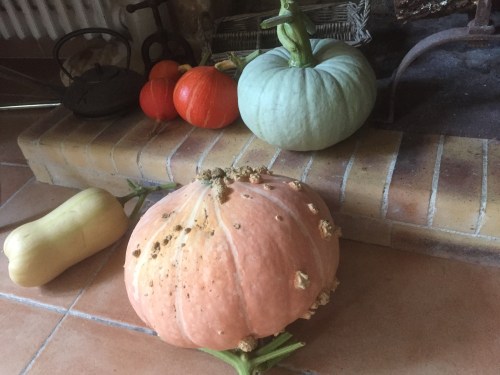
Here’s this year’s crop of pumpkins from the “potager” (veggie garden).

We don’t have a big plot and having lived in a top floor apartment for almost 20 years before emigrating from Scotland to France, we are pretty much beginner gardeners. I love it though.

Last year we planted seeds of several different pumpkin varieties and really come harvest time we had way too much! Still got some roasted pumpkin purée in the freezer for this coming winter’s soup. So, this year we decided to cut way back and planted just three. The butternut squash you can see on the left there, the pretty little orange ones, and that pale green one. (I’m afraid I’m still terrible with names. I could find out if you asked me, but I tend not to bother getting to know their names)

But wait, I hear you say, what about the big guy?! The one in the front with the nobbly bits on! Well, he grew all by himself.

I learned how to turn grass cuttings and garden waste into compost and have been spreading it on the veggie patch each year for about three years now. Last year we read about the “No dig” method of gardening, so took that advice and just spread the compost thickly over the surface of the plot last winter.

Well, clearly there was a pumpkin seed in there, cos this plant began to grow. And it grew, and it grew and it grew! Huge thick green prickly stems, miles of thin, tightly spiralled creepers which caught onto to anything they could reach, and it spread along one side of the patch, turned down a second side, then along a third side, before heading back to its origin. All the time winding itself into the tomato plants, the courgettes, and anything else that was growing there. But despite all this green growth, and believe me there was a LOT of it, it produced just one gourd.

But what a gourd! Look at it! It’s the biggest of the lot!

So, it seems, the garden is better at producing it’s own crops than I am at managing it! Who knew??

I think that’s one of the things I like best about the garden – the surprises, the number of times it makes me wonder, stirs up feelings of awe, and fills me with joy! Then fills me with the tastiest vegetables I’ve ever eaten. Seriously who knew tomatoes could be so varied and tasty? That cucumber was so refreshing and delicious, that radishes were so SPICY! I could go on…….but I won’t!

Read Full Post »

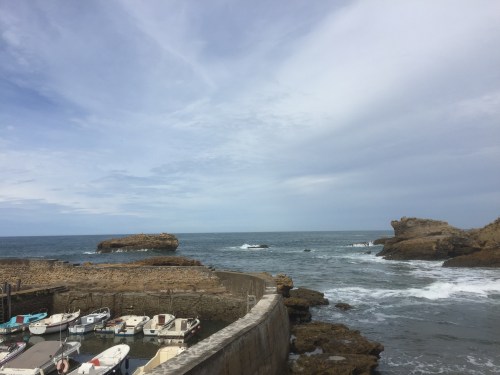
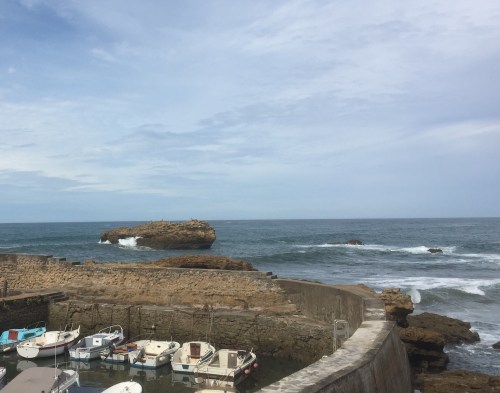
See this large rock just above the harbour in Biarritz? How does the sea make it to the shore when this rock is in the way?

The most obvious way is to go around it.

And that’s what most of the water does. It makes it way towards the shore, and back out to sea again by breaking against the rock and flowing around each side of it.

That’s one way to deal with an obstacle, with something standing in your way…..find a way around it.

But, wait, look at this…..

…the water has found another way as well.

It goes THROUGH the rock!

I suspect this has taken a very, very long time for wave after wave to make its way through a small crack in the rock, widening the gap slightly every time it passes through. But look at it now. Sometimes when a more substantial wave hits the far side of the rock it flows directly through the gap. Doesn’t happen every time. Just when the waves are big enough.

So, there’s the other solution. Keep going. Keep pushing up against the obstacle, looking for a gap, an opportunity, a way through, and once you find it, come back again and again. Each time, it’ll get easier. Each time the gap will get wider, the way will become broader.

Something else…..this is just beautiful to watch. Mesmerising even. Over the course of a few minutes you can see how the rock and the sea sculpt each other. It’s a delightful relationship.

Oh, and something else……Michel Serres, a French philosopher who died recently, used to describe human beings as “anticipation creatures”. I recently listened to an episode of one of my favourite podcasts, Onbeing, where the science journalist, Erik Vance, talked about “the drugs inside our head”. He was discussing the poorly understood but fundamentally important phenomenon known as the “placebo effect”, and one thing he said was that our brains are “prediction machines” (well, I hate the metaphor of “machine” applied to living organisms, but you get the point…).

Both Serres and Vance are talking about our incredible ability to spot patterns, so that we can predict the future. OK, not too far into the future, and not with 100% accuracy, but we don’t just notice the world, we anticipate it.

As I stood watching this phenomenon of the white surf gushing out of the mouth in the rock, I was quickly captured by the experience of anticipation, watching the swells on the surface of sea further out, trying to predict which would turn into waves big enough to pour through the rock.

It was hard to stop.

It was delightful.

Read Full Post »

« Newer Posts - Older Posts »