To meditate is to be waiting, like lying in wait, for thoughts that are going to surprise us, bringing sudden clarity.
and he quotes Heidegger –
“We will never succeed in having thoughts, they come to us,” said Heidegger
This reminded me of what Liz Gilbert describes in her “Big Magic” about how ideas come to us. She suggests we think of ideas as living their own lives, wandering around the world looking for a partner to work them in order to bring them to fruition. I liked that concept. It’s maybe a stretch of the imagination to think of ideas as entities living their own lives, but then, maybe thoughts are a bit like that too?
Here’s Conche again –
We anticipate, with variable probability, the result of an action, and it is for this reason that we act. Yet we don’t anticipate thoughts. The philosopher is, in this regard, similar to the artist. Thought is “work of a poet,” said Heidegger.
Again and again he suggests the approach of the artist – not least because he sees Nature as a continuous creative process.
Liz Gilbert says we need to turn up every day prepared to do the work. She describes what others have called the “discipline” of the writer, but that’s not a word that’s ever had much appeal to me! Maybe we could call it a habit? (or what I’d tell patients about making better dents!)
Conche says that what we need to encourage thoughts to come to us is a kind of ease (an absence of anxiety), and setting aside any preoccupations with our selves.
What is required so that thoughts come to us? First, the soul must reach “freedom from anxiety” (ataraxia), serenity, a sort of negative happiness that we can call “wisdom”—a wisdom that is not the aim of philosophy, but its condition. Then and correspondingly, preoccupation with oneself must be absent.
Ha! Did you ever watch the movie “What about me?” by 1 Giant Leap?
I came across a very short video the other day which both delighted and moved me. It is truly magical. There are no words in it but a little story is told. I think it’s the gestures of the station mistress which make this so incredibly powerful. We have no idea what she is saying to the train driver but her hands and movements are so expressive you can’t help but be entranced by her. Then when the train pulls away, what she does is just…..well, look for yourself……
It was posted onto Facebook by Kyoto Journal (which I like a lot!) Here’s what the film-maker, Erez Sitzer, says about it –
i was searching for a train station. the kind you rarely see. small. countryside. we found it. and by happenchance, found something else. someone else. miyako. the station master. i watched her smile at each exiting passenger. then, noticed her wave at the departing one-car train. then, surprisingly, she continued waving. she waved until there was no trace left of the distant train. no one witnessed her, except, well, me. in that short span, my love and wonder of life was renewed. when i spoke to her later, she said at first she felt so shy. and hardly waved at all. slowly, over time, she began doing something she neither needed to do, nor imagined she ever would. so, this is miyako, master of a tiny station in the middle of nowhere japan who attends to every train and passenger that passes by
That’s one of my favourite Kevin Spacey movie lines.
It’s a phrase which often comes to my mind in relation to health care. We’ve developed a very bureaucratic way of providing health care in Europe and North America. It seems to me that the system comes first now instead of the patients and the doctors.
Health care is a supremely human activity. It involves one human being trying to help another. Both of those human beings are unique and when we reduce the patient to a case of a disease and a doctor to a person who implements a protocol then we de-humanise Medicine.
I think it is important to prioritise uniqueness. We should always be on the lookout for what is new and what is different in every situation. Instead the bureaucratic approach demands we look for what is the same and fit everyone into pre-set categories and treatment paths.
Does anyone know you better than you do? Does anyone really know better what choices you should be making instead of the ones that you are making? Who should finally decide what to do about your life? (How you should eat, how you should spend your time, what “treatments” you should subject yourself to?)
I think it is you!
So when I hear a manager or a “skeptic” tell a patient that they can’t have the treatment which they say is the one which made the most difference for them (relieved their pain, settled their panic attacks, made their breathing easier….whatever) because the “evidence” says that treatment “doesn’t work”, it amazes me.
There not a treatment on the planet which does the same thing for every person who receives it, so there is no such thing as only two categories of treatment – those which work and those which don’t – as some would claim. We need a wide diversity of treatments to be available because human beings are so, well, different….
But I think about this not only in relation to rationing health care, protocol based medicine and so on. I think it’s something to consider in every therapeutic relationship. Here’s the question I’m exploring –
Is it an expert’s job to tell people what to do, or to help them to see how to change, then to support that change?
I’m pretty sure I don’t want anyone telling me what to do!
The movie version of “Le Petit Prince” has just been released in France and, perhaps because of that, I stumbled on what turned out to be a French translation of an English language article in “The American Interest” last year – in it the author compares the two princes – Machiavelli’s and Saint-Exupéry’s.
The key difference lies in how the two books present the social urge that drives human political interactions. Machiavelli penned the incipient modern view that puts fear at the center of political order, turning politics into the craft of fear management. And it is a craft, properly speaking, not a science; yet the flavor of early modern times helped give rise to what we optimistically call today political science. The French aviator’s short book, on the other hand, describes the deep human desire to be social out of love toward others, not from fear of them. For the former, fear of others is the source of social cohesion; for the latter, the source is the need for others. The former would repel others, the latter attract them.
What the author is highlighting is the acute difference between these two authors in their view of their fellow human beings.
The modern approach to politics—one given to us in distilled form in The Prince and more elaborately in the Discourses, and is then expanded by later authors such as Thomas Hobbes—starts from the assumption that we humans do not enjoy each other’s company. Rather, we relentlessly compete with each other for things and for thoughts, for safety, and for status. It is a dim view of men, “ungrateful, fickle, pretenders, evaders of danger, greedy for gain” (The Prince, XVII). The outcome is a constant clash that often degenerates into the war of all against all. As Jean-Paul Sartre wrote in Huis Clos (“No Exit”) in the same year that Antoine de Saint-Exupéry plunged into the sea: “L’enfer, c’est les Autres.”
Well, this certainly rings a bell. We are force fed a daily diet of fear – fear of terrorism, crime, disease, immigrants…..you name it!
Le Petit Prince presents a very different picture. The Little Prince from a distant asteroid is also a keen observer of human affairs, but less jaded than the retired Florentine diplomat and his modern followers. He is a gentle soul in search of others whom he can befriend and love. In one of the many moving moments in this quirky little book, the lonely and somewhat sad Little Prince who had just landed on earth screams from a mountaintop: “Soyez mes amis, je suis seul.” Deriving apparently little pleasure from his loneliness, the Little Prince seeks others, not to dominate them but simply to be with them and engage them in conversations. As he says to a fox, “Come and play with me. . . . I am so sad.” (Ch. XXI).No Principe, no man in Machiavelli’s world, can fathom the idea of seeking others simply to enjoy their company. La tristezza of the Prince leads him to fear others; la tristesse of the Little Prince leads him to seek others.
If one of the key differences is the creation of a society based on fear vs one based on friendship, then the other key difference this author notes is between the quantitative and the qualitative.
Another crucial and related difference between the two Princes revolves around a question that is apparently limited to epistemology, but that has significant political consequences. The Little Prince observes that human interactions are not, and cannot be, based exclusively on visible, calculable features. As Saint-Exupéry famously puts it, “L’essentiel est invisible pour les yeux.” For Machiavelli instead, “Men in general judge more by their eyes than by their hands, because seeing is given to everyone, touching to few. Everyone sees how you appear, few touch what you are” (The Prince, XXVIII). Measurable appearances are more important in the life of the Prince than what is invisible to the eyes, but they are useless for the Little Prince. In anthropologist James Scott’s words, in order to function the modern state requires its citizens to be “legible”: to have a clutch of numbers citing address, age, and income, coded and used to place individuals in various categories. The Little Prince would find the very idea of legibility puzzling and inhuman, and Saint-Exupéry himself would not have been the least surprised to learn, had he lived long enough, that the Nazis tattooed numbers on the arms of their victims. The Little Prince’s criticism of the grown-ups, or us moderns, is that we approach others by focusing on calculable appearances. To know something or somebody, we measure it. When we introduce a friend to an adult, he asks: “How old is he? How many brothers does he have? How much does he weigh? How much money does his father make?” Similarly, when we try to describe a house, its price is one of the first features that we use to convey its beauty. “You have to tell them [grown-ups], ‘I saw a house worth a hundred thousand francs’. Then they exclaim: ‘What a pretty house!’” This is our scientific approach, another essence of our modernity: By counting and measuring, we think we assess the other side as rival or friend, we think we grasp his potential behavior, and, above all, we think we can manufacture benign social arrangements on this basis.This is not real knowledge, and consequently it cannot generate real order. The questions one ought to ask are different. Knowing the price of a house pales before a description of it as a “beautiful red brick house with geraniums at the windows and doves on the roof.” Similarly, if you want to get to know somebody, ask: “What does his voice sound like? What games does he like best? Does he collect butterflies?” Only by asking such questions can one start the long process of “taming.” The development of true social bonds is possible only when based on this deeper, yet far more elusive kind of knowledge. Knowing how much money one makes may be helpful to manage the Prince’s mechanism of fear, but it does little to develop true friendship and lasting order.
I’ve quoted pretty extensively from Jakub Grygiel’s article but I do think it really merits a full read – you can find it here.
Maybe this will whet your appetite to either go out and buy a copy of “The Little Prince” by Saint-Exupéry, or to go see the movie. Delight, pleasure and food for thought if you do!
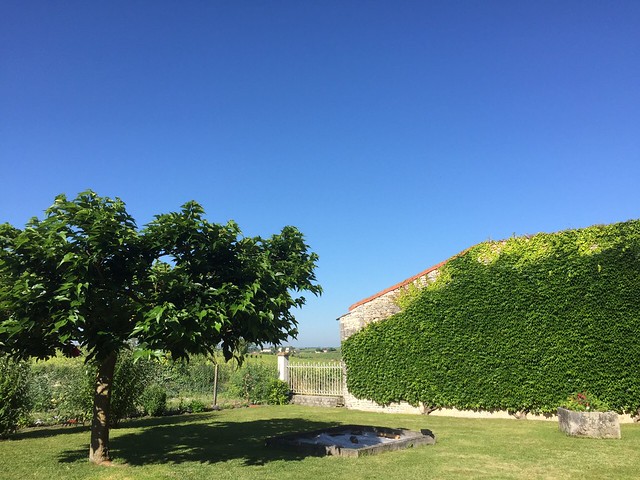
We have a huge vine which covers the wall of a building at the edge of our garden.
The other day I was sitting under the mulberry tree and I heard a strange noise – like water droplets falling on the vine (but it wasn’t raining, and the vine wasn’t being watered!)
I took this little video – turn up the volume and listen very carefully
The noise is the vine, popping those little shells off it’s flowers – see –
Have you ever heard anything like that?
It’s been happening every day since – just after the sun moves west over the wall so that after being in warm sunlight all day, the vine is now in the shade.
Oh, and at the same time, dozens of bees make their way to vine to find the nectar which has just been made available.
If you’ve been following this blog for a while you’ll know that the “émerveillment du quotidien” is a key life principle for me.
That French phrase captures the sense of continuous open-ness to wonder. (It means the amazing everyday – more or less!)
But look what I managed to film today!
I’ve seen and heard this little creature buzzing around my garden recently and he never, ever stays still. Not for a second! I think it’s called a “hummingbird moth”.
His wings make a deep buzzing sound so its always obvious when he is around.
Look at the speed of his wings! Look at that long proboscis and how it can curl right up into a spiral! It’s astonishing!
I bet there’s a good chance you will look at this photo and it will touch your heart.
Looking after wee ones is SO important.
I wonder if we really honour and respect that enough?
Are our societies structured in the way which allows the wee ones to grow and thrive, to reach their full potential?
I think the solutions will lie in developing our heart intelligence, but we need our brain intelligence too.
For a data-driven, brain-focused approach, here’s a video of a presentation by Sir Harry Burns who was Scotland’s Chief Medical Officer until last year. It’s almost half an hour long, and some of it is pretty technical, but Harry Burns is expert at delivering the messages in clear, simple ways. I think the first twenty minutes or so of this presentation will startle you if you haven’t seen this kind of analysis before. The takeaway message is that the way we structure our society, in particular in the physical, emotional and social environments we create, powerfully influences the health and illness paths of individuals right from conception (or earlier?) and the first few months of life. (The last ten minutes or so of this particular presentation goes off into the “patient safety programme” – which is a different issue – in my opinion)
When you look at this photo you’ll see something living, the plants, and something “inanimate”, the cauldron. Some of you will also say you notice the sunlight and the shadows.
Every day these plants look different as they grow, flower, and, ultimately wither.
Every day the cauldron doesn’t look that different, but if we could see what it looked like on that first day when it was carried from the foundry to the shop, we’d see that it has changed a lot.
Everything changes. Just at different rates. Living organisms change rapidly, whilst inanimate objects change much more slowly, except for moments of catastrophic change where, for example, an object is broken.
We forget that, don’t we? That change isn’t optional, but the speed of change can be.
We are creators, we humans, and when we create we embrace change, we engage with it, we bring our imaginations to bear upon it, and so we make the world we live in.
I was watching an episode of Vikings the other day, and was startled when one of the character, King Ecbert recited a few lines of poetry which were completely familiar.
Time present and time past
Are both perhaps present in time future,
And time future contained in time past.
If all time is eternally present
All time is unredeemable.
What might have been is an abstraction
Remaining a perpetual possibility
Only in a world of speculation.
What might have been and what has been
Point to one end, which is always present.
Footfalls echo in the memory
Down the passage which we did not take
Towards the door we never opened
T S Eliot! From the Four Quartets! Dramatically it worked, even if you couldn’t help thinking, whoa there, T S Eliot in the Vikings??!
I studied Eliot at school and he is still one of my most favourite poets. I remember reading this passage and feeling enthralled by it, but I had no idea what he was talking about. Now, as I encounter it again, I’m surprised how well it fits with what I have since discovered about time and memory.
In fact, by one of those strange quirks of synchronicity, this month’s “Philosophie” magazine has a central section on Bergson’s concept of memory. Bergson was way ahead of his time and many of his philosophical ideas about the mind have since been backed up by research findings in the field of neuroscience.
Much as I can be thrilled by reading the work of a philosopher, or research work in neuroscience, neither of these comes close to the power and beauty of Eliot’s poetry.
Draw all three of these strands together, and we have a vision of experience which is not of the past filed away in some cabinet or pigeon hole in the brain, nor of the future lying like the landscape just over the next hill, waiting for us to discover it. No, instead we have a vision of the present which contains the past and the future. This is where we encounter time and reality, in a never ceasing interplay of the ripples of the past, the imagined possibilities of what might be, and the phenomena of the present moment.
So it isn’t just what happened which influences us now, but those passageways we didn’t take, and doors we didn’t open, are also still influencing what we see, hear, feel and think about today.
I welcome constructive criticism and suggestions. I will not, however, tolerate abuse, rudeness or negativity, whether it is directed at me or other people. It has no place here. ANYONE making nasty comments will be banned.






 Heroes Not Zombies