Feeds:
Posts
Comments

Archive for the ‘photography’ Category

Ok, I’ll be honest, this is NOT a bonny bridge! In fact, it’s pretty much devoid of any appealing aesthetic, in my humble opinion! I know some people think concrete is fab, but I’m not one of them! However, what I love about this image is…….

…..look at this divide!

Look at this craggy, rocky, deep, divide. How on earth would you cross from one side to the other? Without a bridge, you just wouldn’t really try. Well, probably hardly anyone would. But build a bridge, even a concrete, not pretty bridge, and you make connections possible. You make it easy for people to cross from one side to the other. You set up the possibility that new relationships will be formed, new bonds forged, different terrains and different ways of living can be discovered.

I have this strong, core belief – making connections matters.

We have two brains, or, more properly, two cerebral hemispheres. The left hemisphere is great for separating things out, for spotting differences, for finding what’s familiar, and sticking with it. But the right is great for seeing connections, contexts and patterns which let us see the bigger picture, let us see what is particular and unique in every case, rather than what is generic and general.

Bridges are a practical and symbolic form of connection.

Don’t you think we need that more, in our seemingly more polarised, more divided time? Don’t you think we need to offer a hand over to the other side now to heal our deep divisions?

Here are some of my favourite bridges….

This is a bridge in a park in Nara, Japan. I love its shape and colour. And, of course, the reflected image in the water makes it even more appealing.
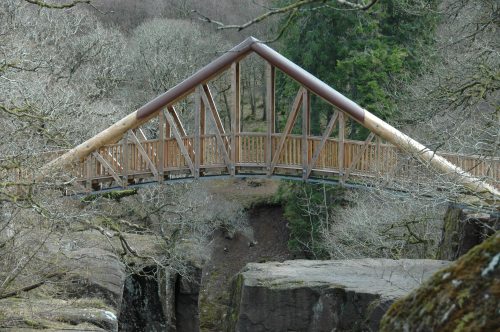
This is the “new” bridge over the Bracklinn Falls, near Callander, Scotland, the “old” one having been swept away in a storm.

Part of the incredible bridge connecting Denmark and Sweden.

The three “Forth” bridges – the old railway one on the right, the more modern road bridge to its left, and the newest, spectacular one to the left of the other two.

Do you have any favourite bridges?

I think it’s good to contemplate them – maybe they are beautiful in their own right – but, always, they help us to remember we need to make connections, heal our divisions.
Read Full Post »

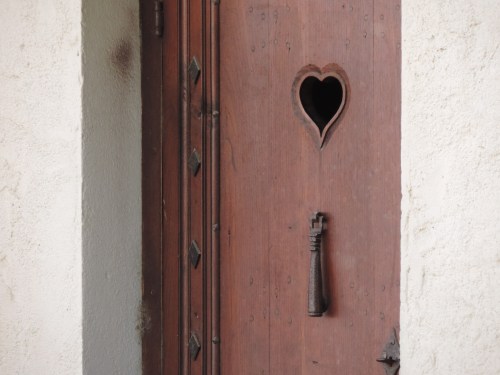
Isn’t this a great door?

Rather than having a tiny peephole to secretly look out through, this person has carved a heart. Sure, some peepholes have lenses in them which give you a wider angle range of view, but the clue to their limitation is in their name – they are just a little hole which allows you to have a “peep”. The view is limited, partial, incomplete. Instead of that, this person has a larger, big-hearted view of the world.

I don’t know how this works in practice, and it may be that there was a secondary door behind this one (otherwise it’d let in quite a draft!) but it’s interesting to me that a peephole is normally known as a security device, something put there because of fear, but this open heart says something entirely different.

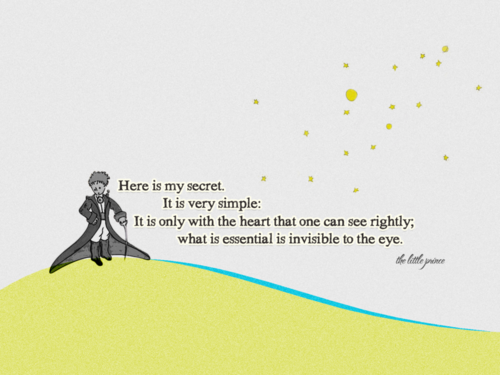
This is one of my favourite passages from “The Little Prince” –

It is only with the heart that one can see rightly; what is essential is invisible to the eye.

What can we do to create a world where more people can engage with an open heart, rather than through the debilitating lens of fear?

What would the world look like if we looked at it with the heart more than with the eye? If we gave more weight to the invisible? After all, the invisible includes the Self, subjectivity, consciousness, feelings, love, care, relationships and attention. None of those can be seen with the eye, or measured and presented statistically. None of those have easily defined borders or limits.

What would life feel like when lived with a more open heart?

Can love flow through a closed heart and a hardened mind?

I reckon it’s worth some consideration.

Read Full Post »

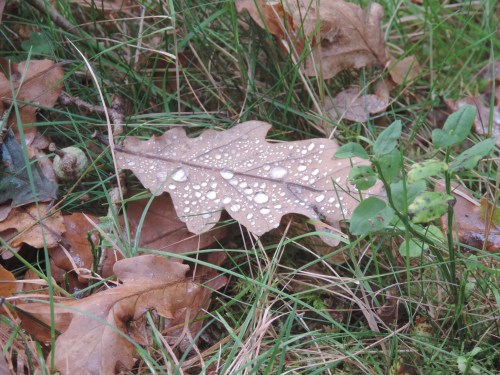
Something which always catches my eye and makes me stop to lean in and look closer is the sparkle of light on water.

Look at these little water droplets on this leaf on the forest floor. They are absolutely like little jewels. Each one lying perfectly on this fallen oak leaf, presented to me as if on a platter. Each one looks like one of those glass paperweights which draw you in so that you can look closely and see if you can see a whole world inside.

How do they form?

I don’t really know. I suspect these particular ones may have come from the rain, but they could have appeared with the morning dew. How does each one make such a beautiful shape, yet every one unique in size and place? How do they form exactly where they form? What is it about the ground, or the leaf, or that part of a leaf, which lets the water molecules coalesce like this, to make these shining beads?

I remember learning about water tension and how water molecules hold together to form these perfect surfaces, but what determines the size? Why are some so much bigger than the others?

The other thing I immediately think of when I look at these images is how it takes the water, the sun, and the forest to create them. I might be drawn to the sparkling droplets on the leaf, but it takes all three of these forces, or presences, to make them. Nothing exists in isolation.

The one closest to you in this photo (I mean the one which is lowest down in the image), hints at a whole world. Click on it and look as closely as you can. There is a forest in there.

No wonder people have long since been intrigued by crystal balls.

But, for me, is the added quality of transience which makes these jewels so beautiful. You can’t pick them up and put them in a bag. You can’t sell them or horde them.

You can only enjoy them exactly where they are in this short but present moment.

Read Full Post »

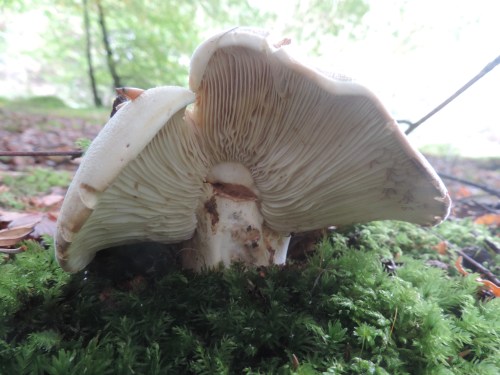
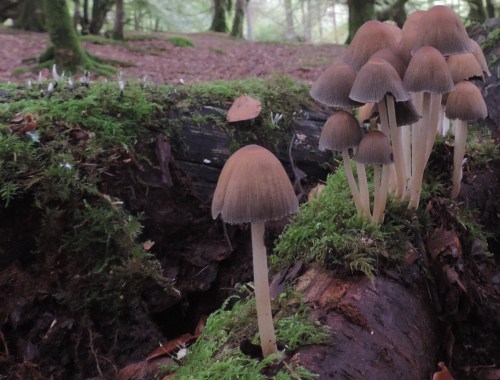
I don’t know about you but when I think of the different kinds of life which exist, first I think of animals and plants. After that, maybe bacteria and viruses. Somehow, I often forget about fungi.

Yet, fungi, are a kingdom of Nature all of their own. They aren’t like other kinds of life, and Life as we know it wouldn’t exist on this planet without them.

The best place I know to find fungi is a forest. Although, at certain times of year the grass in my garden is also a great place to find them. They always astonish me. They seem to appear suddenly, as if from nowhere, and they come in all shapes, colours and sizes.

They amaze me.

And that’s enough.

But there are two other, not so obvious things about them, which intrigue me. Like icebergs, there is a lot more to them below the surface than just the parts we see above ground. So they speak to the hidden, the invisible parts of Life. Secondly they network like mad. Fungi don’t seem to exist as individuals. They are hugely and extensively connected through vast webs of threads throughout the soil.

In recent years we’ve come to understand their significance in maintaining the health of forests. The term “Wood Wide Web” has been coined to describe the immense network of connections between bacteria, fungi and trees in the forest to move nutrients, water and even information around.

So, apart from their beauty, variety and curiousness (is that a word?), I find that fungi remind me of how interconnected ALL of LIFE is, here, on this one, small, shared planet.

It’s good to be reminded of that from time to time, because it applies to us as well, not just trees.

Read Full Post »

We like to be close to the edge, don’t we?

I think that the “call of the sea” is real. We are pulled towards the oceans. Are houses with seaviews the most expensive houses in any country? Why is that? Is it that the sea represents both freedom and adventure? When we look out across the water towards the horizon it is somehow incredibly appealing when all we can see is water and sky. We don’t need to glimpse any distant coastlines to feel drawn to the edges of our land.

It does seem as if the sea, itself, stirs our souls.

But I think there is another factor. The edge.

I am naturally drawn towards the edges. I love to walk along a beach, gazing at the far horizon, breathing in tune to the rhythm of the breaking waves. That constantly changing, dynamic, irregular, line which marks where the water meets the sand, and the sand meets the water.

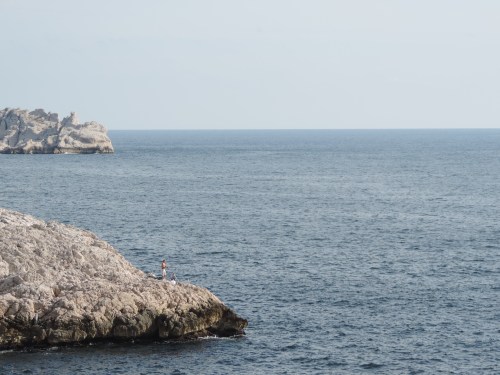
It’s the same with rocky outcrops. Just like the fisherman in the second photo there, we love to get to the edge (of course, he’s hoping to catch fish so if he doesn’t go to the edge, he’s not going to have much success!). But it’s not only the fishermen who like to stand, or sit, at the edge of a rock.

I wonder how much this instinctive attraction is due to a basic law of Nature – that all complex adaptive systems move towards “far from equilibrium” points? All living systems do. All ecosystems do. In fact, I think the concept of “steady state”, or “balance” misleads us. When I was taught about “homeostasis”, the idea that our “internal environment” has multiple checks and balances to maintain a constant inner state, I thought it made a lot of sense. I learned about all the feedback loops which kick in to ramp up or damp down activity in the body, to keep things ticking along in the “normal range”. But gradually I realised that was a bit simplistic.

The missing pieces included growth and adaptation, both of which are linked to creativity. That creativity manifests itself in “emergence” – the appearance of new behaviours and conditions which couldn’t have been predicted from the pre-existent ones. It manifests itself in novelty and difference. It manifests in growth, development, and maturity.

Once we start to understand that Life is based on a dynamic equilibrium – the kind of balance which never settles down – then we notice that everything tends to be drawn towards the edges.

It’s the same when we look at the activity of organs like the heart and the brain. The rhythm of the heart is constantly changing. You can measure the “heart rate variability”, and find that when there is next to none, the heart has become rigid, non-adaptive, and is about to fail. On the other hand, when you find that it’s chaotic, the heart is also about to fail. The sweet spot is the zone at the edge of both of those extremes. Same with the brain. When a seizure occurs the somewhat chaotic activity of the brain waves suddenly develop zones of constancy. It’s the imposition of rigid, regular wave patterns which seems to obliterate the underlying, normal, variable rhythms. The sweet spot, again, is in that zone at the edges of these two extremes – the zone between rigidity and chaos.

If we are going to learn from this pandemic we’re going to need new thinking, new ideas, different ways of living and organising ourselves. We aren’t going to learn if we try to “return to normal”.

The future is still to be invented, and we’re going to find it at the edge.

Read Full Post »

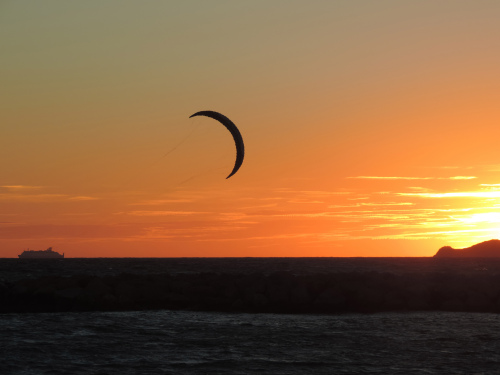
This is a photo I took a few years ago when I was visiting friends in South Africa. There were kite-surfers skimming across the sea, pulled at great speeds by the wind, as the sun began to set.

I’d never seen kite-surfing before and it was pretty spectacular. Quite something to use the power of wind and sea at the same time to experience the joy and freedom of movement.

On the horizon you can see the outline of a cruise ship.

During this pandemic all of these activities have been curtailed. It’s been quite a trauma for we human beings to have our freedom of movement taken away. We are the most social of all creatures with complex skills which enable us to establish bonds with others which enable us to create relationships and connections. We are able to read the emotions of others in their faces. We are fabulous copiers, learning from the actions, behaviours and thoughts of others.

We are also highly mobile creatures. I know there are many people who never leave the town or village they were born in, but over the centuries we have migrated from continent to continent. Every single one of us has ancestors around the world. If you were to try to draw out as complete a family tree as you could, following all the branches of siblings, cousins, and all their spouses and children, you’d end up with a giant web rather than a tree. I’d be surprised if that web didn’t span great distances. DNA analysis shows us that we all have threads which connect us to ancient peoples in distant places.

Sometimes I think we forget that. We become too insular, too separated. History, archeology and biology tell us a story of hyper-connectedness and mobility. We are ONE species and we have spread across the entire planet.

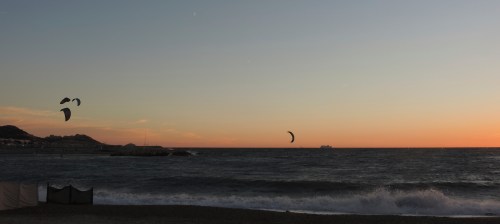
This second photo has a very pleasing symmetry for me. If you look very very closely, you can see a crescent moon at the top of the frame, which is echoed in the shape of the kite. This photo also shows that we social creatures like to do things together. The first photo might have led you to believe there was just one person kite-surfing, but you can see, from this one, that there are several (and in fact there were several more you can’t see in this frame)

I think these are two of our most precious values – our connectedness and our freedom of movement. It saddens me when either, or both, of these are constrained. I’m a fan of making connections and building relationships, and I’m a fan of freedom of movement.

Read Full Post »

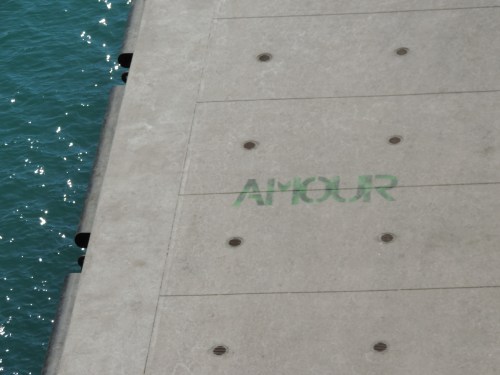
Many years ago I came across this stencilled graffiti on the ground in Marseilles. It struck me as very unusual.

First of all it’s stencilled, which gives it a kind of mass-produced appearance, and it’s been painted onto concrete slabs which people walk over.

Is it a declaration? Of somebody’s love for somebody else?

Is it an instruction? Telling us to love? (Probably not, because it’s a noun, not a command verb)

It is just a literal putting down a marker. Someone laying out an important value? Is it a prod? A stimulus to thought? A nudge?

It reminded me of the English DJ, John Peel, saying on the radio one autumn that he’d taken to carrying a marker pen with him when he went out walking, and from time to time he’d pick up a fallen leaf and write “Hello” on it, then put it back down on the ground. He liked to imagine that a stranger would be out walking, maybe feeling a little lonely, and they’d spot this leaf with the “Hello” on it and not feel so alone any more.

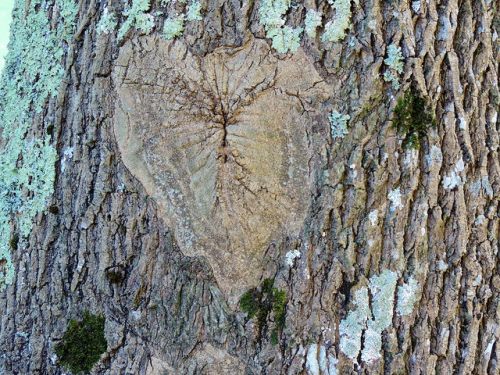
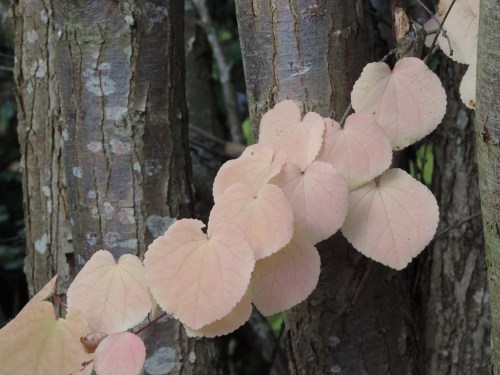
I’ve often noticed naturally occurring heart shapes, and they, too, make me think about love.

Whenever I see a heart shape I think of love, and I’m sure that activates the emotion of love inside me.

I wonder if I should take a leaf out of John Peel’s book, and the graffiti artist in Marseilles, and scatter prompts around the world.

Literally, spread those loving feelings.

Read Full Post »

I have a shelf in my bookcase where I collect some of the books which have made the biggest impact on my thinking and understanding. On that shelf sits a first edition of Iain McGilchrist’s “The Master and His Emissary”. If you’ve been reading these posts for a while you’re bound to have come across my references to his description of how our two cerebral hemispheres engage with the world in different ways.

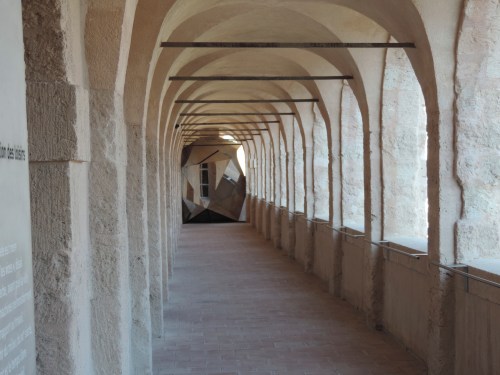
When I came across this old photo from Marseilles the other day I immediately thought of the “left brain” view of the world. The left cerebral hemisphere is utterly brilliant at focusing in on whatever we are considering. It helps us to see the trees in the wood. It picks out elements, features, characteristics or parts. Then it helps us to analyse, label and categorise whatever it is that can be recognised.

It needs to have a narrow focus to be able to do that. It zooms in. It hones our attention. It separates and abstracts by blanking out the connections, the contexts and the environment.

This long corridor of arches looks very much like that kind of focused attention to me.

But there’s more. At the end of this passageway what do we see? It’s kind of hard to make out, isn’t it? What you are looking at here is an installation of irregular, angled mirrors. So you aren’t seeing a complete picture. Rather you are seeing a number of disconnected views or parts.

Our left brain is pretty good at doing that too. Its preference is for the parts, not their connections.

How the brain is supposed to work is that the after the left side does this focusing, separating, labelling and categorising, it’s supposed to pass this information back to the right side to have it contextualised. In other words, after seeing and recognising the pieces, the left passes over to the right to recreate the whole picture, to help us to understand whatever it is we’ve “grasped” by seeing how it connects to everything else.

Iain McGilchrist’s thesis is that this natural flow has become rather disrupted. The left brain has a tendency to hang on to what it grasps, and to convince us that whatever it has analysed is “correct”. Over the centuries we’ve evolved a complex society and civilisation which has encouraged us to prioritise the left brain over the right.

That’s a big mistake. That’s only using half a brain. To rectify this we have to learn how to use the whole brain again, and to practice doing that as often as we can. That’s going to involve deliberately returning again and again to the right brain functions – seeing the connections, discovering the particular, appreciating the whole, and weaving together the multiple threads to enjoy the entire tapestry of the world.

I don’t know about you, but that excites me!

I love that this idea is not about abandoning our left brain functions but re-integrating them into the right brain ones. How satisfying!

Read Full Post »

Looked at from a certain perspective, a particularly narrowed one, it can look like we live alone. It can look like we are unconnected. It can seem as if we are separately autonomous and independent. Such a view is consistent with a model of society which looks to “great men” and “great women” to lead and succeed. The “champions” of society look like they get to the top all by themselves.

But is the world really like that?

Does anyone “succeed” all by themselves? We are social creatures, we humans have evolved to survive and thrive through co-operation and collaboration. We all “stand on the shoulders of giants”, in that we all enter the world helpless and dependent. We wouldn’t make it to adulthood without many other people looking out for us, supporting us, nourishing, nurturing and protecting us.

One of the features of this pandemic has been a theme of gratitude to “essential workers”, not just health and care staff, but producers, transporters, cleaners and food shop staff…..the list goes on. Why does the list go on? Because we all live in this vast interconnected, interdependent web of society.

“No man is an island” – and no island can exist in isolation. It turns out we really are all part of one huge team.

But wait, I hear you say, isn’t competition the engine of Life and Evolution? Didn’t Darwin show us that?

Aren’t there always going to be winners and losers?

I think it would be naive to deny the reality of competition. It’s just that I think we’ve way over-emphasised it, right up to the point that we in danger of deluding ourselves into thinking only individuals can win, and only “the best” individuals at that.

But think for a moment of any award ceremony, whether in sport or the arts, who do the winners thank? Just themselves for being so brilliant and managing to rise to the top with only their own talent, power and fabulousness?

No, they don’t. They, often very tearfully, thank a host of people. At our best we know we achieve what we achieve within a vast, interconnected web which sprawls through time and place.

The latest developments in evolutionary science tell a different story from the old “survival of the fittest” one. They tell the story of the most socially developed, collaborative, co-operative species on the planet – Homo sapiens.

Maybe this would be a good time to shift our emphasis and our priorities, from individualism and competition, to kindness, care, compassion and co-operation.

Read Full Post »

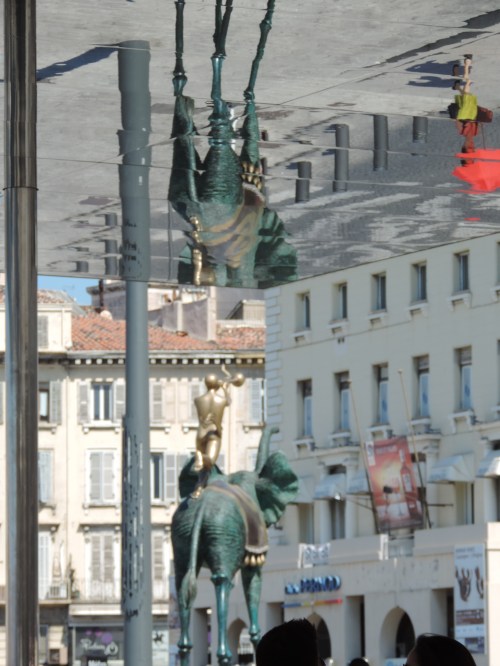
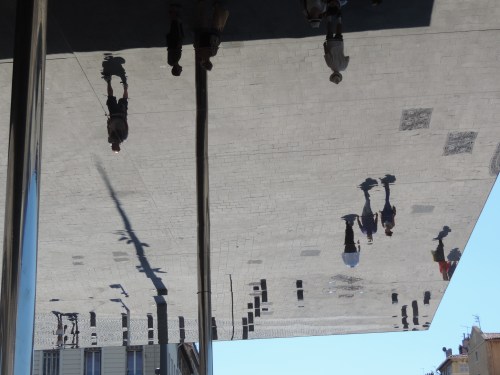
At the port in Marseilles there is a hug mirrored roof over an open area. It provides people with some shade, but also attracts people to gather underneath it and look up – to see the world upside down.

Looking at the world upside down can be very revealing.

Think about this current pandemic. We are told there is this COVID-19 virus sweeping across the surface of the Earth, seeking out victims to slaughter. Several governments have used war metaphors accusing the virus of being an invisible, cunning and evil enemy. The answer, if this is your perspective, is to “beat” the virus, to “crush” it, “flatten” it, or “eliminate” it.

In the absence of treatments which kill the virus, the authorities pin their hopes on better defence – by which they mean immunisation – a mass vaccination programme to increase each individual’s ability to “resist” infection by this particular virus.

But, what if we turn our view upside down? What if we look at ourselves instead of the virus? Who gets sick when they catch this virus? Mainly the elderly, those with ongoing chronic health problems, the poor, and ethnic minorities. Why can’t either Public Health or the hospital services prevent the deaths of tens of thousands? (I mean reduce the number of actual deaths, not save the lives of an imaginary number who haven’t got sick)

What if we addressed these problems by making them the central target of our efforts? That would need our societies to deal with inequality, poor and overcrowded housing, poverty, low waged precarious contract work, racism and discrimination, under-resourced health and social care. We would need to invest in the creation of resilient well-resourced Public Health services including laboratory testing, contact tracing and the supply of safe place, supported isolation of the infected. We would need to invest in the resources of the clinical health services to have enough beds, nurses, doctors, equipment and personal protection for staff. We would need to address under-staffing in the health and care sectors so that too few workers didn’t have to look after too many people in too many different locations, so spreading the virus.

In other words, if we look at this pandemic from an upside down view, we might avoid future pandemics by creating healthier, more resilient, stronger societies…..no matter what the next virus is.

OK, I’m sure you’ll be thinking “but we need to treat all the sick, kill the virus which is overwhelming them, and reduce the current spread through hygiene and distancing measures”. All probably true. But none of those measures are enough. Remember my favourite phrase?

“And not or”.

We need to do both. Treat the sick, try to reduce the spread of the virus through the community, AND deal with the problems in society and the economy which have made us this vulnerable in the first place.

Sometimes it helps to add the upside down view.

Read Full Post »

« Newer Posts - Older Posts »