Feeds:
Posts
Comments

Archive for the ‘photography’ Category

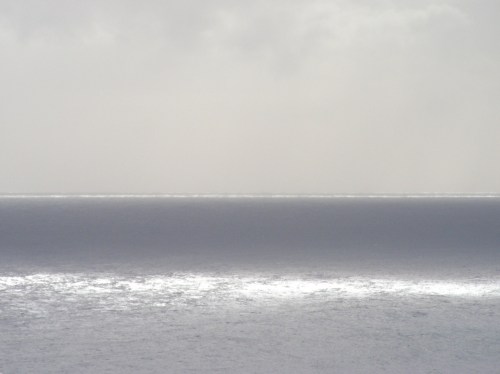
I love this photo, yet it’s probably one of the simplest ones I’ve ever taken.

You can look at this and, at first, think, “grey sky over grey sea”……so, what?

But look more carefully and you notice a fairly significant band of bright water created by the sun shining brightly on it, and the first thing I think, is, how interesting…..why such a narrow band of light? It’s pretty linear and it doesn’t seem to be related to a particular wave. The sky above looks so overcast I can’t see why only a slit of sunlight has appeared here.

Next, I look to the horizon. I’ve got a few photos like this where I capture just an expanse of sea and sky with an almost imperceptible edge where they meet each other, but in this particular photo, because the predominant colours are grey, the transition from sea to sky is even more subtle….except, wait, hang on, there is another bright, white band of sunlit water running across the entire view just immediately before the horizon!

What’s that about?

How come there are TWO bright, linear bands of sunlight, miles apart, with, apparently no other ones in-between?

That fascinates me and draws me into a longer, slower contemplation of this scene.

I looked at this image again this morning as I sat down to post this and I thought “less is more”.

There are very few distinct features in this scene but that minimalism somehow creates time and space.

It stops me.

I don’t rush on by, hurrying on to the next image, the next text, the next event, or whatever.

I thought, well, that’s a bit like this time in the world where the pandemic has brought the everyday hustle and bustle to a screeching halt. Millions of us have been at home for several weeks now.

Has that ever happened before? Not as far as I know.

One common theme which is emerging in the stories these days is of time slowing down, of routines, habits and tasks, melting away, and of small everyday experiences taking on a new significance and new quality. How many people are saying they hear more birdsong? I’ve never heard so much birdsong, and I’ve never heard such diversity of birdsong either. How many people are noticing blossom, flowers, sunrises and sunsets, the Moon?

This pared back life won’t last like this forever, but one of the most positive aspects of this time, for me, is an enhancement of what I value so much – “l’émerveillement du quotidien” – the wonder of the everyday.


Read Full Post »

What do you think when you look at these lemons?

Do you think some of them look lumpy and ugly? Does it bother you that some of them are really small, and others really big?

I think they look beautiful. I love their diversity. The fact that some are very nobbly whilst others are smooth fascinates me. I love the shades of yellow and green in their skins. I adore seeing the small ones cradled amongst the large ones. I’m fascinated by their shapes.

In this one basket you can see that every single lemon is unique.

It’s harder to see uniqueness if the producer, or merchant, sets standards with a narrow range, stipulating limits on the degree of diversity he will accept.

The practice of setting “norms”, “standards” and narrow expectations tends to obscure uniqueness, but uniqueness is still the essence of reality.

Diversity reveals uniqueness to us.

It shows us that every single lemon, every single flower, every single creature, every single human being is unique. Each one comes to life at a particular time in a specific place. Each one has its own unique experiences as it grows….experiences differences in weather, climate, interaction with other forms of life.

I think we humans have obscured the fact of uniqueness in two ways.

Firstly, through “mass” anything….from mass production to mass consumption. A focus on the mass blinds us to uniqueness.

Secondly, we tend to confuse “individuality” with “uniqueness”.

We all want to be treated as individuals, don’t we? I know I do. But a focus on individuality carries a danger of fragmentation. It separates us. Mary Midgely, the English philosopher wrote about the phenomenon of “atomisation” very well. She warned of the dangers of failing to the see the whole when we examined something only in its parts, or its “atoms”. And, in particular, she objected to the neoliberal idea that there is no such thing as society, that the best way to structure a society is for everyone to pursue their own selfish interests in a free marketplace. Those ideas have destroyed communities.

I don’t want to be “just an example of a group”. I don’t want to be treated as “just a number”, as a statistic. I want to be seen, known and treated as an individual. How do I square that circle? By focusing on uniqueness.

Our individuality is often defined by listing our differences from others, our separateness from others.

But our uniqueness combines our differences with our commonalities.

How so?

“No man is an island”

I don’t exist separate from something called Nature. I don’t exist apart from something called The Earth. I don’t exist disconnected from other human beings. I don’t exist separate from other forms of Life.

It’s taken the universe 14 billion years to make YOU. It’s never created YOU before. It will never create YOU again.

“Be yourself, everyone else it taken”

When you meet someone, when you make a new friend, when you get together with your family, you tell your story. You tell the story of where and when you were born, of the events and experiences of your life and how they shaped you.

That story is unique.

Just like everybody else’s.

It’s the circumstances, the contexts, the environments, the specifics of time, place, and experience which create our uniqueness, and the uniqueness of our story.

As a doctor, nothing gave me greater delight than to have the privilege of hearing unique human stories every single day of my work.

I love diversity.

I love uniqueness.

I find it beautiful.


Read Full Post »

I took a lot of photos from my windows when I lived on the edge of the village of Cambusbarron. Most of them looked out directly towards Ben Ledi. I never, ever ceased to be entranced by that view. It changed every day.

Of course, you’d tell me a mountain doesn’t change. At least, not visibly on a daily basis. But, look, this is typical of my idea of “Ben Ledi”. I never saw Ben Ledi, the mountain without any sky around it. I never saw it without the light illuminating it in different colours. I never saw it without the clouds casting shadows on it. Well, maybe there was the odd day when there were no clouds at all, but only rarely, and, even then, the light and colours changed constantly.

So, for me, whatever I look at, I see it in its contexts, its environment. I see its situation. I see the interplay of all the elements in the frame of my gaze. And then…..

….then I “see” it with my heart. I feel the emotions arise within me, shaded by memories and imaginings, coloured by symbols and significance.

When I look at this particular photo, I am in awe very quickly. I see the black hole darkness of the clouds which loom over the top third of the picture. I see how that darkness frames the sunlit mountain with the dark earth below. It’s almost like looking through a letter box. Looking through a letter box to see what the universe is delivering today.

I see the familiar shape of Ben Ledi, like a sleeping giant, an ancient ancestor of the elephants, perhaps.

I see the intensity of the sun peeking out along the edge of the cloud base, and how it lights from behind the low cloud or mist which sits at the foot of the mountain. Lights that low cloud so that it glows, not with a silver lining, but a golden one.

I see some of that low cloud rise up in the shape of dragon, looking towards the mountain….flying home, perhaps?

I see Ben Ledi, that great mountain, cradled in soft clouds, gently glowing with the sun’s golden light. Wrapping it in ephemeral, constantly shape-shifting cloth.

I see the life bringing energy of the Sun illuminating the Earth.

I see the life giving water of the sky kissing and caressing the Earth.

I feel calm.

I feel comforted.

I feel delighted.

I feel the stirring of my Soul.

Read Full Post »

When I noticed this tree in the forest I thought it had a long deep groove running the whole length of its trunk. It was as if it folded in on itself. But then I looked more closely and I saw that a better explanation was that there were two trees growing together. You could trace two distinct trunks all the way up, each spreading its own branches high above the forest floor.

I was even more taken with this when I saw it as two entwined, two organisms, two life forms, living, surviving and growing together. It reminded me of the myths of the soul….that each of us is in search of the other half….each of us longing for our soul mate.

But maybe I’m wrong. Maybe this is one tree which has partially divided itself…..partially, but not completely, so that now it appears as almost two trees instead of one. But does it really matter? Do I care whether these are two trees living intimately together, or one tree manifesting two clearly visible aspects of itself?

The first idea stimulates my thoughts about how important relationships are. It makes me think about how I can’t fully understand anyone, or any thing, in exclusion from its relationships. We are all embedded in vast networks of other people, other creatures, plants, micro-organisms, elements and molecules. We all come into being through a process of emergence within those networks. We all survive and thrive only because of those relationships and networks.

The second idea stimulate my thoughts about our multiple selves. I’ve never been able to understand anyone, including myself, by reducing them to a single, solitary self. Miller Mair’s “Community of Self” really impressed me. It struck me as true. I know a distinct self as a doctor, which is quite different from, yet completely connected to, my self as a parent for example.

A homeopathic doctor in Paris once told me he saw every patient as like a diamond, with different facets glinting in the sunlight. Each facet represented an aspect of that person. That impressed me too.

Then, much later, I read the works of the French philosopher, Gilles Deleuze, and his focus on “a multiplicity of singularities” seemed to me to be saying the same thing, just in a different language.

We are all multiple.

We are all a complex of multiple, distinct, unique “singularities” – both within ourselves, and within our world.

We are all One.

Read Full Post »

I love the concept, and the phenomenon, of flow.

Look at these grasses below the water. You can easily tell that the water is flowing strongly and making them all point in the same direction. You can even see the water. But you can’t see the flow.

It’s like when I’m in the garden. It can be a cloudless, blue sky day, or a grey, cloudy day, but at around 4pm I will feel the wind start to blow on my face. I’ll hear it rush through the trees, shaking their branches and rattling their leaves. But I can’t see it. I can’t see the wind. Just the effects of the wind.

Flow is like that. It’s an invisible force made visible by the way it shapes the world.

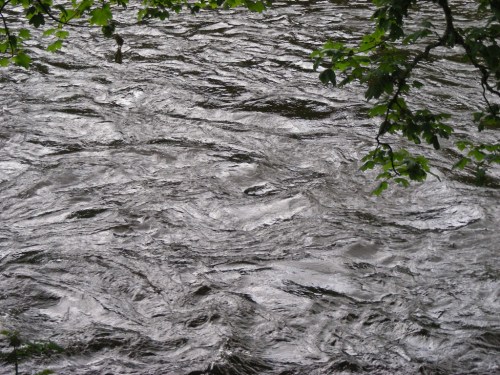
Look at this river. You can tell that it, too, is flowing fast, can’t you? There aren’t any rocks sticking up for the water to foam against but you could swear you can see the currents. Beneath, through, within, the water, is the flow.

We are like that too. We human beings. Life flows through us, shaping us, bending us, pushing us on, encouraging us, driving us onwards. Life flows through us making us grow, mature and develop.

It doesn’t help to resist that flow. Well, that’s not completely true, is it, because there is something in response, in reaction, which is a kind of resisting, a kind of pushing back on, leaning into, or standing against, which shapes us.

Flow doesn’t have a starting point.

Flow doesn’t end.

Flow is.

Many years ago, as I walked to the train station one day on my way to work, I came across an excellent example of how to respond to flow –

Surf it!

Read Full Post »

Every time I look at this flower it makes me think of a hand, with the palm turned upwards, and the fingers curved upwards.

At first glance that looks like a grasping movement. As if the fingers are about to enclose whatever they touch. This is the essential function of our left cerebral hemisphere. It literally allows us to grasp things. It controls the right side of the body, and, in right hand dominant people that’s the very gesture we make when we trying to get a hold of something. We curl our fingers up and make a fist….not so much the kind of fist we’d use to fight with, but the kind of fist we’d use to hold something tight. So, this is how we “get a grip”, how we “get a hold on…” something.

This grasping or gripping is a kind of understanding, isn’t it? Once we say we grasp something we are able to say we understand it. We make sense of it. And once we get a grip, we get hold of something and control it, or possess it.

But what if the movement of the petals, and so the fingers, is in the opposite direction?

What if, rather than curling up to make a fist, or to grasp, the fingers are opening?

What then? How does that feel different? Try it now for yourself. Turn your hand, palm upwards, and make a fist. Now relax your fingers and thumb and allow them to open up the way the petals of a flower unfurl and open up. How does that feel?

It’s quite different, huh? As we turn our hand into a crucible, or a cup, of offering, it feels as if we are seeking to connect, gesturing to say to someone, or to the world, “here you are”, or, alternatively, that we are ready to receive.

Two gestures, one of grasping, one of offering – offering to connect.

Both are necessary, of course, but maybe this is a time for more offering, less grasping?

Read Full Post »

One evening this week, at sunset, the sky was glowing. I went outside into the garden, as I often feel compelled to do at  sunset (as I write that I think of the scenes in “City of Angels” where the angels gather on the beach at dawn….guess I’m an evening angel!).

This is what I saw.

As I looked up across the vineyards to the top of the hill I could see the silhouettes of vines and trees – there are a lot more vines than trees around here! I zoomed in with my camera and framed this shot.

I love this.

It delights me. I find it calming, soothing, and comforting. There’s a single tree, which makes think about how we are living our separate lives now. But it doesn’t strike me as lonely. Maybe that’s because I know no tree exists in isolation. Even when there are no other trees nearby, it is intimately and massively connected to the environment in which it lives, with roots stretching out widely and deeply, constantly exchanging nutrients with millions of other organisms.

I see a tree like this and think how connected it is to the four elements –

Earth – with deep, wide root systems

Air – to collect carbon dioxide and breathe out oxygen

Water – captured from the air, the rain, and the soil

Fire – directly turning the Sun’s energy into power to break down the carbon dioxide, build its physical structure of trunk, branches, leaves and roots, make sugars, and pull nutrients up from the depths.

This tree, this vineyard, this sky, this world GLOWS.

We are all intimately connected.

That delights me.

Read Full Post »

Why does the Moon fascinate us so much?

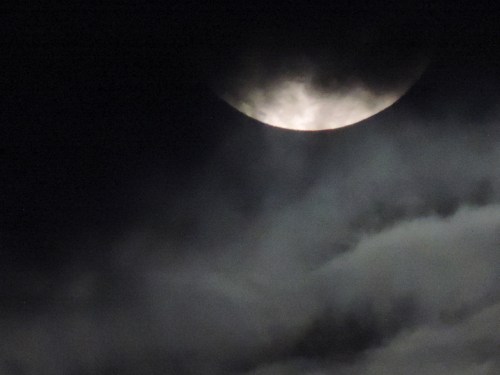
This recent full moon has been a particularly bright one, shining its white, white light across the countryside. It pulls me outside to gaze at it. I love to look directly at it, seeking out the shadows, forms and craters on its surface, recalling the old childhood stories of “the man on the moon”, seeing a face there.

It’s such a different light from sunlight. Well, of course, because sunlight comes directly from the Sun, and moonlight is sunlight reflected. I think that’s part of the Moon’s mystery for us. I’m often attracted to the sight of something which is lit by the Sun but where the Sun is implied. I know that the light I am looking at is coming from the Sun, but it looks like the object is radiating light itself.

Here are a couple of examples.

These white petals, and even the bright green stalks look like they are glowing from within.

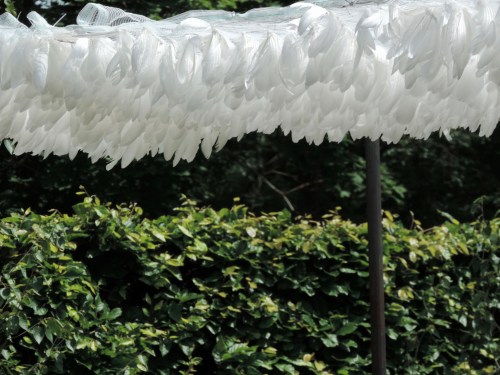
These white feathers, too, look like a glorious lamp with the light at its core softened by the feathers themselves.

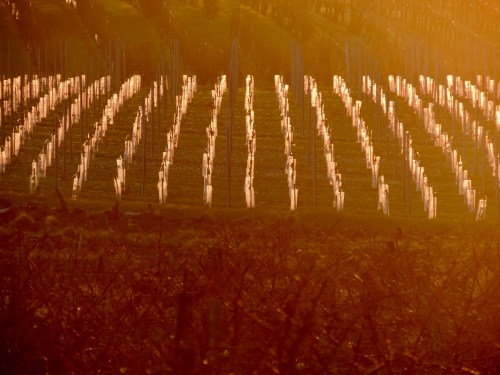
This is a young vineyard where each new vine is protected by a plastic case. When the sun is low in the sky it looks like a field of lamps, or candles lit to remember the sun by.

But it’s not just about the light.

We become familiar with the phases of the Moon at an early age, and whilst a lot of city dwellers can’t even tell you what phase the moon is at tonight, maybe in this time of pause and retreat, more of us will be aware of it. Maybe the skies are even clearer now, so the Moon will be more visible.

Because we are familiar with the progression of waxing and waning, of full moons, crescent moons and new moons, whenever we see the Moon I think we have some anticipation. We see a particular shape and we know it’s about to change.

We know that as small slivers of the moon appear, more will emerge, more will fade, and the cycle will, reassuringly repeat.

The Moon is one of the most tangible examples of the cyclical nature of time and Nature.

We know that, every single month it will appear to us in its fullness, and in its crescents.

I don’t know about you, but that, for one thing, is somehow deeply reassuring.

It’s a rhythm I can see with my eyes, feel with my heart, and think about with my mind.

I know…..there’s a whole lot else to consider here. I haven’t even touched on the influence of the Moon on tides and our internal body fluids. Nor have I explored the myths and stories.

But maybe I’ll leave that to you……..

Happy exploring!

Read Full Post »

Last night as I was sleeping,

I dreamt – marvellous error! –

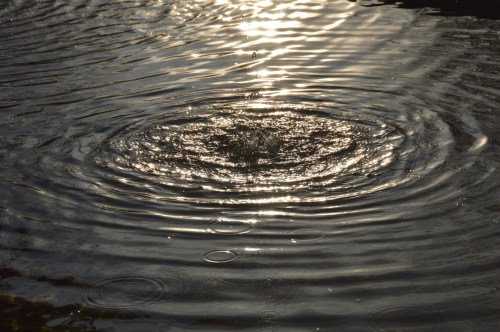
that a spring was breaking

out in my heart.

I said: Along which secret aqueduct,

Oh water, are you coming to me,

water of a new life

that I have never drunk?

Last night as I was sleeping,

I dreamt – marvellous error! –

that I had a beehive

here inside my heart.

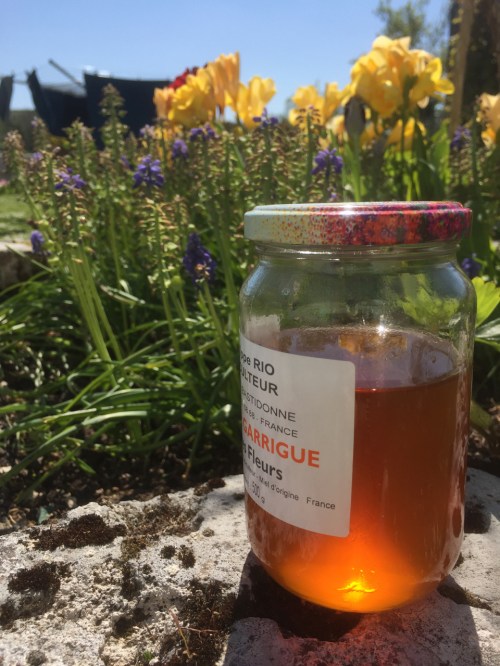
And the golden bees

were making white combs

and sweet honey

from my old failures.

Last night as I was sleeping,

I dreamt – marvellous error! –

that a fiery sun was giving

light inside my heart.

It was fiery because I felt

warmth as from a hearth,

and sun because it gave light

and brought tears to my eyes.

Last night as I slept,

I dreamt – marvellous error! –

that is was God I had

here inside my heart.


Last Night As I Was Sleeping, is a poem by Antonio Machado (this translation from the original Spanish is by the poet, Robert Bly). I’ve decided to return to an exploration of poetry during this strange time in our world, and have started by reading “Ten poems to change your life”, by Roger Housden. The first poem in the book is The Journey, by Mary Oliver, and the second one is this one by Antonio Machado.

Roger Housden, who says, of Antonio Machado, “He lived a plain and simple existence, much of it as a country schoolteacher. What mattered to him was the deep current that joins the human soul to the world. What mattered above all to him was to be awake to that deeper life.”

I love the images in this poem, starting with the spring of fresh water breaking out in the heart. “The origin of the spring is not in your own heart; its waters are carried there by some secret aqueduct from a source beyond all your knowing”.

Then in the next verse he talks of making sweet honey from our old failures. What a nice variation on the “when life gives you lemons make lemonade”!

The next image is of the sun shining in his heart. Roger Housden says “Machado becomes the source of his own warmth and light”.

In the final stanza where Machado dreams of God in his heart, Housden says “He dares to leap over metaphor altogether and say directly what he has been inferring all along: you are own source, drink from your own well, live by your own undying light……..the light of the world that streams through your life….”

I found that as I read it various of my own photos came to my mind so I thought I’d collect them together here with the poem. What I really love about this poem is that idea of the flow of Life pouring through the depths of our being and found by looking at what we have in our heart.

Read Full Post »

Suddenly everything was different!

Oh really?

Like “it came out of nowhere”?

Change isn’t like that.

Everything that happens emerges in the present out of the past and in the light of the possible futures.

Most change actually happens slowly.

Look at this leaf turning red. You can stand and watch it for a while but you’ll be hard put to see it actually turning red. Then one day, you notice it and, wow! it’s turned red!

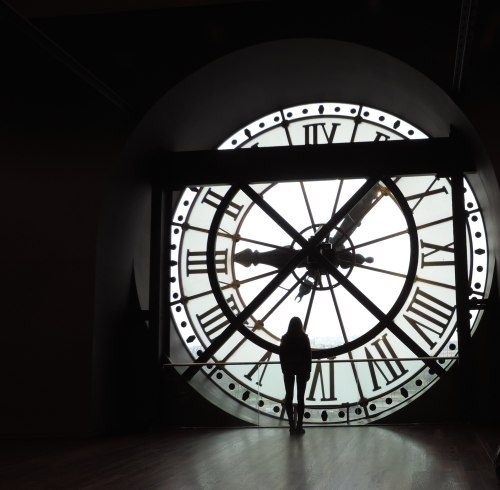
It’s like when you stand and look at the clock and try to see the minute hand moving. Such a different experience from looking at the clock, noting the time, then absorbing yourself in a good book, looking up at the clock and thinking “It’s that time already??!!”

Sometimes I think we have an idea that we humans are separate from this world. That we just popped up fully formed one day. That we are separate from Nature. That Nature is something outside of us. But it isn’t.

We emerged within Nature as a wave emerges on the surface of the sea.

The wave appears, then it disappears. It never leaves the sea.

So, what’s all this got to do with where we find ourselves today in the midst of this pandemic?

Here’s the thing. This pandemic didn’t come from nowhere. It emerged.

It emerged, embedded in the physical, social, cultural, economic, political world in which we live.

I’m not a fan of all the war metaphors. This is not a deadly enemy out to beat us. And even if we “conquer” it (whatever that would look like), like buses, there’ll be another one along shortly.

I think it would be good to look at the bigger pictures.

How do we act in relation to each other?

How do we act in relation to other forms of life – the animals, the plants, the insects and the micro-organisms – none of whom we could live with out?

What if we shifted our emphasis away from competition towards collaboration?

What if we shifted our emphasis away from control to adaptation?

What if we shifted our emphasis away from consuming to helping?

What if we shifted our emphasis away from parts to wholes?


Read Full Post »

« Newer Posts - Older Posts »