Feeds:
Posts
Comments

Archive for the ‘psychology’ Category

bell rope

In my monthly themes, December is the month to focus on gratitude.

I know, for many, your thoughts will be turning to gifts….what to give and what you hope to receive. I just wonder how your choices might be affected by keeping your focus this month on gratitude. Maybe then ever gift you give will demonstrate, somehow, something of the gratitude you feel towards the recipients of your gifts.

Many studies have show benefits, in terms of mental and physical well-being, which emerge from the practice of gratitude.

Have you ever thought about starting a “gratitude journal“? This might be a really great month to try it out.

Even if you don’t want to start a gratitude journal, why not take the opportunity of December to focus on gratitude anyway? Who do you want to say thank you to? Go ahead, tell them. What do you feel grateful for? Take a moment to think about exactly what it is, and to allow yourself the full benefits of feeling that gratitude swell in your heart as you contemplate it.

Or maybe you’d like to create, or participate in, a ritual of gratitude?

There’s certainly no single, only way to focus on gratitude, so explore a few ideas, and see what works best for you.

Read Full Post »

The other day I watched Elizabeth Gilbert’s TED talk about genius.

She recounts how the ancient Greeks had the concept of a “daemon” which would communicate the great ideas and creative breakthroughs from the gods. The Romans adopted this concept but used the term “genius” instead.

The really interesting thing about this concept is that inspiration came from somewhere “out there” – whereas nowadays we tend to think that it is entirely up to us. She tells several stories of artists who experienced inspiration as coming from “out there” somehow and how the artist’s job is to turn up and do their work every day in order to give the “genius” a chance to deliver something.

I think this is a really interesting perspective. It doesn’t lessen the need to be disciplined and to do the work, but it also allows the artist to be a little kinder to themselves, and to know that not all “genius” resides in them. Potentially this could make an artist more humble….if they truly believed that their creations weren’t entirely their personal brilliance.

For me, this makes me think of two things.

First, we all live “on the shoulders of giants” – we all emerge from all that is and all that has existed before. I start at this point in human development, at this moment in the emergence of consciousness in the Universe. I don’t exist in a vacuum. I don’t exist in isolation. My relationships with other human beings now, and other human beings in the past, will, and do, influence what I write, what I compose, what I create. In that sense, at least, inspiration will often turn up from one of those sources.

Second, the idea reminds me of Rupert Sheldrake’s idea of memory. He suggests we think of memory not as a filing cabinet in some part of our brain cells (in fact no “place” in our neural structure has been discovered to be the repository of any specific memories), but instead, we should think that everything that happens, every thought we have, every word we express ripples out into the continuous web of the universe and remains there. To access a memory then is more like tuning in to a radio station than looking in a filing cabinet. He suggests the “store” as such is “out there” and we can tune in to it to access the specific memories. Now, I’m sure that is a very controversial idea and not one which has been even remotely proven, but there is an interesting one in the context of the old ideas of the sources of inspiration, don’t you think?

Here’s her talk in full


Read Full Post »

barometer

In the second part of the A to Z of Becoming, V stands for the verb “vary”.

I found this photo of an old barometer in my collection and it really captures something about the natural function of variation. A barometer is pretty constantly moving, responding continuously to the rising or falling of the atmospheric pressure. I’ve always thought it quite funny that one of the words on these old barometers is “variable” because I tend to think, when it comes to weather, when is anything other than “variable”?! But then, that’s probably down to my experience of living in Scotland for 60 years! I’ve never lived in a country where the weather is the same, day in, day out.

The truth is Nature is constantly varying because all of Nature is a dynamic phenomenon. And the Universe so loves diversity!

But there’s an interesting aspect of human experience, which is “tolerance”. All of our sensory systems have a tendency to tolerance. That is, when something new comes along we notice it, but once its been there for a bit, we stop noticing it. How often have you had the experience of suddenly becoming aware of a noise just when it stops?

Not quite the same as tolerance, but in some ways related, we also tend to move to the “back of our minds” the routines of our lives. This can lead to living on auto-pilot (or as I say in this blog, living like a zombie).

It’s good that a lot of things are dealt with on auto-pilot. What on earth would life be like if we had to think about every breath we take, if we had to initiate every beat of our hearts, if we had to actively, consciously digest all our food, and so on…..? What on earth would life be life if we had to be consciously aware all the time of every single sensory signal our body picks up, second by second?

But the problems come when we default our whole lives to auto-pilot. What happens then is that we tend to just keep repeating the same behaviours, having the same thoughts, feeling the same feelings, and, ultimately, neither making choices, nor creating any life anew.

So, it’s also good to disrupt the default, to break the routines, and raise our conscious level to higher state of awareness.

One way to do that is to vary something.

Walk a different way to work. Choose something different for breakfast. Read a different newspaper. Deliberately introduce a variation to your “normal” habits.

Go on, try it. Vary some things this week and see what that feels like.

Read Full Post »

In the second part of the A to Z of Becoming, R stands for Relish.

Relish is an interesting verb. To relish something you need to be absorbed in it, to be captured by it, to be very present and aware so that you are fully experiencing it.

You might relish a simple food, like this bread or fruit……

plum and bread


Or you might relish a complete experience…..(this next photo shows table set for lunch at Jordans Wine Farm in South Africa. The style of the restaurant, the view through the window, the delicious food and wine, and the great company of dear friends…..all go towards making this an experience to relish


photo


Whatever you relish this week, one thing I guarantee will enhance the experience, is to slow down. Take your time……..


my new motto

This is my new motto (I saw it on a wall in a village in France) – translated into English it says “Gently in the morning, not too fast in the evening”.

So, find something to relish this week – sink into the experience, absorb yourself in it, savour it, enjoy it….RELISH it!

Read Full Post »

Autumn leaves

Hugs

heart in the keystone

I find Plato’s three “transcendentals” of Beautiful, Good and True a very fruitful concept to explore. When I first read about “integral theory” I was very taken by Ken Wilber’s four quadrants of the single-subjective, plural-subjective, single-objective and plural-subjective, and really liked the way the beautiful, the good and the true could be mapped onto that. (read a little more about that here)

Yesterday as I was looking through my photographs of autumn leaves I was enjoying finding the ones I considered to be the most beautiful.

The day before I was listening to a radio discussion about fairness. The concept of fairness seems to be innate, and the panel discussed a video of an experiment which seems to show how fairness is indeed innate in primates.

Last week I was struck again by the observation that most people seem to visit a doctor to make sense of something. In the Medical World, we refer to that making sense as ‘diagnosis’, and I’ve long since preferred to think of it as an understanding. Making sense of a pain, an itch, a dizziness, of anxiety or whatever, involves the co-creation of a credible story by the doctor and the patient working together.

As these three strands came together for me this morning, I got to thinking of the beautiful, the good and the true once more and two things occur to me.

Firstly, all three of these qualities are dynamic and relative. None of them are fixed. And none of them are universal at the level of the individual or particular. What is beautiful to me, might not be experienced as beautiful by you (on the other hand, we might agree!) And I don’t see beauty as a category either – at least, not as a yes or no kind of category – not as an either/or way of thinking. It’s not a box to tick.

Secondly, for me, I think the Good has a strong element of fairness. We tend to think of Justice as being about fairness, and it strikes me that I can ask myself how fair my judgements and actions are, as a way of considering how good they are. I do also think that the quality of integration is a key characteristic of all complex adaptive systems i.e. all living organisms, so an action or choice is better if it is more integrative (if it increases the mutually beneficial bonds between the well differentiated parts)

Thirdly, I see Truth as being about sense making. In some ways, the sense I make of my experience is the truth of it.

So, my current exploration of the beautiful, the good and the true, centres around wonder (émerveillement), fairness and integration, and sense-making.

I discover beauty through wonder. I am motivated to promote fairness and integration in the world. I make sense through the creation of narratives.

Read Full Post »

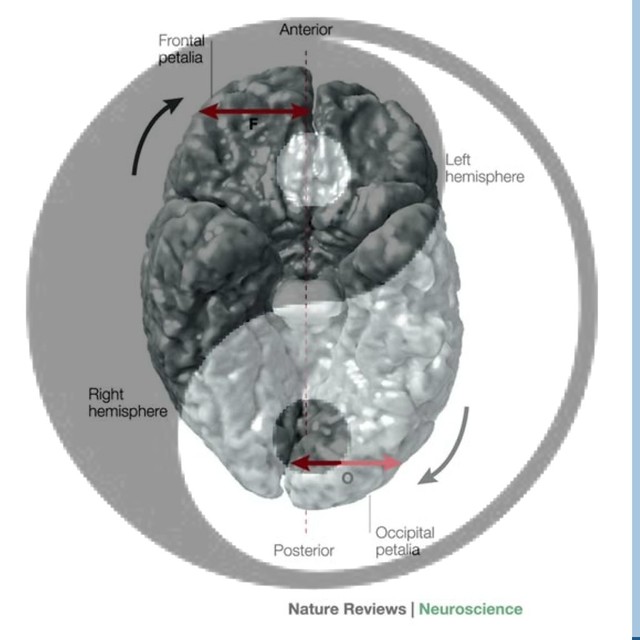
left hemi right hemi

In “The Secret Life of Pronouns”, the psychologist, James Pennebaker discusses two different kinds of thinker – categorical or dynamic. I hadn’t heard of this distinction before but in the briefest of nutshells –

A categorical thinker is someone who tends to focus on objects, things, and categories. The opposite end of this dimension are people who are more dynamic in their thinking. When thinking dynamically, people are describing action and changes

That sounds very familiar to me. In fact, its got a lot in common with Iain McGilchrist’s left and right hemisphere approaches to life. The left hemisphere RE-presents reality to itself, labelling, listing, naming, categorising. Whereas the right hemisphere focuses on what he calls “the between-ness”, connections, relationships, or the whole.

For the last few months, I’ve been sharing on this blog a series of posts under the title “The A to Z of Becoming” where I take one verb each week for you to think about, and play with. I deliberately chose verbs because I think it’s the “doing words”, the “action words” which determine the kind of life we experience. This is partly in tune with William Glasser’s Choice Theory, and partly with Deleuze’s focus on change, or difference, which provided me with the fundamental principle of this blog – “becoming not being”.

So, there is something insightful about this distinction, but, the way my mind works, I also find myself balking at the “two value” use of “or” – I SO much prefer “and”! (Which is something I picked up from the General Semanticists, before I even heard of Deleuze.

So, maybe now I can be more aware of when I am thinking categorically and when I’m thinking dynamically (and, yes, I DO have a preference!)

Read Full Post »

I’m always interested in research which demonstrates ways in which we can support natural healing – after all, there isn’t any other kind of healing, is there?

Here’s an interesting study using writing practice

49 healthy adults aged 64 to 97 years wrote about either upsetting events or daily activities for 20 minutes, three days in a row. After a time lag of two weeks, to make sure any initial negative feelings stirred up by recalling upsetting events had passed, all the subjects had a biopsy on the arm, and photographs over the next 21 days tracked its healing. On the 11th day, 76 percent of the group that did expressive writing had fully healed as compared with 42 percent of the control group.

This particular exercise – writing about an important or upsetting event for 20 minutes each day for three days in a row – has been around for quite some time. James Pennebaker pioneered it, and has studied the effects of writing on health extensively. He says

People who are able to construct a story, to build some kind of narrative over the course of their writing seem to benefit more than those who don’t,” Pennebaker says. “In other words, if on the first day of writing, people’s stories are not very structured or coherent, but over the three or four days they are able to come up with a more structured story, they seem to benefit the most

What’s particularly interesting here is how the creation of story goes along with changing perspectives and understanding better what’s been happening.

Pennebaker’s research developed a computer-based, text analysis program to analyze word counts in different categories, such as emotion words (e.g. happy, sad, angry, joyful), cognitive words (e.g. realize, understand, think), self-reference words (e.g. I, we) and an additional 70 categories. Much to the surprise of the researchers, the change in emotion words didn’t correspond to improved health. The more powerful predictor of improved health was the use of cognitive words–that is, individuals who showed an overall increase in the use of causal words (e.g. because, reason) and insight words (e.g. realize, know, understand) showed improved health.

So it’s not just about telling a story, changing perspective or increasing understanding, it’s about improving immune function and both physical and mental health.

Read Full Post »

Moonlight on water

I was struck today by this paragraph about Romanticism in Iain McGilchrist’s Master and His Emissary –

Romanticism in fact demonstrates, in a multitude of ways, its affinity for everything we know from the neuropsychological literature about the workings of the right hemisphere. This can be seen in its preferences for the individual over the general, for what is unique over what is typical, for apprehension of the ‘thisness’ of things – their particular way of being as ultima realitas entis, the final form of the thing exactly as it, and only it, is, or can be – over the emphasis on the ‘whatness’ of things; in its appreciation of the whole, as something different from the aggregate of the parts into which the left hemisphere analyses it in self-conscious awareness; in its preference for metaphor over simile, and for what is indirectly expressed over the literal; in its emphasis on the body and the senses; in its emphasis on the personal rather than the impersonal; in its passion for whatever is seen to be living; and its perception of the relation between what Wordsworth called ‘the life of the mind’ and the realm of the divine; in its accent on involvement rather than disinterested impartiality; in its preference for the betweenness which is felt across a three-dimensional world, rather than for a seeing what is distant as alien, lying in another plane; in its affinity for melancholy and sadness, rather than for optimism and cheerfulness; and in its attraction to whatever is provisional, uncertain, changing, evolving, partly hidden, obscure, dark, implicit and essentially unknowable in preference to what is final, certain, fixed, evolved, evident, clear, light and known.

Well, well….for those of you who are already familiar with Iain McGilchrist’s hypothesis about the differences between the left hemisphere and right hemisphere ways of approaching the world, I’m sure you’ll agree this is a terrific, comprehensive summary. He, of course, is at pains to point out, time and again, that he is not saying that the left approach is bad and the right is good, or vice versa…….that we need BOTH, and that we need to integrate the functions of the two hemispheres, not allow the left to dominate the right.

But take your time, and read through that paragraph carefully. He is highlighting what is consistent in the values of Romanticism with the tendencies, or preferences of the right hemisphere of the brain. 

I enjoy what the left hemisphere does for me, but I resonate SO strongly with ALL of these “right hemispheric” qualities he describes so beautifully in this paragraph. It captures my fascination for the personal, the particular, the transient, for “becoming not being…..”

Read Full Post »

Untitled

What was/is your experience of school?

David Richard Precht, the German philosopher argues that our schooling system continues to be based on the industrialism of about 100 years ago. We still seek to teach sets of facts to all children of the same age, and then test their ability to recall those facts in examinations leading to qualifications. The intention of the education is to produce compliant workers and consumers who will conform to the demands of industrial society.

He argues that we are not fostering creativity, emotional intelligence or relationship skills which enable communities and teams to work together, and individuals to develop and express their unique talents.

He draws his ideas from philosophy, from neuroscience (NOT materialist neuroscience which seeks to reduce all human experience and cognition to identifiable areas of the brain), and from an understanding of how society has changed over the last few years.

Many of his recommendations are in line with teachings from people like Montessori and Steiner, so he can be understood to be part of a more child-centred, holistic movement in education.

I found myself agreeing with much of what he had to say in a recent interview published in Cles magazine (“Notre école est un crime”). He points out that asking children to sit still for an hour and pay attention is not a good starting point – most children, and indeed most adults, are able to concentrate on one topic for about 15 to 20 minutes (which is why TED talks do so well, and why youtube is the new television), and that one thing we know about health is that sitting still isn’t good for you!

He thinks schooling de-motivates learners and that the average 12,000 hours of education leading to the “Bac” qualification in Europe are experienced as pure boredom by most children.

He also thinks we are not teaching the right kind of skills for the 21st century – we need more innovation, creativity, diversity, the ability to use the internet to gain knowledge and to connect with others, more emotional intelligence and a greater ability to form and grow healthy relationships with others.

His proposals include moving away from classroom curriculae to a more project-based system of education which is by its nature multi-disciplinary and encourages children to pursue their own curiosity.

What do you think? How would you change the educational system?

Read Full Post »

Bay of Biscay

I did a search the other day to see if I could find the origin of the French phrase “l’émerveillement du quotidien” (the amazing everyday) because its a concept which I’ve taken to heart so passionately that if anyone asks me for advice about how to live a good life, how to be happy and healthy, I’ll pretty much always begin by saying they should approach every single day with an attitude of wonder and joy – “l’émerveillement du quotidien” (one good way to do that is to use the “first and last” method)

Well, I haven’t managed to track down the origins yet, but if you put the phrase into a google image search, guess what? MANY of the photos which come are mine!

So, whatever the origins, I guess I’m one of the world’s leading protagonists of “l’émerveillement du quotidien”!

This photo is one I took while on holiday on the West coast of France – it’s a great example of how amazing an everyday view of the sea is. Look at the range of colours! It’s gorgeous, and remarkable!

Read Full Post »

« Newer Posts - Older Posts »