Feeds:
Posts
Comments

Archive for the ‘psychology’ Category

I wrote recently about how paper extends our minds, and how that related to a book I was reading just now, Being There, by Andy Clark (review coming soon), and then along comes this article in the NY Times. OK, it’s pretty tongue-in-cheek, but funny how I should happen across it when I’m just reading about the extended mind concept. How often that kind of thing happens! Seems more than just a paying attention phenomenon. David Brooks, who wrote the opinion piece for the NY Times gives many examples of how he’s given up functions of his mind to technology – from becoming unable to navigate in his car without satnav, to being unable to remember anybody’s phone number ‘cos all his contacts numbers are in his smartphone, to following recommendations from TiVo, Amazon and iTunes for his entertainment.

He’s got a point though. We really are extending our minds by using technology this way. I heard a discussion on Radio Scotland this morning about the spread of broadband and the constant demand for faster and faster connections, and one of the interviewees said that he recently moved house and was without broadband for a couple of days and couldn’t believe just how disconnected and paralysed he felt. I’ve had that experience too. Being connected to the net is becoming an increasingly important part of the way my mind functions – from knowledge seeking, to memory stores, to inspiration and the making of new friends. I love it I must say, and Brooks’ view that we are losing function in the process is not something I share. I don’t care that I don’t know anybody’s phone numbers any more – that’s what the contact list is for! I don’t need to clutter up my brain with that! And I love how Web 2.0 tools help me find things I’m interested and and serves up so many fascinating, amusing and moving sites which stimulate my thinking and extend my networks and my mind.

What do you think? Are you enjoying extending your mind out beyond your personal brain? I guess if you don’t like it you don’t have to do it after all!

Read Full Post »

Darian Leader, co-author of Why do People Get Ill? has written an article about the proposal to expand CBT on the NHS in today’s Guardian. He points out that CBT (Cognitive Behavioural Therapy) has a high failure rate when considered over time. It is effective in the short term but many patients have either relapsed or developed other symptoms over an 18 month period. This is a common problem with a lot of medical care based on the very time-limited RCTs conducted for most treatments – in other words, whilst treatments can often be shown to do what they claim to do in the short term, very few several year long studies are conducted and pretty much almost NO whole of life ones which follow a life-course approach (please draw my attention to the right places if you know I’m wrong about this). This short-term-ist approach to health care keeps us all spinning round on the same hamster wheel. Until we tackle the harder questions of how to improve health, resilience, and the causes of disease, we’re going to be stuck with all these protocols of health care created on the back of short term solutions.

The issue of the problems with this current obsession with RCTs which are narrow in scope and short in duration is explored by Professor Paul Verhaeghe, Professor psychodiagnostics at Ghent University in his paper presented at Health4Life. There’s a twelve page pdf of his paper available at that link (It’s worth reading)

Darian Leader concludes –

Real mental health policy has to recognise that there are no easy answers, that human beings are complex and contradictory, and, most important, that we can never know in advance what will be best for a patient.

A true exploration of psychological suffering is perfectly possible in the framework of the NHS – if policymakers can think beyond mental hygiene and start listening to the patient.

How true! There are no easy answers. Human beings are complex and contradictory. It’s time to start listening to the patient.

Read Full Post »

Check this out – it’s a simple and elegant little visual test which claims to show you whether or not you are right or left brain dominant.

Apparently, I’m right brain dominant. What are you?

LEFT BRAIN FUNCTIONS
uses logic
detail oriented
facts rule
words and language
present and past
math and science
can comprehend
knowing
acknowledges
order/pattern perception
knows object name
reality based
forms strategies
practical
safe

RIGHT BRAIN FUNCTIONS
uses feeling
“big picture” oriented
imagination rules
symbols and images
present and future
philosophy & religion
can “get it” (i.e. meaning)
believes
appreciates
spatial perception
knows object function
fantasy based
presents possibilities
impetuous
risk taking

Read Full Post »

Now here’s an interesting concept – “free won’t” – which, it is argued, is an essential part of free will!

Neuroscientists have shown that we use two different parts of our brain – one to develop an intention to do something; and a separate part to hold off doing it. If someone can’t hold off then they act impulsively. For example, children with Attention Deficit Hyperactivity Disorder who tend to have big problems with self-control. The researchers who did this work are calling the holding off ability “free won’t”.

This is such an interesting idea. Probably somebody has told you at some stage in your life “Count to ten!” – that’s free won’t. This skill is the skill of choosing, so that your experience of life isn’t driven by unprocessed and uncontrolled feelings and urges (a life that is driven this way often feels as if it is happening to the person rather than giving them the sense that they are the active creators of their own lives).

Here’s a great quote from the researchers –

“The capacity to withhold an action that we have prepared but reconsidered is an important distinction between intelligent and impulsive behavior,” says Brass, “and also between humans and other animals.”

On the other hand, I wonder, do procrastinators have an overdeveloped “free won’t”? Is this the part of the brain they use to keep all those intentions under control?!

Read Full Post »

I’ve been reading some of the happiness literature recently. Not because I’m not happy – I am! But mainly because the area of medicine in which I work is based on two things – taking a holistic view, which really just means engaging with a person instead of just a person’s disease! And, secondly, it’s based on trying to aid recovery and increase resilience, as opposed to just trying to rescue a situation, or repair some damaged tissues. There’s a lot involved in helping someone to get better including enabling self-understanding, instilling hope, encouraging a positive attitude, as well as tackling disease processes. I’m especially interested in an approach to medical care which seeks to understand the uniqueness of each and every patient I see and enabling them to develop in the face of their illnesses – by develop I mean to adapt, to become more creative and to be more fully engaged with their lives (see here)
I read The Happiness Hypothesis and thoroughly enjoyed it. Thought provoking and enlightening. I then moved on to Stumbling on Happiness, by Daniel Gilbert (ISBN 978-0-00-718313-5). These two authors have completely different styles but both are tackling the question of what makes people happy. Gilbert’s book is much more a psychologists approach – in fact, I’d go as far as to say an experimental psychologist’s approach. In the opening chapters he lays out his strong belief that the way to understand how the human mind works is to study phenomena of large numbers of people. He says we can’t rely on the experiences of individuals but we can rely on phenomena which can be demonstrated time and again in group studies. That made me a bit uncomfortable because as a clinician I find that often the statistical “evidence” from group trials turns out not to be appropriate for an individual. Drugs are a great example of this. There isn’t a single painkiller on the market which you can guarantee will take away the pain of a particular patient. It doesn’t matter how many hundreds of thousands of people have benefited from a particular treatment, this particular patient today may well turn out to be the one who gets no response at all. We see the same phenomenon with blood pressure pills, sleeping pills, anything really. Obviously a doctor should recommend the safest treatment which seems to have helped a significant number of patients but he or she must remain open to understanding that for this patient this pill just might not work. We are all actually different. I’ll return to this issue shortly.

I really didn’t want to like Gilbert’s book because of the cover. It looks cheap and puerile. However, you can’t judge a book by its cover! Once I started to read it, I loved it. I’ve read criticisms of his familiar, humorous writing style but it really works for me. It’s a treat to read and it often made me laugh. His cultural references, especially to Beatles songs hit the spot for me. The content was fascinating too. OK, many of these studies published by psychologists have been written about in other books, but Daniel Gilbert presented a fair number of interesting studies which I’ve never read anywhere else.

After a while, psychology experiment after psychology experiment begins to feel like a magic show. So often the result is a surprise. I could almost hear “abracadabra!” in the background! This is fun and interesting but its novelty begins to wane. (Actually his section on magic tricks themselves is particularly interesting – check this post) Throughout the book he held my interest, and he made a good, clear case for the claim that memory, perception and imagination are all imperfect representations of reality –

Foresight is just as fallible as eyesight and hindsight.

I have no doubts about that. However, for me, I’m more comfortable with the understanding that memory, perception and imagination are all creative processes – individual, subjective, creative processes.

Having demonstrated that we are not reliable judges of either what did make us happy, or what will make us happy, he ends up with a recommendation that totally baffled me. In his final chapter (the one before the “Afterword”) he seeks to answer the question “how should we decide what to do?” Somewhat astonishingly he says that as we can’t rely on our memories or our imagination, we should rely on the experiences of others. He claims this will work because we have an over-inflated sense of our individuality and uniqueness. He says “What makes us think we’re so damned special?” and argues “Our mythical belief in the variability and uniqueness of individuals is the main reason why we refuse to use others as surrogates……..surrogation is a cheap and effective way to predict one’s future emotions, but because we don’t realise just how similar we all are, we reject this reliable method…”

Pardon?

The best way to predict how I’m going to feel in a situation is to ask others who have already been in that situation? Yes, I understand the importance of empathy and of sharing stories and learning from others, but, you know something? There’s only ONE Daniel Gilbert! And there’s only ONE me! I liked some of the same Beatles songs as you, Daniel, but I don’t rate statistics and experimental psychology as highly as you do because we’ve lead different lives, in different cultures with a myriad of different experiences.

Just stop for a moment and think about taking his recommendation to rely on the reports of others to predict how you’re going to feel in a certain situation. When was the last time you read a movie review, went to see the movie and had such a different experience from the reviewer that you thought “did we see the same movie?!” In “Who Wants to Be a Millionaire?” you can go 50/50, phone a friend or ask the audience – you might get some clues from what they say but they don’t always give you the right answer – why not? Well Daniel Gilbert answers that himself – they too are humans with fallible memories, fallible perception and fallible imagination. Why should the report of someone else be more reliable than what I know about myself?

I think there are two crucial elements missing from this exploration of happiness – narrative and the importance of meaning. We experience life through the creation of stories – the stories we tell others and the stories we tell ourselves. Storytelling involves using memory, perception and imagination. Through the creation of stories we gain a sense of self AND we make sense of our experiences. Human beings are meaning-seeking, meaning-creating creatures. And two people in the same circumstance will have vastly different experiences because the circumstance is interpreted differently, made sense of differently, means something different to each of them.

Yes, yes, yes, we share more than we often realise. With a bit of empathy we can realise just how much we do share with other people, but I insist, we are all different, all unique and, you know what?

YOU ARE SPECIAL!

Read Full Post »
Daniel Gilbert says in his book, Stumbling on Happiness, that research shows us that people regret the things they DON’T do much more than they regret the things that they do.

Do you agree? Do you think you’re more likely to regret what you DON’T do…..maybe not today, maybe not tomorrow, but soon and for the rest of your life?

Read Full Post »

My virtue map

In another post I’ve described this idea of virtues. What interests me is this. Which characteristics and qualities would I hope to develop in my life? I believe that we all create our own personal hero narratives as the main way of having a sense of self and of growing and developing that self. This kind of life project of growth has been variously described by other authors. Jung focussed on what he termed “individuation”. The evolutionary biologists, contemporary neuroscientists, and neurophilosophers have all shown that human beings are continuously in a process of development of strengths, characteristics and qualities.

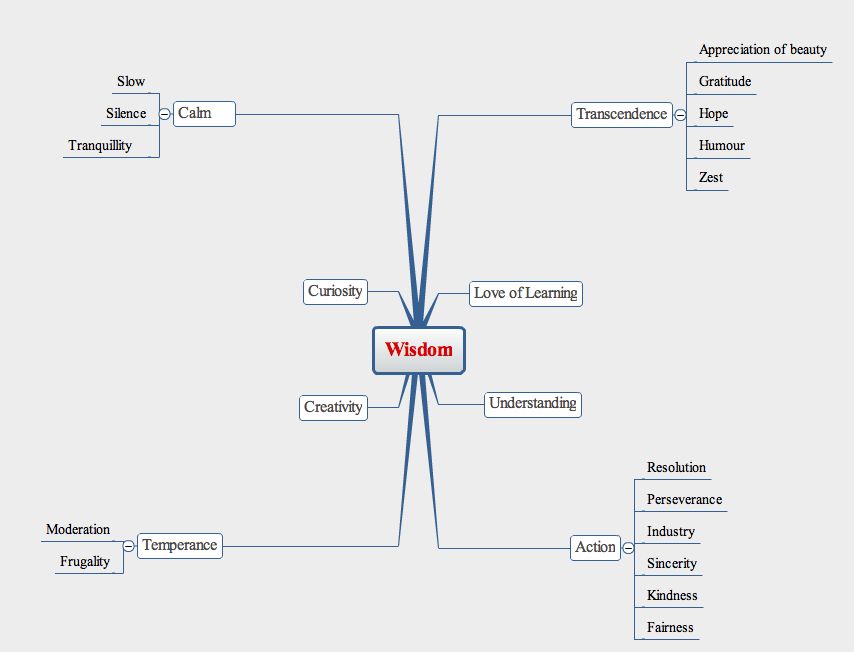
I’ve conducted my own synthesis of Franklin’s and Seligman’s virtues and strengths to come up with a personal virtue map.

Here’s an image of the map –

mindomoexport.jpg

You’ll see this has five main “nodes” – each of these refers to a major virtue cluster – Wisdom in the middle (because for me that’s the centre of it all), then Calm, Action, Transcendence and Temperance. Around each of these nodes I’ve picked a few qualities or characteristics that I’d like to be part of how I grow.

Here’s a summary –

Wisdom (which is about awareness of the world)

  • Curiosity
  • Love of Learning
  • Creativity
  • Understanding

Curiosity and Love of Learning are simply what they are – reflecting, enquiring and learning.

Creativity encompasses the ideas of ingenuity, of novelty, and of emergence.

Understanding encompasses the ideas of perspective, judgement, emotional intelligence and empathy.

Calm (stillness and serenity)

  • Silence
  • Tranquillity
  • Slow

Silence is about finding times without talking, without music or noise. It’s also about valuing conversation, not trivialising it.

Tranquillity is that calm that allows you to remain unflustered or unfazed in the face of trivial difficulties and random events.

Slow is about taking your time, savouring and relishing what you are doing.

Action (engaging with the world and with people)

  • Resolution
  • Perseverance
  • Industry
  • Sincerity
  • Kindness
  • Fairness

Resolution is deciding to do certain things and actually doing what’s been resolved to do.

Perseverance is sticking at something to see it through.

Industry is about being active

Sincerity, kindness and fairness are values which can be used to assess the quality of acts towards others.

Temperance (living within limits)

  • Moderation
  • Frugality

Moderation is about enjoying something without spoiling it by taking it to excess.

Frugality is about not being wasteful, spending productively and well.

Transcendence (living beyond our selves)

  • Appreciation of beauty
  • Gratitude
  • Hope
  • Humour
  • Zest

Appreciation of beauty in all things – the physical world, people, the Arts.

Gratitude and hope are the building blocks of positivity. Gratitude looks back and keeps positive experiences alive whilst hope looks forward and creates the conditions for positive experiences in the future.

Humour and zest are forms of passion. Humour is a lightening of the heart and zest is an energy of the heart.

So, what’s next? I created the mindmap using Mondomo (the map’s name is “virtues”) and exported it as a jpeg which I’ve now printed out onto a 6 x 4 inch index card. I’ll start carrying it around with me and my idea is reflect on it every morning and every evening. By doing that I hope I’ll bring focus and intention to these “virtues” – and if they’re worth developing, I’ll experience the payoff in an increased quality of my life. I’ll keep you posted!

Read Full Post »

Virtues

My brain seems to work in a particular kind of a way. It’s good at spotting connections, building patterns. I’d say it’s a creative brain. When I read a book certain words or passages ring bells, make lights flash, prod my memory of other passages I’ve read elsewhere and I build on what’s already there, not just in a way that gives me more knowledge in my store, but, rather, more dynamically creates something new. Some new understanding that can change my view of who I am and what kind of world I live in.

In my consulting room I find that’s one of the crucial questions I want to find the answer to – what kind of world does this person live in?

I think we all have brains that work that way actually. I think that’s how we learn, connecting new experiences and observations to our previous ones. It’s a constant process and, at best, it increases our understanding.

Sometimes the connections seem quite serendipitous. Do you get that? When a particular word or phrase or idea seems to keep popping up everywhere for a while? I don’t mean the obvious recurrences which come from reading a few books on the same subject area. I mean they pop up in books, newspaper articles, movies, song lyrics and so on. I’m sure I could write a post or two on specific words that do that but let me tell you about one of the ones that’s popping up just now – virtue.

Now this is a word I’d say I probably have never used and it’s not even a word that has held any appeal for me, but I was reading The Happiness Hypothesis recently and came across Jonathon Haidt’s discussion of virtues. He begins by telling of Benjamin Franklin (you can read about his virtues here). I’m a Scot living in Scotland but I quote Benjamin Franklin almost every day. Not a wide range of quotes mind, just one. However, this was a brand new story and it intrigued me. What do I do when something catches my interest? Google it, of course. Well, Franklin’s virtues sounded a bit archaic to me but his little descriptions of each one I thought revealed a man of remarkable insight and balance. But they didn’t feel quite right for me.

Haidt goes on to link this idea of virtues both to the ancient Greek and religious virtues and to the modern practice of positive psychology. That lead me to pick my two Seligman books off my shelves again and remind myself what he’s said. I say remind myself but to be honest I had no recollection of him using the term virtues at all so it was really going back to notice what I failed to notice first time round. Seligman’s virtues seemed different from Franklin’s. Different but not completely different (sorry, this is the way my mind works but now I’m thinking, I wonder what Monty Python’s virtues are? OK, back to the subject) You can read about Seligman’s virtues here.

What I did next was what I often do with such things. I sat in a cafe with a notebook and pen and wrote the words down over a two page spread. It’s a kind of mind mapping technique (not the fancy Tony Buzan variety, just a simple way of seeing connections and patterns). What I do is take the key words or phrases that are bubbling in my brain and write them out not randomly but in clusters so that words which have some connection for me are written close to each other and those that don’t seem so strongly connected are written further apart. Am I making that clear? I should take some photos of the process cos its actually quite a visual thing.

That gave me three clusters of Franklin’s virtues and four of Seligman’s. Only two of the clusters overlapped. (more…)

Read Full Post »

When I read Authentic Happiness by Martin Seligman I was very taken by the notion of identifying your strengths and building on them (as opposed to the more traditional New Year’s Resolution method of picking out your greatest weaknesses and hopelessly wrestling with them!). At the time, somehow, I missed his reference to “virtues”. Then when I read The Happiness Hypothesis recently, Jonathon Haidt’s description of virtues and his reinforcement of the idea of a link between ancient virtues and the findings of positive psychology sent me back to read Seligman’s book again. And there it is, clearly, in black and white – he lists what he says are the SIX main virtues (dropping seven of Franklin’s?) and the 24 “strengths” which lead to the development of those virtues.

Here are his SIX virtues –

  1. Wisdom
  2. Courage
  3. Humanity
  4. Justice
  5. Temperance
  6. Transcendence

Quite different from Franklin’s, at least, at first sight.

Let me summarise his “signature strengths” for you. These lead up to the virtues.

Wisdom

  • Curiosity
  • Love of learning
  • Judgement
  • Ingenuity
  • Emotional intelligence
  • Perspective

Courage

  • Valor
  • Perseverance
  • Integrity

Humanity

  • Kindness
  • Loving

Justice

  • Citizenship
  • Fairness
  • Leadership

Temperance

  • Self-control
  • Prudence
  • Humility

Transcendence

  • Appreciation of beauty and excellence
  • Gratitude
  • Hope
  • Spirituality
  • Forgiveness
  • Humor
  • Zest

Now, I’m sure you’ll see when we come down to the level of what Seligman calls strengths there is considerably more overlap with Franklin’s virtues. However, there are significant differences.

If you’d like to read more about Seligman’s Signature Strengths and Virtues I suggest you go have a look at his website (it’s free) and read the book Authentic Happiness.

Read Full Post »

I was inspired recently reading about Benjamin Franklin’s virtues tool for personal growth. Apparently he wanted to continuously improve his character so he read a lot about virtues to see what people said about the qualities and characteristics a person might hope to develop. He summarised the various authors by collecting together the 13 virtues which he thought most authors agreed.

He then made himself a chart with the 13 virtues down the first column and the seven days of the week making up the other columns. Every day he reflected on his behaviour and put a black mark in any box where he felt he had acted in a way which failed a particular virtue. He did this throughout his adult life, focussing on one particular virtue each week to improve himself.

He showed himself his improvement through the decline in the numbers and spread of black marks.

Now I have issues with that particular method but I’ll return to that in another post.

The 13 particular virtues are interesting and although written in what now seems old fashioned language, the principles he elaborates in relation to each virtue show he had a thoughtful, tolerant and balanced approach to virtues.

Have a look at them. What do you think? Would you sign up to all of these? If not, which would you remove from your list? And would you add any he hasn’t included?

If you want to follow in his footsteps you can download of pdf of his chart here and use it either as a standalone or as an integral part of the marvelous HipsterPDA project!

Here they are –

  • Temperance – eat not to dullness; drink not to elevation
  • Silence – speak not but what may benefit others or yourself;
    avoiding trifling conversations
  • Order – let all your things have their places; let each part of
    your business have its time
  • Resolution – resolve to perform what you ought;
    perform without fail what you resolve
  • Frugality – make no expense but to do good to others
    or yourself; that is, waste nothing
  • Industry – lose not time; be always employed in
    something useful; cut off unnecessary actions
  • Sincerity – use no hurtful deceit; think innocently and justly;
    speak accordingly
  • Justice – wrong none by doing injuries or omitting
    the benefits that are your duty
  • Moderation – avoid extremes; forbear resenting injuries
    so much as you think you deserve
  • Cleanliness – tolerate no uncleanliness in body,
    clothes or habitation
  • Tranquillity – be not disturbed at trifles or accidents
    common or avoidable
  • Chastity – rarely use venery but for health or offspring;
    never to dullness, weakness, or the injury of our own
    or another’s peace or reputation
  • Humilty – imitate Jesus and Socrates

Read Full Post »

« Newer Posts - Older Posts »