Feeds:
Posts
Comments

Tidy

Strange how the universe works huh?

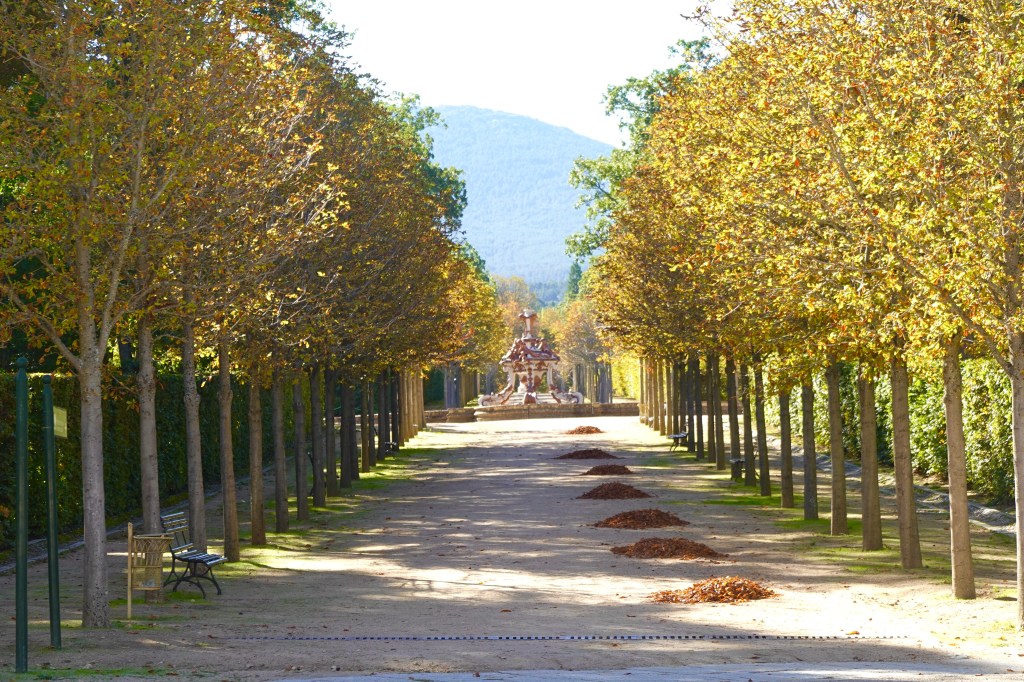
I was struck by this scene of neat piles of fallen leaves on the wide paths in the garden of the Royal Palace at La Granja and earlier I noticed this on coming out of my hotel in Segovia……
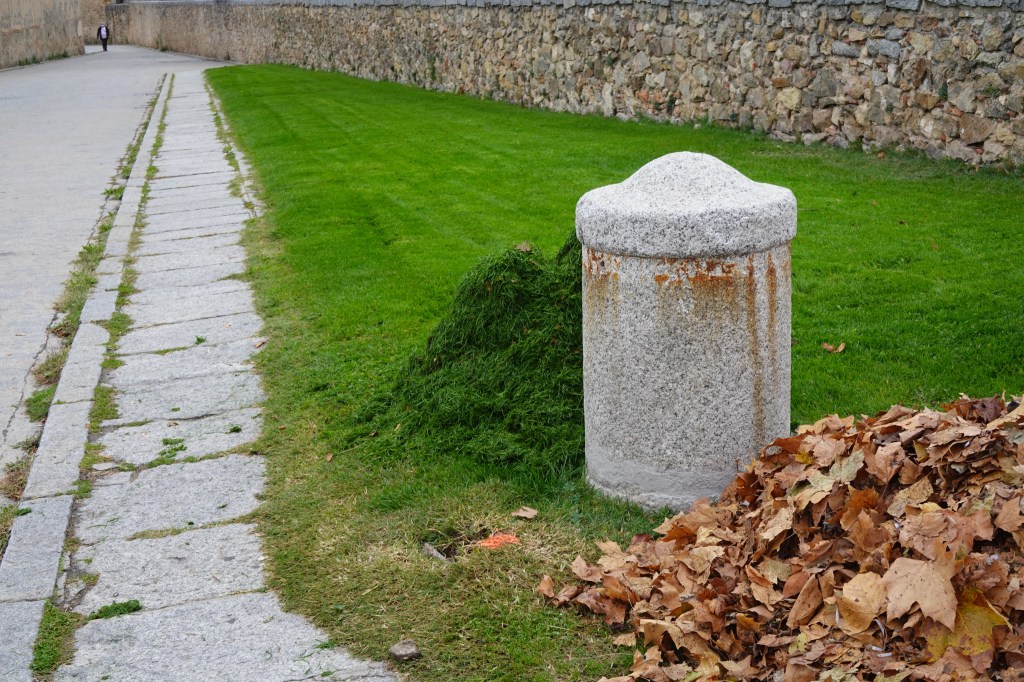
Have you ever seen that level of tidiness in a Public space? I’m not sure I have…which is one of the reasons why I took that photo.

So did that earlier experience of the pile of leaves next to the pile of cut grass prime me to notice the neat piles of leaves in the gardens? Maybe but even that is part of a bigger picture….

I emigrated from Scotland to South West France seven years ago and because I didn’t know if I’d really want to stay here – reality meets dream – I decided to rent somewhere to stay instead of buying a home. I ended up liking living here so much I wasn’t very motivated to go house hunting. Then came the chaos and uncertainty of Brexit and Covid.

Well now the new regulations are clearer and my permissions etc are all in place it seemed the time was right and we went housing. It really took no time at all to find a place we fell in love with and we’ve bought it. Well, still some legal steps to complete but hopefully about a month from now we’ll get the keys.

So – tidying – in the broadest sense of the word is my world at the moment. Sorting through everything I own, giving things away, getting rid of broken things, forgotten things I wonder why I ever kept, and filling boxes to transport from here to the new house.

Maybe this is a good time to be creating some order in the chaos of this pandemic?
Revealing change

I love both Spring and Autumn because then change is so obvious.

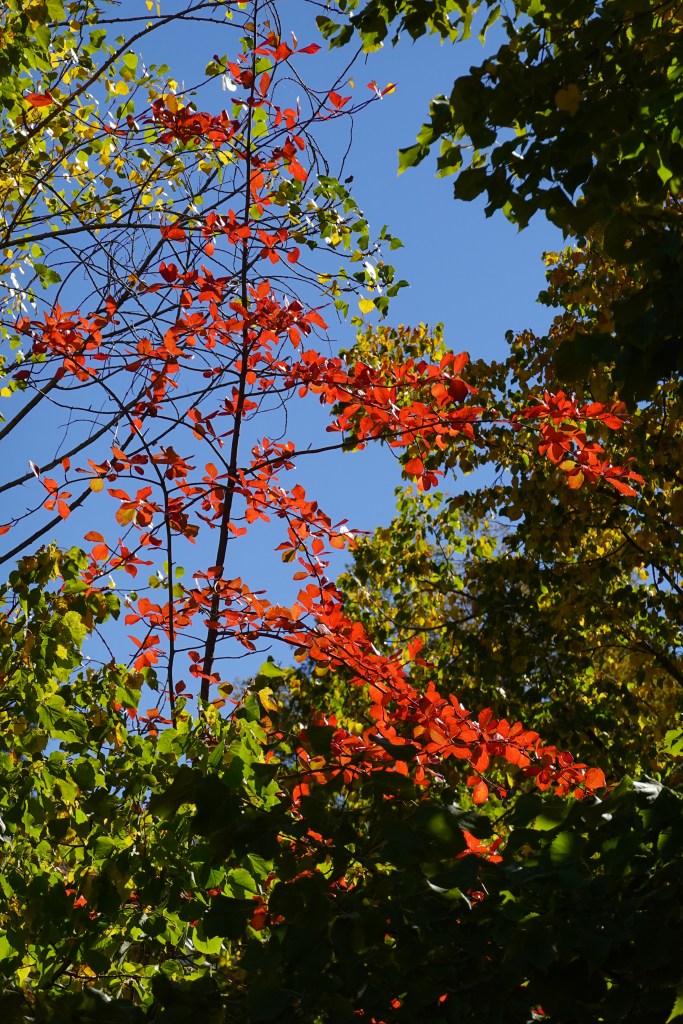
When the leaves start to change colour going from green to vivid red as they’re doing in this photo, they’re beautiful and they grab my attention. I mean how could I miss a spectacle like this?

I know that over the next few days, or couple of weeks, these changes will be everywhere. I’ll be surrounded by reds, yellows and gold.

Change is perhaps THE most fundamental characteristic of reality. Nothing never changes. But often change is so gradual or slow that we don’t notice it. We become familiar with our everyday and slip comfortably into not noticing.

But change is underway all the same. I’m changing. You’re changing. Everything you can see, hear, smell, taste or touch is changing,

When we notice change we wake up. We become aware. And in that moment we can experience the flow of Life, the movement of energy, the cycles of living, the seasons of Nature.

I love it when that happens but it’s not always an experience of pure joy. There can be tinges of sadness in there as we become aware of what is going. Or even more so, change can be felt mainly as loss and pain. It’s not so beautiful then and we might resist. We might refuse to accept that change has happened and experience the pain and sadness more intensely.

But then we adapt. Because time doesn’t stand still. We change along with the new losses and/or gains.

Isn’t that the true marvel of living? That life is complex, so nuanced, so full of paradoxical phenomena, often active and swirling around at the same time. So we experience the reality of a multitude of emotions often over extremely short periods of time.

“This too shall pass” is the old saying and depending on the circumstances that might fill us with relief or sadness, with joy or fear, with delight or regret. Or a lively mix of all that and more.

But that’s the beauty of reality…..and we develop the necessary life skills of acceptance, gratitude and awareness through exactly these experiences of change.

A sense of place

This photo captures a sense of place for me. It’s a view of Segovia with the blue mountains in the distance. The colours of the buildings and their rooftops seem classic Segovia to me. And although you don’t get to see how the streets are laid out from this perspective you still get a feel for it. You know somehow that this isn’t a modern city built on a grid plan for example.

I think it’s the view of the mountains on the horizon which gives us the idea that this is an inland town, fairly high up above sea level. Or is that just because I’ve been there and experienced it?

I grew up in Stirling in Central Scotland and every time I go I have the same tugging at my heartstrings and the same feeling of deep belonging the moment I see the castle high up on the rock with the Ochil Hills as a backdrop.

I lived for many years in Edinburgh and it would be hard to miss the influence of both the castle in the middle of the city and the immense Arthur’s Seat when you are there. There’s also something special about Edinburgh’s street layout with the hugely contrasting Old and New Towns separated by Princes Street Gardens.

How about where you live? What do you think it is about the geography of the place, the architecture of the buildings or the patterns of the streets which give you a strong sense of place when you are there?

And have you ever wondered how those features, those environments, influence your psyche and that of the other people who live there?

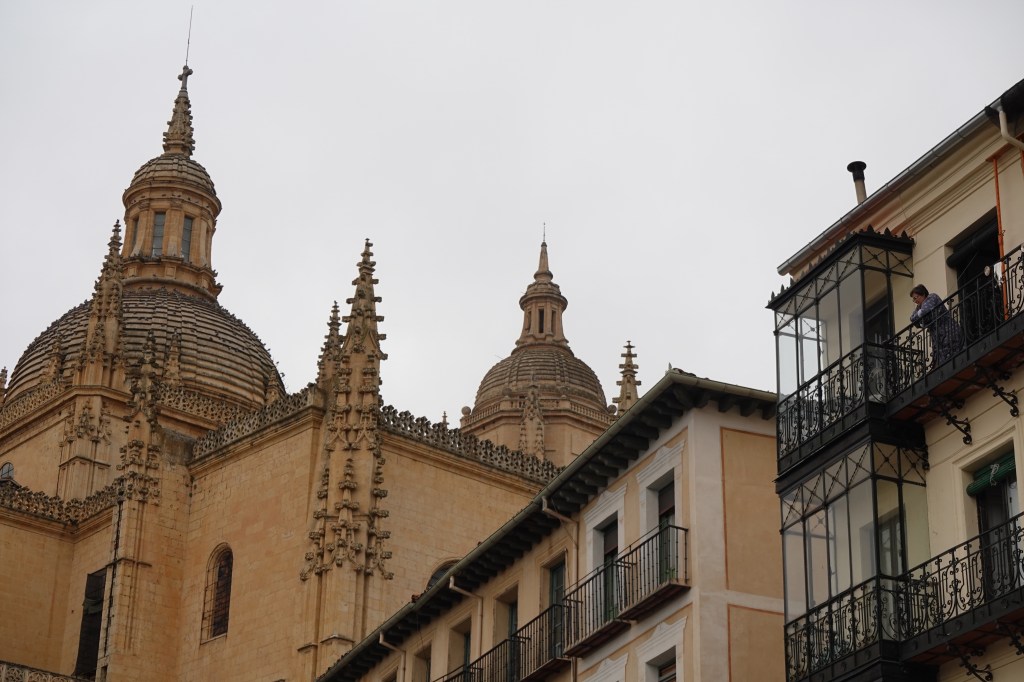
I looked up and noticed this lady leaning on the rail of her balcony on the top floor of the building.

She was watching the world go by. Or so it seemed to me. She could, of course, be looking out for someone in particular, waiting expectantly for their arrival, but even then she seemed to be watching the world go by in the meantime.

I immediately thought of my gran. I was born in her house, and spent my childhood living in the first floor flat above her. It was a corner house and her flat had two large rooms, each with a bay window, one facing one street, and the other “round the corner” facing another.

My gran liked to sit in one of these bay windows “watching the world go by”. One of these rooms was a bedroom and the other a sitting room. I could return from school and find she’d swapped the furniture around during the day making the bedroom, the sitting room, and vice versa, “for a change of view”.

Watching the world go by is an exercise in observation. We do it to practice noticing, and to enhance our awareness. It’s almost a meditation practice. It’s certainly a type of contemplation where we strengthen our recognition of the familiar, and, consequently, the unfamiliar, quickly noticing what’s new, what’s different.

Surely this lies at the heart of our powers of perception – the ability to recognise the familiar AND the ability to spot differences.

Where are your favourite places to “watch the world go by”?

Polishing the brasses

When I was a teenager I worked in the local hospital for a few weeks during the school summer holidays. I worked first as a “ward orderly” then as a “theatre orderly”. Both of these jobs were primarily cleaning jobs but a theatre orderly also had to transport patients to and from the surgical theatres, and the ward orderly also made and distributed tea, coffee, water and other drinks as well as serving meals.

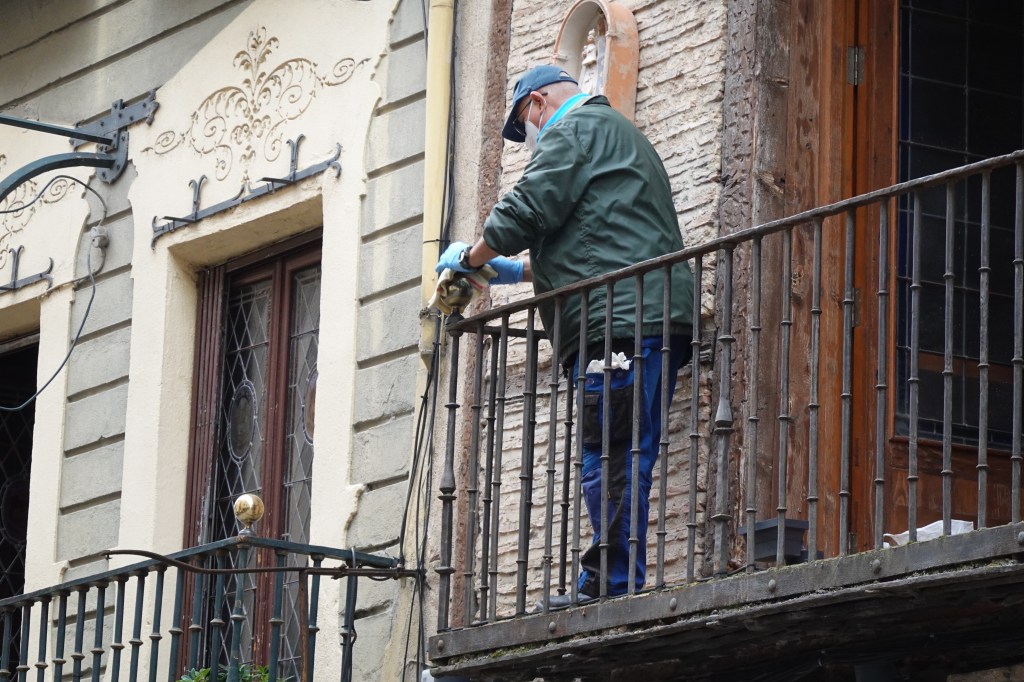
There were daily tasks, weekly ones and monthly ones. It was one of my favourite monthly ones which came back to my mind when I spotted this man polishing the brasses on the balconies above a restaurant in the middle of Segovia.

There were brass plates and handles on the doors of the wards in my day, and plates on the ground too where the doors were hinges. Polishing the brasses was a monthly task and bringing them up to that beautiful bright colour.

Funny, isn’t it, how a small, chance observation can spin you back decades and remind you of little tasks, little pleasures from many decades ago. Of course, this simple memory soon spreads in every direction and I’m quickly remembering what it was like to work in a hospital where, over a few years, I was on first name terms with everyone who worked there…..doctors, nurses, cleaners, porters, secretaries and managers.

I went on to spend the second half of my medical career in a small hospital where, similarly, everyone knew everyone.

I can’t stress how strongly I value that. It’s a bit like Schumacher’s “Small is Beautiful”…..human sized enterprises remain much better attached to human values than vast, industrialised ones.

I’m convinced we should put people before processes and/or profits. It’s likely my teenage experiences embedded that belief in me.

Fruits of our lives

As best we know we humans are the only species to create layers of significance and overlay them on the world around us. We do that using a combination of imagination and memory.

Perhaps one of the simplest examples is when we associate a certain food, a particular flavour or scent, with an event or experience. It might be a single powerful experience, either joyful or traumatic. For example the day we met someone we love, or, perhaps the day someone we love fell ill, or died. Or it can be one of those repeated experiences, like something which we came to associate with our grandmother, or with schooldays.

One of the most famous examples of this is in Proust’s Remembrance of Things Past….the passage about that little French cake, the “Madeleine”.

In some cases the significance becomes much more than personal. It becomes cultural, shared by millions.

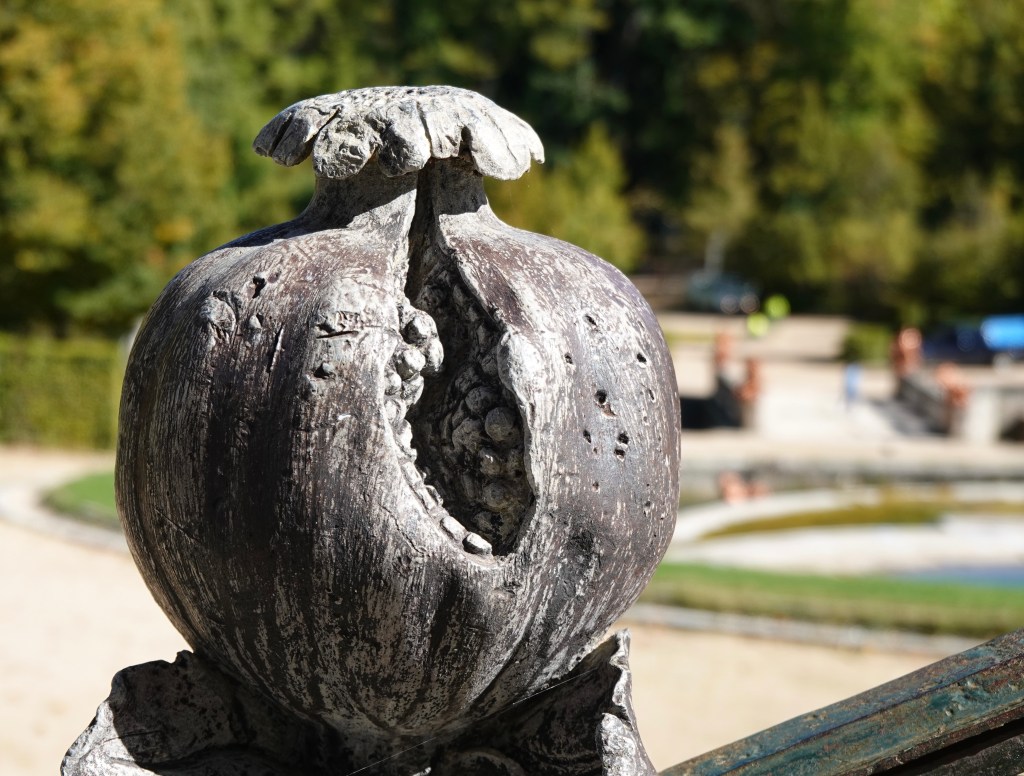
In the gardens of the Royal Palace at La Granja I saw this sculpture of a pomegranate. Is this our most significant fruit? Does any other kind of fruit have a city named after it? “Grenada”, the Spanish word for pomegranate.

In many cultures over many centuries the pomegranate became the symbol of abundance and fertility and has featured in many works of art and rituals.

Has any other fruit achieved such prominence as the pomegranate? I’ve been racking my brain but I can’t think of any.

However, at a personal, or a family level, are there any other fruits which are significant and important to you?

Caring for each other

I want to celebrate caring.

I’ve read a fair bit of research into the lives of trees recently, the most recent being Suzanne Simard’s excellent “Finding the Mother Tree”. It seems that far from seeing trees as separate individuals in constant competition with each other for sunlight and nutrients, that reality is more complex, because trees are in fact in constant communication with each other – primarily through the wood wide web of fungal networks in the soil, but also through chemical signals sent through the air.

It turns out that trees are not as separate as we thought. And it turns out that caring for each other is essential to their health and survival.

And aren’t those the exact lessons we are learning from this pandemic?

We are not separate. My actions have consequences for you and vice versa. Political borders are irrelevant to viruses. We live in one vast interconnected planet. What happens in one community has consequences for other communities.

The most impressive thing to witness in this pandemic has been the spontaneous actions of caring individuals – millions of them – from “front line workers” to “neighbours” to professionals collaborating to find tools and solutions.

And the other side of that coin is the pandemic has hit hardest those in society who have been least cared for – the poor, the frail and the marginalised.

That lack of care has made us all more vulnerable.

So let’s counter the dominant belief system that we are all separate and that competition and greed will be good for us all. And say let’s try something else. Let’s put caring at the heart of what we do.

Utility isn’t enough

These are three photos of some houses opposite the first part of the aqueduct in Segovia.

I’m pretty sure these are pretty regular terraced houses and apartments and this kind of decoration on the outside was actually fairly widespread in the town.

The patterns on the first two remind me of those I saw in the Alhambra in Grenada and the third one seems rather understated in comparison but look carefully. It’s a sort of frieze of pairs of deer, each couple standing facing each other, which is pretty engaging. But look at the pair below the window. They’re crouching down so they don’t bang their heads on the lintel! Such attention to detail.

All too often, it seems to me, our particular form of society has become too utilitarian. Surely the easiest, quickest and cheapest facing on these buildings would be a bland render? And how often it seems that cheapness and so called efficiency are the bottom line decisions. But cheap and so called efficient are rarely beautiful. And they don’t nurture the human heart.

So I was delighted to see that creativity, aesthetics and beauty had won the day here.

One thing this pandemic has shown us is that globalised, just in time, so called efficient and cheap ways of meeting human needs are not very resilient. And, hey, even if they weren’t enchanting, even if they weren’t beautiful or nurturing, surely the least they could be was efficient – as in the best way to do something.

So, folks, can we take a cue from this and turn towards ways of organising, managing and working which nurture creativity, stir the human heart, and value all living creatures over profit and short term goals?

We humans are essentially a creative, highly social species. We’ve expressed ourselves with art and chosen to “adorn” or “embellish” what’s around us since time immemorial. And when we allow those creative and social energies to flow, we flourish.

The storks have flown

Do you associate certain birds with particular places?

I know that now that I live inland, whenever I visit a coastal town I’m quickly aware of the cries of gulls. I noticed that when I visited Edinburgh recently where their calls added to the sense of familiarity I was experiencing revisiting the city I’d spent so many years in, in the past. And even when in the middle of the city they made me think of the sea.

I also associate the caw, caw of crows calling in Tokyo – which every time I was there surprised me and gave me a sense of returning to somewhere familiar.

Around this part of south west France buzzards are perhaps the most striking and distinctive birds, both when I see them riding the air currents and call their high pitched call high, high above, and when I drive past a vineyard and see one perched majestically on one of the poles at the end of a row of vines.

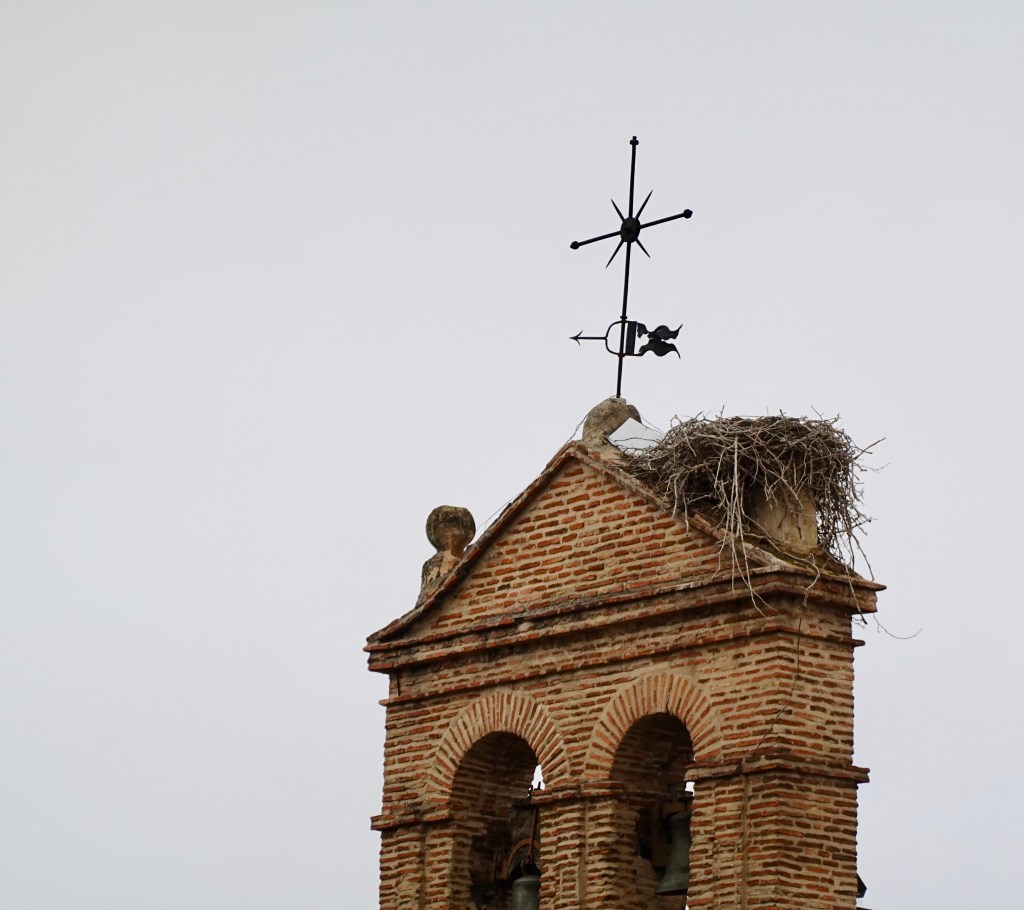
When I was in Segovia last week one of the first things I noticed were the vast ramshackle nests sitting on top of church spires, bell towers, high roofs and tall trees. The storks have gone now, flown off to Africa or the Middle East for the winter so the empty nests remind me of the characteristics of travel and migration shared by so many living creatures.

Fly past

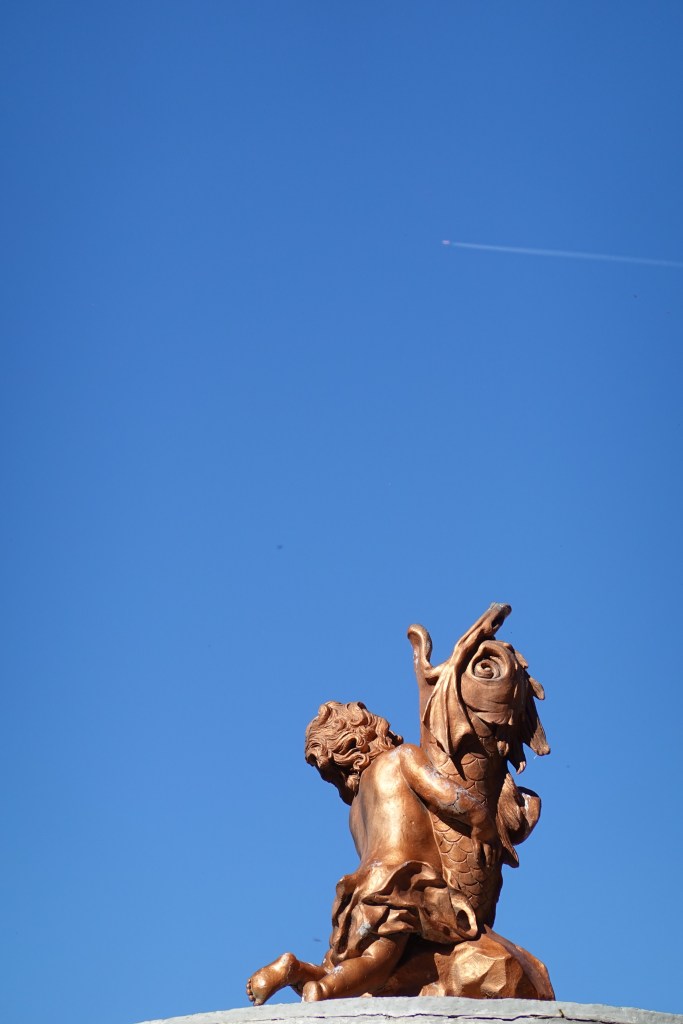
I was framing my shot to take a photo of this fountain (even though there was no water flowing) when I noticed the jet plane high in the sky above. I waited a couple of seconds then pressed the shutter.

So when I look at the image now I see what seems to be fish out of water, held by a child. The fish seems focused on the plane and it’s mouth is wide open as if it is gasping in amazement.

Well, it’s just a little fun of course but it does get me thinking about how different our lives are in relation to the environments in which we live.

There’s a French TV programme where they take a celebrity to a remote civilisation somewhere for a couple of weeks and film the experience. It’s actually very touching and usually by the end of the fortnight you can already see the intensity of emotional connection which has been made. One time they filmed themselves showing three different groups the programmes from each of them. One group lived in huts on stilts in the sea, one high in mountains and a third lived in snow covered lands. The reactions of each group to the programmes about the lives of the other two groups was really something .

They were utterly amazed, and you could see that, like ourselves, watching from Europe, it was really astonishing to see such different environments and the way people lived in them.

What always touched me most about that programme was that it seemed for all of us there was a mix of just not knowing what on Earth it would be like to live in such a different way and the deep sense of rapport and empathy we felt.

I think it’s great to be amazed. And I think it’s great to be reminded that we all live in different ways, in different ecosystems, but that we are all sharing this one small planet together.