Feeds:
Posts
Comments

Posts Tagged ‘history’

Around the world we are seeing a rise in Right Wing politicians with a specific focus on the issue of immigration. Country after country is either reinforcing its borders, or planning to do so. The criteria for authorised immigration are getting tighter and more expensive and the rhetoric against those escaping war, torture, poverty or hunger is becoming more severe. Underpinning all this is a negative stance towards “foreigners” who are blamed for housing shortages, low wages, difficult access to health care, pressures on schools and crime. The answers to these supposed effects include closing borders to new migrants, rounding up unauthorised migrants and deporting them, and even “re-migration” (expelling those with a legitimate right to remain in the country). 

We could look at the facts and try to discover if any or all of these negative effects can indeed be laid at the doors of immigrants, but, frankly, many have already done so, and none of these claims stand up to scrutiny. 

But, let’s take another approach. Let’s think about where we place borders and how we control them. 

In the Middle Ages many cities in Europe built fortified walls around themselves. The gates into the cities were guarded by armed men and nobody could move freely into and out of the city. 

Then as nation states arose those walls came down, either literally, or functionally. The borders were re-drawn around the new nations. 

If you are at all interested in old maps, it’s easy to see that the current “national” borders, have, in many cases, been in existence for only a few decades, and that many have been drawn and re-drawn repeatedly.

But let’s do a thought exercise. What if we were to recreate, if not the actual walls, the borders around cities? What if, for example, we stopped people moving from one part of a country to another part? After all, the arguments against migration from one country to another are mainly down to strains placed on existing services, such as housing, health care and education, on the places to which the migrants move. So, if the problem is people moving into a particular city, or, even area of a city, and the answer is to stop them, why prevent only those coming from other countries? Why not stop those people coming from other cities in the same country? 

China does this. There was a recent report about taxi drivers in Shanghai, many of whom are “migrant workers” whose homes and families are hundreds of miles away (but still in China). These workers have a right to work in Shanghai, live in dormitories together, but have no right to bring their families with them, and no right to health care within Shanghai. 

How does that sound? 

Would you like your country to function like that, controlling the movement of people within the country to stop “locals” in one city from being “invaded” by “hordes” from other cities, or from the countryside? 

The rising tide of anti-foreigner speech, and actions, in populations and amongst politicians, is a return to the Middle Ages. Haven’t we developed since then? Haven’t we learned, since then, to identify with other humans who happen to live further away from us? 

Xenophobia is a political weapon. Migration is not a “legitimate concern”. The issue is how a country uses and directs its resources. If there is a deficit somewhere, then the answer is to address that deficit, not take away freedoms, or stoke fear and hatred of “the other”. 

It makes no more sense to try to control movement over national borders than it does to control movement within them. Setting one part of the population against another is a device to keep the privileged, privileged, to keep the elite, elite, to keep the wealthy, wealthy. 

We have greater wealth in our countries now than we ever have, but we’ve developed an economic/political system which funnels most of it into the hands of a tiny minority. It’s only the richest who are substantially increasing their wealth over the last fifty years. That’s untenable. But it’s not an issue caused by migration, or insufficient control of borders. 

And, for those who say that free movement over borders would be a nightmare, why isn’t it a nightmare to allow free movement within them?

Read Full Post »

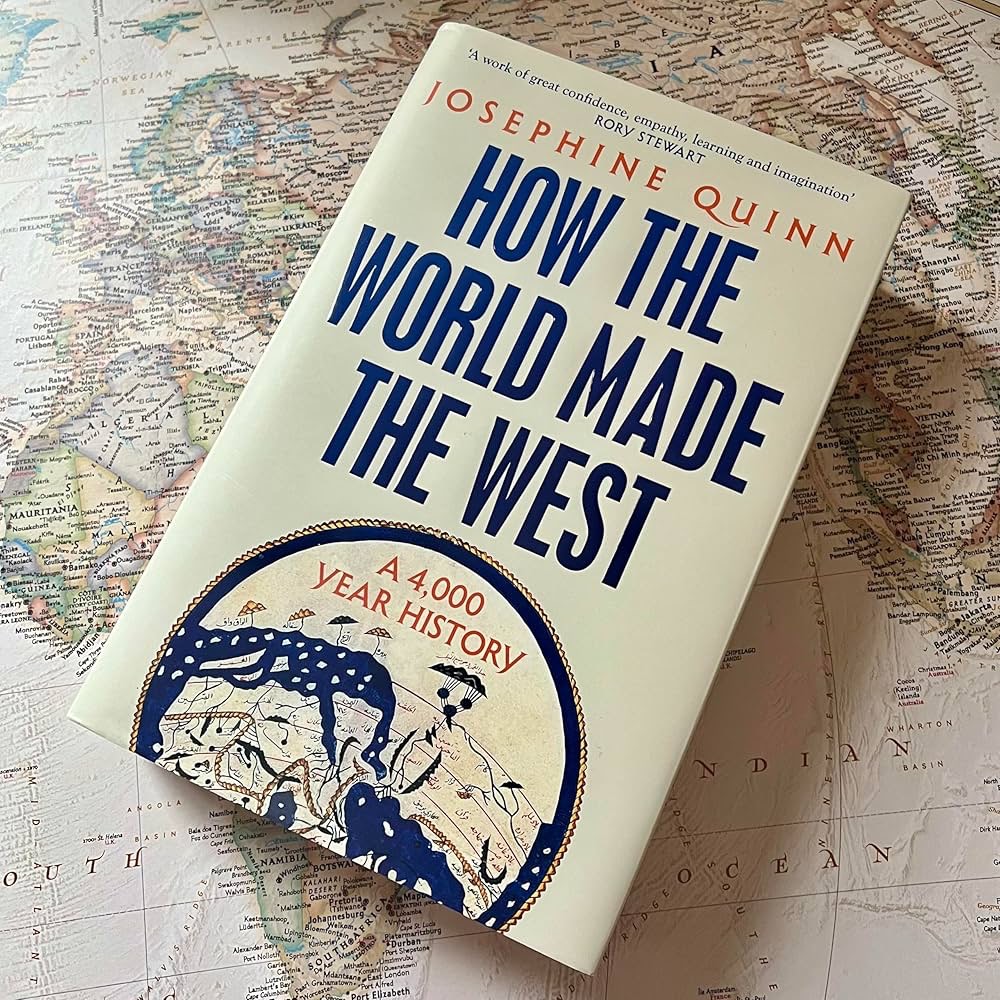
I”m currently reading this astonishing book by Josephine Quinn challenging the whole idea of “civilisational thinking”. She makes an extremely well researched and detailed case for how we got to where we are now, through hundreds of years of trade, travel, migration, and the rise and fall of power bases in cities and lands across Asia, Africa and what we now call Europe. It’s an astonishing read.

In her chapter about Athenian democracy, which is often held up as the standard “the West” claims to pay due to, she shows just how different democracy was there from the versions of it countries say they have now.

It feels as if our current versions of democracy are in crisis. They are distorted by populism, which seems to generate space for new waves of autocracy and fascism. And they are corrupted by money. It’s becoming clearer than ever that wealth buys the governments that the wealthy want. There is soaring inequality, and a decades long grinding down of working people and standards of living as neoliberalism shovels money up from the bottom to the top, privatises the Commons, and pushes “deregulation” to escape any chance of being held to account for the actions of corporations and billionaires. Meanwhile the Public looks at the system and can’t see a political party which will address the real problems we face.

In the Athenian version of democracy, Josephine Quinn highlights three features which protected it from both populism and corruption (accepting it didn’t do that 100%) –

1) Lawmakers were chosen by lot, not by anyone voting for them. What, no voting?! Yep, the method was probably pretty similar to the way a jury is chosen. Jurors are selected by lot. Nobody votes for them.

2) Secondly, those chosen were paid to do the job for a year, so it remained (technically) open to everyone, not just the rich.

3) And, thirdly, they had to step down after a year, and be subject to an open public audit, to look at how they had acted during their term of service. In other words, every one of them was held to account.

    These three basic features were designed to protect democracy from the rich and the corrupt, and to engage the greatest number possible of citizens in the law making of the land.

    Of course, Athens was a pretty small town by current standards, and present day countries couldn’t manage assemblies of the entire population to gather and make decisions (although with modern online technologies, perhaps the geographical limits have been lifted)

    This is an entirely different vision of democracy. If we chose our “representatives” the same we choose jurors, if we paid them for their work, limited them to a single term in office, and held them to open public audit when they stood down, it would make it harder for the wealthy to buy elections and for lobbyists to corrupt politicians (who couldn’t be career politicians any more) – Can you imagine it?

    There are lots of other good ideas around the world which might improve democracy, from citizens assemblies and referendums creating a more participative democracy, to trials of different kinds of proportional representation, but none of these ideas are as radical as those we saw in place back when democracy was born.

    I mean it’s pretty thought provoking, isn’t it?

    Read Full Post »

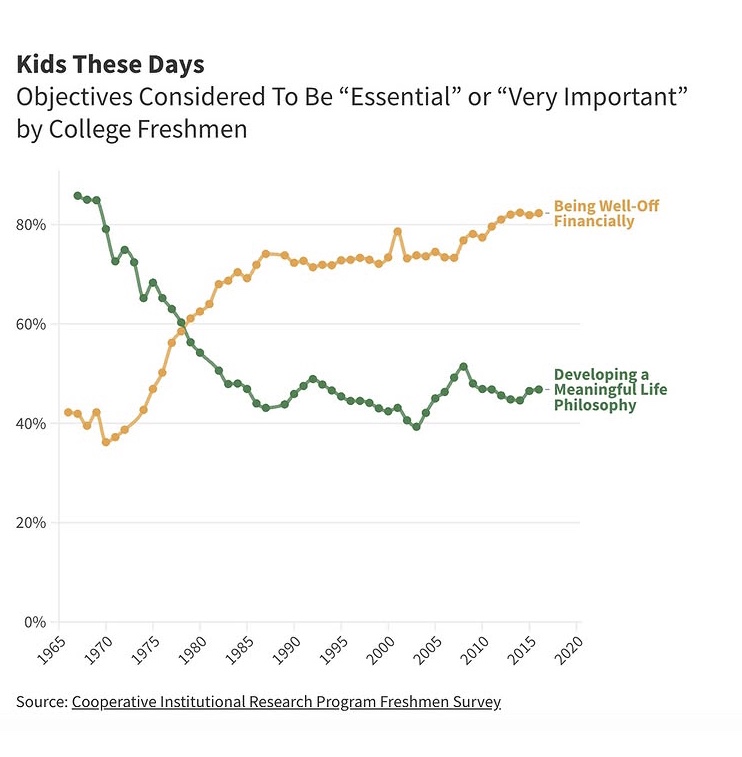
    I came across this chart the other day. Isn’t it fascinating? It charts the percentage of college “freshmen” saying that either “”Developing a meaningful life philosophy” or “Being well off Financially” was considered by them to be either an “essential” or “very important” objective.

    Basically it shows an almost complete reversal of positions of these two objectives between 1965 and 2020. Now, less than half give “developing a meaningful life philosophy” compared to over 80% of them saying “being well off financially” is essential or very important. Back in the 60s, these figures were almost exactly reversed and the crossover point in the chart seems to be in the latter half of the 70s.

    I’ve long held the belief that Thatcher and Reagan, as the main drivers of neoliberal economics, were at the turning point in our societies. I guess I’m part of what is called the “baby boomer” generation, and it seems to many of us that life has got harder and more precarious for most people in our communities over our lifetimes. It seems that Public Services have gone into steep decline, that wages have stagnated, house prices have soared, and jobs have become less secure.

    What went wrong?

    When we hear the present generation of politicians in the UK, and even more so in the USA, put forward policies which are every bit as neoliberal as Thatcher and Reagan, is it any surprise that this steep decline has been experienced everywhere. Inequality is higher now than it has been for decades. The whole economy has been “financialised” where we’ve been led to believe that the finance sector, and the rich, are the wealth creators, while, actually, their wealth is being created out of wealth, not out of productivity. The goods and services produced now seem cheaper and nastier than they were. The heroes of contemporary society are those who have grabbed the most for themselves over the shortest period of time and the huge numbers of billionaires and millionaires can’t find anything left to spend their money on except ridiculously expensive houses, yachts and private jets, so they’ve turned to buying political influence instead.

    When the goals of society are to promote the wealth of the wealthiest and to deny, as Thatcher did, that “society” even exists, has, surprise, surprise, led to exponentially increasing amounts of mental and chronic physical illness.

    Maybe Iain McGilchrist would point to likelihood that giving predominance to the left cerebral hemisphere over the right will have been, at least in part, at the root of this problem. But it’s a profound economic problem too. We are still trapped by the delusions of neoliberalism with its so called “free markets” which aren’t free at all, and “trickle down economics” which never trickle down.

    We need something better. We need to break free of the neoliberals and the populist far right.

    Read Full Post »

    I’m reading “How the World made the West” by Josephine Quinn, a fascinating and mind expanding history of how the concept of “The West” arose. This paragraph really got me thinking –

    “The study of antiquity gives the lie to the idea that everyone is born with a natural, fixed ethnic identity, tied to specific other people by ancestry or ancestral territory. The concept is fundamentally incoherent anyway: at some level all humans share the same ancestry and territory, and decisions about where to draw lines across that shared heritage in time and space can only ever be arbitrary. But ethnic identification is also for the most part a relatively modern phenomenon, associated with modern levels of literacy, communication and mobility. Without these, communal identities tend to form on smaller scales. And despite their physical proximity to one another, links between the ‘Phoenician’ ports were relatively weak.”

    This reminds me of my experience working as a GP in the Irvine Valley back in the early 1980s. There were three small towns in the valley, Galston, Newmilns and Darvel. Although they seemed pretty similar in size, and even appearance, to the locals, especially the elderly locals they each had distinct characteristics. For example, one elderly woman told me a traditional saying was “Darvel for swanks, Newmilns for banks, Galston for guts” and another told me she was born in Galston but when she married she moved to Newmilns (two miles away), “But I couldnae staun it and had to come hame” – she couldn’t stand living in Newmilns and had to move back to Galston. Yet another, this time from Newmilns, told me the old piece of marriage advice she remembered was “If you can’t get a man, go to Galston and get a miner”. As Josephine Quinn writes, “communal identities tend to form on smaller scales”. 

    By the time I was working there, each of the towns had changed considerably, with mining and textile industries disappearing, and an increasing number of people moving to the valley and commuting for work. However, when I left in 1986 to take up a post in Edinburgh, a twenty something year old female patient asked me what Edinburgh was like. She had never been. I asked her if she usually went to Glasgow (there’s actually still quite a cultural divide between Scotland’s two largest cities), but she said no, she’d never been there either. I asked where she had been, and she told me she’d visited Ayr once. She definitely identified with place, not an ethnic group. 

    Anyone who has done even a small amount of genealogical research into their own family, pretty quickly finds that their ancestors come from a wide range of towns, or even countries, and those who use on the DNA testing genealogy services, find that they have percentages of their DNA which can be traced to several countries around the world. 

    Josephine Quinn makes the point that DNA discoveries have undermined the concept of separate, distinct, or “pure” races, and that her research in ancient history (her book focuses on the period from 1500 BC to 1500 AD) undermines the concept of competing “civilisations”. As she describes each period, time and time again, she shows that trade and migration play a key role in the spread of ideas, technologies and innovations, whilst strengthening local cultures of belief and tradition. 

    Nothing we are familiar with today would be possible without a long, long history of migration, communication and trade.

    Read Full Post »

    I have long been a critic of reductionism. I mean, I get how it brings something to the table. Our ability to isolate a certain element from within the flux of phenomena and experience, to focus on that element closely, allows us to further our understanding of the world. I suspect it also does, what Iain McGilchrist describes as a left hemisphere trait….it allows us to grasp, to manipulate and control. Therein lies its power.

    But it all goes wrong when we fail to integrate our new understanding of a part back into the reality of the whole.

    In her novel, Elixir, Kapka Kassabova, writes –

    Medicine emerged from alchemy’s noble attempt to marry the subjective and the objective, matter and mind, inner and outer, and in this way, to lift humanity out of superstition and senseless pain. 

    But like magic, the bias of modern medicine went too far in the opposite direction. Like magic, it assumes too much and has many blind spots. 

    These blind spots come from its many uncouplings, one of which is the uncoupling of psyche from soma, the soul-spirit from the body. Another is the uncoupling of one organ system from another, and another is the uncoupling of the human being from her environment. 

    Both Folk Medicine and Western Medicine discourage you from taking ownership of your well-being through knowledge. Both of them keep you dumb and dependent. 

    In this passage she critiques both Modern and Folk Medicine for taking power away from individuals. Too often Medicine, in all its forms, comes across as a body of secret knowledge, with an expectation that patients will have faith, and hand themselves over to the practitioner with the superior knowledge.

    Personally, I think this is a terrible way to practice Medicine. Diagnosis, prognosis and potential treatment should be a joint process emerging out of a caring, open relationship between a practitioner and a patient. Ultimately, the goal should be to increase an understanding of the self, and to empower individuals towards greater knowledge and autonomy.

    I love how Kapka describes Medicine as emerging “from alchemy’s noble attempt to marry the subjective and the objective, matter and mind, inner and outer, and in this way, to lift humanity out of superstition and senseless pain.” That’s exactly how it felt to me. Medicine, at its best improves the lives of others by “marrying the subjective and the objective, matter and mind, inner and outer.”

    But in fact what really strikes me most in this passage is “These blind spots come from its many uncouplings, one of which is the uncoupling of psyche from soma, the soul-spirit from the body. Another is the uncoupling of one organ system from another, and another is the uncoupling of the human being from her environment. ” It’s that use of the word “uncoupling”.

    I’ve never used “uncoupling” in this context before. But it resonates with me much more deeply than “reductionist”. This, surely, is the heart of the problem – when we “uncouple” one organ system from another, “uncouple” the mind from the body, “uncouple” ourselves from each other, and from the rest of the lived world with whom we share this one, finite, interconnected, little planet.

    Here’s to undoing as much “uncoupling” as we can.

    Isn’t that something to aspire to?

    Read Full Post »

    I find it pretty depressing how immigration is presented as a problem in so many countries. It seems every far right political group on the planet wants to build walls around their own country and keep any foreigners out. Why? Because people who aren’t born in the country where they now live are a problem to be solved?

    Personally, as an immigrant myself, I think everyone who live in the same street, the same village, town, or city, the same country even, should be treated equally. I’m not a problem because of my genealogy or my genes. We are all inhabitants, we who live together, sharing the same roads, the same shops, the same activities. I prefer the concept of “inhabitant” or “resident” over that of “citizen” if, by the latter term, we mean people who have passed whatever administrative and/or economic rules a country applies to people who weren’t born in that particular part of the world.

    In fact, more than anything geographical, I feel I am a member of the human race, and a unique expression of Life, just like all the other human beings who I share this planet with, just like all the other astonishing forms of life I share this planet with.

    I don’t think immigration is a problem to be solved. The problem to be solved is “integration”. Here’s the definition of integration I work with – “the creation of mutually beneficial bonds between diverse and well differentiated parts”. In other words, how do I live with my fellow “residents”, fellow “inhabitants”, fellow “citizens” in the part of the planet which I call home?

    When we don’t create healthy, positive, creative, and caring bonds between each other, we all suffer. We humans have always moved around the Earth, and we always will. Yet, most people who live in a particular part of the world would prefer to stay there – it’s war, violence, and utter poverty that drives out those who would rather stay.

    I think we should put our energies and our resources into living well together – that would include treating people in the same place equally no matter where they were born, actively helping immigrants to integrate by teaching them the language, customs and laws of the country, and encouraging their full participation in society. And we need to develop mutually beneficial, caring, creative relationships between countries, instead of hostility, hatred, fear, competition and violence.

    We humans are superbly adaptive creatures and we’ve evolved to be able to inhabit almost every corner of this little planet. But we’re going to have to adapt better if we all want to survive….or at least, if we want our grandchildren and their grandchildren to survive. We’ll do that through integration – by the creation of mutually beneficial bonds between ourselves and others.

    So, I reject the dominant narrative that immigration is a problem, and I say, loud and clear, that what we should address and “solve” rather, is integration – integration in our streets, our villages, our cities, our countries, and our planet.

    Read Full Post »