Feeds:
Posts
Comments

Archive for February, 2008

The Medici Effect by Frans Johansson (ISBN 978-1-4221-0282-4) says on the front “If you can’t read it and come up with at least a minor Mona Lisa or two, you’re not trying”. Pretty enticing, huh? Well, so far, it hasn’t done that for me. Am I not trying? Well, actually, as Johansson shows, just reading about something isn’t enough. You have to turn your reading into actions.

The front cover quote is kind of misleading – this is an inspiring book but it certainly isn’t a “how to do it” kind of book.

The Medici Effect is an exploration of a single, simple concept – the intersection. The author’s claim is that innovation and creativity flourishes in the intersections. What intersections? Where different disciplines come together in the same team or project; where cultures meet; where languages meet. This concept reminds me strongly of the network science ideas which I read about in the fabulously inspiring “Linked“.

I think it’s very true. Some of my most creative times come around my visits to France and Japan. I spend most of my holiday leave in France and I love to go to the bookshops and the newsagents. The French publish utterly different magazines and books from the kind I find anywhere else in the world, and there is something about their perspective which I find so different from the one I find in the UK. In fact, for me, there’s something about reading French which is stimulating and exciting. I also visit Japan a couple of times a year and there the culture, the architecture, the contrasts of the spiritually ancient and the gaudy new sitting side by side, the design ethos focussed on transience and the constant dynamism of change, I find totally inspiring. When I go to Japan, I teach, with the aid of an interpreter which slows down my presentation style and gives me much more time to reflect. I come up with a new way to communicate something every time I go there.

The Medici Effect is what happens when you bring together diverse influences, and Johansson makes the claim that creativity and innovation is, in the final analysis, something that happens randomly. He gives the example of Edgar Allen Poe, who used to randomly choose three words from the dictionary and try to tie them together to make a new story.

As well as the valuing of difference and diversity which challenges and shifts our perspectives and stimulates our creative flow, Frans Johansson recommends abundance. He gives the example of Joyce Carol Oates, who published 45 novels, 39 collections of stories, 8 poetry collections, 5 dramas and 9 essay collections in four decades.

I especially liked his point that to be an innovative person you can’t just come up with ideas, you have to come up with ideas which are valuable and which are taken up by society or by other people. That seems so true to me. The truly creative people produce. They don’t just think. They do.

Read Full Post »

brassica

Isn’t this an interestingly different flower bed in the middle of the busy Ikebukuro district of Tokyo?

flower bed ikebukuro

Read Full Post »

Sometimes scientific experiments and findings can be really beautiful. When this happens we see a real cross-over from science to art. I recently came across a rather technical study from the field of quantum mechanics. Researchers have used a laser to study the wave patterns of movement of nuclei inside hydrogen molecules. As well as producing amazing colourful images which clearly show exactly the phenomena revealed in the experiment, the scientists produced an acoustic version relating the frequencies at the subatomic level to frequencies which we can hear, so letting us understand what’s going on using the musical analogy of notes and chords. The whole experiment is reported here. Do scroll down to reference 2 which gives a clickable link to a short movie file where you can see and hear what happens.

Read Full Post »

I like to look out onto the hills every morning. You’ve maybe seen some of my photos that I’ve taken from my living room windows. In Tokyo, it’s not so easy to see the hills but when I looked really to the side out of my hotel room window, I could see them. Oh, yes, there they are!

hills beyond tokyo

Read Full Post »

Michael Pollan has written a Change This Manifesto about his new book “In Defence of Food”. I love the opening line –

Eat food. Not too much. Mostly plants. That, more or less, is the short answer to the supposedly incredibly complicated and confusing question of what we humans should eat in order to be maximally healthy.

In a three part book, he attacks the dominance of “experts” who promote a reductionist idea of nutrition based on components which are not foods; the Western diet with its imbalances and overload of processed foods; and sums up with 12 commandments to escape from the effects of the Western diet.

Essentially, he is arguing for us to eat whole foods, not industriously produced so-called foods which are manufactured from components; to enjoy our eating as a social experience; and for us to eat more fruit and veg, and less meat. The conclusions then are not ground-breaking but I like the simplicity of the message and the call to treat food as food, not as some utility, and to enjoy the sharing of meals.

Read Full Post »

As the sun set over Tokyo I snapped this photo of the coppery-reddish sunlight illuminating this office block. It looked like a massive silicon chip or computer motherboard and, somehow, I thought that was really apt.

office ikebukuro

Read Full Post »

I looked out of the window of my 18th floor hotel room in Tokyo and saw these guys cleaning the windows.

I loved the glass, the reflections and the sight of the two men perched up there…..I wonder how long it takes them to clean ALL those windows?

windowcleaning

Read Full Post »

Wow! This could be one of the best talks I’ve ever heard. Randy Pausch is a computer science professor at Carnegie Mellon. They run a lecture series entitled “The Last Lecture” where a professor imagines what he’d say if he only had one lecture left to give before he died. Randy Pausch was diagnosed with terminal pancreatic cancer not long before giving this lecture.

He called the lecture “Really Achieving your Childhood Dreams”. It’s funny, it’s inspiring and it’s deeply moving. Here is the video of the lecture. It runs for just over an hour, so I urge you to sit down, relax and watch it through. The hour will fly past, I promise you. And you’ll be SO glad you took the time to watch it.

If you’ve been as impressed by this as I was, you can find out a lot more here.

Here’s a man who knows what it is to be a hero, not a zombie……..

Read Full Post »

There has been an accepted wisdom in the management of diabetes. Diabetes, as you probably know is a disease which presents with abnormally high levels of sugar in the blood. It’s actually a complex disease and involves much more than sugar levels but doctors, dietiticians and other experts have always worked on the premise that if you can “normalise” the patient’s blood sugar level, then you’ll reduce the risks they have of the serious harms that come with this disease. One of the most serious potential harms is death from heart disease. Now a study which has run for four years has come up with a totally surprising result.

Researchers took people who have “Type 2” diabetes (by far the commonest form of diabetes, and not the kind that usually required insulin treatment – that’s the kind that affects younger people mainly) and they randomly assigned them to different groups. The study is looking at management of sugar, cholesterol and blood pressure. The groups studied for sugar control were divided into an “intensive” control group and a “less intense” control group. The former group has had diet and drugs to try to maintain a blood sugar level the same as that found in people who don’t have diabetes. Everyone expected that the less well controlled group would suffer more heart disease but the study has just been stopped because so many more people in the “intensive” control group have died from heart disease than in the less well controlled group. This is totally contrary to expectations, and, so far, nobody has come up with an explanation.

The researchers are at pains to say that diabetics shouldn’t give up their drugs because we don’t yet understand what’s going on here and there is still clear evidence that blood sugar levels which go sky high pose a serious immediate risk to health.

Here’s the statement which really struck me though –

Clearly, people without diabetes are different from people who have diabetes and get their blood sugar low.

I suspect the answer to this puzzle will be found when that conclusion is taken on board. Human beings are just not like machines, and the idea that health can be achieved by managing to control the level of a single particular component of the body within an artificially set of “norms” is misguided. You don’t cure diabetes by assuming the only difference between a diabetic and a person without diabetes is the level of the blood sugar.

This is an excellent example of why we need to understand health and disease from a complexity perspective rather than a simplistic, reductionist one.

Read Full Post »

Healing trees – the Kaki tree

I lived in Edinburgh both as a medical student and as a general practitioner for a couple of decades. One of my most favourite places in the world is in Edinburgh – The Royal Botanic Gardens. The gardens are pretty extensive and you can see something different every single time you go. I used to go several times a week when I lived close by. Click here and you’ll see a satellite photo of the gardens to give you an idea of their scale. Whenever I had visitors come to stay for a few days, I’d take them to “the Botanics”.

So one day I took two Dutch doctor friends of mine for a visit to the gardens. Like me, they specialise in homeopathic medicine and as we walked around the gardens they were telling me about a homeopathic medicine prepared from the Diospyros kaki tree which survived the nuclear blast in Nagasaki. They’d had some experience using it in helping patients to recover from severe shocks – specifically patients with either Post Traumatic Stress Disorder, or with cancer.

[NB – this is NOT a cure for cancer! Note my colleagues were saying it was of use in helping a patient to recover particularly from a psychological trauma. Homeopathic treatment is not aimed at pathology, the intention is to stimulate the normal repair and recovery processes of a human being, whatever the actual diagnosis. It can be a useful adjunct to treatments designed to deal with any pathologies, but if there is an improvement in the disease, then that improvement is due to the stimulation of self-healing]

Back to my story……….well, I had never heard before that any tree had withstood the blast in Nagasaki but apparently one did. It was a Japanese Persimmon tree (Diospyros kaki), one of the Ebony family of trees. The particular Nagasaki specimen has had cuttings taken and sent all around the world to be planted and nurtured as a “peace tree”. We chatted as we walked over the bridge and into a copse of trees.

botanics bridge

What does this Diospyros kaki tree look like I asked my friend. Well, she said, it looks quite like that tree over there and pointed to the nearest tree to where we were standing.

dios kaki

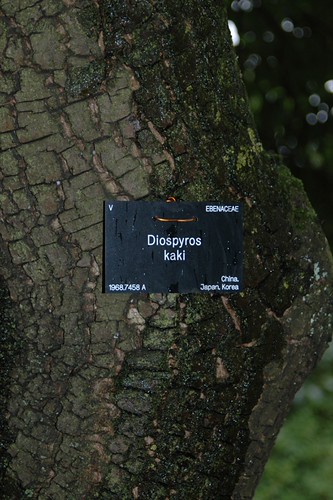
Let’s go and take a closer look I suggested and used my usual technique for identifying trees in the Botanics – I looked at the label!

kaki label

Well! We were stunned! Of all the trees in the Botanics what on earth were the chances that we’d be standing next to the one example in the gardens of the particular tree we were discussing?!
My Dutch friend said, “I don’t know what you believe about how the world works, Bob, but I’m going to send you a sample of the remedy prepared from the kaki tree.

Before I tell you the next part of the story, have a look at the bark of this tree.

kaki bark

You begin to have an idea why this particular species managed to withstand the nuclear blast. Still, for any tree to withstand it was quite amazing. Diospyros kaki means fruit of the gods and this tree is recognised as highly significant in Japan, the kaki fruits being placed in Shinto shrines. Here’s the fruit at an early stage of development –

kaki fruit

My colleague was as good as her word and the following week two vials of the homeopathic remedy arrived for me at the dispensary in Glasgow Homeopathic Hospital.

The following day I had a new patient, a young woman whose recurrent breast cancer disease had recently been described by the oncologists as terminal and who had been told she had very few weeks left to live. She was suffering from nightmares and sleeplessness which none of the sedatives she’d been prescribed had helped and she wanted to try a homeopathic medicine. I’m not going to give any more detail than that here but suffice it to say, I gave her the Diospyros kaki remedy and her sleep immediately returned to normal. In fact, more startling than that, she went on to experience an improvement in her energy and well-being and she went on to live for another couple of years. In those two years she stopped her career, trained in another area altogether, and worked successfully in her new field for a few months before the cancer overwhelmed her and she died.

I’ve used this remedy a few times since in similar circumstances. It’s one of the remedies which really makes me think about our basic concepts of health and healing. It does not cure cancers, but in the right circumstances, in my very small experience with this, it can help a patient cope, and, more than that, even to grow in the presence of severe disease.

[Let me just finish this with a short paragraph about the homeopathic method, because this, I think, is an amazing story. However, I want to make very clear that not only is this not a cure for cancer, but it’s not the relevant medicine for just anyone who has cancer. Every homeopathic prescription is individualised on the basis of the patient’s unique personal story, taking into consideration the disease, the person who has the disease, and the contexts of their life. The patients for whom I’ve prescribed this kaki remedy, and who report that they benefited from it, have all been strikingly remarkable people – pragmatically positive, creative and caring individuals – who share a number of characteristic features]

Read Full Post »

« Newer Posts - Older Posts »