Feeds:
Posts
Comments

Posts Tagged ‘life’

Wonder and awe

Episode 2 of my More Good Days podcast is available now, come and subscribe to my substack to receive each episode, free, in your inbox.

Here’s the text, if you’d like to read it……

Are you having a good day? Was yesterday a good day? Whatever your answer, and, yes, I would really like to know about your good day, let’s make today a good day. I’d like to help you do that, and I think the best way for me to do that is to share with you what I’ve learned from my experience with thousands of patients who told me what makes a good day for them, as well as sharing what makes a day a good day for me. 

We are all different. We live according to our own values, tastes, desires, our own relationships and issues, so what goes towards making today a good day for me, may well be different from what makes a good day for you. However, we also have a lot in common, there’s a lot that we share. 

In this podcast, I’ll share with you lots of actions you can take to make today a good day. There are tried and tested principles underpinning these actions. Many of them have been taught through different cultures and traditions over centuries. Some we’ve only discovered more recently. 

You can take any of these principles, try any of these actions, for yourself. Make them your own. The way you apply these ideas in your everyday life will also be unique. That’s great. That’s how it should be. Your day is unique, because you are unique. Nobody else is living, will live or has lived the exact same life as you. We might all be made from the same star stuff, we might all share the same air, the same water, and food produced from the same ground, on this little blue marble of a planet, but there are no two of us who are, were, or ever will be, exactly the same.

When I ask if today is a good day, I know there aren’t just two kinds of days. Good ones and bad ones. Our experiences are much more nuanced than that. Our days are more multi-coloured than that. You may well have some good experiences today, but there might, as well, be some not so good ones, and only you can decide if you’d like to call today a good day. 

In the evening, maybe before you head off to bed, you might reflect on your day, ask yourself, how does it feel? Are you going to call this a good day? If so, why? What particular moments, which specific experiences or encounters made this a good day? 

And if you don’t feel you can call this a good day? Well, why not? What happened today, what experiences did you have that lead you to say that today wasn’t a good day? 

As you think back over the day, even if you conclude it was a pretty crappy one, were there any moments in it which felt good?

You might like to just spend a few minutes on this, this reflecting, this thinking back over the day. 

Why not get a notebook, a journal, and write your thoughts down? These days some people prefer to speak their thoughts, rather than write them and that’s so easy now. Our phones and computers all have easy to use dictation software on them now. So, you could record your thoughts by speaking them into a digital note. Paper, phone, computer, whatever works best for you. The important thing is to make it a habit. Do it every day. Spend a few minutes, reflecting and noting down what made today a good day (or not a good day!)

Remember what we pay attention to, grows. So, my suggestion is to become more aware of what, in your opinion, makes your days good ones, and to spend some time remembering, and so reinforcing, whatever made them so. 

L’émerveillement du quotidien

If there was just one thing I’d recommend to anyone wanting to increase the quality of their everyday life, it would be to nurture a capacity for wonder and awe. 

There’s a French phrase which has appealed to me a lot from the very first time I encountered it – “l’émerveillement du quotidien”. It’s not that easy to translate, because I don’t think any single English word substitutes for “émerveillement”, but the “du quotidien” bit is easy – it means everyday, as in “ordinary”, “typical” “daily” – but the key is the “émerveillement” which contains the meanings of “wonder”, “amazement”, even “awe”. 

I’m fairly happy to translate it as “the wonder of the everyday” as long as that phrase also conveys the idea of “the extraordinariness of the ordinary”. 

The thing is, every single experience we have, we are having for the first and last time ever. Every single experience is unique. Every encounter is unique, just as every person and every relationship is unique. We can get in touch with that uniqueness by stirring up a sense of wonder. 

Actually, the practice of becoming aware of first and last times, is an ancient “spiritual” or “philosophical” practice, which I’ll go into in more detail another time. But, for now, let’s spend a little time wondering about wonder….where can we find the inspirations that make us wonder?

Wonder in Nature

I find natural phenomena to be the greatest source of wonder. I can be amazed at the sight of a butterfly, the colours and patterns on its wings, (astonishingly, the colours in a butterfly wing are mainly produced by the microscopic scales which cover the wing. These scales reflect and absorb light to produce the appearance of colour. I’m not sure I can quite get my head around that). I watch in wonder at the way a butterfly flits from flower to flower, constantly changing and direction. I try to predict which flower they’ll fly to next, and I never get it right. I’m sure I once read that physicists haven’t managed to work out how on earth a butterfly manages to fly that way. As I watch the butterflies I think of how different they are from the caterpillars which they were when they were younger. How on earth does a creature like a caterpillar, create a cocoon for itself, and emerge some time later utterly transformed into a beautiful, butterfly with the ability to spread its brand new wings and fly? 

I can be entranced by the little lemon tree growing outside my front door, now full of buds, then flowers, amazed at the dark, unexpectedly reddish colour of the new growth leaves, delighted at the appearance of the lemons, first as small green globes, swelling and ripening over many weeks to beautiful yellow lemons.  I can lose myself gazing up at the shapes of clouds in the sky, watching them constantly morphing from one shape into another. I can be surprised and captured by the way the petals of a flower catch the sunlight making it seem like they are glowing, looking as if they are shining this energy from within themselves. You get the idea, I’m sure. 

I love to walk amongst the trees, to pause, take deep breaths and smell that cool, slightly damp, woody smell. I delight in the diversity of colours and shapes of their leaves, their blossoms, the sometimes immense girth of their trunks. I think of how some trees have been alive for centuries, and how, despite the fact they don’t have brains, and they can’t move from place to place, they’ve evolved the ability to live on this planet for much longer than we humans can. I think of the scientist, Richard Feynman who said that trees are created out of the air. They take in carbon dioxide and water from the air, and turn it into trunks, branches, twigs, leaves and blossoms. They capture the sunshine for energy and create the oxygen without which every single animal, including humans, would die. You might think that trees get their water from the ground, but, Feynman said, yes, but where does the water in the ground come from? It comes from the sky. Trees really do create themselves from sunshine and air. Isn’t that incredible?

By the way, there is a lot of evidence that spending time amongst trees is good for your health. I’ll tell you about that in another episode.

If you ever browse through the photos people post on social media you’re likely to find plenty of pictures of sunsets. We love sunsets, don’t we? Especially sunsets over the oceans. How often do people gather on beaches, or along promenades to watch the sun go down? One sunset that really made a great impression on me was in the movie, “Le Rayon Vert”, The Green Ray. The film is based on the Jules Verne novel of the same name, although his story is set in Scotland, whilst Eric Romer’s film is set in France. The green ray in question is a rare phenomenon which can occur just as the last of the sun sinks below the horizon of an uninterrupted view across an ocean. The legend, Jules Verne created, was that when someone observes the green ray, they can see into their own heart, and into the hearts of others. 

I don’t live on a coast, but any time I notice the clouds in the sky turning pink as the sun sets, I feel compelled to go outside into the garden, to look up, and just savour the glorious, fast changing colours, in those last few moments of the day.

Meanwhile, which natural phenomena caught your attention today?

Wonder in people

Also, I’m amazed by people. I looked forward to every Monday morning at work because there would be a new clinic, with new patients come to share their utterly unique and wonderful stories with me, and then there would be others coming to relate the changes they had experienced since their last visit. You couldn’t predict what they were going to say, and you never heard an identical story twice. Time and time again patients would tell me about their experiences of trauma, events which had wounded them sometimes which had happened decades ago. Events which shocked and upset me, but which they’d survived. They would demonstrate astonishing abilities to cope and to keep going. Many times I would think, wow, you are an amazing person. Many, many times patients would say to me “You’re the first person I’ve ever told that. I’ve never spoken about it to anybody else”. The fact that we could create such trusting relationships made me feel very, very privileged. I’d hear people say, “You know me better than anyone else ever has”, and I was convinced that meant they now understood themselves better than ever before. 

These comments were common in my place of work. Colleagues had the same experiences. Both during my years as a GP, and my years working at Glasgow Homeopathic Hospital, I was privileged to have colleagues who shared a holistic, non-judgemental approach to patients. It really was normal for me to hear my partners and co-workers describe their enthusiasm about such impressive, and even awe inspiring encounters. It wasn’t like that 100 percent of the time. We all had our share of misunderstandings, disappointments, and frustrations. But it happened enough of the time for those days to feel like good days, and for there to be enough of them for us to feel that this way of practicing Medicine was a life worth living. It felt like we were helping to make the world a better place, for one person at a time. 

Wonder in learning

When I was a child my parents subscribed to two part work magazines for me. One was called “Knowledge” and the other was “Look and Learn”. I loved them and looked forward, every fortnight, to each and every new issue . I collected them in especially designed folders, gradually creating my own encyclopaedia. In fact, I was so taken with the range of knowledge, discovery and wonder available in an encyclopaedia, that, at 24, when I graduated from medical school, and received my first month’s pay as a Junior Doctor, I bought a complete set of “Encyclopaedia Brittanica”. I still have it. I know the internet, what with wikipedia, and everything, have made something like that pretty redundant, but I still enjoy pulling out a volume at random and opening it to discover something new to me. It’s the serendipity of these discoveries which delights me. 

You’ll be familiar with the old saying “Every day’s a school day”. It’s often used when something goes wrong, but something we can learn from, or where we suddenly realise something. Insights and understandings are the kind of learning which can thrill me. Those, “aha” moments, where something becomes clear. By the way, learning, it appears, is good for you. People who learn a second language, for example, have been shown to have healthier brains. Maybe it’s the old “use it or lose it” phenomenon, but whether or not that benefit is real, I find that on the days I learn something, I’m more likely to experience that day as a good day. 

When I retired from medical practice in Scotland, I emigrated to France, partly because I was drawn to French culture and French weather, but, also to immerse myself in learning a second language. Twelve years here and I learn a little more French every single day, reading it, listening to it, and having everyday conversations with neighbours. It’s even inspired me to begin to learn more languages, which is a bit of a surprise, because I was never keen on language learning at school. So, if “every day is a school day”, I find that learning is actually a lot more fun now than it ever was back in the day when I was actually a school boy. Learning is a form of wonder for me. I’m delighted and amazed by what I discover. 

Wonder in the human body

When I studied Medicine at university, I was frequently amazed by what I learned about the human body. I remember especially the lectures in embryology, illustrated beautifully in coloured chalks by the Anatomy professor. I was utterly astonished by how two cells, at the very beginning of a human life, a sperm and an ovum, after merging, would double and double, again and again, organising themselves into a complete human being, with arms, legs, a face, and all the bodily organs and systems. All in exactly the right places. It still astonishes me to think of that. 

I was amazed at the healing powers of a human body. How it could knit together a broken bone, seal a cut in the skin, resolve a bruise, or reduce a swelling. I saw how the body did all those things and more, not because a drug had been prescribed, but because that’s what a body does. That still amazes me. 

At seventy years old I realise more than ever just how little we humans can know and understand about life, about this planet we live on, about the universe. I know that I understand much more now than I did when I started work aged 24, but I am humbled by the realisation of how little that is in the grand scheme of things. 

So wonder keeps me engaged with the present day world, and it keeps me humble and open minded. Moments of wonder delight me. They can stop me in my tracks. They bring me joy, a smile to my face, a deep sense of belonging in this incredible world which we all share. They stir a feeling of gratitude, and that’s such an important part of making a day a good day. They make me feel it’s good to be alive. 

I’ve got two poems for you today, both of which have something to say about this sense of wonder.

The first is “Lost” by David Wagoner….

Stand still. The trees ahead and bushes behind you

are not lost. Wherever you are is called here,

and you must treat it as a powerful stranger,

must ask permission to know it and be known.

The forest breathes. Listen. It answers,

I have made this place around you.

If you leave it, you may come back again, saying here,

no two trees are the same to the raven.

No two branches are the same to the wren.

If what a tree or a bush does is lost on you,

you are surely lost. Stand still. The forest knows

where you are. You must let it find you.

This is such a beautiful poem. It’s about presence and the power of Nature. It reminds us of the basic fact of uniqueness, how no two moments are the same. It’s entitled “Lost” and it tells us clearly that when we are feeling lost, we just need to turn our attention to the natural world around us, and feel that deep connectedness which arises when we open our hearts and minds to the living world. 

The second poem is by Gregory Orr…

Ask the tree or the house

ask the rose or the fire

hydrant – everything’s 

waiting for you to notice.

Everything’s waiting for you

to wrap your heart around it.

That music has been playing

since you were born.

You must be mad to resist it.

Always the beloved

surrounds us,

eager to dance.

All we have to do is ask.

Here the poet includes inanimate objects, a house, a fire hydrant. He reminds us that this world we live in is an abundant one. We only need to turn our attention to whatever is around us to become aware of that. And, I think, crucially, he says we need to pay a particular kind of attention….you need to “wrap your heart around it”. It’s Mary Oliver’s “loving attention”. It’s Saint Exupery’s Little Prince learning that what’s most important is what we see with the heart. “That music has been playing since you were born. You must be mad to resist it.”

So, there we have it. My main sources of everyday wonder spring from the natural world, from people, from learning and from the amazing human body. 

How about you? If you do start to note down what makes a day a good day for you, then over time you’ll start to become aware of your own personal sources of wonder, of awe, amazement, and, yes, joy. All of these experiences are likely to create good days for you, and as that becomes your norm, I’m convinced you’ll start to feel, more and more, that you are living a life worth living. As you experience that, as I experience that, as we, and our friends and family experience that, we’ll build the strength, the ideas and the will to make this world a better place. 

Last time I included a poem by Mary Oliver, and this time I’ve read you two poems, one by David Wagoner, and one by Gregory Orr. I think poems engage us in a unique way. I’ve learned that they stimulate and reinforce the part of our brain which is responsible for a particular kind of attention – a broad, appreciative, attention which reveals patterns, connections and the whole to us. I’ll tell you more about that part of the brain in a future episode. But, for now, I’d be really interested to hear from you if you have any favourite poems. Please, get in touch and tell me what they are. I’d like to include them in future episodes, so that we, you and I, can build our own poetry collections to dip into, to savour, relish and enjoy. 

I’ve read that poems were originally music, originally sung. I’ve also read there is a theory that music preceded speech in human evolution. Whether or not that’s the case, there is no doubt that both poetry and music go deep into our souls. I can’t imagine life without them. Well, I can, but it would be a diminished life, a poorer one. 

So, what about music? How much do you listen to music? What kind of music do you like? It’s a fair bet that our musical tastes and preferences are unique to us, but I’d like to share with you some of the music which means so much to me. Because I listen to music every day. I listen casually, playing music while I’m doing something else, but I also listen deliberately, sitting down and paying attention, just to the music. Music can affect my mood, and I’m willing to bet it can affect yours too. A particular song has the power to take right back to a day long ago, in the same way that Proust’s madeleine did for him. In fact, there’s good evidence that music has the power to affect our brain function, improving everything from memory to cognition. I’ll say more about that some other time. 

I have a vinyl record collection which I bought, one record at a time, mainly through my teens and twenties. But I suppose I mainly listen to music these days on streaming services, like Spotify and Youtube. I’ve created a More Good Days playlist on both Spotify and Youtube, where I’ve started to add songs that, I find, contribute to more of my days becoming good ones. Check them out, and let me know if there are any particular songs you’d like me to include. Or make your own playlist, for your own enjoyment. If you’d like to, send me a link to your own playlist and I’ll check it out. 

The easiest way to find my playlists is to use one of the links here – 

Here’s the link to the Spotify playlist – and here’s the link to my youtube one – 

Here are the first songs on my More Good Days playlist – 

First off, I like Days Like This, by Van Morrison. I’ve got quite a number of Van Morrison albums on vinyl and this song is one of my favourites. For those days where everything feels just right.

I was born in 1954 and the first records I bought were by The Beatles. I still play many of their songs, but one which actually mentions good days is “Good Day Sunshine”, a simple song about how sunshine and love can make the day a good one. Brian Wilson, of the Beach Boys said this was one of his top 10 favourite Beatles songs.

One Day Like This by Elbow. I love Guy Garvey’s singing voice. Another song about sunshine and love, but with the great line “kiss me like we die tonight” which is spot on for the old “first and last” technique the ancients taught. I also like that Guy sings that one day a year like this would be good enough for him. I know not all days can be good ones, and I sure hope you have more than one every year, but, from time to time, we’ll all have really great days. Just like Van Morrison’s mama told him!

Next up is Lovely Day by Bill Withers. This goes back to the late 70s, and again, sunshine and love are credited for the creation of a good day, but the focus here is really the loving relationship. “Just one look at you and I know….”

I’d never heard of the band Luce until I searched for songs with “good day” in the title, but this is a good one. It also focuses on those themes of love and sunshine, but like Bill Withers song, the loving relationship is the key.

Another song that came up on my search was Good Days by Rodell Duff. I’d never heard this one before either…more sunshine and a loving relationship in play here, but the lines that really connected to me were “so let’s don’t let these Hours and minutes and seconds go to waste, hey ‘Cause these are the good days” which reminds me to reflect on the moments which made today a good one, not least to reinforce them in my life.

Going back to my single buying days, I had to include Thank you for the Days by the Kinks which reminds me of the power of gratitude. I’ll return to that subject, but expressing gratitude for what you’ve experienced today is a powerful psychological practice which contributes to mental health and wellbeing. 

Colin Vearncombe, who sang as “Black”, had a beautiful voice and I’ve long since been a fan of his bit hit with Wonderful Life, which reminds us “There’s magic everywhere”

And, finally, so far, a classic from Louis Armstrong, What a Wonderful World. I mean, this is just perfect, isn’t it? He sings of the natural world, of seeing friends shaking hands and of the miracle of witnessing a child growing up. 

That’s nine songs, and a playlist of 33 minutes. I hope you enjoy all of them, or, at least, some of them!

If you’ve enjoyed this podcast, I’d love to hear from you. You can find me on Bluesky where I post pretty much daily. Just pop my name, bobleckridge, all as one word, into the Bluesky search box and you’ll find me. There’s only one Bob Leckridge! And if you do decide to follow me there, please say hello and introduce yourself. 

I’m just getting started on Substack but you can find this podcast there, you can find a transcript there, and, if you subscribe, you’ll start to receive regular emails from me. But you can also say hello, and introduce yourself there, and if you send me a message, I’ll always reply. 

So, until next time, au revoir et bonne journée, bye, and have a good day. 

Read Full Post »
I’ve created a podcast. If you’d like to listen to it come to my Substack page.

Here’s the transcript of the first episode.

“Hello”, that’s what we say when we answer the phone, isn’t it? 

Hello. 

A simple little word we most likely say automatically. It’s kind of a habit, isn’t it?

But we don’t say it only when answering a phone. We say it to acknowledge other people. To connect, even if only briefly. 

When I moved to France I quickly noticed how often people said “bonjour”. Pretty much everyone who passes when I’m out for a walk says “bonjour”. Even teenagers. That was a shock! In fact, teenagers will often say “bonjour, monsieur” which sounds even more polite than just “bonjour”.

I quickly noticed that every conversation starts with “hello”, or “bonjour”, I mean. So, when it’s your turn at the check-out, the check-out man or woman will always say “bonjour” before starting to process your purchases. And you will say “bonjour” in return. It would be impolite otherwise. In a smaller shop, say, a boulangerie, a cafe, or the local post office, people will say “bonjour” when entering the premises. They might say “bonjour, messieurs, dames”, “hello, ladies and gentlemen”, if there are other customers already in the shop awaiting their turn. But, even if there are no other customers, the first thing to say is always “bonjour”. 

I like that. I liked it from the first moment I encountered it. Saying “hello” is an acknowledgement. It’s a way of making a connection. It says, “I’m here and I see, or hear, you”. It establishes a “we”, even if only fleetingly. It makes the world instantly feel a more friendly place. 

When I was a teenager I used to listen to the DJ, John Peel, and I’ll always remember one autumn when he talked about all the leaves that fall on the ground. He said he liked to carry a pen with him. I guess, these days, it would be a “sharpie” or “marker pen”. And he’d stop from time to time and pick up a leaf, write the word “hello” on it and place it back on the ground. He liked to think it would brighten the day of some stranger who’d notice the leaf, pick it up, and read “hello”. 

It’s a small word, and little habit, but, in my experience, it makes the world a better place. 

Hey, that’s a big claim, isn’t it? I mean, it’s just “hello”, for heaven’s sake! 

I can only say, check it out for yourself. How often to people say “hello” to you? How often do you say “hello” to others? Does it seem to make a difference?

That’s a general principle I have – noticing. We’ve got a tendency to live a lot of our lives on autopilot. In fact, my blog, which I’ve been publishing for many years now, is entitled “Heroes not zombies” – you can find it easily by typing heroes not zombies into any browser. I called it that because to address exactly that issue – that we have this tendency to slip into autopilot, living an only semiconscious life, driven this way and that by others, pushed and pulled by circumstances, like zombies. That makes us vulnerable and biddable, with corporations, politicians, and others pushing our buttons to make us respond their will, rather than use our own. But if we wake up, become more aware, pay more attention, then we can increase our autonomy. We can make our own choices, create our own narratives, become the heroes of our own stories. I mean hero in this way. I don’t mean like a sort of super hero with special powers. I mean the main character, the hero, of the story….of your story. 

Over the years I’ve posted articles and shared photos on my blog, all with the hope that others will be inspired to wake up, pay more attention, and resist slipping into autopilot so much. 

So, about this saying “hello”. I’d say try becoming more aware of it. Notice when people say “hello” to you, and grasp the opportunities to say “hello” to others. Then, you decide. Does this help make a better day, a better life, a better world, even? 

In more recent years, here in France, I’ve noticed that there’s another word people are using every day. It’s “bonne journee” – ok, it’s two words, a phrase, not just a single word. But it’s everywhere now, it seems. When leaving the check-out, when leaving the cafe, or the shop, almost always now, you’ll hear, not just “au revoir”, which, by the way, is such a nice way of saying goodbye, because, literally, it’s “until seeing you again”, but, in addition now, you’ll hear “bonne journee” – the French equivalent of “have a good day”. Once I noticed it being used so frequently, I started to use it myself, and it’s my routine now. As I leave the check-out, the restaurant, the boulangerie, I say “au revoir, bonne journee”. 

Actually the French have rippled out this phrase into a whole range of context-specific forms. So, it’s not unusual now, on leaving a boulangerie on a Friday to hear “Bon weekend”, or if you’re there on a Sunday “Bonne dimanche” – “have a good weekend” or “have a good Sunday”. There are loads of others!. 

What I like about this is that it’s an expression of good will. It’s saying to someone else, you wish them to have a good day. 

Well, all that focus on good days got me thinking. What is a good day, anyway? What makes a good day, a good one? And that’s what led to this podcast. 

My hope is, that together, here, we will share what goes to making a day a good day. Because, as I used to say to my patients, you are only alive today, here and now. If you spend all your time in your head going over the past, regretting it, re-experiencing the pains of it, or if you spend all your time in your head in the future, wondering what if this, and what if that? Then your head is filled with hurts, sorrows, anxieties and fears. But what if you deliberately stop that and turn your attention to the here and now? What if you just slow down for a moment and notice what is around you? Not just notice, but pay some attention. Engage. 

Well, then, maybe you’ll start to find some relief. 

Maybe you’ll start to have more good days.

I’d like to help you to have a good day, and I think the best way for me to do that is to share with you what I’ve learned from my experience with thousands of patients who told me what makes a good day for them, as well as sharing what makes a day a good day for me. 

We are all different. We live according to our own values, tastes, desires, our own relationships and issues, so what goes towards making today a good day for me, may well be different from what makes a good day for you. On the other hand, we are all human, and so we have a lot in common. 

I worked as a doctor for four decades, and I’ve often said how I’d look forward to Monday because it was the start of another week. A week where people I’d never met before would come to me and tell me their unique, individual stories. 

I never lost that sense of awe which I’d experience when people told me about their lives. In fact, it wasn’t just the “new” patients I looked forward to seeing. I was just as keen to meet again with those who’d come to me before, maybe many times before. 

We prioritised continuity of care at my place of work. As a patient you could expect to see the same doctor at every visit. It would be unusual if you didn’t. 

This meant we developed long term relationships with our patients, stretching over many months, many years. In some cases, even over different generations. What a delight it was to help a young parent, who’d I’d originally helped when she was just a toddler. Human beings amaze me. Always have done. Still do.

Everyone I met had a unique story to tell. Everyone I met was different. And, yet, everyone I met also had many similar experiences, suffered from the same common symptoms, and manifested very typical patterns of behaviour, and of illness. 

I first expressed the desire to be a doctor when I was three years old. I don’t know where that came from. Nobody in my family had ever worked in health care. I had no relatives who were doctors or nurses. 

I reckon it’s always been a kind of “calling” for me, even though I know that’s not a common word to use about work these days. 

Why did I want to be a doctor? To help people. In fact, I’ve often thought that there’s a purpose to my life….that I’m here to contribute to the creation of a better world. That I’ve a responsibility to try to leave the world a little better place than it was when I entered into it. 

I guess the main way I’ve tried to do that has been one person at a time. If I can help reduce this particular patient’s suffering, if I can help them to heal, to cope better….if I can help them to grow even, then I’m making a contribution to making the world a better place.

We all live our lives a day at a time, and the only place we have power to make a change is right here, right now. So, in this podcast I want to share with you the ways I’ve discovered to help make today a better day. 

As I started to think about what made a day a good day, it seemed pretty clear to me that if we experience more good days, then we might begin to feel that our lives are more worth living. But I don’t think having good days is just about having more happy days. I think it’s about having more days which feel meaningful, valuable, more days where we enrich our relationships and where we grow. 

If more of us have more good days like that, more of us will have the experience of living lives worth living. Then, maybe, we will be able to contribute to making this a better world. 

I have this picture in my head of three concentric circles. Each circle representing a zone of time and space. The innermost circle is where we experience and create the present. 

It’s where we can have our good days. 

The more good days grow in both frequency and intensity, the more they contribute to the creation of the next circle….lives worth living. This is the zone of a lifetime. 

Our lives can feel more worth living, the more good days we have, and the more our lives feel worth living, the more good days we are likely to experience, because in a life well lived there are more opportunities for good days to happen. 

Good days contribute to lives worth living, lives worth living create more opportunities for good days. 

But there is more to a life worth living than is contained within good days, which is partly why this second circle is bigger than the first one. 

We need more than good days. We need more than happy times, enjoyable and rewarding moments. We need to grow, to develop, mature. There’s a French word I love – epanouissement – which means to flourish or to blossom. It’s used to describe what flowers and trees do, but it’s also used in psychology to describe what Jung would call “individuation” – a growing, developing psyche. 

In future episodes we can explore some of the things which help us to grow, to flourish. 

It seems to me that when more of us experience lives worth living, then we will be on track to make the world a better place. That’s the third, outer circle. The zone of the world. 

Nothing exists in isolation. Our lives and our days all occur within particular contexts, specific environments. If we improve these environments, we’re making a better world, and, in turn, we are creating the conditions for more of to live lives worth living. We live in the shared physical, social, and cultural environments, we find in this third, outer circle. We influence these environments through our choices and our behaviours, and these environments, in turn, profoundly influence us. 

A better world will, I believe, be one where we take care to improve these environments. That’s how we will increase the chances of more and more of us experiencing better lives and having more good days. 

One more thing before I begin. I don’t see the world through a binary lens. What do I mean by that? Well there aren’t two kinds of days. Good days and bad ones. It’s not so “black and white”. In every day there will be experiences we appreciate and others we’d rather have avoided. Life is nuanced, and its mixed. 

What we pay attention to gets magnified, so let’s start by paying attention to what makes for a good day. And see where that leads us. 

Here’s to more good days. 

Whatever we pay attention to gets magnified. The more attention we pay to something, the larger it will feature in our minds. Any gardener will tell you the less attention you pay to your plants, the less likely they are to survive, and, in fact, we can say the same about our children. The attention we pay to babies isn’t only crucial for their survival. It literally shapes their brains, influencing both the number of connections created between brain cells, and also the strength of those connections. 

There’s a whole field of developmental psychology devoted to attachment styles….how the kinds of attention paid by main carers shape a child’s personality and behaviour. Patterns which persist right through adult life. 

Paying attention, especially a loving, and caring attention, profoundly affects both survival and thriving. It shapes how we see the world. It lays the foundations for both how we experience and how we interact with the world.

Philosopher and psychologist, William James, described the natural behaviour of attention as “wandering”. That’s what attention does. It keeps wandering. We all have that experience, don’t we?

It’s pretty difficult to keep our attention focused on anything specific. We have to work at it, because attention doesn’t only keep wandering, it’s always on the lookout for whatever is new – a movement, a sound, a characteristic. 

Have you ever noticed how quickly you can spot the movement of an animal, a bird, or a person, when gazing out over even vast landscapes? When something changes in our field of vision, we notice it straight away and turn our attention to it. The same thing happens with sound. It’s not just that we jump, or get startled by sudden loud noises. If we are in an environment where there is a constant background, perhaps machine noise, the moment it stops, we notice it has stopped. We are wired to detect change. To pay attention to what’s new.

The social media giants, mainstream media, and especially the advertising industry all work hard to try to grab and keep our attention. 

One way they do that is by continuously feeding us new things – images, sounds, or information. The invention of “infinite scrolling” where you can never reach the end of a “feed” is one of the most effective, addictive tools they use to keep our attention – to keep our attention on their website, their platform. I read an interview with a software engineer who invented this “infinite scrolling” and he said it was one of his biggest regrets because it has such enormous addictive power.

Apart from noticing what’s new, there’s another way to grab our attention. Stir up strong emotions. 

Just as attention magnifies whatever it is focused on, so can attention change our world by making us angry or fearful. The more we fill our inner experience with anger and fear, the more we pay attention to whatever that anger or fear is attached to. In fact, not only what they are attached to, but the anger and fear themselves, which become all-consuming, setting up our whole being into “fight or flight” mode, with surges of adrenaline, and cortisone, which creates a state of chronic inflammation in the body. What does on in our minds doesn’t stay in our minds. It cascades throughout our entire body, changing it as goes. 

Sensationalist headlines do exactly the same. They aim to catch our attention and keep a hold of it, turning us into anger and fear zombies in the process. 

But we don’t need to live our lives on autopilot. We can make some conscious choices about what we want to pay attention to. We can choose to notice, and to focus in on, beauty, for example. Or we can look out for whatever inspires wonder and awe. 

We can deliberately pay attention to positive emotions, to whatever stirs our souls and makes us feel gratitude for being alive. We can choose to use what the poet, Mary Oliver, called “loving attention”, the kind of attention which generates care, compassion and gratitude. 

Because if we choose to use attention consciously, to choose, in particular, to use loving attention consciously, then our lives and our minds become ever more full of love, wonder, delight, care, compassion and gratitude. 

We just have to practice it, and to practice it every single day. 

In my medical career, I frequently met patients whose suffering was magnified by their attention being trapped in the past, going over and over old wounds and hurts, or by their attention being trapped in the future, imagining all the worst possible outcomes and fearing them. Part of the work of releasing them from their suffering involved helping them to turn their attention to the here and now, where, around us, every day, there are phenomena which can delight and engage us. 

I think we all can begin to experience better lives by, first, becoming aware of where our attention wanders to, and where it gets caught. Only then are we able to make more conscious, personal choices about where to direct it. 

Remember, attention is a great magnifier. It grows whatever it is focused on. So, let’s choose what we want to focus it on. 

How about we focus it on awe, on wonder. My favourite French phrase “L’émerveillement du quotidien” captures exactly that – the wonder, or amazement, of the every day”. What have you noticed today that caught your attention? Did anything stop you in your tracks, or slow you down, to focus on it? Maybe you paused to get your phone out and took a photo. I do that a lot. It’s a great way to slow yourself down, to pay better attention to the here and now, and to give you more chances later to re-visit that moment, to see it again, but with fresh eyes in a different context. And it gives us a chance to share with others what has amazed us. 

Do you use any social media? Maybe you’d like to share some of your photos on Instagram, Facebook, or, in my case, on Bluesky. If you’d like to see my every day photos come and follow me on Bluesky. You’ll find me at this address – @bobleckridge.bsky.social If you do come to Bluesky, send me a message and say hello, so we can connect there. I’d love to see what amazes you every day. 

But my good days aren’t just about what generates awe and wonder. I find that if I decide to focus on whatever delights me, what touches and moves me, then that too helps to create more good days. For me, that includes poetry. I have a little notebook where I copy out by hand my favourite poems, the ones which I come across and which draw me in, move me, inspire me. 

And it includes music, too. I’ll tell you more about that in another episode, and I’d love to hear from you what songs, what compositions, really delight or touch you. Come and find me, either on Bluesky, at @bobleckridge.bsky.social or at heroesnotzombies.com where I’ll post the transcripts of each of these podcast episodes. 

Another of my great passions, which is a huge source of joy, delight, wonder and awe for me, is art. I enjoy seeing what others have created. I love sculpture, especially sculpture outside, in natural environments. But I love a wide range of visual art and always seek out a good gallery or museum if I’m on a city break, or staying somewhere on a trip. Art has incredible power to communicate what we find difficult to put into words. 

I do love words, too, however, and most good days involve some kind of encounter with stories….either the stories of patients, family or friends, of the stories I find in books. I’m an avid reader. 

I don’t know how many of these activities you identify with, but I’d love to hear about your own examples. In the podcast episodes to come, I’ll share with you examples of all of these, and more. 

When it comes right down to it, I recommend we focus on whatever it is that stirs our souls, whatever it is that generates feelings of gratitude and love. That way, I’m pretty sure, we’ll have more good days, more of us will experience our lives as worth living, and together we can create a better world. 

Let me finish today with a Mary Oliver poem, “The Summer Day”. 

The music I play as an intro and an outro is “What a Wonderful Day” by Shane Ivers. Here’s the credit – Music: What A Wonderful Day by Shane Ivers – https://www.silvermansound.com

Read Full Post »

In Jenny Odell’s “Saving Time” she criticises the term “Anthropocene” and writes – 

“A history with no actors, only mechanisms”

That phrase stopped me in my tracks. Isn’t this also a perspective we could take on contemporary Health Care – a system “with no actors, only mechanisms.”?

“Agenda for Change”, a management led sweeping reform of job descriptions and contracts was applied to all but medical staff in the Scottish NHS. It involved breaking the daily work of employees (mainly nurses and admin staff) into tasks with the defined knowledge and skills required to carry them out. Once written into the job descriptions and contracts the human beings actually performing the tasks became invisible. Only the knowledge and skills to do the tasks are important. The tasks take first place, who carries them out becomes irrelevant. The process resulted in many staff finding their posts had been downgraded, and, later, that less highly trained, less well paid staff, trained to do specific tasks, were employed to take over much of the work. The concept of the nursing professional, trained and experienced to conduct her or himself with much day to day autonomy in clinical decision making, was eroded. The posts became interchangeable, more minutely monitored, measured and controlled. The “mechanism” became more important than the “actors”. 

“Lean Management” techniques, developed in factories and offices, where daily work is broken down into processes and events each of which can be measured and controlled in the interest of “efficiency” were rolled out, with no interest whatsoever in either individual patients or the doctor-patient relationships. It didn’t matter who cared for a particular patient, as long as they carried out the necessary tasks with the prerequisite knowledge and skills. The efficiency of the Service is now measured in terms of numbers – numbers of patients treated each year, numbers of “clinical events” carried out by each member of staff, daily, numbers of various tasks “completed”. In the ward where I worked, where there had never been a case of “hospital acquired infection” or a patient who developed “bed sores”, the nurses had to report the zero number of cases of each of these problems every month to their managers, and to create and display a graph showing the zero number, a straight line, running through a number of months. Concepts like “continuity of care” have been eroded. When my dad was admitted to hospital in the terminal phase of his cancer, I found myself thinking, “Why is it that every single doctor, and every single nurse, I ask about his condition, replies that he is not their patient but they will consult his records and get back to me?” And while visiting another relative in a different hospital I overheard one member of staff ask another if they’d “taken the blood from bed 14, yet?” Good luck getting blood out of a bed, I thought. To be fair, this substitution of patients’ names by their bed numbers was a practice which I’d encountered way back in the 1970s as a medical student where we’d be sent to “listen to the heart murmur” or “feel the enlarged liver” in Ward 3…..”no actors, only mechanisms”.

It’s also a long established fact that a disease centred approach is used both in medical education and in clinical practice. Hospitals and clinics are organised along disease centred lines, with departments of specialisms from Cardiology to Dermatology, Renal Medicine, Endocrinology etc. The disease and the systems of treatment structure the entire institution, irrespective of individuals with multiple comorbidities. As the numbers of people living with three or more chronic diseases rises, more and more people experience their care divided between several different hospital departments, each with their own appointment systems, processes and ever changing staff. General Practice used to be the counter to all this, with both training and practice founded on patient centred, holistic principles, but the same principles applied in hospitals have infiltrated General Practice, with the development of disease-centred clinics within each Practice, and an increasing number of doctors working on limited term salaried contracts, or as locums. None of my relatives can tell me the name of “their GP” any more. Instead, they are encouraged to seek telephone assistance from NHS call centres staffed by people they will never know, and directed to see certain doctors, “specialist nurses” or “assistants” depending on their disease and circumstances. People who they don’t know, and may never encounter every again…..”no actors, only mechanisms”.

An additional systems first approach has become the dominant philosophy in health care – “Evidence Based Medicine” (EBM), based on the statistical analyses of experimental trials. Randomised Control Trials, the “gold standard” of EBM are designed to make the human participants irrelevant. The actual humans involved – the experimental subjects and the prescribers – are “controlled for” – they aren’t named. They don’t exist as anything other than collections of data points. This is the foundation of EBM where treatments “just work or don’t work” irrespective of the nuances and differences between human beings, whether patients or prescribers. It’s a system without actors where individual experiences are disregarded as “anecdotes” of “no scientific value”. Students are taught “patients lie all the time, you can only trust data”, and “if a patient tells you they aren’t any better after taking and evidence based treatment they either haven’t taken it or they are lying” and “if a patient says they are better after taking a medicine which is not evidence based they are either lying or deluded”, or their experience is dismissed as “the placebo effect”. (I’ve heard all these exact statements from young doctors in training). I once heard, on BBC Radio 4, a Public Health doctor dismissing the request for continuing treatment at Royal London Homeopathic Hospital, from a patient with psoriasis who said he’d tried everything dermatologists offered but the only treatment which had really helped his psoriasis was homeopathy. The Public Health doctor said that was impossible because he’d read all the clinical trials and homeopathy did not work. Somehow, his literature review was better able to assess the daily experience of this man’s skin, that the man himself.

Health care with no actors, only mechanisms. 

Read Full Post »

Love, love, love

“Love is what and who we dedicate our time to”

Katy Hessel. How to Live an Artful Life

“Attention without feeling, I began to learn, is only a report. An openness — an empathy — was necessary if the attention was to matter.”

Mary Oliver

Another February, another moment to think about the importance of love. I don’t just mean romantic love, although that’s what we celebrate on the 14th, Valentine’s Day, named after Saint Valentine. I mean love as a way of life. The motherly love, almost all of us experience, which is characterised by unconditional care and attention. The brotherly love, which is the basis of any good society, loving not only your family, but also your neighbours, other people’s neighbours, human beings wherever they live, treating them with respect, care and attention. The love of Life, which underpins our attitude to the world, to all of Nature, ourselves included, to all forms of Life, without which none of this would exist, open to wonder, to the desire to know, to understand, to form strong caring bonds with all that is “not me”. Self love, based on self belief, taking time and making an effort to look after ourselves, to care for this astonishing, complex phenomenon of a body, of an embodied being. 

I can’t define love. I can’t even fully describe it. I can’t lay out its form, its nature or its character. But I know it. And you know it. Because love is an experience. It’s something we do, something we feel, something we live. It’s an attitude towards the world. It’s a way of paying attention. It requires, as Mary Oliver says, openness and empathy. 

We experience love with our hearts. Think of phrases like “heart to heart”, “heart felt”, “heart broken”. I remember Saint Exupery’s “It is only with the heart that one can see rightly; what is essential is invisible to the eye.” and “The most beautiful things in the world cannot be seen or touched, they are felt with the heart.”

What we pay attention to grows. What we pay loving attention to grows love. The way we live spreads the way we live. I guess that’s where the idea of karma comes from. Those ripples and waves we cause change the ocean in which we swim. If we live loving, then love spreads. If we live hating, then hatred spreads.

Nobody can make you love. You have to choose to love, pay attention to love, put your energy into love. 

I like this affirmation – “I choose to live a life of love, so that I, so that others, so that Life on this planet, can thrive.”

The old songs remains true, “What the world needs now is love, sweet love”, and “All we need is love” (well, maybe not “all” but it sure helps!) 

Read Full Post »

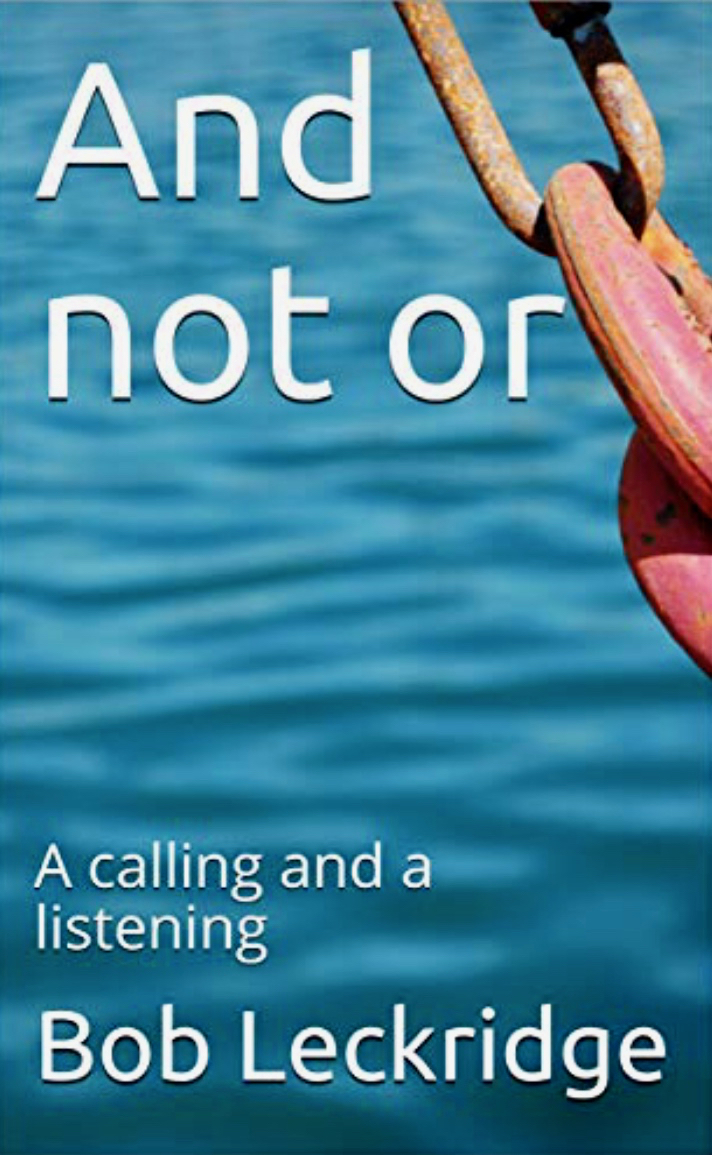
Some time ago I wrote a book called “And not or” – the idea of “and not or” came to me as a good way to approach life, and it’s since become something of a family feature. One of my grand-daughters, mentioning to a friend who queried it, said “What is “and not or” not a thing in your family?”

Essentially, I believe that “or” is divisive. It’s about “this OR that”. It divides the world into pieces, looking through binary lens. “And” on the other hand, builds bridges, forges connections. It is the link between apparently polar opposites. “And” reminds us that no particular experience or view is complete. We never know all that could be known. “Or” is more judgemental. “And” is more humble, more open to learning more.

Here’s the text of the opening chapter of my book, “And not Or” ………..

No man is an island entire of itself; every man

Is a piece of the continent, a part of the main;

If a clod be washed away by the sea, Europe

Is the less, as well as if a promontory were, as

Well as any manner of thy friends or of thine

Own were; any man’s death diminishes me,

Because I am involved in mankind.

And therefore never send to know for whom

The bell tolls: it tolls for thee.

John Donne

Ubuntu – « I am because we are » 

None of us are entirely separate, neither from other people, nor from the rest of the natural world in which we live. On the other hand each of us is unique. It seems as if one of the most fundamental paradoxes in human life is a tension between belonging and uniqueness, between connections and separateness. Do we have to choose between these two options? Or is there some way to reconcile them? Many years ago I was wondering how to share my photos with other people. I looked at one option on the internet – a web service called Flickr, dedicated to storing and sharing photos. I also looked at the fairly new idea, at the time, of personal websites, or “blogs”, where I could post photos and write some descriptions of them. I could combine some creative writing with my photos by sharing some of the thoughts inspired by each image as I reflected on them. It didn’t stop there. There was also Facebook, and Twitter, and a kind of mini-blog site called Tumblr. How could I choose? Each of these options offered some features which the others didn’t, and each service seemed to have its own group of users. I knew that if I shared photos on Flickr, certain people would see them, but if I shared them on a blog, on Facebook, Twitter or Tumblr, then different people would see them. As I researched the different options and read reviews, I realised I wasn’t the only one finding it difficult to choose. 

Then I came across a phrase taken from the language of logic and computer programming – « and not or » – and a light bulb went on in my head. I could share my photos on more than one of these services. I didn’t have to choose only one. In fact, I discovered that there were many ways to create connections between the different services. I could write a blog post, linking it to a photo hosted on Flickr, whilst automatically sharing it one or more of the other services just by clicking a button named « publish ». 

None of us can be reduced to only one part of our character or nature. We are all multiple within ourselves. Have you ever done the thought experiment where you plan a party for everybody you know, and everybody you’ve ever known? You’d hire a large hall and invite absolutely every relative, friend, colleague, client, well, just anybody who has, or has ever had, a personal connection to you. Pretty quickly as you think about all the people who would be there, you realise that almost the only thing they would all have in common is their connection to you. Chances are you quickly realise this isn’t enough to create a cohesive group. The people you know from different contexts in your life may well not share that much in common with each other. The people you’ve known from different times in your life might not share much in common with each other either. Yes, of course, there will be common threads, common interests, values, shared histories, but their individual and even group differences will amount to more than their similarities. You can imagine that several of your guests won’t really click with each other. It turns out that whilst each of us has many different aspects to our character, which particular aspect comes to the fore is highly context sensitive. I could slip easily between my roles of husband, father, son, doctor, colleague, teacher or friend, just to name a few of the more prominent ones. I am not stuck in any single role. I should be able to behave appropriately according to the social context. 

And not or. 

This is how we live. We constantly change. We flow back and forwards between different aspects of our selves. We don’t choose one role and then attempt to live a whole life within it. 

But wait, I hear you say, we have to make choices all the time, don’t we? There are many circumstances where have to make a decision, to commit to one direction rather than another. We can’t have our cake and eat it. 

You are right. We often have to choose. In fact, we have created an entire economic system on having to choose. We have even turned choosing into one of our highest virtues. Freedom equals the freedom to choose. Choosing is based on the word « or ». You can choose this political party in the election, or that one. You can apply for this job, or different one. You can spend your money on this, or that. It is the basis of competition and a free market economy. Competition is the basis of both capitalism and our modern interpretation of Darwin’s principle of selection. Different options are set against each other. One wins, the other loses. This is just how things are. 

When I say « and not or », I’m not advocating the famous « have your cake and eat it ». Nor am I advocating indecision or indifference. The way of « or » is inextricably bound to the way of « and », just as our need to be unique and separate is bound to our need to belong and to connect. Choosing « and » neither restricts us, nor does it stop us from making decisions.

I’ve come to believe that « or » has become too dominant in our culture and in our everyday lives. I’m anxious that it is separating us from each other, setting us in opposition to each other. We seem to be living through a time when polarities and mutually exclusive identities are proliferating, and on the back of that we are witnessing more strife, more anger, and more division. We hear the rhetoric of « us not them », which stokes prejudice, hatred and suspicion. We have created a civilisation of oppositional camps, each creating their own little worlds, each speaking only to like-minded others in shared echo chambers. We talk of « winners and losers » where the winners take all and the losers are advised to « suck it up » and « move on ». There are more walls going up, more doors being closed, less bridges being built, and less agreements made. Competition and winning are seen as strong and desirable, whilst co-operation and consensus are portrayed as weak. 

I want to contribute towards a redressing of the balance. I know we have to make decisions. I know we often have to choose. But when we invest too much in « or » then things start to fall apart. « Or » divides, separates, alienates and creates dis-ease. 

It’s my contention that we need more « and » because «and» connects, creates healthy bonds, encourages sharing, and a sense of belonging. We need «and» in order to heal. 

« Or » stops thought. We choose, we separate, we finish. Why would I be interested in anything else when I’ve already made my choice? 

« And », on the other hand, pushes us towards novelty and connections. It stokes our curiosity, demands our humility, sustains our open-ness to others and to change. It can teach us how to handle uncertainty and unpredictability. It can develop our capacities for awareness, reflection, flexibility and adaptation. 

Every living organism survives and grows by making connections, by being open the flows of materials, energies and information in which we all exist. Every living organism survives and grows by responding to, and adapting to, the ever changing environments and contexts in which we all exist. 

Maybe the best way for me to explore and share this idea is to tell something of the story of my life. Maybe the best thing I can do is to share some of my experiences and to reflect on how those experiences shaped me, and shaped my life. 

This is my story. These are some of my stories. I’m writing this to help me make sense of my life. Maybe reading my story will help you make more sense of yours, too, and I’d be delighted if that were the case, but, ultimately, you will have your own stories to tell. We all do. 

You can find a Kindle version of the book here – https://amzn.eu/d/akoOnrz (or search Amazon in your own country)

A paperback version, with colour photos, is available on Blurb – https://www.blurb.co.uk/b/10155078

Read Full Post »

I read, recently, about “LUCA”, from whom, every single one of us is descended. In fact, not just every single one of we humans, but every single living creature. 

Isn’t that amazing? Yet, at some level, kind of obvious? 

We humans have a tendency to think that we somehow parachuted onto this little planet, just appearing from nowhere, with no history prior to our arrival. This kind of thinking leads us to consider that, on Earth, there is Nature, and there are humans. It’s almost as if Nature is something separate from ourselves, either a place we go and visit on our holidays, or the less important than us part of the world. 

But these two beliefs are delusions. 

We evolved on this planet, along with every other living creature, past and present. The history of our “arrival” isn’t sudden, but it isn’t disconnected from the rest of existence either. 

Advances in molecular genetics have revealed that all living things on Earth are descended from a single organism dubbed the last universal common ancestor, or LUCA, which emerged around 4 billion years ago. We also know that our planet is approximately 4.5 billion years old. During those first half a billion years, simple, then more complicated, organic molecules were spontaneously synthesised and assembled in larger complexes, eventually evolving into the primitive, single-celled LUCA. How did that happen? We really don’t know. But, then, we don’t really know what “life” is either, do we? We can’t even tell if a seed is dead or alive until it starts to change (or doesn’t). 

There are many, many “creation myths” around the world. Every culture seems to have its own. Over the last hundred years or so we’ve been introduced to new ways of thinking about who we are, and where we came from. Yet even with evolutionary thinking we have a tendency to think of ourselves as different and separate. We present Homo Sapiens as the most highly developed form of life on the planet, and we don’t really consider how we might evolve in the future. We tend to think that evolution led to the creation of we humans, and then it stopped. It somehow reached its goal. And we give less consideration to what we share with the rest of the planet. 

But, in fact, we came from somewhere, as did every other life form on our shared planet. Our ability to understand the molecules which exist inside our cells, and the discovery of how so many of the exact same molecules exist in other creatures, has opened the door to a different understanding. 

LUCA is our shared common origin, and as we begin to trace LUCA’s evolution into the abundantly diverse forms of life which we have discovered so far, we come to understand ourselves as embedded, inextricably in a web of Life on this planet we call Earth. This little blue marble where LUCA came into existence, and gave birth to us all. 

We are not disconnected. Neither from all the other living creatures, nor from each other. We share this planet. We share the same air, the same water, the same soil. We depend on each other. Despite the delusion of hyper-individualism, none of us can exist without creating mutually beneficial relationships with others, with our other common descendants. 

What kind of future could there be for us, for our children and grandchildren, if we all took that shared reality on board and put collaboration ahead of competition? If we began to rate mutual benefit over self-centred greed? If we put more energy and attention into the creation, and maintenance, of the healthy environments in which all of LUCA’s descendants can thrive? 

Read Full Post »

A recent book review in New Scientist opened my eyes to something completely new to me – microchimerics. I’m pretty sure I’ve never come across the word before. Here’s the introductory paragraph of the review, which, I believe, captures the essence of the book –

“We now know that during pregnancy, fetal cells cross the placenta into the mother, embedding themselves in every organ yet studied. Likewise, maternal cells, and even those that crossed from my mum to me, can make their way into my kids. And things might get even more chimeric – I have older sisters, so their cells, having passed into my mum during their own gestation, might have then found their way into me and, in turn, into my kids. This fascinating idea – that we are a holobiont, composed not only of human cells and microbes but also fragments of others – and its implications sit at the heart of Hidden Guests: Migrating cells and how the new science of microchimerism is redefining human identity by Lise Barnéoud.”

I’ve long been aware of the discoveries of Lynn Margulis, who back in the 1960s published “On the origin of mitosing cells”, from which she developed the theory that the component parts of our cells evolved from separate unicellular life forms collaborating and incorporating – in other word, “symbiosis”. We humans are perhaps the most complex of all multicellular organisms ever discovered, and, it seems, multicellular organisms evolved by separate, unicellular ones co-operating and collaborating. 

I was taught in Medical School, that each of us is composed of many more cells which aren’t of “human origin”, than we are of our “own” family ones. Whole communities of micro-organisms live on and inside our bodies. We’ve come to think of these communities are “biomes”, and the gut biome in particular has been shown to be crucially important in everything from our immune defences, to our emotions and, even, cognition. Quite simply, we couldn’t live without them. 

Another thing I was taught in Medical School was that all of our cells die off and are replaced, so that many times over the course of the average lifetime, we find ourselves with a complete set of cells which we didn’t have when we were younger. In many ways it’s best to think of ourselves, not as discrete, separate, fixed entities, but rather as flows – flows of cells, of chemicals, of substances, energies and information. 

So, at a biological level, we do indeed “contain multitudes”, as Whitman wrote so beautifully in his poem, “Song of Myself”. 

These latest findings about microchimeric cells are only the latest discovery into this reality….we aren’t just creatures with many facets, or features, we are creatures containing multitudes. 

All of this resonates with Miller Mair’s theory of mind which I’ve long found convincing – “instead of viewing any particular person as an individual unit, I would like you to entertain, for the time being, the ‘mistaken’ view of any person as if he or she were a ‘community of selves.’ I found this metaphor, of a community of selves, rather than a single self, to be incredibly useful in understanding both my patients and myself. It is the psychological equivalent of the biological one of “biomes”.

The “community of selves” idea came back to my mind recently when I read a post on social media where the writer said that when their father died, they lost not just him, but a part of themselves. I hadn’t really thought about that before, but it strikes me as very true. Because each of these “selves” which we experience arises within particular relationships, and we can become aware of how certain selves are only present within those particular relationships. Miller Mair describes how some of the “selves” in our “community” are short lived, whereas others persist and become more integral, or core, to who we are. I’m sure that’s the case with those who we love most, those about whom we care the most. So, there is, indeed, a part of ourselves which will be diminished, or even lost, when a loved one dies. 

I don’t know if you’ve ever encountered the story of the “air telephone” in the garden of a survivor of the 2011 earthquake and tsunami in Japan. It’s an incredibly moving story. You can read it here – https://observer.co.uk/style/how-we-live/article/wind-phone-japan-grief and it’s beautifully told in the “This American Life” podcast in this episode – https://www.thisamericanlife.org/597/one-last-thing-before-i-go-2016

The telephone box, containing a telephone which wasn’t connected to anything, became a place to grieve, by allowing survivors to spend some time speaking to their dead loved ones. This story came back to my mind the other day when I was watching the final scene of the final episode of DCI Banks, where the detective builds a small cairn up on a hill, as a place to go where he could speak to his dead loved one. 

Culturally, we’ve shifted away from graveyards filled with the headstones of those who have passed, to cremations, with the remains scattered in places of meaning, or, sometimes, behind a plaque, but, whatever we do, we need to find the special places to connect, to share some time and space, not just to mourn, but to keep alive the unique parts of our selves which those loved ones created with us. 

We do, indeed, contain multitudes. In so many ways. We are woven from such complex threads of DNA, of cells, of families, societies and cultures. We are not separate, and we are not alone. 

Read Full Post »

A key theme of my blog, heroes not zombies, is about awareness. It’s about waking up, living more consciously, more engaged in the here and now. 

When I was a teenager I used to listen to a pirate radio station, called Radio Caroline, which broadcast music from a ship outside of the jurisdiction of the UK authorities. Radio Caroline still exists, and I tune into it from time to time as an internet radio station – my goodness, how easy it is to find and listen to radio stations around the world now using the internet. There’s a great site, called Radio Garden, which looks a bit like Google Earth, but with the radio stations highlighted. You can spin the globe, zoom in on any country, any city, any town, and immediately hear the radio stations broadcasting from there. I recommend it, though, I think, in the UK, the authorities have blocked users from accessing any internet radio stations which aren’t based in the uk! I’ll come back to this kind of restriction another day, but, suffice to say, back when we used an old fashioned radio and scanned the world on ShortWave, nobody blocked us. Ho hum! 

Anyway, I digress. In one of its phases of life, Radio Caroline adopted a slogan “Get the LA habit” – with “LA” standing for “Loving Awareness”. It doesn’t do that any more, but I liked that they chose for a while to promote not just “awareness”, but “loving awareness” – goodness knows, we could do with more of that in this world. 

Back in the 1990s I read Anthony de Mello’s “Awareness” and it made such an impression on me that it sits on my special “books which changed my life” bookshelf in my study. 

The thing about awareness, is that it grows with practice. If you decide to be more aware, for example, by savouring your meal, of by stepping into the garden and listening for the birdsong, or watching the sun rise, or gaze at the Moon when it’s full on a clear night, or go for a walk with an intention of noticing, then you’ll find that even when you don’t think “awareness” your brain starts to become more aware. 

We see the same phenomenon, for example, with breathing. If you pause and take three deep, diaphragmatic breaths, you’ll interrupt an unconscious pattern of shallow breathing which can be keeping you in a state of chronic anxiety, or disturbing your sleep. Yes, if you have chronic hyperventilation during sleep, you can stop it by practising the three deep breaths a few times during the day. 

When I was living in Stirling and working in Glasgow I walked from home to the railway station every day, then took a couple of trains to get to the hospital where I worked. That walk was a time to practice awareness, just by setting off with an intention of noticing. In fact, I found that if I took a camera with me with an intention of photographing whatever struck me, then I’d notice a lot more in the here and now (and who doesn’t have a camera with them these days, even if it’s only the one in your phone?)

Maybe it’s time for us all to get that old “LA habit” again, and practice a bit more awareness, no, not just awareness, but “loving awareness” every day. 

Read Full Post »

A key theme of “heroes not zombies” is waking up and becoming aware. It’s too easy to drift through a day in a state of semi-consciousness, doomscrolling social media, following routines, swallowing the stories corporations and governments want you to swallow. The Romans used “bread and circuses” to control the population. Modern capitalism uses algorithms.

But there’s a way to break out of these mind-numbing loops….paying attention to what strikes you.

In homeopathy, there’s a teaching about looking out for the “Strange, rare and peculiar”, the symptoms a patient relates which strike you, which stand out, which seem particularly relevant, or particularly unusual. These symptoms might be the key to understanding the patient and finding the right remedy for them. It’s a practice which is the opposite of seeking what is “usual” or “typical”. The thing is, in diagnosis you need to grasp both – the typical symptoms can point to a pathology, but it’s the particular, the personal, and striking ones which point to the patient who has that pathology, which open the path to understanding what the patient is experiencing, how this disease emerged in their life and how it’s affecting them.

I’ve often written here about the power of wonder and awe. I experience wonder and awe when something strikes me. I’ll be wandering through the forest and suddenly see a flower I’ve never seen before, or I’ll hear a bird call I’ve never heard before (or, certainly, not around here). The important thing is to follow that noticing. When something strikes me, I’m drawn to it, I slow down, stop, and explore further. I allow myself to pass a few moments appreciating whatever it is.

We can do the same through the day with lines we read in books. I’m sure you have the experience of reading a novel, or a non-fiction book, and a particular phrase or sentence leaps it out at you. It strikes you. When that happens, why not note it down? Why not slow down, and consider it? I use a mix of methods in this situation. In some books I’ll underline the particular phrase. In others, I’ll get out my phone and take a photo of the passage, then save that photo to my Notes app. Or I’ll get out my notebook and copy it down. “And not or” is my motto. I’ll often do a combination of those things.

Sometimes we’ll be struck by coincidences, or by a feeling of deja vu. These moments can be gold. They can stop us in our tracks and inspire some wonder, some reflection. They are worth noting down too.

Other times I’m struck by a phrase I hear, maybe just a snippet of a conversation, or a remark in the cafe, or in a queue. Again, it’s worth noting these down, taking a moment to consider them, to enjoy then, to reflect.

When I visit a gallery I’ll move fairly quickly through a room, scanning the works of art, then, almost always, some particular painting strikes me, grabs my attention, and stops me. Those always become my favourite paintings.

Wherever you are, whatever you are doing, noticing what strikes you changes your day. It jolts you out of zombie mode, and gives you an opportunity to make the day your own, to make the day special.

Try it out….notice what strikes you today, and explore it.

Read Full Post »

“There’s a time for certain ideas to arrive,
and they find a way
to express themselves through us.”

There’s a theory about where ideas come from, and where memories reside. I’ve read this theory, or some version of it, in several places over the years. Most recently I read it in Rick Rubin’s “The Creative Act”. He suggests that sometimes great ideas come to us but we don’t act on them, then some time later we see them expressed by someone else. It isn’t that other people have stolen our ideas, it’s that the idea’s time has come, and if we don’t act on it, then someone else may.

I read a very similar view a few years ago in Elizabeth Gilbert’s excellent, “Big Magic”, where she said if we don’t write when inspiration comes our way, then, maybe somebody else will. Maybe the idea or inspiration will flow on to someone else because it needs to be expressed. Maybe we will miss our opportunity.

Iain McGilchrist, in “The Matter with Things”, explores memory and consciousness, and dismisses the idea that they lie encased in our skulls. Rather, he argues, our brains act as “receivers” which filter out some of the signals being received to present us with our experiences of consciousness and memory.

Others have argued something very similar……from Jung’s “collective unconscious”, to Sheldrake’s “morphic fields’.

So, it’s not a new idea that we have the ability to “tune in” to whatever is flowing through the universe, nor that that includes ideas, inspirations, memories, and so on. This tuning in is a bit like turning on a radio, the old fashioned, analogue kind, turning the dial, and listening as voices and music begin to appear in the white noise, first of all quiet and fuzzy, till we tune in better and it comes through loud and clear. Aren’t you still amazed that you can sit in a room somewhere, hearing only silence, but, in fact you are surrounded by, you are bathing in, a whole world of songs, stories and speech? You just need to switch on the radio, and tune it in for it all to be revealed.

That still amazes me.

But the idea that the universe is full of stories, words, ideas, images, and music, and that all we need to do is to create the space for it to appear, all we need to do is tune in, and listen….then be inspired…… then we can choose to act on these inspirations, these dreams, these ideas…..express them. Well, that amazes me too.

Read Full Post »

Older Posts »