Feeds:
Posts
Comments

Posts Tagged ‘nature’

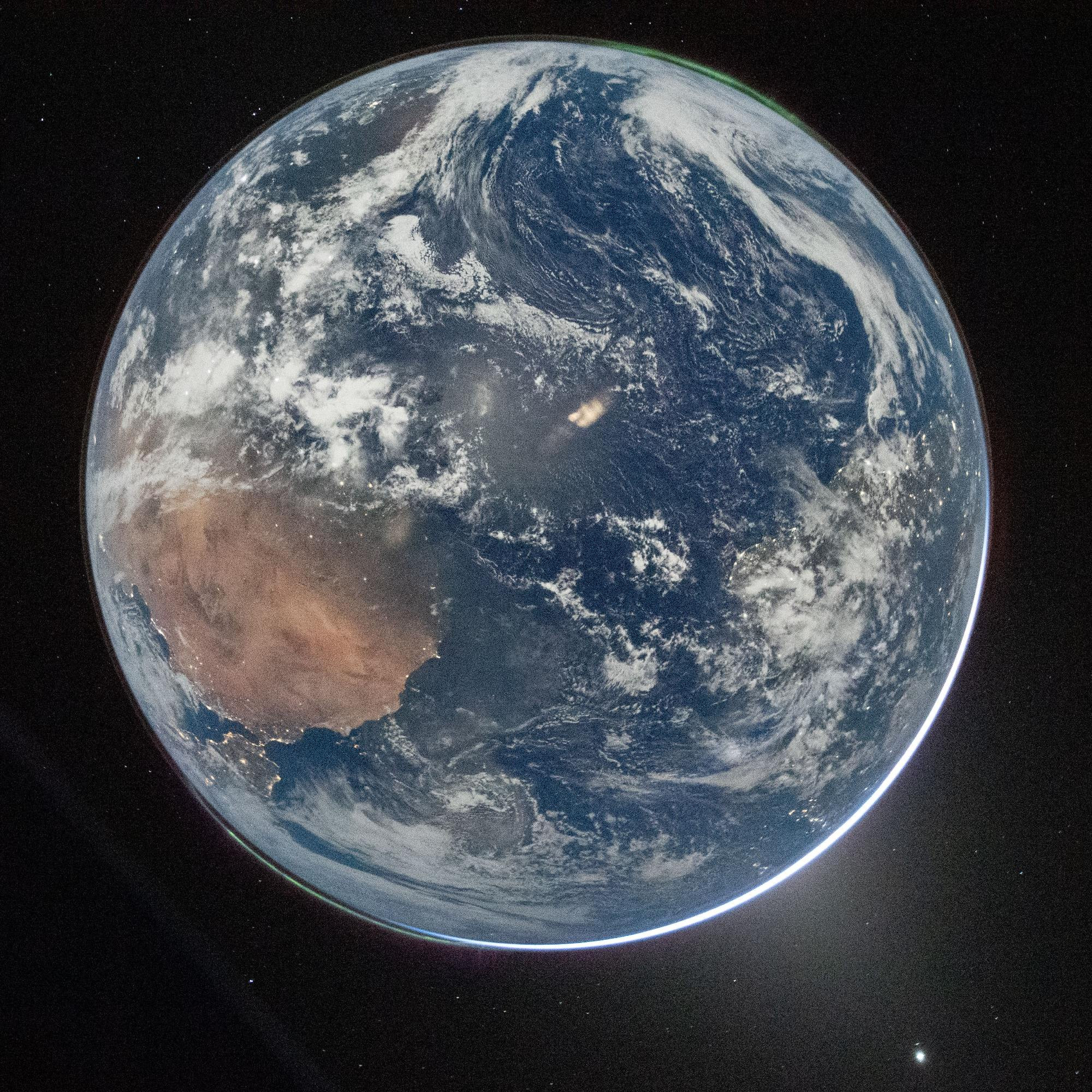
When NASA shared this photo taken from Artemis II I was entranced. I can’t tell you how much time I’ve spent looking at this. This is a view of planet Earth which few of us will see with our own eyes, but thanks to the astronauts, all of us can see it. Look how much water there is! I know, 71% of the Earth’s surface is covered with water, but it still takes me aback to see these great expanses of oceans. And guess what? There are no divisions between one area of water on the planet and another. The great water cycle, from the oceans and seas, to the swirls of rain-soaked clouds which constantly change shape and size, to the streams, rivers and lakes….what goes into the water, flows from one part of the world to all the others.

The second thing I notice are the auroras, one top right of the image, and the other bottom left. In both cases a thin green glow, illuminating just how short is the distance from the surface of the Earth to the airless atmosphere above. There is this incredibly thin layer around our planet, which makes life possible. Compared to the planet herself, this life sustaining layer is astoundingly thin. It looks so delicate. So fragile. Staring at this slip of atmosphere I’m impressed by how, like the water cycle, all of the air we breathe is undivided. What goes into the air at one point on the Earth, quickly spreads around the entire globe.

Nanci Griffiths sings, in “From a Distance” –

From a distance there is harmony
And it echoes through the land
It’s the voice of hope
It’s the voice of peace
It’s the voice of every man

From a distance we all have enough
And no one is in need
There are no guns, no bombs, no diseases
No hungry mouths to feed

and, later, in the same song……

From a distance you look like my friend
Even though we are at war
From a distance I can’t comprehend
What all this war is for

“From a Distance” was written in 1985 by Julie Gold, and recorded by Nanci Griffith for her album, “Lone Star State of Mind”. I heard Nanci perform it in Edinburgh in the early 1990s, and it delights me still. Yet, there is, of course, a sadness there, because all these years on and there are still pathological narcissists flinging bombs, missiles and bullets at people, killing, destroying, and sowing fear and chaos.

It doesn’t need to be this way.

Human history tells us that we humans excel at killing each other, destroying habitats, and wiping out whole species. But we are also capable of great art, from the cave drawings of Lascaux, to Botticelli, Michaelangelo, Picasso, Van Gogh, and so on. We are capable of creating the most exquisite music, of writing the most astonishing poems and stories. We are able to invent mind boggling technologies. And, most of all, we are one of the most social animals on the planet, deeply desirous of love, affection and caring relationships.

I look at this photo and I think of all of that. I think, with sadness, of the hate, the selfishness, greed and destruction. I think, with hope, of the kindness of strangers, of the infinite creativity of humans. And, most of all, I think, what a tiny, finite world we all share, spinning on this little planet as it flies, soundlessly, across the universe.

We are well capable of creating a better world, recognising what we share, caring for this planet, and all the marvelous diversity of life living here.

Maybe the view from on high will remind us of that, and inspire us to work to achieve it.

Read Full Post »

Small boats

The British obsession with “small boats” has always struck me as odd. Not least because the numbers of migrants arriving that way is a tiny fraction of total net immigration. There is no way the people arriving in the UK in these small boats can be responsible for unacceptable NHS waiting lists, inadequate social housing, or poverty and inequality in the country. However, let’s set that aside, because the “Small boats” issue is part of a greater narrative being spread by Right Wing populists in many countries. 

The thing is – we humans migrate. We always have done. We always will. Sometimes it’s just a trickle, other times, it occurs en masse, as it did when early humans moved out of Africa. In fact, we reckon that around 70,000 or 60,000 years ago, modern humans began leaving Africa in large numbers. And they didn’t just stick to the land masses. They set off in small boats. 

A recent article in New Scientist explores the evidence for human migration across seas occuring tens of thousands of years ago. 

https://www.newscientist.com/article/2511681-ancient-humans-were-seafaring-far-earlier-than-we-realised/

Indeed, even the ancestors of we homo sapiens headed off to new lands in small boats. “There is probably growing acceptance that early humans, and perhaps hominins like Neanderthals, were making sea crossings to the Greek islands earlier than 200,000 years ago,”

The New Scientist article arrives at some important conclusions. 

“But seafaring also points to something intangible – prehistoric peoples were cooperative. Building boats takes a long time, so “you would have reduced that labour cost by having multiple people”, he adds. Seafaring is also evidence for something even harder to see across deep time: courage….simpler craft don’t feel so secure. “If you start thinking about getting into a hide-skin boat and travelling long distances… there’s absolutely no way that most people would do that.” Yet many prehistoric people, like those who made their way to Malta at least 8500 years ago, must have jumped into boats and taken that chance, voyaging to new lands that they couldn’t be sure were there, because they lay far beyond the horizon. These were incredible, inspiring leaps of faith – and they took our ancestors all around the globe.”

You know what? We’ve inherited all that. We are still a co-operative species, working together to achieve what we couldn’t do separately. And we still have the courage, the “leaps of faith”, to set out, to explore, to discover, to find better lives…..even in small boats. 

Migration can’t be stopped. You can’t stop Nature. What we can do is develop our abilities to work together….to integrate, to cooperate, to build healthy communities, no matter where the inhabitants set off from. 

Read Full Post »

I read, recently, about “LUCA”, from whom, every single one of us is descended. In fact, not just every single one of we humans, but every single living creature. 

Isn’t that amazing? Yet, at some level, kind of obvious? 

We humans have a tendency to think that we somehow parachuted onto this little planet, just appearing from nowhere, with no history prior to our arrival. This kind of thinking leads us to consider that, on Earth, there is Nature, and there are humans. It’s almost as if Nature is something separate from ourselves, either a place we go and visit on our holidays, or the less important than us part of the world. 

But these two beliefs are delusions. 

We evolved on this planet, along with every other living creature, past and present. The history of our “arrival” isn’t sudden, but it isn’t disconnected from the rest of existence either. 

Advances in molecular genetics have revealed that all living things on Earth are descended from a single organism dubbed the last universal common ancestor, or LUCA, which emerged around 4 billion years ago. We also know that our planet is approximately 4.5 billion years old. During those first half a billion years, simple, then more complicated, organic molecules were spontaneously synthesised and assembled in larger complexes, eventually evolving into the primitive, single-celled LUCA. How did that happen? We really don’t know. But, then, we don’t really know what “life” is either, do we? We can’t even tell if a seed is dead or alive until it starts to change (or doesn’t). 

There are many, many “creation myths” around the world. Every culture seems to have its own. Over the last hundred years or so we’ve been introduced to new ways of thinking about who we are, and where we came from. Yet even with evolutionary thinking we have a tendency to think of ourselves as different and separate. We present Homo Sapiens as the most highly developed form of life on the planet, and we don’t really consider how we might evolve in the future. We tend to think that evolution led to the creation of we humans, and then it stopped. It somehow reached its goal. And we give less consideration to what we share with the rest of the planet. 

But, in fact, we came from somewhere, as did every other life form on our shared planet. Our ability to understand the molecules which exist inside our cells, and the discovery of how so many of the exact same molecules exist in other creatures, has opened the door to a different understanding. 

LUCA is our shared common origin, and as we begin to trace LUCA’s evolution into the abundantly diverse forms of life which we have discovered so far, we come to understand ourselves as embedded, inextricably in a web of Life on this planet we call Earth. This little blue marble where LUCA came into existence, and gave birth to us all. 

We are not disconnected. Neither from all the other living creatures, nor from each other. We share this planet. We share the same air, the same water, the same soil. We depend on each other. Despite the delusion of hyper-individualism, none of us can exist without creating mutually beneficial relationships with others, with our other common descendants. 

What kind of future could there be for us, for our children and grandchildren, if we all took that shared reality on board and put collaboration ahead of competition? If we began to rate mutual benefit over self-centred greed? If we put more energy and attention into the creation, and maintenance, of the healthy environments in which all of LUCA’s descendants can thrive? 

Read Full Post »

Little Owl

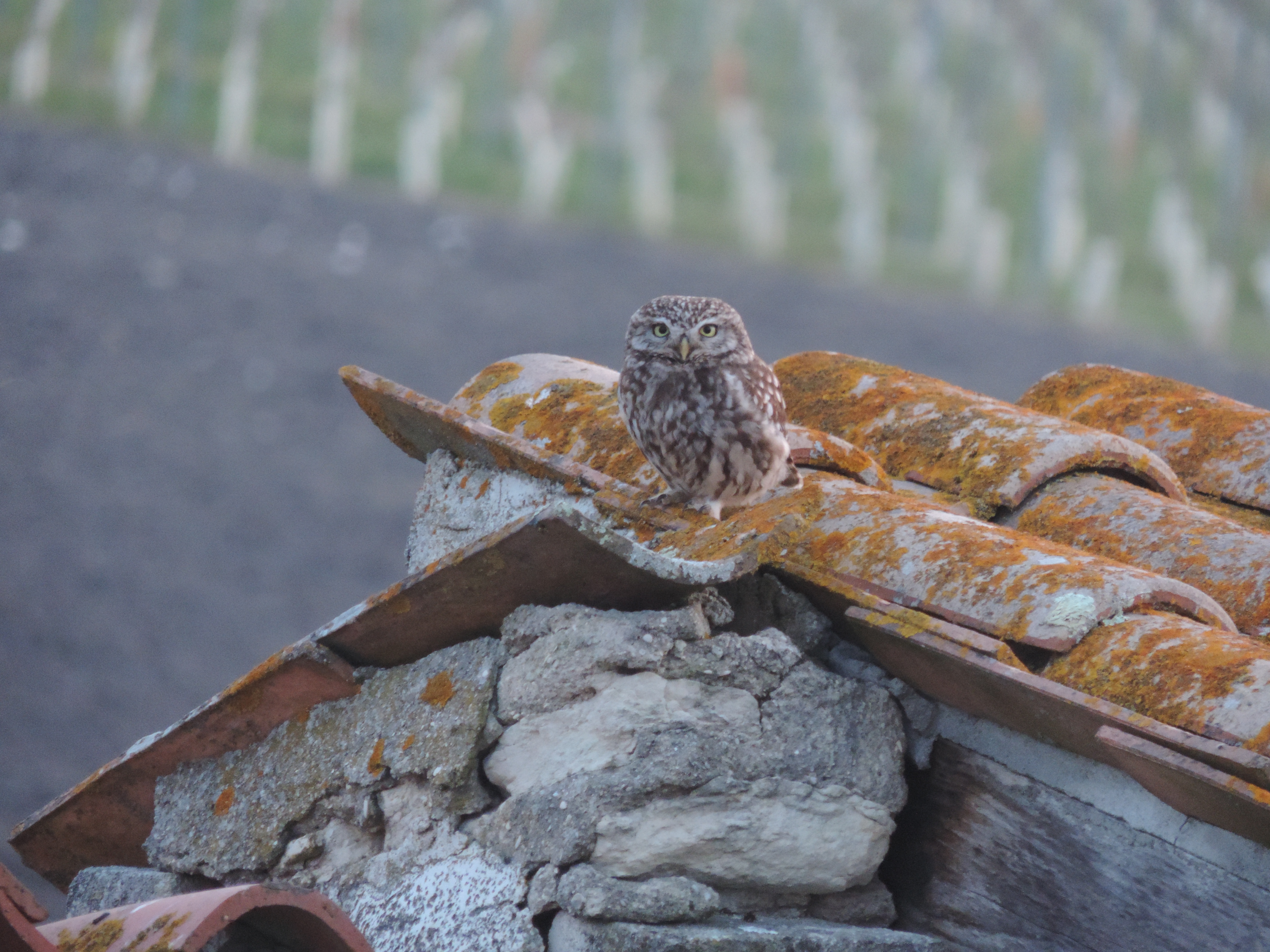
When I lived in Genté I had a studio upstairs looking out over old, abandoned barns to a hillside covered with vines. One day I had that sensation of being watched and when I looked out of the window I saw this bird. It’s a “Little Owl”. Yep, that’s what it’s called. There were several Barn Owls living both in one of the old barns, and in a dovecot cut into the wall of the house, just above our front door. I’d become quite familiar with them, but I hadn’t seen a Little Owl before. I reached for my camera and took this photo. No wonder I had the sensation of being watched! Look at that gaze!

We moved to the Charente Maritime, from the Charente, four years ago. I haven’t seen any Barn Owls since. But over the last few days I’ve heard a really loud bird call at night, and, then, more often, in the daytime too. I use an app on my phone to identify birdcalls. It tells me this is the call of a Little Owl. I haven’t managed to see him yet, but I’m hearing him loud and clear. I think he’s taken up residence in the forest area at the top of the garden.

But to return to this gaze……how do we sense that we are being looked at?

It can happen in a cafe, or restaurant. It can happen in the street. Somehow, we are attuned to the gaze of others (not just other people, but other creatures too). I’m convinced it’s not about scanning the environment and just noticing who, or what, is looking our way. It happens too often that I’ll look up from a book (yeah, I do a LOT of reading) and turn in the exact direction to meet the gaze of another. I don’t know how that works.

But, we all have a need to be seen, to be acknowledged, to be taken into account. Solitary confinement, “sending to Coventry”, and exile are powerful punishments. Intolerable, even. We are social creatures, and we can’t survive entirely without others. Yet, on the other hand, we can receive too much attention. We can wish for times where we aren’t noticed. We are living in a disturbing time of mass surveillance, where corporations and governments are watching, keeping an eye on us, and it’s not comfortable, or welcome.

Like so much else in Life, we have to find some kind of balance, some kind of harmony of two polar opposites. We need connections, we don’t want to be ignored or excluded. But we need privacy too, we don’t want others watching over us, following what we do, whether that’s to feed us advertisements, or policies, or to exert a control over us. And like the other balances we seek to achieve, there isn’t an end point, a place where we get to and then that’s it, we can move on. It’s a way of life.

There’s another question I have when I look at this photo. Why?

Why is this Little Owl looking at me? Why is he sitting out there on the roof, looking through the window into my studio, looking directly at me?

Fear? He’s keeping an eye on me, as a potential threat? I’m definitely no expert in bird expressions, but he doesn’t look afraid.

Because he wants to connect? Not, like have a chat, or start a beautiful friendship, but just to connect. Sometimes making a connection is enough.

Read Full Post »

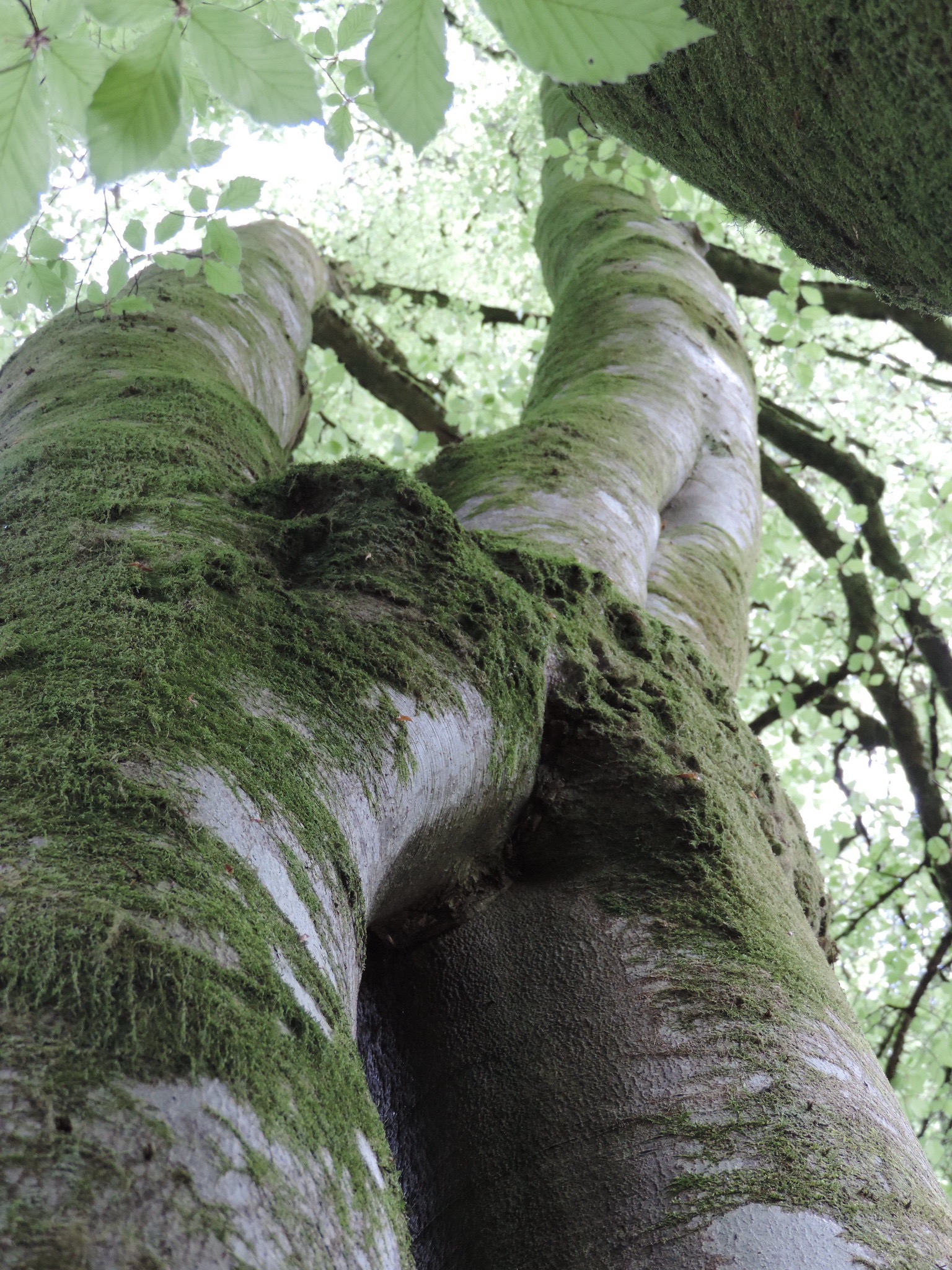
This is one of the most extraordinary trees I’ve encountered. The one on the left seems to have reached out to the one on the right, then the two trees have merged to continue upwards together as one trunk. I don’t know how they did this. It’s like grafting but as best I can tell this wasn’t a forest where there was active grafting happening. I’m pretty sure they’ve managed this all by themselves.

This image is one of my favourites and it always makes me think about the importance of connections. There really isn’t any species of life where each organism exists all by itself, disconnected, as it were, from its fellows, from other creatures, and from its environment. We can only imagine that an organism could exist completely separately if we think of it as a fixed, bounded object. But, in reality, there are no fixed, bounded objects.

As we zoom in and in to look deeper and deeper into any organism, or so-called “object”, we get down to the atoms we all learned about at school. But twentieth century physics has enabled us to look inside those, previously imagined, “fixed” objects, and we’ve discovered that there is no final, fixed material in there. Rather, even atoms are interactions between flows of energy and information, sparkling briefly in and out of existence. They aren’t fixed. They aren’t separate.

Human beings have evolved to have the longest period of dependency for their young. It takes years and years for babies to learn enough to be able to survive….I was going to say, “by themselves”, but, actually we never live “by ourselves”……..independently. So we have evolved superbly social capabilities. It has been argued that we are, in fact, THE most social of all animals.

Yet we swallow the myth of the “Self made man”, of the “hero”, or “genius”, who has somehow come to be all by themselves, without the help and support over their years, of others. It’s a nonsense. The narcissistic, massively egotistical politicians we see today are totally deluded. They only have what they have because of others, because of their connections. Same goes for the tech billionaires. They didn’t create money from nowhere, they grabbed it from others. They didn’t invent and build the technologies they own all by themselves, they profited from the skills and work of many others.

Maybe we need to follow connections a bit more carefully in order to realise just how co-dependent everyone really is.

Finally, let me zoom out a bit and consider nation states. These are inventions. They didn’t drop down onto Earth from the sky, fully formed. Some human beings, some time in the past, staked out the borders and said everything inside these lines is “mine” or “ours”, then fought off any attempts by their neighbours to live on any of that land. Those borders around the nation states are way more permeable than the politicians would like you to believe. The entire planet has one water cycle. You can’t keep separate what flows into one ocean from another. You can’t keep what flows into an ocean separate from the sky, the rivers and the lakes. Same with air. We have one atmosphere around the entire planet. You can’t stop radiation from a disaster like Chernobyl or Three Mile Island spreading freely across “borders”. Same goes for most species in the world – for bacteria, viruses (remember Covid??), insects, birds, plants and many mammals. As each species is lost through loss of habitats, connections are broken, and we are all diminished. We humans are one species. It doesn’t matter which part of the map someone has drawn is where we were born, or where we live now. Our fellow humans aren’t only those in our village, our city, or even our nation state. We are inextricably connected to them all. We are inextricably connected to the entire planet.

Read Full Post »

I get it.

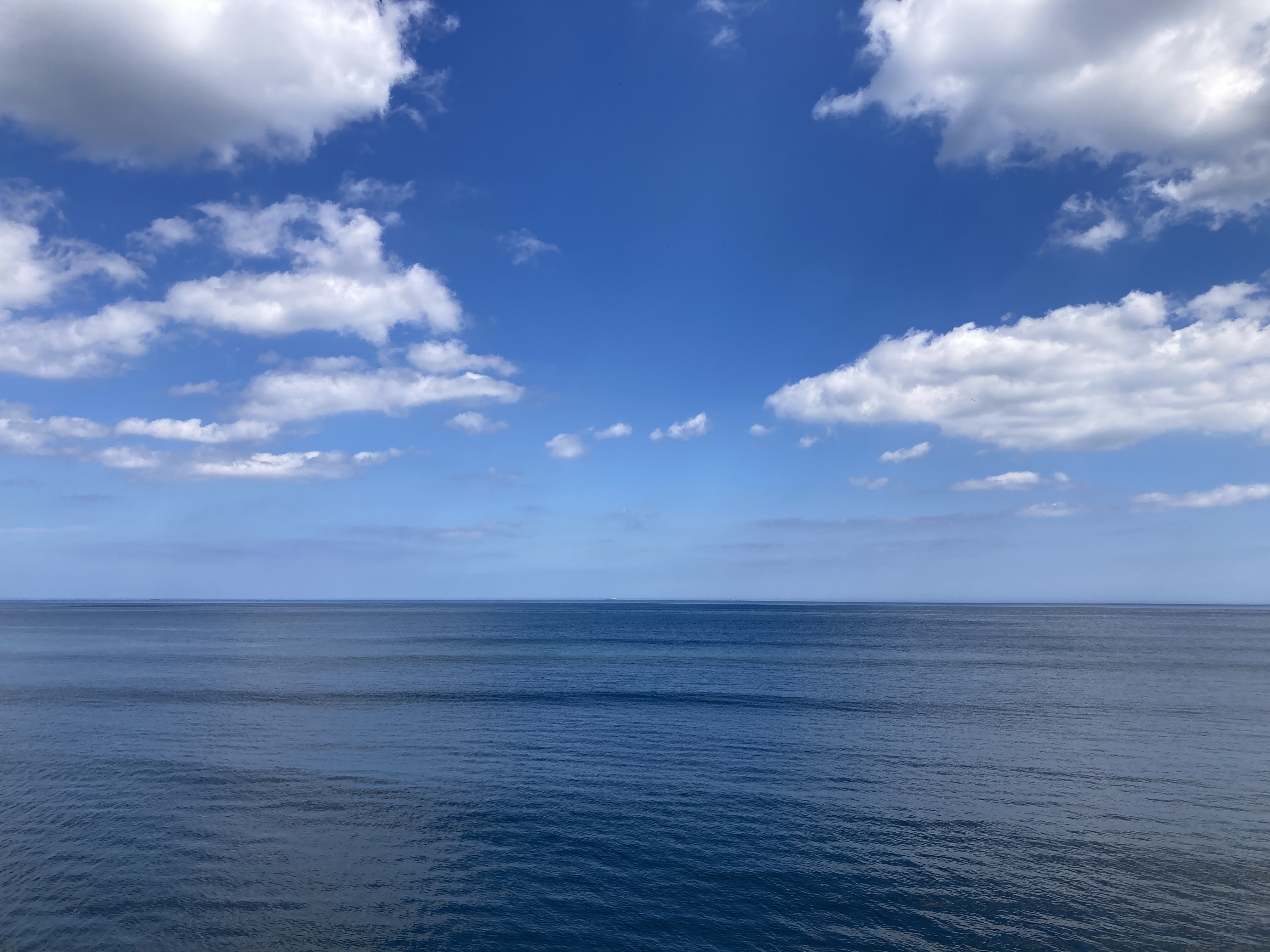
As you stand, alone, gazing out to the vast expanse of the sea, it’s easy to think you are separate. Separate from everyone else, separate from other creatures, standing on the outside, looking in, at this world you find yourself in.

But, that’s an illusion.

We are not separate. We don’t exist apart from Nature. We don’t survive all by ourselves. We are not disconnected.

Yet, this sense of being separate lies at the heart of so much dysfunction and trouble in this world. We have created a system of society, of politics and economics, on the foundations of this delusion. The idea that by encouraging selfishness, actions and choices which put our own interests, not just above those of all others, but with no thought whatsoever to consequences, we can create a healthy, thriving life, is just crazy.

So, why do we live this way? Why do we support the idea that we can consume more and more of the Earth (what we call “resources”) forever and forever? We live in a finite planet. What we burn and destroy won’t come back. The species we eliminate won’t come back. We can argue about timescales, but the Club of Rome’s “Limits to Growth” report, published decades ago, was, essentially, correct. Unlimited growth in a finite world is going to hit the buffers one day, maybe not in our lifetime, but in the lifetime of our grandchildren, or our grandchildren’s grandchildren.

Should we care about our grandchildren’s grandchildren?

I think we should.

Why do we support the idea that a tiny minority of the people in the world should be allowed to grab as much of it as they can? Why do we have billionaires? Does it matter what they do? Does inequality matter? A question which won’t even occur to the narcissist.

Iain McGilchrist’s thesis about our brain asymmetry helps me understand. It rings true and it helps me to see that if we use our left hemisphere excessively, and, as if it is disconnected from our right hemisphere, then we are going to experience the world as if everything is disconnected. Our reductionism and selfishness will narrow our view so much that we’ll fail to see that we, and everything else on this planet, are intimately, inevitably, interconnected.

We are embedded in this world. We exist, for a brief time, in a vast web of relationships. We are the individual waves which appear on the surface of the sea, then dissolve, back into it.

Can we learn to take a longer view? Can we begin to act as if our grandchildren, and their grandchildren matter? Can we make choices which take into account the ripples and effects of those choices, and the effects they have on others, on our environment, on the world in which we belong?

I watched a short video last night which promoted the part of the world where I live, Nouvelle Aquitaine. One phrase they used really struck me – “Vous êtes unique, nous sommes unis” – You are unique, we are united. It’d be good to live that way, owning and respecting our own uniqueness, and that of all others, and feeling connected, deeply knowing, that we are all one.

What do you think? Can we develop and share a different vision for our lives and our world? A vision more consistent with the use of both our cerebral hemispheres, a connected world of embedded lives, where everything we do has consequences, for ourselves, for our loved ones, for others? Can we learn to see the bigger picture, the longer timescale, a better way to live?

Read Full Post »

In his “A Sand County Almanac”, Aldo Leopold writes…..

The last word in ignorance is the man who says of an animal or plant: “What good is it?” If the land mechanism as a whole is good, then every part is good, whether we understand it or not. If the biota, in the course of aeons, has built something we like but do not understand, then who but a fool would discard seemingly useless parts? To keep every cog and wheel is the first precaution of intelligent tinkering.

Now, this language, from the late 1940s is too mechanical for my liking, but, actually it’s still not uncommon today. We humans are not machines. Plants are not machines. No living organism on the planet is “machine-like”. As a result of the dominance of left hemisphere thinking, reductionism, for all its results and benefits, has blinded us to reality.

A human being cannot be reduced, cannot be broken into separate, isolated parts, without, at best, ignoring the consequences of changes in the whole body which come about from changes in a part, and, at worst, without killing the individual human being. Reductionism can only ever be a stage on a journey towards an understanding. The reductionist work of the left hemisphere needs to be integrated back into the holistic perspective of the right in order to understand the connections and consequences.

The same can be said of any living form. There isn’t a plant, an animal, or any other living creature which can be fully understood except by exploring their relationships and connections with the world in which they live.

One of the most unfortunate consequences of reductionism (I don’t know if it results from it, or simply accompanies it), is a focus on utility. What use is this? What use is this plant? What use is this creature? What use is this person? Utility can, or should, only be considered as one aspect, one perspective. We know this instinctively, don’t we? We wouldn’t reduce a loved one to an assessment of their “usefulness”, unless we were suffering from some kind of psychopathy. So why do we allow that to happen when we create businesses and factories? Industrial capitalism has a tendency to reduce human beings to “human capital”, or “Human Resources”, to be weighed, assessed, and judged, only on the criteria of utility. If they aren’t useful towards to the goal of increasing profits, then they are “useless”. A sad, miserable way to view the world.

What’s the utility of music? What’s the utility of art? Of gardens, of beauty, of poetry, of stories? What’s the utility of love, compassion and care? What’s the utility of joy, of wonder, awe and happiness?

Do people think that way?

Actually, it’s not uncommon to find that they do. Have you read anything that tells you about how gardening is “therapeutic”, of how music can improve “your mental health”, of how sharing a meal with a loved one can be “good for your health”?

The thing is, a good life, a life worth living, is full of activities and experiences which we pursue, not for their utility but for joy, for love, and because they touch our souls. Don’t wait for “science” to “prove” that music is beneficial to your neurones, to your immune system, or your hormones. Don’t wait for “science” to “prove” that a walk in the forest modulates your immune system, or stimulates your vagus nerve. Live for the everyday moments of wonder, joy, love and delight. One day, “science” will catch up, and tell you what you already know…..music, nature, poetry, caring relationships, love, wonder and joy are all “good for you”.

Read Full Post »

We hear a lot about growth these days. The Labour government in the UK seems to think achieving economic growth is the answer to all our problems, and, frankly, every other capitalist country agrees. Perhaps that’s because capitalism as a system requires continuous growth to exist.

But the thing is, when I was a teenager I read the Club of Rome’s “Limits to Growth”. That scientific report caused quite a stir since it came out but then the usual suspects mounted their attacks and derided it, so, not much has happened since then. Well, I say not much, but we do have Kate Raworth’s Doughnut Economics, and also the de-growth movement. What I mean is the world has failed to respond remotely adequately to climate change, several governments are rowing back their “green” targets, and Trump and co are all in for “drill, baby, drill” and abandoning environmental protections. So, it doesn’t look good.

However, I come back to a point I’ve made elsewhere – growth of what, and for whom? Because the logic on which “Limits to Growth” was based is still sound. We live on a finite planet, so even if we use technologies to make “better” or “more efficient” use of physical “resources” (by which they mean the natural world), at some point, if every country “grows” every year ad infinitum, at some point, there is going to be nothing left to extract. We just can’t keep grabbing more and more and from the planet, creating more and more pollution, killing off species after species, and expect to have a planet our grandchildren’s grandchildren can thrive on. It just doesn’t make sense.

What is growing? Well, CO2 in the atmosphere. That’s growing. Microplastics in our brains. That’s growing. Insecticides, herbicides, fungicides, I-don’t-know-what-icides, in our water, our food, our bodies, even in our babies before they are born. And the wealth of the wealthiest people on the planet. That’s growing. Maybe we haven’t reached peak inequality yet, but we sure aren’t going to reach the point where really rich people think “OK, I’ve got enough. I don’t need any more than this”.

The planet, Nature, Gaia, grows. But she grows without creating waste or pollution. We see her growth in evolution, and in the history or evolution we see a growth in diversity of species. We see a growth in the interconnectedness of environments, biospheres and individual living creatures. Nature doesn’t grow exponentially in a straight line. It grows in a vast interconnected web of feedback systems, in competition and collaboration with all the other parts of that web. It grows in cycles. Cycles of seasons. Cycles of birth, development, reproduction, maturity and death.

What does healthy growth look like in a human being? Development, maturation, increased skills, abilities, knowledge and intelligence (not artificial intelligence, but the real intelligences of the mental, emotional and social kind). Are our societies doing well at fostering that in their populations? I mean, for ALL the people in their countries? Not so much, huh?

We’re going to have to take on board the basic insights of the “Limits to Growth” scientists, and to create a better system that makes better choices about what it wants to grow. Aren’t we?

Read Full Post »

Prussian Asparagus

Lizard tongue orchid

Poppy

Selfheal

Star of Persia

These are all plants which I’ve discovered in my garden this month. I didn’t plant any of them. They just appeared, clearly their seeds having been borne here by birds, wind, or other creatures. Every single one of them is a delight. Every one of them stimulates my favourite “emerveillement du quotidien” (my everyday wonder). Every single one of them has stopped me in my tracks, to gaze, admire and contemplate not just their beauty, but the incredible, unpredictable nature of Nature.

And in every case, there are several of them. There are a number of these plants, either close together, or in quite different parts of the garden.

I first saw “Selfheal” when it appeared by the forest and spread across the grass as I was recovering from an operation the year before last. I didn’t know what it was, but it gave me a real boost to discover its name and its ancient uses (I didn’t actually swallow any of it, however!).

The poppy is also a medicinal plant, and the ones which have appeared “from nowhere” this year are the tallest poppies I’ve ever seen. (I haven’t swallowed any of that either!)

Apparently the “Prussian asparagus” is edible, but there are only about six of them, so I’m letting them be, in the hope that they will seed and spread further.

Several of the “Lizard tongue orchid” plants have appeared together in a clump at the edge of the forest, and I found a “Bee orchid” in the front plot. Every orchid I’ve ever encountered strikes me as a wondrous plant. They all appear to me as astonishingly beautiful.

So, with the beauty, the wonder, the science and the symbolism of these plants, I really feel blessed. I’m going to share the photos on social media using a hashtag of #AGiftFromGaia – maybe you’d like to do the same.

Read Full Post »

I’m really enjoying reading Aldo Leopold’s “A Sand County Almanac”, published in 1949. He was a naturalist who bought a farm in Wisconsin and this little book is full of beautiful observations and reflections. Read this extract –

We know now what was unknown to all the preceding caravan of generations: that men are only fellow-voyagers with other creatures in the odyssey of evolution. This new knowledge should have given us, by this time, a sense of kinship with fellow-creatures; a wish to live and let live; a sense of wonder over the magnitude and duration of the biotic enterprise.

Fabulous.

But it could have been written yesterday.

How much progress have we made with this understanding and knowledge in the last, over seventy years, since he wrote these words? How’s it going with our “sense of kinship with fellow-creatures”? Maybe there are individuals, and even groups of individuals, who feel this strongly, but where is it in the politics and economics of any country? Which political party, or politician, has risen to power on the back of a promotion of our “sense of kinship with fellow-creatures”? Heavens, they can’t even have a sense of kinship with children dying in war, famine or poverty. They can’t even have a sense of kinship with people who were born on some other patch of land, other than the one they, themselves, were born on. But, I think it’s still something we should aspire to. It’s still something we should call for. Not just kinship with children everywhere, but with our “fellow-creatures” too. The loss of species threatens the very survival of our own species. Industrial farming techniques produce poor quality food to shipped into factories and, not just processed, but “ultra processed”, something we are learning causes inflammation in our bodies, triggers chronic diseases, and, I read today, even pushes microplastics into our brains.

“a sense of wonder over the magnitude and duration of the biotic enterprise”……..I am firm believer in the power of wonder. I haven’t the slightest doubt that it contributes to the experience of a better life, of a better today, of a better present. If we had more wonder, we might be more humble, we might be more careful, we might fall in love more, we might understand more, we might care more.

These are values I think we can build better lives on, values we can create better societies from……let’s have more “kinship”, more “wonder”, and more desire to “live and let live”.

Read Full Post »

Older Posts »