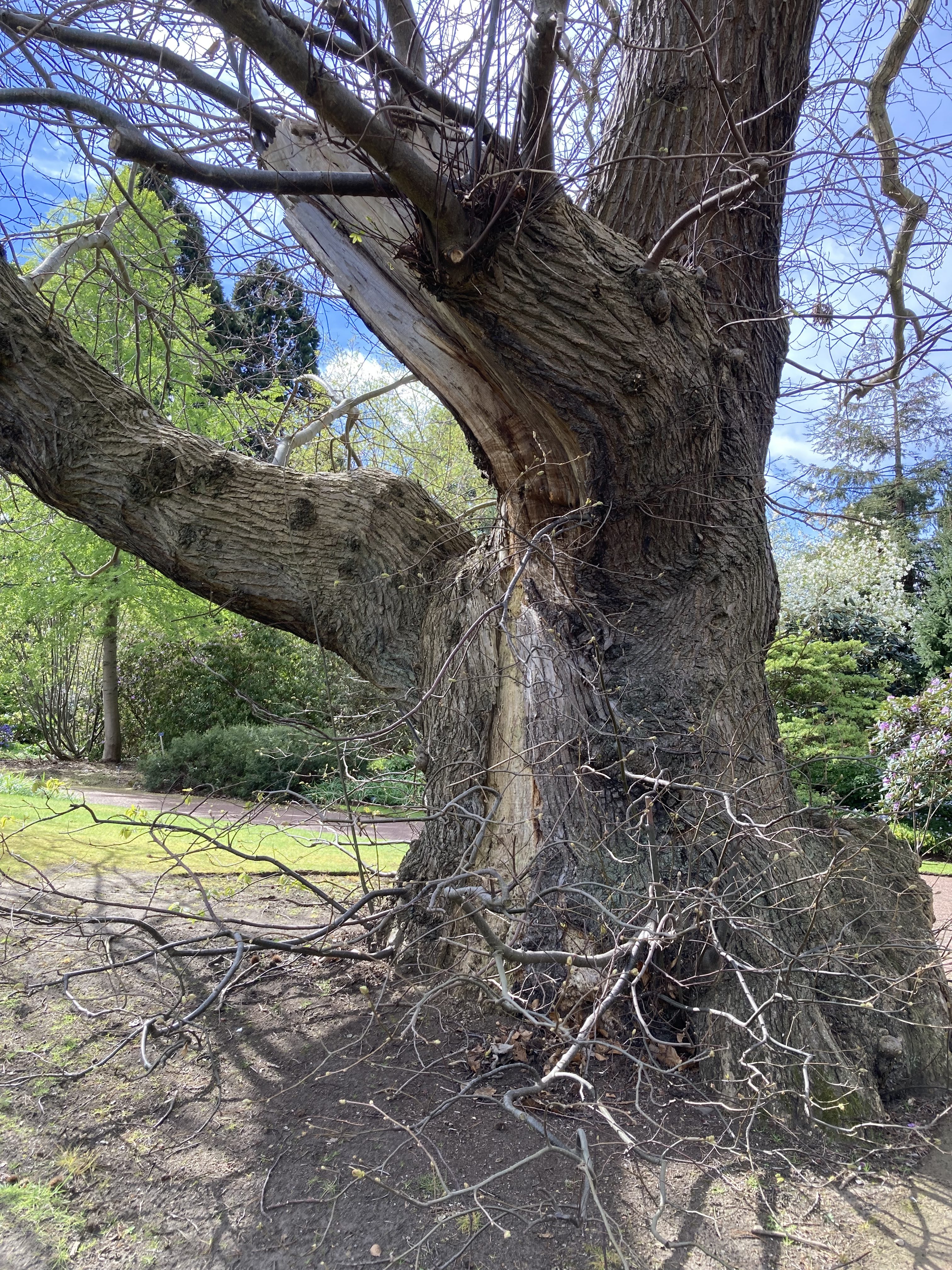
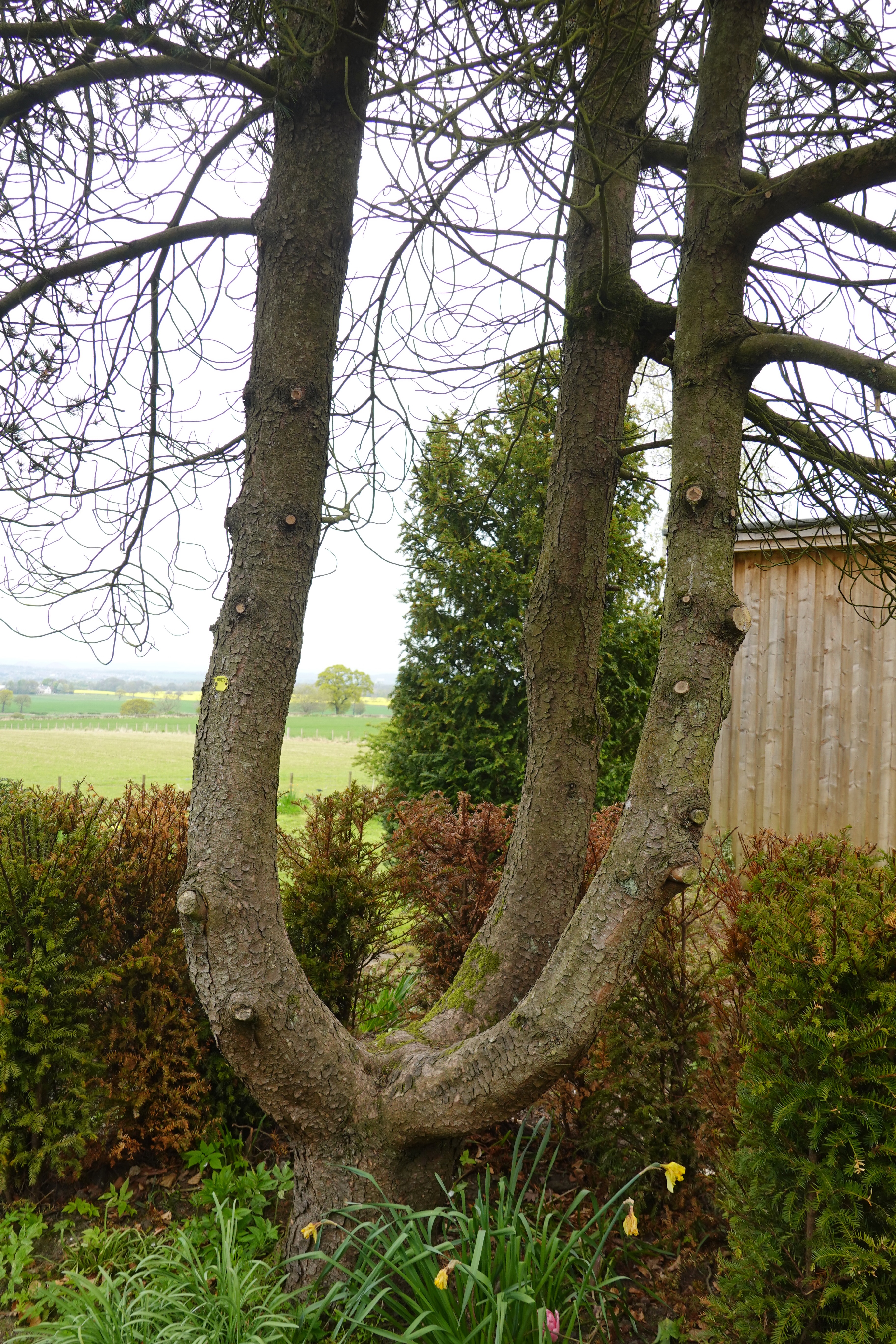
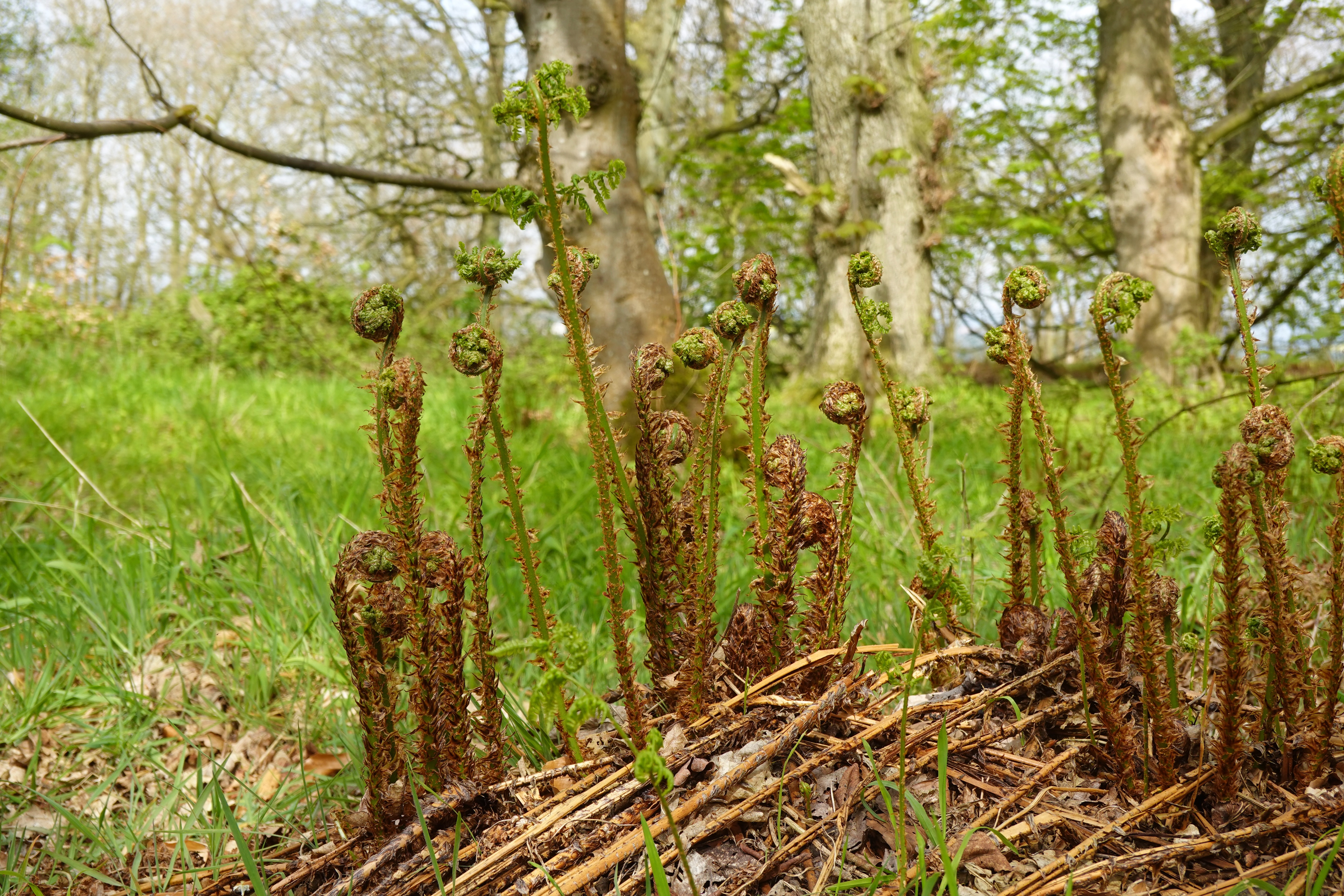
I came across this tree in Edinburgh’s Royal Botanic Gardens recently.
I’m pretty much a life long user and fan of “the Botanics”. When I was a medical student, my wife and I rented our first flat in Rodney Street, a short stroll from the gardens. I went there a lot. Really, a lot. I found being outside amongst the trees and flowers a great environment for study and would take my stacks of revision cards down there to try and get all those new facts into my brain. But it was also the place I’d go when I was feeling stressed out, by exams, or whatever. As I wandered around the rock garden, or paused amongst the great Sequoias, my heart rate, my breathing and my mind would quickly settle down.
It’s a place of great pleasure for me. But it’s also a place of healing.
Years later, when I was learning homeopathy, I’d delight in finding the plants, whose medicinal powers I was just discovering, and I’d wish that botany and plant medicine had been included in my medical curriculum. Mind you, something would have to have been removed from it too because it was crammed full.
On this recent visit I found this tree, which, in its pre-storm state, I had encountered many times. My first feeling was sadness. This was one of the tallest of the ancient trees in the garden, and to see how much it was damaged was really a shock.
But, then, as I looked closer, I noticed all the new growth emerging from the base of the trunk. This tree, clearly, is not dead. How will it develop from here? Surely it can’t just keep growing branches from so low down? Well, maybe it can. Which made me very conscious of two things – the power of healing adaptation which is shared by all forms of life, and the unpredictable nature of repair and development.
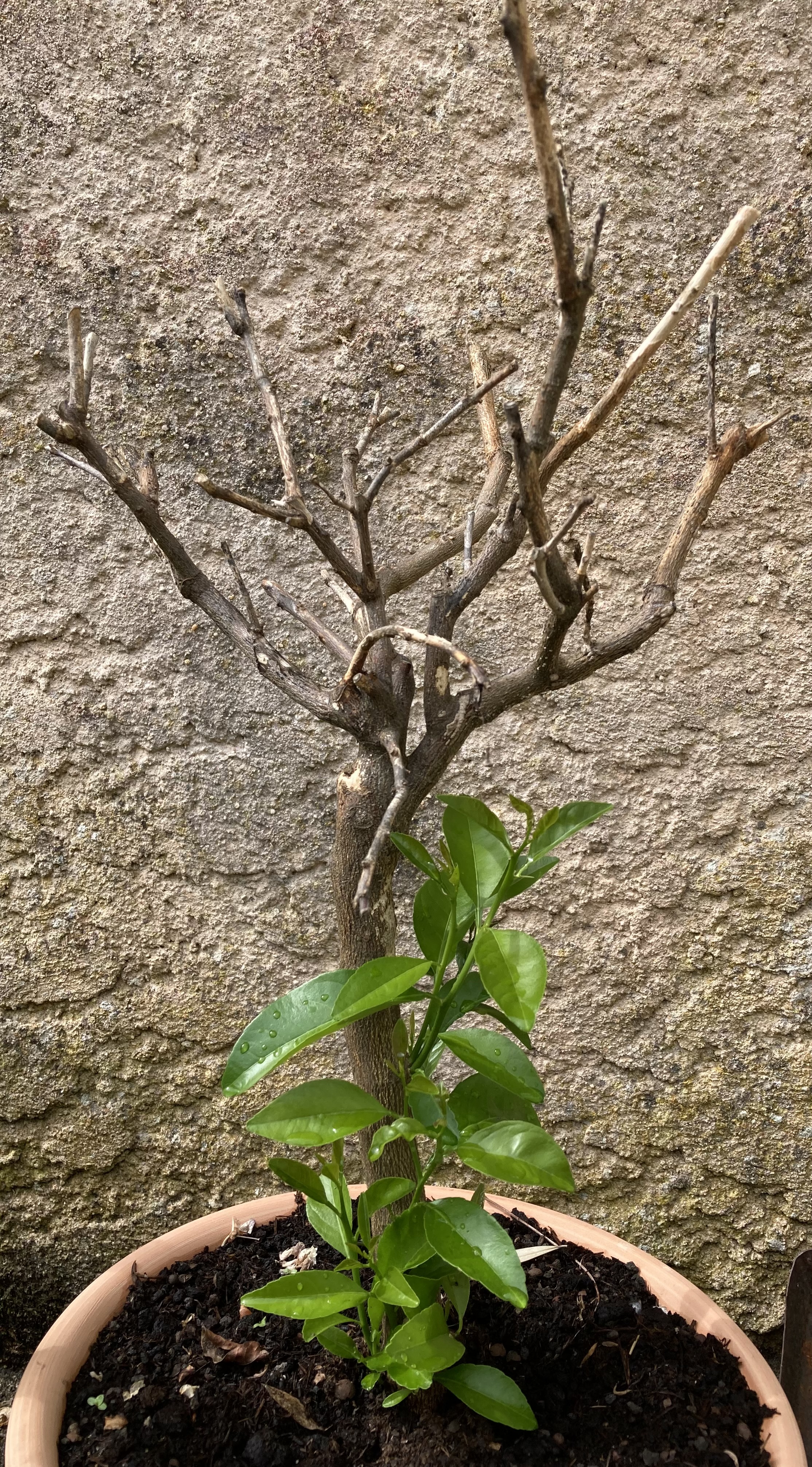
When I returned home to France, I noticed the little lemon tree which I thought had been thoroughly killed off by the unexpected frost and even deep snow this last winter, is showing real signs of life. Just like the great tree in the botanics, the lemon tree has started to recover from the base up. Now, that really is a surprise. And what, I wonder, will happen next? Well, I’ll water it, feed it and give it some attention, and in time, all will be revealed. Pretty exciting, actually.
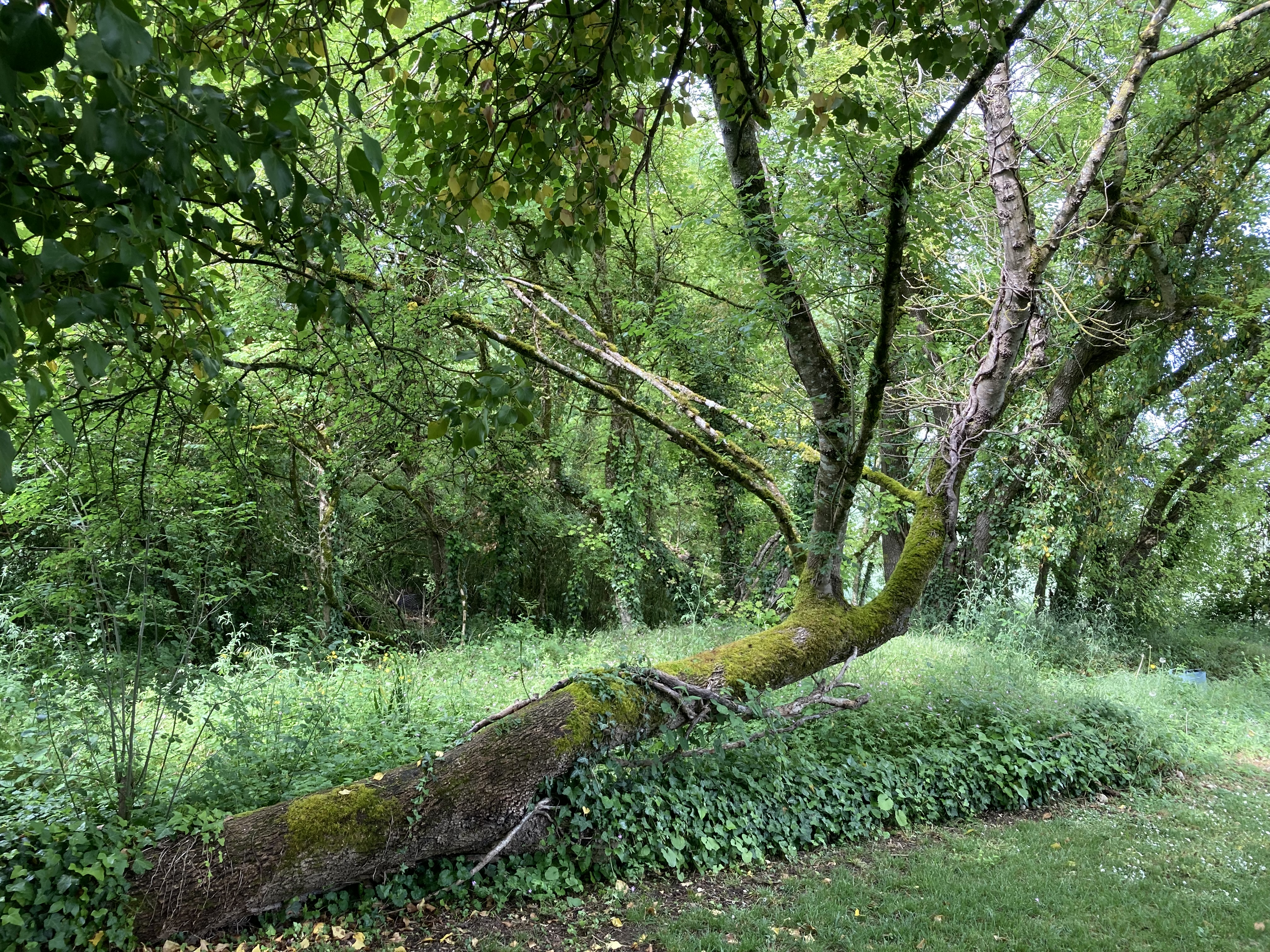
There’s another tree in my garden which is an astonishing example of recovery and growth. When we first moved here I thought I’d found a bit of a wall, but it turned out to be the roots of a tree, embedded with stones, a tree which had been uprooted in a storm long ago. It hadn’t died as it lay horizontally across the ground. It just started growing up again towards the light. Look at it now!
And, you know, it’s exactly the same with human beings. I think the way Medicine has gone with an emphasis on parts over the whole, and a default to the use of drugs and surgery in pretty much all circumstances, we’ve lost sight of the innate power of healing.
I’m not talking about anything magical or fanciful. I mean, if you break a bone in your body, a good orthopaedic surgeon will support the bones, with plasters, splints, or plates and screws, but the actual knitting back together of the bone to make it whole again? That’s all down to your body’s natural power of healing.
Same thing on a lesser scale, with a cut or a bruise. You body will repair the damage…in many cases leaving no trace of the original injury. Yes, you an apply creams and plasters, but it’s your body which is doing the healing.
What if you get an infection? If it’s bacterial, modern medicine can give you and antibiotic to fight the bug, but, by and large, if it is a virus, it’s up to you to recover. Actually, even if an antibiotic does what it is intended to do, it’s still your natural power of healing which will repair the damaged surface of your throat, your lungs, your bladder, or wherever the infection took hold.
Isn’t that amazing? Isn’t it surprising how little we understand how that happens, or why it happens more quickly, more completely, in some people than it does in others?
Did you know that patients with a view of nature out of the ward window will recover more quickly after an operation, will require less painkillers, have less complications and will be able to go home more quickly?
That’s one of the reasons the architects of the hospital where I worked in the second half of my career, built it around a garden.
We promote healing by providing the conditions for healing.
And we can’t predict just what path that healing will take.
There’s no doubt we are changed if major accidents or illnesses come into our lives. We might heal. We might adapt. But we will always be changed.
Just like those trees, we are likely to grow in new directions. We are likely to recover according to our own personal uniqueness.
It seems to me that if we want to be resilient, if we want to give ourselves the best chance of recovery when we get ill or hurt, then we need to get in touch with whatever it is that encourages and supports healing. That will, likely, include, some engagement with nature, with good food, with care and attention, and, I believe, with art.
I’ll be exploring more of all of that in my future newsletters and podcast episodes.
Sign up to my Substack account so you don’t miss any of it.
I read Daisy Fancourt’s “Art Cure” this year. She’s a Professor of Psychobiology and Epidemiology at University College London, and in this book she tells us about the huge evidence base for the impact on health which can be made by participating in art.
She describes art broadly, encompassing singing, listening to music, dance, drawing, reading, crafting, visiting museums, galleries and going to the theatre. And she shows astonishingly high levels of benefit on everything from depression, anxiety and pain, to blood pressure, mobility and cognitive function, and even changes to dementia, and increases in longevity.
I found it both convincing and inspiring. I hope it convinces those who think the arts are a luxury.
Mind you, I don’t listen to music, visit galleries, read, or write creatively for the good of my health. I do these things because I enjoy them and they give me more good days.
But who wouldn’t want to live a longer, better life quality life? No matter your current state of health.
Two chapters especially struck me. In one she describes the impact of “Magic Camp” on children with cerebral palsy, enabling them to improve their motor skills, boost their confidence, and find access to whole new worlds of possibility. What teaching these children how to do magic tricks can result in enormous breakthroughs which regular physio and psychology couldn’t achieve.
In another she describes a music therapy where patients with fibromyalgia and other chronic painful conditions listened to music with their eyes closed for twenty minutes twice a day for two months. Their pain levels were halved. As was their level of depression and anxiety. The music was “U sequence”, using genres the patients preferred, starting with stimulating 90-120 beats per minutes, moving to slow 30-40 beats per minute pieces, and ending with moderate 60-80 beats per minute.
I don’t know how to find music I like by beats per minute but I’m going to research that further. Maybe you know ways to do that.
But imagine if your doctor could recommend two twenty minute music listening sessions a day which could halve your pain levels?
Early in her book she mentions the “five pillars of health” – diet, exercise, sleep, nature and art.
Most of us only hear about the first three, so it’s incredibly refreshing and exciting to explore the fourth and fifth ones.
I’ve often written about the health benefits of nature, and you can find several such posts on this blog. Forest bathing is one of my favourites. Many studies have shown the positive effects on the immune and inflammatory systems of spending time amongst trees. But in fact engagement with the natural environment is available to all of us every day.
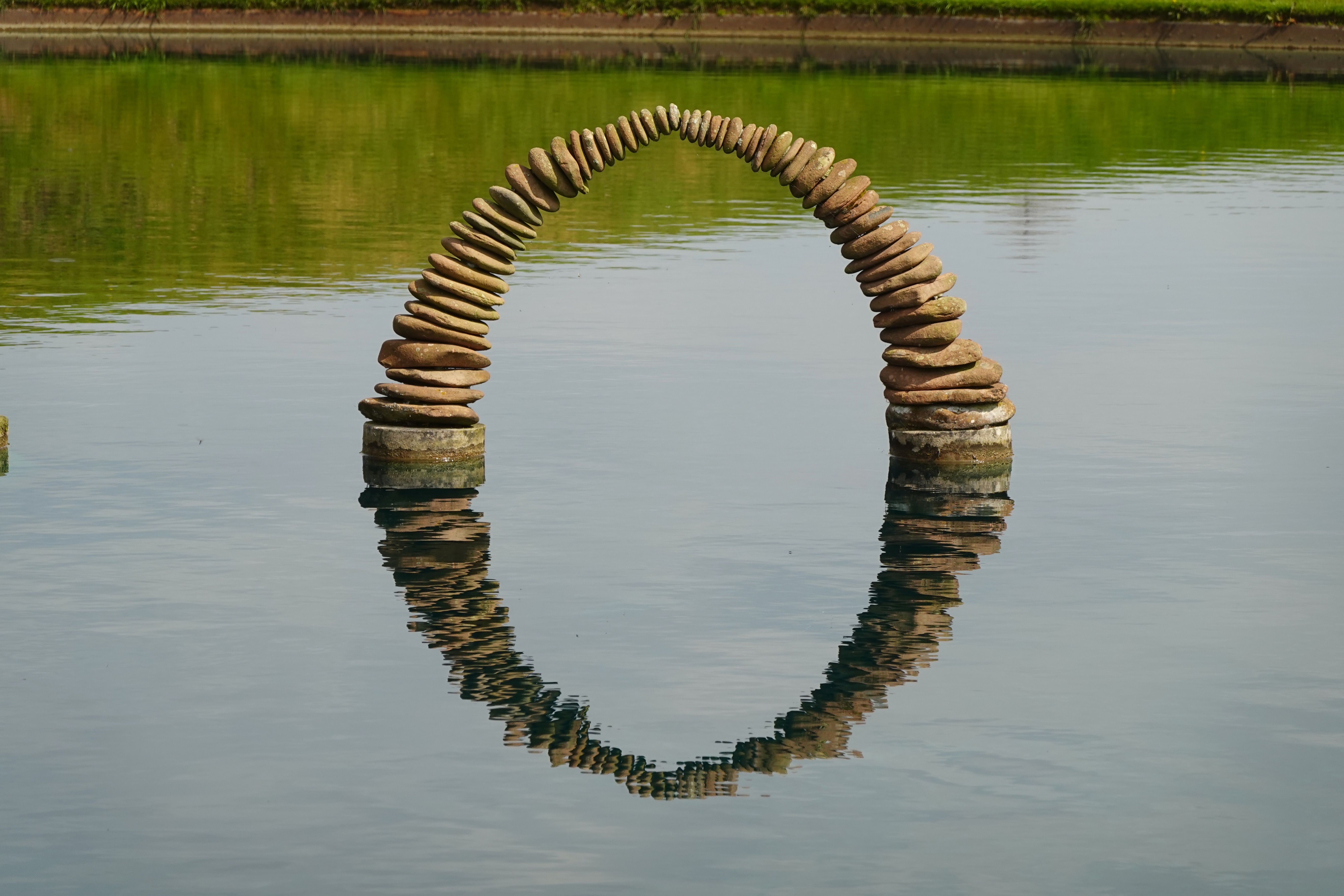
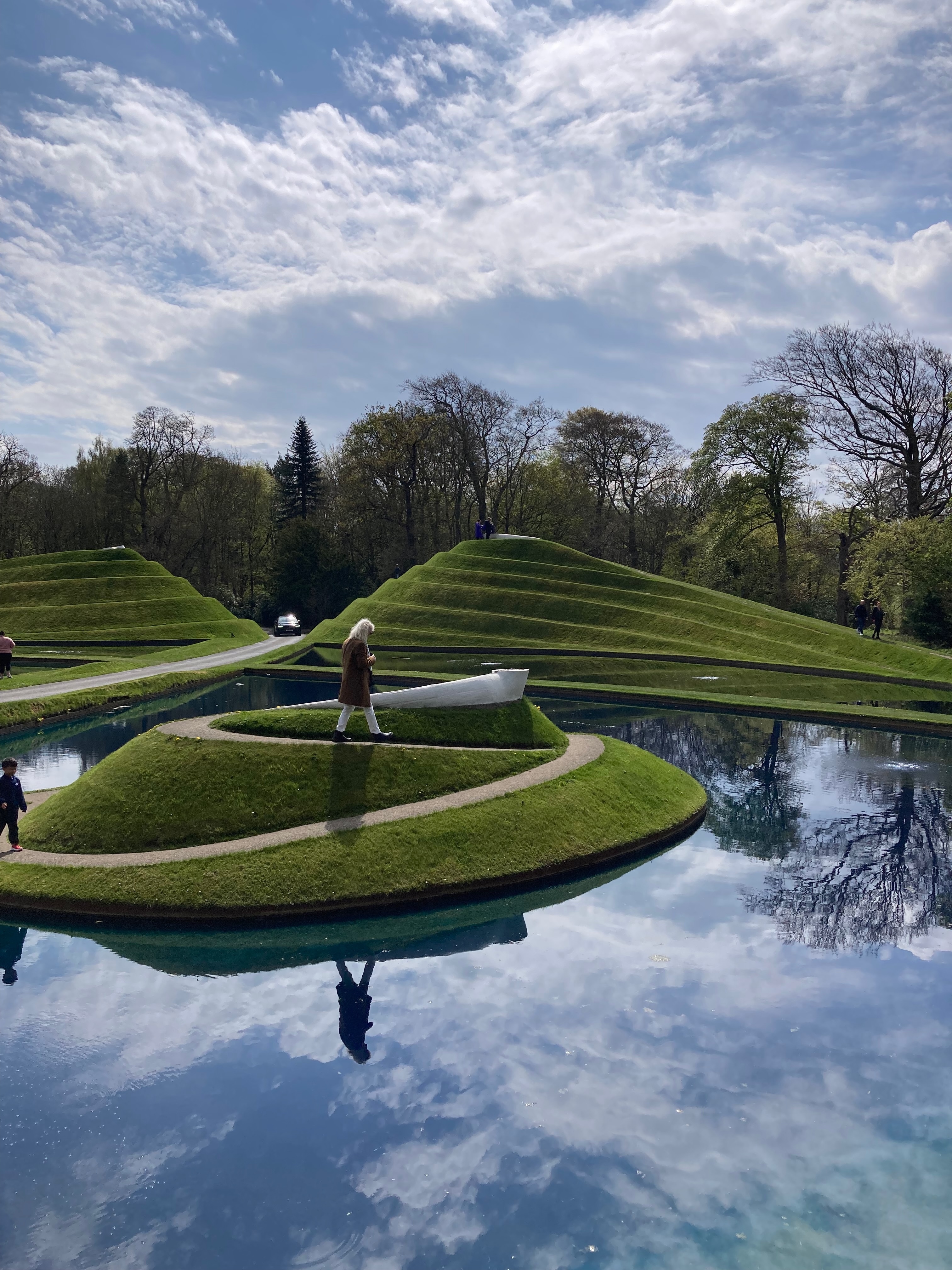
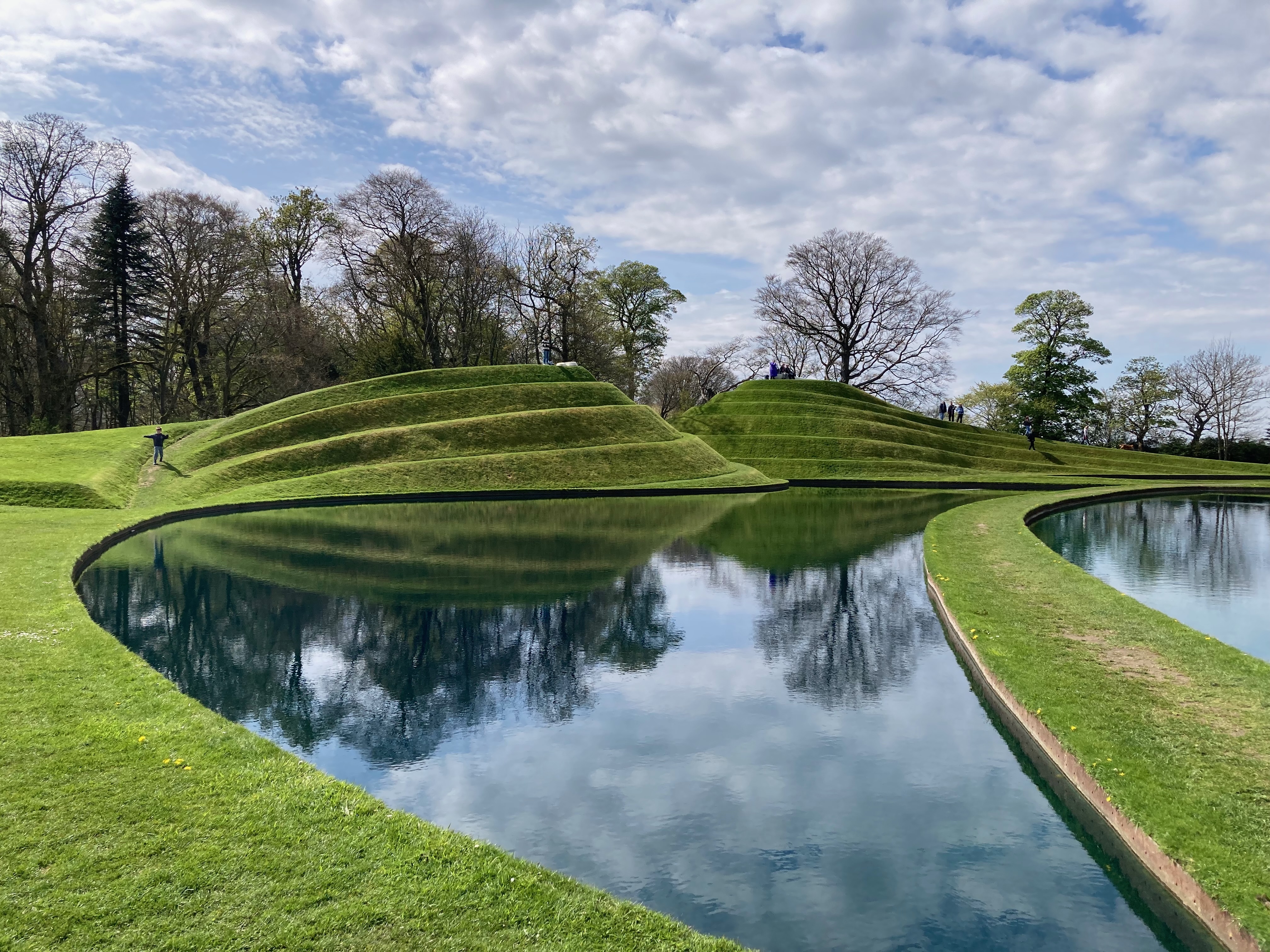
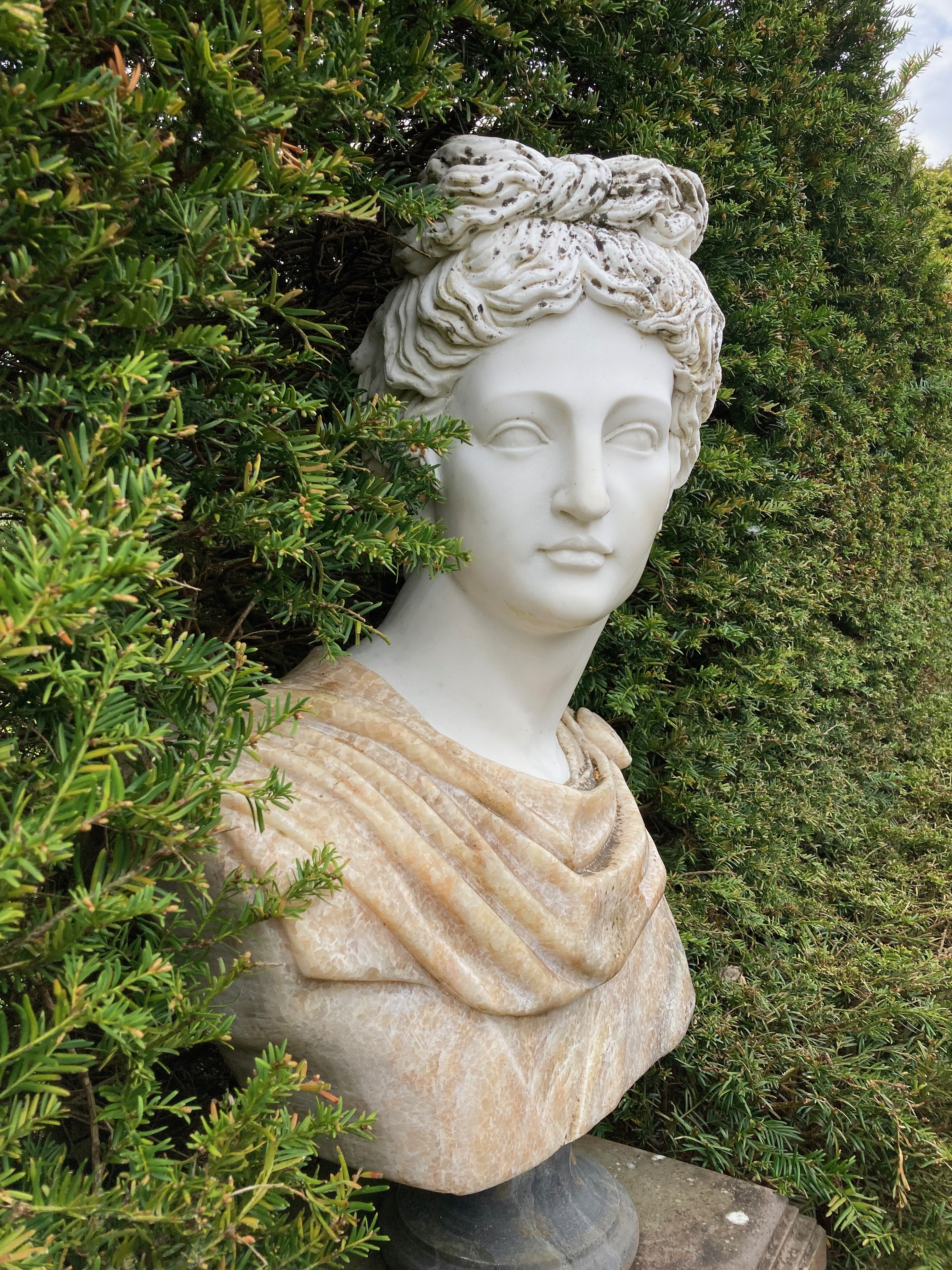
One weekend in Scotland, I paid a visit with some of my family to Jupiter Artland which is just outside Edinburgh. It’s truly one of the world’s special places created around a forest walk sprinkled with sculptures and art installations.
In other words, it offers the opportunity to experience two of the five pillars of health at the same time – nature and art. I love that combination.
OK, so maybe you’re wondering, why haven’t I said anything about the first three pillars – diet, exercise and sleep. Well, mainly because we are flooded with information about all three of these. There are so many variations, and, the truth is, no one size fits all, so you have to find the diet, the exercise regime and the sleep routine that works best for you, but essentially, it seems to me that a healthy diet includes diversity of foods, and is mainly, if not exclusively, non-ultrahigh processed foods. On top of that, most healthy diets recommend eating more plants than meat, and, if possible, eating food which hasn’t travelled all that far. I guess I’m lucky, living here in rural South West France, because there is an abundance of weekly markets within an hour from where I live. At any of these markets you can easily find seasonal foods, and locally grown ones.
As far as exercise goes, the main rule isn’t about a certain number of steps every day, it’s about not spending too much time just sitting. Many of us have pretty sedentary jobs, or lifestyles, and there’s no doubt that the less we move each day, the more likely it is that we will develop severely limited mobility. Again, it’s a matter of finding what works best for you, but most specialists advice both strength training exercises, and some exercise which puts your heart rate up.
Sleep? It comes down to finding the routine that works best for you, and sticking with it. That includes both determining when you want to go to sleep, and when you want to wake up ( 6 – 8 hours sleep is usually recommended ) and developing a wind down routine pre-bed time. It’s pretty much common sense, but, the underlying principle is to gradually reduce your exposure to stimulants, whether they be food and drink, or activities.
Anyway, you really won’t find it difficult to find advice about those first three pillars of diet, exercise and sleep. What I will keep coming back to in these newsletters, posts and podcast episodes, is the value which nature and the arts can bring to our lives, to our health, and, to making more of our days, good days.
As I’ve so recently enjoyed that perfect combination of art and nature, during my visit to the Jupiter Artland, outside Edinburgh, I thought I’d share a few photos with you. I hope you enjoy them and that they add to your own personal more good days.
So, here’s my quick summary advice for this week – listen to music, treat yourself to some art experiences and, if possible, allow yourself some time in nature.
In “Saving Time”, Jenny Odell (who also wrote the excellent, “How to do Nothing”), writes –
“my definition of being alive is simply that: the embrace”
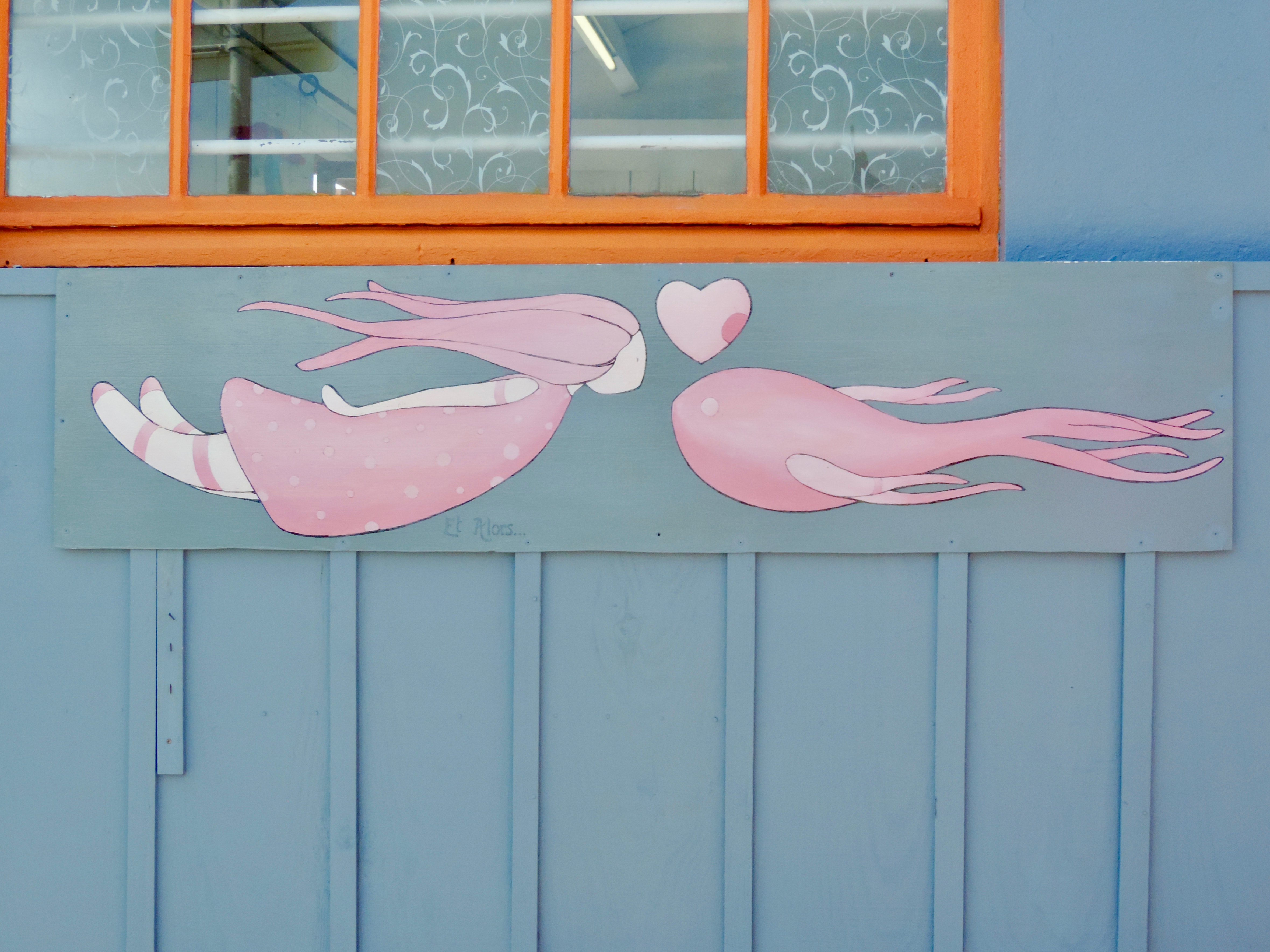
A long time ago I took this photo of a painted door of one of the craft shops on the Ile d’Oleron, which is only about an hour west of where I live. I loved it the moment I saw it. It’s pretty simple, really, but it captures several ideas in one little graphic. A human, in this case a young girl, encountering a sea creature, a “medusa”? They are almost kissing, looking directly into each others eyes. This is an encounter. A meeting. An interaction. The heart, the universal symbol of love, tells us that this a loving encounter. An embrace.
I think Jenny Odell is onto something….being alive is an embrace. Because everything which exists, exists in a vast web of connections and relationships, and if those relationships are loving, then they are nurtured, then they grow. The poet, Mary Oliver, says that we should pay a particular kind of attention to the world, a loving attention. She’s right.
Elsewhere in Jenny Odell’s book she quotes Harmut Rosa –
“Resonance is something that can only happen between us. Love as a resonant experience thus refers not to the fact of loving or being loved, but to the moment or moments of mutual, transformative, fluid affecting encounter” – Harmut Rosa.
I love this concept of resonance as an interaction. When we resonate with another, we create a harmony between us. We are on “the same wavelength”. And when we make that heart to heart, soul to soul, connection, then we experience moments which are both mutual, and transformative.
Resonance also occurs between us and other forms of life. That’s pretty easy to see when we consider animals. Our relationships with animals are a two way phenomenon. How we behave towards them, changes how they behave towards us, and vice versa. In fact, the resonance which can occur between humans and dogs, for example, results in the multiple ways in which a dog can become a “helper”, whether that’s to someone with partial vision, or someone who has epileptic seizures.
Doesn’t the same thing apply to plants, even? I know many people who talk to plants (though I’ve never met anyone who claims that the plants talk back to them!) but, I’m sure the benefits which accrue to plants from loving human attention, are clear to see. Any gardener will tell you so. It’s not just what The Little Prince had to say about “his rose”.
Plants, it appears, are able to respond to about fifteen different environmental factors all the time. They have elaborate, highly evolved systems of detection and response. Much more than we realised when we didn’t look close enough.
One of my favourite writers about physics, is the Italian physicist, Carlo Rovelli, (“Seven Brief Lessons on Physics” and “Reality is not What it Seems”) wrote this beautiful passage –
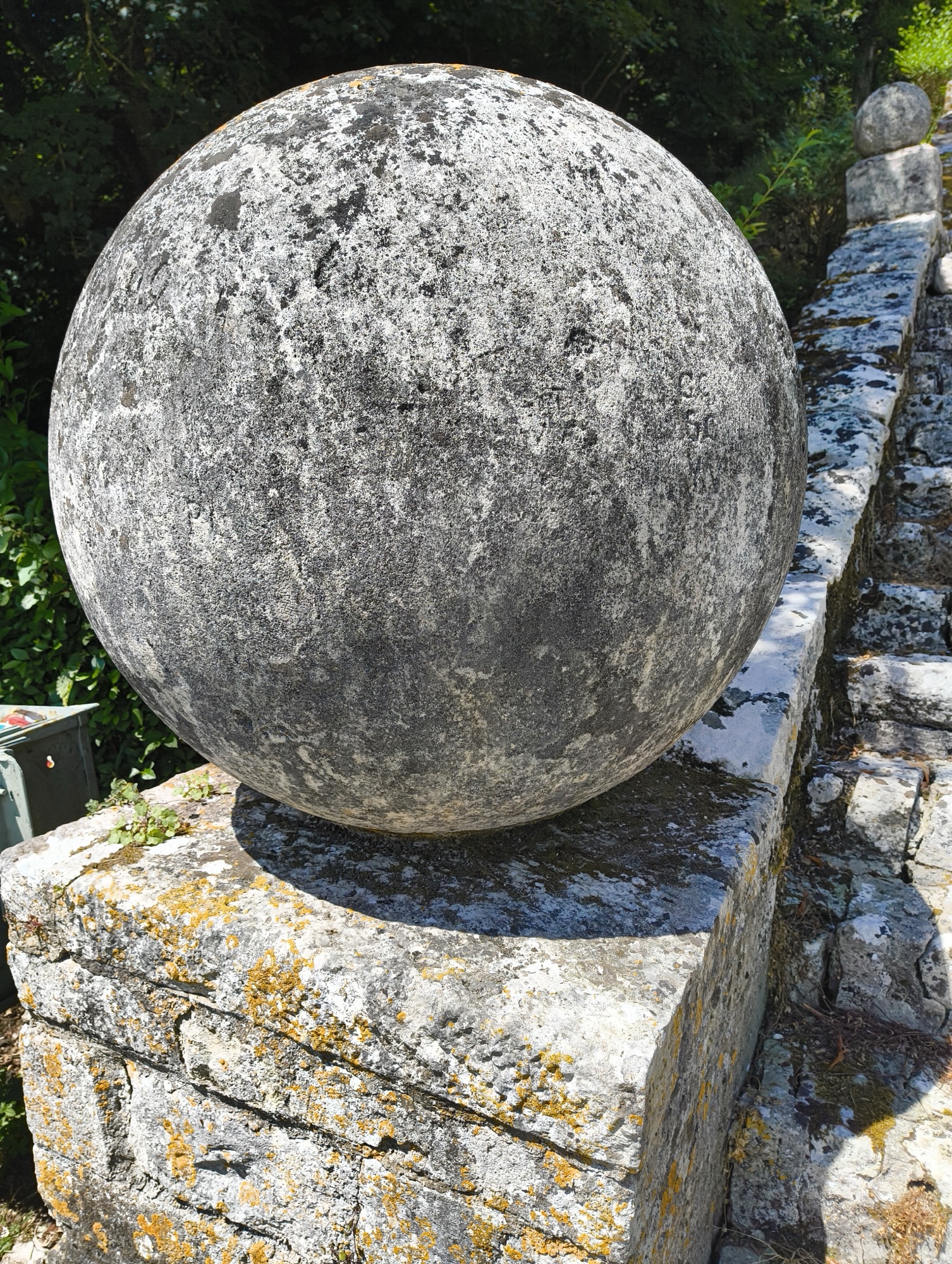
The world is not a collection of things, it is a collection of events. The difference between things and events is that things persist in time, events have a limited duration. A stone is a prototypical ‘thing’: we can ask ourselves where it will be tomorrow. The world is made up of networks of kisses, not stones.
“the world is made up a networks of kisses, not stones”……..isn’t that lovely? Of course, stones only appear as “things” because they change so slowly. Every one of them came about through a sequence of events too. The “limited duration” he refers to is the timescale of a human life, mostly. There was a time when every single “thing” we see didn’t exist, and there will come a time when it ceases to exist. But in the meantime, and here’s the even more important point, I think, every “thing” is constantly changing. Maybe kisses don’t last long, but their effects can ripple out through our lives for years…..generations even!
I read Rebecca Solnit’s latest book, “The Beginning comes After the End”, this week. I love her writing, and this collection which is focused on how everything is connected to everything else, is superb. In it she writes – “A new subfield called processual biology looks at the world as made up of processes rather than objects, as phenomena forever flowing and changing and thereby exchanging with each other and changing into each other. It proposes that it is more useful and accurate to think of ourselves and most of what we call things as events.”
This strikes me as another way of saying that reality is made up of embraces, of “kisses not stones”.
Actually, I think there’s an even more important point than the fact that everything is connected to everything else and that’s the fact that absolutely everything constantly changes. Reality is a network of relationships. Each of us is a mind-bogglingly complex network of cells and molecules, constantly interacting with each other. And each of us lives in a multitude of environments, physical, psychological, social, cultural, and so on….which means we are constantly exchanging molecules, energies and information with the rest of the universe.
There is nothing I can do, say or even think, which isn’t going to send out ripples through these networks and environments and there is nothing in those environments which can be walled off to prevent them from setting off actions and reactions too.
I think that’s why we should do our best to be loving, kind and understanding, rather than judgemental, angry and hating. The former creates, stimulates and grows, the latter poisons and destroys.
How about a Mary Oliver poem? I think this one is really pertinent to this idea of life full of embraces.
On the Beach
On the beach, at dawn:
four small stones clearly
hugging each other.
How many kinds of love
might there be in the world,
and how many formations might they make
and who am I ever
to imagine I could know
such a marvelous business?
When the sun broke
it poured willingly its light
over the stones
that did not move, not at all,
just as, to its always generous term,
it shed its light on me,
my own body that loves,
equally, to hug another body.
Finally, Do you know the Canadian singer songwriter, Tenille Townes? I love her melodies, but I most especially love her lyrics. This song, somehow, also seems appropriate to include in this post. I hope you enjoy it.
When I was in Clinical Practice and trying to help a patient who was overwhelmed with stress and distress, I’d often draw a simple straight, horizontal line.
I’d say the left hand end of the line represented the day they were born. We know that date. The right hand end of the line was the day they would die. None of us can know that date. And I’d put a cross in the line somewhere around the middle, and say, this cross represents today, this moment. Everything from the day you were born until the present moment, we call the past. Everything from this moment until the day you will die, we call the future. If you pay most of your attention to the past, ruminating, regretting, rehearsing the hurts and wounds of the past, and the rest of your time paying attention to the future, wondering and worrying about whether this or that might happen, filling your mind with “what ifs”, then the one place where you aren’t investing your attention, your energy and your time is here on this day, on this moment.
Imagine if you spent more time and energy focused on the present….this would inevitably be accompanied by less time and energy spent on the past and the future. Doing this bring a double bonus. It helps you become more aware of this moment, more able to savour it, enjoy it, fully live it. And it reduces the time and space in your mind occupied by hurts, wounds, worries and fears.
I still think this model is a bit simplistic. I mean, the past, present and future are not so linear as this little drawing implies. Life tends not to follow straight lines, but rather loops and cycles. However, there’s a value in simplicity, if we take it as a starting point.
I have a couple of large filing cabinet drawers filled with old notebooks which I’ve written and drawn in over several decades. From time to time I pick one out at random and browse it. The one I pulled out this week had a lot of notes about relationship between the past, the present and the future. I’ve always tended to use notebooks for thinking. They aren’t really diaries in the style of I did this, and then that, today. They are more phrases and sentences which have struck me in whatever I was reading at the time, and simple diagrams to help me think something through. They are full of ideas and thoughts and explanatory models.
Here’s what I was exploring about the past, present and future. It seems to me that we access the past through memory, the present through awareness, and the future through imagination. We need all three.
I turn to my memories when I want to reflect. Whether that be at the end of a day, the beginning of new month, or revisiting some shared memories with family or friends.
I turn to awareness to experience the here and now, to find beauty and wonder and joy in the everyday. To find peace and contentment through a savouring of what I see, what I hear, what I smell, touch and taste in this still moment.
I turn to imagination to solve problems, to innovate and create, and to plan.
But, of course, none of this fits well into three separate boxes, or along a single horizontal line. Memory involves imagination. We re-create our experiences and thoughts as we remember. They don’t lie dormant in some drawer, just waiting for us to pull them out and have another look. We know from neuroscience that it isn’t like that. The filing cabinet metaphor of memory is a very poor one. Remembering is a thoroughly active, creative process. We use our imaginations to make our memories.
Imagination draws on memory. If I want to solve a problem, I need to remember what I’ve done to tackle the issue on previous occasions. We don’t innovate and create out of a void. We do it by drawing on both memory and awareness.
And the present moment can only be experienced by a complex, active, ever changing interaction between memory, awareness and imagination. I can’t remember where I read it, but I read we can’t see what we’ve never seen. We need a starting point. We need some foundation ground to every new experience.
But the simple model still works I reckon, because, although all three “zones” are in a constant flux of interaction and change, whatever we focus on grows bigger in our minds. By deliberately paying attention to the present moment, we direct our attention and fill our minds with what we are experiencing right now. And if we really are stuck, devoting so much of our waking hours to memories of wounds and fears and anxiety about futures which might never come, then we denying ourselves the chance to be fully alive today.
One phrase I found in the notebook, was
“Let me understand what was, know what is and imagine what will be.”
I think I must have been reading some of John O’Donohue’s blessings at that point, because I don’t usually write in the form of a prayer or a blessing. But I rather like it….
We look back to understand, piecing together what might have led to what we are experiencing today.
We are aware and awake in this present moment in order to appreciate the world as it is, and,
We dream, daydream, imagine, to look ahead and envision where we want to be.
But there’s something else to add to all this. Nothing is fixed. I think we can accept that when we think of the future. The future isn’t a destination, waiting for us to arrive. It emerges, moment by moment, influenced by the events and experiences of the present. We make choices. Others make choices which affect us. And, we musn’t forget the power of chance. We can also accept that the present isn’t fixed. The present is influenced by past experiences, future possibilities, and the multiple contexts and environments within which we live our everyday. But the past? Isn’t it gone? Isn’t it behind us, written down in black and white? And therefore fixed? I don’t think that’s a helpful way to think about it. It’s said that history is written by those who win the battles, by the conquerors. But those stories are just the stories told from that perspective. Change the perspective, change the focus, and you find other stories. Pull together a diversity of those stories and you get a more holistic view. But, at the very least, even if we can’t change the past, we can change the effects the past is having on us now. That’s how we heal. That’s how we manage to break out of depression, move on from grief….not by changing our past experience, but by changing how we respond and react to it.
And, one more thing……as we try to understand our lives, we look back, we reflect and review. Our default is to see the chain of events as cause and effect. This happened, which led to that, and that led to where I am now.
There’s a danger in relying too heavily on the cause and effect analysis though. Sure, it’s how we learn, but cause and effect is often more a statistical probability than something we can prove. How many times have you read articles about, say a hundred year old man or woman, asked what’s their secret? How did they manage to live so long? Some will say by eating only vegetables, some will say by going to church every week, others will say because they have exercised regularly, but others will tell you it’s because they had a whisky every day and spent as much time as they could with their friends and family. There isn’t A secret. Not A secret which each of us can adopt, nor even a single secret which explains why someone has reached the grand old age of 100.
Thinking about that reminds me of an old joke about Jack Benny who on receiving an award, said “I really don’t deserve this, but, then I have arthritis and I don’t deserve that either!”
Jung believed we didn’t pay enough attention to synchronicity, to the “coincidences” which were connected only through meaning, not through “cause and effect”, and he pointed out that by relying too much on “cause and effect” we tend to ignore the effects of chance. Often, we are just in the right place at the right time (or, conversely, at the wrong place at the wrong time!)
I think we don’t pay enough attention to factors and influences. We’ve learned from science and Public Health, that if we improve the quality of housing people live in, improve the quality of the water they drink and the food they eat, give them more opportunities to be creative and to make good social connections with each other, then many. many more people will experience better, healthier lives…even in the face of randomness, multi-factorial influences, and personal choices.
So, I reckon, as we attempt to have more good days, to lead a more meaningful life, and contribute to the creation of a better world, we need to have a bit of humility, accepting we can never know everything, and we need to accept the reality of change and chance.
Where does that leave me and you?
I think it leads right back to that point, or zone, on the straight line I mentioned at the beginning of this piece….the zone marked “the present”. The best we can do is to focus on this moment, this day, this period of our lives, and be aware, consciously choosing to be on the lookout for moments of wonder, beauty, and love. Maybe it’s not a point on a straight line, but an intersection of multiple memories, creative imaginings and awareness…..a bit like that image I put at the beginning.
Please come along and subscribe there, where you can find all my newsletters (15 issues so far, as I write this) and all my podcast episodes (just shared episode 10 this week). That way, you’ll get every newsletter and every podcast episode delivered to your email inbox whenever they are published
I have a long, long love for the French language and culture. I’ve found books, articles, magazines over the years which do a couple of things which I didn’t come across in Scotland, reading English. It’s not just the way these texts are written, nor the way they use beautiful graphic art and images, it’s the subject matter they consider worth while spending time on.
One particular book from 2009 opened up a whole way of seeing for me. The book is called “La Maladie cherche à me guérir”, and it’s by a doctor called Philippe Dransart. The book has never been translated into English as far as I’m aware, but the title in English would be something like “The Illness is searching for a way to heal me”. Dr Dransart starts from the idea of the embodied metaphor. Now, I have read about this idea elsewhere, not least in the books like “Metaphors we Live By”, by George Lakoff and Mark Johnson. But Dr Dransart draws from his own clinical experience to show us how often the actual words patients use, especially the body-focused metaphors they use, can be the key to understanding their suffering. Understanding not only their diseases, and why those diseases might have appeared in specific organs or tissues, but also understanding their psyche and life story, and how that connects so deeply to their unique patterns of illness. Put simply, he discovered, time and again, that when someone presented with a problem in a particular part of the body, then they’d often use metaphors about that very part when talking about themselves.
In his book, he systematically considers metaphors and figures of speech used by patients presenting with problems in pretty much every system and organ of the body, but for my purposes here, I want to focus on only one – the heart. And, as an English speaker, I’m going to focus on the heart metaphor phrases which we use in the English language.
I’ve already mentioned one at the very beginning….having a heart to heart. When we say that we imply that our conversation will be true, important, and intimate. You don’t have heart to heart conversations with just any stranger you might encounter in a coffee shop, do you? We have heart to hearts with loved ones, with family and friends, and with trusted professionals. In a heart to heart conversation we will talk about what’s important to us, and also, to what is shared between us. A heart to heart, does, after all, involve two people. It’s not something you do yourself, and it’s not something you’d normally try to do in a group. It’s personal. It’s specific. It’s an opening up to another.
Let’s look at some other heart metaphors. Do you know someone who is “big hearted”? It means they are generous doesn’t it? Not at all the same as someone who is “big headed”! And notice we don’t say people are “big kidneyed” or “big livered” by the way. On the other hand, do you know anyone you think of as “heartless”? We might even apply temperature differences to these opposites. So maybe someone is “warm hearted” and another is “cold hearted”. A warm hearted person will often do, or say, something we’d describe as “heart warming” when we feel that comfortable, cosy feeling inside.
What would you say if I were to ask you what was “dear to your heart”? You might say, not what, who, and tell me of loved ones. Or you might tell me about whatever it is that is most important to you, whatever you feel most passionate about. In fact, we tend to think of the heart when we think of passion, don’t we? Maybe we associate “will” with the head, but we associate “passion” with the heart. On the other hand, when we are de-motivated, we might say our “heart isn’t in it”. We are not really committed. It doesn’t move us, inspire us.
We apply a weight to the heart too, don’t we? When did you last feel “light hearted”? Can you think of a time when you felt free of anxieties, content, even happy, where “light hearted” would be a good description? When I think of someone “light hearted” I think of them smiling, moving easily, maybe even skipping (if they are still young and fit enough to skip!) It’s a joyful image. But what gives you a “heavy heart”? When do you get sense of dread, a sinking feeling? We often move our metaphors down into our abdomens when we have these heavy feelings, don’t we, describing a “gut feeling” of something not quite right. Isn’t it interesting that we “feel” intuition in our hearts and in our guts? As if our bodies are telling us something, our brains haven’t quite figured out yet.
The heart, of course, is the seat of love, isn’t it? We use a stylised image of a heart, usually a red one, as an emoji to say we love someone or something. We put red hearts on the Valentine cards. We make a heart symbol with our two hands when we want to communicate love at a distance. How often do you see athletes or performers do that when their fans are loudly applauding an achievement?
When we fall in love, the very sight of our loved one can make our hearts “skip a beat”, and if they abandon us, we feel “heart broken”. In unresolved grief, we might even say someone died of a broken heart.
The heart is also the seat of excitement. There’s a Dutch knitting podcaster who my wife listens to, who often talks about something being “heart jumping” – which, although not an expression I’ve heard much in English speakers, is a great one for conveying what is exciting, what stirs her or inspires her.
Can you think of any others?
There are two more I’d like to consider. The first is how we oppose the head and the heart, saying someone lets their heart rule their head, or vice versa. Usually there, we are talking about the balance between rational thought, cognition, and feelings and emotions.
And here’s my most favourite one, which comes from “The Little Prince” by Saint-Exupery. The fox asks the Prince if he want to know his secret.
“It is very simple. The important things in life you cannot see with your eyes, only with your heart”
Isn’t that wonderful?
But how do we do that? How do we find the important things in life by seeing with our heart?
When I was at university I was taught about the heart, its structure of four chambers, with valves between the atria and the ventricles, its muscle cells with their astonishing ability to beat out a rhythm, its incredible system of production and distribution of electrical currents to co-ordinate the beating of those muscle cells, its blood supply and its nerve supply, and a lot about the diseases of the heart, how to diagnose and treat them.
But it was only years after graduation, when I was working as a young doctor, that I came across the discovery that the system of nerves around the heart was much more complex and powerful than had previously been thought.
There’s a special kind of nerve in the human body called the neurone. We have somewhere between 80 and 100 billion of these cells in our brains, and another billion spread throughout the body. These neurones either transmit information up to the brain from our sensory organs and from specialised sensors which are spread through the other tissues of the body. Or they are responsible for sending electro-chemical signals from the brain to all our muscles, co-ordinating which contract, and which relax.
The 100 billion neurones in the body are each directly attached to as many as 5,000 other neurones forming an astonishingly complex web known as a neural network. I mean, these numbers are beyond our comprehension, aren’t they? They are just mind boggling!
For a long time we’ve paid a lot more attention to the neural networks in the brain than we have to the ones in other parts of the body. But we now know that there are in fact important neural networks which surround especially the heart and the gut. That discovery is fascinating enough, but, what I find even more fascinating is that the nerves connecting the network around the heart to the one in the brain are mainly carrying information from the heart to the brain. Only a minority of them are carrying instructions from the brain to the heart.
So, it turns out, the heart is more than a complex muscular pump responsible for distributing blood around our arteries and veins. It’s actually doing some of the processing we used to think was exclusive to the brain.
What’s it doing? Well it’s now known as heart intelligence. It’s gathering information and processing it before passing it on to the brain.
I mean, that’s fascinating enough, isn’t it? But there’s more. We’ve discovered something else. Everything in the world which beats a rhythm sends out electromagnetic waves. As the rhythm of the heart changes so does the pattern of these waves.
You know how in medical dramas on tv there is often a heart monitor attached to some sick person lying in a bed? The monitor shows the beating rhythm of the heart, with a little line running across the screen. A flat line means the heart has stopped beating. A healthy pattern is of little spikes appearing in that line at regular intervals.
Well, it turns out, those intervals shouldn’t be too regular. The actual gap between each beat of the heart should be varying, ever so slightly. We can measure that variation and we call it “heart rate variability”.
Different degrees of variability send out different patterns and strengths of electromagnetic waves. We’ve discovered a particularly important pattern, which we call “coherence”. When the rhythm of the heart achieves coherence a number of powerful, important healthy changes occur throughout the body. This rhythm affects the release of certain hormones and other chemicals, it affects the tone of the other muscles, and it affects the activity of the brain. Not only that, but heart rate coherence is associated with very distinct emotional states. It’s a two way process if you like. We can focus on the heart and induce both coherence and particular emotions, and we can relive certain emotional experiences and induce heart rate coherence.
I first learned about all this when I came across the publications of a group of researchers in America who described this phenomenon, and were teaching people how to achieve it. They called it “Heartmath”. I took the training programme and taught the techniques to many of my patients over the years.
I’d like to teach one of these techniques right now. It’s called “Quick Coherence”.
There are three steps to achieve “Quick Coherence” – a basic Heartmath technique, and by the way, you can find out a lot more about these techniques at the website of the Hearthmath Institute.
Step 1. Heart focus. Bring your attention or your focus to the heart area of your body. Remember how important attention is? It activates and it magnifies. So we want to bring our attention now to the heart area of the body.
Step 2. Heart breathing. Take three, slow, deep, even breaths, filling the heart area of your body with oxygen, then emptying your lungs of all the carbon dioxide. Slowly in, slowly out, for three breaths. Just these three deep, diaphragmatic breaths resets a part of the nervous system we call the “autonomic nervous system”, calming us down, settling us.
Step 3. Heart feeling. Now recall an event where you experienced one of the positive, heart felt emotions. Here’s a couple of ones I use to give you an idea of the kind of event I mean. One is one of my grandchildren running up to me, shouting “grandpa!” and jumping up into my arms. That’s a great one! Another is looking out over Ben Ledi from my living room window when we have one of those gorgeous deep red sunsets – just amazing! Pick one of your own, and recollect it. Stay with that memory until you become aware that you are feeling that feeling again. This is about recreating a feeling. Once you have it, that’s it. You’re there.
Congratulations, you just managed “Quick coherence”.
Many of my patients would use that technique to escape from a panic attack, or to settle a state of agitated anxiety. It’s quick. It’s effective. And it gets more effective the more you practice it.
But we can do something else with this state of “coherence”. We can use it to access our heart intelligence. Let me just suggest one way to do that. Start by following the steps to achieve coherence, then ask your heart what it wants you to know. Just sit quietly for a few minutes, maintaining this coherent state with slow, deep breaths, and notice what comes up for you. Alternatively, ask a specific question. Is there something you are trying to decide? Is there a problem you are trying to solve? In the state of coherence, ask your heart for its suggestions. Ask it to help you decide.
All this is a very deliberate, very conscious way of accessing our heart intelligence. But, in reality, this is just the way we are. We are using heart intelligence all the time. It never goes away. It’s just that it is occurring in the background, below the level of consciousness.
But heart coherence isn’t just an exercise. As the research has shown it is associated with certain emotional states, namely, love, awe, joy, excitement, and contentment, ease, calm and peace. So when we experience an everyday event which generates one of those emotions in us, it sets up the heart to enter into coherence. The same thing happens if we re-create in our minds a particularly vivid memory of an event where we experienced one of those emotions. That’s the step 2 in the quick coherence exercise.
There’s a way to make all this happen more often. Practice. Both the practice of an exercise like the one I’ve just described, or setting an intention at the start of the day. When we set an intention, it doesn’t mean that the universe magically aligns itself to that intention, but it can feel like that. It means we heighten our ability to notice whatever might align with that intention.
You can prove this for yourself with a simple exercise. Pick a colour. Any colour. Now during the course of the day take a photo of whatever you see that is that colour. It’s likely you’ll pretty quickly start to see that colour everywhere.
Well you can do the same with the heart. How about you set an intention to notice the moments in the day when you feel warm hearted, or light hearted? Or how about moments when you experience what the Dutch vlogger calls “heart jumping”?
It’s that old thing of attention magnifying whatever it is focused on. An intention like this is a kind of focus, and it increases the chances of you experiencing what aligns with it.
You can also increase your experience of heart centred living and seeing by reflecting at the end of the day – what did I experience today that was “dear to my heart”? What did I do which made me feel “my heart is in this”? Did I have any “heart to heart” conversations?
Because there is another aspect to this heart coherence thing that I haven’t talked about yet. Remember how I said anything which beats with a rhythm sends out waves into the world? Well, anything which CAN beat with a rhythm can pick up those waves, and align itself.
You know there is a story about the clockmaker who had several old clocks in his workshop. The kinds of clocks which work with a pendulum. At the end of the day, he would set each clock pendulum swinging. Before he left the room he could see that each pendulum was swinging its own rhythm, left to right and back again. When he came back to the workshop the following day he noticed that every single pendulum was swinging in synchrony. They had aligned themselves. That’s a physical phenomenon called “entrainment”…..the rhythms coming into alignment with each other. Well, the Heartmath researchers discovered they could measure the electromagnetic waves coming from the human heart. In fact they could measure them outside of the body as they spread into the environment. And you know what? They found that if someone achieved heart coherence, then the person standing next to them was more likely to develop it too. The wave pattern travelled from one person to the next….entrainment. Or, maybe you could say, “attunement”. Now this happens, not only with coherence, but with other patterns too. Maybe that at least partly explains why we feel uncomfortable around certain people, or why we can “pick up an atmosphere” in a room.
But here’s the exciting part. If we deliberately practice coherence, both through exercises and emotional experiences, the we can spread those healing waves to others.
Do you find that surprising? Well, let me tell you one other finding….that the power of the transmission increases when two people touch. So, one person whose heart is in coherence, holding hands with another is likely to induce coherence in their heart too.
Now, you’re probably thinking…isn’t this a two way process? Isn’t the disturbed or anxious pattern likely to be transferred too? Yes, I’m pretty sure that’s true. But signals have a power, and the more we practice coherence, the more powerfully we will transmit that to others.
Intentions and reflections. They can both train our attention. So let’s put our heart into both of them.
How about a Mary Oliver poem?
An Old Story
Sleep comes its little while. then I wake
in the valley of midnight or three a.m.
to the first fragrances of spring.
which is coming, all by itself, no matter what.
My heart says, what you thought you have you do not have.
My body says, will this pounding ever stop?
My heart says: there, there, be a good student.
My body says: let me up and out, I want to fondle
those soft white flowers, open in the night.
Her heart says, “there, there, be a good student”. Why not take that advice? Give it a go. Sit yourself down somewhere, take the three, deep breaths slowly, and ask “what does my heart have to say?” Maybe nothing will come to mind. Maybe something clear will appear. Maybe something will suddenly pop into your consciousness later, even at night, asleep, in a dream.
In episode two of my podcast, “More Good Days”, I shared some music with you which I collected together into a “More Good Days” playlist. So, I thought, today, I’ll make a playlist for this episode, “Heart to heart”, gathering songs which mention the heart.
I’m going to start with Neil Young’s “Heart of Gold”. This goes all the way back to my first year at university, 1972, and even though, now, I’m really “growing old”, I think the “heart of gold” is still worth seeking out in life. I feel so blessed to have discovered so many of them!
I am a life long Genesis fan, not just the Peter Gabriel years, and I’ve got many, many favourite Genesis tracks in my favourites list. “Hold on My Heart” still moves me every time I hear it.
“Heartbeats” by Jose Gonzales, is a beautiful song, with the memorable line – “sharing different heartbeats in one night”. We are all different, but is there anything more beautiful than sharing our different heartbeats?
“Heart” by Sleeping at Last, only mentions the heart in the title, not in the lyrics, yet it is a gorgeous, heart felt song.
“My Heart Will Go On”, Celine Dion. Oh my, this ballad has been played a bit too much at times, but, returning to it today, flipping heck, it still reduces me to tears!
“Heart and Soul”, by Roseaux and Olle Nyman, might be completely new to me, but the line “You’ll remain like a song in my heart and soul” reeled me in. Isn’t that what Celine Dion sings about in “My Heart Will Go On”? And isn’t that a beautiful metaphor that illuminates the deepest truth – that we keep each other “like a song” in our “heart and soul”?
“The Shape of My Heart”, by Sting. Sting is another of my favourite singers who has written so many beautiful songs. This song asks me, and asks you, what is the shape of your heart?
Finally, I’m suggesting an instrumental track, Max Richter’s “On the Nature of Daylight” which holds my heart and makes it soar.
Until next time, bonne journée. Have a good day.
Here’s a link to a Spotify playlist of these songs –
I’ve created a podcast. If you’d like to listen to it come to my Substack page.
Here’s the transcript of the first episode.
“Hello”, that’s what we say when we answer the phone, isn’t it?
Hello.
A simple little word we most likely say automatically. It’s kind of a habit, isn’t it?
But we don’t say it only when answering a phone. We say it to acknowledge other people. To connect, even if only briefly.
When I moved to France I quickly noticed how often people said “bonjour”. Pretty much everyone who passes when I’m out for a walk says “bonjour”. Even teenagers. That was a shock! In fact, teenagers will often say “bonjour, monsieur” which sounds even more polite than just “bonjour”.
I quickly noticed that every conversation starts with “hello”, or “bonjour”, I mean. So, when it’s your turn at the check-out, the check-out man or woman will always say “bonjour” before starting to process your purchases. And you will say “bonjour” in return. It would be impolite otherwise. In a smaller shop, say, a boulangerie, a cafe, or the local post office, people will say “bonjour” when entering the premises. They might say “bonjour, messieurs, dames”, “hello, ladies and gentlemen”, if there are other customers already in the shop awaiting their turn. But, even if there are no other customers, the first thing to say is always “bonjour”.
I like that. I liked it from the first moment I encountered it. Saying “hello” is an acknowledgement. It’s a way of making a connection. It says, “I’m here and I see, or hear, you”. It establishes a “we”, even if only fleetingly. It makes the world instantly feel a more friendly place.
When I was a teenager I used to listen to the DJ, John Peel, and I’ll always remember one autumn when he talked about all the leaves that fall on the ground. He said he liked to carry a pen with him. I guess, these days, it would be a “sharpie” or “marker pen”. And he’d stop from time to time and pick up a leaf, write the word “hello” on it and place it back on the ground. He liked to think it would brighten the day of some stranger who’d notice the leaf, pick it up, and read “hello”.
It’s a small word, and little habit, but, in my experience, it makes the world a better place.
Hey, that’s a big claim, isn’t it? I mean, it’s just “hello”, for heaven’s sake!
I can only say, check it out for yourself. How often to people say “hello” to you? How often do you say “hello” to others? Does it seem to make a difference?
That’s a general principle I have – noticing. We’ve got a tendency to live a lot of our lives on autopilot. In fact, my blog, which I’ve been publishing for many years now, is entitled “Heroes not zombies” – you can find it easily by typing heroes not zombies into any browser. I called it that because to address exactly that issue – that we have this tendency to slip into autopilot, living an only semiconscious life, driven this way and that by others, pushed and pulled by circumstances, like zombies. That makes us vulnerable and biddable, with corporations, politicians, and others pushing our buttons to make us respond their will, rather than use our own. But if we wake up, become more aware, pay more attention, then we can increase our autonomy. We can make our own choices, create our own narratives, become the heroes of our own stories. I mean hero in this way. I don’t mean like a sort of super hero with special powers. I mean the main character, the hero, of the story….of your story.
Over the years I’ve posted articles and shared photos on my blog, all with the hope that others will be inspired to wake up, pay more attention, and resist slipping into autopilot so much.
So, about this saying “hello”. I’d say try becoming more aware of it. Notice when people say “hello” to you, and grasp the opportunities to say “hello” to others. Then, you decide. Does this help make a better day, a better life, a better world, even?
In more recent years, here in France, I’ve noticed that there’s another word people are using every day. It’s “bonne journee” – ok, it’s two words, a phrase, not just a single word. But it’s everywhere now, it seems. When leaving the check-out, when leaving the cafe, or the shop, almost always now, you’ll hear, not just “au revoir”, which, by the way, is such a nice way of saying goodbye, because, literally, it’s “until seeing you again”, but, in addition now, you’ll hear “bonne journee” – the French equivalent of “have a good day”. Once I noticed it being used so frequently, I started to use it myself, and it’s my routine now. As I leave the check-out, the restaurant, the boulangerie, I say “au revoir, bonne journee”.
Actually the French have rippled out this phrase into a whole range of context-specific forms. So, it’s not unusual now, on leaving a boulangerie on a Friday to hear “Bon weekend”, or if you’re there on a Sunday “Bonne dimanche” – “have a good weekend” or “have a good Sunday”. There are loads of others!.
What I like about this is that it’s an expression of good will. It’s saying to someone else, you wish them to have a good day.
Well, all that focus on good days got me thinking. What is a good day, anyway? What makes a good day, a good one? And that’s what led to this podcast.
My hope is, that together, here, we will share what goes to making a day a good day. Because, as I used to say to my patients, you are only alive today, here and now. If you spend all your time in your head going over the past, regretting it, re-experiencing the pains of it, or if you spend all your time in your head in the future, wondering what if this, and what if that? Then your head is filled with hurts, sorrows, anxieties and fears. But what if you deliberately stop that and turn your attention to the here and now? What if you just slow down for a moment and notice what is around you? Not just notice, but pay some attention. Engage.
Well, then, maybe you’ll start to find some relief.
Maybe you’ll start to have more good days.
I’d like to help you to have a good day, and I think the best way for me to do that is to share with you what I’ve learned from my experience with thousands of patients who told me what makes a good day for them, as well as sharing what makes a day a good day for me.
We are all different. We live according to our own values, tastes, desires, our own relationships and issues, so what goes towards making today a good day for me, may well be different from what makes a good day for you. On the other hand, we are all human, and so we have a lot in common.
I worked as a doctor for four decades, and I’ve often said how I’d look forward to Monday because it was the start of another week. A week where people I’d never met before would come to me and tell me their unique, individual stories.
I never lost that sense of awe which I’d experience when people told me about their lives. In fact, it wasn’t just the “new” patients I looked forward to seeing. I was just as keen to meet again with those who’d come to me before, maybe many times before.
We prioritised continuity of care at my place of work. As a patient you could expect to see the same doctor at every visit. It would be unusual if you didn’t.
This meant we developed long term relationships with our patients, stretching over many months, many years. In some cases, even over different generations. What a delight it was to help a young parent, who’d I’d originally helped when she was just a toddler. Human beings amaze me. Always have done. Still do.
Everyone I met had a unique story to tell. Everyone I met was different. And, yet, everyone I met also had many similar experiences, suffered from the same common symptoms, and manifested very typical patterns of behaviour, and of illness.
I first expressed the desire to be a doctor when I was three years old. I don’t know where that came from. Nobody in my family had ever worked in health care. I had no relatives who were doctors or nurses.
I reckon it’s always been a kind of “calling” for me, even though I know that’s not a common word to use about work these days.
Why did I want to be a doctor? To help people. In fact, I’ve often thought that there’s a purpose to my life….that I’m here to contribute to the creation of a better world. That I’ve a responsibility to try to leave the world a little better place than it was when I entered into it.
I guess the main way I’ve tried to do that has been one person at a time. If I can help reduce this particular patient’s suffering, if I can help them to heal, to cope better….if I can help them to grow even, then I’m making a contribution to making the world a better place.
We all live our lives a day at a time, and the only place we have power to make a change is right here, right now. So, in this podcast I want to share with you the ways I’ve discovered to help make today a better day.
As I started to think about what made a day a good day, it seemed pretty clear to me that if we experience more good days, then we might begin to feel that our lives are more worth living. But I don’t think having good days is just about having more happy days. I think it’s about having more days which feel meaningful, valuable, more days where we enrich our relationships and where we grow.
If more of us have more good days like that, more of us will have the experience of living lives worth living. Then, maybe, we will be able to contribute to making this a better world.
I have this picture in my head of three concentric circles. Each circle representing a zone of time and space. The innermost circle is where we experience and create the present.
It’s where we can have our good days.
The more good days grow in both frequency and intensity, the more they contribute to the creation of the next circle….lives worth living. This is the zone of a lifetime.
Our lives can feel more worth living, the more good days we have, and the more our lives feel worth living, the more good days we are likely to experience, because in a life well lived there are more opportunities for good days to happen.
Good days contribute to lives worth living, lives worth living create more opportunities for good days.
But there is more to a life worth living than is contained within good days, which is partly why this second circle is bigger than the first one.
We need more than good days. We need more than happy times, enjoyable and rewarding moments. We need to grow, to develop, mature. There’s a French word I love – epanouissement – which means to flourish or to blossom. It’s used to describe what flowers and trees do, but it’s also used in psychology to describe what Jung would call “individuation” – a growing, developing psyche.
In future episodes we can explore some of the things which help us to grow, to flourish.
It seems to me that when more of us experience lives worth living, then we will be on track to make the world a better place. That’s the third, outer circle. The zone of the world.
Nothing exists in isolation. Our lives and our days all occur within particular contexts, specific environments. If we improve these environments, we’re making a better world, and, in turn, we are creating the conditions for more of to live lives worth living. We live in the shared physical, social, and cultural environments, we find in this third, outer circle. We influence these environments through our choices and our behaviours, and these environments, in turn, profoundly influence us.
A better world will, I believe, be one where we take care to improve these environments. That’s how we will increase the chances of more and more of us experiencing better lives and having more good days.
One more thing before I begin. I don’t see the world through a binary lens. What do I mean by that? Well there aren’t two kinds of days. Good days and bad ones. It’s not so “black and white”. In every day there will be experiences we appreciate and others we’d rather have avoided. Life is nuanced, and its mixed.
What we pay attention to gets magnified, so let’s start by paying attention to what makes for a good day. And see where that leads us.
Here’s to more good days.
Whatever we pay attention to gets magnified. The more attention we pay to something, the larger it will feature in our minds. Any gardener will tell you the less attention you pay to your plants, the less likely they are to survive, and, in fact, we can say the same about our children. The attention we pay to babies isn’t only crucial for their survival. It literally shapes their brains, influencing both the number of connections created between brain cells, and also the strength of those connections.
There’s a whole field of developmental psychology devoted to attachment styles….how the kinds of attention paid by main carers shape a child’s personality and behaviour. Patterns which persist right through adult life.
Paying attention, especially a loving, and caring attention, profoundly affects both survival and thriving. It shapes how we see the world. It lays the foundations for both how we experience and how we interact with the world.
Philosopher and psychologist, William James, described the natural behaviour of attention as “wandering”. That’s what attention does. It keeps wandering. We all have that experience, don’t we?
It’s pretty difficult to keep our attention focused on anything specific. We have to work at it, because attention doesn’t only keep wandering, it’s always on the lookout for whatever is new – a movement, a sound, a characteristic.
Have you ever noticed how quickly you can spot the movement of an animal, a bird, or a person, when gazing out over even vast landscapes? When something changes in our field of vision, we notice it straight away and turn our attention to it. The same thing happens with sound. It’s not just that we jump, or get startled by sudden loud noises. If we are in an environment where there is a constant background, perhaps machine noise, the moment it stops, we notice it has stopped. We are wired to detect change. To pay attention to what’s new.
The social media giants, mainstream media, and especially the advertising industry all work hard to try to grab and keep our attention.
One way they do that is by continuously feeding us new things – images, sounds, or information. The invention of “infinite scrolling” where you can never reach the end of a “feed” is one of the most effective, addictive tools they use to keep our attention – to keep our attention on their website, their platform. I read an interview with a software engineer who invented this “infinite scrolling” and he said it was one of his biggest regrets because it has such enormous addictive power.
Apart from noticing what’s new, there’s another way to grab our attention. Stir up strong emotions.
Just as attention magnifies whatever it is focused on, so can attention change our world by making us angry or fearful. The more we fill our inner experience with anger and fear, the more we pay attention to whatever that anger or fear is attached to. In fact, not only what they are attached to, but the anger and fear themselves, which become all-consuming, setting up our whole being into “fight or flight” mode, with surges of adrenaline, and cortisone, which creates a state of chronic inflammation in the body. What does on in our minds doesn’t stay in our minds. It cascades throughout our entire body, changing it as goes.
Sensationalist headlines do exactly the same. They aim to catch our attention and keep a hold of it, turning us into anger and fear zombies in the process.
But we don’t need to live our lives on autopilot. We can make some conscious choices about what we want to pay attention to. We can choose to notice, and to focus in on, beauty, for example. Or we can look out for whatever inspires wonder and awe.
We can deliberately pay attention to positive emotions, to whatever stirs our souls and makes us feel gratitude for being alive. We can choose to use what the poet, Mary Oliver, called “loving attention”, the kind of attention which generates care, compassion and gratitude.
Because if we choose to use attention consciously, to choose, in particular, to use loving attention consciously, then our lives and our minds become ever more full of love, wonder, delight, care, compassion and gratitude.
We just have to practice it, and to practice it every single day.
In my medical career, I frequently met patients whose suffering was magnified by their attention being trapped in the past, going over and over old wounds and hurts, or by their attention being trapped in the future, imagining all the worst possible outcomes and fearing them. Part of the work of releasing them from their suffering involved helping them to turn their attention to the here and now, where, around us, every day, there are phenomena which can delight and engage us.
I think we all can begin to experience better lives by, first, becoming aware of where our attention wanders to, and where it gets caught. Only then are we able to make more conscious, personal choices about where to direct it.
Remember, attention is a great magnifier. It grows whatever it is focused on. So, let’s choose what we want to focus it on.
How about we focus it on awe, on wonder. My favourite French phrase “L’émerveillement du quotidien” captures exactly that – the wonder, or amazement, of the every day”. What have you noticed today that caught your attention? Did anything stop you in your tracks, or slow you down, to focus on it? Maybe you paused to get your phone out and took a photo. I do that a lot. It’s a great way to slow yourself down, to pay better attention to the here and now, and to give you more chances later to re-visit that moment, to see it again, but with fresh eyes in a different context. And it gives us a chance to share with others what has amazed us.
Do you use any social media? Maybe you’d like to share some of your photos on Instagram, Facebook, or, in my case, on Bluesky. If you’d like to see my every day photos come and follow me on Bluesky. You’ll find me at this address – @bobleckridge.bsky.social If you do come to Bluesky, send me a message and say hello, so we can connect there. I’d love to see what amazes you every day.
But my good days aren’t just about what generates awe and wonder. I find that if I decide to focus on whatever delights me, what touches and moves me, then that too helps to create more good days. For me, that includes poetry. I have a little notebook where I copy out by hand my favourite poems, the ones which I come across and which draw me in, move me, inspire me.
And it includes music, too. I’ll tell you more about that in another episode, and I’d love to hear from you what songs, what compositions, really delight or touch you. Come and find me, either on Bluesky, at @bobleckridge.bsky.social or at heroesnotzombies.com where I’ll post the transcripts of each of these podcast episodes.
Another of my great passions, which is a huge source of joy, delight, wonder and awe for me, is art. I enjoy seeing what others have created. I love sculpture, especially sculpture outside, in natural environments. But I love a wide range of visual art and always seek out a good gallery or museum if I’m on a city break, or staying somewhere on a trip. Art has incredible power to communicate what we find difficult to put into words.
I do love words, too, however, and most good days involve some kind of encounter with stories….either the stories of patients, family or friends, of the stories I find in books. I’m an avid reader.
I don’t know how many of these activities you identify with, but I’d love to hear about your own examples. In the podcast episodes to come, I’ll share with you examples of all of these, and more.
When it comes right down to it, I recommend we focus on whatever it is that stirs our souls, whatever it is that generates feelings of gratitude and love. That way, I’m pretty sure, we’ll have more good days, more of us will experience our lives as worth living, and together we can create a better world.
Let me finish today with a Mary Oliver poem, “The Summer Day”.
The music I play as an intro and an outro is “What a Wonderful Day” by Shane Ivers. Here’s the credit – Music: What A Wonderful Day by Shane Ivers – https://www.silvermansound.com
“There are such things as ghosts. People everywhere have always known that. And we believe in them every bit as much as Homer did. Only now, we call them by different names. Memory. The unconscious.” The Secret History. Donna Tartt.
Throughout my career in Medicine my everyday was spent in one to one consultations with individual patients. My focus was always the person present before me. So you might think I’d be a firm believer in the physical world, and, indeed, I am.
I found that patients who were suffering were often separated from the here and now, and that, one way to help them find relief was to bring their attention back to the present, teach them to notice and wonder about the everyday.
I described myself as a wholistic practitioner because I understood each person as a whole being, not divisible into separate realms of mind and body, and certainly not reducible to the body alone.
But is there more than this?
When a person dies, is that it? Last chapter written. Book finished. Gone.
That’s not my experience. Here’s why.
A human being, a person, is not contained fully within the skin and bones of a body. We exist in relationship. We come to be within relationship. Relationship to others, certainly, but also relationship to the world in which we live. Our senses are activated by the signals they receive from the environment (and, yes, they are also activated by our own minds and bodies). Our world view is created by our experiences and events. We are beings constantly changing, constantly becoming. We are creative beings, always in the process of receiving, giving, expressing, making the everyday unique.
I read someone recently saying that when they lost their parent, they suffered two losses….the loss of their loved one, and the loss of that part of themselves which only existed in relationship with that loved one. I think that’s an incredibly important insight.
We are multi-faceted creatures, with a Self which is best understood as a “community of selves”. We experience, and others experience, a different self at work, from at home, a different self with a close friend, with a lover, with a competitor.
It’s helpful to understand that we are the totality of the multiple relationships in our lives….past, present and future. Yet, where are these selves? Despite advances in neuroscience and imaging techniques we still cannot pinpoint these different aspects of the Self. We know some of the key brain areas involved. But we’ve also discovered that complexes of nerve networks, and chemical messaging pathways in the gut, around the gut, around the heart, and, indeed, throughout our physical body, are also involved.
Within psychology, neuroscience, and the developing disciplines of psychoneuroimmunology and psychoneuroendocrinology, we have learned that our emotions and our cognition is “embodied”. In other words, they are not confined to our brains. Others have shown that we are good at outsourcing some of our cognition to the extent that we should think of our psyches as not simply “embodied”, but also, “extended”…..extended into the environment and into others. I suppose that’s become all the more obvious with our new technologies. Our phones have taken over vital parts of our memory functions, vital parts of our cognition. We use technology to create what is popularly called a “second brain”.
But, even though we now understand that no human being lives in complete isolation, even though we now understand that we are not fixed beings captured within physical bodies, isn’t there even more to be understood?
I think there is. And there’s a clue in that quote from “The Secret History”. We humans have always believed in ghosts, but, nowadays we call them by different names – memory, the unconscious.
I think we see this best when we consider great artists and musicians. We can recognise a Van Gogh, even if we haven’t seen a particular painting before. We can identify Frank Sinatra even if he’s singing a song we’ve never heard before. We can spot a Mary Oliver poem, a Shakespeare play, a Hemingway novel. Can’t we? Because that’s the thing about the great creators. They were great at expressing their uniqueness. And when that uniqueness resonates with so many people, it can ripple down through not just years, but centuries.
Even within a single family, there are characters whose uniqueness made such an impact that their “presence” is still felt, and known, generations later.
There is something about the person which exists and persists outside of, and beyond the body, beyond the mind-body, beyond the brief period of history marked by two dates, a date of birth, and a date of death.
It’s partly memories, but it’s also partly unconscious patterns of behaviour, patterns of speech or thought, sayings, expressions, the undercurrents of our everyday. It’s the lingering traces of uniqueness.
You see, we can’t help but change this world, just by being alive. We consume, we metabolise, we send out into the environment molecules, energies, waves, thoughts, ideas and feelings. The world is never the same tomorrow as it is today, and that active, constant process of movement, of adaptation, of growth, of actions and reactions, ripples outwards over much greater distances and timescales than we can be aware of.
We don’t just stand on the shoulders of giants, we live with them. Don’t you think it might be worthwhile getting to know some of them? We can still reach so many of those unique and amazing people. We can still develop healthy, creative relationships with Bach, with the Beatles, with Van Gogh, Turner, Picasso, with Jane Austen, Keats, T S Eliot, Rodin, Michelangelo and Leonardo, even if they are “long since gone”, because their uniqueness lives on.
We don’t have to focus solely on the past either, because there is no doubt we are influenced by others every day. We can choose who we want to pay attention to (even if certain massive egos make it hard to ignore them!). We can choose which songs to listen to, which poems to read, which people we want to spend time with. Or we can just be blown along like zombies, driven this way and that, unconsciously, unthinkingly, our days determined by those who seek to influence and control us for their own purposes.
There are such things as ghosts, and some of them, aren’t even dead yet…..
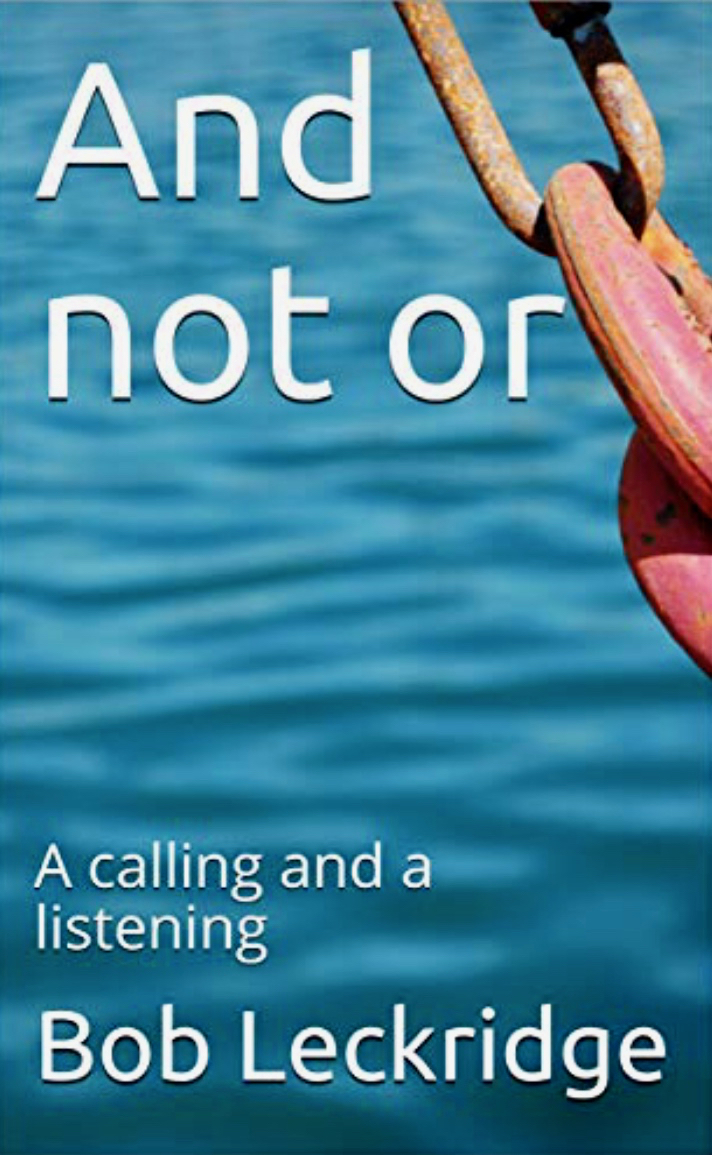
Some time ago I wrote a book called “And not or” – the idea of “and not or” came to me as a good way to approach life, and it’s since become something of a family feature. One of my grand-daughters, mentioning to a friend who queried it, said “What is “and not or” not a thing in your family?”
Essentially, I believe that “or” is divisive. It’s about “this OR that”. It divides the world into pieces, looking through binary lens. “And” on the other hand, builds bridges, forges connections. It is the link between apparently polar opposites. “And” reminds us that no particular experience or view is complete. We never know all that could be known. “Or” is more judgemental. “And” is more humble, more open to learning more.
Here’s the text of the opening chapter of my book, “And not Or” ………..
No man is an island entire of itself; every man
Is a piece of the continent, a part of the main;
If a clod be washed away by the sea, Europe
Is the less, as well as if a promontory were, as
Well as any manner of thy friends or of thine
Own were; any man’s death diminishes me,
Because I am involved in mankind.
And therefore never send to know for whom
The bell tolls: it tolls for thee.
John Donne
Ubuntu – « I am because we are »
None of us are entirely separate, neither from other people, nor from the rest of the natural world in which we live. On the other hand each of us is unique. It seems as if one of the most fundamental paradoxes in human life is a tension between belonging and uniqueness, between connections and separateness. Do we have to choose between these two options? Or is there some way to reconcile them? Many years ago I was wondering how to share my photos with other people. I looked at one option on the internet – a web service called Flickr, dedicated to storing and sharing photos. I also looked at the fairly new idea, at the time, of personal websites, or “blogs”, where I could post photos and write some descriptions of them. I could combine some creative writing with my photos by sharing some of the thoughts inspired by each image as I reflected on them. It didn’t stop there. There was also Facebook, and Twitter, and a kind of mini-blog site called Tumblr. How could I choose? Each of these options offered some features which the others didn’t, and each service seemed to have its own group of users. I knew that if I shared photos on Flickr, certain people would see them, but if I shared them on a blog, on Facebook, Twitter or Tumblr, then different people would see them. As I researched the different options and read reviews, I realised I wasn’t the only one finding it difficult to choose.
Then I came across a phrase taken from the language of logic and computer programming – « and not or » – and a light bulb went on in my head. I could share my photos on more than one of these services. I didn’t have to choose only one. In fact, I discovered that there were many ways to create connections between the different services. I could write a blog post, linking it to a photo hosted on Flickr, whilst automatically sharing it one or more of the other services just by clicking a button named « publish ».
None of us can be reduced to only one part of our character or nature. We are all multiple within ourselves. Have you ever done the thought experiment where you plan a party for everybody you know, and everybody you’ve ever known? You’d hire a large hall and invite absolutely every relative, friend, colleague, client, well, just anybody who has, or has ever had, a personal connection to you. Pretty quickly as you think about all the people who would be there, you realise that almost the only thing they would all have in common is their connection to you. Chances are you quickly realise this isn’t enough to create a cohesive group. The people you know from different contexts in your life may well not share that much in common with each other. The people you’ve known from different times in your life might not share much in common with each other either. Yes, of course, there will be common threads, common interests, values, shared histories, but their individual and even group differences will amount to more than their similarities. You can imagine that several of your guests won’t really click with each other. It turns out that whilst each of us has many different aspects to our character, which particular aspect comes to the fore is highly context sensitive. I could slip easily between my roles of husband, father, son, doctor, colleague, teacher or friend, just to name a few of the more prominent ones. I am not stuck in any single role. I should be able to behave appropriately according to the social context.
And not or.
This is how we live. We constantly change. We flow back and forwards between different aspects of our selves. We don’t choose one role and then attempt to live a whole life within it.
But wait, I hear you say, we have to make choices all the time, don’t we? There are many circumstances where have to make a decision, to commit to one direction rather than another. We can’t have our cake and eat it.
You are right. We often have to choose. In fact, we have created an entire economic system on having to choose. We have even turned choosing into one of our highest virtues. Freedom equals the freedom to choose. Choosing is based on the word « or ». You can choose this political party in the election, or that one. You can apply for this job, or different one. You can spend your money on this, or that. It is the basis of competition and a free market economy. Competition is the basis of both capitalism and our modern interpretation of Darwin’s principle of selection. Different options are set against each other. One wins, the other loses. This is just how things are.
When I say « and not or », I’m not advocating the famous « have your cake and eat it ». Nor am I advocating indecision or indifference. The way of « or » is inextricably bound to the way of « and », just as our need to be unique and separate is bound to our need to belong and to connect. Choosing « and » neither restricts us, nor does it stop us from making decisions.
I’ve come to believe that « or » has become too dominant in our culture and in our everyday lives. I’m anxious that it is separating us from each other, setting us in opposition to each other. We seem to be living through a time when polarities and mutually exclusive identities are proliferating, and on the back of that we are witnessing more strife, more anger, and more division. We hear the rhetoric of « us not them », which stokes prejudice, hatred and suspicion. We have created a civilisation of oppositional camps, each creating their own little worlds, each speaking only to like-minded others in shared echo chambers. We talk of « winners and losers » where the winners take all and the losers are advised to « suck it up » and « move on ». There are more walls going up, more doors being closed, less bridges being built, and less agreements made. Competition and winning are seen as strong and desirable, whilst co-operation and consensus are portrayed as weak.
I want to contribute towards a redressing of the balance. I know we have to make decisions. I know we often have to choose. But when we invest too much in « or » then things start to fall apart. « Or » divides, separates, alienates and creates dis-ease.
It’s my contention that we need more « and » because «and» connects, creates healthy bonds, encourages sharing, and a sense of belonging. We need «and» in order to heal.
« Or » stops thought. We choose, we separate, we finish. Why would I be interested in anything else when I’ve already made my choice?
« And », on the other hand, pushes us towards novelty and connections. It stokes our curiosity, demands our humility, sustains our open-ness to others and to change. It can teach us how to handle uncertainty and unpredictability. It can develop our capacities for awareness, reflection, flexibility and adaptation.
Every living organism survives and grows by making connections, by being open the flows of materials, energies and information in which we all exist. Every living organism survives and grows by responding to, and adapting to, the ever changing environments and contexts in which we all exist.
Maybe the best way for me to explore and share this idea is to tell something of the story of my life. Maybe the best thing I can do is to share some of my experiences and to reflect on how those experiences shaped me, and shaped my life.
This is my story. These are some of my stories. I’m writing this to help me make sense of my life. Maybe reading my story will help you make more sense of yours, too, and I’d be delighted if that were the case, but, ultimately, you will have your own stories to tell. We all do.
You can find a Kindle version of the book here – https://amzn.eu/d/akoOnrz (or search Amazon in your own country)
My area of work was health. I worked as a doctor over four decades and I learned a lot about what made for a healthy environment and what was a more toxic or harmful one. I reckon the characteristics of healthy environments are pretty universal. We all need to breathe clean air, drink clear water, eat nutritious food, have nourishing and caring relationships. There’s a lot of evidence about the positive healing effects of natural environments. I say “natural” but what I mean is, as opposed to built environments. Trees and forests stimulate healthy changes in body and mind, but busy six lane motorways, not so much. But even within these universalities we are all different, so, for some, it’s healing to walk by the shore, or to gaze out at the ocean, breathing in the salt air. For others, the most healing environments are in the mountains and lakes, breathing the clear, fresh air of a little altitude, surrounded by birdsong and wildflowers (“and not or” remember…..both these environments can be good for the same person)
I read a section of Rick Rubin’s “The Creative Act” recently (I’m working my way through, reading and meditating on, one section a day just now. It’s such a rich resource)….this morning’s section was “Setting” where he discusses what environments are creative, illustrating how very different ones allow us access to different flows from the universe, each of which can stimulate our intuition. He points out how tranquil natural environments allow us to appreciate the direct information from the universe, whereas, busy peopled places, like cafes, town centres etc, can allow us to tune in to the universe as filtered through human beings. In all situations it’s a question of detached awareness, so that we can notice patterns, but not allow ourselves to be overwhelmed by them. That made me think of the phenomenon we call doomscrolling, where we get caught up in social media feeds. They too can be sources of creative stimulation if we allow ourselves to notice the patterns and themes, and not get caught up in them.
In fact, Rick also suggests cultural environments where we focus on reading, music, visual art, etc to pick up the information from the universe filtered through culture.
The most important point he makes is that we are all different. His conclusion is that we need to “hear the chimes of the cosmic clock ring, reminding [us] it’s time. Your time to participate.”
It is.
It’s your time to participate, to become aware, to trust your intuition and to engage. Which environments do you find most conducive to creativity? What factors make a positive contribution to your creativity?
I read an article in New Scientist by Florence Gaub and Liya Yu entitled “Nothing’s certain”. The authors explore two different ways that we handle uncertainty. Their specific take is a “political neuroscience” one. Now, let me just say I have a paradoxical relationship with the “neuro” tag. Firstly, it attracts me. I’m interested in the brain, scored my best exam result ever in the neuroanatomy exam at Medical School. I’m interested in pyschology and in the “mind-body connection” (although that, too, is a phrase which can both attract and repel me). Secondly, “neuro-” has become a bit of a fashion, with everything from “neuroscience”, to “neuromarketing” and this “political neuroscience”. I just don’t think neurology can explain everything about human behaviour. Alongside that, the correlations between neurological observations and behaviour are just that….correlations. We still haven’t explained how the physical brain can have subjective experience, and whether or not subjective experience creates the changes in the brain, or vice versa.
However, what they had to say really interested me. They say “Political neuroscience shows that the brains of people with conservative views favour security and avoid open-ended solutions with no clear closure. They tend to have increased volume in their amygdala, the region responsible for threat signalling” And, “Liberal brains have a higher tolerance for uncertainty and conflict, as they have more grey matter volume in a brain area implicated in the processing of ambiguity called the anterior cingulate cortex.”
They point out that when uncertainty is high, the former “conservative” people are attracted to whoever offers the idea of certainty (think Hitler and his 1000 year Reich), and are fearful of novelty, whether that be technologies, foreign people or cultures.
They conclude that we need to learn that “cooperation across identity and interest groups” can be beneficial, and that we can overcome our big global challenges “only by overcoming our brains’ vulnerabilities together”.
I’m not sure that MRI scans of peoples’ brains reveal their political preferences, and I’m a bit uncomfortable with how this thesis basically implies that “Liberals” need to help “Conservatives” get over their fear and anxiety, but apparently “Liberals” don’t have anything to learn from “Conservatives”.
I say that despite seeing myself as firmly in the “Liberal” camp, not least because I was trained as a General Practitioner, a speciality sometimes described as doctors who specialise in managing uncertainty. Uncertainty was my daily professional experience, one unique, novel, unpredictable patient at a time.
However it does seem that the “Right” are on the rise across the world, and this might well be connected to an increase in the amount of uncertainty which people are facing in modern times…..uncertainty about climate change, about technology, about both national and personal security.
So, if I want to make a positive contribution, perhaps I need to understand and address the anxieties and fears of those people with a larger amygdala….
In other words, how can I help people to deal with uncertainty more comfortably? How can I help them to enjoy novelty, to delight in diversity and difference, and how can I help to create a more secure society for us to live in together?
In addition to that, what do I have to learn from those who may be more sensitive to uncertainty than I am?
Let me start with the last point first. We humans need sufficient certainty. We couldn’t go on without it. When I buy a train ticket, it doesn’t cross my mind that the train I’m about to step on won’t make it to its destination (despite the fact that between Stirling and Glasgow I’ve had several experiences of trains being delayed, cancelled, or even terminating a few stops before my intended one). The point is that I’ve had enough experiences of reliable trains to actually get on a train and expect it to take me to where it says it’s going to go.
When I first went to university in Edinburgh, my mum, who clearly had a well developed amygdala, used to send me newspaper cuttings about crimes in different parts of the city, with the accompanying advice to avoid those areas. When she sent a story about a boy who was stabbed in Princes Street, I had to ask her to stop sending these cuttings, because there was no way I was going to be able to spend at least the next six years of my life in Edinburgh without walking along Princes Street!
When we wake up in the morning, most of us don’t wonder if this will be our last day. But one day, it will be. No, we have to have enough confidence, enough of a sense of certainty, that we will make it through to bedtime. Otherwise, how could we even get up?
My point is, that we need certainty. Or, do we? Is it more that we need confidence? Confidence that, no matter what the day brings, we will get through it, we’ll handle it? I suspect confidence and certainty aren’t the same thing, but the greater the certainty, probably the more confident we feel. And, probably, vice versa, because the more confidence we develop through our practice and experience, the more we will experience certainty in our day to day lives.
I think this is the key lesson those with a larger amygdala have to teach us……although certainty, like perfection, is an impossible goal, it is still important to have it as one of our goals if we are to survive and thrive.
We can do that as a society by attending to the circumstances of life which lead to security…..abolishing poverty, driving down inequality, creating decent houses and work for everyone, creating and protecting clean air, clean water, and nutritious food, as well as providing freely available, good quality education and health care to all.
We can do it individually by attending to the rhythms, rituals and habits of our lives. We pass a lot of each day on autopilot, finding ourselves trundling along the railway tracks of our own well established habits. I wouldn’t be surprised if you told me you wake up about the same time each day (or, certainly, each Monday to Friday), follow the same sequence of toilet, toothbrushing, showering, maybe shaving (well, I do), and having a “regular” breakfast. If you are employed, you’ll probably make your way to your workplace, without any great awareness of your surroundings (unless something unexpected occurs on the way). You’ll have your work routines, with the well established break times, and finish time, before heading back home, retracing your steps. The French have a phrase for this – “Metro, Boulot, Dodo” (metro for the commute, boulot for work, and dodo for sleep) – which captures this sense of a routine, hamster wheel, existence.
It’s not a bad thing to have habits and routines. They can provide a certain security, a certain sense of certainty, an unchallenging, comfortable, structure. But you can see that, pushed too far, they can create a mode of living where life itself seems to pass us by.
That brings me to the first question I posed to myself….how can I help others to deal with uncertainty more comfortably? My lifetime work experience would lead me to suggest doing whatever gets us to focus on the here and now. I saw hundreds of patients with paralyzing anxiety and/or mind numbing fear. What they all had in common was that their inner world, the world of their thoughts and feelings, was trapped in a kind of loop, or whirlpool, with one anxious thought feeding the next one. Whilst they were absorbed, even overwhelmed, with this inner world, they were consequently disconnected from other people and from the rest of the world. So, we’d begin by pulling their attention to what was happening around them, in this moment, in this particular place. We had built a hospital around a beautiful garden and I’d take patients out into it to walk along the winding paths, noticing the different plants, blossoms, flowers, birds and other animals along the way. We’d sit on one of the benches and just notice….notice what we could see, what we could hear, what we could smell, what textures we could touch.
There’s a French phrase I’ve loved since I first encountered it – “L’émerveillement du quotidien” – which translates, roughly, as the wonder of the every day. The truth is that every day is unique. Every moment is lived for the first and last time. And each day is filled with encounters which we’ve never had before….a particular moment with a Robin, a moment when the light catches the dew on the newly woven, intricate spiders web……
Paying attention to what is around us, paying loving attention to what is around us, opens us up to a world filled with wonder, with diversity and novelty, and gives us a lived experience of change, of surprises, of unexpected delights.
Well, that’s a beginning. It’s a way to calm down that amygdala and strengthen the anterior cingulate cortex, perhaps.
What’s your own take on uncertainty? How high is your tolerance to it? And what do you do to balance consistency and novelty?
I welcome constructive criticism and suggestions. I will not, however, tolerate abuse, rudeness or negativity, whether it is directed at me or other people. It has no place here. ANYONE making nasty comments will be banned.