Feeds:
Posts
Comments

Posts Tagged ‘art’

I recently read an article by Richard Collett, author of “Along the Borders”. Here’s what struck me.

“Four millennia ago, a Sumerian king, his frontier beset by nomadic tribes fleeing prolonged drought in their own lands, ordered the construction of the world’s first border wall: a 177km-long boundary laid in stone between the Tigris and Euphrates rivers. Since humanity’s earliest city-states and kingdoms arose in ancient Mesopotamia, walls, ditches and fences have defended territory, marked the edges of empires and projected political power across the void. But the world’s first border wall failed. It now lies buried beneath Iraq’s desert sands. Rome’s legions abandoned Hadrian’s Wall long ago, and the iron curtain’s razor-wire fences fell with the eastern bloc’s collapse in the late 1980s.”

I was born in Central Scotland and lived my whole life there until I retired to France. From childhood I was aware of the remains of two walls – Hadrian’s and the Antonine Wall. Both had been built by the Romans at the edge of their empire to try and keep we Scots out. Both were little more than piles of stones and mounds of earth centuries before I was born. I could visualise those remains came as I read Richard’s opening paragraph. 

When someone takes a historical perspective it can help us to see the present day in a different, often clearer, light. Thousands of years on from the Sumerians, we humans are still building walls, still calling for “taking back control of our borders”, still trying to prevent our fellow human beings from escaping the suffering and hardship of drought, famine, and war. 

The answer has never been walls. 

Wouldn’t it be better to build connections? To create bridges between ourselves and “the other”? To create, in particular, those fundamental, life enhancing, health giving, connections we call “integrative” – and, just to remind you, integrative bonds are the ones which promote integration – they are the ones where highly differentiated parts relate to each other in mutually beneficial ways. 

Those are the kind of connections we see in every human being. Every single one of our organs, tissues and cells, exists within a vast web of mutually beneficial relationships with all the others. That’s what enables us to survive. That’s what enables us to grow and to thrive. 

There’s an old saying “As above, so below”, but I’ve often thought we also need to remember “As within, as without” – what we learn about our healthy insides is applicable outside of us…..in other words, for each of us to be healthy, we need to form “mutually beneficial relationships” with each other, with other forms of Life, with the rest of this small, beautiful, planet, where we all share the same air, the same water, the same earth. 

Richard Collett concludes his piece with –

“….if the aim of hard borders is to halt the flow of refugees, curb illegal economic migration or counter terrorism or instability, then surely a better solution is to tackle the conditions driving people from their homes, or towards extremism, in the first place.”

Interestingly, Pope Leo XIV, recently made a very similar point, when he asked what the rich nations were doing to improve the lives of those who live in poorer countries. The wall builders didn’t like it. 

I mentioned recently that I’d just read Daisy Fancourt’s “Art Cure”, about the impact of the arts on health, and how she wrote about the “five pillars of health”….diet, exercise, sleep, nature and art. 

I write a lot about nature, I take lots of nature photographs, and I am blessed to be living in rural France where I feel closer to nature than at any previous time in my life. I love to be amongst the trees, to be able to hear a chorus of bird song every day. I love to breathe the fresh air, to see the flowers and fruits appearing on the plants around me. All of that is about me being more connected with nature, more “engaged” with nature. I remember how important that was in my work as a doctor….to enable people to re-engage with the world, with the natural world, and with each other. Illness and suffering can be so terribly isolating, cutting us off from the world around us. It’s both a therapy and a sign of progress, when someone is, or becomes, engaged again….when someone makes better connections with both the natural world and with others. 

But Daisy Fancourt’s thesis is about art and how engagement with the arts has a positive impact on our health. I had a very special and powerful experience of that last week. 

Georgie Brown is a local, 23 year old, musician, who was born in England but brought up here in SW France. She gave a concert in Saint Jean d’Angely, in the beautiful, Art Deco, Eden Theatre, just over ten minutes from my house. The concert was billed as “Symphonic Jazz”. I confess I didn’t know what that might mean, but we’d seen Georgie perform a short set, in the middle of Saint Jean in the summer during the annual French festival of music, and really enjoyed her performance.

Symphonic jazz turned out to be Georgie Brown singing her own compositions, with her “jazz men” band of a pianist, double bassist, drummer and small brass section of trombone, trumpet, and two sax players. But, for this concert, she’d composed orchestral arrangements of her songs, and performed them with her band and a thirty piece local orchestra…..the “Orchestre Symphonique des Vals de Saintonge”. 

From the first notes of the string section I felt moved to tears. You could see that every single musician on that stage was loving what they were doing. The joy, passion, and delight in music was infectious. The clearly evident mutual respect between them all was moving. Look, I know we all like different kinds of music. Some people love opera, others country music, yet others the Blues, but whatever their tastes, the audience at this concert were treated to something unique, and very special. It was heart warming, life enhancing and a great example of why Daisy Fancourt describes live music in particular, as something which can have positive and profound effects on health. For that concert to be so successful, it required the creation of multiple “mutually beneficial bonds” between all the musicians. When human beings get together to make music, they aren’t only capable of producing beautiful harmonies, but they build better connections between themselves and others…..between other musicians on stage, and between themselves and the audience.

I’m not saying we should go to concerts for the good of our health. We should go because we love music. But what I am saying is that when we choose to participate in activities which build and strengthen connections, our lives can feel better……that building connections is the way to building a better world.  

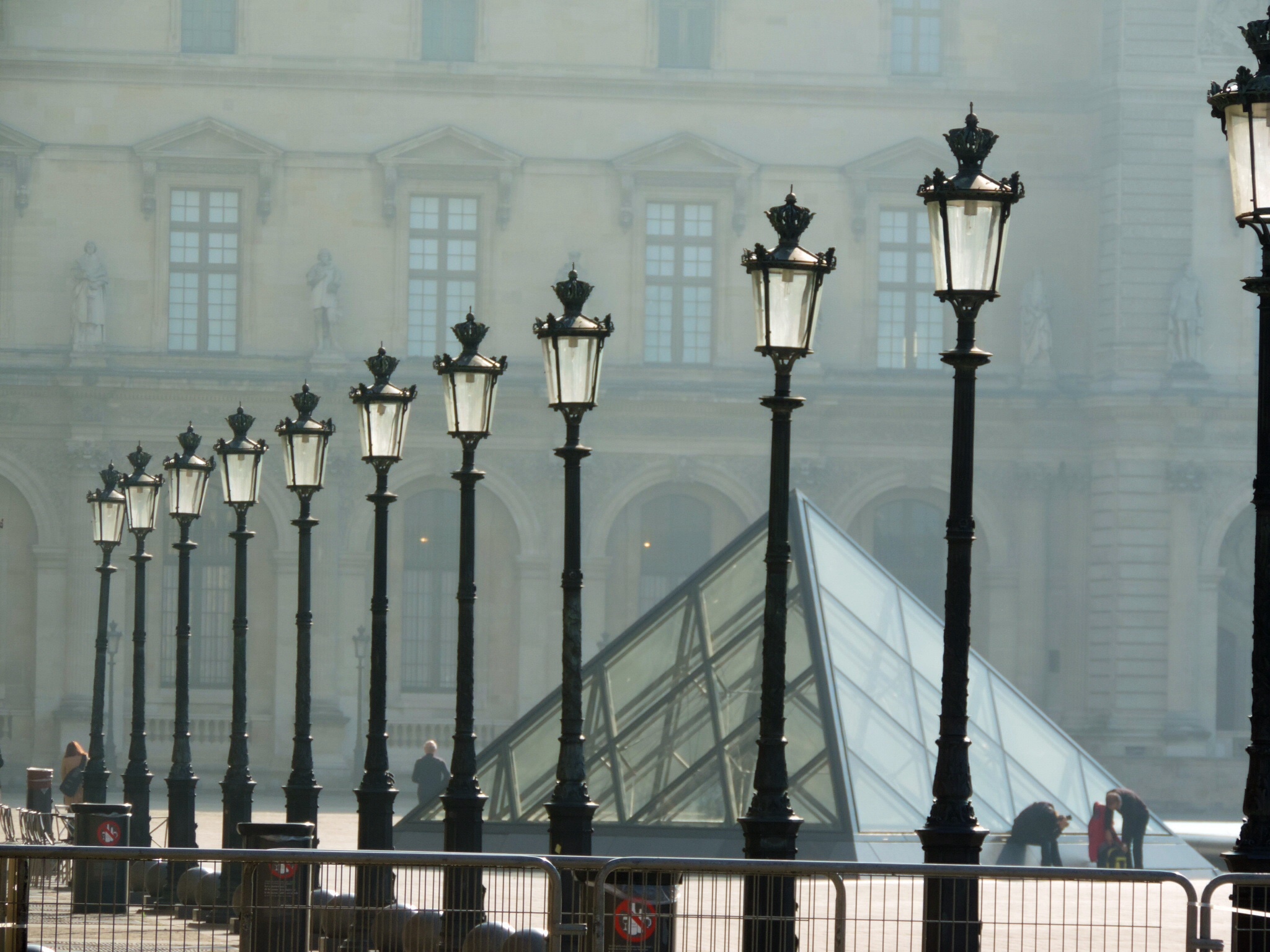
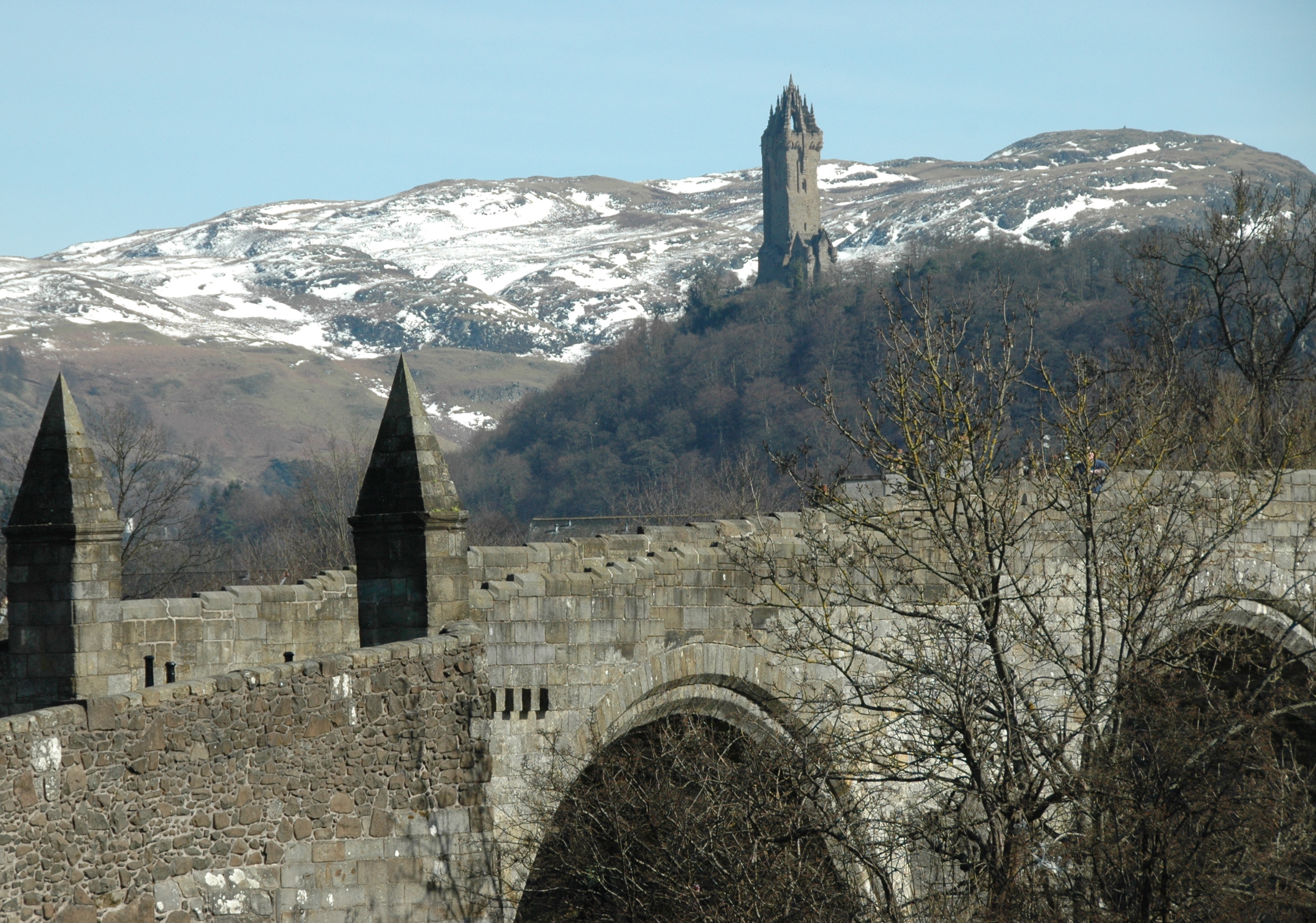
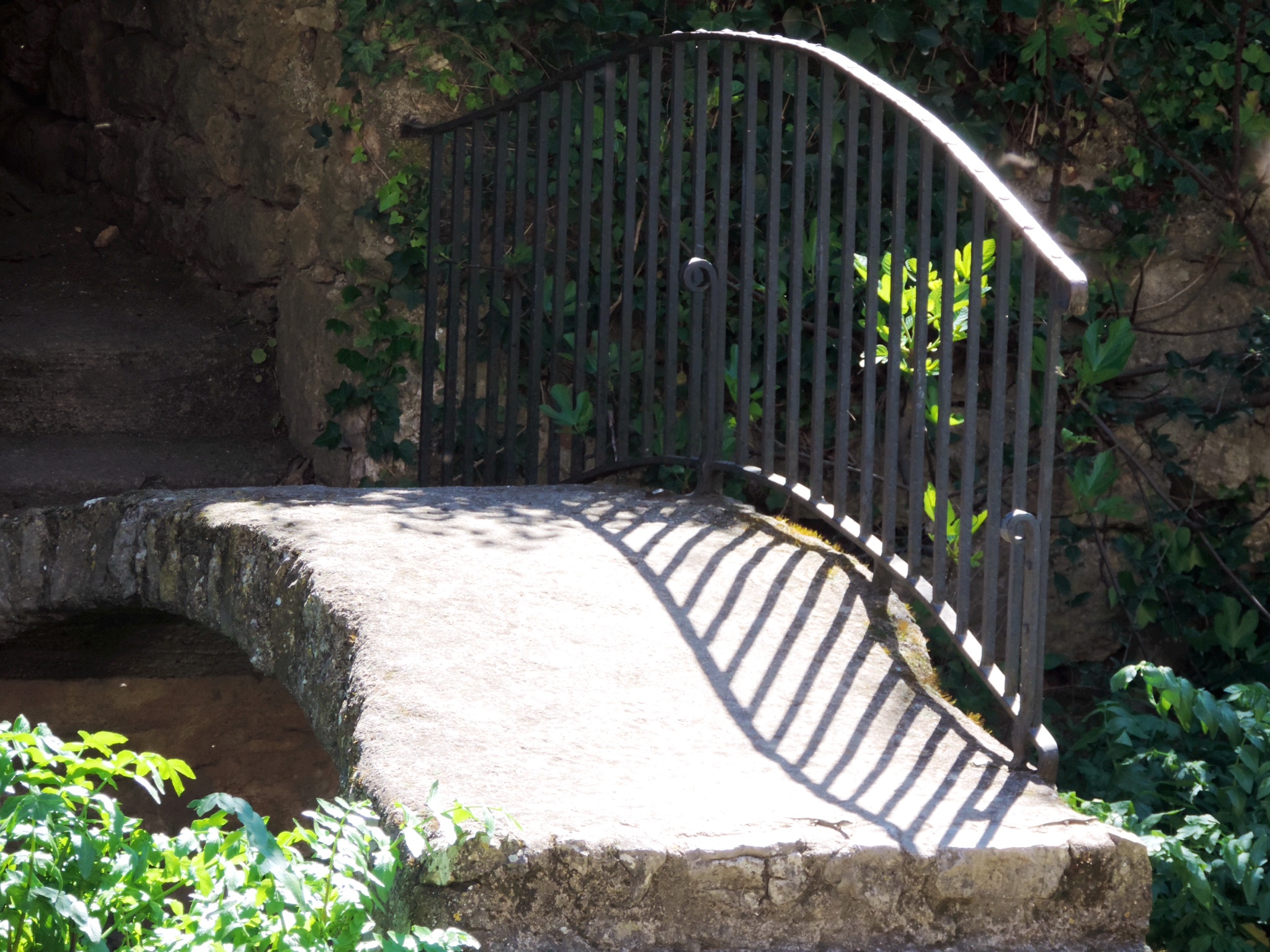
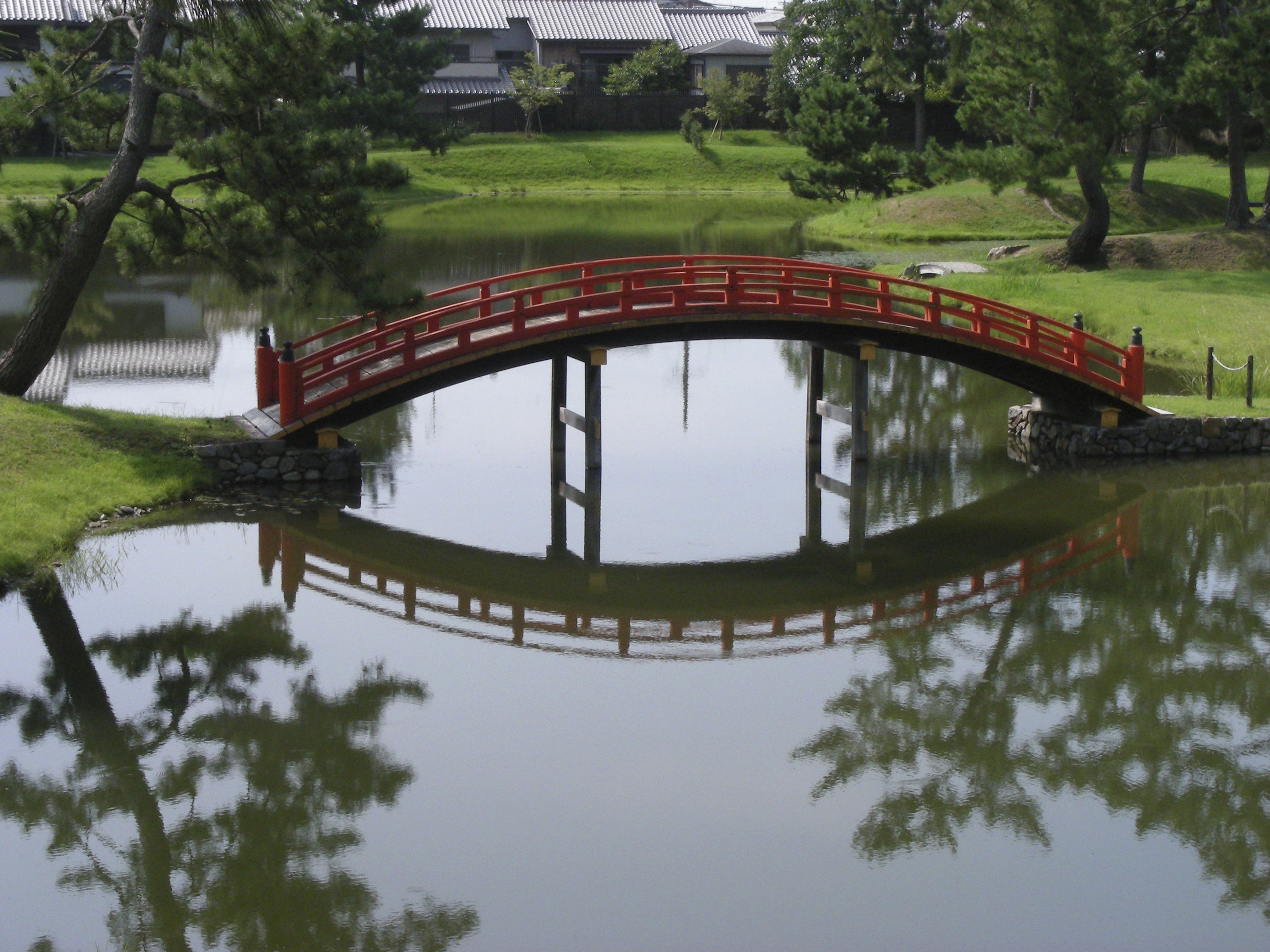
One very obvious type of human construction is the bridge. I’m pretty sure we’ve built a heck of a lot more bridges than walls over the centuries. I pretty partial to bridges. They appeal to me. Part of the reason I love them so much is that they are a physical manifestation of our need to make connections. They also facilitate our basic desire to travel and explore the world we live in. My photos this week are some of my favourite bridges. I think they make it clear why I prefer bridges to walls. 

Here’s a video of one of Georgie Brown’s songs where she sings about being partly English and partly French – just to give you a flavour of her style –

https://youtu.be/QtklkcXdqkY

And I’m sure you’d like a song about bridges…..what songs do you know about bridges? For me, first up is surely Simon and Garfunkel…..Bridge Over Troubled Water. I think my friends all had their own copies of that album, and I still have mine, and it’s still a classic!
Read Full Post »

I recently read Daisy Fancourt’s Art Cure, and I highly recommend it. Daisy Fancourt is Professor of Psychobiology and Epidemiology at University College London, and in this book she tells us about the huge evidence base for the impact on health which can be made by participating in art. 

What do we mean by art? Well, someone was bound to ask that question. Daisy tackles it by defining it broadly, not by trying to give characteristics of features to qualify for art, but, by giving examples, from a wide range of creative disciplines. I think that’s the essence of it, actually….creativity. Engaging with creativity, your own, and that of others.

For example her definition of art encompasses singing, listening to music, dance, drawing, reading, crafting, visiting museums, galleries and going to the theatre (not a definitive list) And she shows how many studies have found astonishingly high levels of benefits of arts engagement on everything from depression, anxiety and pain, to blood pressure, mobility and cognitive function. There is even good evidence that it can produce useful changes in dementia, (both at the level of the pathological lesions in the brain, and, at the level of cognitive function) and that it increases longevity. 

I’m finding all this very exciting. I hope it convinces those who think the arts are a luxury. Some of the comments I’ve read from reviewers and other scientists are particularly encouraging, including those who admit they started the book as sceptics, and ended up convinced.

Mind you, I don’t listen to music, visit galleries, read, or write creatively for the good of my health. I do these things because I enjoy them and they give me more good days. I don’t think what Daisy is trying to do, though, is reduce art to a tool, or a new treatment modality to be applied to patients. She’s helping us to understand that engagement with the arts has very profound effects on everything from mental health, to reductions on the need for drugs and surgery in those with chronic conditions. This might seem a small point, but, I think it’s an important one.

I mean, who wouldn’t want to live a longer, better life quality life? No matter your current state of health. Not by applying a “treatment” but by making changes in everyday life which lead, naturally, to more good days….

Two chapters of the book especially struck me. In one she describes the impact of “Magic Camp” on children with cerebral palsy, where children were given the opportunities to learn how to do magic tricks, by professional magicians, working with a team of therapists. Learning these tricks enabled them to improve their motor skills, boost their confidence, and find access to whole new worlds of possibility. I love the holistic range of “outcomes” these camps achieved. What teaching these children how to do magic tricks can result in enormous breakthroughs which regular physio and psychology couldn’t achieve. She focuses on one particular case, and it’s a remarkable story in its own right, but goes on to describe how that one boy’s experience was not a one off.

In another she describes a music therapy where patients with fibromyalgia and other chronic painful conditions listened to music with their eyes closed for twenty minutes twice a day for two months. Their pain levels were halved. As was their level of depression and anxiety. The music was “U sequence”, using genres the patients preferred, starting with stimulating 90-120 beats per minutes, moving to slow 30-40 beats per minute pieces, and ending with moderate 60-80 beats per minute. I don’t know how to find music I like by beats per minute. Maybe you know ways to do that. Actually, for me, this particular intervention seemed over-focused on the measurables – the numbers of beats per minute and the numbers of minutes spent, but I am seriously impressed with the outcomes. Imagine if your doctor would recommend two twenty minute music listening sessions a day which could halve your pain levels? What impact might that have on your need for pain-relieving medication, for mood elevating medication? What impact might that have on your everyday experience of life?

Early in her book she mentions the “five pillars of health” – diet, exercise, sleep, nature and art – and, for me, this very simple point, turns out to be a crucial one. Most of us only hear about the first three, diet, exercise and sleep, so it’s incredibly refreshing and exciting to explore the fourth and fifth ones – nature and art, both of which are dear to my heart.

I’ve often written about the health benefits of nature, and you can find several such posts here on heroes not zombies, if you search in the search bar for words like “nature”, “NDD”, “forest bathing” and so on. Forest bathing is one of my favourites. Many studies have shown the positive effects on the immune and inflammatory systems of spending time amongst trees. But in fact engagement with the natural environment is available to all of us every day. There’s a wild area of my big, French, rural garden, which really has the feel of a mini-forest. Just stepping into that pattern is enough to feel different. The temperature is different in there, the light and smells are different. I love to slowly wander along the little winding paths I built, and just see, hear, smell, what I can notice.

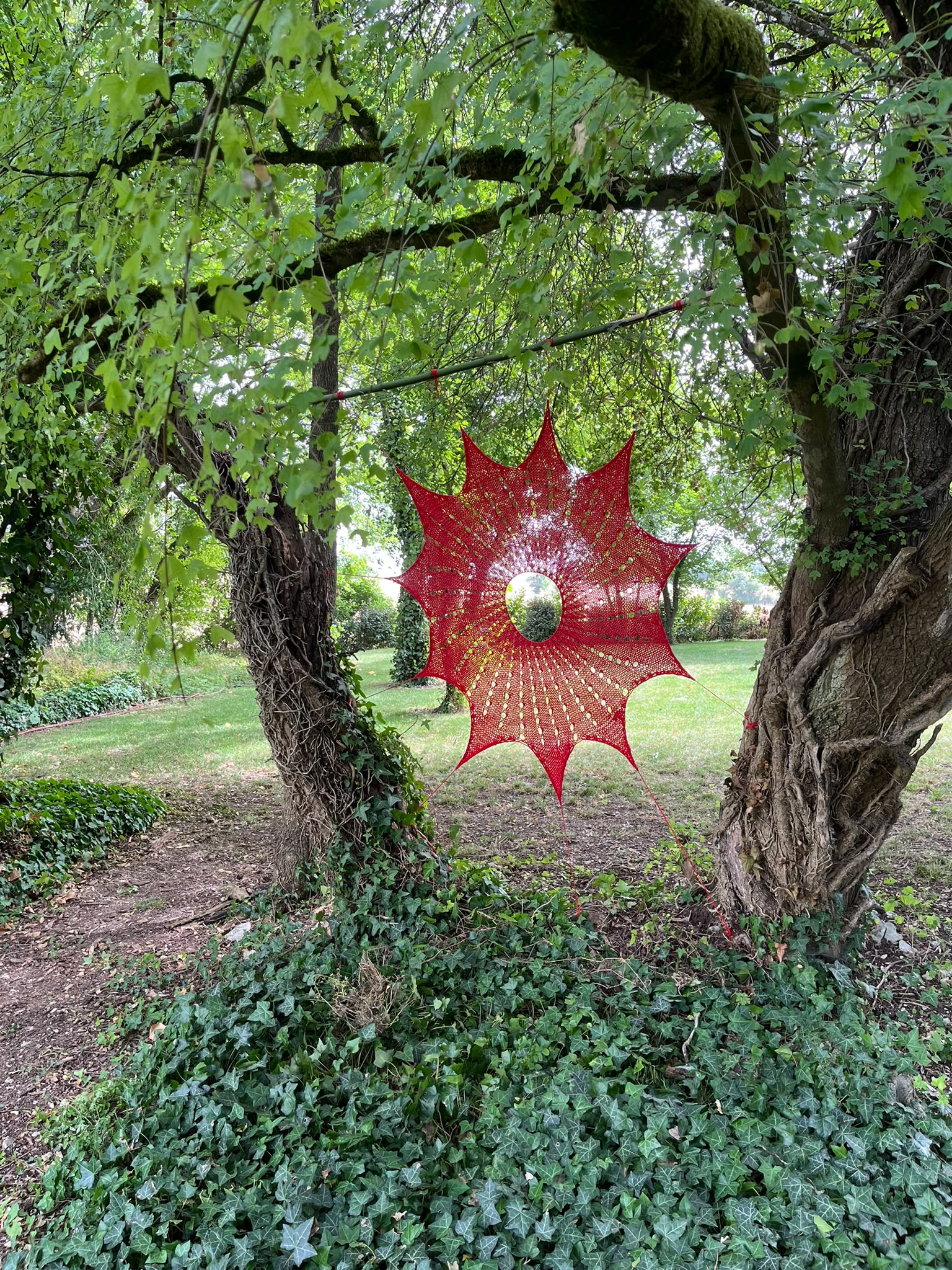
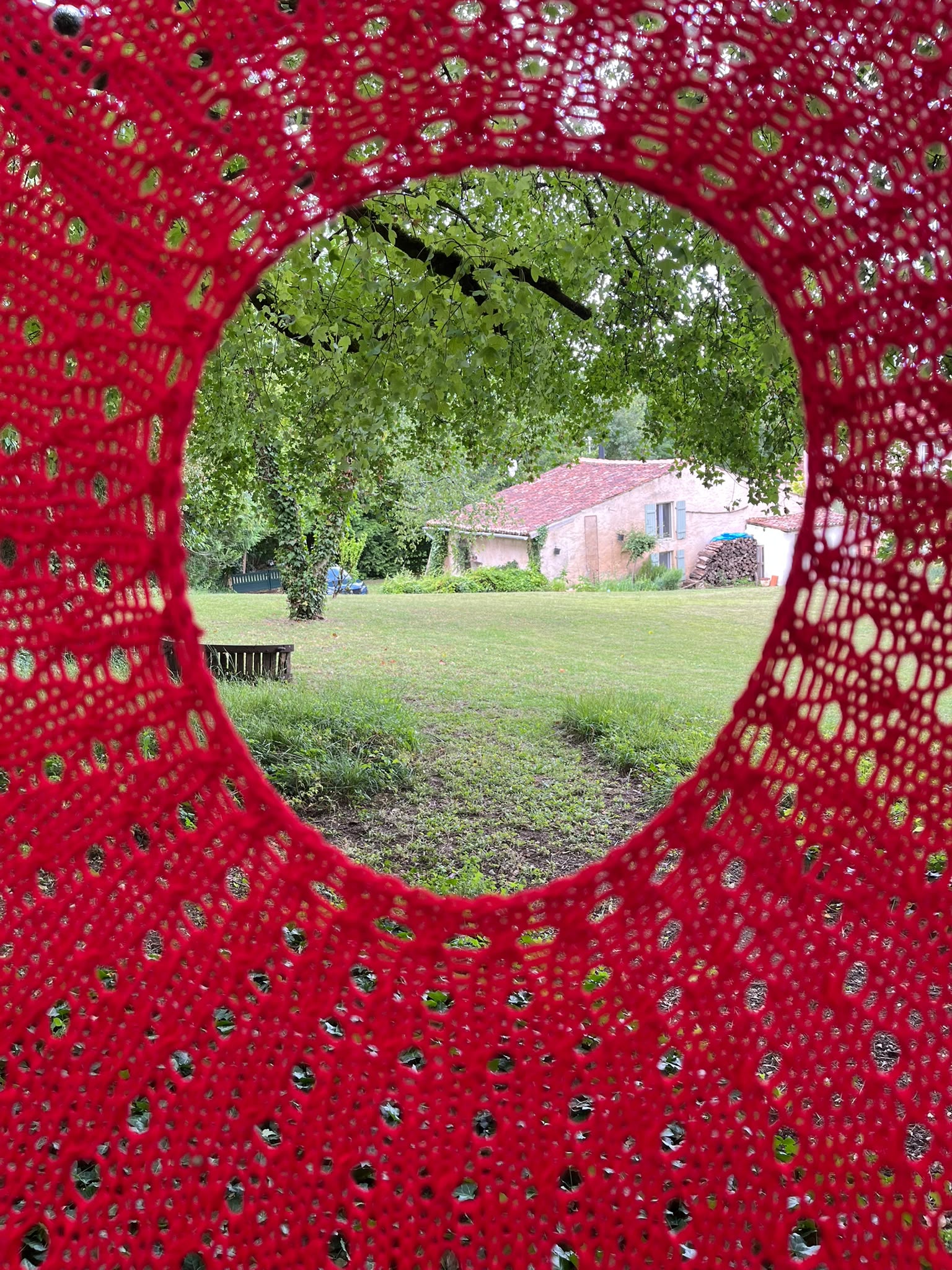
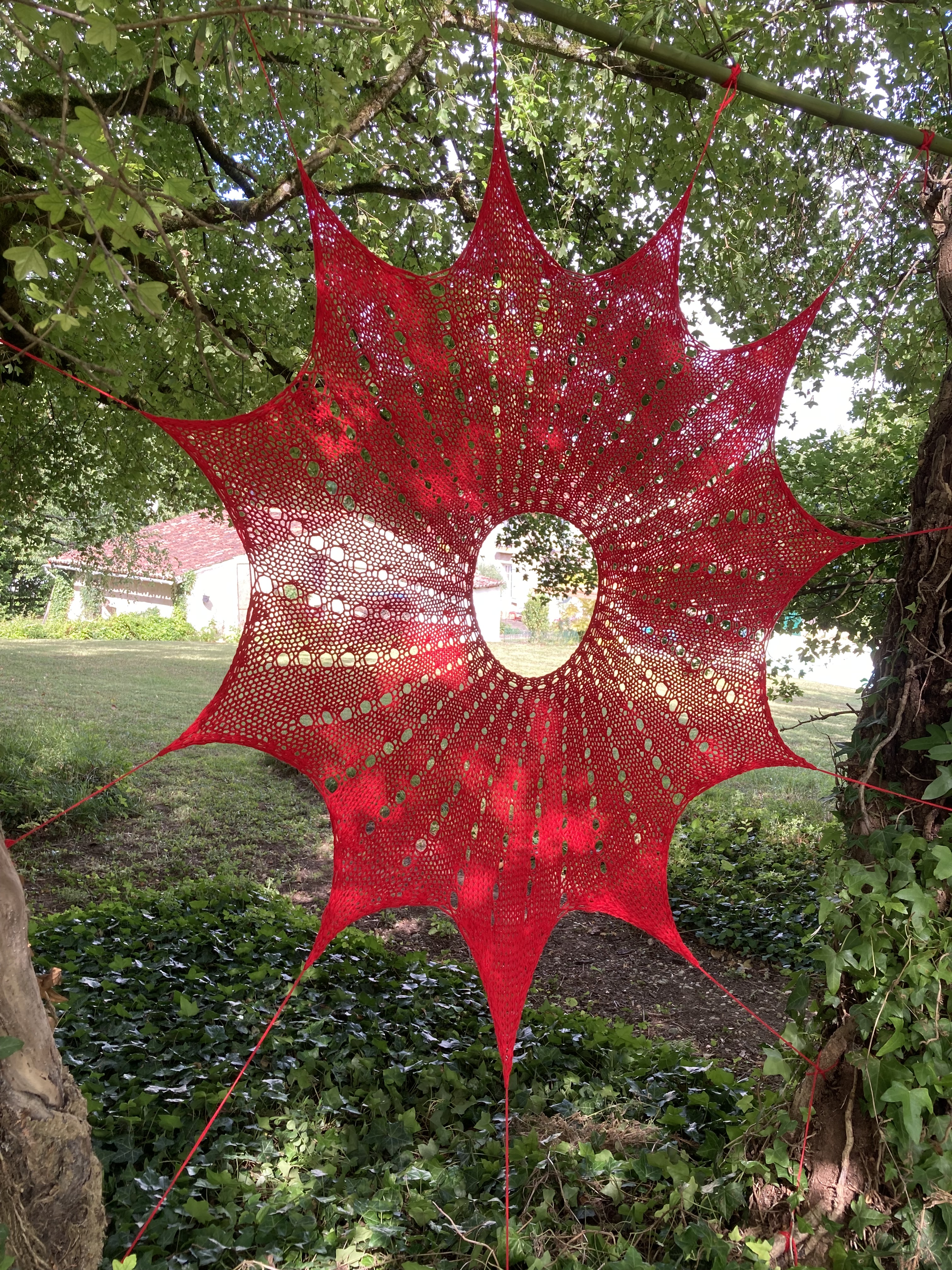
I recently paid a visit with some of my family to Jupiter Artland which is just outside Edinburgh. It’s truly one of the world’s special places created around a forest walk sprinkled with sculptures and art installations. Do you know it? Here’s a link to their website – https://www.jupiterartland.org/ I highly recommend visiting, although it is just outside of the city, and it’s not that easy to get there by public transport. Still, it’s really worth it. I have a particular liking for art installations in natural environments, and the diversity and range of works in the forest there are really something special. In fact the visit inspired us to create our own installation. My wife, Hilary, is a very talented and prolific knitter. So she created a kind of giant web, or dream catcher and we attached it across a gap between a couple of the trees. Here are a couple of photos.

I’m SO delighted with it. Yesterday, in the afternoon, on a breezy day, as clouds flew across the face of the Sun, I watched how patches of light shone bright red on the dark red background, constantly changing shape and position. It was almost like watching a 3D kaleidoscope. Mesmerising!

Anyway, the opportunity to experience two of the five pillars of health at the same time – nature and art. I love that combination. 

OK, so maybe you’re wondering, why haven’t I said anything about the first three pillars – diet, exercise and sleep. Well, mainly because we are flooded with information about all three of these. There are so many variations, and, the truth is, no one size fits all, so you have to find the diet, the exercise regime and the sleep routine that works best for you, but essentially, it seems to me that a healthy diet includes diversity of foods, and is mainly, if not exclusively, one of non-ultrahigh processed foods. On top of that, most healthy diets recommend eating more plants than meat, and, if possible, eating food which hasn’t travelled all that far. I guess I’m lucky, living here in rural South West France, because there is an abundance of weekly markets within an hour from where I live. At any of these markets you can easily find seasonal foods, and locally grown ones. 

As far as exercise goes, the main rule isn’t about a certain number of steps every day, it’s about not spending too much time just sitting. Many of us have pretty sedentary jobs, or lifestyles, and there’s no doubt that the less we move each day, the more likely it is that we will develop severely limited mobility. Again, it’s a matter of finding what works best for you, but most specialists advice both strength training exercises, and some exercise which puts your heart rate up. 

Sleep? It comes down to finding the routine that works best for you, and sticking with it. That includes both determining when you want to go to sleep, and when you want to wake up ( 6 – 8 hours sleep is usually recommended ) and developing a wind down routine pre-bed time. It’s pretty much common sense, but, the underlying principle is to gradually reduce your exposure to stimulants, whether they be food and drink, or activities. 

Anyway, you really won’t find it difficult to find advice about those first three pillars of diet, exercise and sleep. What I will keep coming back to in my newsletters, posts and podcast episodes, is the value which nature and the arts can bring to our lives, to our health, and, to making more of our days, good days. 

So, here’s my quick summary advice for this week –

listen to music,

treat yourself to some art experiences and, if possible,

allow yourself some time in nature. 

Oh, and one more piece of advice, or, rather, an invitation. Come to bobleckridge.substack.com and sign up to follow me. 100% free. If you do that, you’ll get an email every time I publish a newsletter (I’m writing one every week just now) and every time I publish an episode of my new podcast, More Good Days.

By signing up, you’ll make sure you never miss an issue or an episode, and you’ll be able to catch up with any of the ones I’ve published so far.

Read Full Post »

I’ve visited Copenhagen a number of times. In the winter months there are no direct flights from my part of France to Scotland so when visiting family before Christmas, a few times we’ve taken the train up to Paris, flown from there to Copenhagen, then from there to Edinburgh, returning by the same route. We stop over for a couple of nights in Copenhagen and in Paris as part of the trip which makes the journey into a bit more of an adventure and takes away time pressures related to train and flight connections. 

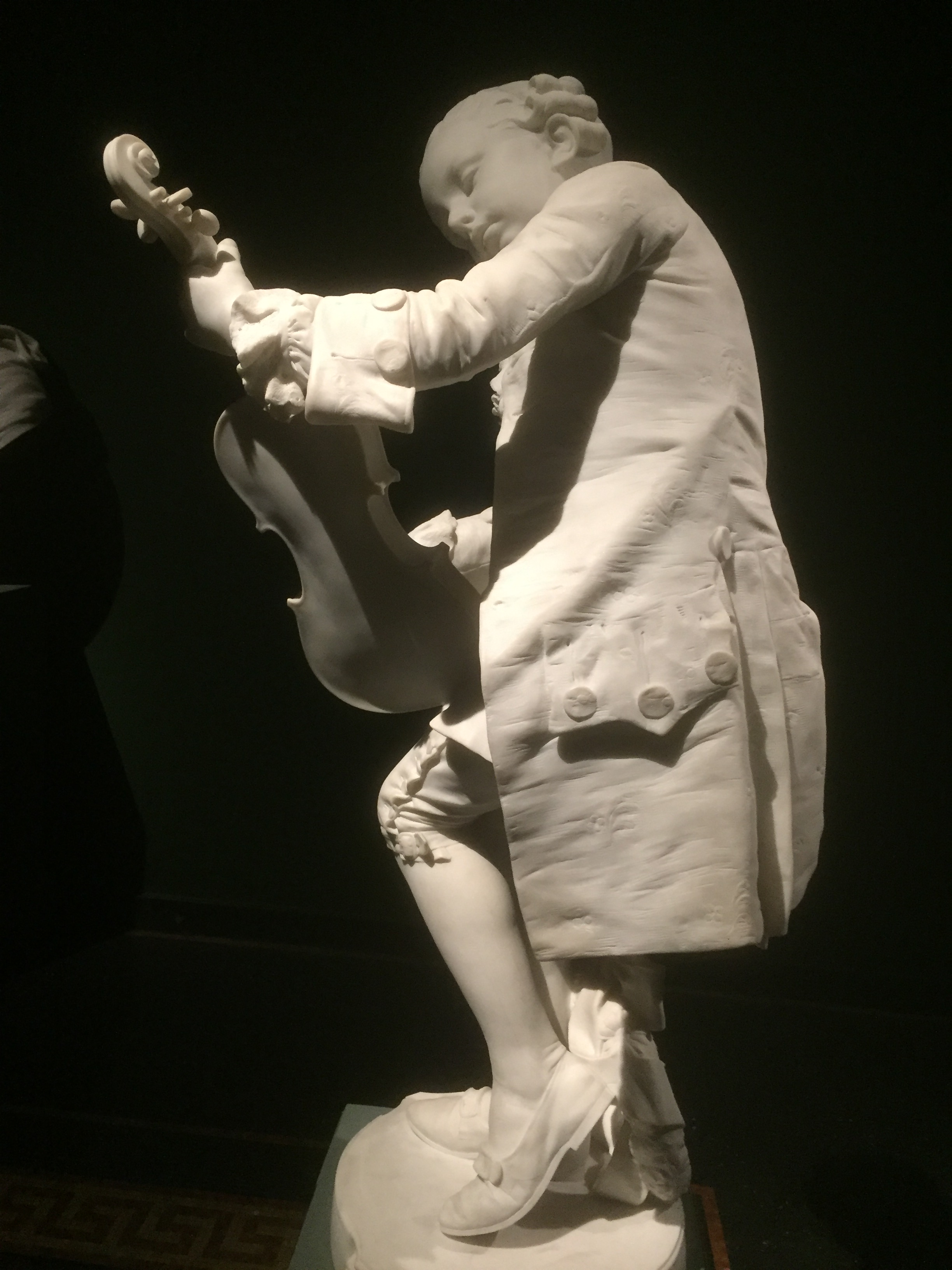
One of my most favourite places to go in Copenhagen is the Glyptotek. It’s a beautiful museum in the heart of the city. It has a lovely internal garden courtyard with a cafe restaurant which serves delicious Danish food. But the main reason to go there is to see the exhibits of sculpture. Their permanent displays include a vast number of marble sculptures and, honestly, they are magnificent. 

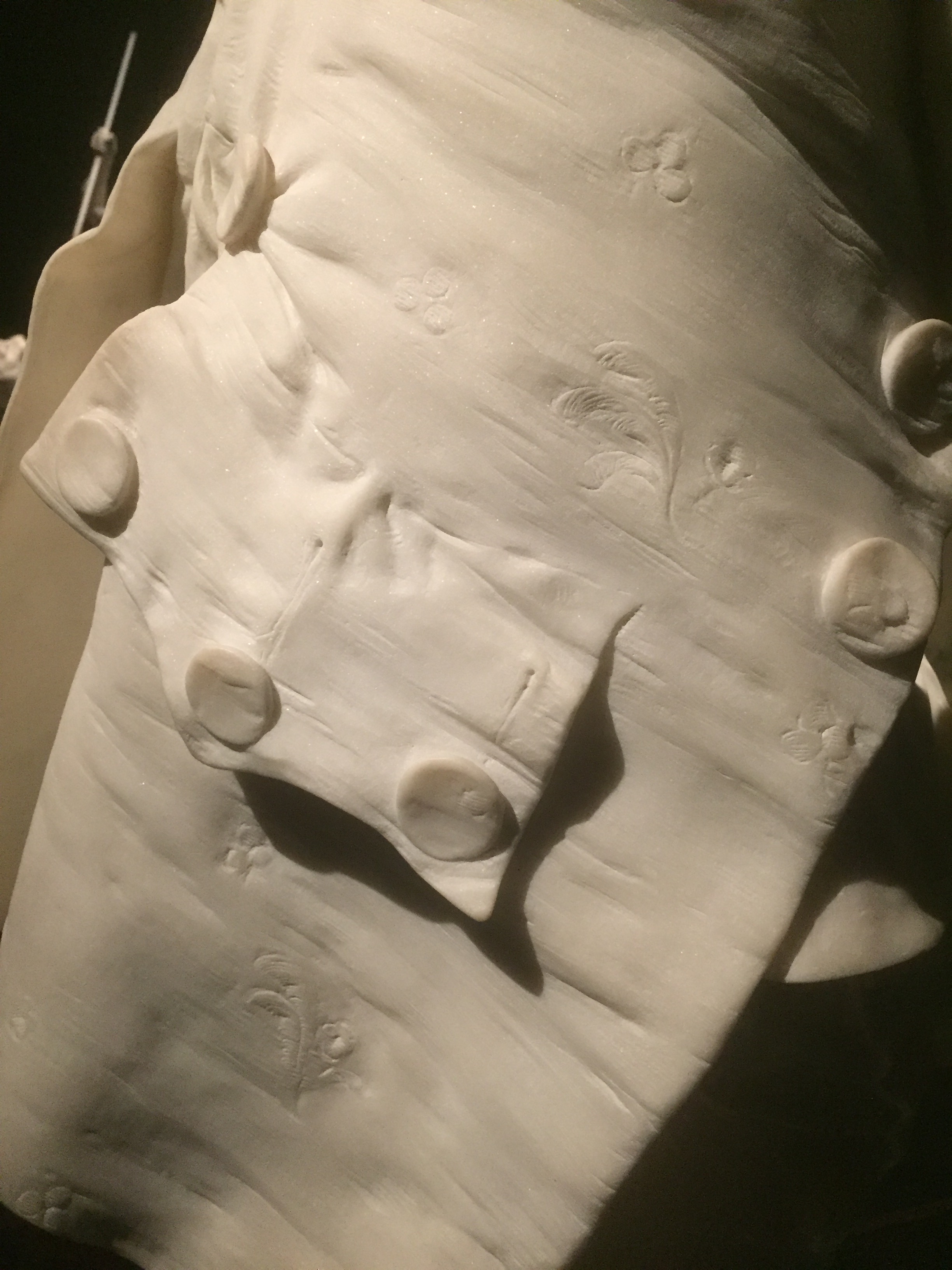
I took this photo during my first visit there. It is the “Young Mozart” by Louis Ernst Barrias. I couldn’t quite believe this was carved out of a block of marble. Look at the detail! Here’s a section of his coat…..

….it looks like real cloth. This is the kind of art which stops me in my tracks and takes my breath away. The skill involved in carving this is astonishing. The whole piece is a real beauty, and, beauty, I contend is one of the most life enhancing phenomena we can encounter. I’d have been happy to have seen just this single work that day, but, in fact, there are many, many more just as impressive. 

The subject matter here interests me too. I’m not a classical music buff, but I know enough about Mozart to be astonished at his youthful creativity. There is a whole catalogue of his works written between the ages of eight and twelve years old. 

What can we make of such extraordinary talent? Where does it come from? I have no idea, but surely one of the most significant characteristics of our species, is our creativity, and how, we express it through the Arts, Sciences, Philosophy, and even in everyday problem solving. 

But there are always those whose talent, whose genius, appears first at a very young age, and develops throughout their adult lives. It’s a gift. It’s a gift they have received, and it’s a gift they give to us every time we encounter their works. 

I wrote about Saint-Exupery in the last newsletter, but I didn’t tell you about one of his inspirations for The Little Prince, which occurred during a train journey through Poland. Here’s what he wrote

“I sat down [facing a sleeping] couple. Between the man and the woman a child had hollowed himself out a place and fallen asleep. He turned in his slumber, and in the dim lamplight I saw his face. What an adorable face! A golden fruit had been born of these two peasants….. This is a musician’s face, I told myself. This is the child Mozart. This is a life full of beautiful promise. Little princes in legends are not different from this. Protected, sheltered, cultivated, what could not this child become? When by mutation a new rose is born in a garden, all gardeners rejoice. They isolate the rose, tend it, foster it. But there is no gardener for men. This little Mozart will be shaped like the rest by the common stamping machine…. This little Mozart is condemned.”

This was written in 1935 as dark clouds were gathering over Europe, so, maybe his rather gloomy conclusion should be read in that context. Isn’t it interesting that he thinks of the “child Mozart” when he sees this little boy? And, he was so right to point out that “a life full of beautiful promise” could either be nurtured to fruition, or crushed by the machine-like forces of industrial society. 

Just before Christmas last year I went to a concert in the Art Deco, “Eden Theatre”, in Saint Jean d’Angely, my local town. The concert was a performance by a young French violinist, Esther Abrami, who I’d read about in the French press. She is one of the most talented violinists I’ve ever heard. One of her albums is called “Women” and features compositions by female musicians. Esther told a little story about each composer before she played one of their works. I’d never heard any of these stories before. The concert was a real eye opener, and ear opener too? So, I was delighted to learn that she had written a book about women in music. It was published just last week and I got my pre-ordered copy delivered on Friday. I’ve been delighting in it every day since. 

Esther’s own story is fascinating. She is from Aix en Provence, and as a little girl, was gifted a violin from her grandmother, a particular instrument her grandmother had, herself, played as a girl. But her first lessons didn’t go well which she puts down to the fact that she found her teacher unkind and difficult. However, only a few years later, she was inspired by another violinist and persuaded her parents to let her try again. This time, things clicked, and she’s turned out to be the excellent professional musician she had dreamed of becoming. That story reminded me of how important it is to nurture and nourish little children. Not that they will all grow into musical prodigies but surely at least one purpose for us all is to become the fullest expression of our uniqueness, and we can’t do that alone. 

One of the female composers she described in her concert, and writes about in her book (“La Musique est (aussi) une affaire de femmes”) is Chiquinha Gonzaga, Brazil’s first female conductor, who was born in 1847. She was a remarkable woman who led a quite astonishing life, divorcing her husband to whom she had been forced into an arranged marriage, after he asked her to choose between him and her music. She chose her music, which meant she had to give up a life of riches and servants, to become a poor, single mum making her living teaching piano and selling music sheets of her own compositions. 

She eventually found success, love and happiness, and composed over 2000 works, living to the ripe old age of 87.

One of the most astounding parts of her story is that she composed her first musical work, the song “Canção dos Pastores”, at the age of 11. 

You can listen to it here – https://open.spotify.com/track/43AB805Bd0sKhCQ2FtWp0P?si=1fe230517e11432c

Go and have a listen. If you don’t use Spotify, search for it online. I’m sure you’ll find it elsewhere. But, seriously, she composed this at 11 years old?

You can find a playlist of over 500 videos of her compositions here – https://youtube.com/playlist?list=PL6nx2WTN7S1-NtIL3PY1Yf2QEhuHW223s&si=lFgmVQZcIIhlItmx

Esther Abrami’s book is just out in French, but I think she plans an English language translation. I’ll tell you about it when it gets published. Meanwhile, if you can read French, do get yourself a copy. It’s a real treat. 

Back to Esther and her own skills…..if you’d like to explore her work, I suggest you start with one of her own compositions, “Transmission” which she wrote for the grandmother who gifted her her first violin. It’s on her album, “Women”, and here’s the link to it on Spotify – https://open.spotify.com/track/0w8AtUiGnz0Khf5AZOPLu4?si=3cc4b13d9c714fff

At her concert, as well as featuring music from her album, “Women”, she played a number of pieces from another of her albums, “Cinema”, and my favourite from that album is probably “Yumeji’s Theme” from the movie, “In the Mood for Love”. 

Have you ever seen that movie? Oh, it’s on my list of all time favourites. One of the most beautifully filmed movies I’ve ever seen, and “Yumeji’s Theme” fills my mind with gorgeous scenes from it which I’ll never forget. 

I’ll leave you to go exploring Esther’s work wherever you listen to music. I know we all have different musical tastes, but I think you’ll be delighted by both the beauty of the music and the skill of this young violinist. 

Can I leave you with a question? 

Who are some of your own favourite sculptors and who are some of your own favourite composers/musicians? 

I’d really like to know. 

And if you’d like to receive my weekly newsletters and fortnightly podcast episodes please come and sign up here – https://bobleckridge.substack.com/

Read Full Post »

“Nothing begins with us.”

“The more we pay attention, the more we begin to realise that all the work we ever do is a collaboration. It’s a collaboration with the art that’s come before you and the art which will come after. It’s also a collaboration with the world you’re living in. With the experiences you’ve had. With the tools you use. With the audience. And with who you are today.”

Rick Rubin, in his “The Creative Act”. 

This really resonates with me. Over the last few decades we humans seem to have privileged competition over collaboration. Many people even call competition, “Darwinism”, because Darwin showed the role of competition in evolution. But Darwin also showed the role of collaboration in evolution. Why don’t we give that aspect, equal, or even greater, attention. 

It strikes me that even in my lifetime here on this little planet, over these last just over seventy years, I’ve witnessed a growth of alienation and isolation. The cult of the Self, of the Ego, of the so called “self-made man” (a total delusion, by the way), contributes to this isolationism. 

We are isolating ourselves from each other, because we are blind to how connected we are….to each other, to the past, to our ancestors, to our children, and their, as yet unborn children….to the myriad of other forms of Life on Earth. 

We even think of “Nature” as something that is separate from us. We are never separate from “Nature”. We emerge within it, within this vast, complex web of relationships and billions of other organisms with whom we are in constant collaboration. The very cells of our bodies come into being from the flows of materials, energies and information which gather and co-exist for a short while to create what I experience as “me”, which create what you experience as “you”. 

If we are going to heal ourselves, heal our communities, our societies, our world, we are going to have to become more aware of our connectedness, and to build creative, collaborative, “integrative” relationships (mutually beneficial ones). 

Because “nothing begins with us”……and nothing ends with us, either. 

Read Full Post »

There’s been a shift in social media channels. Not long ago many people presented themselves as “Influencers”, but now, not so much. Increasingly I’m seeing the term “Content creator” instead. Or, sometimes, “Digital content creator”. I must say, the first time I noticed this shift I wondered mainly about the word “content” – I don’t find it appealing, but I understand it will cover anything from text, images and videos, to the spoken word or music (and maybe more, I’m not sure!). I do think of myself as a photographer and a writer. I do both of those things frequently…..pretty much every day. But, I guess none of that is “content” unless I publish it (or upload it) somewhere, like here on my blog, or on a social media platform like Bluesky (or Facebook, Threads, Mastodon, Substack, or whatever). However, having wondered for a while about what constitutes “content” I shifted my attention to the second word….”creator”.

A few years ago when thinking about health, and how did I know a patient was becoming more healthy, I hit on a three word acronym – ACE – for Adapation, Creativity and Engagement. Briefly, for me, the healthier someone became the better I saw their ability to cope, to deal with whatever they had to deal with, to adapt and change. In addition, I’d notice they were becoming more creative, more able to solve problems, to come up with new ideas and ways of living, to be better able at expressing themselves. And, finally, I’d see they were becoming more engaged, building connections and relationships, deepening connections and relationships, paying better attention to the here and now.

It struck me then, and it continues to strike me, that we humans are naturally creative creatures. Maybe you learned from a religious teacher that God created us in His likeness? I always thought that meant He created us as creative creatures. (We are more than simply creative creatures, and there are several other factors we can consider which contribute to our “human-ness”, but I’ll explore that another time.

Rick Rubin’s “The Creative Act: A Way of Being”, begins with a chapter entitled “Everyone is a Creator”. He writes –

To create is to bring something into existence that wasn’t there before. It could be a conversation, the solution to a problem, a note to a friend, the rearrangement of furniture in a room, a new route home to avoid a traffic jam.

He goes on to explore how through our senses and our brain/body processes, we create experiences for ourselves, we create our internal reality, from the undifferentiated external reality. In other words, just being alive is a creative act.

Finally, he writes –

To live as an artist is a way of being in the world. A way of perceiving. A practice of paying attention……your entire life is a form of self-expression. You exist as a creative being in a creative universe. A singular work of art.

I couldn’t agree more.

It’s not just “content creators” who are creative, it’s you and it’s me and it’s everyone you know. How does it change your perception of someone once you start to explore their creativity? What do you notice when you start to ask yourself, “in what ways is this person creative?”

Read Full Post »

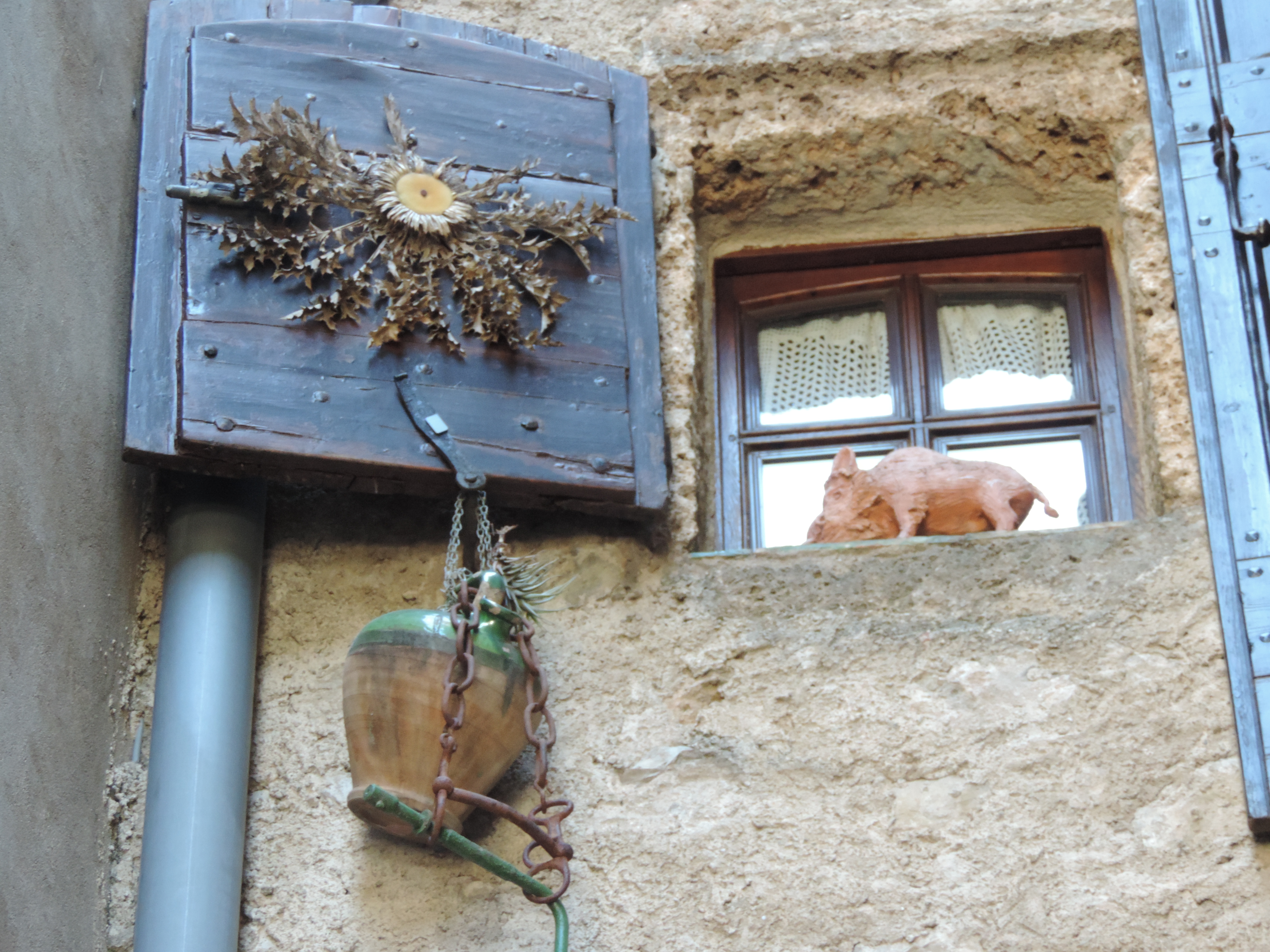
The “cardabelle” dried out and attached to the exterior of a house is a common sight in Saint Guilhem le Desert, in the far South of France. It’s a great example of one those uniquely human phenomena that I love to find.

First, its local purpose was to predict the weather. When it’s becoming more humid, a storm might be on the way, and the shepherds would notice that the flower had closed up. It keeps this ability long after it’s been removed from the fields and pinned to a doorway. So, shepherds would pay attention to it, and make sure that both they, and their flocks stayed safe. This primary use is very utilitarian.

But we humans don’t stop there. We love beauty. And so people would collect these plants and put them in, or on, their houses, simply because they found them beautiful. There’s beauty everywhere in nature, and it’s often used as a method of attraction – flowers to attract pollinators, birds to attract mates etc. But we humans have definitely taken it to new heights. We love to be surrounded by beauty and we can find it everywhere – in landscapes, in gardens, in the people we meet, the objects we create, the music we listen to, the art we make. Setting off today with an intention to notice beauty can be a good way to make today a good day.

But we do something else, something I don’t think any other creatures do at all. We have the capacity to symbolise. We can make anything we want into a symbol of something else. I don’t think any other creature does this. It enriches our lives, helps us to have a daily sense of purpose and to discern meaning in our existence. There’s a magical quality to symbols. We use them to focus our attention, to create a frame of reference through which we engage with, and co-create, the world. These “Cardabelles” are pinned outside houses for good luck. They are one of many, many items, we, in our different cultures use, to either bring good fortune, or to ward off evil, or misfortune.

I don’t think we should dismiss the value of symbols in life and reduce everything to utility. Symbols are powerful ways for us to get in touch with, and share, our values. They can act as anchor points, or, in complexity science terms, as “attractors”, organising our local reality around us.

What symbols are most important to you?

Read Full Post »

There’s what some people call a spiritual practice taught by the Classical Greek philosophers. It’s called “The view from on high”. I thought of that when I looked, again, at this photo which I took from the train crossing the Alps last year.

The idea of the view from on high, is about taking an overview. It’s about seeing the context of something, seeing the “bigger picture”. We can be too close to something, so close in fact that we can’t “see the wood for the trees”. The answer is to go higher for a more comprehensive perspective.

Although the Greeks didn’t know it, this is advice to access your right hemisphere. The left hemisphere of the brain has a very narrow focus. It enables us to zoom in, separate out elements, and grasp what we are looking at. But the right hemisphere takes in the context, sees the connections, enables a more holistic understanding.

Of course, it’s best when we use our whole brain, not just half, but, sadly, we’ve developed the habit in our cultures of thinking the left hemisphere knows best. It doesn’t. It only helps us when we take its “re-presentation” of reality back into the right hemisphere, to situate it in the whole.

Reality is not made up of pieces which are assembled. Reality is a whole, in constant flow and change. Stepping up a level and taking “the view from on high”, can help us to appreciate that.

Read Full Post »

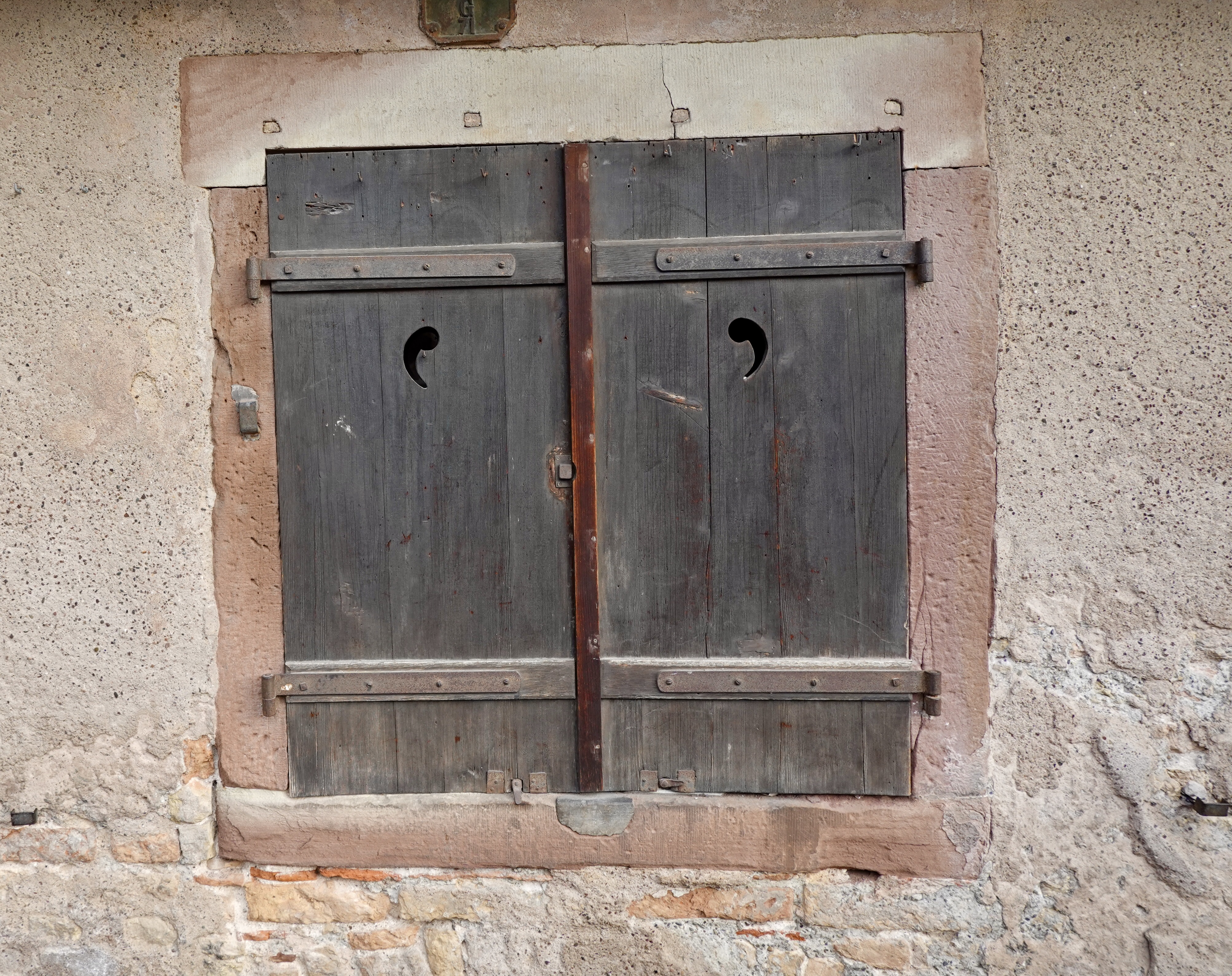
You could argue that these little “commas” cut out of the shutters covering this window are to let some light in. But if you wanted to let light into the room, you’d open the shutters, wouldn’t you? But maybe you just want some light in, not much. So why cut the holes into these carefully crafted shapes? Or maybe we need to think of this from the other side. Maybe these are holes to look out through….viewing points to see a bit of the world outside. But there again, why make them this shape? You know what? Maybe they aren’t carved for a utilitarian function. Maybe they are neither for letting in light, nor for facilitating observations of the street outside.

Maybe the creator just wanted to make something beautiful. Because they are beautiful, aren’t they? And without them, the shutters would look pretty, well, uninteresting. It’s the comma-shaped holes which have caught my attention, made me pause, take a photo, and return to it again to wonder……what are these all about? Who made them? Questions to which I’ll never find the answers. But, this much is sure…..they bring me a moment of delight and wonder…..”l’emerveillement du quotidien“.

I’ve looked at these shutters several times now, spent some time with them, reflecting, and wondering. But this morning, something else comes up – don’t they suggest a word? If you look at them, there is one on the left, a space, then another on the right, and if you saw them on a page like that, you’d assume that in that space there should be a word. Wouldn’t you? A word. Or a quotation.

So, here’s something to play with today…….what word, or what words, would write in this particular space?

Read Full Post »

I read an article in the Guardian today entitled “Consuming arts and culture is good for health and wellbeing, research finds” It caught my eye – first because I thought consuming arts and culture ??!! I hate that. I don’t consume arts, I experience/enjoy/participate in…..not consume…. and what is culture anyway? Well, let’s leave that issue for another day. The next thought I had was “I don’t enjoy arts in order to improve my health or wellbeing, and this headline leads me to think these folk are about to try and justify arts on the basis of their utility. But, in fact, the article is even worse than the headline suggests. Here’s how it begins –

Most people are familiar with the buzz that attending a memorable play, film, concert or art exhibition can trigger. But now it is official: consuming culture is good for your health and wellbeing – and generates £8bn a year worth of improvements in people’s quality of life and higher productivity.

Seriously? I might have felt a “buzz” but, “now it is official” – “it generates £8bn a year of improvements in people’s quality of life and higher productivity”. Oh, thank goodness they’ve quantified that. Otherwise I’d have been stuck with my personal delusion that I was just enjoying something, or that it was adding meaning to my life!

Look, I understand what these people are doing, and, at one level, I commend them for it. They are trying to make an economic case for what isn’t measurable. We can’t measure paintings, poems or music. We can’t even really measure “health and wellbeing” (instead we invent questionnaires, the answers to which we allocate scores, then we say we are measuring the invisible – ok, another controversial view I can return to another day) They are claiming that, for example, going to a weekly drawing class at a museum is worth £1310 to each person from “going to see their GP less and feeling better about their lives”. Really? £1310? Not £1315? These apparently definite figures remind me of the old joke that 86.57% of statistics are made up……but, good on them for trying to make the case for arts funding to governments and policy makers who seem to understand only sums and measurements.

But, fundamentally, this makes me hugely uncomfortable. Can’t we make a case for the place of arts “and culture” in our lives without reducing them to arbitrary financial “values”, or so-called “measurements”. I don’t need any of those justifications to play music every day, to write, to read novels, to visit galleries and delight in their works, to feel the connections to their creators……

However, I read, just the other day, that more and more universities in the UK are closing down their Humanities courses, claiming that students don’t want them because they don’t see how they can lead to remunerative employment. Oh goodness, what has happened to our idea of education? What have we reduced that to? Is education only valuable if it lets you get a job managing a McDonalds outlet, or selling people “stuff”?

I hope reports like this one do stimulate debate about the Humanities. I hope they stimulate debate about what makes our lives valuable and meaningful. Meanwhile…..I’m going to continue taking photos, writing, sharing my creativity. I’m going to continue listening to music, reading novels, visiting museums and galleries – because those are some of the activities that bring me joy, that amaze me, that make me think, that help create meaning in my life. If all that contributes positively to my “health and wellbeing”, then so be it. But that’s not the reason I’ll keep filling my daily life with “arts and culture”.

Read Full Post »

The English philosopher, Mary Midgley, in her response to those who said the Self was an illusion, said “If the Self is an illusion, who is it who is having this illusion?”

Philosophers, psychologists, psychiatrists and neuroscientists, continue to debate exactly what the Self is. I’m taking a pragmatic, maybe simplistic approach. For me, the Self is what does the experiencing. Me, myself and I, as the song goes…….All the sensations I experience, are experienced by my Self. Yes, I know there are complex sensory cells and networks throughout the body which enable me to pick and process various signals, energies and waves which flow around and through my body. But, ultimately, the experiencing of the light, of colour, of sound, touch, temperature, taste….that’s all done by my Self. Similarly, it’s my Self which experiences my thoughts and feelings. Again, maybe thoughts and feelings involve a huge network of cells and chemicals in my body, but it’s my Self which experiences them.

I know that not everyone will agree with that conception of the Self, and I’m neither a philosopher, nor a neuroscientist, but I just want to describe, as clearly as possible, how I envisage the Self.

From that standpoint, I explore the world in which I find myself alive. I turn to Science to help me grasp and understand what is external to my Self. Primarily, that picks out elements from within the flux of reality, and considers them as objects…objects which can be measured and manipulated. I even turn to Science to discover elements which exist within my body, but which, I argue, are “external” to my “Self”. So developments in anatomy, physiology, pathology and so on, help me to comprehend the tissues, organs, cells and chemicals within my body, and, as a doctor, to understand them within the bodies of others. That helps me to make diagnoses and to suggest treatments when people fall ill.

Secondly, I turn to Art, to understand what is “internal” to my Self, to express what is “internal” to my Self, and to communicate with the “selves” of others. It’s through music, poetry, painting, sculpture, storytelling, novels, dance, and so on, that I attempt to show others what I feel, what I experience, what I think, from this unique perspective on the universe which I call my Self. Through Art I channel, and stimulate my creativity, my imagination and my empathy.

Thirdly, I turn to Spirituality to explore the connections between my Self, and the rest of the Universe. Through experiences of awe and wonder, I dissolve the boundaries of my individuality, and step into the Oneness of Reality.

I know these terms, external, internal, and beyond, are simplifications in their own right, but I reckon if I am to know a person, to really get to know and understand another person, then my best chance will emerge by taking a blend of these three approaches – science, art and spirituality. And, I’ll see more clearly that no single one of them can give me a comprehensive understanding.

Does this make sense to you? I’d love to hear your take on all this.

Read Full Post »

Older Posts »