I’ve visited Copenhagen a number of times. In the winter months there are no direct flights from my part of France to Scotland so when visiting family before Christmas, a few times we’ve taken the train up to Paris, flown from there to Copenhagen, then from there to Edinburgh, returning by the same route. We stop over for a couple of nights in Copenhagen and in Paris as part of the trip which makes the journey into a bit more of an adventure and takes away time pressures related to train and flight connections.
One of my most favourite places to go in Copenhagen is the Glyptotek. It’s a beautiful museum in the heart of the city. It has a lovely internal garden courtyard with a cafe restaurant which serves delicious Danish food. But the main reason to go there is to see the exhibits of sculpture. Their permanent displays include a vast number of marble sculptures and, honestly, they are magnificent.
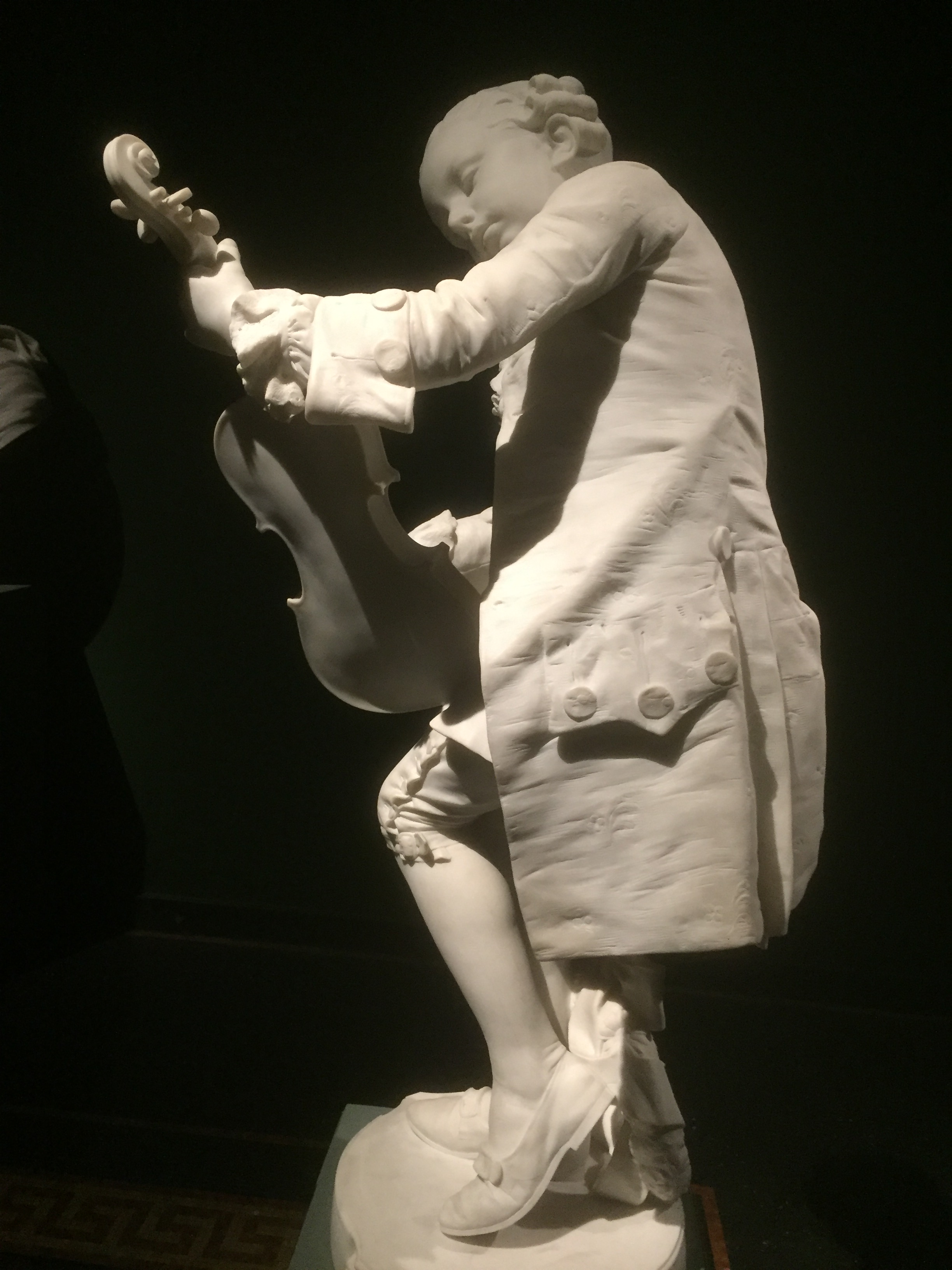
I took this photo during my first visit there. It is the “Young Mozart” by Louis Ernst Barrias. I couldn’t quite believe this was carved out of a block of marble. Look at the detail! Here’s a section of his coat…..
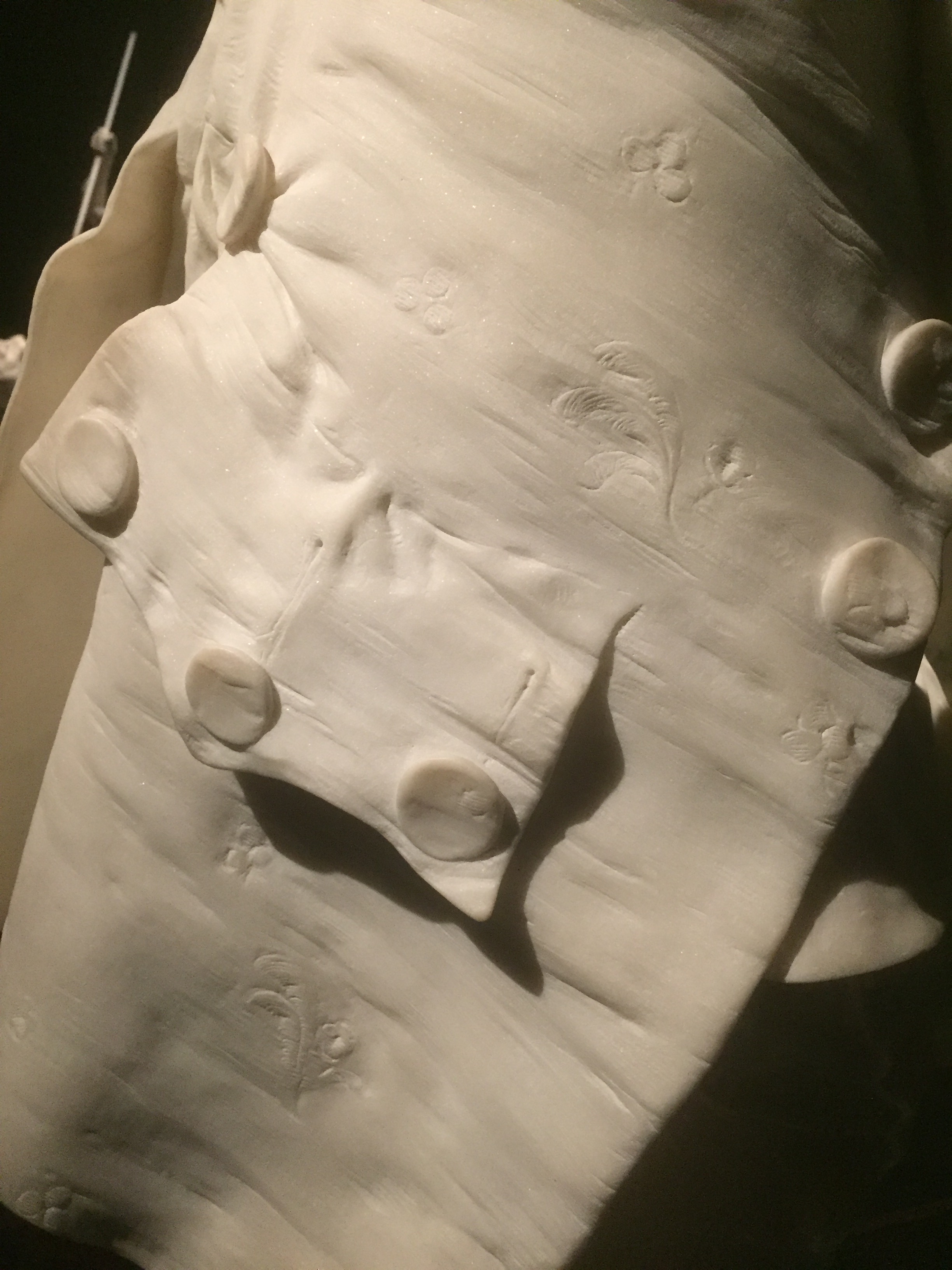
….it looks like real cloth. This is the kind of art which stops me in my tracks and takes my breath away. The skill involved in carving this is astonishing. The whole piece is a real beauty, and, beauty, I contend is one of the most life enhancing phenomena we can encounter. I’d have been happy to have seen just this single work that day, but, in fact, there are many, many more just as impressive.
The subject matter here interests me too. I’m not a classical music buff, but I know enough about Mozart to be astonished at his youthful creativity. There is a whole catalogue of his works written between the ages of eight and twelve years old.
What can we make of such extraordinary talent? Where does it come from? I have no idea, but surely one of the most significant characteristics of our species, is our creativity, and how, we express it through the Arts, Sciences, Philosophy, and even in everyday problem solving.
But there are always those whose talent, whose genius, appears first at a very young age, and develops throughout their adult lives. It’s a gift. It’s a gift they have received, and it’s a gift they give to us every time we encounter their works.
I wrote about Saint-Exupery in the last newsletter, but I didn’t tell you about one of his inspirations for The Little Prince, which occurred during a train journey through Poland. Here’s what he wrote
“I sat down [facing a sleeping] couple. Between the man and the woman a child had hollowed himself out a place and fallen asleep. He turned in his slumber, and in the dim lamplight I saw his face. What an adorable face! A golden fruit had been born of these two peasants….. This is a musician’s face, I told myself. This is the child Mozart. This is a life full of beautiful promise. Little princes in legends are not different from this. Protected, sheltered, cultivated, what could not this child become? When by mutation a new rose is born in a garden, all gardeners rejoice. They isolate the rose, tend it, foster it. But there is no gardener for men. This little Mozart will be shaped like the rest by the common stamping machine…. This little Mozart is condemned.”
This was written in 1935 as dark clouds were gathering over Europe, so, maybe his rather gloomy conclusion should be read in that context. Isn’t it interesting that he thinks of the “child Mozart” when he sees this little boy? And, he was so right to point out that “a life full of beautiful promise” could either be nurtured to fruition, or crushed by the machine-like forces of industrial society.
Just before Christmas last year I went to a concert in the Art Deco, “Eden Theatre”, in Saint Jean d’Angely, my local town. The concert was a performance by a young French violinist, Esther Abrami, who I’d read about in the French press. She is one of the most talented violinists I’ve ever heard. One of her albums is called “Women” and features compositions by female musicians. Esther told a little story about each composer before she played one of their works. I’d never heard any of these stories before. The concert was a real eye opener, and ear opener too? So, I was delighted to learn that she had written a book about women in music. It was published just last week and I got my pre-ordered copy delivered on Friday. I’ve been delighting in it every day since.
Esther’s own story is fascinating. She is from Aix en Provence, and as a little girl, was gifted a violin from her grandmother, a particular instrument her grandmother had, herself, played as a girl. But her first lessons didn’t go well which she puts down to the fact that she found her teacher unkind and difficult. However, only a few years later, she was inspired by another violinist and persuaded her parents to let her try again. This time, things clicked, and she’s turned out to be the excellent professional musician she had dreamed of becoming. That story reminded me of how important it is to nurture and nourish little children. Not that they will all grow into musical prodigies but surely at least one purpose for us all is to become the fullest expression of our uniqueness, and we can’t do that alone.
One of the female composers she described in her concert, and writes about in her book (“La Musique est (aussi) une affaire de femmes”) is Chiquinha Gonzaga, Brazil’s first female conductor, who was born in 1847. She was a remarkable woman who led a quite astonishing life, divorcing her husband to whom she had been forced into an arranged marriage, after he asked her to choose between him and her music. She chose her music, which meant she had to give up a life of riches and servants, to become a poor, single mum making her living teaching piano and selling music sheets of her own compositions.
She eventually found success, love and happiness, and composed over 2000 works, living to the ripe old age of 87.
One of the most astounding parts of her story is that she composed her first musical work, the song “Canção dos Pastores”, at the age of 11.
You can listen to it here – https://open.spotify.com/track/43AB805Bd0sKhCQ2FtWp0P?si=1fe230517e11432c
Go and have a listen. If you don’t use Spotify, search for it online. I’m sure you’ll find it elsewhere. But, seriously, she composed this at 11 years old?
You can find a playlist of over 500 videos of her compositions here – https://youtube.com/playlist?list=PL6nx2WTN7S1-NtIL3PY1Yf2QEhuHW223s&si=lFgmVQZcIIhlItmx
Esther Abrami’s book is just out in French, but I think she plans an English language translation. I’ll tell you about it when it gets published. Meanwhile, if you can read French, do get yourself a copy. It’s a real treat.
Back to Esther and her own skills…..if you’d like to explore her work, I suggest you start with one of her own compositions, “Transmission” which she wrote for the grandmother who gifted her her first violin. It’s on her album, “Women”, and here’s the link to it on Spotify – https://open.spotify.com/track/0w8AtUiGnz0Khf5AZOPLu4?si=3cc4b13d9c714fff
At her concert, as well as featuring music from her album, “Women”, she played a number of pieces from another of her albums, “Cinema”, and my favourite from that album is probably “Yumeji’s Theme” from the movie, “In the Mood for Love”.
Have you ever seen that movie? Oh, it’s on my list of all time favourites. One of the most beautifully filmed movies I’ve ever seen, and “Yumeji’s Theme” fills my mind with gorgeous scenes from it which I’ll never forget.
I’ll leave you to go exploring Esther’s work wherever you listen to music. I know we all have different musical tastes, but I think you’ll be delighted by both the beauty of the music and the skill of this young violinist.
Can I leave you with a question?
Who are some of your own favourite sculptors and who are some of your own favourite composers/musicians?
I’d really like to know.
And if you’d like to receive my weekly newsletters and fortnightly podcast episodes please come and sign up here – https://bobleckridge.substack.com/


