Feeds:
Posts
Comments

Archive for April, 2008

The rationale for what is known as “orthodox”, “Western”, or, more accurately, “biomedical” medicine, is very materialistic. It’s focussed on the physical, and has been since the morbid anatomists of the 15th and 17th century Parisian hospitals began conducting post-mortem dissections and claimed that disease was what you could see, touch, and measure. This reduction of human suffering to physical components was a new phenomenon which was dramatically captured by Rembrandt in The Anatomy Lesson of Dr Tulp.
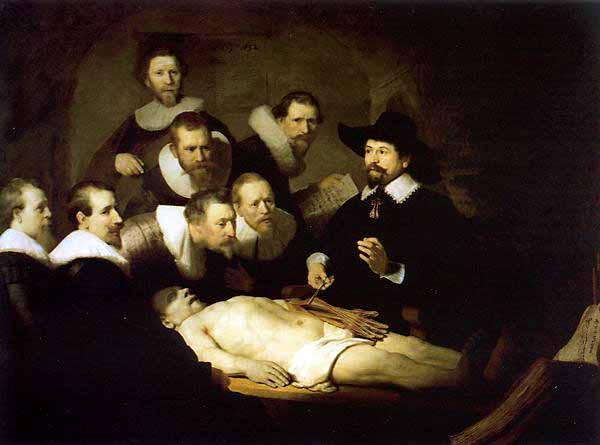
This combined with Bichat‘s concept of “the lesion” focussed the attention of doctors and scientists on smaller and smaller parts of the human body. The development of the microscope knocked the morbid anatomists off their dominant chairs by showing that disease was not just what you could see and measure with your own eyes, but was actually a disturbance of, and within, cells. Further technological developments allowed smaller and smaller components of human beings to be studied and measured, and this has continued up to the present day, to the extent that “diagnosis” has become the art of interpreting machine-generated measurements of body components and even an examination of DNA.

But human beings are complex adaptive systems, and the more complex a system, the less you can understand it by only examining its parts. Pain cannot be understood by a simple consideration of neural pathways, cell receptors and short chain proteins. Depression cannot be understood by a simple measurement of serotonin levels. And health cannot be understood by adding up a whole list of biological metrics.

As Mary Midgely said,

One cannot claim to know somebody merely because one has collected a pile of printed information about them.

However, most of our interventions are devised within this materialistic and reductionist framework.
Most surgical interventions are intended to remove diseased, or “abnormal” tissue. Most non-surgical interventions involve the use of drugs – manufactured molecules intended to interact with molecules within the human body.

In many cases, this approach pays off. In managing acute, life-threatening disease it is very effective. You are less likely to die in the middle of heart attack, an asthmatic attack or an epileptic fit now than you would have been fifty years ago. The problem lies with chronic illness, where this approach is not nearly so effective. The chances of having heart disease, asthma or epilepsy is greater now than it was fifty years ago, and there are still no cures. There are no known treatments which will cure these chronic problems.

Maybe this is partly because the more chronic the problem, the more unique, the more personal, the experience and its manifestation. Maybe we need a different approach because whole people cannot be understood as mere sums of their parts.

We need to put molecules and materialism into their most useful contexts and not assume that they present the only truth.

We need to design health care around whole people, not bits of them. Let’s have Person Sized Medicine.

Read Full Post »

Yesterday I posted about Seth Godin’s comments about making money.

Today I read an article by Desmond Morris about living to a grand old age. Remember Desmond Morris? He’s the zoologist who wrote “Manwatching“, a book I read as a teenager and found utterly fascinating. Well, he’s 80 years old now and he was writing about ageing. He tells us about Madame Jeanne Calment who lived in Arles until she died aged 122 (at 121 she was the world’s longest living human being). He wondered about her longevity. I’m sure you’ve read articles like that before, where people are interviewed to try and figure out what they were doing that contributed to their experience of health and longevity. Well, the amazing Madame Calment was still cycling and gardening at 121, and had tried to give up cigarettes at the behest of a local doctor a few years before but didn’t manage, and she enjoyed daily cheap, red wine, ate well of a typical French diet including rich stews, fois gras, and chocolates. She joked that her name, Calment, was very appropriate because she was always calm. And this, Morris thinks, was a key characteristic –

Had she worried about her health and taken steps to improve it, the anxiety caused by stirring up fears about ill-health would themselves have reduced the efficiency of her immune system.

Worrying about your health can make you sick! He mentions other long living people who shared this characteristic of not worrying about their health –

The oldest man who ever lived, Mr Izumi of Japan (who made it to 120), enjoyed his daily saki (rice wine) and said his secret was “not worrying”. Eubie Blake, a U.S. jazz pianist, said at his 100th birthday party: “If I’d known I was gonna live this long, I’d have taken better care of myself.” The irony is that it was probably his not worrying about his health that enabled him to live that long.

Regular, gentle exercise, like walking, cycling and gardening are common features of the lives of those who are over 100 years old and Desmond Morris makes an extremely interesting point about the place of exercise in these peoples’ lives. He noted that, when it came to exercise –

Cycling, walking and gardening were three of the most popular – done not to keep fit but for pleasure.

What’s Morris’s conclusion?

It seems that if you wish to live an unusually long life, you need to eat and drink what you fancy, keep as mobile as possible, have a lively interest in the world around you, avoid introspection and, above all, do not waste time worrying about your health.

I like his summary on the place of food in our lives too –

  1. There are three truths concerning human feeding behaviour.
  2. The first recognises that we evolved as omnivores, succeeding where others failed because we consumed a wide range of foods. One of the reasons we are now living longer than we did in the past is that the shelves of supermarkets display a truly astonishing variety of food from all over the world.
  3. The second truth, which renders all diet books superfluous, is that the more you eat, the fatter you get, and the less you eat, the thinner you get. End of story. But whether you are eating more in order to put on weight or eating less in order to lose it, it is always important to keep the range of foodstuffs as wide as possible.
  4. The final food truth is that you should enjoy what you eat and take time to relax while eating it. Speed and anxiety ruin digestion.

Read Full Post »

Seth Godin is one of my favourite bloggers. I have his blog on my rss feed reader (google reader) and I frequently enjoy his short, thought-provoking posts.

Today he posted a piece entitled The wealthy gardener where he mentions that he was asked at a talk how to make a lot of money blogging. Seth says he wouldn’t be surprised if at another talk on orchid growing somebody asks how to make a lot of money growing orchids.

He says

Sure, people make money growing orchids. Some people probably get rich growing orchids. Not many though. And my guess is that the people who do make money gardening probably didn’t set out to do so.

The lesson he says is

the benefits kick in best when you don’t set out to achieve them.

This is a very different counsel from the one we read more commonly – that the way to get what you want is to set it as a clear goal, visualise it, then pursue it relentlessly.

I like this message – I think you should do what you feel passionate about – and sometimes, sure, that activity might bring a decent income.

What do you think?

Read Full Post »

reflected tree, originally uploaded by bobsee.

There’s something about seeing the reflection of a tree in a puddle which always catches my eye.
Maybe it’s seeing part of the world upside down. I remember reading about a technique to learn how to draw which involved turning the image you are copying upside down then drawing it. Apparently it helps you see the shapes better.
Well, as I was walking to the station this particular puddle definitely caught my eye. I love the shape of the tree and the pinkish morning clouds are lovely too.

Read Full Post »

We all love simple solutions. Human beings have such strong urges to understand. We are driven to try and make sense of our experiences and our lives. It could be argued that this drive is a significant factor in human survival and development. It’s a good thing to try to understand. What’s not appreciated so much is the value of doubt. Whilst it’s good to understand, it’s the belief that we never completely understand anything that drives our continual growth. Without doubt, thought stops, reflection ceases and learning hits the buffers.

I’m not arguing for obfuscation. I do like clarity. But the reality is that we are complex creatures living complex lives. Health and illness cannot be reduced to simple formulae or single causal factors. It’s for these reasons that I find myself so impressed with the recent work from the Glasgow Centre for Population Health which has just published an interesting piece of research.

They have studied 20 European regions to make comparisons with the experience of the West of Scotland. The regions they studied were similar to the West of Scotland in terms of de-industrialisation, deprivation and poverty. What’s happened over the course of the second half of the twentieth century is that the West of Scotland has fallen behind all the other regions. Life expectancy figures and a whole bank of illness and health measures have shown all the other regions are improving faster than the West of Scotland.

There’s a common and fairly simplistic view that deprivation is the main cause of ill health, but deprivation cannot explain the differences between the West of Scotland and other similar regions. That’s the somewhat startling conclusion of this study. If deprivation cannot explain it, then what is the explanation? I’m impressed that the Centre for Population Studies has explored a number of possible explanations but hasn’t found any of them to be satisfactory. However, complex causes such as income inequality (it’s been repeatedly shown that the greater the income inequality within a community, the poorer the health experience at any discrete level of wealth), migration and the speed of change (de-industrialisation), are probably all significant, whilst, simple explanations such as absolute deprivation scores, cigarette and alcohol consumption, and so on, cannot explain the differences.

Health is a complex phenomenon and this kind of adult, intelligent research is just what we need.

Read Full Post »

I’ve just finished reading Michio Kaku‘s “Hyperspace” – it’s a book I’ve had on my shelves for years but didn’t get round to reading (I’ve got LOADS like that – but I’m still convinced I’ll read them ALL eventually!). It’s about multi-dimensional thinking in physics and maths, and I read it because of a dream I had. It’s a fabulous book, which really does make difficult concepts understandable. I highly recommend it.

In the last chapter of the book, Michio tackles the reductionism vs holism issue, because in Physics, apparently, there are two very different groups of adherents to each of these viewpoints. He has an interesting exposition of the more extreme forms of these two groups, referring to the reductionists as “Belligerent science” and holists and “Know-nothing science” – OK, I know, both extremely judgmental and controversial terms but read this paragraph where he describes them –

Belligerent science clubs the opposition with a heavy, rigid view of science tht alienates rather than persuades. Belligerent science seeks to win points in a debate, rather than win over the audience. Instead of appealing to the finer instincts of the lay audience by presenting itself as the defender of enlightened reason and sound experiment, it comes off as a new Spanish Inquisition. Belligerent science is science with a chip on its shoulder. Its scientists accuse the holists of being soft-headed, of getting their physics confused, of throwing pseudoscientific gibberish to cover their ignorance. Thus belligerent science may be winning the individual battles, but it is ultimately losing the war. In every one-to-one skirmish, belligerent science may trounce the opposition by parading out mountains of data and learned PhDs. However, in the long run arrogance and conceit may eventually backfire by alienating the very audience that it is trying to persuade.

Know-nothing science goes to the opposite extreme, rejecting experiment and embracing whatever faddish philosophy happens to come along. Know-nothing science sees unpleasant facts as mere details, and the overall philosophy as everything. If the facts do not seem to fit the philosophy then obviously something is wrong with the facts. Know-nothing science comes in with a preformed agenda, based on personal fulfillment rather than objective observation, and tries to fit in the science as an afterthought.

I recognise these attitudes clearly. I have been on the receiving end of classic “belligerent science” communications – some of it so offensive, I just delete it straight after reading it (and wish I’d never read it in the first place!) “Belligerent scientists” clearly don’t like homeopathy! In fact, the tone of some of the comments I have received to posts I put up concerning homeopathy, led me to create a “Commenting policy” which you can read at the bottom of the right hand sidebar of this blog. On the other hand, I’ve read plenty of comments from the other extreme end of this axis. I find this latter group to be a lot nicer than the belligerent crowd I must say, but often not any easier to have a discussion with.

I confess to having a strong affiliation to holistic perspectives on the world, but science has always been a fascination for me and it thrills me to understand how things work so I see a real value in reductionist thinking too.

How to reconcile these two viewpoints? Well, you could read Kaku’s final chapter, but essentially he argues for taking a higher perspective and seeing that both methods are appropriate in different circumstances.

One contemporary philosopher who has considered this issue is Mary Midgely.

She argues against reductionism or the attempt to impose any one approach to understanding the world as the only right way to see things. She suggests that there are “many maps, many windows” on reality and argues that “we need scientific pluralism – the recognition that there are many independent forms and sources of knowledge – rather than reductivism, the conviction that one fundamental form underlies them all and settles everything” and that it is helpful to think about the world as “a huge aquarium. We cannot see it as a whole from above, so we peer in at it through a number of small windows … We can eventually make quite a lot of sense of this habitat if we patiently put together the data from different angles. but if we insist that our own window is the only one worth looking through, we shall not get very far”

I like that. I like it a lot.

Here’s to an understanding of the value of different viewpoints, and different methods in diverse circumstances. I think we could advance the lot of humankind so much more if we attempted to engage with, and understand, each other, rather than bashing each other about the heads! In particular, less arrogance and conceit would be good!

Read Full Post »

The UK government has announced this week that it is to roll out a screening programme – “Health MOTs” – checking blood pressure, height, weight, age, current medication, family history and whether a patient smokes and include a simple blood test to check cholesterol and, in some cases, sugar.

Patients with abnormal results will be offered advice, blood pressure drugs and/or statins.

Announcing the plans, Alan Johnson, the Health Secretary, said screening could save 2,000 lives a year

This is an old but much peddled nonsense.

The mortality rate for human beings is 100%. Everybody dies. Reducing the numbers of people dying from one particular disease inevitably increases the numbers dying from something else – people don’t die healthy! But there is virtually no debate at all about this. I’ve never read a single piece of research which asks the question – if less people die from heart disease and strokes, what will they die from instead? Does anybody know? Does anybody care? Well, they should do.

Let me be clear. If there are effective interventions and treatments for any diseases, we should use them. I’m not saying it would be good NOT to reduce heart disease. However, I’d like to know two things – firstly, those who have been treated after a heart disease risk factor is picked up in screening…….what life experience do they have? What diseases are increased in this group? (do we see more cancer, more dementia, more degenerative diseases for example?) And, secondly, more specifically what is the life experience of this group who are put onto drugs for decades after screening? (lifestyle interventions are likely to have positive impacts on a wide range of diseases, but drugs for preventing specific diseases only, at best, impact on those particular diseases)

I think that we need to start thinking of health, not in the short term, but from what has been termed a “life course” perspective. Without that, we are barreling in, at best, semi-blind.

Read Full Post »

A rather disturbing report from the Healthcare Commission in England has found that less than half the staff in the NHS believe that patient care is top priority for the Trusts which provide NHS services.

That’s pretty shocking. Shouldn’t it be clear to everyone who works in health care that THE top priority should ALWAYS be patient care? There’s something going badly wrong if patient care is NOT the top priority. Health care is about people, and there are two groups of people who are very important in delivering health care – the patients and the carers (staff). This latter group, as far as the NHS is concerned, are not a happy group. The same report states that only one in four staff members feel valued by their bosses.

There’s been something going on in the NHS in recent years……a form of managerialism which has introduced management methods from industry and commerce which are not appropriate in health care. “Agenda for Change” has broken NHS staff morale, and is probably one of the key factors causing staff feelings of being undervalued. And targets based on throughput and so-called outcomes is producing a health service which has lost sight of its main purpose.

Health care should be about caring – caring for the people who use the service and those who provide it.

Read Full Post »

where the flowers grow, originally uploaded by bobsee.

This kind of thing constantly amazes me.
As the boat I was in sailed past this cliff, this little yellow flower caught my eye.
Isn’t it amazing how a seed can find the smallest amount of soil in which to grow and thrive? You’d almost think this tiny hollow was especially created just for this single flower.
Life is amazingly opportunistic and can make the most out of any chances which come its way

Read Full Post »

One of my patients today told me a terrible story of her experience undergoing surgery. I’m not going to recount any of that here of course, but she made such a good point to me I thought I’d share it with you. Maybe you agree?

She said, whenever a drug is prescribed, even if the doctor doesn’t go into a lot of detail about the possible benefits and potential harms, when you pick up the medicine from the pharmacy, the packaging contains a pretty comprehensive description of the product, including a list of the known, potential harms. This, she said, allows a person to make a fairly informed choice about whether or not to take the drug. However, there don’t seem to be any such leaflets available about surgical procedures.

Why not? she asked. There are “generic” potential harms – anaesthetic risks, infection risks and so on – which could easily be desribed, and then, surely there are known “specific” risks related to the intended procedure. Couldn’t the Royal College of Surgeons organise its members to develop comprehensive written information to be given to any patient before an intended procedure? Wouldn’t that allow a more properly informed consent?

I think this is SUCH a good idea. I’m not aware that such a thing exists at the moment. If it does, could you point me to it?

Thank you

Read Full Post »

« Newer Posts - Older Posts »