Here’s a page from today’s “i” newspaper –
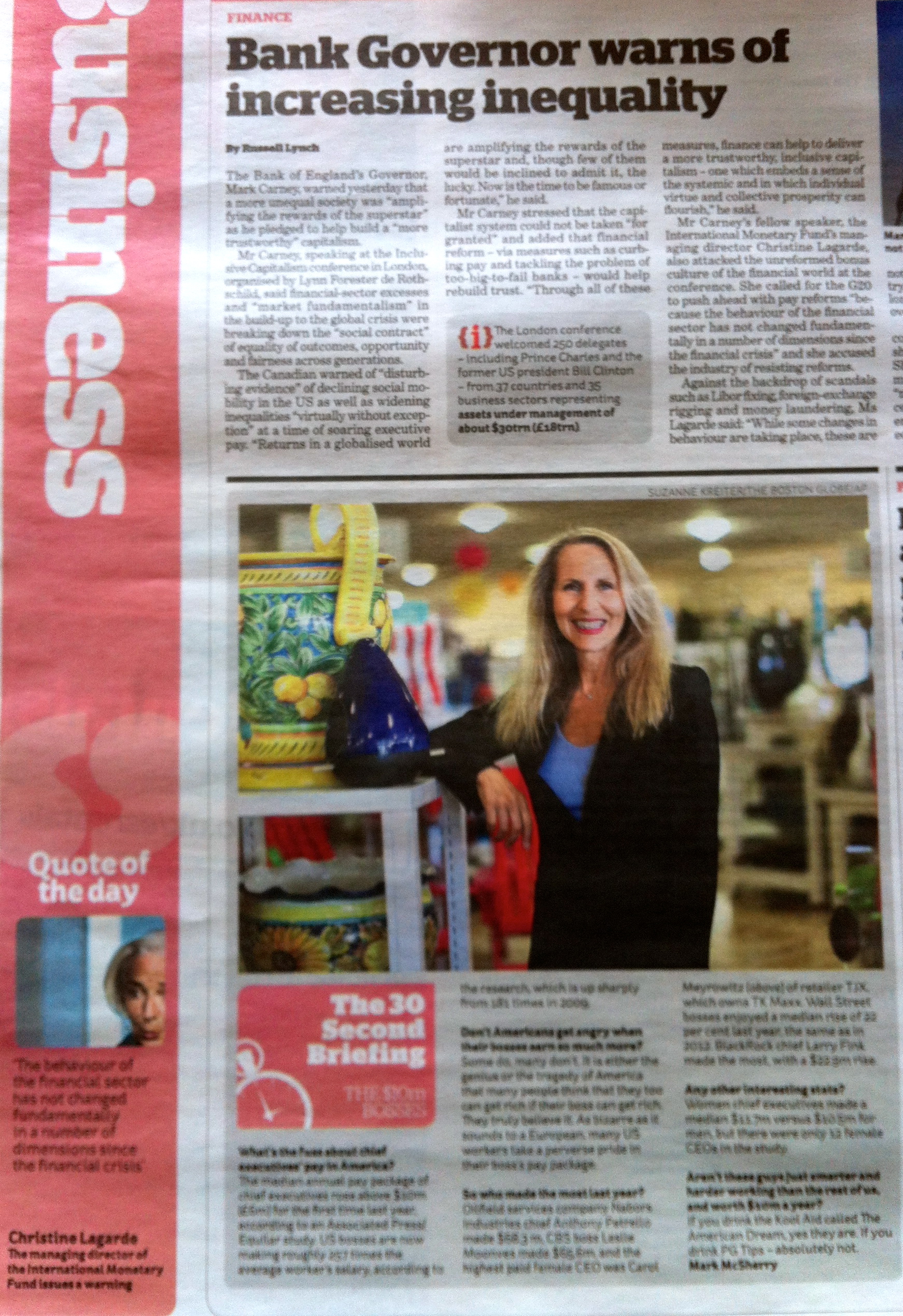
There are three interesting stories here about inequality and the global financial system which probably have some bearing on the voting patterns of the people of Europe in this last week. (Just to remind you, a lot of voters in Europe have turned away from the “mainstream” parties to vote for “extreme right” or “extreme left” in a way which many interpret as a protest against the current powers that be)
Down on the bottom left of the page is a quote from Christine Lagarde, the chief of the IMF. She says
The behaviour of the financial sector has not changed fundamentally in a number of dimensions since the financial crisis
Not exactly a snappy or readily comprehensible quote, but what is she referring to?
Against the backdrop of several leading banks caught in scandals over the fixing of Libor rates, foreign-exchange rigging and money laundering, Lagarde said: “Although some changes in behaviour are taking place, these are not deep or broad enough. The industry still prizes short-term profit over long-term prudence, today’s bonus over tomorrow’s relationship.”
Well, that’s a bit clearer. She’s saying bonuses are too high and are given for high risk, short term gain behaviour, and that banks are still “too big to fail” ie that they can still expect the rest of us to bail them out when their gambles don’t pay off. (as an aside, look at that wee list of “issues” highlighted by the i – “the fixing of Libor rates, foreign-exchange rigging and money laundering” – who’s been found guilty and jailed for these crimes?
At the top of page is a piece on the Bank of England governor, Mark Carney, who says
financial sector excesses and “market fundamentalism” in the build-up to the global crisis were breaking down the “social contract” of equality of outcomes, opportunity and fairness across generations. [He] warned of “disturbing evidence” of declining social mobility in the US as well as widening inequalities “virtually without exception” at a time of soaring executive pay. “Returns in a globalised world are amplifying the rewards of the superstar and, though few of them would be inclined to admit it, the lucky. Now is the time to be famous or fortunate,”
So as well as referring to the “excesses” (that would include some of the things they’ve fined, but not jailed, for?) he says why he thinks it is important for capitalism to deal with the issue of inequality. I think he highlights an interesting aspect of this issue – how in our present time, being “famous or fortunate” is what brings the greatest rewards. In other words, it’s not about effort, contribution, talent, work etc….its about being famous (read anything about a wedding in Florence in this week?), or fortunate (who your dad was, who your spouse was, what lottery you won?)
Finally, the third piece on this page is an expansion of Mark Carney’s reference to CEO pay.
The median annual pay package of chief executives rose above $10m (£6m) for the first time last year
This gives them “roughly 257 times the average worker’s salary, according to the research, which is up sharply from 181 times in 2009.”
Two questions here – is any boss worth 257 times the average worker’s salary? And, what have these bosses done to merit such a substantial relative increase in the last five years? They’ve gotten THAT much better/more valuable??
Is it any wonder that people are losing faith in the current economic-political system?
Is it not clear we are not on a sustainable path? (see here or here for more, and if you’d like to explore the potential impact of inequality, read this)

 Heroes Not Zombies
Leave a comment