Feeds:
Posts
Comments

Archive for October, 2014

Autumn reflecting in the charente

Life can feel very full. If it is like a river, then that river can seem like it’s in full spate, rushing, rushing, rushing and very, very full.

So, in the midst of that, I find it helps, to choose to slow down for a bit, to stroll, wander, meander…..to see what catches my attention and to stop for a moment, gaze, listen, breathe.

The river in this photo is the Charente……which has a reputation for flowing slowly.

One of the features of life in France which surprises and delights me, is how the routine of closing all the shops on Sundays is still so common. In fact, in many towns, the shops will close not just on Sunday, but maybe on Monday too. When you’re not used it, it can catch you out, or frustrate you, but once you become used to it, and settle into it, it brings so many opportunities to slow down and create a healthy rhythm.

If your life has been flowing fast recently, choose a little slowness….just for a wee while. See how that feels.

Read Full Post »

As I was walking in a forest the other day I came across this –


new growth in the forest

I often feel a kind of thrill seeing new growth like this. It’s the emergence of Life on Earth. This little seedling might well grow up to be one of the great trees of this forest. How does it do that? How does this one little seed begin to sprout, begin to reach upwards through the decaying leaves on the forest floor, and seek out the sun, the air, and the rain?

And then a little further on, I find this tree….


tree

Don’t adjust your screen – it’s the right way up!

Look at these twists and curves and corners, as the tree reaches first this way, then another. Who could predict which way any of these branches would grow? Who could predict what this tree would look like today if they were seeing it back when it was one of those little seedlings pushing its way towards the light?

I see this everywhere.

I saw it every day with every patient I ever met. Who could have predicted how this person would be today, what life they would be living, and how they would be experiencing it?

Nobody.

That’s what gets me about the irrational arrogance of those who claim to know. Those who claim certainty. I am never convinced by those who claim they know what the results will be of a particular treatment for a particular individual. They can throw the term “evidence based” about as much as they like, but if they think that label gives them some magical ability to predict the future for individual human beings, then they are quite likely to be mistaken.

I don’t like the irrational arrogance of certainty in any area. I don’t like it in politics, matters of belief, wordview (religious, atheistic or scientistic), in economics, or any other human domain. Life is not predictable. Living organisms cannot be properly understood if represented as mere objects. All living forms are dynamic, open, complex systems. All are unique and together they are diverse. Commonalities matter, but so do differences.

If there is one thing I always doubt, it’s certainty.

But then, like Montaigne, I’m fond of saying “mais, que sais-je?” (“but what do I know?”)

Read Full Post »

Dandelion

I am currently reading a fascinating book entitled “The Secret Life of Pronouns” written by James Pennebaker, a psychologist who has studied the way we speak and write and how that relates to our personalities, to our illnesses and to our ability to heal wounds.

I was really struck by the section where he is discussing traumas and how people deal with them. He made the point that despite the fact that everyone experiences different traumas in their lives, most people neither become ill as a result, nor need specialist help.

That was one of those moments for me which is, on the one hand, and “aha!” moment, and on the other a moment of recognition/reaffirmation.

I think this observation applies to the whole of life and is fundamental when we think about health and health care but we’ve forgotten it.

Working as a doctor it’s easy to get the perspective that everyone gets ill and needs medical interventions, but that’s such a distortion of the reality of life. In fact, I’m reminded of what the Professor of Obstetrics said to my wife at her first antenatal visit. He said, “I see your husband is a medical student. Tell him that pregnancy and childbirth are normal experiences. As a medical student he will only see the situations where something goes wrong but for the great majority of women, things don’t go wrong.”

I was very grateful for that advice and it came back to me from time to time throughout my career. For most of us, for most of our lives, we are not thinking about our health, and we don’t need to seek specialist health advice. Of course I’m not denying the reality of morbidity and mortality. It’s also true that we will all experience illnesses and we will all, finally, die. It’s just that we have amazing adaptive abilities.

Take something like a flu epidemic. Only a minority of the people who are exposed to the virus will actually contract influenza. Only a minority for those who contract influenza will need specialist medical help. All of those who recover from influenza will do so because their body’s natural healing functions do what they are designed to do.

We do really forget that. There is no healing, other than that brought about by the body’s natural, adaptive, healing capacity. Yes, medical treatments can make the difference between life and death at times, it’s not that they are in any way irrelevant. But too often we think that healing is about medical treatment alone. It never is.

We humans have astonishing, natural, default abilities to deal with what comes along in life – whether that be mental traumas, physical traumas, infections etc. And when we do become sick, in every single instance we need our body’s self-organising, autopoietic abilities to do what they are designed to do.

Yes, if you are ill, you may well need specialist help, and please do seek it when you think you should. But don’t ever forget have the natural human ability to recover, to heal, and to be healthy.

Health is normal. Healing is normal. We should never forget that in all circumstances we should support and encourage those natural mechanisms.

Read Full Post »

I saw this on a gravestone the other day….


Heart, anchor and cross

….what caught my eye was that little collection of three symbols placed at the top.

A heart, an anchor and a cross.

It got me wondering why those three particular symbols for this person, and then it got me wondering which symbols I’d choose to have associated with me in this way – not necessarily as a literal gravestone symbols, but as personal symbols.

Which symbols, if any, would you choose? Which mean the most to you, and why?

Read Full Post »

The other day I came across these bird footprints in the sand…

Bird footprints

……then a couple of days later I saw this pattern on an old door….

Where the climber climbed

bird prints….plant prints…..

Read Full Post »

Fishing net

In the second part of the A to Z of Becoming, O stands for Observe.

My first thought was to write again about using a camera. I carry a camera everywhere and have done for years. I find that if I have the camera in my hand I take a lot more photographs (I mean instead of carrying it in my bag and getting it out each time to use it). I have repeatedly had the experience that a conscious choice to have the camera in my hand increases my power of observation……I notice more when I have a thought about maybe taking photos. These days almost everyone has a camera with them all the time – in their smartphone. But sometimes you have to remind yourself that you do really have that camera with you…..it’s not just a phone!

But my second thought has been stimulated by reading James Pennebaker’s Secret Life of Pronouns. Pennebaker is a psychologist and in that book he describes an interesting experiment he did years ago. He attached a small video camera to a baseball hat then got students to put the hat on, walk a block from the college to the drugstore, buy some chewing gum, then walk back. Afterwards, they watched the videos. What they saw was fascinating. One video was almost exclusively of the pavement, as the student hardly looked up. Another couple showed the students were checking out any members of the opposite sex who passed by. And in one there was a very long shot of the chewing gum display as the student stood for ages trying to work out which gum to buy.

His point was that no two students observed the world in the same way because their personalities affected what they observed.

I’ve thought something similar before when you think about the conversations you hear after a group of friends have been to see the same movie, and you think “did we all actually see the SAME movie?”. There are many things which affect how we experience the world, but not least is what we observe.

So your challenge for this week, should you choose to accept it, is to observe your observations. Take some time to see what you’ve been seeing today. You can do that either by carrying a camera and taking photos through the day, then looking at the set in the evening, or by taking notes through the day…..writing down little observations, things which catch your attention, then reading through the notes at the end of the day.

Observe your observations. Become aware of what is catching your attention.

Read Full Post »

Rose hips

Last few grapes

Human beings are very adept making medicines from plants.

Have you come across the Sacred Science project? (They have made a thought provoking documentary about plants used in healing in the Amazon – you can find it on vimeo, but google sacred science to learn more).

Many, many years ago in the Botanic Gardens in Edinburgh I saw an exhibition of the uses of plants by desert peoples. I’ve never forgotten it. I was so impressed with the market stalls they set up, with one displaying plants used to die clothes beautiful colours, and another one showing plants used to treat a variety of diseases. I remember thinking how on earth did they figure that this particular plant was great for dyeing your clothes purple, but this other is a great cure for diarrhoea?! It was that exhibition which introduced me to the whole field of ethnobotany……the study of Man’s relationship to plants.

A few years later I read that Samuel Hahnemann, the founder of homeopathy, first experimented with Peruvian tree bark (Cinchona). When I read about that medicine, which had been used to treat “swamp fever”, a disease we now know as “malaria”, I remember thinking how did the indigenous peoples of Peru know that this particular plant would treat this particular disease – a truth we confirmed many, many years later when we isolated the chemical, quinine, from this same tree, and found it was a good treatment for malaria.

I don’t know the answers to those old questions, but I am still fascinated by potential benefits we humans can receive from plants.

As I write this I’m watching the last few days of the grape harvest in Charente. Those grapes will be used to make cognac, using processes not that dissimilar to the ones we use in Scotland to make whisky from grain. I’m just learning that the various areas within the cognac-producing region of France produce extremely different flavours – just like the different regions of Scotland produce distinctly different whiskies. In both cases, the specific interactions between people and plants in these countries produce distinct and unique results.

What’s your favourite human-plant interaction?

Read Full Post »

Maybe clover?

Sometimes I describe myself as “insatiably curious”. I suppose I have an instinct for what’s different, unique or unusual. And I find all of those things every day.

I’ve no idea what this is in this photo I took. It was pretty small but the colour made it stand out in the grass. Now that I can see it more clearly in this photo it’s even more beautiful, even more curious, than it was when I was taking the picture.

Amazing! Isn’t life just full of such uniqueness and diversity?

Read Full Post »

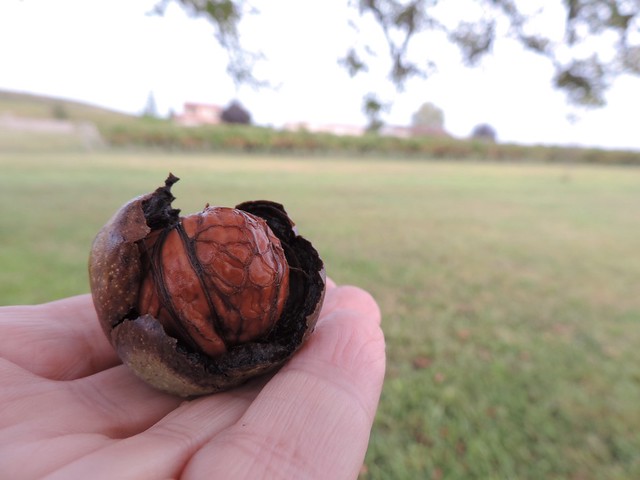
Walnut in hand

There are a couple of walnut trees outside, each one abundant with nuts just now. I picked one of the nuts up from the dozens carpeting the ground.

Look!

Isn’t it amazing? This incredible dark brown walnut emerging from its shell. Look at the patterns on its surface. See how those patterns are echoed in the lines of my skin?

And, slightly disturbingly, doesn’t it look a little like a small brain?


Read Full Post »

Autumn rain

This is a beautiful season here in the Charente. After a heavy shower of rain (it’s impressive when rain falls with a certain determination or significance) I saw the raindrops on these gorgeous autumnal leaves.

I love the Japanese cultural reverence of transience which they celebrate  every Spring with the cherry blossom, but this combination of raindrops on autumn leaves seems to me to capture the essence of the dynamic changes we experience continuously in our lives……changes upon changes.

Read Full Post »

« Newer Posts - Older Posts »