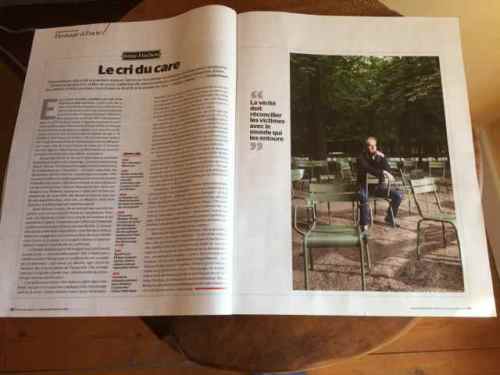
I read about Irène Frachon the other day. She’s a French doctor who back in 2007 noticed a strange pattern of illness which seemed familiar to her. She noticed that a patient with “pulmonary hypertension” had developed the condition only after taking a particular medication for diabetes – “Mediator”. Then she came across one who had heart valve disease develop after the same drug. She remembered similar problems occuring with an earlier, but in some ways, similar drug, so started to investigate. It took several years, and the publication of a book, “Mediator 150mg. Combien de morts?” before the company Servier finally took the drug off the market. Various estimates of between 1300 and 1800 people may have died as a result of taking this drug.
It wasn’t the Mediator story itself which caught my attention (sadly, such drug stories are really not so rare), but it was Irène Frachon’s story. As she talks about her involvement in the Mediator story it is clear that from the very beginning it was not just her ability to recognise a pattern which was a great strength, it was her compassion and empathy which drove her to keep a single focus on the patients. This is what gave her the determination to have the problem recognised and dealt with. In fact, she is still astonished that neither the drug company, nor the regulators acted more quickly. She says “The elephant was in the room but everyone was turning their head away”. The story caused quite a disturbance in France (click through on my reference to Mediator to read a Lancet article about it) and has shone a light on drug company behaviour, the “spinelessness and credulity” of the regulator in relation to the drug companies, and the links between big business and politicians. But Dr Frachon fought on for the one single reason – to get justice for those who had been harmed.
Where did she get this determination from? She says that as a girl she was inspired by the stories of Albert Schweitzer and his “empathie absolue” for those who suffered. When she heard those stories she decided to become a doctor. Interestingly, I would argue, those stories didn’t just prompt her to become a doctor, but to become a particular kind of doctor – one for whom “absolute empathy” was the core value.
A lot of thoughts arose for me when reading this article. Firstly, how lucky I have been to have encountered so many doctors, through my training and through my workplaces, who share this core value of empathy. It’s what characterises their everyday actions as well as their career choices. And, secondly, how stories we hear in childhood influence the rest of our lives.
I first said I wanted to be a doctor before I was 4 years old. But I didn’t come from a family where there were any doctors, so where did this come from? I don’t know but I do know I was very influenced by a fictional doctor – Dr Finlay – a GP in a small Scottish town who had all the characteristics of what would now be termed an “old fashioned family doctor”. I didn’t want to just be a doctor, I wanted to be a Dr Finlay kind of doctor.
So, maybe one of the best things we can do is tell our children stories of inspirational, empathic people. Not that that should mean they all grow up to be doctors, but maybe they will take the core value of empathy into their adult lives.
What stories do you think influenced your career, or life choices?

 Heroes Not Zombies
Leave a comment