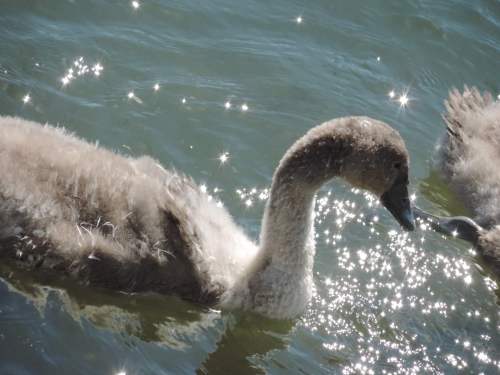
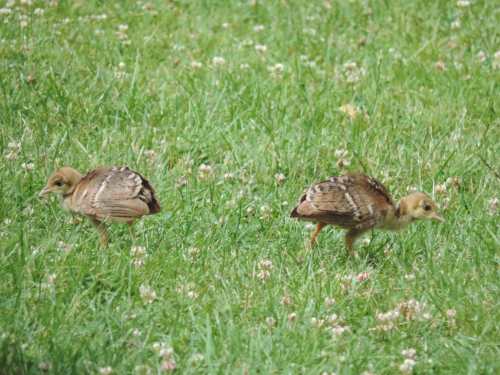
On a recent trip to the nearby town of Saintes, I chanced across two little families.
Do you know what these particular chicks are going to look like when they grow up?
We are all dealt a certain hand when we are born, a particular and unique pattern of DNA. Our personal pattern shares a lot with others of course. All we humans have distinct DNA patterns that distinguish us from other animals. The surprise really is how shared the common patterns are. Some patterns are the same in humans, chimps, fruit flies and earthworms. Fruit flies and earthworms? I’m not too astonished about the similarities between humans and chimps (over 95% similar genome apparently), but fruit flies and earthworms? Who’d have thought it?
But there’s more to how we begin than our DNA code. From the very first moments of life we begin to develop differently. We humans have fingerprints for example, and there are no two identical sets of fingerprints in the world – ever. We have unique patterns all over our bodies, not just in our fingertips. Our eyes, for example, are also very distinctly different. We’re all becoming a lot more familiar with that uniqueness as we use our fingers to gain access to our mobile phones, or our irises and fingers to gain access to particular rooms, buildings, or even countries.
Babies develop distinctly different patterns of behaviour from their very first hours in this world. If you are a parent of more than one child you’ve probably wondered many times how can your children be SO different when they both came from the exact same parents, and grew up int he exact same family?
It’s so, so difficult to know what a little one is going to become. We can’t know what events will occur in their lives. We can’t know how their personalities will develop, what coping strategies they will acquire, what choices they will make.
But all of that is ok. It’s the nature of life. It unfolds. Little ones grow, change and develop every single day. And when I say little ones, I don’t just mean little human children. We see the same, albeit over shorter timescales, when we watch chicks grow into adult birds, or seeds grow into flowers, vegetables or trees. We see it everywhere.
I’m sure at some point you’ve chanced across an old photograph of yourself, your parents, or your children and you recognise them. Instantly. But oh how they’ve changed! Oh, how I have changed! And isn’t that second insight often quickly followed by “but I still feel the same me” (or some variation of that).
What’s the best thing we can do for the little ones?
Nurture them.
Love them in their developing uniqueness, knowing that from those very first days they are already different from us, and it’s our job to help them on the way to becoming all they can be.
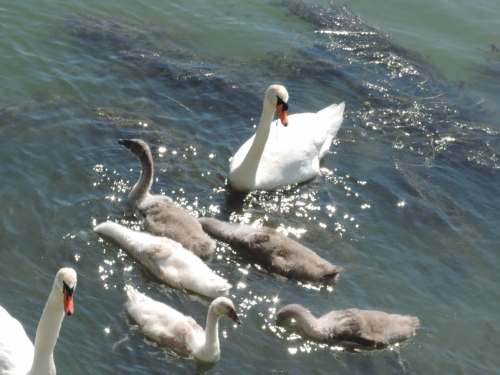
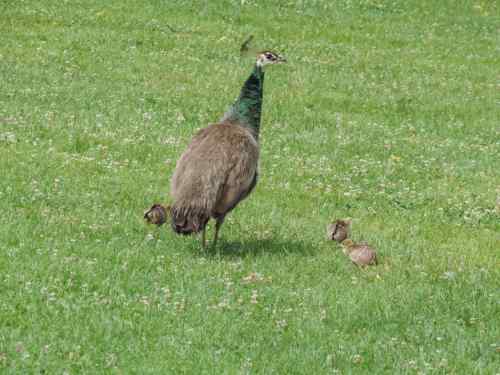
If you’re still not sure what those chicks at the start of this post are going to turn out to be like when they grow up – here’s a couple of hints –
Your children are not your children.
They are the sons and daughters of Life’s longing for itself.
They come through you but not from you,
And though they are with you yet they belong not to you.You may give them your love but not your thoughts,
For they have their own thoughts.
You may house their bodies but not their souls,
For their souls dwell in the house of tomorrow,
which you cannot visit, not even in your dreams.
You may strive to be like them,
but seek not to make them like you.
For life goes not backward nor tarries with yesterday.You are the bows from which your children
as living arrows are sent forth.
The archer sees the mark upon the path of the infinite,
and He bends you with His might
that His arrows may go swift and far.
Let your bending in the archer’s hand be for gladness;
For even as He loves the arrow that flies,
so He loves also the bow that is stable.
Kahlil Gibran (On Children. From “The Prophet”)

 Heroes Not Zombies
It is strange that none of our four adult children are alike– from their appearance to their personalities. We love them all.