Feeds:
Posts
Comments

Archive for January, 2017

twelve-project-day-ten

Day ten of my “twelve project” brings me to this photo which I took in October last year. It’s a picture of the river Charente as flows through the town of Jarnac, which is about a half hour’s drive from the village where I live.

The river gives its name to this whole region, the “Charente” and it flows to the Atlantic passing through the neighbouring region of the “Charente Maritime” on the way. But the river does more than give its name to this region. It is symbolic of, or maybe more accurately, it creates, the pace of life here. People say it flows steadily and calmly, just as you can see in that photo. I’ve been here just over two years now and I’ve never seen it churned up or terribly disturbed. It might happen sometimes but I’ve never ever seen it. Normally when you walk along its banks or look down from one of the bridges, it looks like this.

I encounter the river most commonly in three different towns. My “home town” of Cognac, half an hour to the East in Jarnac, where this photo is taken, and half an hour West to Saintes. In all three of these towns the Charente looks like this. Yet in each of these towns it is also unique and different, because a river isn’t just the water, it’s the banks and the land around the water.

I think it’s not just that it is calming to watch the water flowing so steadily, it slows you down. It slows you down by capturing your attention so that you stand and gaze at it for a while, or you are drawn to wander along one of the miles and miles of footpaths which follow its course, and as you wander it seems the river is keeping pace with you. It’s wandering too. Or is it the other way around? Do we unconsciously fall into step with the river? It slows you down another way too, because when it flows this way the surface is typically highly reflective. Look at the reflections in this photo. It was the sparkle of the sunlight on the lily leaves which initially caught my attention this day, and it was only just after that that I noticed the reflections of the little clouds floating by. It inspires you to reflect.

I love rivers. I grew up in the town of Stirling in Scotland. The River Forth winds its way towards, through and beyond Stirling like a great ribbon, or maybe a snake. You can see it best from Stirling Castle. Standing at the castle gazing down to the Old Bridge, following the curves of the river with my eyes as I look towards the Ochil Hills is one of my strongest memories. It’s one of those scenes which embeds that place in my identity.

I love the symbolism of rivers, how they are never the same two days in a row. As Heraclitus said “you can never step in the same river twice”, reminding us that every moment changes and every moment is unique. I love how you can’t look at a river without imagining both where it has come from and where it going to. It’s like a story. It is present in front of you now, but it brings into this present moment, the past, from the springs in the hills, through its journey of days or weeks, and it holds within it all the potential to become the river it will become as it flows towards the sea.

I can’t think of rivers without thinking of the incredible water cycle of the Earth. How the rivers flow to the sea, how the wind and the sun lift the water into the air, how it condenses to make clouds which then dissolve into rain on the hills and the mountains to create the streams which flow together to create the rivers again. I like that I can see at least part of that in this photo with both the river and the clouds sharing the same space in my picture.

 

Read Full Post »

twelve-project-day-nine

In September, the ninth month, our walks through the surrounding countryside brought a bonus. Fruition.

We have a number of paths to choose from when we go out for a walk, but all of them involve partly wandering through the outskirts of a village or two, partly walking down quiet roads between the villages, and mostly walking through, or around, vineyards.

This year we discovered that one of the paths between the vines leading back down the hill towards our house passes a handful of fig trees and a couple of walnut trees. In September the figs ripen and the walnuts fall to the ground. These are all wild trees growing beside the grassy paths which traverse the vines. And these paths are quiet paths. I can’t remember the last time I passed anyone else walking along them. This happy discovery meant that preparation before setting off on the walk changed a little bit. As well as putting on walking boots I’d put a couple of plastic bags in my pocket.

Every day, if we wanted, we could bring home a harvest of figs like the ones in this photo. Have you ever tasted fresh, wild figs? Delicious! When I was a boy growing up in Scotland the only figs I tasted were in a biscuit called a “fig roll” – that was the kind of biscuit you only ate when you were desperate and there were only kind left in the biscuit tin. I could force one down, but I didn’t really enjoy them. Well, fresh figs are NOTHING like “fig rolls”! Yet another experience which shows me the difference between what is natural and fresh, and what’s been processed and manufactured.

And fresh walnuts? Walnuts used to be my least favourite nut. They often seemed dry and tasteless, but fresh walnuts, picked up from the ground and eaten straight away are moist and delicious. Can you see a couple of them lying on the table in front of the figs?

There was one more treat I could pick up on my September walks – blackberries. The field next to my garden has a hedge running along two of its four borders, and both of those hedges are full of blackberry bushes. I didn’t include them in this photo but they made a great addition to the morning cereal bowl.

So, here’s my gratitude for the ninth month – the fruits and nuts which made my morning walks extra specially delicious!

Read Full Post »

twelve-project-day-eight

Day eight of the Twelve project takes me to August 2016 (I’ve selected one image for each month of 2016 and I’m posting one a day for twelve days). The big thing for me in August was my first ever visit to Spain. The Spanish border is just four hours drive from where I live in France so you can leave first thing in the morning and have lunch in Spain. I’m not going to write about that whole trip and all the places I visited here but I’ve selected this one image because it captures one of the main threads of that story.

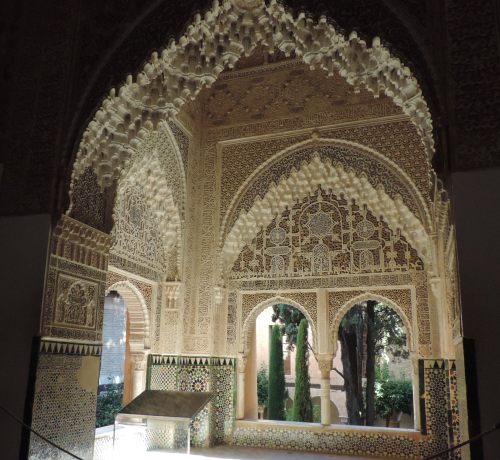
This photo is taken in the Alhambra in Grenada. If you’ve ever thought of making a “bucket list” of places you want to visit before you die, then I highly recommend putting the Alhambra on that list. It’s best to buy your tickets in advance (here’s the official site for buying them online) and you have to select both the date and the time you want to visit. There are a limited number of tickets for each half hour period of the day to manage the flow of visitors. Here’s the number one tip – buy tickets for the 0830 entrance – its the first entrance of the day before it starts to get too busy and way too hot.

This one photo reminds me of several of the things I loved best about my visit.

The shapes of the windows and doors. There are so many in the Alhambra and Generalife site. You can wander from room to room as you wish, unless you are on an organised tour in which case you have to go with your chosen crowd. I prefer to explore freely. Every room you enter has beautiful, enticing windows and doors. You’re drawn to them, both to look through to see what’s on the other side, and to pause and admire their shape, design and decoration.

The decoration – there are just the most astonishing patterns in the stonework and the plaster everywhere. They reminded me of the Celtic knots and Pictish patterns on the ancient stones in Scotland but they are different from both of those. One glance at them captures you. They are beautiful at that very first look, but then you’re drawn into them, exploring more of the detail and noticing how the patterns both repeat and evolve. If you look at the walls, archways and frames in this photo you won’t see a single area left unadorned. The whole place is like that. Room after room. But look down too under the double window and to the left of it….see the mosaic pattern of the tiles? That’s the other major design feature here, the tiles. There are so many different tiles creating so many different patterns in so many different combinations…..the diversity, the creativity, the workmanship….breathtaking.

Through the double window here you can glimpse a garden and that’s one of the things I loved best about the Alhambra….the courtyards and gardens, with trees, flowers, bushes, fountains, pools, paths and benches. The fact that the windows and doors are all wide open to the outside spaces breaks down the boundaries between the inner and outer parts of the palace.

Light and shade – the shadows, the reflections, the contrasts of light and shade are as varied as the patterns on the tiles and walls. I don’t know if they designed the place to give you that experience of light and shade but I’ve never seen anything like it anywhere else.

I know there are many, many, beautiful places to visit in the world. Too many for any of us to experience in one lifetime. But despite the crowds the Alhambra made a huge impact on me. A lot of my photography is of Nature  but this was one of the places where it was the unique creativity of human beings which was almost overwhelming.

We humans really can create the most beautiful, varied, delightful world when we work together with focus and determination.

Patience and persistence – I’d say these are two of the skills I learn to practice every day living in the Charente – and those are the very two skills needed to create beauty. Slowing down, paying attention to the details and enjoying every single moment to the full.

Read Full Post »

twelve-project-day-seven

Day seven of the twelve images over twelve days, one photo from each of the months in 2016 – Happy New Year to you, by the way (I’m writing this on the 1st of January 2017)

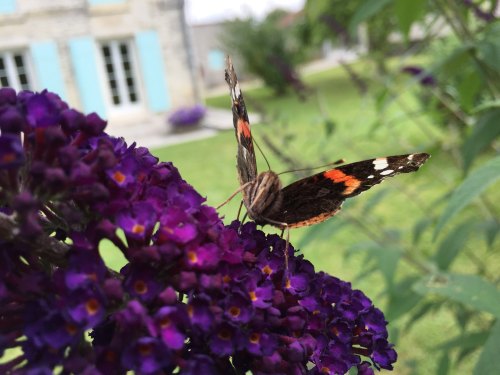
We have a number of buddleia bushes in our garden. Most of them produce these amazing purple flowers (one produces white flowers) which butterflies and hummingbird moths just love. I like to sit close to these bushes where I am surrounded by dozens of these beautiful creatures. The wings of the hummingbird moths are so fast that they emit a deep buzzing sound so you know when they are around, but the butterflies are completely silent.

I can watch them for ages. I love to see them up close like in this photo. You can see them delicately slipping a long proboscis into the centre of each little flower. They are so quick and so accurate. And of course their wings are painted so gloriously.

The butterflies stimulate two trains of thought for me – unpredictability and change.

I’ve tried to see if they work around a bush in any kind of methodical way but I can’t see that they do. Every move seems totally random. They’ll be selecting one little flower after another to explore, then suddenly they fly off into the air, zigzagging around, up, down, left and right, then might settle again on the exact same flower they had just left, check out a different part of the bush or fly off to a neighbouring bush. There’s just no telling where they are going to go next. Their whole movement seems to embody randomness. It’s quite something.

Then if you stop to think about how the butterfly you can see is only one stage in a cycle of astonishingly different forms you realise very quickly why they are the symbols of metamorphosis and change. From egg, to larvae (caterpillar), to pupae (chrysalis) and the beautifully winged creature. A life of the most incredible phases and changes. As far as I know nobody has managed to explain how this cycle of change came about. We change throughout our whole lives, and our bodies change a lot, but not as much as these butterflies. Maybe our most astonishing changes are on the inside – our psyche and and our spirit?

Then when I get thinking about these butterflies and wonder where they go when the buddleia are not in bloom I find that many of them are migratory, traveling between Africa and Europe, cycling back and forth between very specific locations. How do they do that? How do they find their way over hundreds, no thousands, of miles? But wait, it’s even more amazing, because for some of them the journey is long it takes several generations of them to complete it. Now how do they do that? How does the great great grandchild of the butterfly which left my garden find its way back to my garden when its parents and grandparents had never ever lived here?

So, here’s what the butterfly in this photo is the symbol of for me – curiosity and the unfathomable depths of our human lack of knowledge and understanding?

So much to learn, so much to discover, so much to understand.


Read Full Post »

« Newer Posts