

Take a look at these two photos.
The first one is of an office block I saw in Malmo, and the second is of a leaf in one of the glasshouses in The Royal Botanic Gardens, Edinburgh.
No, seriously, just pause for a moment and look at both of them.
What similarities do you see, and what distinct differences?
The extremely regular, beautifully straight lines of the office block are very striking to me. It’s an image full of right angles and, what shall I say, hard edges. I find I’m both attracted to it, and repelled by it. There’s a beauty there in the symmetries, the reflections and the colours, but you’ll see I included that little street sign in the bottom left corner to convey what I really felt – let me out of here! There’s something limiting, bordering, imprisoning even about those hard lines. It immediately makes me think of conformity, regularity, 9 – 5 work…….it definitely induces, in me, a desire to escape!
This leaf is really strange. I don’t think I’ve seen one just like this before. That’s the first thing to grab me. It’s uniqueness. I’m sure the office block is unique too, but maybe mainly because of its location, its situation. This leaf immediately stirs my curiosity. It draws me towards it. I want to look closer. And when I do I see what at first glance were a multitude of totally regular small lines turns out to be not regular at all. The spaces between those little bars is varying all the time. They are not like a printed bar code (as I thought at first when I saw it) but display an irregularity, a diversity, a constantly changing variation.
This issue of regularity/irregularity reminds me of something I learned as a doctor. You know the image of a cardio trace? I’m sure you’ve seen it on screens in medical dramas, even if you’ve never seen one in real life. Here’s an example –
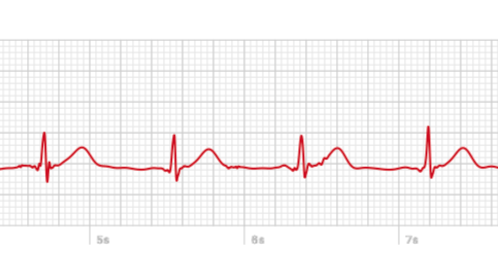
Well, each of those peaks is a heart beat and if the heart was beating very regularly then the distance between each peak would be exactly the same. Except it isn’t, not exactly. If the time gap between each heart beat is identical that’s a sign of a heart that’s about to fail. What’s healthy is when there is something called “heart beat variability” – not something totally chaotic, but subtle little differences in time between each of the beats. That’s partly because as you breathe in, you increase the pressure in your chest, and as you breathe out, you decrease it. The heart has to respond to that. And it’s partly because when you stand up, your heart has to pump the blood a little faster and harder to keep the flow to your brain, and when you lie down, the opposite happens…..and we’re changing our positions all the time. So if the heart is unable to respond to all those changes it will just keep beating entirely regularly….and then it might not cope.
Just so you don’t get worried, let me just emphasise that too much irregularity is a bad thing for both the heart and your health! There are many “arrhythmias” (irregularities) which require to be treated. I’m talking here about the healthy heart which beats with a healthy variability. The “Heartmath” method is based on this understanding.
Here’s the next thing I thought about when I realised that the pattern in the leaf showed constant variation – wabi sabi. You know about wabi sabi? It’s a Japanese concept, a little difficult to explain, which includes seeing the beauty in “irregularity” – according to this view, something too regular, too hard edged and fixed, isn’t so beautiful. Partly because Nature shows us the beauty of variations and irregularities everywhere we look.

 Heroes Not Zombies
Leave a comment