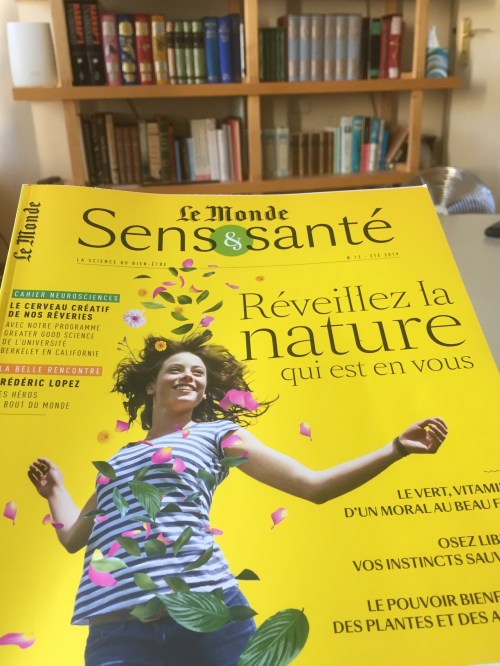
One of my favourite French magazines is “Sens et Santé” (that translates as “Sense and Health”). The latest issue has a major section on the effects on human health of exposure to natural environments. They describe several scientific studies showing lowering of inflammatory substances in the body after walking, or contemplating, in a forest, reductions in blood sugar levels, improvements in mood levels, reductions in the need for painkillers, and the famous study showing post surgical patients with a view of a wall required more medication and longer admissions than those who had a view of trees outside.
They even describe the inspiring “nature prescriptions” project in Shetland where GPs are giving patients a calendar of activities in nature to pursue each week. The calendar is a joint project of the local health service and the RSPB (the UK’s bird charity).
I delighted in reading all of this, but then I wondered do we really need research to “prove” or even simply highlight the health benefits of spending time in nature?
Does any of this information change my mind about anything? No. I’ve been convinced that natural environments are “a good thing” for a long time.
Maybe these studies just reinforce my confidence in my views and my beliefs?
Well, I’m not so sure. I think they deepen my understanding.
And that, for me, is science at its best.
I don’t see science as a way to gain control over the world, although that does seem to be the dominant view these days. No, I like science when it provokes my curiosity, stimulates my “émerveillement” (wonder and delight), and deepens my understanding of the world.
The philosopher Deleuze described three ways of thinking. Philosophy, he said, was thinking about concepts, art, thinking about percepts and affects, and science, thinking about function.
In that scheme, science helps me to understand how something comes to be the way it is. It answers “how?” but not necessarily “why?”.
I reckon Deleuze got it right and we need all these ways of thinking to better understand the world.
Since I retired and moved to France I’ve read a lot of philosophy. I’m not trained in philosophy. I just enjoy it. It struck me the other day that philosophy doesn’t really present itself as the ultimate, be all and end all, the way modern science does too often.
Philosophy seems more about opening the doors to understanding and reflection, to thinking, “if I look at the world this way, then…..” and a path of exploration lies ahead.
Science which pursues certainty too often claims “the truth, the only truth” and discards any alternatives. At least, that’s the kind of science I like least. All those headlines that science has proven this or that or disproved that or this. I can’t be doing with them. It seems to me there’s a difference between seeking utility and seeking understanding.
I visited the Chateau de Clos Lucé in the Loire Valley where Leonardo da Vinci spent his last few years. The king, Francois 1st, invited him, gave him board and lodging plus an annual grant and told him he was free to do whatever he wanted. All the king wanted in return was a daily conversation with him. How many scientists would love that kind of arrangement over their current publication driven grant seeking working lives? How different might our world be if we just supported scientific pursuit of understanding, in the realistic knowledge that understanding is never complete, never “the truth, the only truth”? Seems to me that might be better than the agenda of prediction and control funded by those who seek wealth and power.
I didn’t expect this post to go this way but I’ll finish by saying I love the scientific pursuit of understanding but I’ve also come to love the philosophical pursuit of “how might I live”. I think that’s why I like “Sens et Santé”.

 Heroes Not Zombies
Leave a comment