Feeds:
Posts
Comments

Archive for March, 2022

Ok, so this is a photo of some vegetation on a cliff. So far, not very interesting.

Then, suddenly, I see the cliff face! I mean THE FACE in the cliff!

Do you see it?

I can see one dark eye, a long face with a very straight nose and a thin, straight mouth.

Once you see it, you can’t un-see it.

There’s two things here which are highlighted by this. Our brains are particularly evolved to see faces – not just to recognise familiar faces (which is indeed one of our powers) but to spot a face even when it’s just a shape or pattern which has characteristics of a face. The second is our power of “re-cognition”. Once we register something, we are much quicker at being able to see it again. In fact that “re-cognition” is so “sticky” that it can be difficult to see past it.

We probably evolved these powers because they were beneficial to our survival. They enable us to spot another human very quickly and to be able to see a stranger quickly too. In both those cases, scientists would argue, that’s in case other humans are dangerous.

But that’s not our default is it? Well, sadly, for many people it’s becoming like that. And the stories we hear of violence, murder, and crime heighten our wariness.

Despite that, it’s still not my default. I engage with others from a more positive position. For example, I’ve recently moved house to a small hamlet in the French countryside and about a dozen strangers have stopped to speak to me since I moved here. Every one of them introduces themselves, tells me where they live around here and welcomes me. They are my new neighbours. Our connection is positive.

In my four decades of work as a doctor I saw I don’t know how many thousand patients. My repeated experience was that the more I got to know a person, the more I understood them and the more I cared about them.

So I think there’s another aspect to the evolutionary value of our ability to recognise faces. It enables us to make connections. We are social creatures through and through.

Babies learn to recognise their mother’s face astonishingly quickly and we soon develop the power to read emotions in peoples faces.

In other words we don’t just spot faces, we quickly learn to “read” faces too, and that, too, allows us to both make connections and to be wary when we recognise a threat.

Our contemporary cultures spread messages of threat and competition, but in every crisis, from the pandemic to this current war in Ukraine, I’m more struck by the countless acts of kindness carried out by ordinary people.

We are, in our core, social creatures. We want to connect, to help, to cooperate and share. But in places of power and wealth something else comes to the fore.

It’s as if we are suffering from a pandemic of narcissism. That’s not normal, and it’s not healthy. I hope we are on the cusp of change for the better. People are talking of a great awakening. I hope that’s true. Maybe one day we’ll change things. We will stop rewarding narcissists and reward kindness, love, caring and compassion instead.

How good would it be to recognise those values in the faces of those with power? To know that every day they spread love, kindness and compassion in the world.

Well we can start at home, start in our communities and localities, by being aware of those values in ourselves and others and just encouraging and growing that.

From there perhaps we can insist that people who assume responsibilities and powers act positively towards others too.

Let’s promote kindness, love, caring and compassion by demanding these values in all our organisations, businesses and politicians. We can reward those who manifest these values and withdraw our support from those who don’t.

Once you see it, you’ll see it all around you.

Read Full Post »

Looking at this old photo today, taken in a Marqueyssac gardens in France, I’m struck by the difference between the planting on each side of this path.

On one side is a long, straight, trimmed hedge, whilst on the other a much “looser”, almost random distribution of bushes and trees.

Thomas Berry in “The Great Work” names the two fundamental forces of the universe as “wildness” and “discipline”. Too much wildness and you have unstructured chaos, too much discipline and you have a static order. For Life to emerge you need a perfect interplay of both.

Note that it’s an interplay, or what some would term “integration”, not the kind of balance where two opposites balance each other out.

David Wade, in The Crystal and the Dragon, describes the basic forces as the moving, flowing principle, and the ordering, or structuring principle.

Iain McGilchrist describes our two ways of engaging with reality. The left hemisphere allows us to focus, abstract and represent. It seeks to “grasp” whatever it sees and make use of it. The right hemisphere engages with reality as it is, seeking out the connections, relationships and seeing what exists within its contexts and environments.

We need both. And when they integrate well together we see the most amazing examples of creation.

Read Full Post »

Traces

This is a pretty common pattern in the sand created by the sea before the tide recedes from the beach. It looks like waves or ripples doesn’t it? When you look at this you know that it’s been created by the water.

There’s something about this kind of pattern which we recognise instantly as natural. I’m sure with skill, time and effort, an artist could create a similar pattern but there is something about an interplay of regularity and irregularity here.

Natural patterns usually share this quality. Not only are there “no straight lines in Nature”, a statement which isn’t 100% true but true enough to be a useful generalisation, but this interplay creates a kind of chaotic, or near chaotic, design.

This is where Nature exists. On the “far from equilibrium” zone, in the borderland between chaos and order. It’s unpredictable in detail, co-created with the local environment and it’s beautiful.

Here’s a different, equally natural, common pattern caused by water running over sand.

Beautiful, isn’t it?

Both of these patterns can be seen elsewhere, in rock, in trees, in a cloudy sky or on the landscape seen from high above.

When I come across patterns like these I feel I’m glimpsing the usually invisible creative power of the Universe.

Read Full Post »

I object

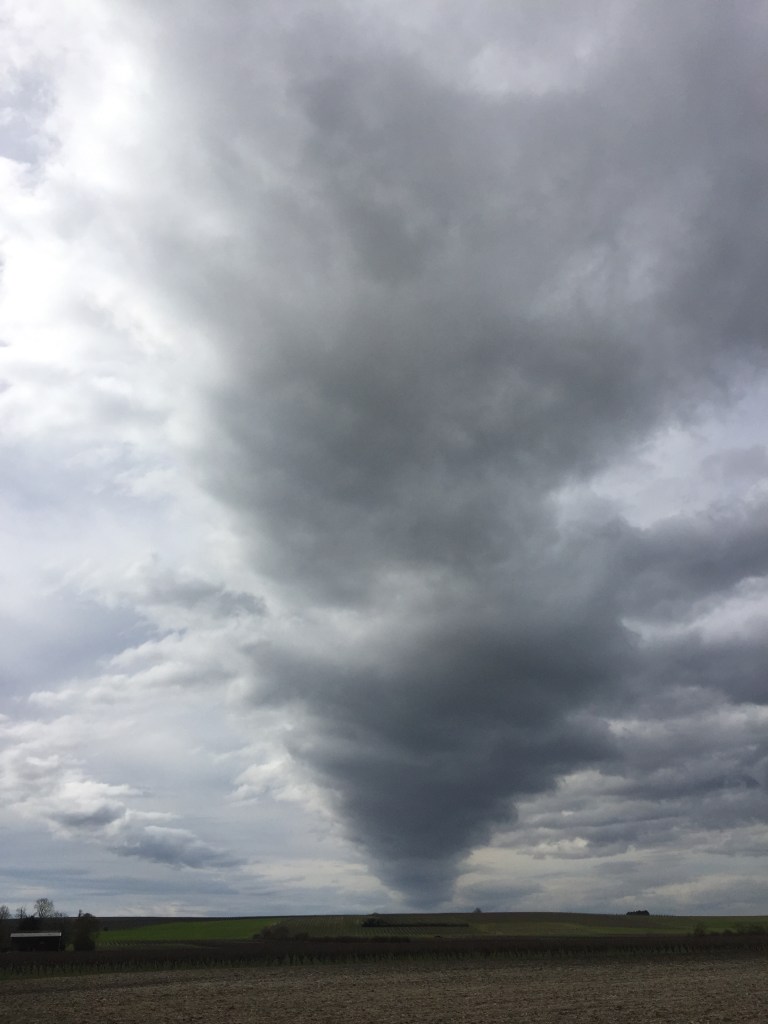
We humans see objects everywhere. I look at this sky and I don’t see simply an entirely grey sky, I see patterns. The sky is laden with water which, on a clear day, I can’t see, but on a day like this I see the water molecules collected together. We call these collectons clouds.

On this particular day I see a vast dark grey funnel of cloud stretching from above my head to as far as I can see. It looks like a vast highway or path in the sky. I see it as a distinct object…..a particular cloud, separate from the other clouds.

But where are it’s edges? Where does it begin and end? The closer I look, the harder it is to see an edge. “It”, this cloud, doesn’t seem so separate from the rest of the sky as it appears at first. It’s edges blur and fray and blend into the neighbouring clouds.

Yet it still seems an enormous heavy presence stirring a certain anxiety in me, carrying the threat of a storm, or at least, some heavy rain.

I don’t have to stand looking at it for long to see it change. Over the course of a few minutes it slides to the side, thinning and dissipating as it goes. Not much later, I can see no trace of it.

This is what we do. We abstract certain elements of reality, focusing on just a few of them, to the exclusion of others, and, so we see patterns which we’ve seen before, and we give them names. We turn them into objects.

Objects like clouds remind us that there are no fixed, separate objects at all. They show us that all so called objects are patterns within the Flow.

Clouds emerge in the sky, the way a wave appears on the surface of sea. They are perceptible for a short period of time, constantly changing, through every second of their existence, then they’re gone.

Some objects have much shorter lives than clouds, others much, much longer. It depends on the speed of the flow. Mountains take millions of years to form, and millions more to disappear.

I’m not saying objects are not real. I’m just saying they are never fixed, separate or permanent. They are a useful concept but it helps, I think, to try to see them as emerging patterns within the Flow, vastly interconnected within Indra’s Net of reality.

Read Full Post »

Influence

One March day a few years ago I noticed some ducks and some fish in a pond. Not very remarkable you might think, but what caught my eye was the pattern.

This particular duck is creating concentric rings of ripples on the surface of the water, probably through the paddling action of its webbed feet. It seemed like it was sitting quite still on that one point, even though it was obviously constantly moving to create the waves. That in itself is quite beautiful and mesmerising, but there’s more. Look where the fish are swimming. Some of them seem to be swimming along the ripples, making them appear to fit the overall pattern.

As a whole image the duck, the ripples and the fish, create an interlinked, beautiful pattern.

I return to this photo quite often. It reminds me how interconnected everything is. Nothing exists in isolation or in a vacuum. Just by being alive I change the world. My breathing, my eating and drinking, my actions, my words and even my thoughts create ripples of change.

Some ripples don’t go very far, but others are picked up and magnified by others and spread far through time and space.

This is how it is for all of us, and it’s long been this way.

So this reminds me to try to live consciously in awareness of the fact I’m embedded in one great web of becoming.

What energies are you sending out today? What ripples are you creating?

Read Full Post »

Reading

I read a lot. I’ve always read a lot. I have a LOT of books. I’ve never counted them, quality not quantity after all! So, perhaps it was no surprise that I noticed this statue last time I was in Nîmes.

I can’t think of any other statues of people reading. Do you know any? Actually maybe I should call this a sculpture rather than a statue because I don’t think it was a commemoration of a particular person (correct me if you know better).

Storytelling and sharing knowledge must be two of the most fundamental characteristics of human beings. Books, of course, are one of the most powerful ways of sharing – of telling stories, expressing ourselves, learning what life is like for others, exercising our imagination, creating a shared web of knowledge and ideas.

Dictators and zealots have a history of attacking books, destroying libraries and/or burning and banning particular books. I suppose that speaks to the power of books and learning. Those who want to control others often end up trying to control what they read.

These days reading has become even more widespread, not just through books, but through social media, newspapers, magazines, hey, even blogs!

All of these channels can, of course, be weaponised, used to spread propaganda, to undermine and disempower as much as to spread knowledge, joy and experiences. That’s why I think education is so important. We have to teach our children, not just how to read, but how to discern, how to think critically, how to be aware of the power of words.

I do think a healthy, vibrant, flourishing society is one where everyone is well housed, well nourished and well educated. How bizarre that such basics seem so utopian.

Still, I’m an advocate for better societies, where the instinct for care and cooperation is given more attention and energy than the instinct for aggression and competition.

Read Full Post »

Isn’t this the most glorious bee?

I’m no bee expert but I think this is called a “Carpenter Bee” (please correct me if you know better).

It’s almost completely black but has this iridescent purple colour on its wings. When I think “purple”, I think “royal purple”, and, actually we associate bees with royalty, don’t we? The “Queen Bee”. “Royal jelly”. I remember the three bees on the coat of arms of the Barberini family in Rome (Palazzo Barberini is an utterly astonishing gallery of art. Put it on your bucket list!)

We also have a number of bee metaphors in our language. “Busy as a bee”. “Make a beeline for”. “Got a bee in her bonnet.” What other ones can you think of? “Honey”, in English anyway, is a term of endearment. “I love you, honey”.

Do you see what’s happening here? A photo I’ve taken of a single bee sets off my trains of thought down pathways of the significance of the colour purple, the association of royalty with bees, memories of a long weekend in Rome, and a handful of associated metaphors.

That’s what we humans do. For every one of our experience is unique. If I just showed you this photo and kept quiet, you’d tell me your own particular thoughts, memories and musings. Our experience of this bee would be different for each of us.

Reality is an ongoing process of co-creation.

Read Full Post »

Elemental flow

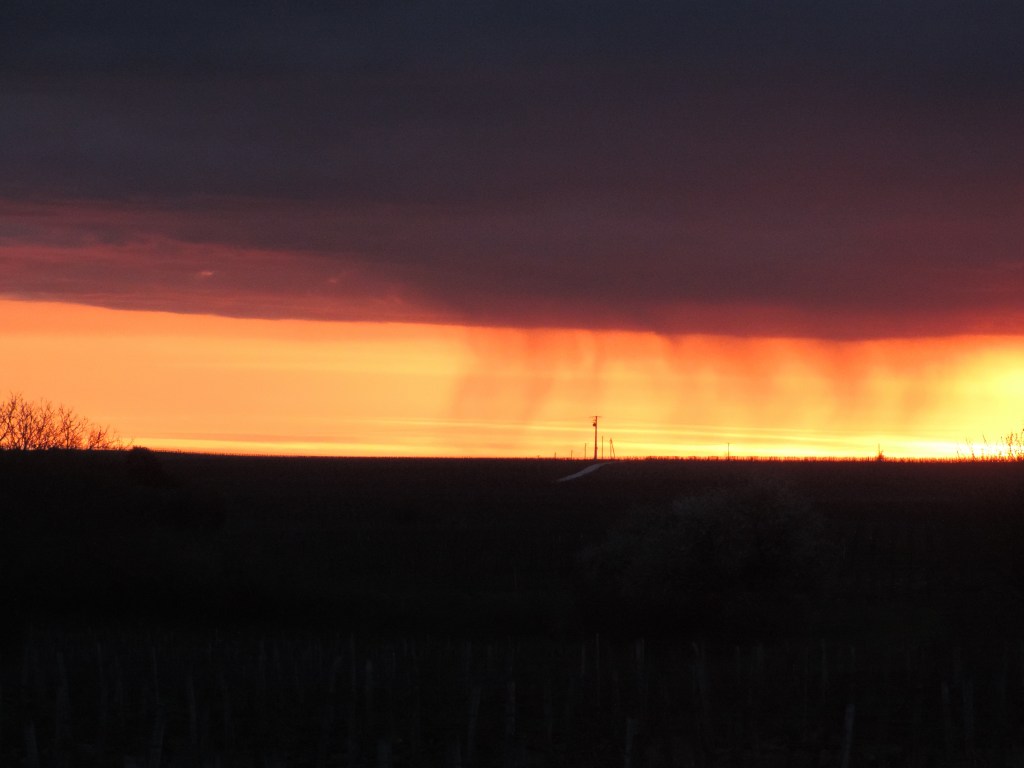
I love this photo. The fire of the Sun has turned the sky orange and tinged the water laden dark cloud red. Fingers of rain reach down to soak the surface of the Earth. The little silhouettes reveal signs of Life, of trees on the far left and of a human constructed road and telegraph pole in the centre.

This scene is one of a spectacular concurrence of the elemental flows – fire, water, earth and air – which combine and interact to create and nurture the life forces and evolutionary drives which flourish on this little planet.

Fire. The energy of Sun without which there would be no Life, and with too much of which there would be no Life. Water. The apparently simple molecule of hydrogen and oxygen combined, which cycles around the planet, falling as rain on mountains and plains, creating rivers to reach the sea, evaporating under the heat of the Sun to fill the air with clouds, ready to fall again onto the earth. Earth. The carbon laden surface rich with a vast array of minerals, the substrates of all existence, without which there would be no forms. Air. Rich in water, oxygen, and carbon dioxide, ready to be sucked into the plants which use the Sun’s energy to turn it into stems and leaves and flowers and fruit.

The astonishing plant kingdom, our predecessor in the story of Life on Earth, the complex, vast web of living organisms, mind boggling in its diversity, adaptability and resilience.

And we humans, with our inventiveness, our creativity, our ability to transform whatever environment we live in.

Isn’t the ordinary, everyday, just astonishing? Isn’t this planet and our very existence utterly awe inspiring?

Read Full Post »

Reflect

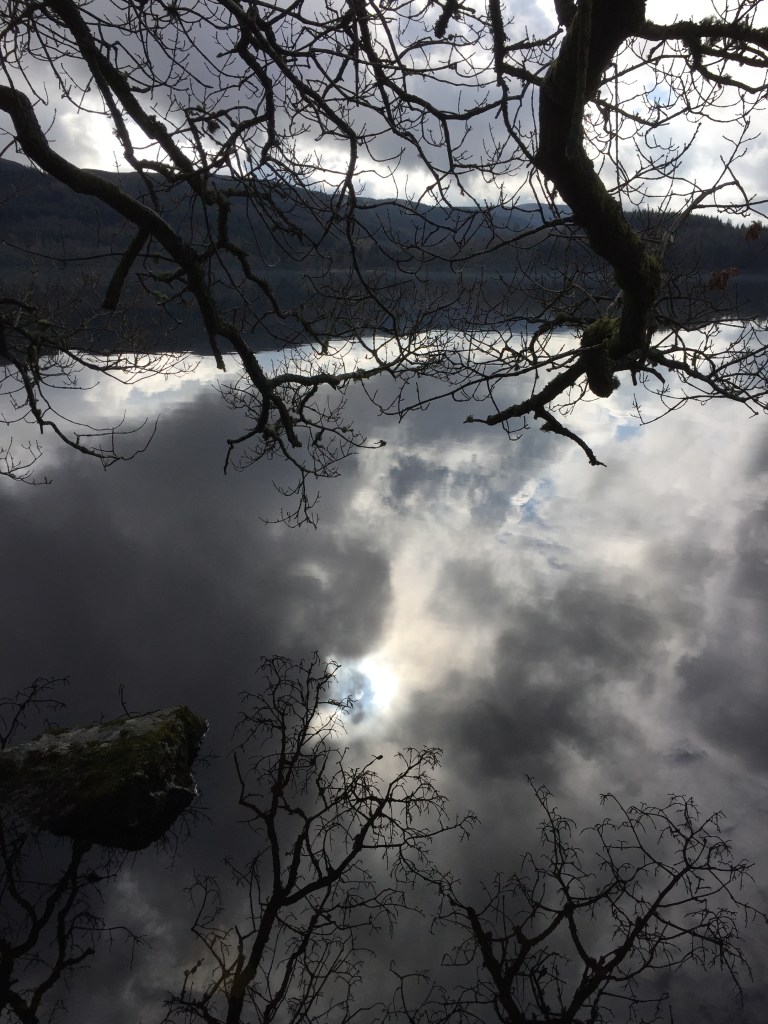
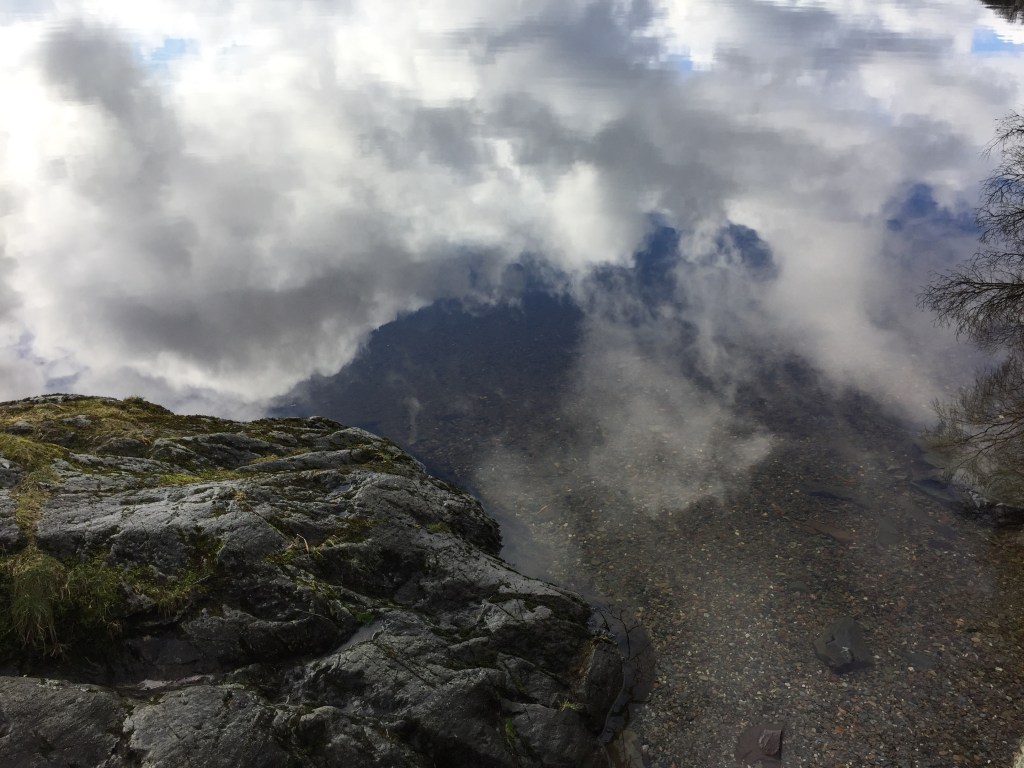
One March day I drove to Callendar, just north of Stirling. One of the old ways of describing Stirling was “the gateway to the Highlands” because Stirling Bridge was one of the few crossing points over the River Forth. North of Stirling, the Highlands began, and to the south, the Lowlands.

Certainly by the time you reach Callendar the landscape changes dramatically, lochs, mountains and glens everywhere.

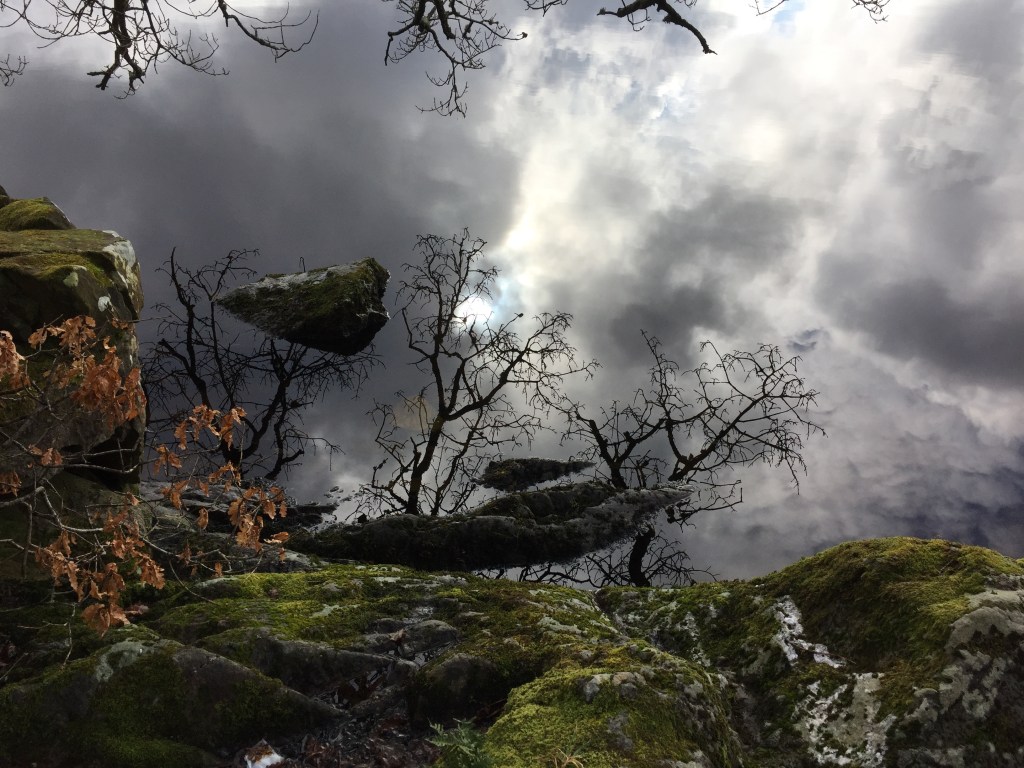
This one particular day it was very still so the surface of the loch I stopped next to was just like a mirror. I took a number of photos that day and I return to them frequently. They are both mesmerising and calming.

Such clear reflections challenge us to look more carefully, to take the time to figure out what we are looking at. And that’s a lesson I take with me wherever I am.

So why not pause now and reflect, allow yourself to slow down, raise your conscious awareness and see more clearly just what beauty and wonder there is around you today.

Read Full Post »

Repetition

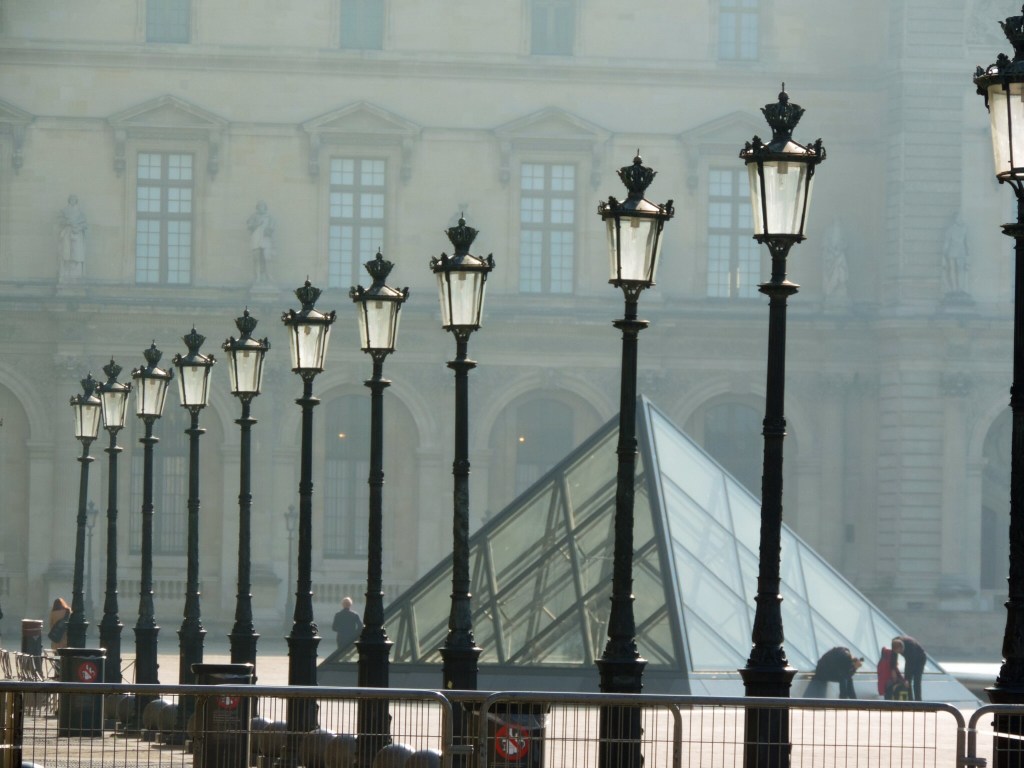
Look, I know I stress the importance of things like uniqueness, difference and diversity, but today I want to share the beauty of repetition.

There is a comfort in the familiar. There’s an ease in routine. We are creatures of habit. And there is a beauty in repetition and symmetry.

I delight in all of that, so isn’t this another of the essential paradoxes of Life? I’ve often written here about the importance of separateness and belonging, of our need to be different and our need to share what we have in common with others. So here’s another one – the beauty of difference and uniqueness and the beauty of sameness and repetition.

What holds these opposites together for me is awareness – becoming conscious of, embracing and engaging with our everyday encounters. Not choosing one “opposite” to the “other”, but appreciating both, relishing both, delighting in both.

And not or.

Read Full Post »

« Newer Posts - Older Posts »