There are three great historic structures in Stirling, the town of my birth. The castle, the Wallace Monument and Stirling Bridge. This photo shows the latter two.
I don’t know if it’s because I grew up with the bridge that I find bridges so attractive but I suspect its presence played a part.
Stirling has always been a crossing point, from East to West, and across the river from South to North. I think that’s embedded a number of values in my psyche – a desire to meet others, make new connections, to travel and to say “and not or”.
For me bridges are powerful connectors. They open up the ways we can expand our experience and develop our lives. They are an invitation to increase diversity and to build new relationships.
Walls keep the inside inside and the outside out. Whilst they provide necessary boundaries and defence, they are used to create enclosures….closed, not open, “or” not “and”.
We build bridges between ourselves and others. They open us up to différence and novelty.
I’ve been retired for over seven years now. This photo shows my last place of work. Just beyond the clematis and jasmine you can see a window…the window of my office/consulting room. Although I wasn’t a gardener at the time (I was living in a top floor apartment) the hospital where I worked had been designed and built around a garden.
There are many scientific studies demonstrating the health benefits of spending time in forests, parks and gardens. There are many which demonstrate the health benefits of gardening as an activity. And there are many which show the impact made on healing times by buildings which enable patients to see green life through their ward windows.
But I didn’t need any of those studies to appreciate and enjoy the physical environment of my workplace. It was great to see the cycles of the seasons through my office window, and to be able to slide back the big glass door and step out into the garden.
When I retired I moved to South West rural France, first to a house on the edge of a village, surrounded by vineyards. Stepping out into a garden every morning, listening to the birds and looking to see which flowers, butterflies and birds I could spot has put me more in touch with Nature than ever before.
Now I’ve moved house and am in a small hamlet in a traditional old house with a big pretty wild garden to explore. It feels home here. The garden is full of birdsong, and has an area of trees making a little forest…..forest bathing on my doorstep!
I have a bit of a love hate relationship with numbers. They fascinate me but I distrust them. I’m really a sceptic when it comes to statistics and it often seems to be the case that people choose the figures to bolster their opinions or actions.
Here’s a couple of incidents related to numbers which stuck with me. One day I was invited to give a talk to a group of dentists. One of them told me the story of the local facial pain clinic. It had been set up and run by a particular chief surgeon who had fairly recently retired. The surgeon who had been appointed to replace him had a curious experience the first time he conducted the clinic. He’d introduce himself to each patient, and ask them how they were. If this wasn’t their visit to the clinic they’d reply with a number. “7” or “4” or whatever. He was a bit puzzled. He then discovered the previous surgeon was quite intimidating in his manner. He’d invented a number based pain scale to measure the amount of pain patients were experiencing and he had trained them to report their figures instead of describing how they were. Apparently he’d been known to cut talkative patients off and say “The next thing I want to come out of your mouth is a number!”
The other experience was a conversation with a junior doctor in training where I was explaining the importance of the patient’s story. The doctor said they’d been told in training “You can’t believe patients. They lie all the time. The only thing you can trust is data. Read the test results!”
Well, those attitudes were the antithesis of my principles and showed way too much belief in numbers at the cost of blinding the doctors to the human beings they encountered.
Numbers can be helpful, but only when used in context and when that context is a human life they are no substitute for the individual unique story which each of us has to tell.
I saw this graffiti on traffic lights in France some years ago and I’ve seen it a few places since. If you look carefully you’ll see someone has drawn a smiley face on the green light, a frustrated one on the amber and a sad face on the red.
I suppose most of us don’t like having to stop at traffic lights, and I remember an Italian friend telling me, as we drove through Naples, that stop lights “were just advisory”!
However, I reckon that in Life it’s a good idea to hit the pause button from time to time.
Here in rural France, most commerce is closed on a Sunday, although a handful of supermarkets now open on a Sunday morning. And in the smaller towns there’s usually a weekday when pretty much everything is closed. That all took a bit of getting used to coming from a seven day open economy in the U.K. but once you learn that’s how it is here, you adjust your plans accordingly.
Sundays still sound different here. Even though I live in the countryside, not in a city, it’s particularly and noticeably silent on a Sunday.
Lunch time is often a two hour period here too and there is always a little burst of traffic bang on midday as people hurry home for lunch. Even some really big stores close for a couple of hours for lunch.
I think it’s a good thing to hit the pause button from time to time. I appreciate that slower pace.
There’s a climbing plant covering an archway at our front gate. As we moved in here just in December the garden is completely new to us. In the middle of winter it’s hard to know which plants are alive but sleeping and what exactly some of them are.
So, as Spring arrives, the garden is full of surprises and discoveries.
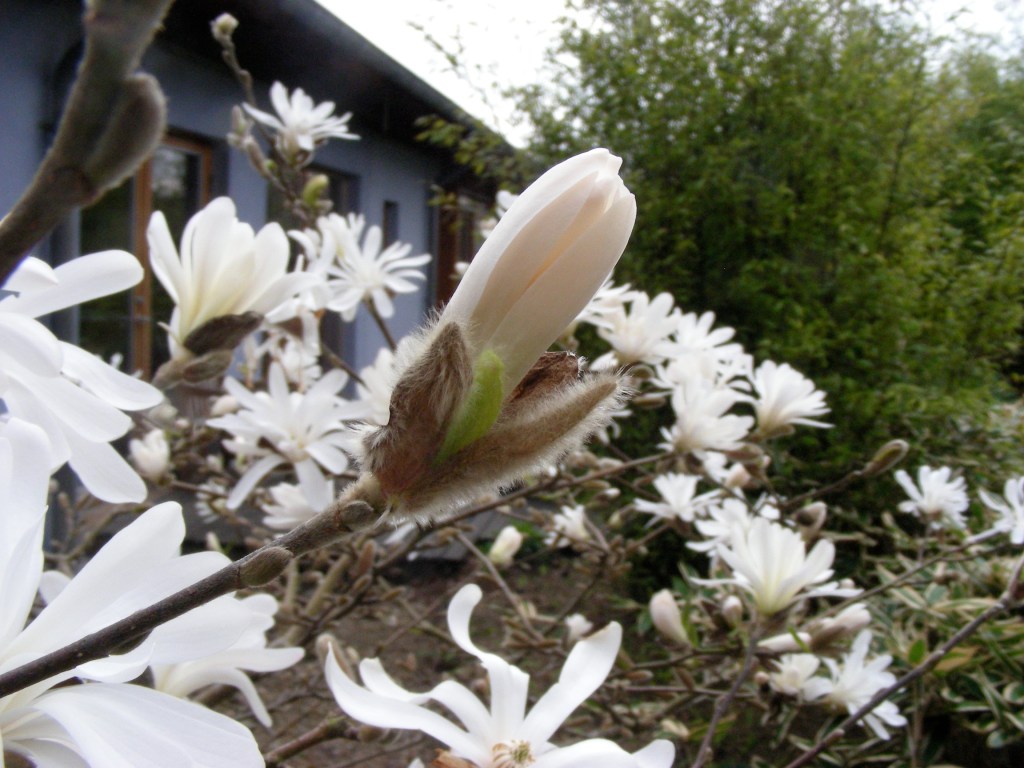
It seems that this climber is a wild clematis and it’s suddenly covered with these beautiful dark red little flowers. They are about the size of my fingernail.
When a flower is as small as this it draws you in close to see it more clearly, and that drawing you in makes you pause, take your time and linger a little. All of which heightens the pleasure of the encounter.
I often mention the importance of uniqueness and diversity but this little flower reminds me of another important life principle – small is beautiful.
It must be over forty years since I read Schumacher’s book entitled “Small is beautiful” but its central theme has stayed with me throughout my life. He promotes the importance of human sized organisations in that book. It’s a counter idea to that of “economies of scale”, of “mass production”, and “mass consumption”.
Since moving to France I’ve been struck by the number of small, family businesses, whether they are a local boulangerie or café bar, or a skilled craftsman. I’ve seen many interviews with people who are passionate about their work or business but almost always there’s an emphasis on there being more to life than work. Of course there are huge businesses and chain stores here, but there is still something smaller, something more human scale. I like that.
Small is Beautiful also applies to social and political organisation. I often think that a lot of our problems exist because there’s too great a distance between those who make the decisions and the rest of us. Time and again in crises, from the pandemic, to floods, to poverty and waves of migration, it’s ordinary people and local communities who show human beings at their best, instinctively trying to help those in need. Whilst the political and economic elites, with power over millions, seem riddled with greed, corruption and narcissistic selfishness.
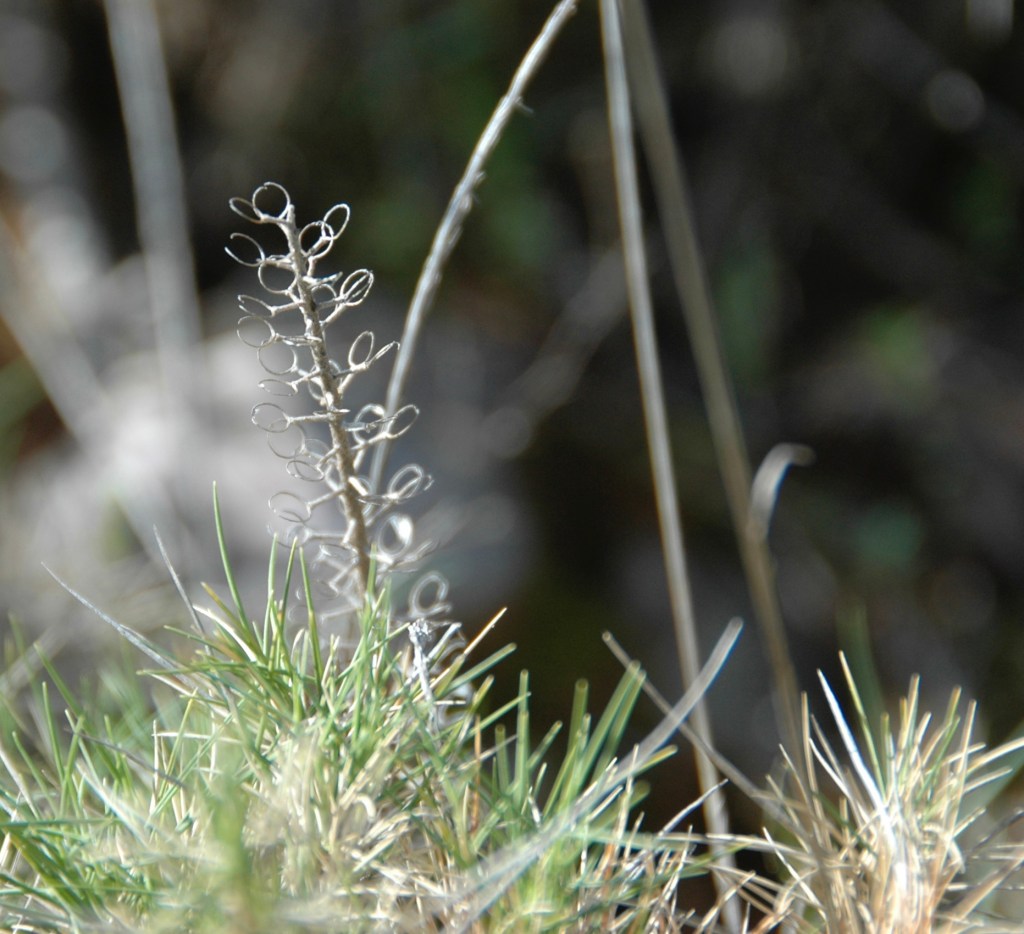
Isn’t this the most extraordinary plant? I came across this a few years ago and I don’t know what it is. I suspect it may be a plant which has the common name “honesty”. Do you know it? It has delicate paper like leaves, or petals, I’m not sure which. They are semi-transparent and you can see a couple of seeds held in the middle of each one. Well, this looks like that plant once the substance of the leaf/flower (which is it?) has gone, freeing the seeds to find new ground to grow on. What’s left is this almost skeleton of structure which looks like a small, beautifully crafted sculpture of rings attached to a central stalk.
When I look at this I see what seems to be a collection of lenses. I want to get down beside it and peer through them to see what I can see. I imagine they might let me see what’s invisible.
It is only with the heart that one can see rightly. The essential is invisible to the eye.
The Little Prince. Saint Exupery
I’ve just finished reading The Nutmeg’s Curse, by Amitav Ghosh. In that book he argues for a “vitalist politics” to counter the dominant “mechanistic” one. Although his book is a critique of colonialism, capitalism and neoliberalism, he doesn’t adopt a Left/Right position but instead contrasts the materialist/mechanical view which regards the Earth and its living forms as stuff and resources to be conquered, consumed and grabbed with an animist one which sees our planet as one vast interconnected living being, where we emerge, briefly, within the cycles of this life world.
His description of the actions of the Dutch East India Company in the early 17th Century is horrifying. He shows how the mechanistic/materialist beliefs and attitudes they had, created the structures which supported their use of genocide, slavery and destruction for short term profit. And he shows cycle after cycle of similar behaviours across the planet in the last four centuries leading us to our present crises of climate change, wars and extreme inequality.
This mechanical/materialist view of the works isn’t working out too well, is it? Maybe it’s time to see reality more clearly, to become more aware of what’s invisible – life, love, meaning, purpose, beauty and wonder – and change our priorities to find how we can play a part in enabling Planet Earth to survive and thrive.
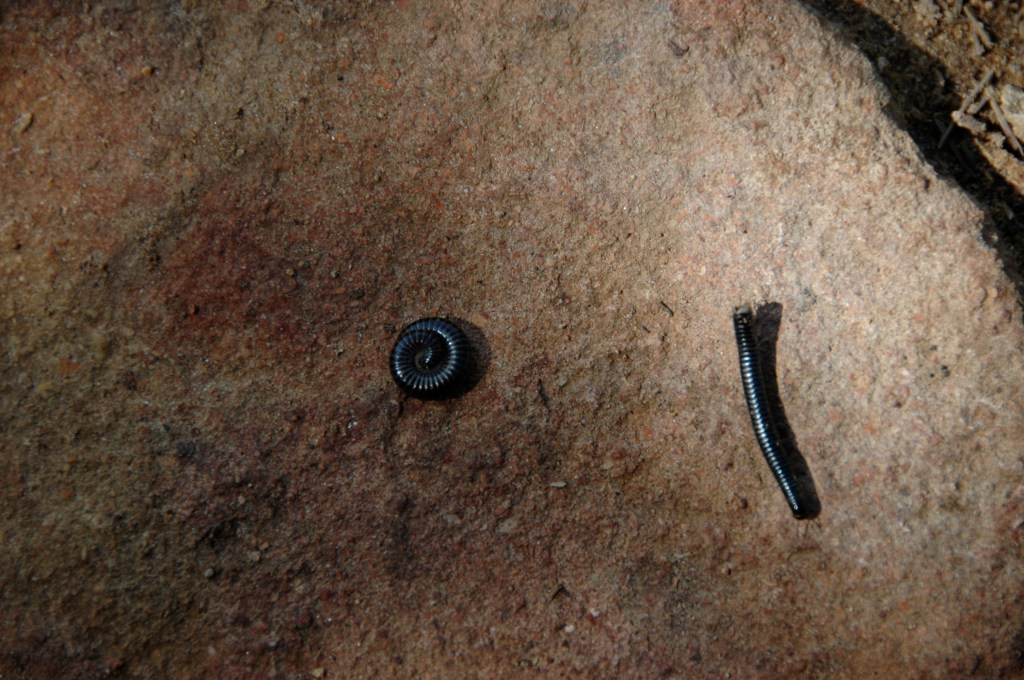
I spotted these two strange little creatures on the ground. I don’t know what they are but what struck me at the time, and what strikes me again now, is that one is curled up tightly into a little circle and the other is stretched out straight like a stick or a line.
Two the same, two different.
I’m pretty sure that if they had both been behaving the exact same way as each other I wouldn’t have noticed them, and probably wouldn’t have stopped to photograph them.
The fact that every patient I saw was unique and would tell me a different story was one of the most important things to me. I looked forward to each clinic knowing I was going to meet someone who would tell me their unique life story.
We are all different. No matter what labels we apply to each other. And we have a lot in common. We connect through our values, needs, desires, problems, challenges and delights. Both the patient and the doctor.
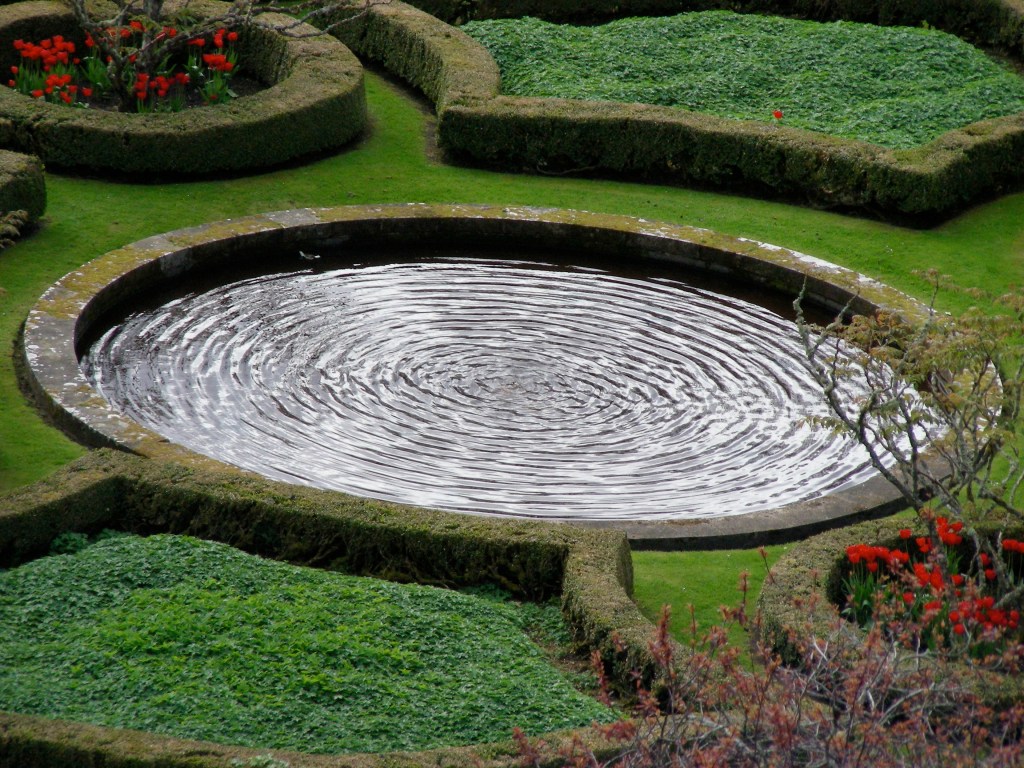
This pool with the concentric ripples radiating out towards the edges from the centre has always fascinated me. One of the trains of thought it sets off for me is the amazing powers of self healing which all living creatures possess.
This power comes from within and radiates through the whole being. In one telling this is the Vital Force, or Life Force, a mysterious phenomenon which flows through all animated substances. But my issue with that telling is it suggests this energy is an entity of some kind, a thing. And I’m pretty sure no such “thing” exists – well that could send me down the whole rabbit hole of our habit of separating ourselves out and reducing all we encounter to objects, things, resources or whatever. A big mistake in my opinion!
Another telling is that self healing is one of a set of characteristics possessed by all “complex adaptive systems” and all living organisms can be viewed that way. I’ve written plenty here on “complex adaptive systems” so if you want to read more put that term in the search box at the top right of the page.
From that perspective living creatures can self heal, self repair, and self defend themselves. But how do they do that?
I reckon we are at a very early stage of understanding these processes but it strikes me there are at least three major “systems” or “processes” which are most commonly involved.
The first is balancing. The term homeostasis was coined to describe this. It’s our ability to maintain a pretty steady internal environment. Through a vast web of interconnected feedback systems involving cells, molecules and structures such as the blood vessels and nerve fibres, when there is “too much” of something we self regulate to reduce it, and if there’s “too little” we increase it. You can see this in blood pressure, as well as in a host of circulating levels of different nutrients, enzymes and hormones.
The second is the inflammatory system. We tend to think of inflammation as a bad thing because too much inflammation is highly destructive but this ability is at the basis of our ability to defend ourselves and to heal wounds. You’ll be very familiar with the changes in your skin around the site of a cut, or in response to an infection. This is the inflammatory system at work.
The third is integration. I find that integration can be both a simple and difficult to grasp….which is interesting because integration is all about our ability to handle paradoxes. There are two opposite and essential patterns in the universe – wildness and discipline or chaos and order. We need both the play together nicely to have the world we live in. It’s that classic “and not or”.
Too much organisation and order and everything becomes rigid and stuck. Too much chaos and disorder and everything falls to pieces, implodes or explodes!
We need all our systems to integrate – not balance in the sense of cancelling each other out – to flow, to grow and to flourish.
So even if we don’t understand these processes in detail, these three viewpoints can help us to understand how we got sick and what we need to do to mobilise and support self healing – homeostasis, inflammation and integration. All three are constantly present. All three interact with each other perpetually. It’s not about reducing the problem to one of them. It’s paying attention to them all.
And here’s the thing – sometimes there are small specific adjustments to make, but, generally self healing is a holistic function. It’s individual, unique and embedded within multiple contexts. So we need to be wary of one size fits all solutions and we need to tend to the environments in which the individual lives – the physical, social and cultural environments.
I don’t know if this way of thinking is helpful to you but it’s how I came to understand both how patients became unwell and what my job was to help them heal.
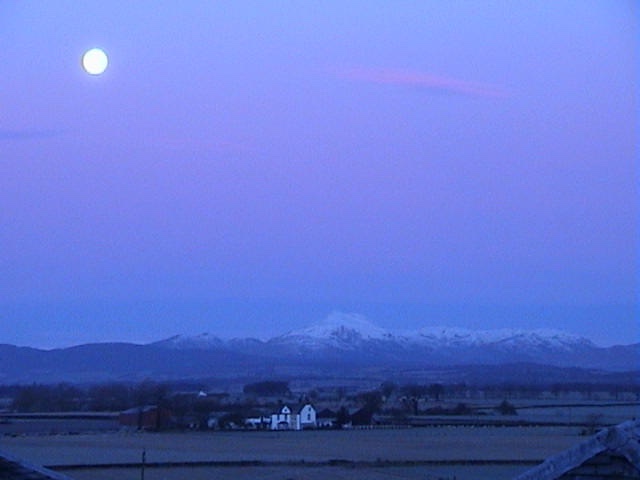
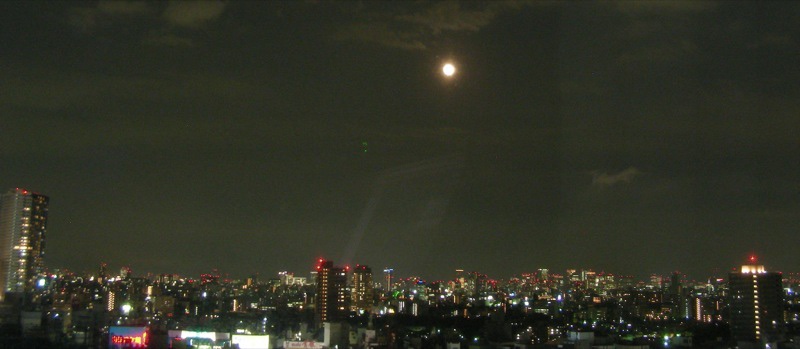
Here are two photos taken on the night of a full moon.
They are actually two consecutive full moons so they show one full lunar cycle. These were taken back in 2007. I took the first one from my bedroom window, and the second from a twenty seventh floor Tokyo hotel room.
Of course, neither is actually a good photo of a full moon. Trying to take a decent photo of the moon isn’t easy, especially if you want to show the landscape over which it is shining. But I really like both of these photos all the same. They are such a contrast. One blue shot of Scottish hills and fields, and the other, several million electric lights shining in a dense urban landscape.
The fact that these two nights bookend a single lunar cycle, yet show such dramatically different living conditions, makes them an interesting pair of photos to contemplate together.
My preference is for the Scottish one, perhaps because that’s where I was born and grew up. But a lot more people prefer to live in Tokyo!
I’ve heard people say they could never live anywhere but in the city, and just going on population size, clearly cities are a popular choice.
I think we’re all different. Some of us genuinely prefer to live in small towns or in the countryside but others definitely prefer city life. Given how different these environments are, I’m pretty sure they show us a good argument for the devolution of power to the greatest extent possible. The needs and daily issues of country and city dwellers are not the same, and neither are the solutions to their problems.
And yet, lift your gaze a bit higher and that moon reminds us that despite our differences we all share the one planet, the same atmosphere, the same water cycle, the same living web of Nature.
I noticed this weeping willow while I was out exploring my new locality. Isn’t it glorious?
Of course I’ve no idea how it came to grow there but you can tell from the size that it’s been around a long time. I suspect that as with most plants in the world, this one wasn’t put there deliberately by a person. Does that mean it’s appeared completely by chance?
Well, chance isn’t always as random as it appears. The way I understand it, this tree will only grow to maturity here when a number of events, factors and circumstances come together.
The seed, no doubt one of many, had to land on this particular area of ground, it had to germinate, put down roots and find the nutrients it needed to grow. The weather would influence it, as would any human interventions or actions of certain animals.
In fact, when it comes to living organisms, there are more connections and factors in play that when it comes to an individual, you can never fully understand all that’s brought them to this point, and you absolutely can’t predict their future course.
That knowledge always influenced my work as a doctor, keeping me both humble and open minded, reinforcing my preference for attentive, non-judgemental listening.
In Medicine, as in the garden, or the in the wild places on Earth, we can care, attend, understand, support and do whatever we can to encourage self healing, growth and flourishing.
I welcome constructive criticism and suggestions. I will not, however, tolerate abuse, rudeness or negativity, whether it is directed at me or other people. It has no place here. ANYONE making nasty comments will be banned.





 Heroes Not Zombies