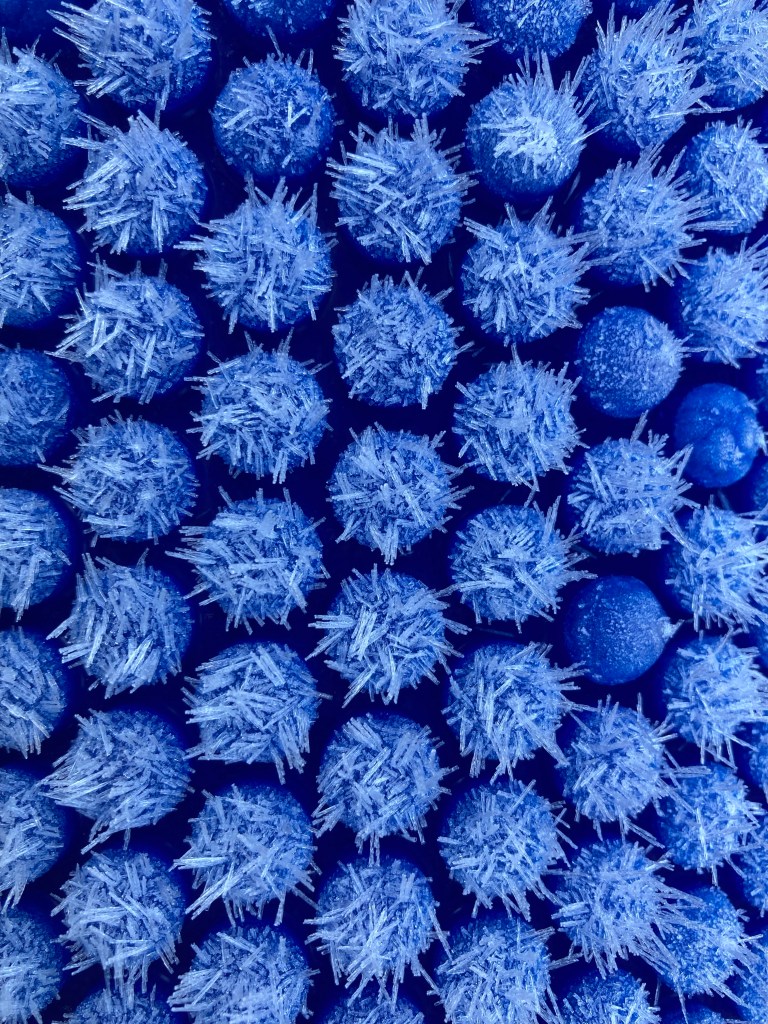
When the first frost of the winter arrived I went out to take photos before breakfast. Here’s one I took of the ice particles which formed on a plastic cover.
Aren’t they beautiful? I don’t think I could’ve dreamed up shapes like this. I’ve looked at this photo again and again, and if you’re a regular reader here, I bet you know what’s fascinating me….
This is one of those places where at first glance you think, oh look at all these identical clusters of ice! Then, immediately you notice differences and the closer you look, the longer you take over them, you realise…..there are no two exactly the same.
Yep, every single one of them is unique. Just like snowflakes. Just like each of us are unique. Just like every moment of every day is unique.
To me, a universe with tendencies towards beauty, complexity, and the rich unfolding of uniqueness is already teleological
Iain McGilchrist. The Matter with Things
When I started to read philosophy books I came across the word, “teleology”, and I wasn’t sure what it meant. Best I know it refers to an end point, or a goal….so when something is described as teleological it means it has a purpose determined by its destination. Maybe that’s not an exact definition and I’m happy to be educated if you know better, but the destination doesn’t have to be a fixed, limited one….it can be like a “North Star” or “lode star”…. something to aim at.
So when I read this sentence about the universe, I read it as stating that the universe isn’t random and purposeless, rather it is moving forward in a particular direction…..it’s going “somewhere”, and that somewhere gives a clue about purpose.
So what’s the suggestion here? That, the direction, the “somewhere”, the purpose, is beauty, complexity and uniqueness. That’ll do for me.
I have my eyes and ears open for that every single day….to be awoken by, to be absorbed by, beauty, complexity and uniqueness, so that I stop, wonder, and savour, enriching my life and my soul.
The teleology of the universe is directed to the production of beauty
Alfred North Whitehead
Is the universe moving in a particular direction? Does the cosmos seem to evolve towards some destination? Or, better, perhaps, if not a destination then, at least, in developing it reveals a purpose?
Is that purpose beauty, as Whitehead suggests? Beauty, which Iain McGilchrist describes as “gloriously superfluous and unnecessary, its nature is that of a gift.”
I can’t see a destination, or a pre-imagined purpose – at least, I don’t see it from any utilitarian perspective. I don’t see that the universe exists as a tool to achieve the completion of some hidden task.
Rather, I’m more convinced by those right hemisphere understandings of the direction being towards beauty and ever greater interconnected complexity, and the purpose as the daily celebration of Life, of creativity, of difference, uniqueness and diversity.
I enjoy the idea that the universe exists as a celebration rather than as a tool, and that the direction of travel, or of the “flow”, towards ever more beauty, creativity and uniqueness is exactly my “touchstone”, my “values and principles” with which I want to orientate my life.
“A machine has an extrinsic purpose – not its own but that if the person who made it. It exists purely to achieve an and: another being’s end. By contrast, a melody has an intrinsic purpose: it’s hardly pointless, but it has no other point than itself.” – Iain McGilchrist in The Matter with Things
Despite the fact that we can now understand reality through the lens of complexity science, the mechanistic, materialistic model remains the dominant one. I hope that will change soon.
We are not machines. We are not “machine like”. Machines are built by someone to serve a purpose set by whoever built them. To consider a human being, or indeed, any other living creature as a machine reduces them. It dehumanises people, devitalises Life. It sets up societies where individuals are reduced to cogs in a machine, replaceable, dispensable, having value only when they deliver for whoever hires them.
We are more like music than we are machines. Every one of us sings a unique melody, the melody we instantly recognise because every individual is unique.
I often refer to how everyone has their own unique story to tell…the one which allows them to know who they are, to make sense of life, and to communicate their inner experience to others. But this passage comparing machines to melodies makes me realise that we don’t just tell unique stories, we sing our singular songs.
Think how we use metaphors such as “singing from the same hymn sheet”, or of “working in harmony”, being “in tune with each other”.
Isn’t life a performance of a beautiful composition, one which we create and share as we live, day by day, moment by moment?
Of course the answer is – all of the above – and more.
I’m not a fan of labels. I understand the value of classification to organise our thoughts or our filing cabinets, but labels hide so much more than they reveal.
We develop a mental habit based on re-cognition – we say, I know what that is, I’ve seen one like it before. It’s an incredibly useful skill, and we can’t really function without it. But the danger is that we use this ability to stop instead of seeing it as a start.
Yes, it’s really helpful to recognise something and put it in a box with a label on it (literally or metaphorically) but we never fully see, so never completely know, anything or anyone. So, recognition is a good starting place, but we have to be ready to let go of those initial assessments as we start to see more detail, start to see the particular, not just the general.
I was taught this as a core skill – taught to make a diagnosis by recognising certain signs, symptoms and patterns, but always exploring further to move from seeing the disease to seeing the person who was ill.
I often think of this when people divide others into groups, dismissing them because they have put them in a particular box labelled with a political party, a religion, a skin colour or a sexual orientation.
There’s enormous danger in recognising, classifying, labelling and generalising. It leads to all kinds of prejudice (pre-judging) and, frankly, to the de-humanising of individuals.
I always want to know more about someone than I already do. I always want to be surprised as I discover that nobody fits neatly into any labelled box.
There’s a teaching from the “General Semanticists” – “Judgement stops thought” – which alerts us to the danger of using labels.
Everyone and everything is richer, deeper, more nuanced, more multifaceted than first appears.
In Ian McGilchrist’s The Matter with Things he says we need to discover (or re-discover) the truths which unite us.
That sentence really leapt out at me and I immediately thought, yes, it seems that divisions have become deeper, that social media is used to set people against each other, to create echo chambers which exclude “the other” and that there is an unprecedented level of deception and lying.
I don’t know if the election of seemingly pathologically narcissistic politicians has brought to prominence people who either deliberately lie with ease, or who actually are unable to know they are lying.
So, yes, we could do with finding truths which can unite us.
But then I thought….you never, ever get absolutely everyone to agree what seems to be true. In a world of conspiracy theorists, religious fundamentalists and people with vested interests in power and wealth, how do we find truths which unite us all? Well, we probably can’t. But surely that’s not the point. Surely we can find truths which are more likely to unite than divide, truths which bring more of us together – in other words truths which turn the tide the opposite way and carry us towards greater togetherness.
Then I began to wonder what those truths might be….and, so far anyway, I’m thinking they mainly exist in Nature and the Cosmos.
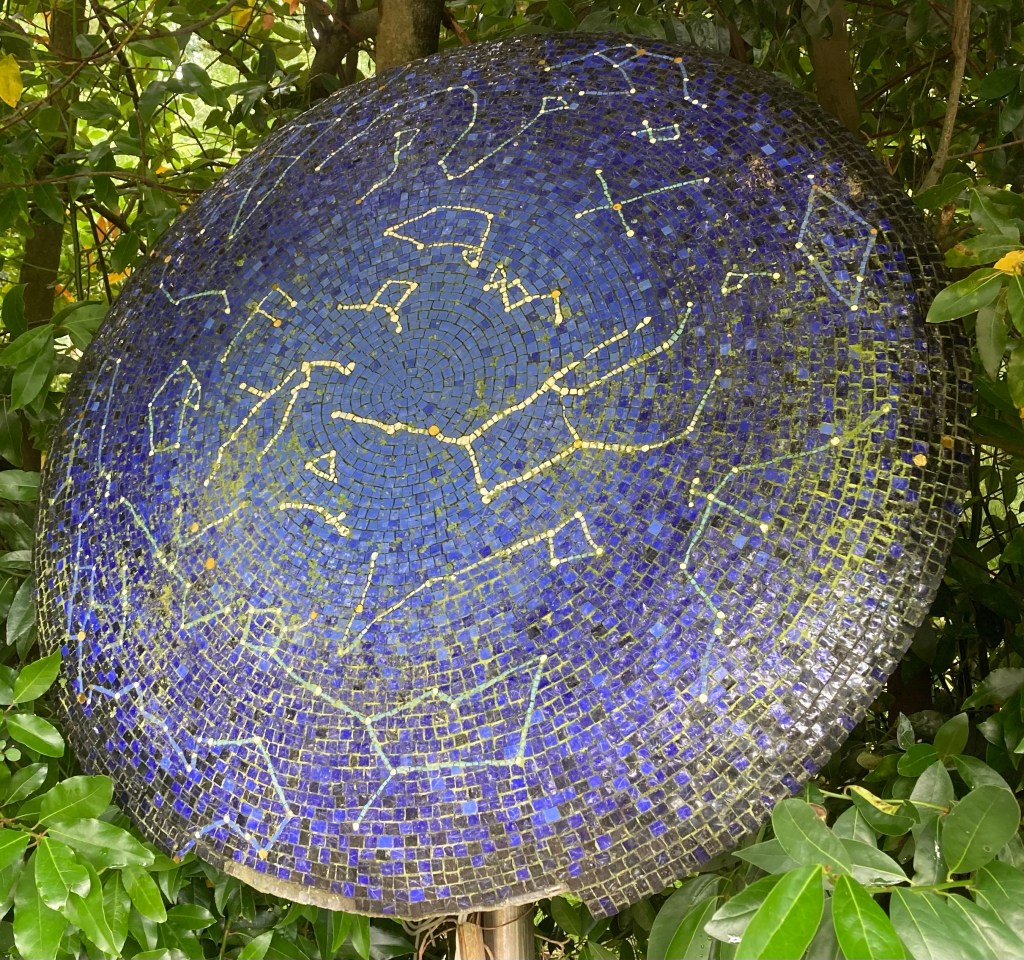
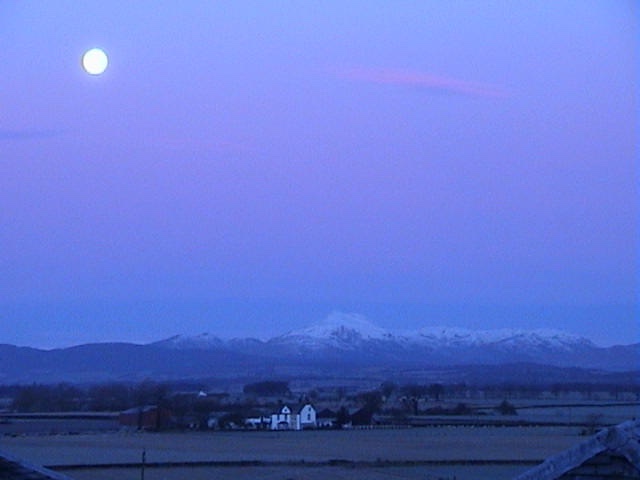
We all look up at the same night sky, see the same Moon, see a particular set of constellations depending on where in the world we are when we look up (which reminds us that we can change what we see by putting ourselves in the shoes of others)
We all live on this one small planet, sharing the same air, water and soil. When we change the air, water or soil around us, we change what others will breathe, drink, and eat.
We see the cycles of Nature, seasons, which remind us that change is the only certainty, that transience can be beautiful, and that “this too shall pass”.
We see that, in Nature, living organisms don’t just co-exist, they interact, and often become interdependent.
We learn that all of Life on Earth depends on a wonderful synthesis of competition and collaboration.
How’s that for a start? Aren’t those truths which might unite us?
What do you think? What truths do you think can unite us?
Dear God! The very houses seem asleep and all that mighty heart is lying still.
William Wordsworth
Luckily, I’m not up much during the night anymore, but when I was a General Practitioner I was out and about in Edinburgh through the night pretty regularly. Much of the city was eerily quiet in the middle of the night, with hardly any traffic, or pedestrians, and just the occasional window lit in a few houses. I thought of those nights again when I read these lines by Wordsworth.
That’s exactly what night time felt like to me when I was out – the city was sleeping. But more than that, you could feel its heart lying still….by still, I don’t mean not beating, I mean that slow, calm relaxed beat which we can all experience, although some of us only experience it during sleep.
There’s a huge overlap for me between heart and soul. I don’t understand soul as an entity lurking somewhere hidden in the body….it’s more like a state, a condition, which we discover in what Iain McGilchrist calls the “betweenness”. Just as music can’t be reduced to a set of individual notes, but works because of melody, rhythm and harmony which all depend on the betweenness – between the notes….in the “movements”.
But I don’t consider the heart as an entity either. It is an entity more clearly than soul is, because you can see, touch, even hold the organ we call the heart in your hands. I’ve done that. No, you can’t reduce the human heart to what you can hold in your hands. The live, beating heart, surrounded by its own special neural network, emanating complex waves of electromagnetic radiation which influence the whole body, and even the bodies of others.
We humans use metaphors with great power. They’re a kind of magic. They turn what could otherwise seem merely mechanical and utilitarian into something enchanting and profound, something which gives us access to feelings and the unconscious.
We do need to still our beating hearts from time to time, to steady ourselves, to quieten down our inner and outer worlds.
And when we do we discover we can live a more full life, a life of heart and soul.
I welcome constructive criticism and suggestions. I will not, however, tolerate abuse, rudeness or negativity, whether it is directed at me or other people. It has no place here. ANYONE making nasty comments will be banned.





 Heroes Not Zombies