Feeds:
Posts
Comments

Archive for August, 2024

I don’t understand xenophobia. Why fear, and/or hate, someone because of some way in which they are different from you?

The rise of political “populism” seems to be fed by, and feeds, xenophobia. Whether the targets are immigrants, asylum seekers, or those who adhere to a particular religion, those who promote “send them back home”, or “take back control”, or “secure our borders” always focus on a “them” who are not “us” and “shouldn’t be here”.

I don’t get it.

Every one of us is different. Every day of my working life patients told me stories I’d never heard before. No two of us share the same story. No two of us have the exact same history or experience. No two of us share the exact same face, the exact same voice, think in exactly the same way or respond to life’s challenges in exactly the same way.

It’s our differences which make us unique. I find that fascinating, and, an essential part of treating someone when they are ill.

And yet, despite our differences, we all share a lot. We have many, many points of connection. We share the same air, drink the same water, live on the same planet. People live in the same city together, they live in the same street together, they might buy their food and clothes in the same shops. Many of us enjoy the same music, participate in the same sports, work in the same offices, shops, factories, hospitals, or schools.

Our points of connection are infinite. How often have you had a conversation with someone and explored your shared tastes, experiences, similar memories, discovered shared contacts?

It’s our connections which make us unique.

Yes, it’s both our differences, and that unique set of relationships, experiences and connections which we have, which combine to show us, simultaneously, that we are different, and that we have much in common.

If we are to thrive together, we humans, we’re going to have to reject the poison of xenophobia, and replace it with kindness, curiosity, and compassion. Is that so hard?
Read Full Post »

Flow and structure

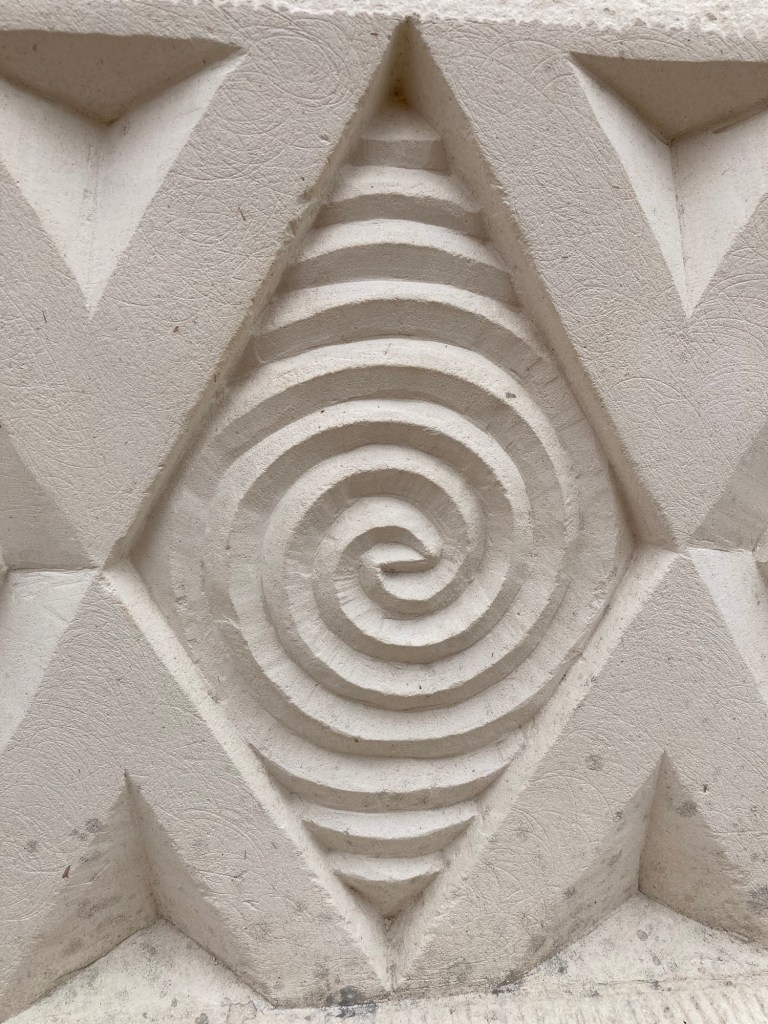
When I noticed this design on a nearby sculpture I immediately thought of the two forces which create everything that is.

Flow, in the middle, representing movement and change, bounded by structure, which limits and contains.

Together they create a universe where everything is becoming (not being), emerging out of the flux, the web, to manifest temporary forms.

These forms persist. All that exists persists….for a while. Stars for millions of years, trees for hundreds or thousands, and us for a few dozen.

It’s amazing, beautiful and wonderful.

Read Full Post »

You’re not alone

It’s impossible to really know someone if you don’t take into consideration their relationships.

None of us exist in isolation.

The human baby wouldn’t survive if it wasn’t for the care and attention of others.

We have evolved as social creatures and both the quantity and quality of relationships we create influences who we become.

There’s a theory of development which highlights the default patterns which we all share and which become apparent in the earliest years, even days, of our lives. When the umbilical cord is cut, suddenly the child “knows” (not consciously) that they’ll die if they don’t take their first breath, then another and another. In those first moments we each experience a mix of fear, anger and separation anxiety. Which of these emotions becomes the strongest manifests itself throughout the rest of our life. How we respond to and cope with those emotions shapes who we become.

There’s a danger that our society has become hyper individualistic which drives division, separation and disconnection. None of that is conducive to good mental health, to a healthy immune system or to positive levels of inflammation. What emerges is dysfunction and disintegration at multiple levels, from cellular, to systemic, to social.

We all need a healthy level of belonging. We all need to love and be loved. We all need to care and be cared for.

The healthiest bonds are “integrative” bonds – relationships between well differentiated parts, or people, which are mutually beneficial.

What’s good for “us”, is good for “you” and “me”.

Forming integrative relationships is good for everyone and good for the planet, as we create caring, loving, mutually beneficial relationships with others, with other creatures, with the rest of Nature, with the planet.

Read Full Post »

If I want to understand someone I ask them about the most significant events in their lives…the traumas which left wounds, the bereavements, injuries, separations and losses, but also any event which made an impact on them. Anything which made a lasting impression.

As doctors we often focus exclusively on the traumas. On the events which have left wounds. How someone copes with a death, with an injury or a loss, shapes the person they have become. But I think it’s as important to understand the, what we might term, positive events, too. The births of children, the first kiss, the achievements, and, pretty much anything which creates a feeling of awe. Because those experiences of awe, and how we respond to them, also shape the person we have become.

Dacher Keltner, in his book, simply titled, “Awe”, and subtitled, “The Transformative Power of Everyday Wonder”, explores this latter phenomenon in detail. He describes eight types of awe, as described in the narratives of over two thousand people from around the world. The top one is “moral beauty” which we encounter when we witness an “exceptional virtue, character or ability” in someone. This is something I experienced frequently when listening to my patients. Time and time again I was in awe of someone who was telling me what had happened in their life and how they had coped. The second is “collective effervescence” which I’ve experienced frequently at concerts, or when witnessing a sports spectacle. It’s that feeling we get when we feel connected to what is more than ourselves, and which we share with others. I expect “Swifties” get this a lot! The third is “nature”, and that’s my source of daily wonder. I am constantly amazed, and in awe of, the plants, trees, birds, butterflies, hummingbird moths, bats and so on, which I encounter every day. The fourth is “music” and this is also an everyday source for me. I listen to music every day. I listen a lot, and I share my greatest pleasures with four old school friends who were all part of the same “record club” when we were younger. Fifth is “visual design” which includes architecture, sculpture and painting. Sixth is “stories of spiritual or religious awe” (honestly, that’s not my most common one!), and seventh is “stories of life and death”, again, one I experienced most, and most deeply, as a working doctor. Finally, is “epiphanies”, those sudden profound, and life changing insights. I find these in science, in art, in philosophy, as well as in other people’s stories.

How about you? What kinds of awe have you experienced? How do you think those experiences have contributed to you becoming the person you are today?

Read Full Post »

From weather forecasting to medical prognosis, we love trying to predict the future.

We live in an ever changing universe, a universe which changes us and is changed by us.

Randomness, chaos and discernible patterns pervade our everyday reality. The constant interplay of structural “laws” and emergent new forms creates everything we can perceive.

I was taught “common things are common”, but “don’t hold onto your most likely diagnosis too tightly”. Learning both diagnosis and prognosis enables doctors to make the best decisions possible in the moment while continually observing, ready to change and adapt as the unexpected pops up.

But it’s not just a professional issue. Every one of us deals, for the most part intuitively, with these two forces – randomness and structure.

How do we do that? We make decisions based on reasonable expectations, experience and an acceptance of a certain amount of risk. When we set out on a journey we expect the train, the bus, the plane, boat, car or bike to get us to our destination. Otherwise we wouldn’t set off. When we encounter a cancellation, an accident or a breakdown we adjust. We adapt, alter our plans and carry on with life.

As a doctor I knew the importance of follow up and continuity of care – it was the only way to deal with the fact that no outcome can be guaranteed at an individual level. Just because a particular treatment results in a hoped for outcome for the majority of participants in clinical trials, we can’t be certain this person, this individual, will experience those same outcomes. We have to remain vigilant, build a long term relationship and change course whenever necessary.

It pains me to see the development of algorithmic medicine which attempts to squeeze individuals into preset moulds. Human beings are not machines and life just doesn’t follow fixed predictable paths.

Relationships and continuity of care are, and should remain, the bedrock of all clinical care.

Read Full Post »