I’m back in the town of my birth, Stirling, this week. My mother in law passed away at the weekend so this is a rather sad, unplanned visit.
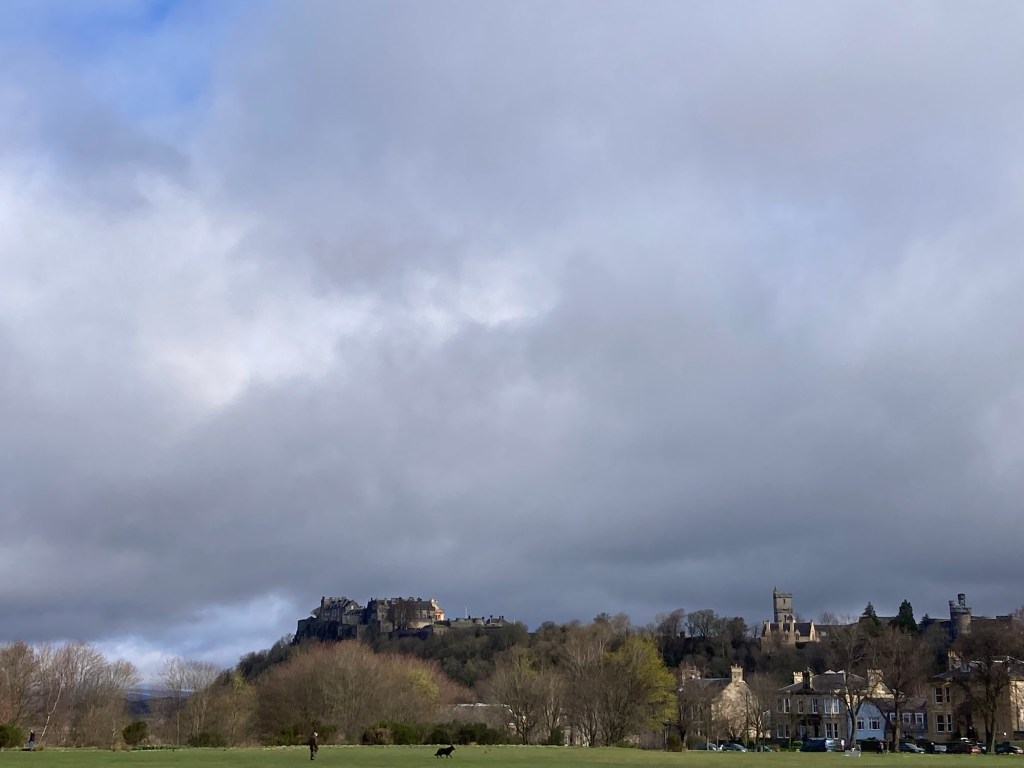
Yesterday I decided to walk into town, following part of the route which I used to take to get to work each day for the best part of twenty years. My routine, weather permitting, was to walk from home to the railway station where I’d catch a Glasgow train. In the winter it’d be pitch black over Kings Park, but for most of the year I’d walk through it taking in the long views to the hills, and enjoying the big green space of the park. It was a good start to the day.
Stirling Castle has always been my favourite Scottish castle, but you could say I’m biased, seeing as I was born in Stirling. My gran used to tell me that made me a “son of the rock”.
Seeing the castle again yesterday as I walked through the park, I had a feeling of belonging, a feeling that this is where I came from, but I didn’t feel I’d come home. Stirling has changed a lot over my seventy years on this planet.
My wife’s mum is the last of our parents to go, few relatives still live here, and our old school friends have long since dispersed across the planet, so I don’t recognise anyone as I walk the streets, and no-one recognises me.
I realise it’s the castle, the Wallace monument, the Ochil Hills and the “bens” around Ben Ledi towards the Trossachs which make me feel like I belong.
But it takes people to create a sense of home. People, routine and day after day of everyday wonder.
It strikes me there’s a similar inner experience at work. When we look at photos of ourselves from school days we know “That’s me”. We don’t doubt it. But at exactly the same time we think “Goodness, is that really me?” Because although we have a sense of continuity of the Self, we’re just as aware of how much we’ve changed.
I suppose that’s the nature of change. There’s a continuity within it. The present emerges from the rapidly receding past and we’re already imagining all kinds of possible futures. The flow of time doesn’t break up into neat, separate seconds, minutes and hours, that mechanical view of time is a much more recent invention. For most of history we humans have lived with the rhythms of sunrises and sunsets, and of the cycles of moon phases and seasons.
The philosopher Bergson helpfully showed us the difference between the real lived experience of time which he called duration, and the artificial measured time. Strange that we now let our lives be dominated by the latter over the former.
The long timescales of the mountains and the castle have the power to create this feeling of belonging, despite all the other changes which have dissipated the feeling of this being home.

 Heroes Not Zombies
Leave a comment