Feeds:
Posts
Comments

Archive for the ‘art’ Category

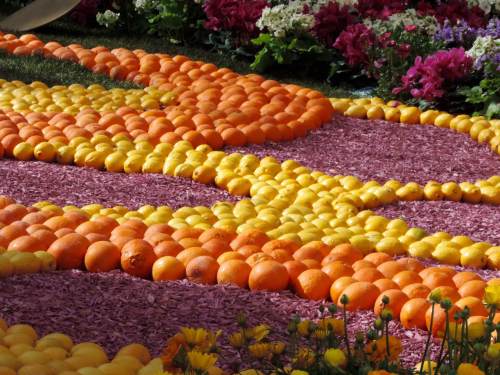
Day Two February.jpg

Over twelve days, starting on December 26th, I’m selecting one photograph from each month of 2016 and sharing it here with you. My choices are based on the images themselves, plus what they represent about my life here in France.

Down in the bottom right hand corner of France, the region in the south east which borders onto Italy, is a town called Menton. I’ve visited it a few times in my life and have always liked it. I like its fabulous synthesis of French and Italian culture. I love the colours of the buildings, the views of mountains and sea, the variety of cafes and restaurants, and the ease with which you can pop over into Italy and back. Once a year, the town of Menton holds an event called the Fête du Citron. It lasts for three weeks with a parade through the town each Sunday, a night parade midweek, installations of sculptures made from oranges and lemons, and various other events. In 2016 the theme of the event was “Italian cinema”.

I’ve never seen such immense sculptures made from fruit. They are absolutely astonishing. Some are the size of buildings, some are pulled through the town during the parades, and all are simply, astonishingly colourful and beautiful. But here’s what made the biggest impression on me – the celebration.

Maybe it’s because of the shocking and disturbing terrorist attacks and the appalling stories of brutality and oppression reported in the news in this era but to see thousands of people parading sculptures, no, whole scenes, made from orange and yellow fruit, through the streets of the town, with the buzz of the admiring crowds, the loud Italian movie theme music, the marching bands, the street dancers, the joyous smiles and laughter on the faces of participants and spectators alike…..it was SUCH an antidote to all that horror. This celebration. This delight in dressing up, singing, playing music, dancing, creating works of art, this enjoyment of the spectacle, is such a unique human experience. Yes, it seems some humans have a very mean-spirited, anti-life approach to living, but here was a great example of that opposite pole. Here was a celebration of beauty, colour, music, art, storytelling, dancing, singing, and laughing together.

Uplifting.

Life-enhancing.

Joyous.

Wow, am I grateful to have been able to participate in this celebration of being human.

February 2017, the 84th Fête du Citron will have a theme of “Broadway”. It’s likely that, like this year, about a quarter of a million people will visit and share the celebrations.
 

Read Full Post »

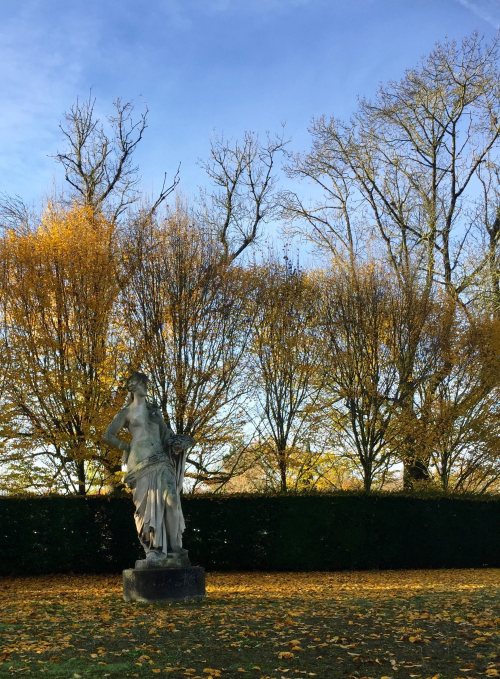
goddess-of-the-garden

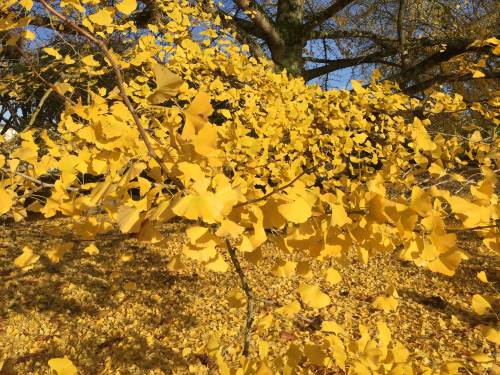
I stumbled upon a goddess in the gardens today. She looks well pleased now she’s finished painting all of the leaves yellow.

I think she’s every right to be pleased. She’s done a fantastic job!

ginkoes

Read Full Post »

dragons-and-crystals

Everywhere you look you can see the effects of the interplay between the universe’s two forces.

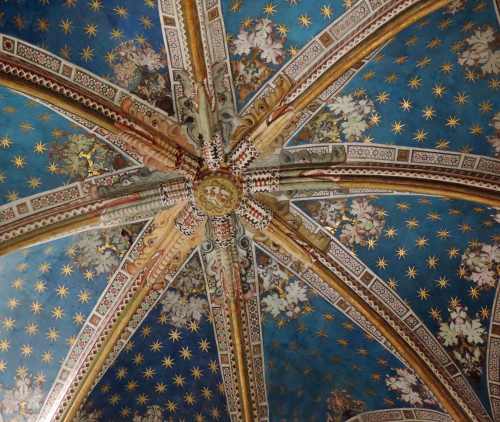
When I looked up at the ceiling of the Chapel of Saint Blaise in Toledo I was entranced by the colour, the gold and the eight pointed stars. It was only later when I was back home that I realised that the centre piece contained eight dragons, out of whose mouths poured not fire but crystals…..at least that’s how it looks to me.

Dragons for wildness, crystals for discipline, to bring together David Ward and Thomas Berry, for this is how they each describe the two forces.

Without the integration of these two polar opposites our planet would not exist, and nor would we. Astonishing. Awe inspiring. Wondrous.

Look around and I’m sure it won’t take long for you to spot these forces at work.


Read Full Post »

on-reflection

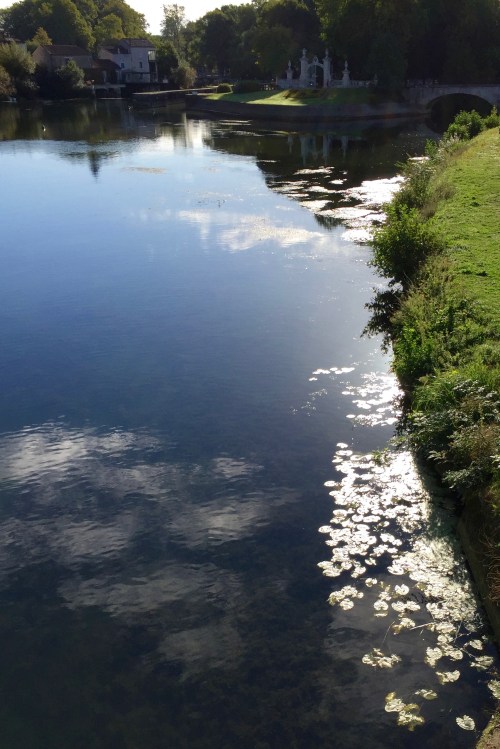
The sunlight reflecting on the leaves of the lilies caught my eye, but once I’d uploaded the photo and looked at it more closely I realised there were three completely separate areas of reflection in this one image.

There is the one which initially caught my eye. It’s so bright that the leaves are hardly green at all. They are like silver plates floating on the river. Right next to them is a reflection of the clouds passing up above. The ripples in the river give these clouds the appearance of a water colour painting. Quite beautiful.

Between them, these two reflections put me in mind of Monet’s paintings of lilies in the Musée de l’Orangerie in Paris….which is definitely one of those places to put on your bucket list.

monet-lilies

To stand in one of those galleries with Monet’s astonishing paintings filling the entirety of your visual field is one of the most amazing experiences you could have in an art gallery.

Finally, right at the top of the photo, there are the reflections of the old watermill, the entrance to the park, and a bridge, all seemingly a much more literal kind of reflection somehow.

I hadn’t really thought much about different types of reflection before, but this one image has inspired me. I hope it does the same for you.

Read Full Post »

multiple-stars

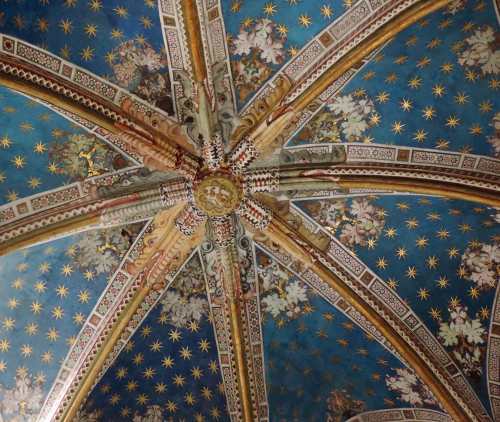
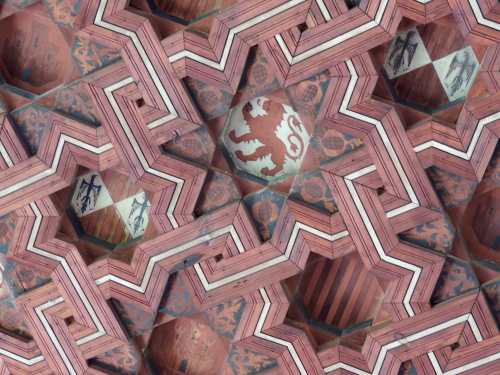
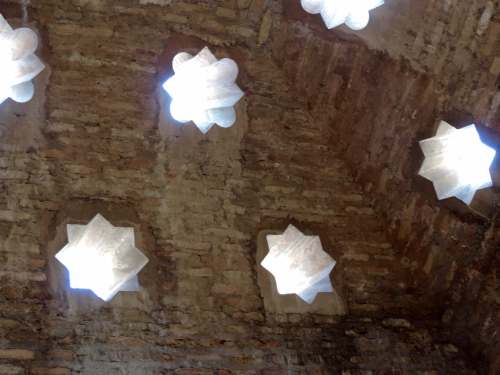
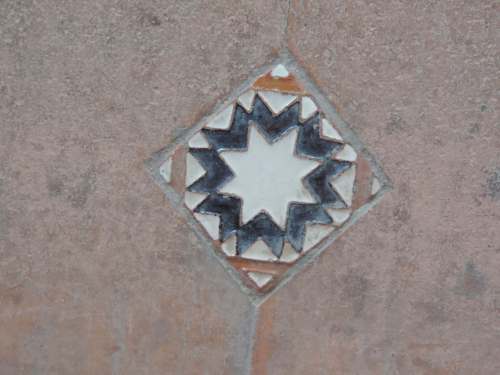
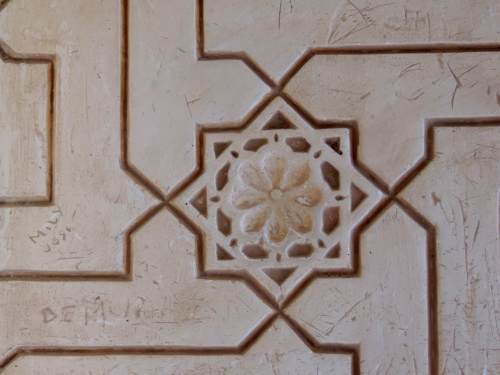
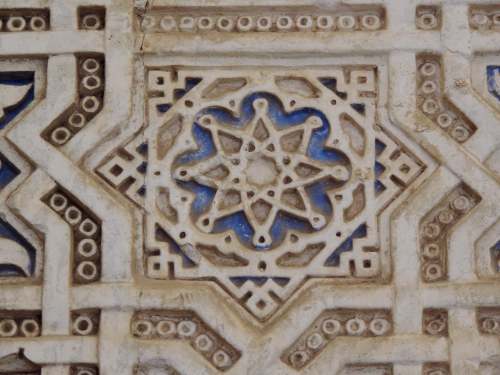
I seem to have developed a fascination for eight pointed stars. I’m seeing them everywhere.

Up on the ceiling like a kind of night sky.

lion-star

Or constructed from pieces of wood with emblems in the middle.

window-stars

Cut into the roof to create star shaped sources of sunlight.

tile-star

On the floor.

wall-star-lines star-on-blue

or on the walls.

Aren’t they beautiful? In their variation, in their detail, and in their design.

Read Full Post »

DSCN7534.jpg

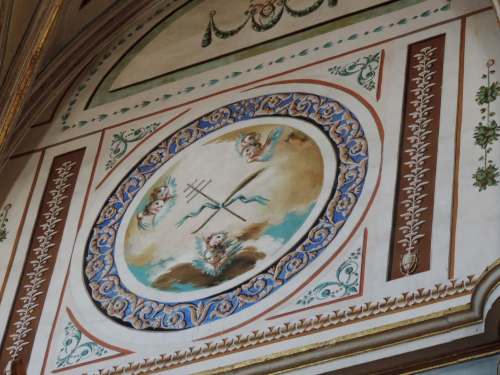
I noticed this painting high up on a wall inside the cathedral in Segovia, but I don’t know what it means.

In the centre is this interesting cross of what looks like a plume and a cross with three cross bars tied together with a blue ribbon. It’s painted as if it is flying high in the clouds and surrounded by three pairs of cherub-like angels.

Have you ever seen a symbol like this before?

Can you interpret it for me, please?

Read Full Post »

illuminate

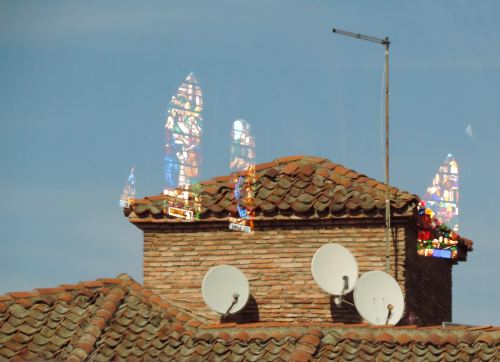
I stepped out through the back door of the cathedral in Segovia and onto a large paved terrace surrounded by stone lions. When I turned to look back to the tall arched doorway I noticed that the plain glass doors which hung in the doorway perfectly reflected the buildings across the street. I took a photo.

When I loaded up the photo later I noticed that there were some strange lights above and on the roofs and when I zoomed in I saw more clearly that behind the reflection of the tiles and the satellite dishes some of the cathedral’s stained glass windows shone through the glass door.

That got me thinking……

Here in this one photo is an interesting idea. For centuries the church has created the images and the stories to tell people what the world is like, what life is like, and how they should live. With captivating art and gripping stories it presented a particular view of the world. More than that, really, because in presenting that view and spreading it so widely, it created a reality for the people who lived in it.

But look at those satellite dishes.

Who is creating the images and the stories now? Who is telling people what the world is like? What life is like? And how they should live?

Who is presenting a view, and spreading it so widely, that it’s creating the reality for those who live in it?

With the rapid development in communications technology, with powerful mobile phones, connected computers, the internet, social media, memes, images and videos which “go viral”, some writers say we have created a whole new layer of the environment in which we live – the “noosphere” (the sphere of human thought). The truth is we’ve always had a noosphere. We’ve always lived, we humans, within this environment of human thought.

There are the image creators and the story tellers who fashion the patterns in this environment, and in so doing, they influence many others.

We have a choice. We can be the image creators and the story tellers, or we can be passive consumers. If we choose to be passive consumers, whose world, whose idea of the world, are we choosing to live in?

If we choose to be the image creators and the story tellers, what images shall we share? What stories shall we tell?

Read Full Post »

mermaid sleeping

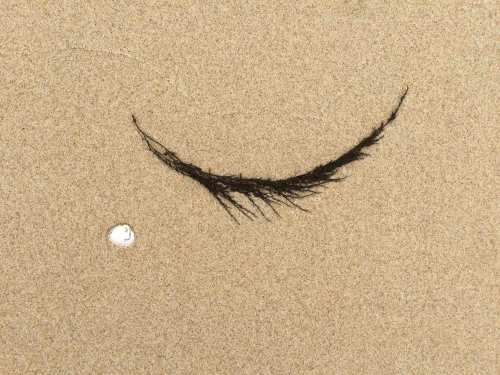
As I walked along the beach I stumbled across this mermaid sleeping…

The man who has no imagination has no wings. Muhammad Ali


Everything you can imagine is real. Pablo Picasso

The world of reality has its limits; the world of imagination is boundless. Jean-Jacques Rousseau


Read Full Post »

water angel

OK, I know I’m just using my imagination here, but don’t you think you can see a water angel in this iris?

She’s wearing a long robe, reaching up with both her arms and facing left as if she’s climbing up the yellow part of the flower…..

So you see her?


Read Full Post »

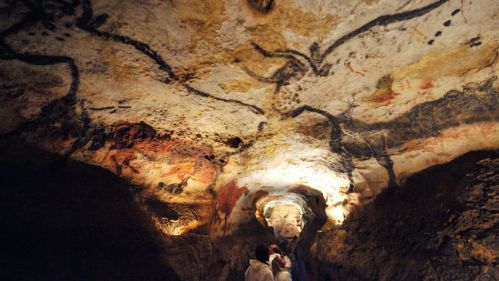
FRANCE CAVE DRAWINGS

Part of Lascaux famed cave drawings are photographed in southwest France, during a rare visit, Friday, July 25, 2008. Clusters of black fungus have been spreading over the drawings said scientists in 2007. The stains were the latest biological threat to the Lascaux cave drawings, which were discovered in 1940 and are considered one of the finest examples of prehistoric art. Carbon-dating suggests the murals of bulls, felines and other images were created between 15,000 and 17,500 years ago in the caves near Montignac, in the Dordogne region. In 1963, after green algae and other damage appeared, the caves were closed to the public. Only scientists and a few others are allowed to enter at certain times. (AP Photo/Pierre Andrieu, Pool)

I recently visited the Lascaux caves which are about a three hour drive from where I’m living now. I’d heard of them but I hadn’t realised they were as close as this.

You’ll see from that photo above, which isn’t mine, that the incredible wall art in the caves was deteriorating quickly due to the effects of fungi and carbon dioxide brought in by visiting tourists, so the government closed the caves to preserve them and did something astonishing.

They built an exact replica of part of the cave network, faithful down to 5mm, using teams of artists to recreate the artwork using the same kinds of pigments used by the original artists on artificial cave walls.

The caves were discovered in 1940 when a group of boys were exploring a forest. A storm had blown down some trees and one of the fallen trees had opened up a hole in the ground under its roots. Their dog disappeared down the hole so they went after it, quickly realising it was a tunnel into caves. After retrieving their dog, they went back home and got lamps, returning to squeeze along the dark tunnel until it opened up into a cave. Can you imagine how astonished they were when the light from their flames lit up the huge paintings of bulls, bison, cows, horses and deer which covered the walls and ceiling of the cave?

There was a lot more down there than what the boys found in the first cave. The paintings are thought to have been created up to 18,000 years ago and had remained, perfectly preserved, once the cave network was sealed off by the forest.

Lots of questions immediately spring to mind – how did they manage to paint such life-like depictions of animals under the ground in the darkness using just small lamps for light? They covered not only the walls but the ceilings. How did they get up there? They used the contours of the cave walls to make their paintings seem three dimensional. How did they have the imagination and the skill to do that? And WHY? Why did they put so much time and effort into the creation of this fabulous art?

It didn’t take long before the effects of thousands of visitors started to degrade the art work so the government sealed it off and created Lascaux 2, a replica. If you click through on that link you’ll go to an interactive tour of the re-creation.

So, I went down the stone steps with a couple of dozen other visitors and a guide. In the ante-room after the great doors were pulled closed, our eyes adjusted to the low level of light and the guide talked us through the story of the discovery of the Lascaux caves and the creation of Lascaux 2. Then he opened the far doors and we all squeezed down a narrow passageway between rough walls of rock. The passageway opened up into the Hall of the Bulls, so called because of the four, almost life size paintings of bulls which completely cover the ceiling of the cave.

He switched off the lights and lit a cigarette lighter. As the small, single flame cast its faint light up onto the walls and ceiling you could swear the animals were moving. It was quite cold down there and without artificial light it would be pitch dark.

We spend the best part of an hour exploring the cave and hearing about the different paintings.

So, you’re thinking. You just visited a replica? How did that feel?

You know what? It was magical. I thought it might be a bit Disney-like, but it wasn’t. You know what it was like? It was like standing in the middle of an art installation. That’s exactly what the replica is. It’s a work of art designed to communicate to you something of the experience of the artists. And that’s what this replica represents, isn’t it? A work of art. Created by unknown artists almost 18,000 years ago….

So there it is…one work of art, touching the viewer, stirring some kind of feelings which the artists had after they’d been inspired in a similar way by other artists, long gone, who left these astonishing creations.

Here’s my final thought. Isn’t it just wonderful that we humans create art? Not for a sum of money, fame, or some utility, but to…..what? Interpret our world? Interact with our world? Make sense of our world? Express ourselves, just because we can?


Read Full Post »

« Newer Posts - Older Posts »