Feeds:
Posts
Comments

Archive for the ‘art’ Category

I do really love some of the larger Parisian galleries like the Musée d’Orsay, and the Louvre, but some of my most favourite ones are much smaller. The Rodin museum is a long time favourite of mine. I like it best when it’s warm enough to be able to stroll in the gardens there. It has that wonderful combination of Nature and Art which really encourages you to take your time and savour it.

On my last trip to Paris I found another smaller gallery, the Musée Jacquemart André. Look at the main foyer –
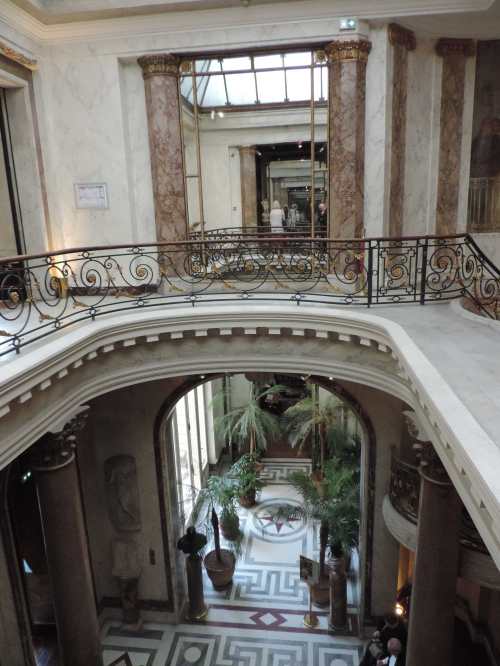
gallery

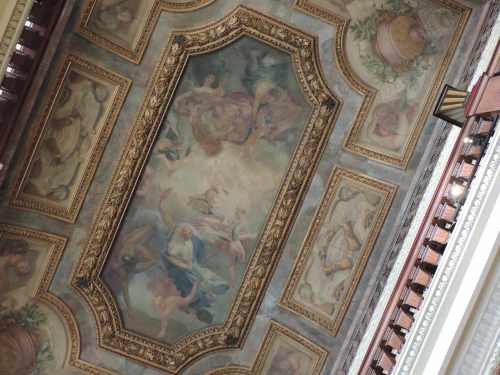
And the ceilings…..

ceiling.jpg

I went there to see an exhibition of portraits of the Medici from Florence, but the building itself entranced me.

Here’s one of the many things which caught my eye and surprised me, a wall covered with a tapestry which has had a door cut into it –
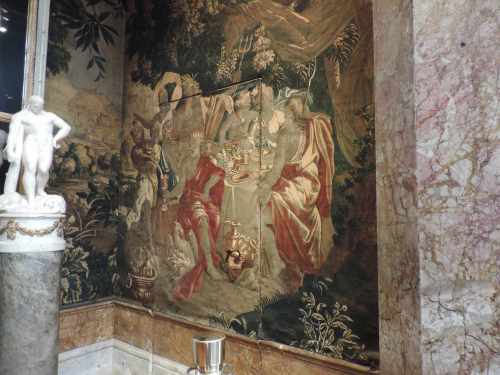
tapestry door

Maybe for the owners of this gallery, back when it was a private house, bought and used tapestries the way people use wallpaper nowadays, but they seem like such works of art to me that I was shocked to see a door cut into it. Then when I looked a little closer I noticed the door-handle!
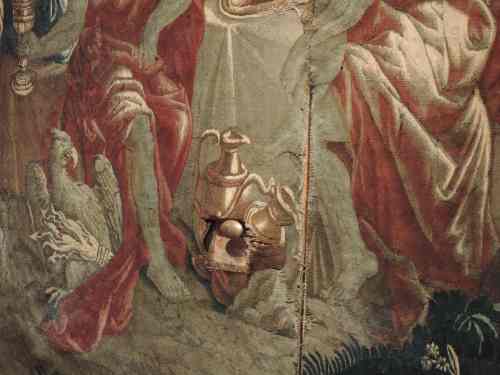
doorhandle

I’m not sure what I think about that!

What do you think? Does this make art more utilitarian? Does it make the everyday practical more beautiful?

Whatever you think about it I think it’s a great example of the extraordinary in the ordinary….”l’émerveillement du quotidien”.
Read Full Post »

Have you ever visited the Musée d’Orsay in Paris?

No?

Put it on your list.

It’s one of my favourite places in the world. It was originally a railway station and has been turned into an art gallery on the banks of the Seine. It’s an astonishing building. Quite incredible that anyone would construct a railway station to look like this, but also, quite brilliantly transformed into a gallery.

When I go I like to go straight from the main entrance, down through the sculpture gallery right to the far end of the building where you can find an escalator that takes you up to the fifth floor where there is a fabulous collection of the work of the Impressionists.

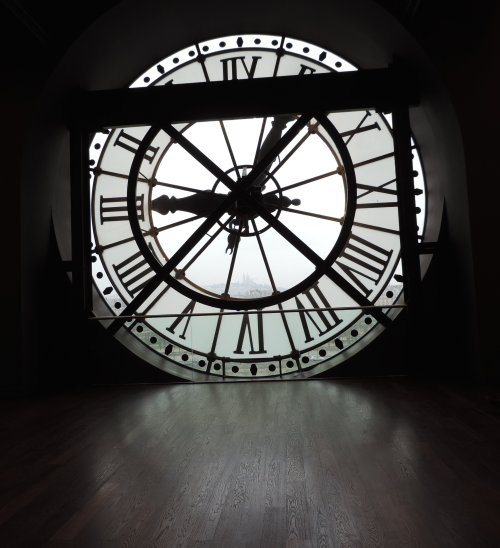
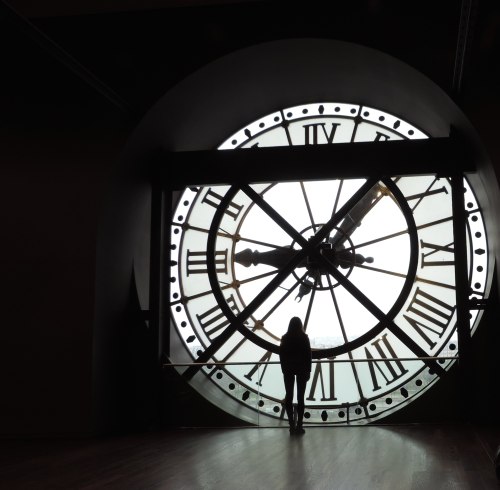
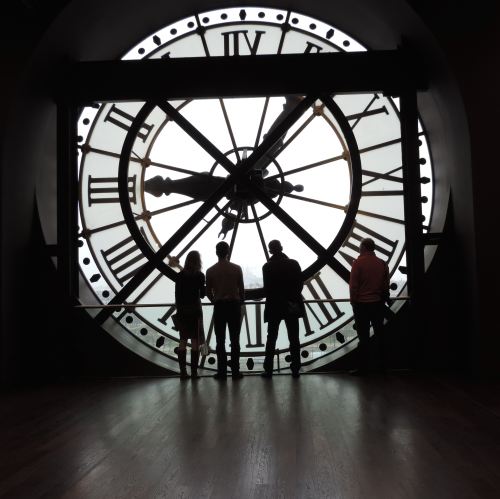
Before you get to their work though you pass through the room with the clock in it.

That’s the one I want to share with you today.

Here are three photos I took –

one

group

seeing beyond

These all stimulate my thoughts about time and how we relate to it. They conjure up my thoughts about “taking time” – in other words, slowing up, savouring, taking the time to fully experience the here and now, but also, taken in sequence, these three images provoke the following thoughts –

Firstly, how good and necessary it is to spend some time by yourself. Remember Julia Cameron’s “Artist’s Way”? I often told people about her exercise of making an “artist’s date” – actually scheduling into your diary a piece of time – it might be an hour, half a day, a day – and there are only two rules to apply to that piece of time – you have to spend it alone (no sharing!) – and you have to spend it doing something you enjoy (no chores!). You should then schedule in a regular series of these dates at a frequency you can manage – daily, weekly, forthnightly….whatever. Whether or not you are an artist, I think this is a very, very valuable exercise to try.

Secondly, how good and necessary it is to spend some time with others. There is something truly magical about sharing an experience with someone else – whether that be a visit to a gallery, listening to song, watching a movie, having a meal – we are social creatures, we human beings and sharing experiences with others makes our heart sing.

Thirdly, when we lose ourselves in something….a view, a book, a creative act……we experience “FLOW” – what Czikszentmihalyi wrote about in his study of happiness. It’s that time when we are “in the zone” and time “stands still”. Just gazing through this clock to Montmartre is an entrancing experience.

Isn’t strange that time doesn’t pass at a constant speed? Despite what clocks seem to tell us?

Read Full Post »

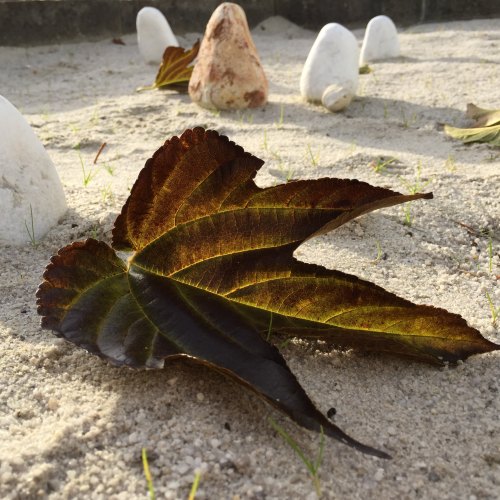
leaf and stone

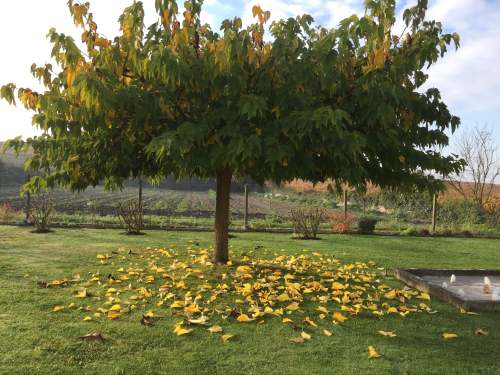
I have a large mulberry tree in my garden and at this time of year, every morning there is a small carpet of leaves on the ground waiting for me to come and gather them up.

There is also a sandpit in this garden. Someone, sometime, presumably created it for children to play in, and my littlest grandchildren played in it in the summer time. For the rest of the year I arrange, and re-arrange some stones we bought in a local store and rake the sand from to time, almost like a Japanese garden but on a much smaller, more amateur scale! My landlord, when he saw what I’d done asked if I’d arranged a “petit menhir” – a small circle of standing stones. I hadn’t thought of them like that but circles of standing stones are in my genetic memory so the idea has stuck.

Some of the mulberry leaves fall into the circle of the stones and when I got down to the sand-level I managed to take this photo.

I love the contrast of the transient, seasonal leaves and the apparently unchanging stones on the sand.

I say “apparently unchanging” because I know that everything is constantly changing, but some at such a slow rate that a single human lifetime is not enough to spot the difference.


Read Full Post »

circle

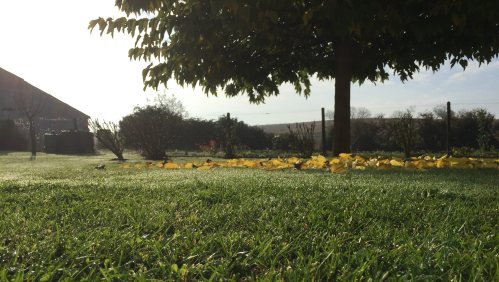
The other morning I was thinking how lovely the mulberry tree leaves are as they fall onto the ground forming such a beautiful circle. It reminded me of Andy Goldsworthy’s art.

Then I got down on the ground to photograph the morning sunlight on the dew-bejewelled grass…

line

…and the circle turned into a line!

Interesting that, huh? And it worked the other way too – turning back into a circle when I stood up 😉

How different the world looks when you change your perspective!

Read Full Post »

IMG_3200

(me, aged 8, on a boat to Orkney, taking photos with my box camera)

If in every field the triumph of life is creation, must we not suppose that human life has its goal in a creation which, unlike that of the artist and philosopher, may be pursued always by all – the creation of self by self, the developing of the personality by an effort which draws much from little, something from nothing, and adds unceasingly to whatever wealth the world contains? (L’Énergie spirituelle. Henri Bergson. 1919)

I talk a lot about creativity. I think it is one of the defining characteristics of human beings. We constantly make and re-make our world.

It’s quite common for people to think that creativity is what artists have and if you aren’t an artist you aren’t creative. I think that’s a way too limited understanding of what creativity is.

We are creative when solve daily problems. We are creative when we make food. We are creative when we tell stories (which do all the time). We are creative when make plans. We are creative when we sing, play an instrument, make something, express ourselves.

We are creative all the time as we make our selves – we are constantly engaged with the process of self-making, and we never stop developing, evolving and growing – all of which are creative acts.

Own your creativity.

I think it’s one of the three basic characteristics of human life.

Read Full Post »

September’s issue of Philiosophie magazine has an interview with the Japanese author, Kenzaburô ôe who won the Nobel Prize for literature in 1994.

It’s a fascinating and striking article. He has been a controversial figure in Japan because of the subject matter of his novels, one of which challenges the official version of what happened in Okinawa at the end of the Second World War. Officially, 100,000 Okinawans committed suicide claiming loyalty to the Emperor rather than be over-run by the invading Americans. Kenzaburô says this is a lie. He says the Imperial Army massacred the Okinawans and they died called for their mothers, not swearing loyalty to the Emperor.

He has also shone a clear light on the reality of life for those who survived the blasts in Hiroshima and Nagasaki. Telling their stories shows how these particular bombs didn’t just kill and wound when they were dropped, but continue to damage those who survived right into the present day.

It’s no surprise then to read that since Fukushima he actively campaigns for the abandonment of nuclear power in Japan.

A big part of the story of his life is the birth of his son in 1963. Hikari was born with a severe brain defect and his parents had to decide to either let him die, or have an operation which would likely leave him severely mentally handicapped. They chose the latter. In addition to his severe handicap he has autism and he didn’t speak until he was six.

His first words were actually a sentence. The family was walking in the forest and at the sound of a particular bird call, Hikari said, in exactly the same way a radio presenter of a nature documentary would, “that is the call of the (such an such bird)” – and it was! After that his parents started buying bird song CDs and Hikari learned them all. They moved on to music, playing him Bach and Mozart, and were astonished to find, as he got older, that he could transcribe into musical notation perfectly any piece of music after hearing it just once. More than that, he went on to compose his own music.

Kenzaburô says his son has never expressed any emotion but his music is deeply emotional. His first CD sold 400,000 copies in Japan.

Here’s a video clip of one of his pieces.

Kenzaburô’s daily life is spent in his study reading and writing, while his son sits by him listening to, and writing, music.

A remarkable man.

Right at the end of the interview he says of creative work that it is important to find your own voice, or your own style – to be careful not to “get lost in the universal”.

I like that a lot. Too often we lose our singular uniqueness by trying to be accepted, or to fit in, or to be popular. Isn’t it more important to be the one unique person who only we can be?

Read Full Post »

turning japanese

I look at this photo, and I wonder what country I was in when I took it.

Well, I don’t have to wonder for long because I only took it a day ago and I remember well that when I did I was only about an hour from where I live (in France) – but, seriously, couldn’t this have been taken in Japan?

What gives an image a strong sense of place or of culture? Is it the colour? Is it the juxtaposition of flowers and something particular a human being has made?

I don’t find it hard to see beauty in Nature, and now that I live surrounded by vineyards I feel more connected to that beauty than ever, but what takes the whole experience to a different level for me, is to see, in the same moment, so much creation – the creation of Nature, and what a person created.

You see, there is a spiral of creativity here.

There’s the creativity of the Universe which has produced this flower and the person who constructed and painted the shed behind it.

Then there’s the creativity of the person themselves, and where their imagination took them, and then their choices, their decisions and their actions to make this shed, pick this paint, paint that wood, choose that flower, plant it, nurture it and train it.

And there’s me.

To stand there and look up and see this, and to focus in on part of what I could see as I compose this image, and to capture it, and now, to post it for you to see.

And there’s you.

What might this image stimulate for you?

What might this post provoke your imagination to create now?

Read Full Post »

paint

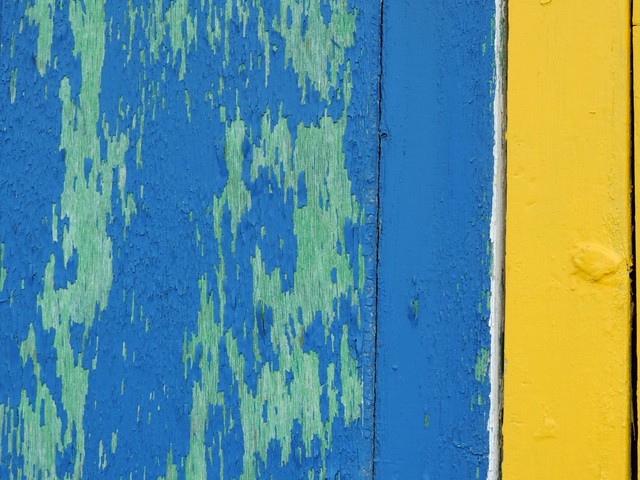
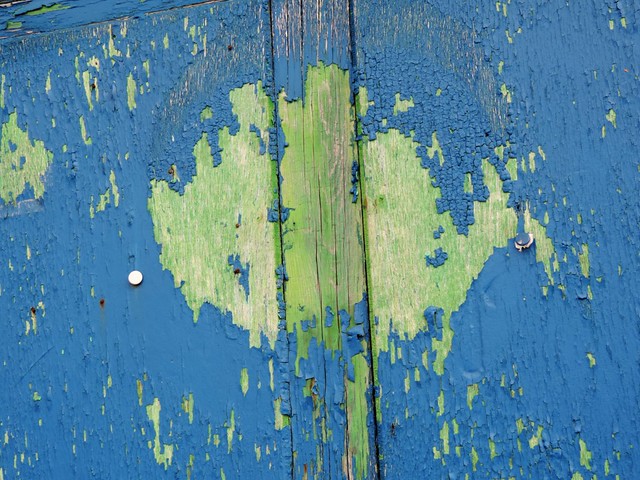
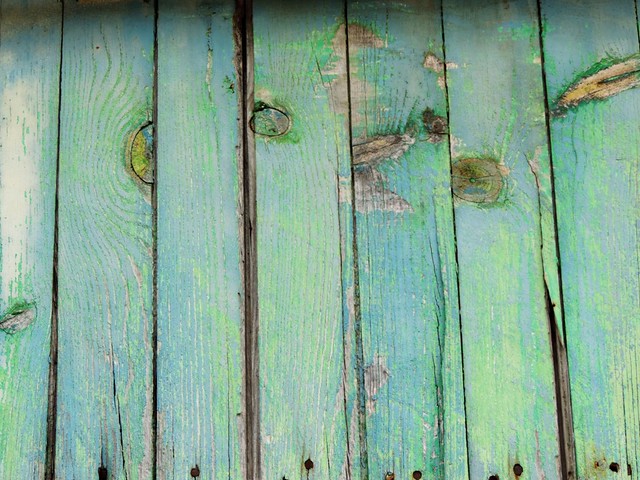
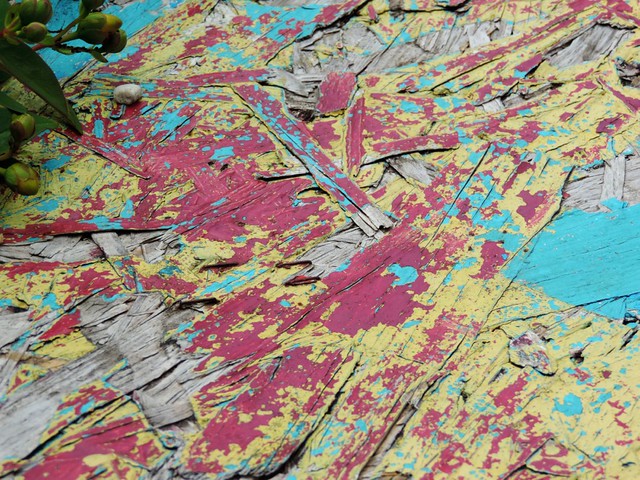
This old wall revealing layers of paint reminded me of something important about memory.

The past isn’t something with disappears behind us, like the last station we just passed on the train. Rather, it’s what the present emerges from.

And because the present emerges from the past, the past is always a part of the present.

I am who I am, and my body is what it is, not brand new, isolated from the rest of the world and reality, but, as a living, developing, growing phenomenon.

I am emerging from not only the past in my life time, but from the life times of all who lived before me.

I think that’s partly why many people are fascinated by genealogy. It’s not just interesting stories about ancestors, its an uncovering of patterns, streams and influences which continue to create the here and the now.

Here’s some more beautiful photos of paint from the old fisherman’s shed on the Ile d’Oleron

green and blue
old greens
multicolour

I hope you enjoy them.

As well as stimulating my thoughts about the past and the present, they also demonstrate (I think) a very beautiful Japanese aesthetic concept – wabi sabi – which I love, not just because of the beauty but how it honours the beauty of reality as opposed to the delusional ideas we have about “perfection” (which doesn’t exist!!)

Read Full Post »

Living stories

Human beings are story telling creatures.

I think our daily lives are influenced by stories. The question is which stories and who is telling them?

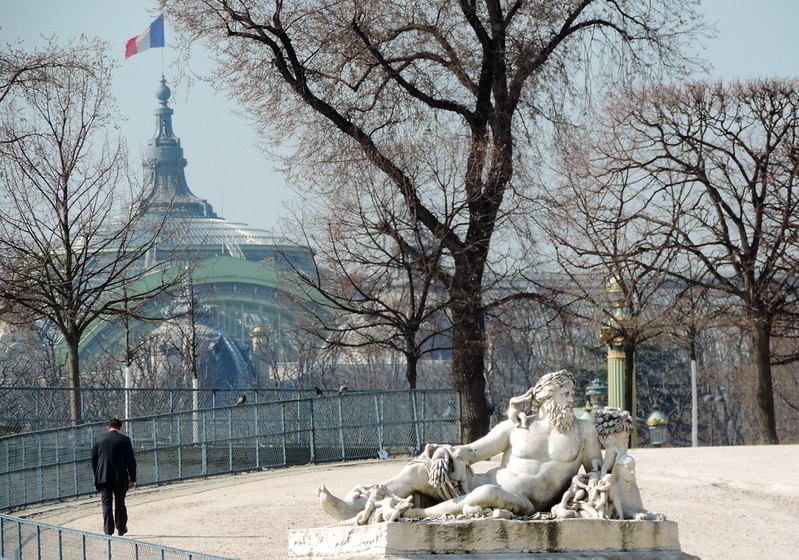
I took this photo in Paris a couple of weeks ago and two things strike me about it – the large sculpture, and the solo man walking by, apparently oblivious. Paris has these kinds of sculpture everywhere, and often they are of characters from classical mythology. Every one of these works of art tells a story. But most people today probably don’t know these myths. When you don’t know these myths, the sculptures become statues, and we either don’t notice them once they become familiar to us, or we notice them and can be affected by them as works of art. In the latter case, they retain the power to enchant, but what might life be like if their stories come to our minds when we pass these great works?

I think the man in this photo may be passing by uninfluenced, and somehow I get a forlorn or lonely feeling looking at him.

In the classical era, the people of Greece were surrounded by such art, but they interacted with it, dressing their sculptures, contemplating them. They represented living gods to them. Great powers which could influence their daily lives.

What stories surround us now?

Stories of fear, of violence, of injustice? Stories of hatred, division and alienation? Stories of celebrities, famous for being famous? Stories of desire and calls to consume (advertising)?

Are some of these stories responsible for the common feelings of disenchantment?

We can re-enchant our lives, give them more depth and more meaning by choosing to create and live our own stories. We can choose what art, what symbols, what music, what objects imbued with personal meaning to surround ourselves with. We can choose to focus on certain stories we find delight us, challenge us, wake us up, stir our hearts, touch our souls.

We can tell our stories to ourselves as we write in our journals. We can share our stories in our blogs. We can tell our stories to each other.

You do this all the time.

But what stories do you tell? And what stories flow through your head? The first step in moving from zombie to hero (the hero is the main protagonist in a story) is to become aware. The second step is choosing to act…..moving from passive mode to active mode. You’ll find plenty of posts on this site about that. Start by putting “story” into the search box at the top of this page. Or try the “a to z of becoming”.

Storytelling is not optional. It never stops. Time to choose which stories you pay attention to?

Read Full Post »

I am a great believer in “l’émerveillement du quotidien” – the amazing marvel of the everyday, but there are also experiences we have which are far from everyday, which profoundly influence our experience of life.
Great, truly great, Art, is one of those far from everyday experiences for me.

A visit to the Musée de l’Orangerie in Paris is one of those. So unique, so astonishing…..sadly photographs won’t capture that experience and me telling you about it won’t either, but if at all possible, at some point in your life, if you have the opportunity to visit, DO!

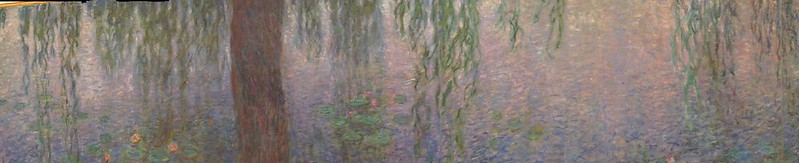
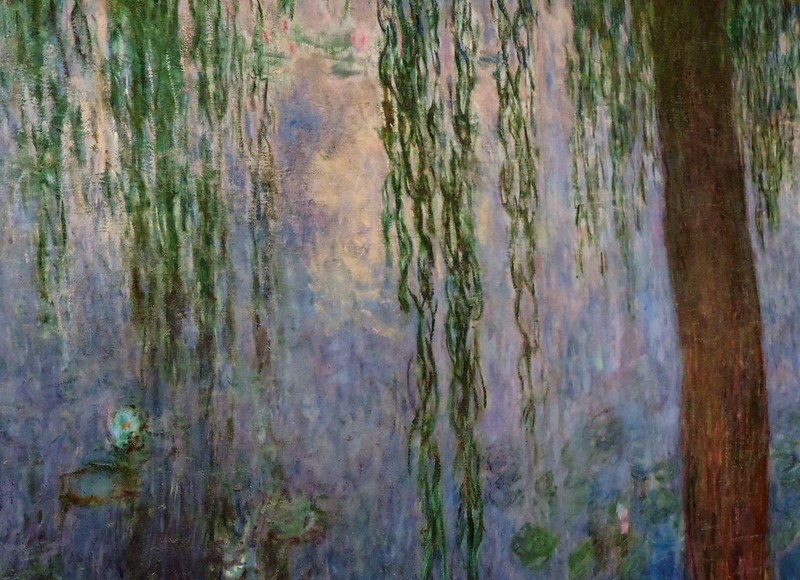
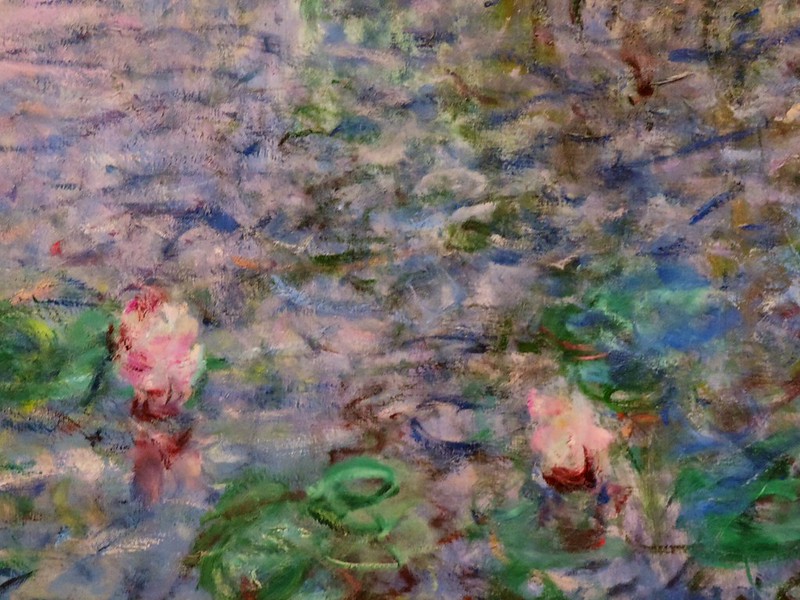
There are two oval rooms filled with Monet’s paintings of the waterlilies in his garden.

When you stand in the room your field of vision in every direction is filled with them. It is as if you really are IN these paintings. A total immersion experience.

Here are some photos I took. First of all two taken using the panorama function on my iPhone, then a couple of close ups of details.

 
Orangerie

Monet

Monet

Monet

Far from everyday, but another way to counter “dis-enchantment” with enchantment.

Read Full Post »

« Newer Posts - Older Posts »