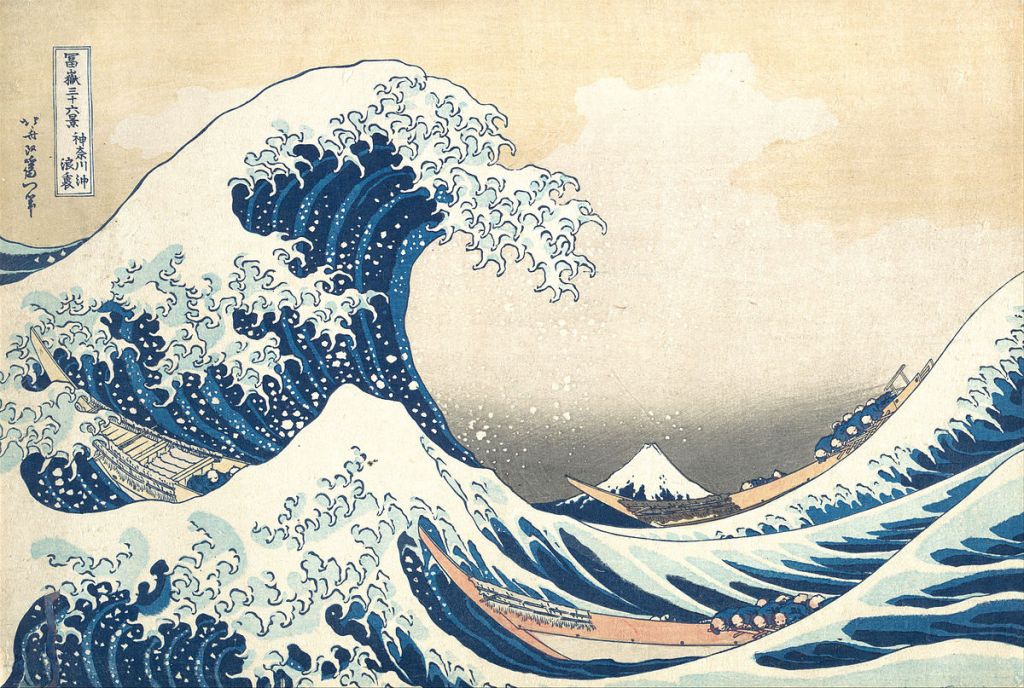
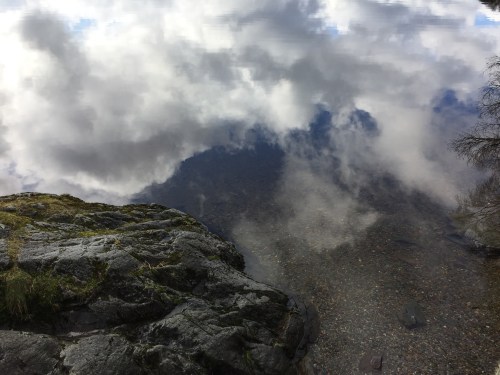
When I looked up at the sky and saw these clouds I thought of Hokusai’s famous work of art, “The Wave” …….
Of course, now that it’s 2020 and we’re still in the midst of this COVID-19 pandemic, that image has taken on a new significance I think.
There was always something both awe-inspiring and a bit frightening about “The Wave” (or is it called “The Great Wave”?). When I look at it I’m immediately struck by its beauty. What a fabulous form! And with Mount Fuji on the far horizon you get the impression that the wave is actually bigger than the mountain! Then you notice the people in the boats, and they are looking, to say the least, precarious! I mean if a wave the size of a mountain is about to come crashing down on you with its foam forming giant claws above your head, then, how could you be anything other than terrified? Well, maybe exhilarated too, responding to the challenge, the way a surfer would, but surely you’d be afraid?
This pandemic is a bit like this. I can’t help but feel awe in the face of the power of this tiny virus to spread over such enormous distances and affect so much of our tiny human lives. And I can’t help but feel a bit afraid of it too. Sure, we now seem to have reached a phase of frustration and don’t we all just wish the bloody thing would go away? But wishing isn’t going to get us there, is it? We have to face up to it, paddle like fury and try to ride it out.
What we’ll find on the other side of the Wave/Pandemic none of us know, but, one thing is for sure, we’ll be changed. This world will be different. Maybe we’d better face up to that too, and start to make the personal and collective changes which make sense in the light of what we’re learning from this experience……
Maybe that’s the big wave coming, actually…..not so much the tiny virus, but CHANGE…….change which washes away old and ingrained habits, routines, methods and ways of organising things. Change which inspires us to invent new ones.
When you look at this photo I think it seems to be a mountain with clouds and sky just above it. But you immediately recognise that’s not quite right.
So then you see this and you think it’s trees with the sky above….maybe one of those forest pictures where the photographer directs the camera straight up to the sky and catches the topmost branches of several trees. But that’s not quite right.
In the first photo, the apparent mountain in the foreground is an odd shape. Mountains just don’t look like that, then, in the second photo, what’s that rock doing balanced on top of the trees?
The thing is, these are both photos of reflections on the still water of a loch. Once you know that, the whole image makes sense.
This inspires a train of thought in my mind…..about how we perceive and make sense of reality. It’s a complicated business but it involves context. It helps to know where you are when you are looking around and what you can see in the immediate environment. There is nobody standing at the edge of this loch wondering what they are looking at. They know where they are and how they got there.
We make sense of reality by spotting patterns, but we need to learn the patterns before we can spot them. A bit chicken and egg-ish isn’t it? In normal life these two aspects of the same thing are iterative…..we are constantly learning and spotting patterns, the more we learn, the more we spot, and the more we spot, the more we learn.
Medical Practice is like that. Doctors learn pathology and the natural history of diseases. In other words, they the patterns of illness. The better a doctor knows the patterns, the more easily they’ll be spotted – or diagnosed. And the more diagnoses a doctor makes, the better the knowledge of patterns. We call it experience. I always felt that a good diagnosis was crucial in good health care. If the diagnosis was wrong, the chances are the treatment would be wrong.
In my first Paediatric job, my mentor told me on the first day that his goal for my six months with him was to teach me how to recognise a sick child. When he said that I thought it was a pretty bizarre thing to say. I mean, wasn’t it obvious when a child was sick? Wasn’t the goal to diagnose ie name the sickness? Well, of course, he was right. I was wrong. What he wanted to teach me was that very first important step…..how to recognise, in an instant, that this child was ill and needed immediate attention. Working out exactly what the disease was and how to treat it came a close second, but if you didn’t recognise that the child was sick, all was lost. It turned out that learning was by experience, encountering sick children and healthy children of all ages, to become familiar with what was normal behaviour and demeanour at different developmental stages. That teaching was crucial for my practice as a GP. It let me walk into someone’s house and know instantly that this child needed close attention and help.
The clues, and the signs, were in the contexts, the environments and the relationships. Yes, some were in bodily or facial “signs”, but mostly they were in behaviours and responses.
I suppose it’s that kind of experience and learning which made me suspicious of reductionism and generalisations. Every individual is unique and can only be understood within their contexts, their environments and their relationships.
Diagnose, like pattern spotting, is like joining up the dots. It’s got a lot to do with connections and behaviours. It’s not all about “data” and “measurements”. Especially when considering the real, actual, unique individual here and now.
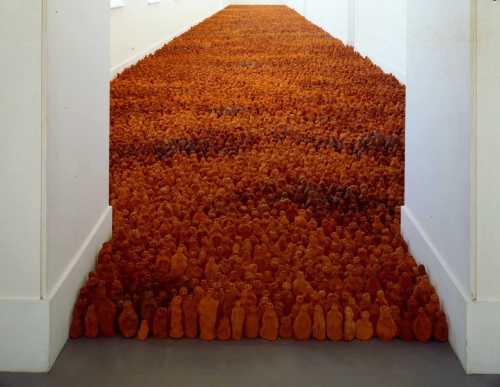
One of my most favourite sculptors is Antony Gormley, he who made “The Angel of the North” which stands beside the M1 in the North of England. His “The Field”, which I saw in Inverleith House in the Edinburgh Botanic Gardens years and years ago left an indelible mark on me. I recalled it in my mind time and time again as I wrestled with the paradox of what makes every patient unique and what they share with others.
But I was thinking again of his work the other day and I remember “Capacitor” which is what you see in this photo at the beginning of this post. This was one of the works he created from an outline shape of his body. In this case he made it with dozens of metal rods.
Maybe this came to mind because for the first time since I moved here almost six years ago I came across a hedgehog in the garden after dark, as I was out closing the shutters for the night.
I have such a clear memory of being in the same room as “Capacitor”….how awkward and dangerous it felt to be anywhere near this work. Like it could take your eye out, or pierce your body if you got too close.
So, you can see why that’s come back to me now. When I’m out and about now I sometimes think everyone has got on a suit that makes them look like “Capacitor”. Except all the spikes are invisible. Has this become the famous “new normal”? All of us increasing our stand-offishness (is that a word?). All of giving each other “a wide berth”. Everyone now regarded as a potential threat.
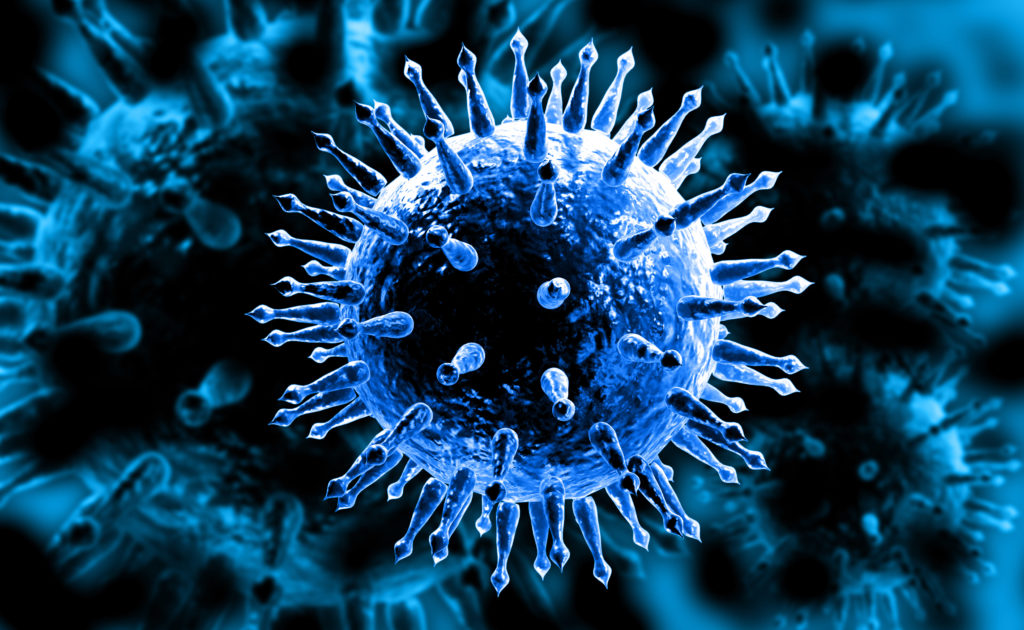
Then it struck me…have you seen the images of the coronavirus?
It’s a ball of spikes!
Yikes! It’s turning us all into images of itself!!
Plants send out creepers and tendrils which twist and turn and spiral on their way are always fascinating. For the last five years I’ve been composting grass cuttings and “garden waste” then spreading it on the veggie patch. It’s turned a stony, hard, bare piece of ground into something of a mini-jungle once each year’s vegetables start to grow. This year there must have been some viable pumpkin seeds in the compost because a couple of pumpkin plants started to grow in places where I definitely hadn’t planted them. Once they started to grow they took off, spreading all around the entire patch, weaving between other plants, sending spiralling tendrils out to grasp onto to anything it could touch, reaching each of the two boundary walls (the veggie patch is in a corner), climbing those walls, the fences above them and by now developing over half a dozen huge pumpkins. Every morning you could see how much further the plant had managed to grow since the previous morning. It’s astonishing.
This photo isn’t of a pumpkin plant. There are many, many varieties of plant which have this ability to send out these incredible tendrils. They reach out, touch and catch on. They connect, they bind, they tie together. Look at the size of these ones! You can sense how strong they are.
I was thinking this morning about how pretty much every single atom on the Earth has been here since the planet was formed. They arrived here from distant stars. I was contemplating how the Earth doesn’t make new copper atoms, gold atoms and so on. But what Nature does is create what’s unique and new every single day. She does that by making connections, reaching out, touching, drawing together, blending and binding. In other words, the world is full of newness every day….not new elements but new forms. Nature is like the most inventive creative artist you could imagine, fashioning brand new, individual, unique, forms every single day.
Making connections. Making new connections. That’s the essence of creation.
The wonders of the everyday. Or “L’émerveillement du quotidien”. It’s normal for me to find myself wondering about something I’ve just seen or heard.
I suppose for most of my working life my days were filled with patients. I never tired of that. I never got bored of that. Every day each patient would present to me a unique a story, a new, and singular problem, puzzle or conundrum to unravel. Each patient would be asking me to help them make sense of what they were experiencing and to support their abilities to heal, to cope, to adapt. Maybe they didn’t quite use that language but that’s always what I heard.
Before I became a doctor, way before, right back as early as I can remember I was driven by curiosity. I wanted to learn, discover and explore. It strikes me now that it isn’t a long way from curiosity to wonder.
People have always amazed me. They still do. Life has always amazed me. This Earth, this planet, the solar system, this universe which we all live in have always amazed me, filling me with an infinite supply of curiosity.
But there’s something else.
Beauty.
Look at this photo of a glorious, immersive sunset, where every single element of the sky and the Earth changes colour. Look at the palette! It is just breathtakingly gorgeous.
I see beauty everywhere. Which isn’t to say I find everything I see beautiful, I don’t. But there is “so much beauty in this world” (do you know what movie that comes from? Here’s the answer).
I am a very visual person. I think visually. I sketch and diagram as I think. I love photography and I think I “have an eye for it”. I see what I find amazing, curious or beautiful and I try to take a photo or two. Then I return to those images again and again, year after year, and I find that, like with this one, the delight, the pleasure, the amazement in beauty like this never fades.
Of course there are other senses and I don’t just experience beauty visually. I love music. I collected “records” long before people starting calling them “vinyl”. I still have them. I still play them. I spent hours and hours ripping CDs onto iTunes and I don’t even know where those libraries are any more! But I stream music now. Every day. Several times a day. I used to discover new music on the radio. I took the back off an old radio when I was a teenager, attached two wires to the speaker using clips, and fed the audio directly into a cassette recorder. I still have some of those recordings…..studio sessions on John Peel’s programme on Radio 1.
I’ve long had a love for movies. I love them for their stories and for their beauty, oh, and I often love them for their music. I compiled short clips of about a hundred movies to teach doctors and other health care workers about our unique human strategies for coping and adapting. I could have taught those strategies without movies but the beauty, wonder and emotional engagement which came with the movies made them much easier to learn and to remember. I probably have a whole vocabulary of coping and adapting based on movie characters, scenes and plots.
There is beauty all around us. I delight in images. I delight in music. I delight in movies.
Where do you find beauty? Where did you find beauty today?
When you look at these two photos, how do you respond?
Do you find you prefer one to the other? Or do you like both, equally?
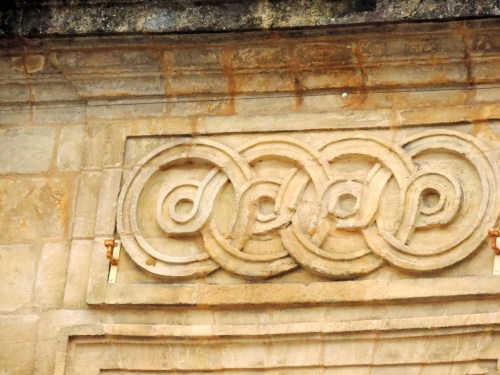
The design on the left is all straight lines and right angles, whereas the one on the right is of interlocking circles and loops.
Some people find straight lines and right angles somewhat aggressive. I seem to remember reading that the architecture of Waldorf Schools and other Steiner inspired buildings seeks to avoid these “harsher” lines and angles. The hospital where I worked for the last two decades of my career, “The NHS Centre for Integrative Care” (formerly, “Glasgow Homeopathic Hospital”) was designed to have as many curves, and as few right angles, as possible. The main reception desk was curved and open, and even the walls of the inpatient unit were a series of curves which evoked the image of gentle waves. I liked that.
As I was born and grew up in Scotland, the typical Celtic designs of knots and loops were familiar to me from an early age. Although the image on the left is also of intertwining lines, it isn’t typical of the Celtic drawings I know.
But maybe the straight lines and right angles are more appealing to you? If they are, why don’t you tell me about them? I’d be interested to hear what your preference is, and why.
There was a craze hundreds of years ago for “chimera” – originally an idea from Greek mythology, medieval peoples took it a whole stage further and created all kinds of bizarre animals.
The chimera is an invented animal made up of the parts from other animals…so maybe a human head, a lion’s body, wings, a serpent tail etc. You can see lots of them carved onto the sides of old churches, and they illustrated old texts as well.
What do you think of them? Are they horrifying? (I think they were often intended to be so) or are they fun? Fascinating?
They just aren’t “natural” are they? You would never imagine that a creature like this existed anywhere. Maybe, once upon a time, some people did. Maybe they believed that they lived in unexplored regions…..remember the old maps with the unmapped areas labelled “Here Be Monsters”?
Probably the commonest reaction to them is a sort of disgust. We find them a bit repulsive….even the more beautiful ones!
I wonder if both chimera and genetically modified plants and animals touch that same core discomfort in us. There’s something a bit unsettling about cutting some DNA out of one creature and splicing it into another, don’t you think?
I think it’s no surprise that many people want GM foods labelled so they can choose not to buy them if they don’t want to. I think it’s not a surprise either that many people think there are complex ethical challenges to be addressed, and a need for intense oversight and control of the whole business of mixing DNA from creature into another……
This is a photo I took many years ago, just using my phone. It’s taken in Edinburgh at night. The purple light of the underside of the bridge caught my attention. It was only once I’d uploaded the shot to my computer that I noticed the person walking along the pavement. At that moment I realised the scene was greatly enhanced by the human presence. It became a much, much more interesting image.
I believe this is a fundamental principle and value which I have. I don’t share the views of some people who think the human species is bad. I believe that we humans are not separate from Nature, we are a part of Nature. We are, in fact, an inextricable part of Nature. I can’t understand a human being without knowing them within their webs of connections, without exploring the flows of materials, energy and information through those networks, without considering them within their contexts and multiple environments, physical, social and cultural.
Yes, we humans have done, are doing, and will do, a wide range of harms to each other, to other creatures, and the one, small, blue marble, planet which we share with all other forms of life, and we need to learn how to live in greater harmony with each other and within this Nature that we are part of. But in four decades of face to face, person by person, patient by individual patient, work as a doctor, I never met a single human being I didn’t value.
I’ve found that as I get older, and in particular, since I retired and moved to live in the French countryside, that I value the rest of Nature, more and more. As I opened the shutters the other morning I looked out and saw two birds…..a Hoopoe drilling down into the grass for some breakfast, and Little Owl, sitting up on the highest point of the wall, spinning his head around surveying his territory. And I thought, well, how amazing is this? I’m more aware of the phases of the moon now, and the rhythm of the seasons. I’m more aware of sprouting seeds, the rate of growth of pumpkins, the cycles of leaves, flowers and fruits. As I garden, I feel in touch with a bond of care, attention and nurture, in this phenomenon we call Nature. But I sure wouldn’t want a world without human beings in it.
There’s something else this image does for me. It sparks the creative, story-telling part of me. Here’s something else which is uniquely human. The ability to perceive, interpret and invent. The ability to make sense of, to apply values to, and to create narratives from, our daily experiences. We are a creative species. We have a driving need to make sense of our lives. I can’t help but wonder about this solitary person, making their way through the streets of Edinburgh at night.
Maybe we just need to learn to shift the balance of our actions and efforts, away from harm, consumption and destruction, towards more harmony, more humanity, and more life-enhancing care. Maybe this pandemic has given us an opportunity to hit the reset button, and do just that.
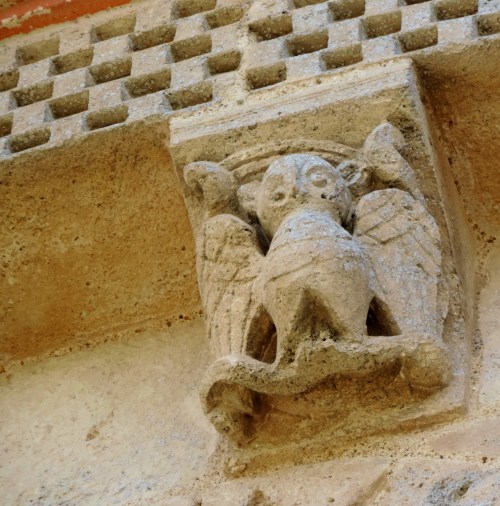
I’m fascinated by carved objects on buildings. Often they are above a door or a window. Other times they are under a roof overhang, or somewhere in a garden or building. Certain buildings, like churches, are often highly embellished with these works of art. This owl is on a church wall. I know most of the carvings on churches relate to saints and important people in the Christian faith, but many of them are really not so directly related (think of all the gargoyles!). Who chose them, and why?
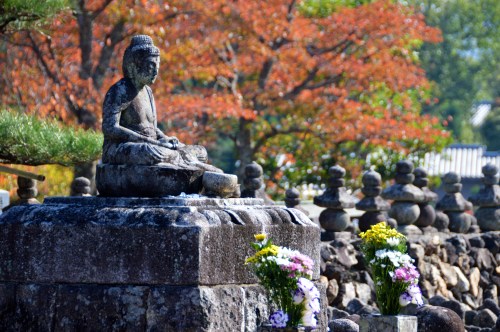
When I’ve traveled around Japan I’ve seen lots and lots of statues and statuettes….particularly buddhas.
However, it’s not at all uncommon to find figures like this for sale in Garden Centres here in France and I’ve noticed them a lot in French people’s gardens and houses.
There’s also quite a controversy raging just now about statues, with calls for the removal of statues of famous people whose actions and values communities no longer wish to celebrate (although maybe they were never celebrated, despite standing there for decades).
All this got me thinking about the symbolic power of objects. I wonder if you have any in your house? Or your garden? I wonder which ones you notice in your Public spaces?
Maybe we should assume that they are intended to exert some influence over us. For example, I think many people with the buddha statues often see them as objects to help them to remain calm. One of the first phrases I encountered here, in the Charente, was “Soyons zen” – “Let’s be “zen” – or calm”.
I have quite a lot of owls in my house. I feel an affinity with them and I think they help me access reflection, contemplation and wisdom.
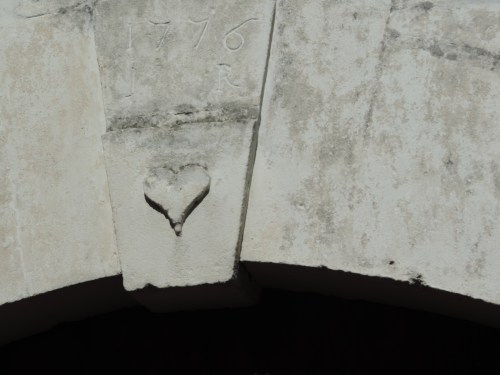
A common “device” over doorways is a heart.
I can certainly see the point of that! In fact, I think I’d quite like having a house where there was a heart over the doorway. Maybe it would help everyone who entered to remember the importance of “seeing with the heart”.
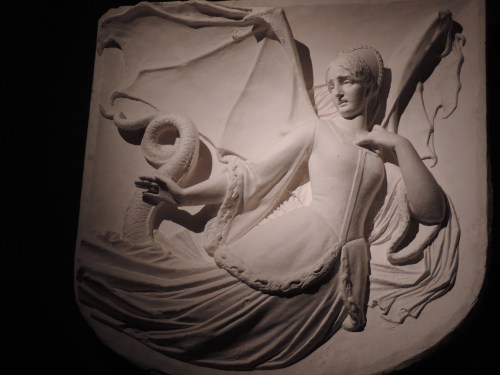
There’s a really interesting mythical one in this part of France (and I believe elsewhere in Europe too) – Melusine.
Half woman, half serpent (or dragon), with wings, there are a number of variations of the Melusine myth. Here’s a passage from wikipedia about her
One tale says Melusine herself was the daughter of the fairy Pressyne and king Elinas of Albany (now known as Scotland). Melusine’s mother leaves her husband, taking her daughters to the isle of Avalon after he breaks an oath never to look in at her and her daughter in their bath. The same pattern appears in stories where Melusine marries a nobleman only after he makes an oath to give her privacy in her bath; each time, she leaves the nobleman after he breaks that oath. Shapeshifting and flight on wings away from oath-breaking husbands also figure in stories about Melusine.
I wonder what influence her presence has on the people who live with her likeness on their walls?
One of the things which makes we human beings so unique is how we handle symbols and metaphors. We don’t just see objects as “things”. We attach value and meaning to them. They provoke emotions in us. They provoke our memories, stimulate our imaginations.
The objects to which we attach symbolic value, either individually, or as part of a culture, or society, have an influence on us. We often choose them exactly for that reason.
What symbolic objects are there around you in your daily life? And are you aware of the influence they have upon you?
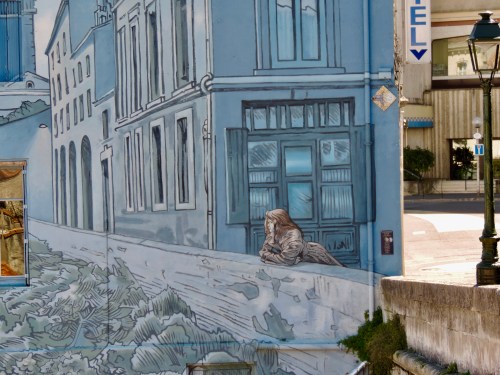
What’s this young woman doing? She looks relaxed, leaning both her forearms on the low wall as she gazes, or looks, (there is a difference) towards….who knows what? You can’t help but turn your head to see if you can see what she is seeing.
Deleuze and Guattari, in “What is Philosophy?” talk about three ways of thinking – concepts, functions and affects+percepts. Philosophy, they say, is our way of thinking concepts. Science describes functions. Art deals with sensations, affects and percepts.
In the city of Angouleme, about an hour from where I live, there are many, many examples of wall art. Angouleme is a major, maybe THE major centre, for graphic arts in France. Several of them are absolutely stunning. Many of them make you stop and think.
If art is a “bloc of sensations, that is to say, a compound of affects and percepts”, then what does that really mean in everyday life? I’m no philosopher and I wouldn’t be surprised if I misunderstand philosophical writings, but I am a “wonderer”. So, the two photos I’m sharing with you today, in this post, are just two examples of murals I’ve come across in Angouleme…….two murals which really stimulate my powers of perception and evoke emotions. They both make me wonder.
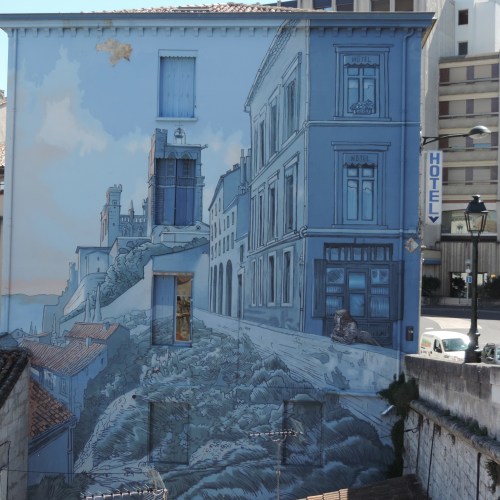
In this first one, everything in blue is the painting, but it’s been so cleverly painted that, at least at first, you have the impression you are looking at a real woman, leaning on a real wall, in front of a real hotel. Well, actually, it is painted on the gable end of real hotel, and the painted wall is an extension of one you can actually lean on. Maybe this graphic woman is looking into the window on the left? If so, she’s looking into a real window, not an imaginary one. Here’s the full picture…..
I love how the painted image blends with the physical world around it. It transforms reality. As I gaze at this in wonder, I slow down, feel calm and contemplative, and take my time to explore the whole painting. Isn’t it amazing that the woman, who is the artist’s creation, somehow induces in me, the viewer, these feelings of slow, calm contemplation?
What would this building look like unpainted? I’m not sure I’d even have noticed it. I certainly wouldn’t have stopped to gaze at it. And, here’s the other thing….I might not have followed the gaze of the woman beyond this low wall out over the valley below, towards the winding river, the boats, the houses and buildings at the edge of the city, and the farms and forests further out. I haven’t the slightest doubt that this work of art transformed my experience of Angouleme.
But, then, so did this one….
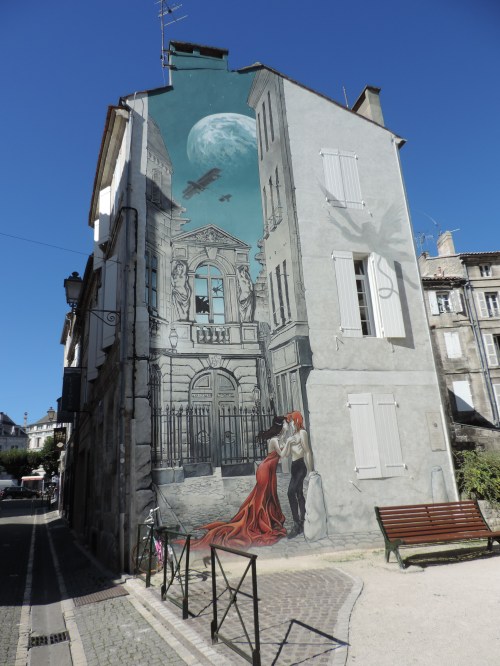
This is one of the most imaginative, evocative, narrative murals I’ve ever seen. It also stops you in your tracks. You can’t help but get drawn in, first to the woman and the man, who are kind of embracing, but there’s a mystery in this embrace. It doesn’t look entirely comfortable. What’s going on with these two? Then, above them, the glass in the window is broken. How did that happen? And above that, this enormous moon, which doesn’t really look like our Moon, but maybe some other planet? It always makes me think of the movie, “Another Earth“….But look at the biplane flying over the face of that planet? What era is this? Which makes us look at the couple again, and wonder what era they lived in as well…..they sure aren’t dressed the way we’d expect to see someone dressed in this day and age.
Then as I look again at this photo, I see the pink bike, parked against the railing, and I can’t help but think it’s her bike! So reality and fantasy blend and blur and lose their hard edges (do reality and fantasy really ever have hard edges?)
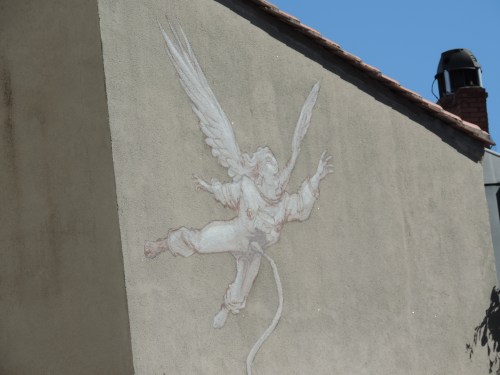
Finally, I look up and see what looks like the shadow of an angel with a trailing umbilical cord…..at least, that’s what it looks like to me, and I can’t help but turn around to see if I can see the actual angel behind me.
Oh, there’s the angel, over there, on the building opposite….
Isn’t that quite something? A drawing of a shadow which makes you turn around to see what’s casting the shadow? What a wonderful blending of perception and imagination!
Somewhere in the depths of my memory I seem to have a story of an ancient debate about whether or angels would have tummy buttons – because angels, allegedly, aren’t born, so don’t have umbilical cords. I remember thinking what an odd thing to have a debate about! But as I stand looking at this drawing, that old story comes rushing back to me, and in so doing, makes the artwork all the more interesting and engaging.
With both of these murals my experience of the day was transformed. They both challenged my perception of reality. They both stirred my feelings, stimulated my imagination and provoked memories. They both made me wonder.
I welcome constructive criticism and suggestions. I will not, however, tolerate abuse, rudeness or negativity, whether it is directed at me or other people. It has no place here. ANYONE making nasty comments will be banned.









 Heroes Not Zombies