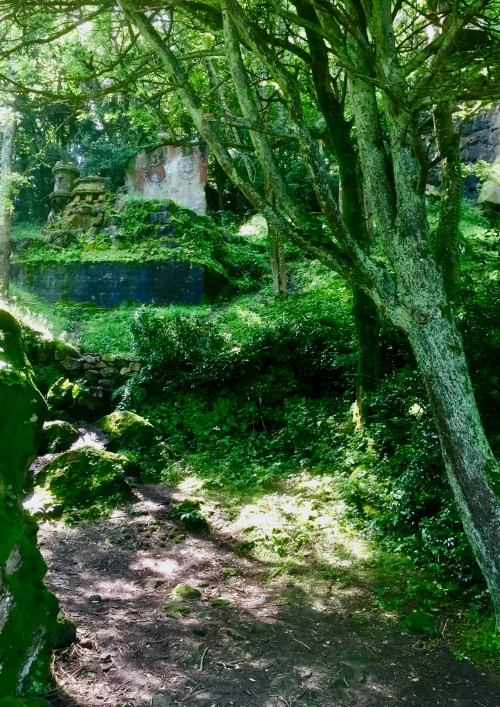
Oh I just LOVE how green this image is! Such a rich green environment pulses with Life! It declares diversity, vibrancy, energy and flourishing. This green is the expression of THE core emotion experienced in some way or another by everything that lives – SEEKING (See Panksepp’s work on that – which I’ve written about in my book, “And not Or“)
All forms of Life drive themselves forward to find what they need to survive and thrive. This is what he calls “Seeking” behaviour. I chose those words carefully there…..”drive themselves forward…” because that’s another defining characteristic of living forms…..they all demonstrate “self-organising” capacities. They move, grow, change, act, according to movement and forces within themselves. Machines, on the other hand, need to be created and driven by external forces. In fact, Maturana and Varela refine this “self-organising” capacity, noting that living forms have a special kind of self organisation which they called “autopoiesis” – “self-making capacity”. We living creatures can grow and reproduce.
I know nobody has ever identified a particular “force” or “mechanism” for all of this. I know that “vitalism” has been dismissed by most scientists. But clearly there is something there we could call “the Life Force” isn’t there? Even if all we are doing is describing the presence of a phenomenon, a behaviour or characteristic. I think that’s how I see it. It’s this “self-organising”, “autopoietic” characteristic which vibrates, throbs, beats, resonates, responds, adapts, grows and acts…..I don’t think it comes from somewhere else…..I think it infuses the entire universe and expresses itself in what we call Life.
So, it’s not a thing or an object, this “Life Force” for me. It’s a presence, an experience, a colour, a sound, a scent, an ever-changing phenomenon.
This is it. This green vision of a forest. This is vibrant, pulsating, Life.
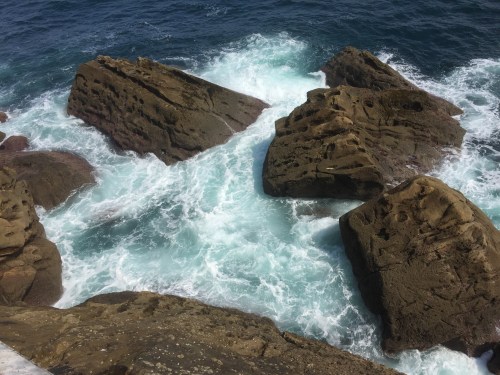
You’ve probably looked over the edge of a cliff, or stood on a shore somewhere and seen something like this image. Isn’t it beautiful? You can almost hear the sound of the waves crashing against the rocks and the foaming of the sea.
What I see when I look at this photo is the constant interplay of two distinct media, or elements – rocks and water. The rocks look as if they are dancing a circle dance, with the sea swirling between them. I can almost hear the sound of ceilidh music! (well, I am Scottish!)
The rocks form a boundary. They are the limits of the reach of the water. The water can go no further. It crashes against the rocks, foams, splinters, evaporates, and falls back.
But the water changes the rock every time the two make contact. Look at the particular shapes of the rocks, with their smoothed, yet pitted surfaces. How do you think they came to be that shape? Only by years and years and years of constant interplay between the sea and the rocks.
What isn’t so easy to see from this distance, is that every time the water washes over the rocks it takes into the sea some of the atoms which the rock is made of. It dissolves some of the rock.
The sea changes the rocks. The rocks change the sea. Both in form and in substance. Both in shape and in content.
The rocks and the sea co-create each other, co-shape each other, co-make each other.
Isn’t it beautiful to witness?
All of Nature is like this. All of Life is like this. All of Existence is like this.
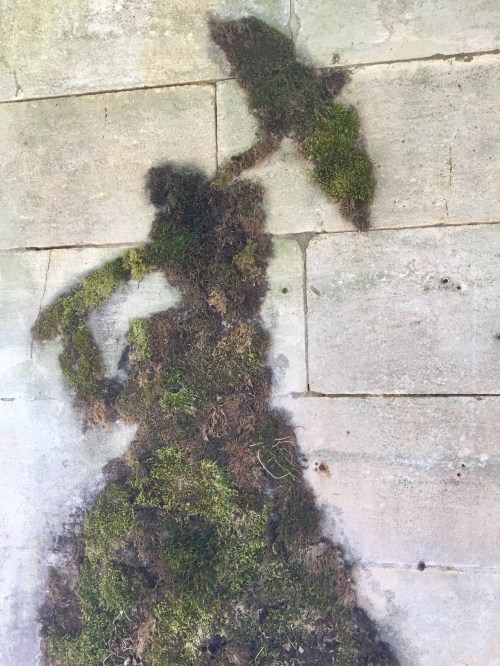
I didn’t really know what this was when I took this photo, and years later, when I look at it again, I realise I still don’t really know what it is. One thing I am sure of, however, is that this shape didn’t appear on the wall all by itself.
I don’t know if it started with a damp patch, then some growth of moss, then some shaping and trimming by someone…..but I’ve never seen anything else quite like it.
I think it’s a great example of co-creation. Human and non-human forces working together to produce something unique, something which could only be produced by the human and non-human forces working together.
Co-creation is one of the characteristics of complex adaptive systems. I know we often think of healing as an individual activity but it’s not. It is always a co-creation with others, with other human beings, with other life forms which are not human, with other energies and forces in the world.
We are co-creators, we humans, and we co-create our Selves, our Lives, our communities, societies, environments. There are even some who now call this period of the Earth, the “anthropocene” – a time when human activities are changing the geological nature of the Earth.
So, here’s the thought worth having……what am I co-creating today?
The other day I came across this. Doesn’t this look like an entrance to you? The curve of the branch from that tree on the right looks like it forms a perfect arch over towards the tree on the left, and the whole structure looks like a delightful, pleasing, enticing doorway. It’s more than a space. It’s more than a frame. It’s an invitation.
So I step forward, and this is what I see…….
Same two trees, same space, completely different perspective. The doorway has gone. The archway has gone. Over the course of half a dozen steps what I was looking at has literally changed shape.
Well, not changed shape in itself….it’s what I could see which has changed shape. Don’t you think that’s interesting? That the form, the shape, of what I could see could entice me, draw me towards it, only for it to change completely before my eyes, as I changed my position, as I took some steps.
I think this happens a lot. When we do more than look, when we act, when we move, then the world changes around us. And, I’m sure, we change with the world too.
Did the attraction disappear?
No, not at all. But the focus of attention did. I was attracted to the doorway, literally drawn towards it. It sparked my curiosity. But a few steps on, that curiosity had shifted. I was no longer wondering what lay through the doorway, what I might discover if I walked through it. I was standing, astonished. Astonished by two things.
First, astonished that the shape could change so completely. That the doorway could become two trees, one with a branch which had a completely different shape from what I initially saw.
Second, astonished at the actual shape of that branch. I mean, look at it! It does way more than curve towards the neighbouring tree. It suddenly changes course. As if it had hit an invisible wall, and so had to grow now in an entirely different direction.
I can’t see that without wondering…..what’s the story here? How did this shape arise? How did this branch arch itself through the air for a bit, then, suddenly, change so completely? What happened? What influenced this change?
Those are the kinds of thoughts I’d have every day with patients. As they described the patterns of their illnesses, shared their unique stories, I’d be astonished. Astonished at the details of the story, astonished at the coping mechanisms the patient had learned, astonished at their powers of adaptation, and curious…..thirsting to understand, to discover, to know….how had this come about?
What events were there in this person’s life, what impacts did those events have, and how did the person adapt to those impacts?
To understand, I had to shift my perspective. I had to act. I had to take some steps to make an active connection, build a trusting, functional relationship, create a bond of care and attention. Without doing that, I wouldn’t know what I was really looking at.
In the midst of this pandemic many people are beginning to despair. People are asking questions like “Is this the new normal?”, or “Is it always going to be this way now?”
My hunch is…in response to both these questions….no.
Sure, as we look ahead it can seem like we see more of the same as far as we can see. We humans are great at spotting patterns, but we’re often not so great at letting go of them.
We turn repetitions into habits and rituals. Habits into ruts. Rituals into blinkers. We see the future as being full of what we are seeing in the present. And, maybe, in many cases things can seem like this. But the truth is these repetitions, these habits, these already noticed and entrenched patterns are never permanent.
In the history of the planet there hasn’t been an epidemic, or a pandemic, which didn’t go away. I’m not saying the coronavirus will go away, but like pretty much every other bug, it’ll settle in at a lower level. The pandemic will give way to background presence with outbreaks and flares…much the same way as influenza, colds, and even serious diseases like Ebola. Look what’s happened with HIV? Aids hasn’t gone away but learning how to minimise its spread and discovering better ways to treat it has transformed the part it plays in the world now.
So, I remain optimistic, even if there are days when I’m feeling quite despairing. Who knows how long it will be till it all quietens down, and who knows just what the “new normal” will look like when that time comes?
We just have to be wary of getting stuck into the thought patterns which blind us to the nature of Life – a complex, emergent phenomena which is constantly changing and developing, going ways it’s never gone before.
Life is adaptive and creative. It never just keeps on behaving the way it always used to.
I don’t know about you, but I find this frieze pretty bizarre….even disturbing. What’s so odd about it is the representation of about half a child…..one leg, half a body, make one arm (I’m not even sure about that!)….and I don’t know what’s hiding the child’s head….a cabbage??
This image immediately reminded me of two things. First, a church I visited in Salvador, in Brazil. In one room the ceiling was covered with latex models of parts of peoples’ bodies….arms, legs, hands, and sometimes even a whole small child…..all suspended from the ceiling, each one created in gratitude for a miracle of healing. I know it was supposed to be a celebration but I found it really disturbing!
The second thing it reminded me of was Roger McGough’s wonderful poem “Bits of me”
When people ask: ‘How are you?’ I say, ‘Bits of me are fine.’ And they are. Lots of me I’d take anywhere. Be proud to show it off.
But it’s the bits that can’t be seen that worry. The boys in the backroom who never get introduced. The ones with the Latin names
who grumble about the hours I keep and bang on the ceiling When I’m enjoying myself. The overseers. The smug biders of time.
Over the years our lifestyles have become incompatible. We were never really suited and now I think they want out.
One day, on cue, they’ll down tools. Then it’s curtains for me. (Washable plastic ones on three sides.) Post-op. Pre-med. The bed nearest the door.
Enter cheerful staff nurse (Irish preferably), ‘And how are you today?’ (I see red.) Famous last words: ‘Bits of me are fine.’ On cue, dead.
This is the opposite of holism, and we are all guilty of it…..too focussed on too little. Reality needs to be understood holistically…..bits are never enough.
We make sense of the world holistically. It might not seem like that sometimes, but, even when we put on blinkers, turn abstraction up to the max, and go all in on reductionism, ultimately, reality leaps up and let’s us know…..there’s something else you need to consider here.
There is always something else.
Knowledge is never complete. Truth is never fully known. Understanding is never full.
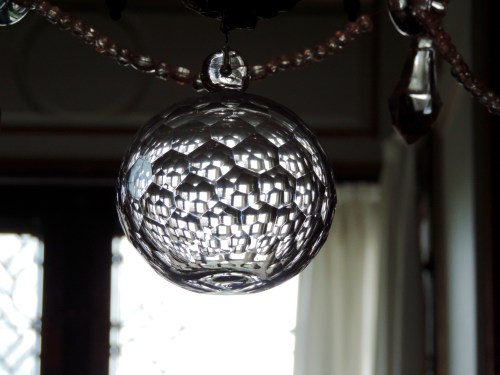
I love this photo of a crystal because you can see how the sphere contains a multiple of facets, and you can see that through each facet you can see the others. I think reality is like this. Multifaceted, multidimensional, massively interconnected. There are no clear beginnings, no clear endings, nothing is entirely separate and detached, nothing is closed. Life is an “open system” of continuous flow and change, unceasingly responsive and adaptive to environments, contexts and signals.
Human beings are relational, social creatures. None of us live in isolation. We find our uniqueness in our complex webs of relationships, memories, experiences and imaginings. There isn’t a single facet, or aspect, or characteristic, or feature which makes us unique. Our uniqueness is found in our connections.
And so, this is how we make sense of the world – through pattern spotting and recognition, through images, words, myths and symbols, through abstraction and reflection, and synthesis and integration.
Sense making is holistic.
I think that realisation should keep us humble. It should remind us that none of us ever know all there is to know about anyone or anything.
A couple of the most common things patients said to me at the end of a consultation were “I’ve never told a single other person what I’ve just told you”, and, “You know me better now than anyone else does”. And I understood what they meant…..that they had revealed an important, powerful secret, or memory, which they had felt unable to reveal to anyone else, and the revelation was enlightening……or that they felt they had been heard, understood, even known better than ever before. Yet, I would think “Well, how much life have you and I shared through these consultations? (whether this was the first consultation or the tenth one) And how big a proportion of your whole life do those few hours represent?” Because even when I felt we’d achieved a new, and deeper, level of understanding, I still knew that I only knew a little part of this person’s life.
Continuing on the theme of sense making…….I’m endlessly curious about how we human beings do three things – perceive the world, make sense of life, and influence our day to day experiences of reality. Each one of those contributes to the richness of our unique daily lives. No two of us have the exact same experience at the exact same time and place. Never. We will all bring our previous experience, our memories, habits and distinct patterns of being to the present moment.
I think that perhaps one of the most powerful, and certainly most magical, qualities we have is the power of imagination. Some people seem to think we can separate imagination from the perception of reality very easily, that there is a permanent and impermeable barrier between the two. Sometimes I wonder if there’s a connection between that thinking and what doctors used to describe as “the blood brain barrier”, an invisible border between the body and the brain which drugs couldn’t cross. We know it’s not that simple now. But is there a big stretch between that thinking and the idea that some illnesses are “all in your head”? I mean, whatever did that really mean? I remember hearing someone claiming that for a certain patient “her pain is all in her head”. What did that mean? That it didn’t really exist? That she was either lying or deluded? What a way to dismiss a person’s lived experience. What a way to undermine a relationship of trust. What a way to fail to understand.
I think our power of imagination doesn’t switch itself off and on. Blimey, it even keeps going while we are sound asleep!
Perception is a creative act. It involves memory, signals from the environment, signals from within our own bodies, as well as our creative powers of imagination which enable us to make connections, see patterns and create images which we hope provide us with good representations of the world.
Sense making is also a creative act. Whether we draw on numbers, words, stories, images or similarities, making sense of the world is an act of imagination, a creative act of imagination.
Our daily lives are creative acts. We are much more the active agents of our experience than we realise. We are not blank slates for someone else to draw on. We are not data to be fed into an algorithm. Algorithms, statistics and data do not KNOW us better than ourselves. We are creating ourselves every moment of every day.
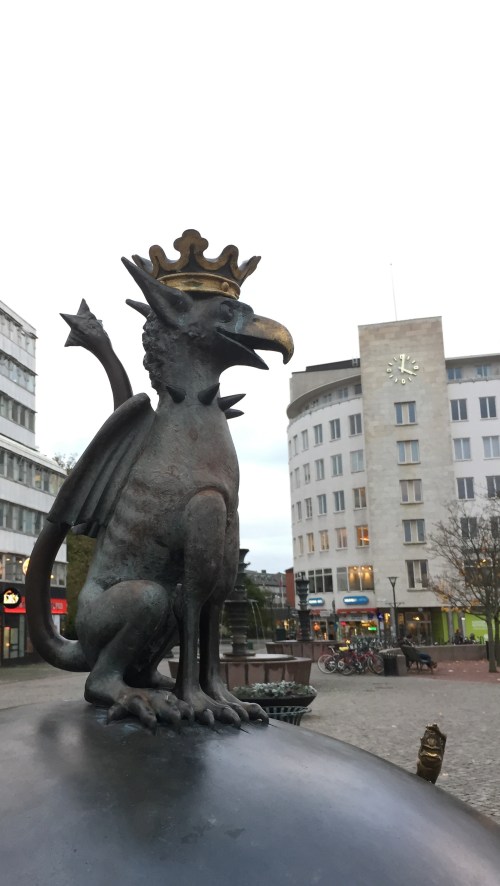
This photo is of a public work of art, placed in a square in Malmo. It’s a griffin with a crown. A griffin? An imaginary creature. There are no griffins in Nature. But we respond to this, don’t we? We react to it. It influences us. Part of the genius of this sculpture, I think, is the crown. Placing the crown on this creature’s head increases its impact and magnifies its significance and importance.
I’m well used to living with imaginary creatures. I come from Scotland. And, no, I’m not thinking of the Loch Ness Monster. I’m thinking of the imaginary creature which adorns castles, flags and buildings throughout Scotland.
The unicorn.
A magical, mythical creature of incredible power.
I’m not going to describe my own responses to the unicorn today. Instead I’d like you to notice what your own responses are. When you look at an image of a unicorn, what do you experience? What images spring to mind, what thoughts enter your head, what feelings emerge within you? What do you imagine?
We humans have invented incredible cultural tools which help us to make sense of the world, to bring about changes, to create connections, and to express ourselves. Alphabets, language, words, symbols and art are some of the ones I’ve written about over the last few days, but there is another class of cultural tool entirely – numbers.
We love to make measurements. Well, some of us love it more than others I suspect, but how often do you hear questions such as “How big is it?” “How heavy is it?” “How long is it?” and so on…..?
I can see the point of favouring measurements when it comes to building and maintaining houses and machines, but I find them partial, or even distracting once we try to apply them to non-physical, invisible phenomena…..like subjective experience, qualities and time.
This photo is of an astonishingly beautiful, elaborate clock. Have you ever stopped to wonder about this idea of measuring time? It’s a complete invention because time isn’t a phenomenon which can be measured. We arbitrarily agreed to divide the day into small pieces, 24 hours, each of 60 minutes, which each has 60 seconds. But why those figures? Why those “units of time”? Other creatures deal with time without making measurements which produce figures. They deal with the natural periods of time, from sunrise to sunset, sunset to sunrise, from one solstice to another, from one equinox to another. They live according to the rhythms of Nature’s cycles and the rotations of the Earth, both on its own axis, and in its orbit around the Sun. They live according to the rhythms of the Life in each of their cells. We do too, but we stand apart from all that, or at least we try to, and we impose a human invention instead – measured time.
The thing about measured time is it can’t tell you anything about the quality of the time. It can’t tell you the difference between a “good time” and a “bad time”. It can’t tell you about the “best time of my life” or the “worst time of my life”. It can’t tell you about the experience of “passing the time”, “wasting time”, or “saving time”. It’s not enough to measure the number of minutes a consultation lasts, you have to know what the doctor and patient are doing and experiencing during that consultation.
I heard a story once. It was told to me by a dentist who was running a Facial Pain Clinic. He said he’d taken the clinic over from the colleague who had created it, once that colleague retired. He told me about his first day in the clinic. When the first patient came in, he introduced himself, asked the patient how they were and they replied “14”. He was a bit puzzled but let it pass and carried on with the rest of the consultation. The next patient did the same strange thing, telling him “9” before telling him anything else. When it happened with the third patient he asked the nursing staff if they knew what was going on. Oh, yes, he was told, the previous colleague had invented a numerical scale of pain severity, from 0 to 20. He trained all the patients to tell him what number they were applying to their level of pain each time they came for a check up. He was a pretty intimidating and demanding man and the nurse said that if a patient started by telling them what had been happening in their life since the last visit, he’d say “Stop! I want the next thing to come out of your mouth to be a number!” They all learned to comply!
Well there’s a whole movement within Medicine to try to quantify qualitative phenomena – ie symptoms, like pain, dizziness, nausea and so on, symptoms which can’t be “seen” or “measured” in any other way.
What do you think of that?
Both of these examples, the measurement of time, and the measurement of pain, highlight an important division in our values – do we pay more attention to numbers, to what can be measured, or to which we can invent and apply artificial measures? Or do we pay more attention to the lived experience? That is, do we favour the quantitative over the qualitative or vice versa?
I find some people fall into the former camp, whilst others fall into the latter. You know what I’m going to say, don’t you? “And not or”! I think both can be helpful. It depends on context. If we are dealing with machines, I can see that the quantitative approach is really helpful…..if we are dealing with human beings…..not so much! By that, I don’t mean there is no point in measuring somebody’s blood pressure, checking their haemoglobin levels, etc. I just mean the numbers are never enough. They always, and, yes, I believe that’s the right word, always, need to be put into the context of this individual, unique human being’s life……and we do that by paying attention to the qualitative.
Have you ever read that sentence before? It was coined by Freud in 1915, and used by Steve de Shazer as the title of his book about his “solution focussed approach” to brief psychotherapy.
Do you think writing “freedom” repeatedly over the front of this office block works some magic? Who decided to write this in this particular place? Were they being ironic? Pointing to the fact that offices are actually soul-less, regimented places of control….the antithesis of freedom? Or were they trying to cast a spell….to make people feel more free by presenting the word to them?
I don’t know. I don’t know the history of this office block in Malmo.
We are told we now live in a world of “post truth” where words are used to confuse, misdirect, obscure, lie and evade…..where words are used to persuade and manipulate……where words are propaganda….ways to influence and control whole populations one three word slogan at a time. “Take back control”, “Get Brexit done”, “Build, build, build”………
Well it seems that words are losing their magical power when they are used so cynically and when they aren’t backed up with actions. But still, they work a magic over millions of people who voluntarily give up their freedoms and quality of life for the sake of a privileged few (just as Montaigne’s friend, Étienne de La Boétie, described in “Discourse on Voluntary Servitude” back in 1577)….inequalities are increasing massively, wealth and power is becoming ever more concentrated while “strong men” narcissists bewitch large numbers of people into supporting them.
Ok, political rant over! Back to health care….my specialist subject! As a doctor you have to be really careful about the words you use. Telling someone they have X months to live can become a self-fulfilling spell. People give up, or gain hope, depending on the words the doctor uses….and how they use them (by which I mean the contexts in which they use them, and whether or not they are used within already established relationships of trust). In a good consultation the doctor is on the alert for specific words which the patients might use, words which might hold the key to both diagnosis and prognosis. Which words does the doctor pick up on, and ask you to say more about?
We have to be especially careful of using words as labels…..such labels can put people into boxes. It’s a danger in health care, but also in wider society….the fast track path to prejudice and injustice.
Words are still magic. They still have enormous power. It’s worthwhile staying aware of that……
I welcome constructive criticism and suggestions. I will not, however, tolerate abuse, rudeness or negativity, whether it is directed at me or other people. It has no place here. ANYONE making nasty comments will be banned.





 Heroes Not Zombies