Feeds:
Posts
Comments

Archive for the ‘creativity’ Category

FRANCE CAVE DRAWINGS

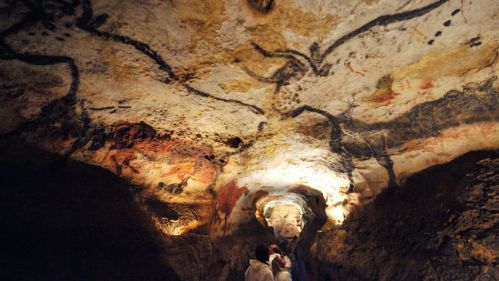
Part of Lascaux famed cave drawings are photographed in southwest France, during a rare visit, Friday, July 25, 2008. Clusters of black fungus have been spreading over the drawings said scientists in 2007. The stains were the latest biological threat to the Lascaux cave drawings, which were discovered in 1940 and are considered one of the finest examples of prehistoric art. Carbon-dating suggests the murals of bulls, felines and other images were created between 15,000 and 17,500 years ago in the caves near Montignac, in the Dordogne region. In 1963, after green algae and other damage appeared, the caves were closed to the public. Only scientists and a few others are allowed to enter at certain times. (AP Photo/Pierre Andrieu, Pool)

I recently visited the Lascaux caves which are about a three hour drive from where I’m living now. I’d heard of them but I hadn’t realised they were as close as this.

You’ll see from that photo above, which isn’t mine, that the incredible wall art in the caves was deteriorating quickly due to the effects of fungi and carbon dioxide brought in by visiting tourists, so the government closed the caves to preserve them and did something astonishing.

They built an exact replica of part of the cave network, faithful down to 5mm, using teams of artists to recreate the artwork using the same kinds of pigments used by the original artists on artificial cave walls.

The caves were discovered in 1940 when a group of boys were exploring a forest. A storm had blown down some trees and one of the fallen trees had opened up a hole in the ground under its roots. Their dog disappeared down the hole so they went after it, quickly realising it was a tunnel into caves. After retrieving their dog, they went back home and got lamps, returning to squeeze along the dark tunnel until it opened up into a cave. Can you imagine how astonished they were when the light from their flames lit up the huge paintings of bulls, bison, cows, horses and deer which covered the walls and ceiling of the cave?

There was a lot more down there than what the boys found in the first cave. The paintings are thought to have been created up to 18,000 years ago and had remained, perfectly preserved, once the cave network was sealed off by the forest.

Lots of questions immediately spring to mind – how did they manage to paint such life-like depictions of animals under the ground in the darkness using just small lamps for light? They covered not only the walls but the ceilings. How did they get up there? They used the contours of the cave walls to make their paintings seem three dimensional. How did they have the imagination and the skill to do that? And WHY? Why did they put so much time and effort into the creation of this fabulous art?

It didn’t take long before the effects of thousands of visitors started to degrade the art work so the government sealed it off and created Lascaux 2, a replica. If you click through on that link you’ll go to an interactive tour of the re-creation.

So, I went down the stone steps with a couple of dozen other visitors and a guide. In the ante-room after the great doors were pulled closed, our eyes adjusted to the low level of light and the guide talked us through the story of the discovery of the Lascaux caves and the creation of Lascaux 2. Then he opened the far doors and we all squeezed down a narrow passageway between rough walls of rock. The passageway opened up into the Hall of the Bulls, so called because of the four, almost life size paintings of bulls which completely cover the ceiling of the cave.

He switched off the lights and lit a cigarette lighter. As the small, single flame cast its faint light up onto the walls and ceiling you could swear the animals were moving. It was quite cold down there and without artificial light it would be pitch dark.

We spend the best part of an hour exploring the cave and hearing about the different paintings.

So, you’re thinking. You just visited a replica? How did that feel?

You know what? It was magical. I thought it might be a bit Disney-like, but it wasn’t. You know what it was like? It was like standing in the middle of an art installation. That’s exactly what the replica is. It’s a work of art designed to communicate to you something of the experience of the artists. And that’s what this replica represents, isn’t it? A work of art. Created by unknown artists almost 18,000 years ago….

So there it is…one work of art, touching the viewer, stirring some kind of feelings which the artists had after they’d been inspired in a similar way by other artists, long gone, who left these astonishing creations.

Here’s my final thought. Isn’t it just wonderful that we humans create art? Not for a sum of money, fame, or some utility, but to…..what? Interpret our world? Interact with our world? Make sense of our world? Express ourselves, just because we can?
 

Read Full Post »

hanburymarqueyssac

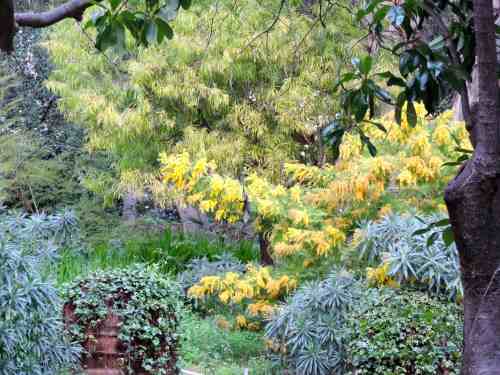
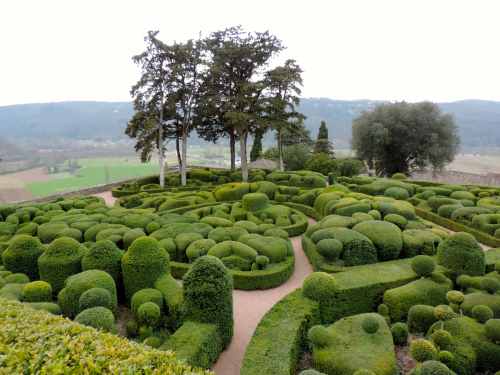
Two gardens.

Could they be more different?

The first is the Hanbury Botanic Garden in Ventimiglia, Italy, and the second is Marqueyssac in the Dordogne, France.

Thomas Berry, in The Great Work, describes the two forces of the universe as wildness and discipline. David Wade, in The Crystal and the Dragon, describes them as the moving, flowing principle, and the ordering, or structuring principle. You get the idea? One tends toward expansion and one towards constriction. Empedocles wrote about Neikos and Philia, the forces of repulsion/separation and of attraction/combination.

Our left cerebral hemisphere is great for sorting, labelling, and ordering. The right seeks out the new and makes connections.

There is no right or wrong here. Both forces need each other, like the yin and the yang. As they interact with each other, as we produce integration (the creation of mutually beneficial bonds between well differentiated parts), we create.

These two gardens are examples of this. In the first case, the Hanbury Garden, there is a glorious “far from equilibrium” quality brought about by encouraging diversity and a light touch on control. In the Marqueyssac, constant pruning, trimming and shaping brings this astonishing spread of geometric and repeating forms.

Is one more beautiful than the other?

I suspect each of us have certain preferences…..drawn towards the wildness, or drawn towards the discipline.

Isn’t it great when we can have “and” not “or”? It just requires the will to explore and to stand back and see the view from Sirius.

Read Full Post »

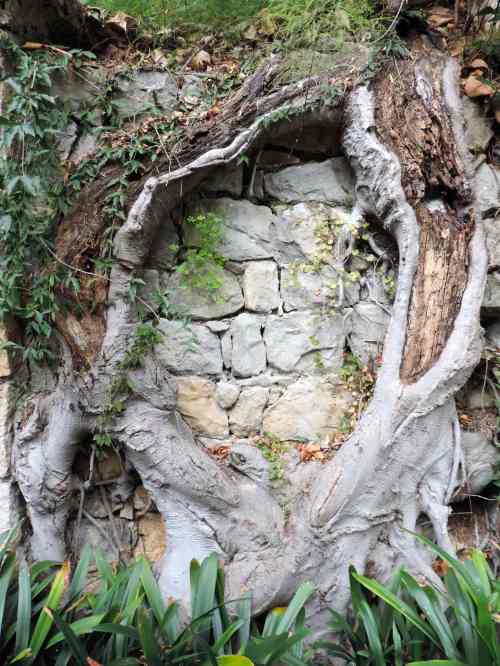
tree wall

I didn’t see any white rabbits, but, like Alice, I stumbled across this.

What is this? A wall with a tree growing in a strange, separated way over it? Why would a tree grow that way?

A portal deep in the woods? A portal which someone has walled over? Why would they do that?

There’s a story here.

How would you like to tell it?

Let me help you to get started. Once upon a time……..

Read Full Post »

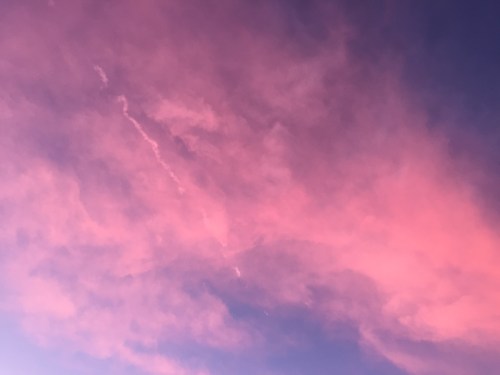
sky above

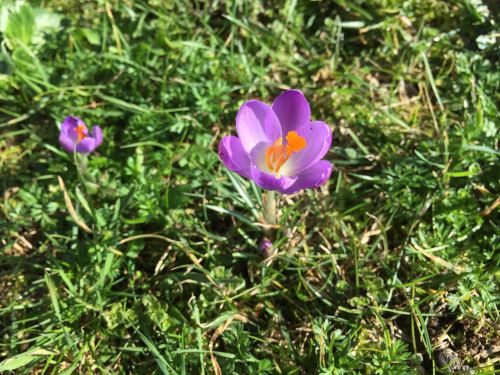
Sometimes the beauty of the sky straight above your head reminds you of something you saw earlier when you looked down at your feet….

crocus.jpg

Read Full Post »

weather passing

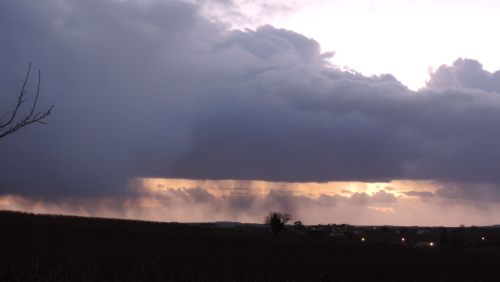
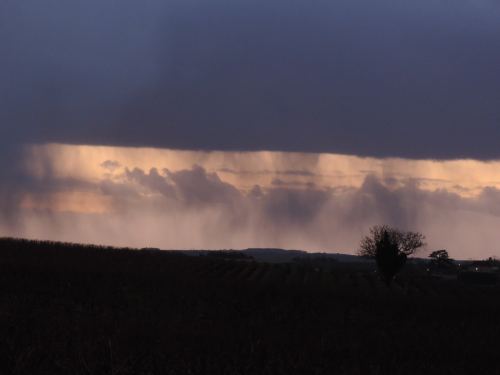
I saw some weather passing by the other evening.

When I zoomed in it looked even more spectacular –

weather window

….like looking through a small window – or even a letterbox!

There’s something very appealing about wind and rain and clouds and light all at once – particularly when you can see the whole weather system from a distance!

Why does it feel so great and cosy to be warm and comfortable inside your house while the rain hammers on the window, or the wind blows a gale outside? Is it the contrast? Whatever the reason, it seems to heighten the pleasure of being inside doesn’t it?

The other thing I like about seeing the weather passing by like this, is how transient it is. How brief it is. A few minutes later and this photograph would have been impossible. That’s one of the many things I enjoy about photography – the call to action! When you see whatever it is that catches you eye, there’s no point thinking “I’ll come back and take a photo of that some time” – it’ll be gone! You have to be present. You have to act. Now.

Read Full Post »

I do really love some of the larger Parisian galleries like the Musée d’Orsay, and the Louvre, but some of my most favourite ones are much smaller. The Rodin museum is a long time favourite of mine. I like it best when it’s warm enough to be able to stroll in the gardens there. It has that wonderful combination of Nature and Art which really encourages you to take your time and savour it.

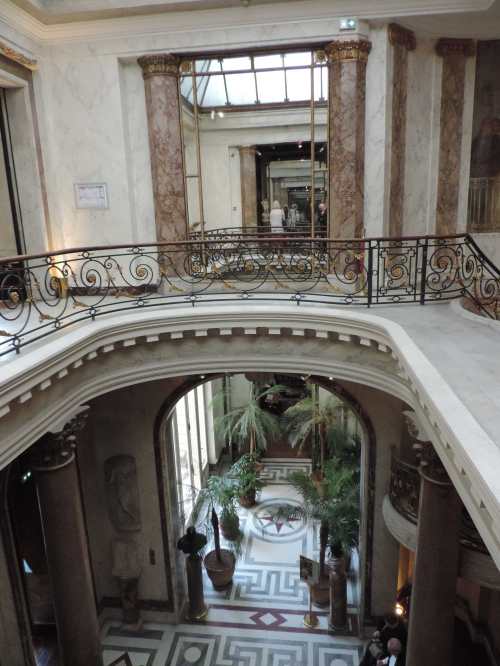
On my last trip to Paris I found another smaller gallery, the Musée Jacquemart André. Look at the main foyer –

gallery

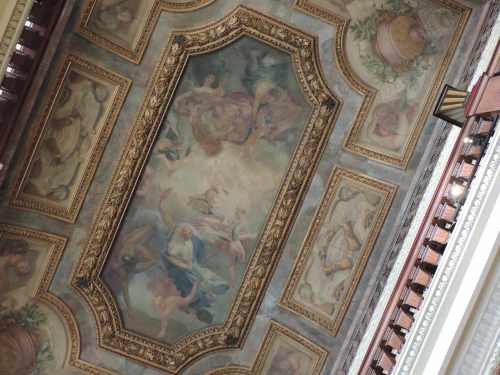
And the ceilings…..

ceiling.jpg

I went there to see an exhibition of portraits of the Medici from Florence, but the building itself entranced me.

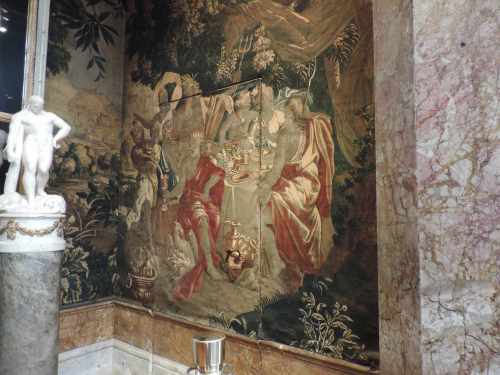
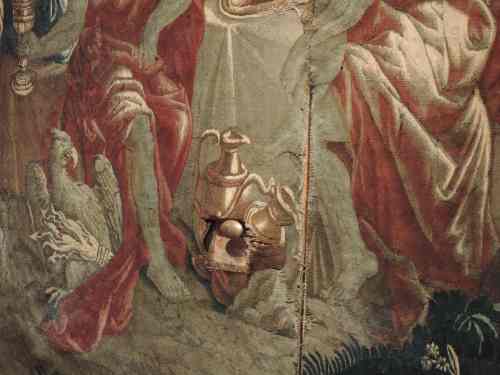
Here’s one of the many things which caught my eye and surprised me, a wall covered with a tapestry which has had a door cut into it –

tapestry door

Maybe for the owners of this gallery, back when it was a private house, bought and used tapestries the way people use wallpaper nowadays, but they seem like such works of art to me that I was shocked to see a door cut into it. Then when I looked a little closer I noticed the door-handle!

doorhandle

I’m not sure what I think about that!

What do you think? Does this make art more utilitarian? Does it make the everyday practical more beautiful?

Whatever you think about it I think it’s a great example of the extraordinary in the ordinary….”l’émerveillement du quotidien”.

Read Full Post »

paris

Returning from Scotland to France the other day, I flew over Paris and captured this view.

The first thing which catches your attention is probably the sunlit River Seine, around which the city has grown. It sparkles and shines and reminds me that Paris is known as the “city of light”.

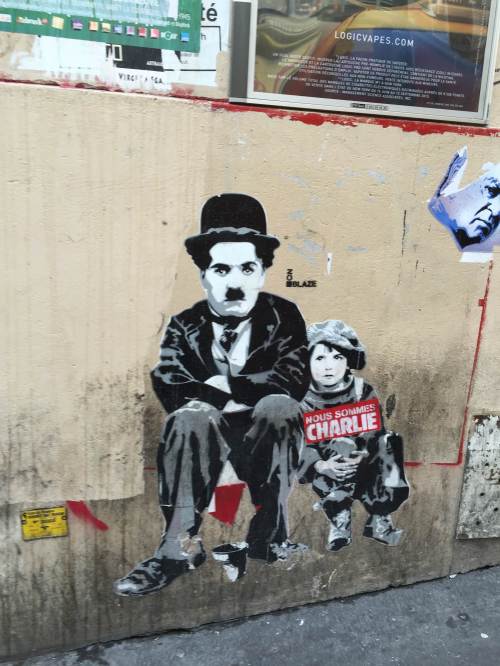
But what comes to mind when people mention Paris now, in the light of 2015? At the start of 2015, we heard about the terrorist attacks on the cartoonists at Charlie Hebdo, and on the Jewish supermarket. Then we saw the huge expression of solidarity spreading far beyond Paris into the rest of France and the rest of the world with thousands upon thousands of people coming out into the streets and declaring “Je suis Charlie”.

je suis charlie

At the other end of 2015 came the massacres of mainly young people enjoying music, drink, food and each others company as the terrorists struck again in this same city. And, again, there was a reaction across the world, as people flew the tricolour, changed their profile pictures, sang La Marseillaise, and declared their solidarity with the people of Paris.

These attacks have been interpreted as an attack on what Paris “stands for” in the world, as an attack on “French values”……and so as an attack on both pleasure and delight in Life, and on “freedom, equality and brotherhood”.

Of course, these events are complex and can’t be reduced to such apparently simple interpretations.

How do we choose a life of joy instead of a life of fear? How do we say “yes” to the world, instead of “no”? I don’t think we know all the answers, but when seen from above, this sparkling city still seems to shine as some kind of beacon.

Paris is still a “city of light”.

Then I looked again at this photo, and I zoomed in so I could see the Eiffel Tower. The truth is it’s not to easy to see the Eiffel Tower in a clear blue sky any more. Most days it seems to be dulled or obscured by pollution in the atmosphere, so isn’t it interesting that the global climate change conference took place in Paris just before 2015 ended?

Wow! We have a lot of work to do, to make this world a better place for us all to live in together. A lot needs to change as we switch from consumption and waste to resilience and sustainability, as we choose to shift our attention from fear to love.

But let me return again to this image, because, instead of reducing it to its parts, I find it simply beautiful. Isn’t Paris also known as a place where artists gathered? Isn’t it one of the great symbolic cities of creativity and imagination?

Here’s my hope then for 2016. That we can each enrich our lives this year with love, imagination and the joy of living. That this can be a year when we nurture and sustain the beauty of the light in our world – that burdens are lightened, days are brightened and that we become more enlightened.

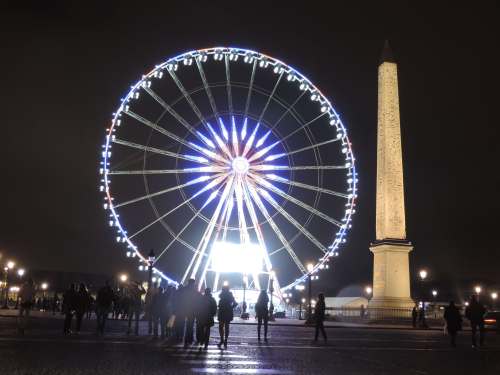
paris by night

shining lights


Read Full Post »

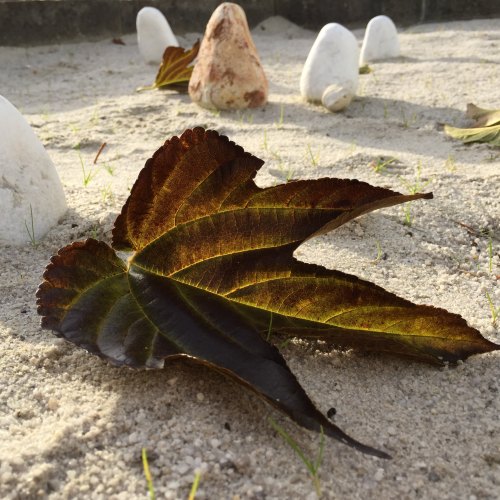
leaf and stone

I have a large mulberry tree in my garden and at this time of year, every morning there is a small carpet of leaves on the ground waiting for me to come and gather them up.

There is also a sandpit in this garden. Someone, sometime, presumably created it for children to play in, and my littlest grandchildren played in it in the summer time. For the rest of the year I arrange, and re-arrange some stones we bought in a local store and rake the sand from to time, almost like a Japanese garden but on a much smaller, more amateur scale! My landlord, when he saw what I’d done asked if I’d arranged a “petit menhir” – a small circle of standing stones. I hadn’t thought of them like that but circles of standing stones are in my genetic memory so the idea has stuck.

Some of the mulberry leaves fall into the circle of the stones and when I got down to the sand-level I managed to take this photo.

I love the contrast of the transient, seasonal leaves and the apparently unchanging stones on the sand.

I say “apparently unchanging” because I know that everything is constantly changing, but some at such a slow rate that a single human lifetime is not enough to spot the difference.


Read Full Post »

starlings

In his essay, “On Experience”, Montaigne wrote

Nor is there anything more remarkable in Socrates than the fact that in his old age he finds time to take lessons in dancing and playing instruments, and considers it well spent.

Socrates? In his old age? Dancing and playing music?! Well, I never…..

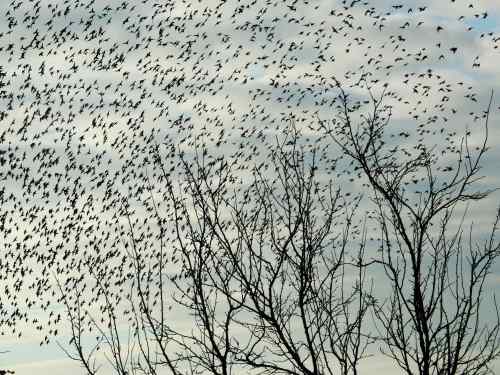
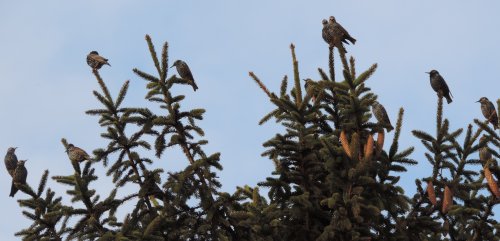
I thought about that the other day when I saw the starlings gathering again in the trees at the top of vineyard. They gather in their dozens, then their hundreds, and then, I suspect (because I haven’t tried to count them), in their thousands. As they settle into the trees they begin a great commotion, all singing and whistling and shouting it seems at the same time. They can keep this up for several minutes and so far I haven’t been able to figure out whether or not they are singing together or just all singing at the same time.

No matter really, because all of a sudden the whole flock falls completely silent – not a cheep! The silence is always, and I mean always, followed by flight. Suddenly they take off as one and fly away from the trees.

Then you can see something quite remarkable. The flock will divide into sub-groups and be joined by yet others you hadn’t even noticed coming. They will swoop down onto the vines, or soar high into the sky. I have no idea how you predict which way they are going to fly next and I can’t see that they all follow a single leader.

They really do seem to fly as one great organism.

I don’t know why they gather and behave like this. I fancy they just like singing and dancing. A bit like Socrates did, it seems…..

When they fly directly overhead the sound of their wings beating the air can take your breath away.

I’m sure they enjoy what they are doing even more than I enjoy watching them, but they affirm for me somehow how one of the best things to do in life is to enjoy living, to celebrate your music and your movement and your ability to join with, and flourish with, others…..

starlings in the tree

Read Full Post »

IMG_4143

I’m lucky to live in a place where I can see a lot of sky. I don’t think I’d like to live somewhere where I could only catch glimpses of it.

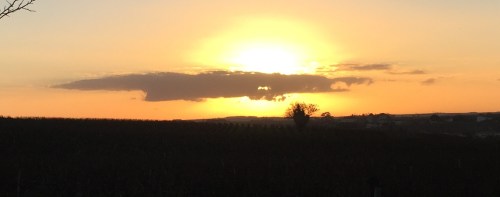
I notice the sky. A lot. I notice it when I open the shutters in the morning. This morning there was a pinkish orange/peachy glow from the rising sun. Now the sky is blue again. I find I only need to gaze up for a few moments and I see something which catches my attention – a high trail of white from a jet hurrying from the south to the north (or vice versa); a single bird hovering so high above the ground I can’t begin to understand how it can spot its prey in the vineyard; some clouds gathering, floating on by, changing shape every second.

Clouds catch our attention a lot, don’t they? Well, not so much when they are uniformly grey and stretching from one horizon to the next, but especially when they form shapes.

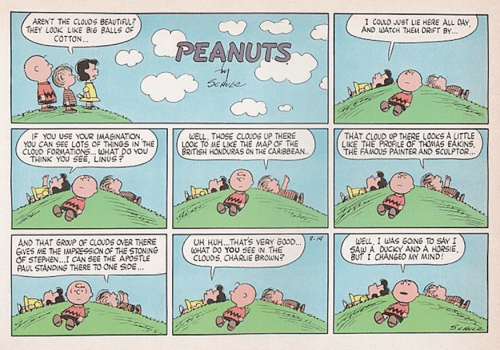
Actually I can’t tell you how often one particular Peanuts strip comes to my mind when I start to think about the shapes which clouds make! Wait, I’ll have a look…..oh, yes, here it is!!

peanuts clouds

What do you see when you look at the cloud I photographed yesterday and posted at the beginning of this piece?

Do you see a dragon? A crocodile? What?

Two things spring to my mind when I start to reflect on our ability to see recognisable patterns in clouds – patterns which we can name – the first is about imagination and how it is always active and always busy creating the reality we experience. It’s not something we switch on and off. We use it all the time to see….to see the physical world, to make sense of it, to interpret it, to make and recognise symbols and be inspired.

The second is about the astonishing pattern-making/pattern-recognising power of the human mind. It’s such an integral part of who we are that we aren’t even aware that we are doing it. But we are. All the time. Seeing not just the patterns of the physical world around us, but the hints, suggestions and representations which are unique to each one of us.


Read Full Post »

« Newer Posts - Older Posts »