Feeds:
Posts
Comments

Archive for the ‘creativity’ Category

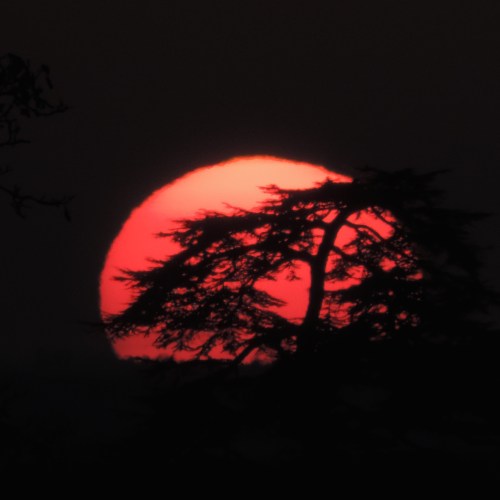
setting sun behind tree

Sometimes as the sun sets it looks bigger than it does on most days.

Yesterday was one of those times.

There’s a lot I like about this shot.

I like the wavy edge of the sun. We tend to think of the sun as a perfect circle but when we see the close up photos taken from satellites and with telescopes we see that it is a huge furnace of fire, constantly sending flames and gases into the rest of the universe.

I like the shades within the colour of the sun. I put on my exposure bracketing to capture a number of different exposures because a straight point and shoot bleached out the sun and made it appear white, when, in fact, it was the rich redness which drew me out into the garden with my camera. This particular exposure captures the colours I saw most closely.

I like the tree on the horizon just in front of the sun. If you are in the habit of watching the sunset from a particular place you’ll be well aware that it disappears below the horizon slightly further east, west, depending on the season. Just now, in December in France, the sun is moving slowly further east. In midsummer it settles down way further west than where this tree is growing. So, in fact, I could only get this particular image from this particular spot in the garden yesterday. Even if the sun sets as beautifully again tonight, it won’t be setting exactly behind this tree (leastways, not from my garden)

Aren’t all those aspects of this image wonderful? The irregularity of the edge of the sun, the changing shades of colour, and the particularity of the place, which is created by the unique combination of the observer’s position, and the day of the year.

I adore this uniqueness.

I love this transience.

I delight in the beauty of ever-changing Nature.

I relish these rhythms of the year.

I am grateful for the opportunity to see and to be aware.

And it warms my heart to share.

I hope this enriches your life today.
Read Full Post »

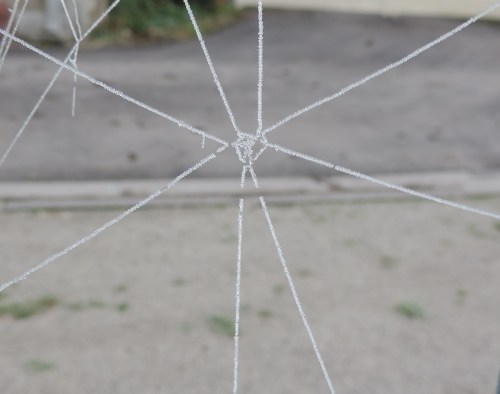
simple web

I’ve seen some amazingly complex and elaborate spider webs in my time, but look at this one I stumbled across early one morning recently.

I reckon this has been spun by a truly Charentaise spider. One of the commonest phrases people use in the neck of the woods is “soyons zen” (“let’s stay zen” – meaning keep calm, take it easy, relax…..you get the drift!). The creature which is one of the emblems of this region is a snail, and a small town near me (Segonzac) is one of the “Citta Slow” network.

cagouille

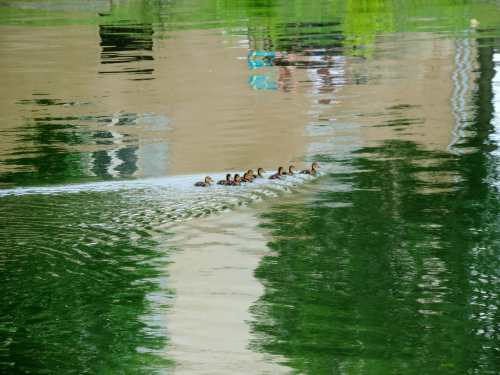
People say the River Charente flows slowly and calmly. It’s not in a rush. It doesn’t get all white spray and choppy (at least not as it flows through Cognac), and the way that river lives becomes yet another potent emblem of the Charentaise way of life.

duck family

So what struck me about this web was its bare, sparse, simplicity. And it’s that simplicity which appeals to me so much. I find a real beauty in it. Yes, I admire, and can easily be in awe of, the complex and the elaborate, but simplicity just hits the mark so directly and powerfully, don’t you think?

I know, some of you might be thinking “that spider’s not going to catch many flies with that web!” and I thought that too, but then I got to thinking, who says spiders never make webs just for the sheer fun of it? Who says spiders only have one reason to spin a web? And how does whoever says that, know?

Maybe some webs are spun to catch morning dew.

Maybe some are spun to be beautiful.

Maybe some are just spun because a spider is just being, sorry…… becoming, a spider!

Read Full Post »

DSCN4747

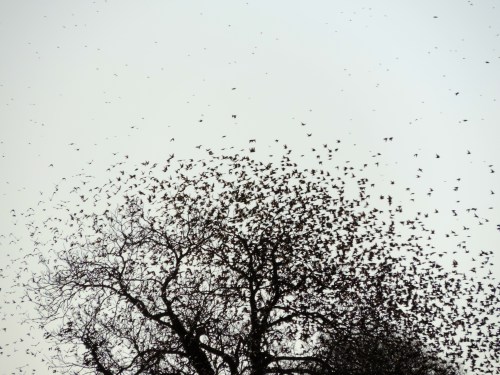
Look at this tree. Those aren’t leaves, they’re birds! Hundreds of them, thousands maybe.

I’ve never seen such a large flock of birds near me before. Maybe you haven’t either. What do you think your response would be? Would you think of Alfred Hitchcock?

Not me!

I didn’t think of that for a moment.

I was fascinated, entranced, drawn outside with phone and camera to do my best to record something of this phenomenon.

Here’s what I put together from my short video clips and some photos.

Later, while reading Montaigne, I read

He who fears he will suffer, already suffers from his fear.

It got me thinking about the stance we take towards the world, about our default attitude. Because isn’t there so much fear around? In fact, it seems to me that fear is often used deliberately as a weapon of control.

What’s the greatest fear?

Some say it’s the fear of death. That this “existential fear” is the foundation of all other fears. For example, as a comedian I heard once said “I don’t have a fear of flying. I have a fear of crashing!” People who fear the dark, fear what dangers might be hidden in the darkness. People who fear dogs, fear that the dogs will attack them. People who fear illnesses, fear suffering and death.

Montaigne says if you spend your life fearing suffering, you’ll be suffering throughout your life. Yet so much of the health advice offered to people is based on trying to avoid death (the greatest fear).

12072632_978160722251727_1794598302913905177_n

If fear is our default, we don’t just suffer, we live in a shrinking world, fearing difference, the “other” and change.

What’s the alternative?

6d36c2e75bc308b00db209125c854c06

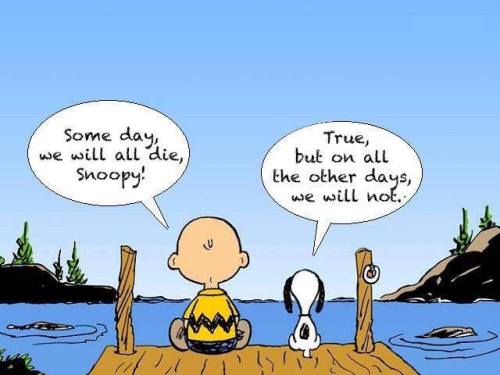
Dread one day at a time??!!

Nope.

The great thing about alternatives to fear is that there are so many of them.

There’s courage. Courage is the determination to go ahead even when you are feeling fear. That’s something I’ve been practising since coming to live in France. When you start to live in another country with a different language, not only are customs and habits different but at first you’ve no idea how to ask the simplest things. So a trip to a post office, or the local Mairie, or the garage can be quite intimidating. Until you summon up your courage, and just go. And, in my experience here, each and every time I discover there has been absolutely nothing to be afraid of. People are friendly and they want to help. (Then next time you go the fear has diminished, or even gone away entirely)

There’s wonder. Wonder and curiosity. That’s the response I had when I saw all the birds. That’s the attitude I hope to take into every day – l’émerveillement du quotidien.

There’s love. Love comes with a desire to make connections and with an intention to care, or at very least, not to harm – and that applies in relation to plants and animals as much as to other human beings. How often does it seem to be that when your intention is a loving one, that you meet the same response? When I was a GP, my partners and I built a new clinic and the reception was an open one – no glass or metal barriers between the patients and the staff. We were warned that we’d be vulnerable to being attacked. It never happened. Not even remotely.

Fear closes.

It closes us off from the world and from life.

The opposite is whatever opens – courage, wonder, curiosity, love…..add your own favourites at the end of this sentence!

I prefer the opposites for what they bring in themselves, but I resist fear for another reason. I don’t want to be controlled. Heroes not zombies anyone?


Read Full Post »

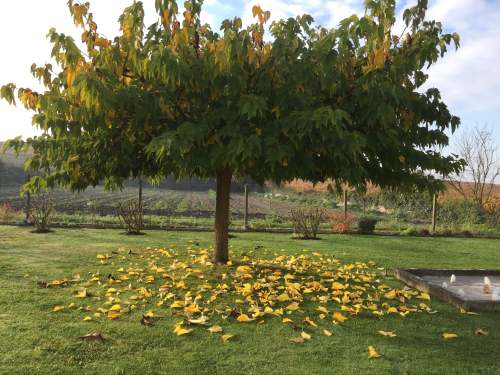
circle

The other morning I was thinking how lovely the mulberry tree leaves are as they fall onto the ground forming such a beautiful circle. It reminded me of Andy Goldsworthy’s art.

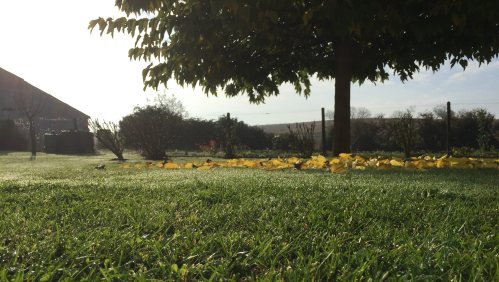
Then I got down on the ground to photograph the morning sunlight on the dew-bejewelled grass…

line

…and the circle turned into a line!

Interesting that, huh? And it worked the other way too – turning back into a circle when I stood up 😉

How different the world looks when you change your perspective!

Read Full Post »

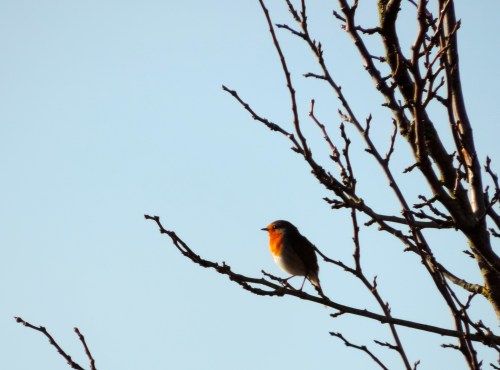
robin

He’s back. The robin who hangs around my garden. Here is up taking up position in the most-favoured tree at the south-western corner of the garden. He’s looking east as the sun rises and the warming rays are making both his red feathers and his eyes shine.

Bright eyed, and looking to the dawn of a new day. Watching over his familiar ground  and singing loud and long.

I don’t know where prayers go,
or what they do.
Do cats pray, while they sleep
half-asleep in the sun?
Does the opossum pray as it
crosses the street?
The sunflowers? The old black oak
growing older every year?
I know I can walk through the world,
along the shore or under the trees,
with my mind filled with things
of little importance, in full
self-attendance. A condition I can’t really
call being alive
Is a prayer a gift, or a petition,
or does it matter?
The sunflowers blaze, maybe that’s their way.
Maybe the cats are sound asleep. Maybe not.

While I was thinking this I happened to be standing
just outside my door, with my notebook open,
which is the way I begin every morning.
Then a wren in the privet began to sing.
He was positively drenched in enthusiasm,
I don’t know why. And yet, why not.
I wouldn’t persuade you from whatever you believe
or whatever you don’t. That’s your business.
But I thought, of the wren’s singing, what could this be
if it isn’t a prayer?
So I just listened, my pen in the air.

Mary Oliver. I Happened to be Standing.

Whether it’s a wren or a robin or another species of bird entirely, we need to hear these prayers, these hymns, to Life.


Read Full Post »

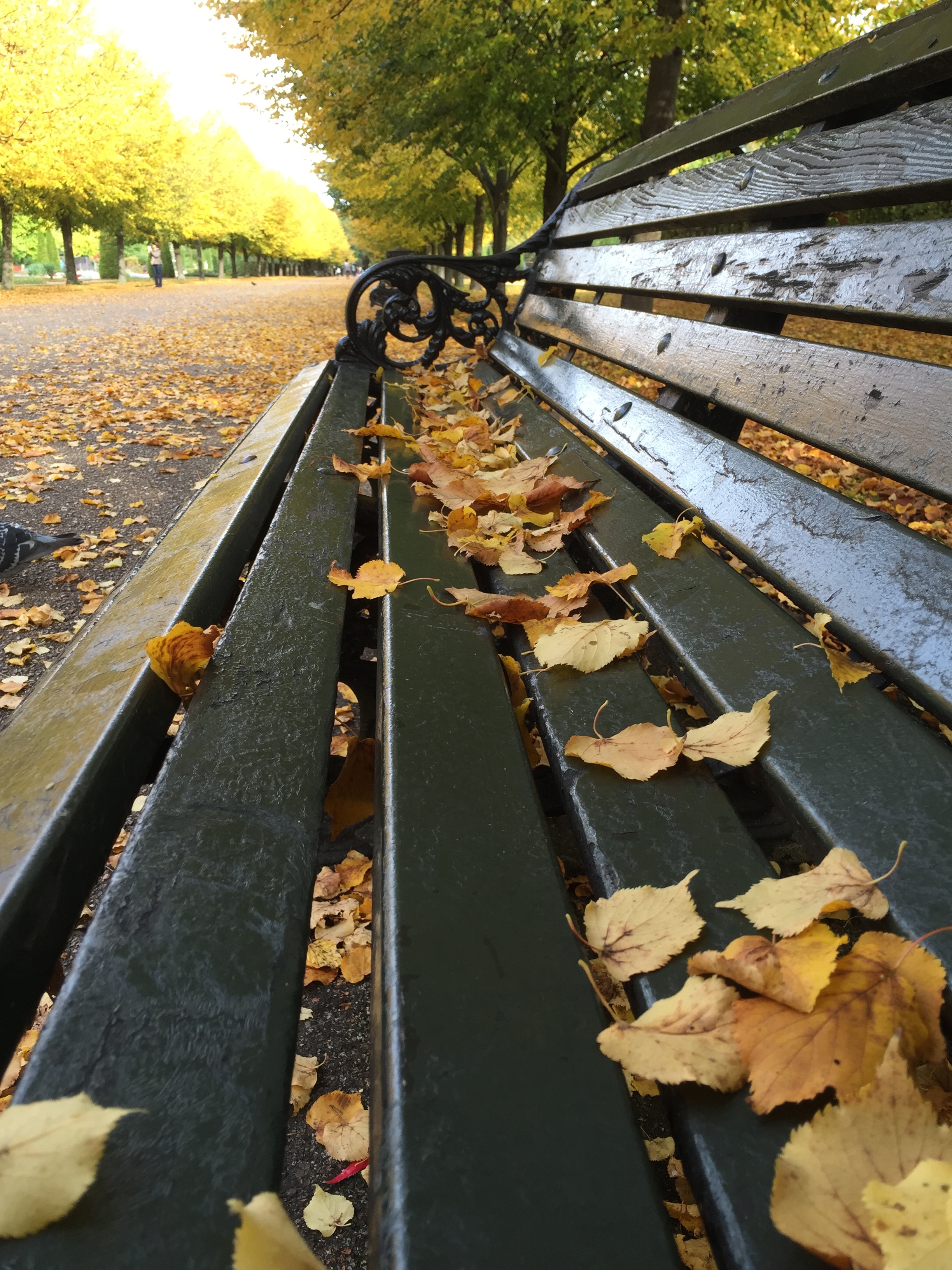
I love the autumn. Not least because, like the Spring, it’s a season when change is most evident. Every morning when I open the shutters and step out into the garden the world around me is markedly different.

I was looking at the variety of shades and colours in the mulberry tree and the vine and I realised I quickly ran out of words. I don’t know if it is true that in some languages there are many different words for snow, but the range and number of colours and shades in one garden! Whew!

It’s astonishing.

I took a bunch of photos and turned them into a little slideshow. I hope you enjoy it. A couple of minutes of delight and “émerveillement du quotidien”.

Read Full Post »

IMG_3445

Marcel Conche says this about thoughts –
To meditate is to be waiting, like lying in wait, for thoughts that are going to surprise us, bringing sudden clarity.
and he quotes Heidegger –
“We will never succeed in having thoughts, they come to us,” said Heidegger
This reminded me of what Liz Gilbert describes in her “Big Magic” about how ideas come to us. She suggests we think of ideas as living their own lives, wandering around the world looking for a partner to work them in order to bring them to fruition. I liked that concept. It’s maybe a stretch of the imagination to think of ideas as entities living their own lives, but then, maybe thoughts are a bit like that too?
Here’s Conche again –
We anticipate, with variable probability, the result of an action, and it is for this reason that we act. Yet we don’t anticipate thoughts. The philosopher is, in this regard, similar to the artist. Thought is “work of a poet,” said Heidegger.
Again and again he suggests the approach of the artist – not least because he sees Nature as a continuous creative process.
Liz Gilbert says we need to turn up every day prepared to do the work. She describes what others have called the “discipline” of the writer, but that’s not a word that’s ever had much appeal to me! Maybe we could call it a habit? (or what I’d tell patients about making better dents!)
Conche says that what we need to encourage thoughts to come to us is a kind of ease (an absence of anxiety), and setting aside any preoccupations with our selves.
What is required so that thoughts come to us? First, the soul must reach “freedom from anxiety” (ataraxia), serenity, a sort of negative happiness that we can call “wisdom”—a wisdom that is not the aim of philosophy, but its condition. Then and correspondingly, preoccupation with oneself must be absent.
Ha! Did you ever watch the movie “What about me?” by 1 Giant Leap?

Read Full Post »

IMG_3131

I only recently stumbled across the work of Michel Conche, the French philosopher.

He says this about Nature – that Nature is like an artist. Nature is a poet, continuously improvising and creating.

I like that.

In one of his works where he writes about the Tao Te Ching, he says

The Tao Te Ching allows the artist and the philosopher to live according to Nature, to place their confidence in the flow of things, to be led by inspiration, unlike the man of action who attempts to master Nature and the course of things through calculation.

The reference to “the flow of things” particularly resonates with me. As does living a life “led by inspiration”. But the phrase “unlike the man of action who attempts to master Nature and the course of things through calculation” really struck me. It immediately made me think of the definition of the scientific method which I saw a student on the train learning years ago – “Observation, Description, Explanation, Prediction, Control”. And it reminded me of the left hemisphere approach to the world which is described so clearly in Iain McGilchrist’s “The Emperor and His Emissary” – how we use that half of our cerebral cortex to analyse, measure, categorise and “grasp” things.

Conche uses this language of the “man of action” vs the “artist”, not to suggest that artists don’t “do” anything, but reflecting the thinking of the Tao Te Ching and concepts such as “wu wei

Because he is about to create, he finds himself on the margins of society and fixed forms. If he consents to a paid profession, it is only to earn what is necessary for life and work. Literally, the artist “works without acting” (wei wu wei: Chinese for “non-action”), because, contrary to the entrepreneur who sets an objective for himself and then uses means to obtain it, the artist cannot know in advance what the work will be. He advances step by step, innovating where necessary, incapable of rationalizing his steps.

We’ve lost touch with so much of that “artistic” way, haven’t we? With our emphasis on outcomes, goals and targets.

The man of action is the opposite of the artist, because he wants to know in advance all things concerning his actions, in order to move forward in complete safety. He wants, as much as possible, to avoid risk, which is precisely what the artist cannot avoid. To master Nature and the course of things by calculation is the dream of the man of action; nothing pleases him more than the progress of science and technology. The artist places his confidence in the flow of things, allowing himself to be led by inspiration.

Ha! There’s that thing about fear again! As Elizabeth Gilbert said in her “Big Magic” –

…when I refer to “creative living”….I’m talking about a life that is driven more strongly by curiosity than by fear.

So if we understand Nature as an artist, “led by inspiration”, “driven more strongly by curiosity than by fear”, “continuously improvising”, placing “confidence in the flow of things” – how does that feel?

Doesn’t it feel very different from the view of Nature as a mechanism, measurable, and controllable?

I like this idea of Nature as an artist – becoming not being!

Read Full Post »

I came across a very short video the other day which both delighted and moved me. It is truly magical. There are no words in it but a little story is told. I think it’s the gestures of the station mistress which make this so incredibly powerful. We have no idea what she is saying to the train driver but her hands and movements are so expressive you can’t help but be entranced by her. Then when the train pulls away, what she does is just…..well, look for yourself……

It was posted onto Facebook by Kyoto Journal (which I like a lot!) Here’s what the film-maker, Erez Sitzer, says about it –

i was searching for a train station. the kind you rarely see. small. countryside. we found it. and by happenchance, found something else. someone else. miyako. the station master. i watched her smile at each exiting passenger. then, noticed her wave at the departing one-car train. then, surprisingly, she continued waving. she waved until there was no trace left of the distant train. no one witnessed her, except, well, me. in that short span, my love and wonder of life was renewed. when i spoke to her later, she said at first she felt so shy. and hardly waved at all. slowly, over time, she began doing something she neither needed to do, nor imagined she ever would. so, this is miyako, master of a tiny station in the middle of nowhere japan who attends to every train and passenger that passes by


Read Full Post »

IMG_3419

Elizabeth Gilbert’s book, “Big Magic”, is about “creative living”. What is that?

…when I refer to “creative living”….I’m talking about a life that is driven more strongly by curiosity than by fear.

Well, I think that really is a key – we are so driven by fear, and fear is used as such a tool to control whole populations these days. To be driven by curiosity rather than fear strikes me as likely to completely alter our view of the world.

Take health care for example. So much health care is generated by fear – fear of dying, fear of getting cancer, fear of getting this disease, or that disease. It creates a whole ethos and it’s sure not a positive one. What if we underpinned our healthcare with curiosity instead? What if we consciously sought out experiences which were nourishing, nurturing, stimulating, life enhancing? Would that lead to healthier lives instead of lives of avoidance?

I do believe a creative life is a richer life. Here’s what Elizabeth Gilbert says –

A creative life is an amplified life. It’s a bigger life, a happier life, an expanded life, and a hell of a lot more interesting life.

That reminded me of a book I read a long time ago – Robert Solomon’s “Joy of Philosophy” – where he juxtaposes a “thin” life with a “passionate” one. His use of the metaphors of thin vs thick throughout that book struck me as original and clear. Who wants a “thin life”?

Elizabeth goes on to explain in a little more depth what she means by “creative living” –

The universe buries strange jewels deep within us all, and then stands back to see if we can find them. The hunt to uncover those jewels – that’s creative living.

Ooh, I love that. What a lovely metaphor! We really do all have unique and wonderful treasures buried within us. In fact, I don’t think it is possible to fully mine the depths of any individual human being, but what jewels lie there waiting to be discovered when we take the time to explore!

The courage to go on that hunt in the first place – that’s what separates a mundane existence from a more enchanted one.

Yep, it might take courage, but what else are you going to do with all that fear that is thrown at you in this world?

And who wants a “mundane existence”?

Read Full Post »

« Newer Posts - Older Posts »