Is there anything more thrilling than witnessing or participating in creativity?
Whether it’s watching day by day as a seed grows into a full blossoming flower, or seeing a child acquire new skills through play and experimentation, acts of creation surround us.
We are a process of creation.
Every day we wake up changed, with new cells, new thoughts, new visions, new hopes and ideas.
Bergson wrote –
The more we study the nature of time, the more we shall comprehend that duration means invention, the creation of forms, the continual elaboration of the absolutely new. (L’Évolution créatrice, 1907)
This way of thinking puts creativity at the heart of all Life. Creativity is just something which artists have. It’s how we live.
As Michael Foley writes –
This idea, that Life is its own creator and that creativity is not a late aesthetic refinement but the very principle of existence, was Bergson’s most radical and inspiring insight.
To see the universe as a creative process, stretching from the earliest formation of stars, through the appearance of galaxies and nebulae, to the creation of Earth and the emergence of life……isn’t it breathtaking?
Stuart A. Kauffman, sounding exactly like Bergson:
‘In the new scientific worldview I’m describing, we live in an emergent universe of ceaseless creativity in which life, agency, meaning, consciousness and ethics . . . have emerged. Our entire historical development as a species . . . has been self-consistent, co-constructing, evolving, emergent, and unpredictable. Our histories, inventions, ideas, and actions are also parts of the creative universe.’
Creativity is not just about art as practised by gifted, or professional, artists.
It’s our every day reality.
We, every one of us, is engaged in a continuous process of co-creation of our universe. A universe that grows, evolves and develops.
What makes creation thrilling?
Awareness.
The conscious awareness of it. Try it for yourself today.
See if you can notice the unfolding creation of the new.
Or perform a creative act. Make something. Express yourself.
Or notice how what you are doing involves creativity, as you make something new, bring something new into this universe.
September’s issue of Philiosophie magazine has an interview with the Japanese author, Kenzaburô ôe who won the Nobel Prize for literature in 1994.
It’s a fascinating and striking article. He has been a controversial figure in Japan because of the subject matter of his novels, one of which challenges the official version of what happened in Okinawa at the end of the Second World War. Officially, 100,000 Okinawans committed suicide claiming loyalty to the Emperor rather than be over-run by the invading Americans. Kenzaburô says this is a lie. He says the Imperial Army massacred the Okinawans and they died called for their mothers, not swearing loyalty to the Emperor.
He has also shone a clear light on the reality of life for those who survived the blasts in Hiroshima and Nagasaki. Telling their stories shows how these particular bombs didn’t just kill and wound when they were dropped, but continue to damage those who survived right into the present day.
It’s no surprise then to read that since Fukushima he actively campaigns for the abandonment of nuclear power in Japan.
A big part of the story of his life is the birth of his son in 1963. Hikari was born with a severe brain defect and his parents had to decide to either let him die, or have an operation which would likely leave him severely mentally handicapped. They chose the latter. In addition to his severe handicap he has autism and he didn’t speak until he was six.
His first words were actually a sentence. The family was walking in the forest and at the sound of a particular bird call, Hikari said, in exactly the same way a radio presenter of a nature documentary would, “that is the call of the (such an such bird)” – and it was! After that his parents started buying bird song CDs and Hikari learned them all. They moved on to music, playing him Bach and Mozart, and were astonished to find, as he got older, that he could transcribe into musical notation perfectly any piece of music after hearing it just once. More than that, he went on to compose his own music.
Kenzaburô says his son has never expressed any emotion but his music is deeply emotional. His first CD sold 400,000 copies in Japan.
Kenzaburô’s daily life is spent in his study reading and writing, while his son sits by him listening to, and writing, music.
A remarkable man.
Right at the end of the interview he says of creative work that it is important to find your own voice, or your own style – to be careful not to “get lost in the universal”.
I like that a lot. Too often we lose our singular uniqueness by trying to be accepted, or to fit in, or to be popular. Isn’t it more important to be the one unique person who only we can be?
Do you have a favourite place to sit? And what do you do while you are sitting?
When I was a busy GP in Edinburgh I’d often drive through Holyrood Park on the way from one house call to another, or one clinic to another, and if I saw someone sitting on one of the park benches….just sitting….I’d get a sudden longing. I’d think “How great to be able to just sit”.
In our busy lives, we’re always doing. In the midst of that we are encouraged to “live in the present moment”, to learn to be “mindful”, learn how to meditate, learn to “soyez zen” (as I’ve heard it said so often in this part of France).
I know it’s important to be active but I also know it’s important to slow down sometimes (I have a whole series of posts on verbs…. Here’s one on slowing down) . Yes, maybe to meditate. Maybe to focus on my breathing. Maybe to day dream even.
Sometimes I go outside and sit down under the mulberry tree, listen to the birdsongs around me, look at the blues and greens and other colours in the world around me, breathe deeply and fill my lungs with the clear air, close my eyes and feel the warmth of the sun on my skin.
Sometimes I practice some form of meditation, sometimes Heartmath, sometimes I just let my consciousness flow, drifting from a sensation to a feeling to a thought.
I find some of my best ideas arise in those moments and I’m reminded of David Lynch talking about TM and diving for the big fish….
ideas are like fish. If you want to catch little fish, you can stay in the shallow water. But if you want to catch the big fish, you’ve got to go deeper. Down deep, the fish are more powerful and more pure. They’re huge and abstract. And they’re beautiful. Everything, anything that is a thing, comes up from the deepest level. Modern physics calls that level the Unified Field. The more your consciousness – your awareness – is expanded, the deeper you go toward this source, and the bigger fish you can catch.
Seriously, if you are busy doing all the time, you aren’t going to catch the big fish! Pull up a chair, sit on that bench, and “take a moment”. Who’d have thought it? Moments are there for the taking!
Clearly in the spaces between the stones of this wall, a spider has found a place and made it his, or her, own.
When I saw this is inspired me in a number of ways.
Firstly, isn’t it amazing how Life appears everywhere on this planet? If its not an animal, bird, or spider, it might be a plant, a moss, a lichen, or, invisible to the naked eye but living probably everywhere – single-celled organisms like bacteria. There just doesn’t seem to be anywhere on Earth too inhospitable for Life. There is such a tremendous diversity of habitats.
Secondly, how opportunist Life is. What might seem the smallest possibility can be seized quickly. “Seize the day!”
Thirdly, how creative Life is. Look at this web. Isn’t it astonishing? Just how does something as small as a spider manage to create such a perfect structure – perfect for its purposes of protecting eggs or trapping food – and at the same time, perfectly beautiful?
Fourthly, as a Scot, I can’t help seeing things like this and remembering the story of Robert the Bruce who, it’s said, watched a spider try and try again to make a web in a particular cave and was inspired in his own life to always “try and try again” – to never give up.
Finally, it made me wonder about how we create a home and how we create a niche for ourselves.
It jumped out at me because for a long time I’ve become very disatisfied with the contemporary emphasis on hierarchies, bureaucracies, organisations and societies modeled on machines. The mechanical model with all its emphasis on measurement and its basic assumption that nothing is more than the sum of its parts has been useful in some ways, and remains useful in some areas of life – parts dealing with machines!
But when it comes to Nature and, in particular, to living organisms, that model just does not add up. With sufficient power and resources the mechanical model can be imposed on natural systems – but only for a while. Eventually, the mechanical model diverges too much from natural reality to be useful.
That’s where we are now – our economies, our societies, our systems of health care and education, our politics – are all being changed as the network model undermines the hierarchies.
With new information, communication and collaboration technologies we have more and more opportunities to work with others to create different ways of learning, different ways of healing, different ways of living.
That’s pretty exciting but for many people it’s more frightening than anything else. We have to support each other to build our ability to hope and to innovate or we’ll remain suppressed, controlled and stuck.
It’s going to be fun to imagine and create our new ways together. Are you up for it?
I’ve reached “Y” again in my “A to Z of Becoming”, and the first “becoming” verb I thought of for the letter “y”, was “yearn”.
This is a tricky one, because yearning has a bit of a bad press. It’s often associated with wanting what you don’t have, or, in other words, with dissatisfaction. But I think it emerges from something very positive and creative.
When we yearn for something there is the possibility that we are getting in touch with our heart’s desire. The French philosopher, Deleuze, whose writings were the original spark for this blog, talked of “lines of flight” – and interesting metaphor to change the way we think about things. When we look up at the sky and see a plane flying past the moon
, we can see a bit of a trail. We can see something of where it’s come from and what direction it’s heading in. It’s an image like that which came to my mind when I read about the “lines of flight” and for me it’s an encouragement to see something in its context – the context of where it’s come from and where it’s going.
When I think of yearning from this perspective, it seems to me that yearning arises from our heart felt desires, from our deepest longings. So, one of the benefits of yearning is to become aware of what our heart’s true desires are.
As K D Lang sang in “Constant Craving”
Maybe a great magnet pulls
All souls to what’s true
Do these heart desires push us forward from within, or are they magnets pulling us towards something, somebody, some place?
When you stop and reflect and wonder about what stirs your longings, your yearnings, you have at the chance to get in touch with some of your most heart felt desires.
There’s something else about yearning – it pulls us out of balance.
I know people talk a lot about balance as a good thing, but it isn’t everything. All living creatures are “complex adaptive systems” and one of the main ways that such systems grow and develop is by tending towards the “far from equilibrium” points. At those places the system can fall to pieces, tipping into chaos, or it can transform to a whole new level, as we see in “dissipative systems“. The “far from equilibrium” points are where our yearnings take us.
So, there’s something potentially enormously creative about yearning. It can pull us towards the new and the heart-felt.
Remember John Masefield’s poem?
I must go down to the seas again, to the lonely sea and the sky,
And all I ask is a tall ship and a star to steer her by;
And the wheel’s kick and the wind’s song and the white sail’s shaking,
And a grey mist on the sea’s face, and a grey dawn breaking.
I must go down to the seas again, for the call of the running tide
Is a wild call and a clear call that may not be denied;
And all I ask is a windy day with the white clouds flying,
And the flung spray and the blown spume, and the sea-gulls crying.
I must go down to the seas again, to the vagrant gypsy life,
To the gull’s way and the whale’s way where the wind’s like a whetted knife;
And all I ask is a merry yarn from a laughing fellow-rover,
And quiet sleep and a sweet dream when the long trick’s over.
Or a butterfly if you can’t imagine what an angel might look like!
I read recently that our retinas only register colour in the central 30 degrees of visual field ….the fact that we see a full panorama in colour (even out the edges of our vision) is due to our ability to make up what we are seeing.
Really?
I know that seems a bit incredible, but when you stop to think about it, our eyes convert light energy into electro-chemical signals which are then processed by the neurones in our brains for us to “see” anything, so maybe it’s not such a surprise that we are responsible for “colouring in” most of what we see!
We are incredibly creative organisms with fabulous bodies and powerful imaginations.
Mark Twain said
a person cannot depend on the eyes when imagination is out of focus
Because we are living in a connected universe, everything we do has an impact. Sometimes that impact seems small, and at other times it seems pretty huge. Even what seems a small difference at the moment it occurs goes on to have effects which can multiply and set off chains of events far and wide.
The other day, as I wandered through the streets of Cognac, I was suddenly aware of lots of bubbles in the air. When I looked up to see where they were coming from I saw someone had set up a bubble machine on their window sill, to make bubbles and send them off down the street all day long.
What is it about bubbles that enchants us so?
It seems they induce smiles, a sense of playfulness, and a lightening of the heart.
Thank you whoever set up the bubble machine. The bubbles delighted me.
I wonder what my smiles, my lightness of heart and my playfulness brought into the world….
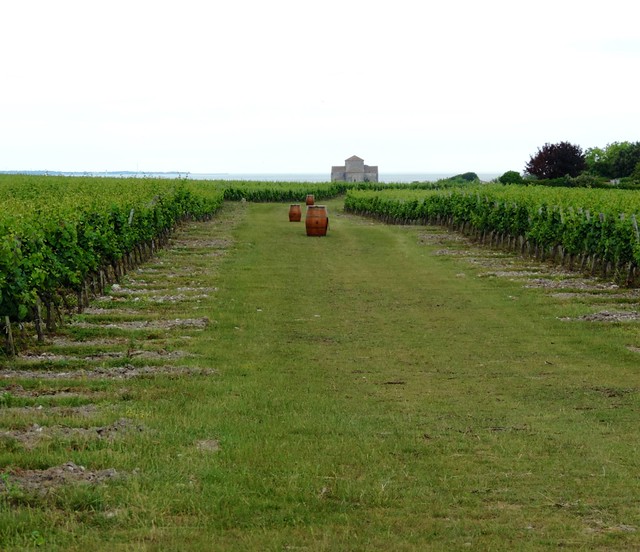
I think you can look at various elements in this photo and be stimulated to reflect on the “life of the spirit” – in the countryside, in the vines, in the barrels!, in the “place of worship”, in the sky, in the sea…..
When I first looked at this photo I heard this song in my head (I like this version from Postmodern Jukebox) –
ooh! And you can FEEL it in this music!
So, how about you? What does “life of the spirit” mean to you?
What stirs the invisible in you?
Voici mon secret. Il est très simple: on ne voit bien qu’avec le cœur. L’essentiel est invisible pour les jeux. Here is my secret. It is very simple: It is only with the heart that one can see rightly; what is essential is invisible to the eye.
I welcome constructive criticism and suggestions. I will not, however, tolerate abuse, rudeness or negativity, whether it is directed at me or other people. It has no place here. ANYONE making nasty comments will be banned.