Feeds:
Posts
Comments

Archive for the ‘creativity’ Category

I’ve long since been drawn to Romanticism. I feel they bring some extra, something deeper, something substantial to the dominant perspectives of the rationalist Enlightenment thinkers. It’s a funny thing, because in many ways I think I’ve lived with a foot in both camps. I trained in Medicine, practised as a General Practitioner for the first half of my career, then as a Specialist in what we came to call “Integrative Care” for the second half. That second half move was enabled by my training in Homeopathy which gave me a different framework to understand individual health and illness, as well as a set of therapeutic tools. We specialised in the care of people with long term conditions at the “NHS Centre for Integrative Care” in Glasgow, with the majority of our patients coming to us for help when they felt orthodox care wasn’t helping them enough. But we had a foot in both camps there, because our hospital was embedded within the Scottish NHS and we had access to all the tools, specialist help and advice of all that orthodox care could offer.

What does that have to do with Romanticism? I’m not sure, but I’ve recently been inspired to explore the Romantics in more depth, because I heard an interview with Eugene McCarraher about his new book, “The Enchantments of Mammon“. He talked a lot about the Romantics and I remembered that Iain McGilchrist had written about them too, so I picked “The Master and His Emissary” off my “most significant books bookshelf” (yes, I do really have such a shelf in my bookcase!), and yesterday sat down to re-read his chapter on Romanticism. One of the first lines in that chapter is

As always it was the clashes of theory with experience that showed up the cracks in the edifice of rationalism.

Well, that’s it in a nutshell……it was the “cracks in the edifice of rationalism” which opened the door to my enlarging my Practice to include a focus on the qualitative, and the “unmeasurable”. And, boy, was that a set of “clashes of theory with experience”!

Then this

Differences are as important as generalities

Now, this must be what became THE foundation stone of my Practice as a doctor. It still makes me a mixture of sad and annoyed when Medicine is conducted as if generalities trump differences every time. There continues to be a real struggle for individuals to have their stories heard and believed, especially when they don’t fit with either “generalities” or “theory”.

The idea of individual difference is central to romanticism

Well, if that is true, then I need to know more about romanticism, because the importance and the inescapable reality of individual difference lies at the heart of my life values.

What’s all this got to do with the photo I’m sharing today? Well, I just read this line

The Romantics perceived that one might learn more from half-light than light

OK, I’ve taken it out of the context of the rest of the chapter but Iain is arguing that a difference between the left and right hemispheres is that the left wants certainty, clarity and exactness, where the right is more interested in the whole, in the synthesis of opposites, in the distance between where we are and where we can almost see.

There’s real beauty here. There’s mystery and enchantment. There’s wonder and amazement. Well, I just love all of that.

Read Full Post »

Three elements in this photo induce me to think about dreaming – sunset, a plane trail, and the moon (yes, look closely, she is there!)

We associate dreaming with sleep, even if we often wake up, knowing that we have been dreaming but have not a single memory of what it was we were dreaming about. Don’t you think that is strange? That the brain can be so active while we are not awake, creating images and whole stories for us to experience, yet somehow so little of that reaches the level of memory. There’s this annoying phenomenon of the first thought on waking – if your first thought is about the dream you were having, then you have a good chance of remembering at least a part of it. But if you are woken by an alarm, or your radio, or somebody wakes you and says something, then the dream is gone. It’s like you have one shot only to recall what you’ve just been experiencing inside your own mind just minutes ago. Turn your attention outwards, and the opportunity is lost.

We don’t only dream during sleep of course. “Day dreaming” has a bit of a bad press. It’s often condemned as distraction, as not paying attention. Or it’s dismissed as fanciful, not useful, not real. But I’m really not sure that dream processes only occur during sleep. After all they aren’t under our conscious control, are they? (lucid dreaming practices aside) So why should we think they aren’t happening below the level of consciousness all the time? Do we need to be asleep for dreaming to occur? I’m not sure that we do. Let’s imagine for a moment that dreaming goes on all the time. Is that where sudden insights come from? Is that where apparently random thoughts come from? Is that where we find inspiration, find our “muse”, tap into our creativity? I think, perhaps, it is.

Our dreams are sometimes thought of as goals or aspirations. They are focused on the future, and suggest new destinations for us to reach for. I’m not a big fan of goals. I think they’re rather over-done. After all, the future is never predictable in detail so what seems a relevant goal now, can become quite irrelevant by the time we get there. And life flows on a continuum. It isn’t broken into discrete, separated parts. Maybe a goal can be thought of as the end of a chapter in an ongoing story, but there’s a danger that goals are seen as conclusions. I’m sure lots of people like to have goals, and find them very useful. They can certainly give us something to progress towards, something to aim for. And if they do that, then fine. They can be motivating and they can help us to focus. And that’s good too.

So, I’m not against goals. I just don’t think they are ever enough. We need more than goals. We need dreams, we need free-floating thought, and we need to keep our eyes open for the whole picture, for the contexts and consequences of our ideas and aspirations.

I suppose I’m saying we need both – to be focused, and to be free-floating. Strangely, dreams can be both of those things at the same time.

Read Full Post »

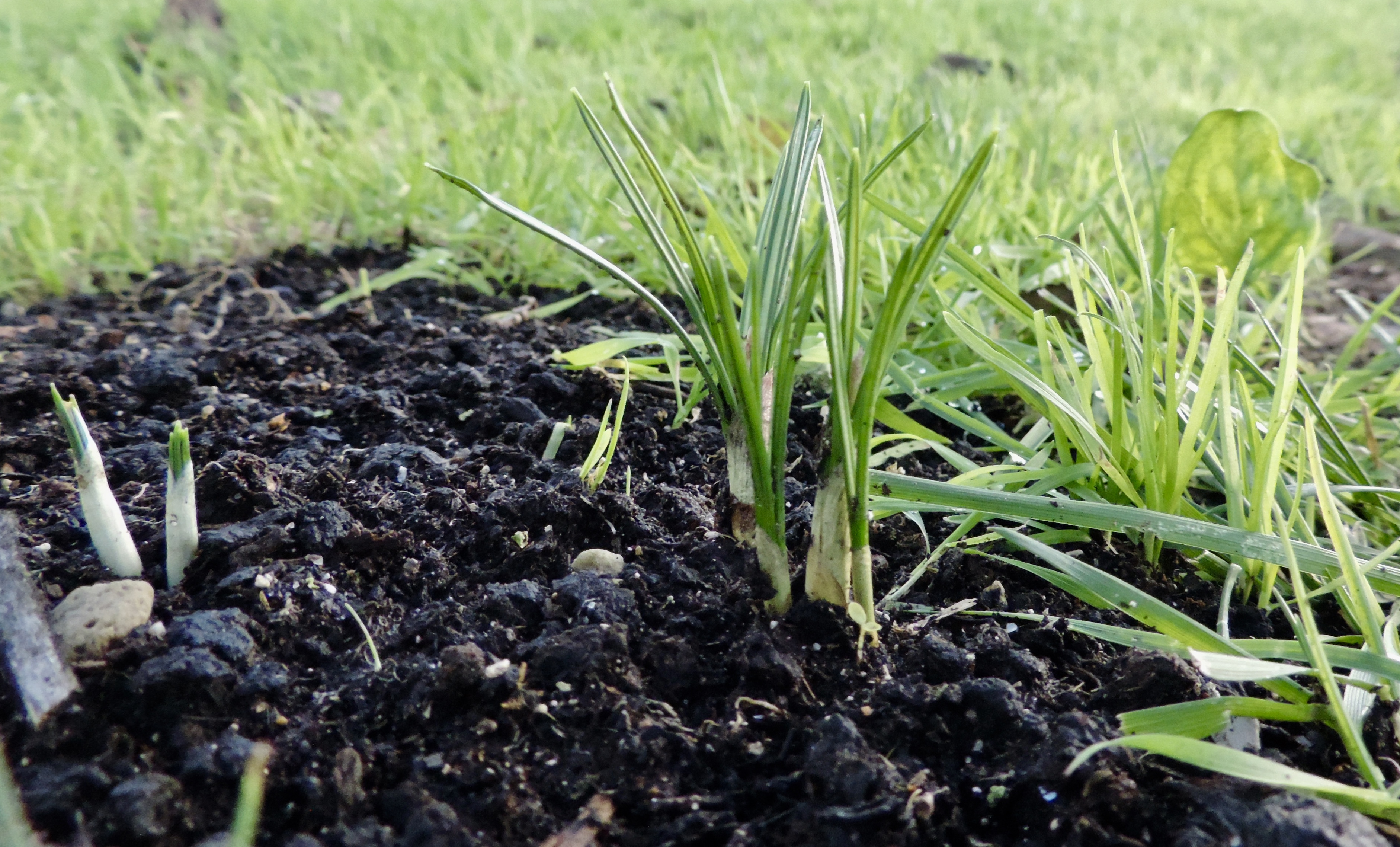
I tend to associate new growth with the Spring, but, these crocus plants popped up from under the soil through the month of December. I took this photo on December 24th last year, and so far, on the 6th December, as I write this, there is no sign of them yet.

But that just reminds me – that creation is going on all the time. The phase, or season, or time of new and emergent growth is not limited to the Spring. It’s not limited to any single season, any particular month, or even any specific day.

We have a great tendency to chop the flow of life into pieces. We did that when we invented measured time – by making clocks and “time pieces” with their minutes and their hours. We weren’t even satisfied to stop there, but chopped the minutes into seconds, driving everything faster and faster, measuring this thing we call time in ever shorter, ever smaller units.

The thing is – those units are a human invention. Time flows in Nature. It flows continuously, the way a river does. Time is experienced by each of us in different ways. It flies past when we are enjoying ourselves, drags when we are bored, can’t pass quickly enough when we want to escape. However, the one constant is…..time is continuous. And so is creation.

The other thing this image provokes in my mind is how much is going on that we just don’t see. Are these crocus bulbs lying sleeping, unmoving, unchanging under the dark soil, then in a flash they turn into green shoots stretching towards the Sun? Nope, it’s not like that. But life often seems like that to us because we invent disconnections. In reality change, growth, development, maintenance, on the one hand, and dis-integration and dying on the other, are happening all the time, and all at once. They don’t fall into nice neat boxes. Nothing in life does.

I like the feelings which arise when I think of this – I like the focus on flow, on continuity, connectedness, on the whole, on change, and on invisibility. They bring me joy, delight, and wonder. Hey….so do little crocus plants shooting up from under the black earth!

Read Full Post »

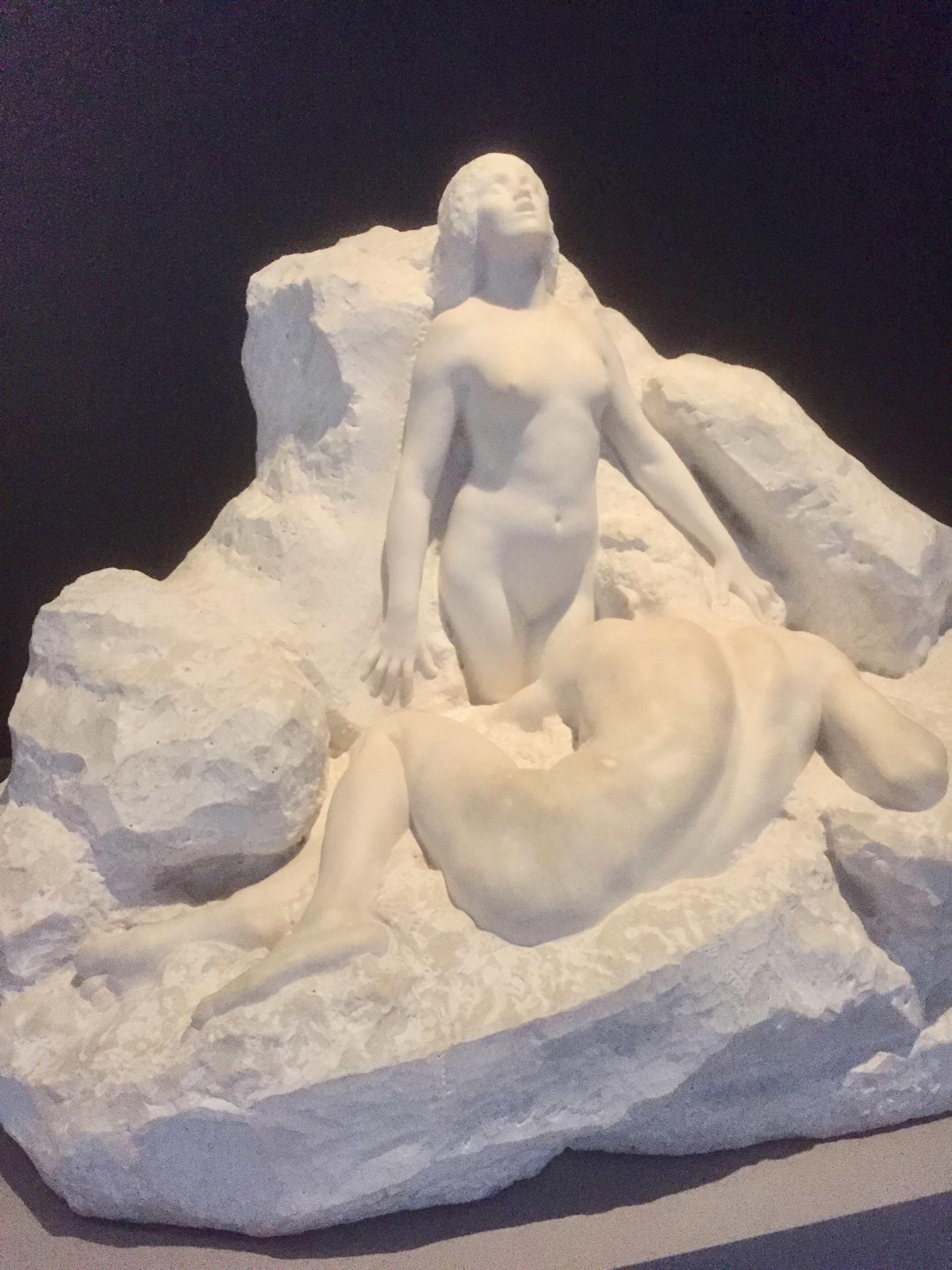
This sculpture in the Glyptotek Museum in Copenhagen is called “Creation Fantasy”, and it’s by a Norwegian-Danish sculptor called Stephan Abel Sinding.

It reminds me of some of Rodin’s work, not least the “Hand of God“, which is one of my most favourite of Rodin’s works.

I love how the male and female bodies are emerging from, but are not separate from, the rock. It think this captures a deep truth – that we are not separate from the Earth, not separate from “Nature”, not separate from each other. But instead we emerge within all that exists, and we remain forever, embedded in everything. I think one of the most pernicious beliefs human beings have adopted is the notion that we humans are “apart from” not “a part of” Nature, that Nature is something “out there”, maybe even something to go and visit from time to time. Worse still, that The Earth and all that “out there” Nature is a resource to be plundered, consumed, polluted at will, as if none of that activity will affect “us”, we humans, because we are outside of Nature.

I hope we are beginning to move away from that terrible misconception. I hope we are beginning to KNOW that we emerge within Nature, and that we live inextricably within all that exists.

It reminds of me of the “Universe Story” – which tells how all the elements of the Periodic Table were created in the giant furnaces of stars throughout the universe, and how once the Earth was formed, all the elements which had been created in distant stars were gathered together, almost like being dealt a hand in cards. How every material substance which has ever existed on Earth has been made from those initial elements. The Earth doesn’t create new elements. She transforms what she has into every molecule, every cell, every organism, every substance which we find on our one small blue planet.

This sculpture makes me think of something else – the relationship we have between men and women. It seems to me we need to learn from sculptures like this one. For far too long we’ve built civilisations and societies on the basis of male dominance. It’s well past time to redress that imbalance and create more loving, more respectful, more mutually nurturing relationships between the sexes.

So, there’s my “Creation Fantasy” – that we are called to live by – that we humans emerge within Nature on this single planet, and that men should not dominate women.

Read Full Post »

I can’t stress too highly the importance of art in life. We seem to be the only creatures on the planet who have the immense creative powers to produce drawings, paintings, sculpture, poetry, stories and music (OK, I know, there are other arts you can think of, but I’m just choosing these ones today)

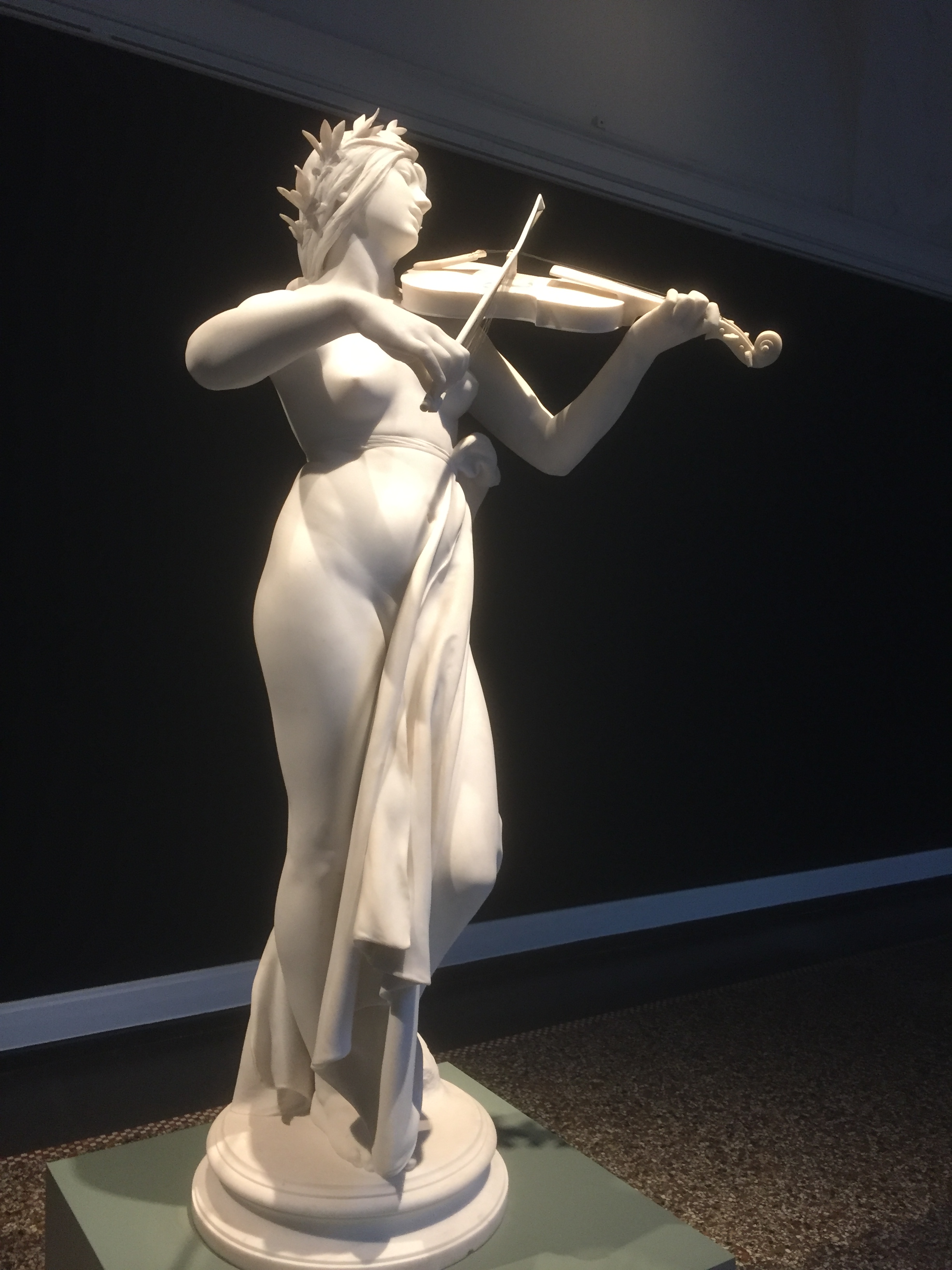
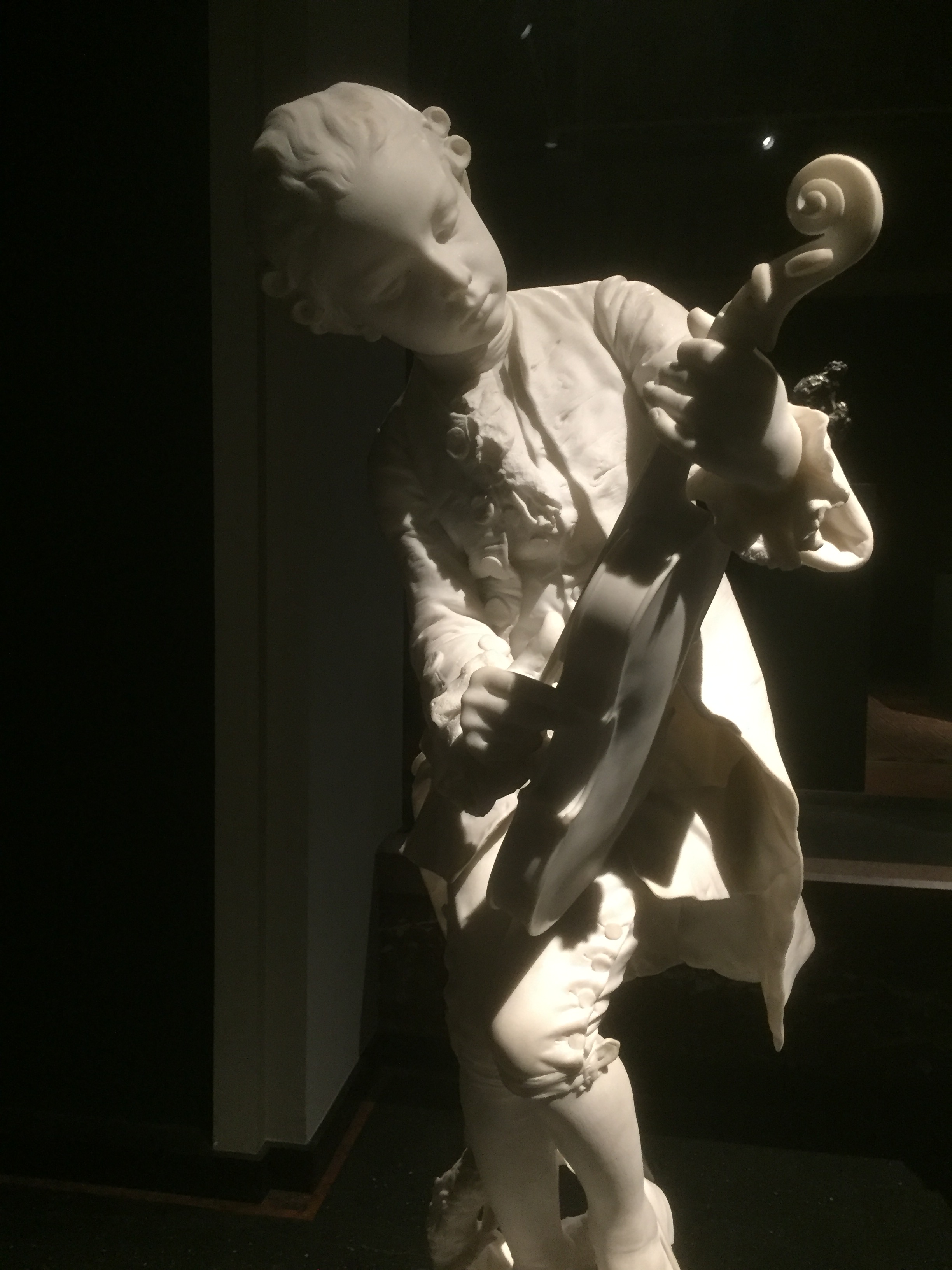
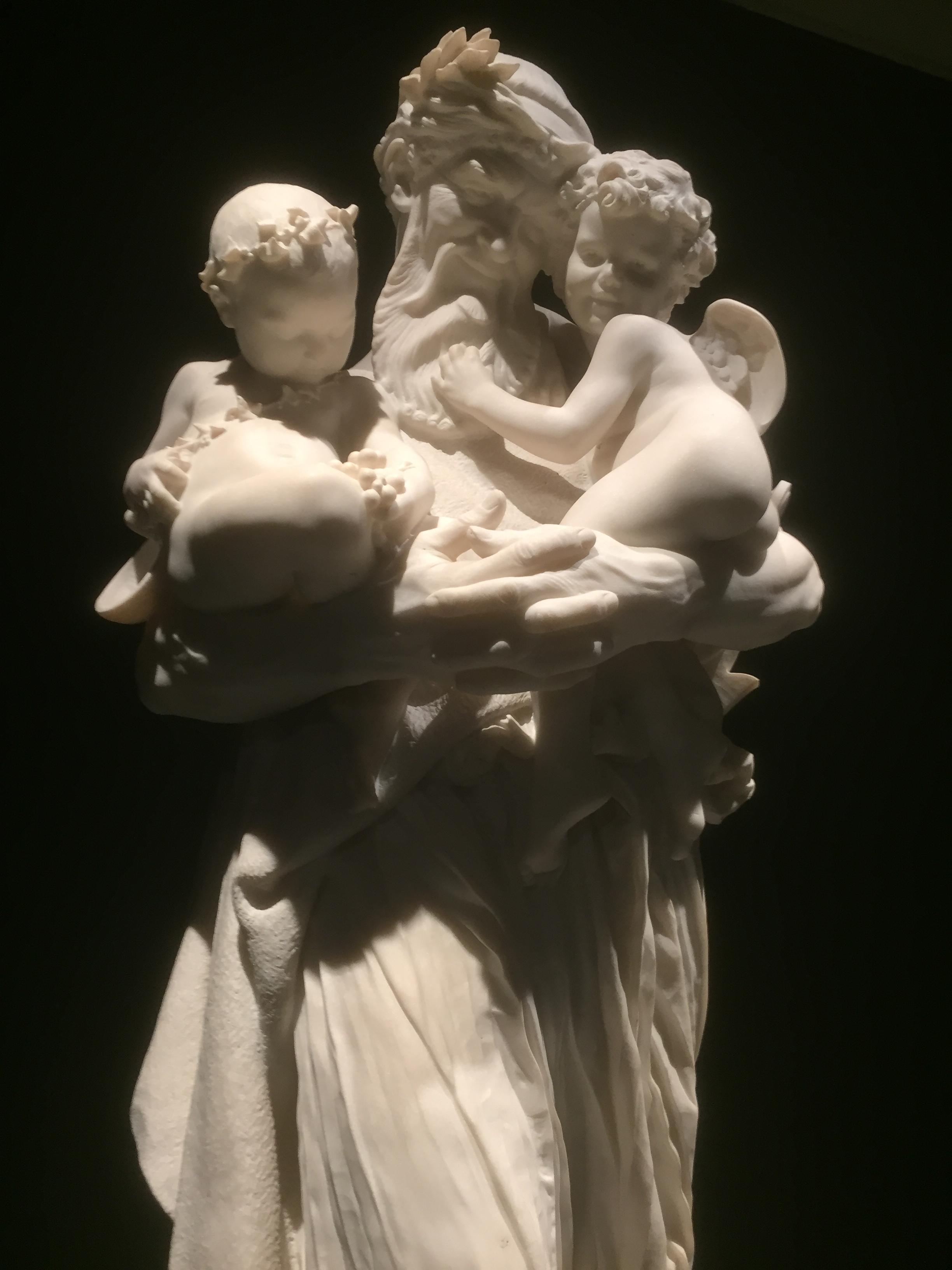
In the Glyptotek museum in Copenhagen you can find these three sculptures in a room filled with many similar gorgeous works of art. Part of the beauty we experience when we look at these images is created by the way the works are lit (and there’s another layer of creativity between my experience and yours because I’m the one who took these photographs).

At the top, are two sculptures about music. Look at the violins, the bows, and the musicians fingers….all carved out of blocks of marble. Aren’t they incredible? The one on the right is titled “Young Mozart”, and I’m afraid I can’t remember the title of the one on the left (if you know, maybe you could let me know in the comments?)

I read in Iain McGilchrist’s “The Master and His Emissary”, that one theory of language is that human beings sang before they spoke. It seems there is some evidence to support the idea that the first humans created a variety of sounds, and only later, turned some of those sounds into spoken language. Written language followed a long, long time later. Also, in his book, he explores how music works, not as a collection of notes, or moments or sound, but as a combination of notes and silences between the notes. When you stop to think about music it’s incredibly difficult to pin down what seems so simple – where is the music, actually? It’s not in the notes by themselves. It’s not in the spaces. It’s in the whole – in the phrases, the bars, the themes, the entire melody and the rhythm. I love how it seems to resist reduction – you can only appreciate it, and enjoy it, when it’s whole.

Another thing about music is how personal it is. I bet you had the experience when you were younger of your parents just “not getting” the music you enjoyed. Perhaps always telling you to turn it down? Or saying “That’s not music!” Then as you got older, if you’ve had children of your own, you might find they like a lot of the music that you like, but I bet you’ll also find that they enjoy some music that has you saying “That’s not music! Turn it down!”

Music is intensely personal. It’s one of the best, most powerful ways, to evoked memories. A certain song can take you right back to a particular moment years ago, or can evoke all the feelings you have for a loved one. It stirs us, moves us, changes our entire physiology, affecting our breathing, our heart rate, the mobilisation of chemicals and hormones in our bodies. It affects our muscles, our movement, our stomachs.

I saw a short piece on French TV recently about Melody Gardot, who at age 19 had a serious bike accident. She was in hospital for over a year and had many difficult neurological problems. At one point a doctor suggested music therapy and her mother bought her a guitar. She taught herself to play it, started writing songs, and made a full recovery. She is now an internationally famous, beautiful jazz singer. Check her out. Quite a story! And such beautiful music!

The lower photo above is of Anacreon the poet. Poetry, like music, is handled mainly by the right hemisphere of the brain (whereas language, words stories are largely handled by the left). Poetry is closely related to music. It’s not about conveying instructions or information. It evokes emotions, changes our bodies the way music does, and also has the power to evoke intense memories. In this sculpture, Anacreon has two infants in his arms….and doesn’t he so obviously love them? They are Bacchus and Cupid. Bacchus is the God of Wine, and Cupid the God of Love. Well, not hard to see why he loves them so, huh? Bacchus is also known as Dionysus. You can read a bit more about him here. He’s the God of a lot more than wine. Cupid, the God of passionate desire, of affection and attraction.

Finally, here’s an interesting fact connected to this issue of how our two cerebral hemispheres engage with the world in different ways. Iain McGilchrist’s thesis is that we’ve become a bit stuck in our left hemispheres and we need to develop a better integration of the two halves. One way to do that might be to consciously use the right hemisphere more – so, what better way than to start with spending more time each day listening to music and reading poetry?

Read Full Post »

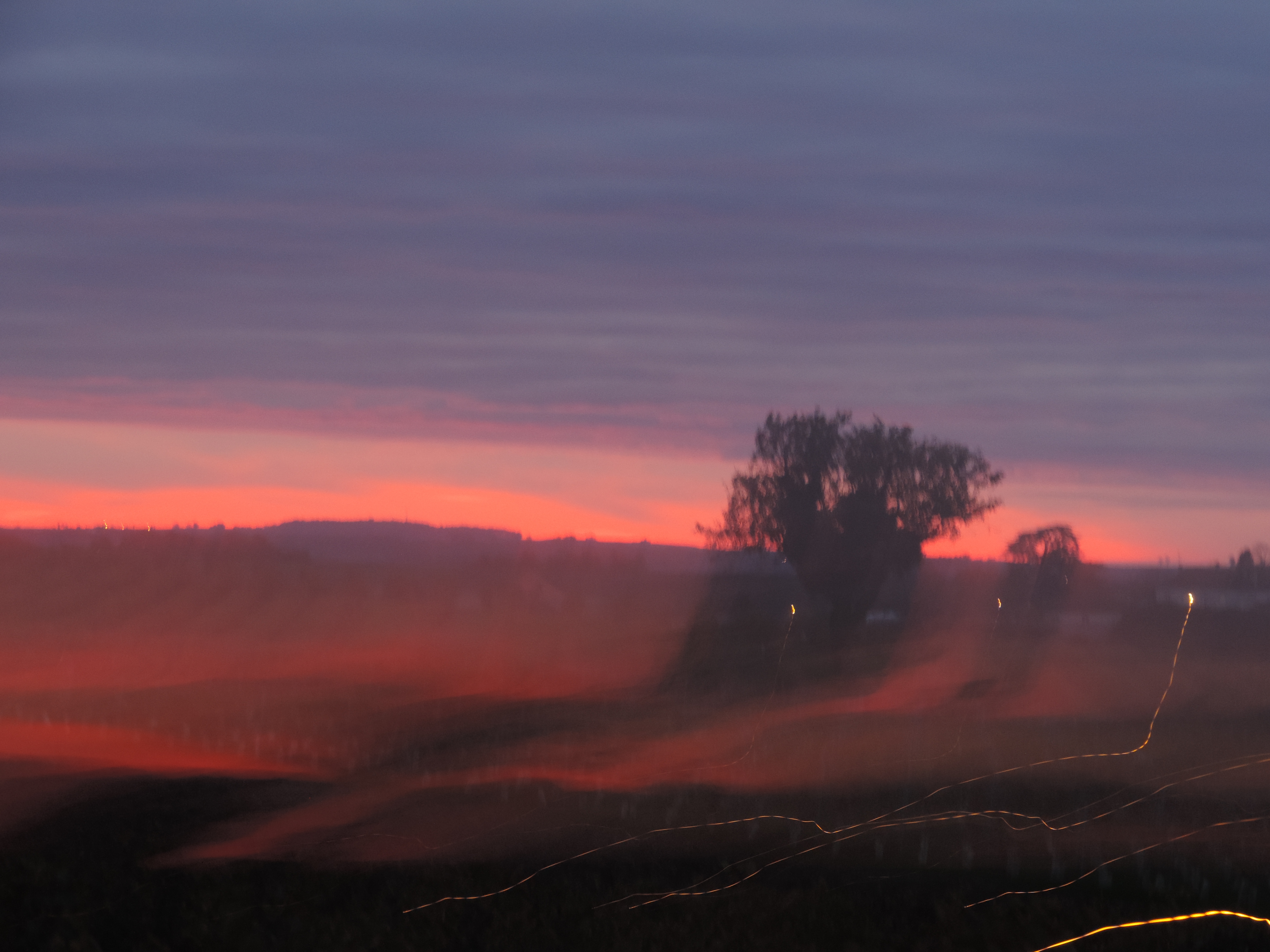
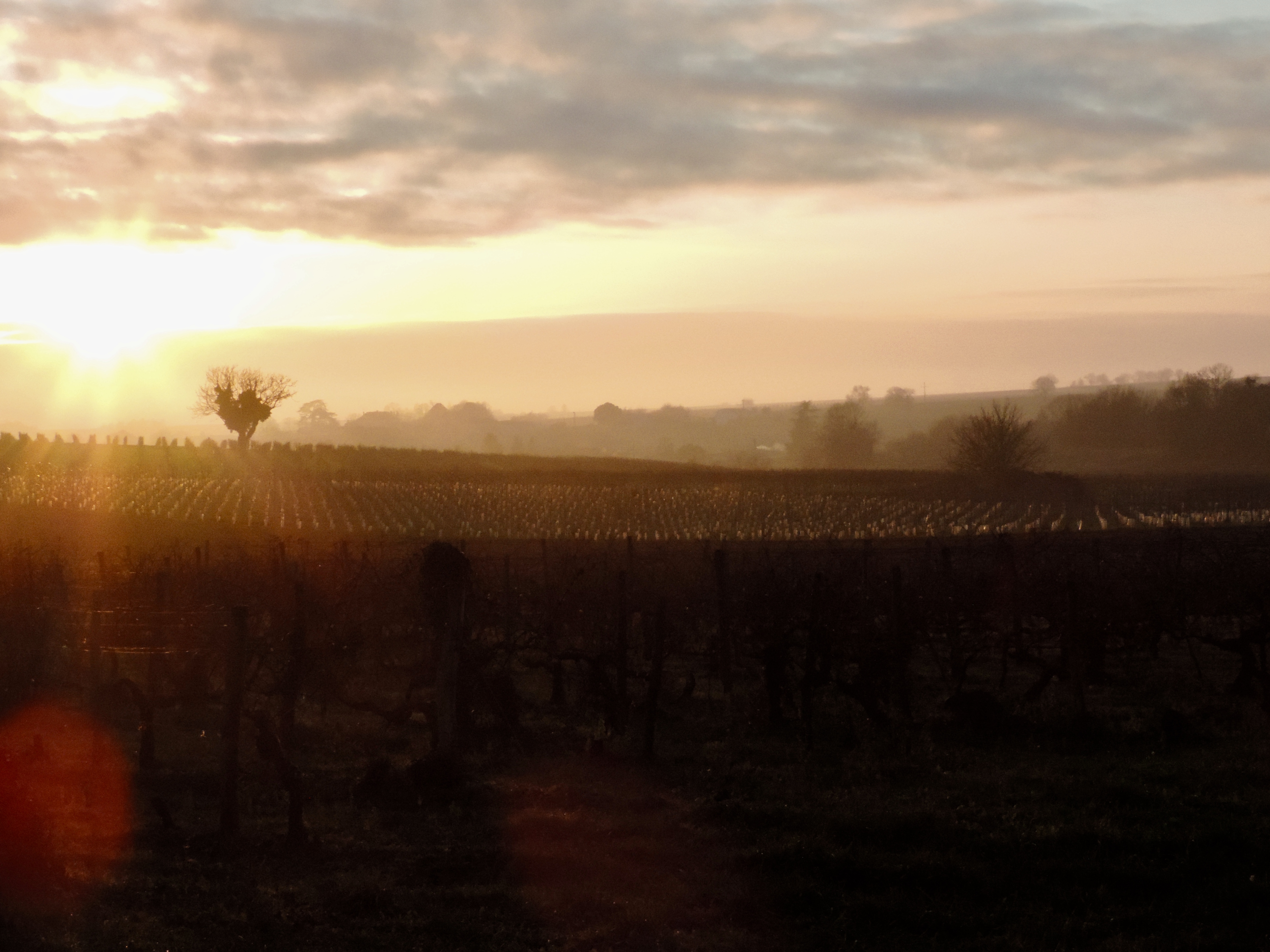
I took this photo of a sunset with a long exposure time and my hand moved a bit but when I looked at the result I really liked it.

OK, it’s obviously not exactly what I saw as I looked out over the vineyards that evening. In fact, it’s almost more like a water colour painting than an exact representation of what I could see with my eyes. But don’t you think that makes it, somehow, all the more appealing?

We have a tendency to prefer clear boundaries, to be able to pick out an object or an individual as separate from all the others, in order to recognise them, to name them. This recognition and categorisation skill takes us a long way. Such a long way that we tend to forget the power of fuzziness, the reality of uncertainty, and the unavoidable fact of dynamic change.

Nothing exists in isolation. Everything changes all the time. The future is unpredictable with any accuracy when we pay attention to the details, to the unique and to the individual.

Seeing how everything flows into everything else, how there are streams of substances, energies and information flowing through us and everything else constantly, streams which form us, which we process, which flow through us on into the future and into other beings and other objects.

We need that skill too. That ability to shift our perspective away from labelling and categorising to flows, to connections, relationships and uniqueness.

Maybe that’s why I find this image so beautiful. Because reality can’t be fully understood as made up of separate “bits”.

Read Full Post »

I’m convinced the images we encounter daily influence what we feel, what we think and how we behave. In fact, I don’t just mean images such as artworks, adverts or photos. I mean how things look – including the shapes and sizes of buildings, the presence of trees, flowers and bushes, the colours of walls, the landscape or the cityscape, depending on where we live, and the decor, light and shapes of the rooms we live in, as well as the objects which surround us.

All of these images influence us deeply, and, largely unconsciously, creating moods, emotions and feelings which stimulate or inhibit well-being, and which change the course of our lives.

One dramatic example of that is in hospital design. There is a lot of research about this, but, to give one example, it was found that patients who had a view of nature from their hospital bed recovered more quickly, needed less painkillers, and had less complications than those who only had a view of a wall.

Of course the advertising industry is well aware of the power of the image. These days there is even a specialist area of knowledge and advised described as “neuro-marketing” which seeks to employ the findings from neuroscience to persuade customers to buy certain products. These things work at the level of image, sound and smell. Mostly, they work unconsciously.

So, I think it’s good to notice our here and now, our everyday reality. I think it’s good to be aware of the images we absorb as we work, play and relax in our home and shared environments.

Taking photos is a good way to become aware. When you look around, or go out somewhere with a conscious intention of photographing what you notice, then your awareness is automatically heightened. These days most of us have smartphones which are more than ably equipped to take photos. You don’t have to have a fancy camera.

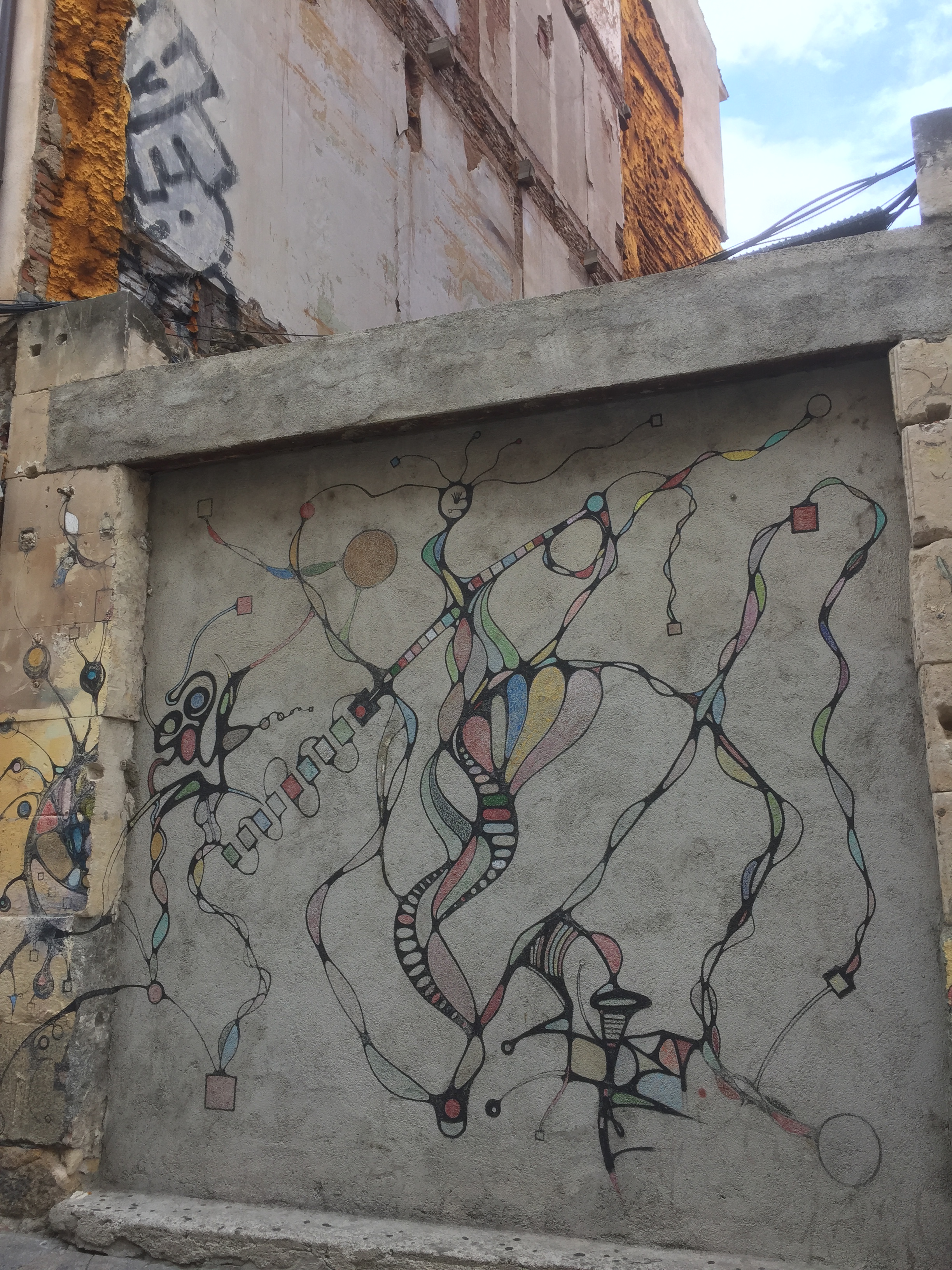
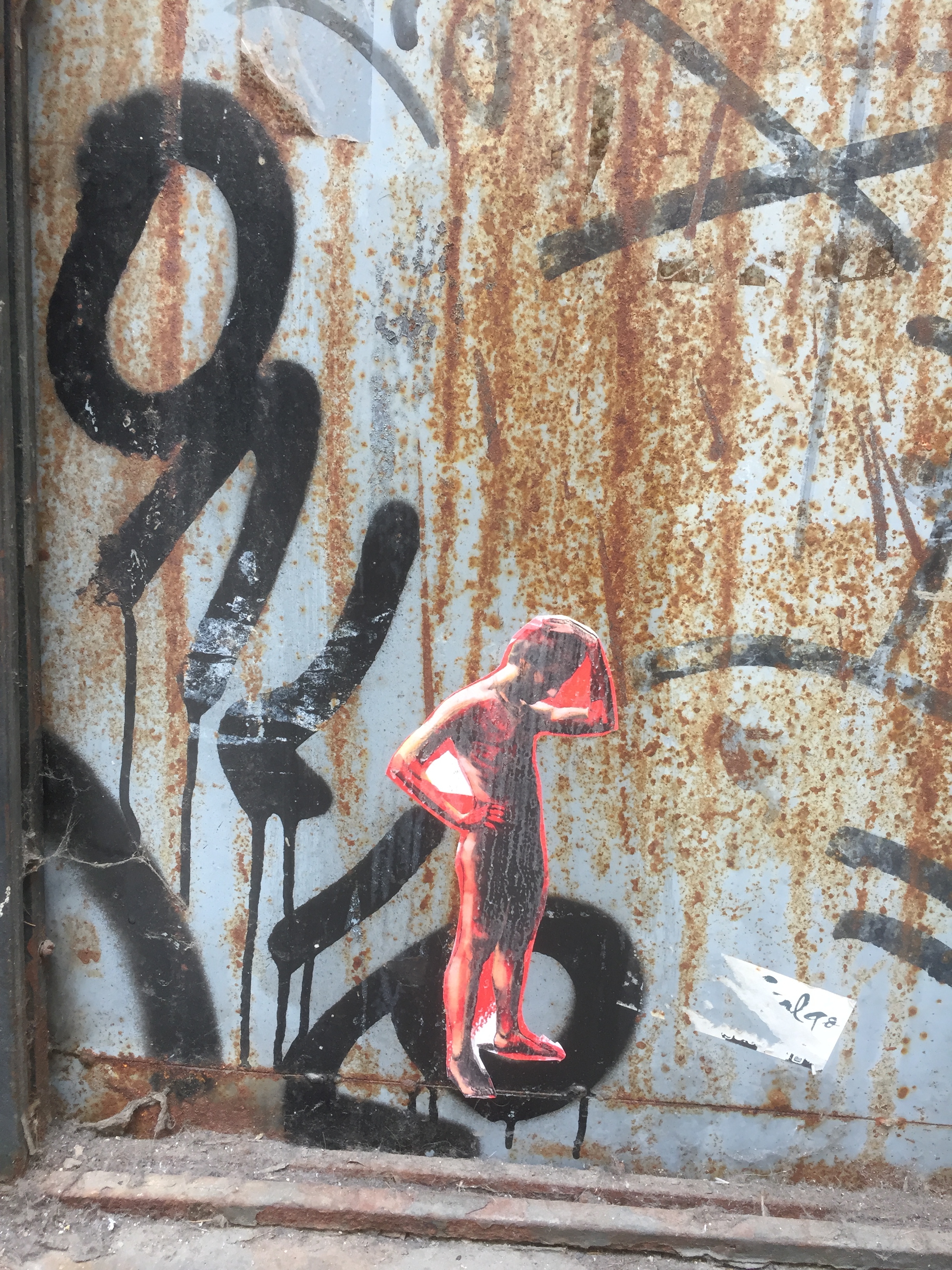
These two photos I’m sharing today are of street art I noticed as I walked around the streets of Salamanca one day last year. The image on the left is like a work of modern art. It looks a bit “Miro” to me! What I really notice about it is how the artist has used the walled off entrance as a frame, using the concrete filling the space as a canvas, but, he or she hasn’t stopped there. They’ve spread their artwork beyond the bounds of that frame….reaching out to cover the left hand pillar. I like that. I like how it demonstrates how creativity can be opportunistic, inspired by what is already there (the walled-in entrance way), and how that inspiration can come from the most unlikely places. Would you have thought that entrance way represented a canvas? I like how the artist isn’t bound by that either. How they kept creating outside of the frame – thinking and creating “outside of the box”. This work inspires me to be creative, to see opportunities for creative work, and to refuse to be constrained by other people’s frames.

The second photo shows the power of stencil. I mean just look at this person holding their head. Are they in despair, or are they trying to figure something out? I can see both. So it’s an image of hopelessness which reflects something we all feel from time to time, but, instantly, it’s also an image of someone thinking, someone deep in thought, trying to come up with a solution. At least, that’s what I see there. How about you?

I know, with every interpretation we bring our own standpoint, our own sets of values and beliefs, our own moods and preoccupations. But that’s one of the great things about art, isn’t it? It isn’t just the power of the work to convey “percept and affect” (as Deleuze would say). It offers us the chance to wake up and change by engaging with it. And even if we don’t wake it, it influences us without us realising. It interacts with us, and we interact with it. It’s a relationship.

Read Full Post »

I don’t know if it’s partly due to going into the second significant lockdown here in France, or mainly down to the wider disruption of normal routines and activities which we’ve all been experiencing for almost a year now, but I recently felt pretty dissatisfied with how my days can so easily drift.

I decided that were two areas of activity which have always increased the quality of my day – creative activities and learning activities. I so enjoy writing, photography and playing music – my main creative activities. And I have a life-long, curiosity driven, passion for learning.

Do you know the “pomodoro” time management method? Based on the classic Italian tomato shaped kitchen timer. The idea is that you set the timer for 20 minutes and start your activity. When the 20 minutes is up you take a short break, then set it for another 20 minutes, and go again. Well, starting from there, but deciding I wanted sessions to last longer than 20 minutes, I came up with the idea of one hour, timed sessions – ones for creative activities, and ones for learning activities.

I didn’t want to schedule entire days….well, I’m retired now and don’t need to schedule entire days the way I had to during four decades of work as a doctor. But I reckoned that even if I managed one of each of these timed sessions a day, the day would feel better. And you know what? It does.

My one hour of creative time and one hour of learning time are my minimum. I can have other ones if I want and if it’s feasible to have them on a particular day. So, there’s nothing to stop me having one hour of learning a language, and one hour of learning piano, for example, to make two learning sessions. Or one hour of one writing project, and another hour of a different one, to have two creative sessions.

I did have a notion to apply a similar technique to other activities in my day and on reflection reckoned there were two other major kinds of daily activity – there are all things you have to do just to keep life going – washing, cleaning, food shopping, meal preparation etc. And there are all the things which are just done for enjoyment – listening to music, watching movies, reading fiction etc. So I thought of “Doing sessions” and “Enjoying sessions”. But I abandoned that idea before I got going – it felt like a slippery slope to something too micro-managed – and, hey, even without trying I find that every day I do the “doing” things and the “enjoying” things anyway, so I really don’t need to do anything to enable them to happen. What I needed to pay attention to, and to consciously create, were the creativity and learning sessions.

I share this with you today, because maybe you too are feeling you’d like to have more quality in your day, or maybe achieve that nice balance of quality and structure. Anyway, if you like the idea, please develop it the way it will work for you. Play with the types of sessions, and the specific activities you want to include in particular sessions. Decide how long you’d like a session to be, and how many you want to include in an average day. Then just start.

Why not let me know how you get on? I’d be delighted to hear from you. All comments on this blog are “moderated” – that means I have to approve them before publishing them – so if you want to tell me something but don’t want me to publish what you tell me, just make that clear in the comment you send me, and I won’t publish it.

Read Full Post »

Picking up on yesterday’s post about threads and weaving life stories, I thought I’d share this photo I took in an old weaving factory in Aubusson. Isn’t this a fabulous stock of yarns? Look at the colours!

Probably because I was thinking about the metaphor of threads and weaving in the way we create our reality through our stories, I looked at this image again today and thought “Well, that’s what they have to work with. That store of colours and shades” So what if we think about how that idea might apply to how we create our daily experiences?

What is there in your palette? What can you select to weave together to create your unique, singular experience of today?

What if these yarns are like beliefs, ideas, thoughts and emotions? Which ones do we have to draw on, and which do we keep going back to, perhaps over-using, when we could be shifting our attention and using a different section of the palette if we want today to be really different?

I remember reading about a theory, which seemed to be validated by studies and observations, that when a baby is born, at the moment when the umbilical cord is cut, they experience their first existential threat. In those first few seconds if the baby doesn’t take their first breath, they won’t live. Perhaps, in those few seconds, the baby experiences certain strong emotions. We don’t have access to those memories because in our early years, our consciousness and memory functions haven’t formed to allow us to access them, but that doesn’t mean to say they aren’t happening, all the same. After all, most emotions occur below the level of consciousness, and becoming aware of them takes time, attention and practice.

So, what emotions might a baby experience in the midst of this first existential crisis? The theory proposes three – fear, anger or separation anxiety. Makes sense to me. So, the idea is that maybe which of the three dominates is genetically determined, but, whether it is or not, that particular pattern of those three emotions sets itself up as a core as we continue through life and try to make sense of our experiences.

So, some people have fear at the core, and that’s the main colour they use in their daily palette. For others, it is anger, and for yet others it is separation anxiety. You can try this for yourself. See if you can think back to your very earliest memory. Preferably one form before the age of five, from before you started school. When you recall that event, what emotions do you associate with it? Is it fear, anger or separation anxiety? I found with patients that some would identify one of these very clearly, some would identify a mix, or find more than one strong early memory, each with a different dominant emotion. Others would find none. They either couldn’t access any early memories at all, or they wouldn’t be able to say which emotions they associated with any they could remember.

For people who can find one, it is interesting to then follow that thread through life. To what extent does that emotion seem a foundation to other significant life events? Remember that with each emotion, we might suppress it, express it, or deal with in some hybrid way. So, if it is fear, then both fear and courage might appear. If it’s anger, both temper and avoidance of conflict might appear. And so on…..

Well, that’s one way to start to think about what palette you have, and what section of the palette you draw upon most frequently to create your daily reality.

You can also become aware of your dominant emotions, thoughts and beliefs by journaling….for example by doing “morning pages”. In fact, there are many ways to become aware of our habitual patterns of emotion, thought and belief.

I think it’s good to explore this, but we can take it a stage further by deliberately choosing certain part of the palette, or even adding new sections. We can decide we want to colour each day with more joy, more wonder, more love. We can decide we want to see each day through more half full glasses than half empty ones. We can do that with affirmations, with visualisations, with making more conscious choices about where to focus our attention, our time and our energies.

But all that is maybe for another day. Today, I’m just suggesting an exercise in awareness. Can you become more aware of what your personal palette looks like? Can you become more aware of which sections of that palette you keep going back to again, and again, and again? Finally, which underused sections of your palette would you like to pay more attention to? Or as you look at the vast range available, which colours of yarn would you like to add now?

Read Full Post »

I love stories. I always looked forward to hearing the stories patients would tell me, and I’m sure a significant part of my work was to be an active co-creator of stories. It would be common for a patient to sit down next to me for the first time, and I’d begin “Tell me your story”. Quite often that opening would be met with surprise or even some puzzlement, but I’d just stay quiet, maintain eye contact, and show I was waiting with undivided attention. Sometimes people would ask “Where will I start? How I am now, or what went wrong first?” I’d suggest there wasn’t a right or wrong place to start so just choose to start wherever they like.

The first part of the story would be up to the patient, but then I’d ask certain questions to explore particular aspects of the story, or to open up other areas which hadn’t been covered. So, together, we’d enable the telling of a unique story, a life story, with a certain focus – health and disease. Because, I am a doctor after all.

Now when I see this photo of threads beginning to be woven into a tapestry I think that rather than “focus” in that last paragraph, maybe I’d be better using the word “thread”. Because often the life story of health and disease is a story which needs unravelled, untangled, to identify the important threads, colours, textures, and images, or the important events, themes, experiences and patterns.

Maybe, in fact, the life story of health and disease is just one of the tapestries we create from all the threads and colours which allow us to create and experience our one, unique, and singular life.

So, threads, tapestries and images turn out to be as important for me as stories.

Where do the threads come from? The ones we weave into our personal experience? Some come from our genes. There are threads of lineage which run through each of us. Some come from our birth experience, and our response in those first few seconds to the cutting of the umbilical cord. Others come from our experiences, from the events of our lives and both our reactions and responses to those events. Yet others come from our relationships and from the physical environments in which we live.

Then there are other kinds of threads which we pick up and make our own. The threads of myths and legends. The threads of other peoples’ stories, beliefs and values. The threads of culture, music and art. In other words, the threads of our collective imagination.

Finally, as well as threads, the weaver has to have some idea of what they want to create. They have to have a vision, have imagination, maybe even have a pattern or a plan to follow.

I wonder what threads you can find in your life. I wonder what visions, thought patterns, feeling patterns, behaviours and influences create what you do with those threads…..

Read Full Post »

« Newer Posts - Older Posts »