Feeds:
Posts
Comments

Archive for the ‘from the consulting room’ Category

We often look at the world this way….just a peek through a narrow gap. We can see a bit this way. It’s a way of being focused. If we narrow our gaze we can ignore everything except what’s in the target zone of our attention.

You know we have “two brains”, right? I mean the recognition that we have a cerebral cortex which is divided into two, non-symmetrical parts. Why do you think the brain is like this? Why not just have one, whole brain? Why did evolution prefer to develop the cortex in two significantly different hemispheres?

Well a lot of people have tried to claim that the right half does these things, and the left these other things….like the right is what we use to “do art” and the left is what we use to “do logic”. But we know that’s not true. The brain is not like a clock, a car, or a computer. It doesn’t function with one part doing “this” all by itself whilst other parts do “that”.

But Iain McGilchrist figured it out. In his “The Master and His Emissary” he lays out what I find to be a convincing thesis – each hemisphere engages with the world differently – in other words, each hemisphere gives us a different way of approaching, understanding and interacting with, the world.

What the left hemisphere allows us to do is like what you see in this image. We use it to narrow our gaze. We use it to focus in on “parts”, to analyse them, label them, categorise them, in order to try and “grasp” and manipulate them. The right hemisphere, on the other hand (see what I did there?), is used to enable a broad gaze. We use it to focus on the connections, to explore the bonds and relationships, to discover what’s new, and to see things in the broader view, or in “the whole”.

What amazes me about this is that we use both halves simultaneously pretty much all the time. They are in constant interaction, giving us the ability to “integrate” and “synthesise” what they focus on.

The trouble comes when we fail to pay enough attention to one of the halves – actually, in our modern world, it’s the right hemisphere we fail to attend to sufficiently. We get stuck in our world view of seeing reality as composed of separate parts which we can label, categorise and control. We get hooked on a mechanistic model. And, well, reality is not like that. That picture is incomplete and can lead us astray.

So, we do need these abilities to focus narrowly, to separate out elements, analyse them and organise that knowledge, but we ALSO need to be constantly aware of the big picture. We also need to see the contexts, the connections and the circumstances. It’s this that enables us to see uniqueness.

When it comes to this pandemic, we need to understand and analyse the COVID-19 virus. It will be a real boost to us to discover how to improve our treatment of people who are infected with it to try and reduce the potential damage they might suffer. But we need to use that other half of the brain too and see what the circumstances are in which this pandemic has arisen. We need to join up the dots. We need to see the connections and the contexts.

Isn’t it clear that one reason why this pandemic is so damaging is that we don’t have enough good health care? I think this issue is the same whether you live in the UK, France, the US, Spain, Belgium….you name it. It’s not the sheer number of people who are suffering from significant effects of this virus – after all, it seems about 80% of those who catch it don’t even get any symptoms. It’s that the small percentage of people who DO suffer serious effects from it still constitute numbers potentially too big for our health services to cope with.

Why do you think there is this constant message about “protect the NHS” in the UK? The NHS shouldn’t need “protecting” from sick people! It’s very purpose is to treat them. But the truth is there aren’t enough staff, there aren’t enough hospital beds, there isn’t enough equipment, there isn’t enough PPE, there aren’t enough testing materials, or laboratory resources.

There isn’t enough decent, safe social care available for the elderly. There isn’t sufficient support for people whose incomes are hit by forced closures of their workplaces. There isn’t enough decent housing. There isn’t enough decent nutrition because the current model of industrialised farming and processed food production is feeding both obesity and nutritional deficiencies of important vitamins and minerals which are needed for healthy immune systems.

And so on……

Unless we use our whole brains and address the underlying weaknesses, vulnerabilities, insufficiencies and injustices in our societies we will find not just this pandemic hard to handle, but we’ll set ourselves up for more of the same.

It’s time to change.
Read Full Post »

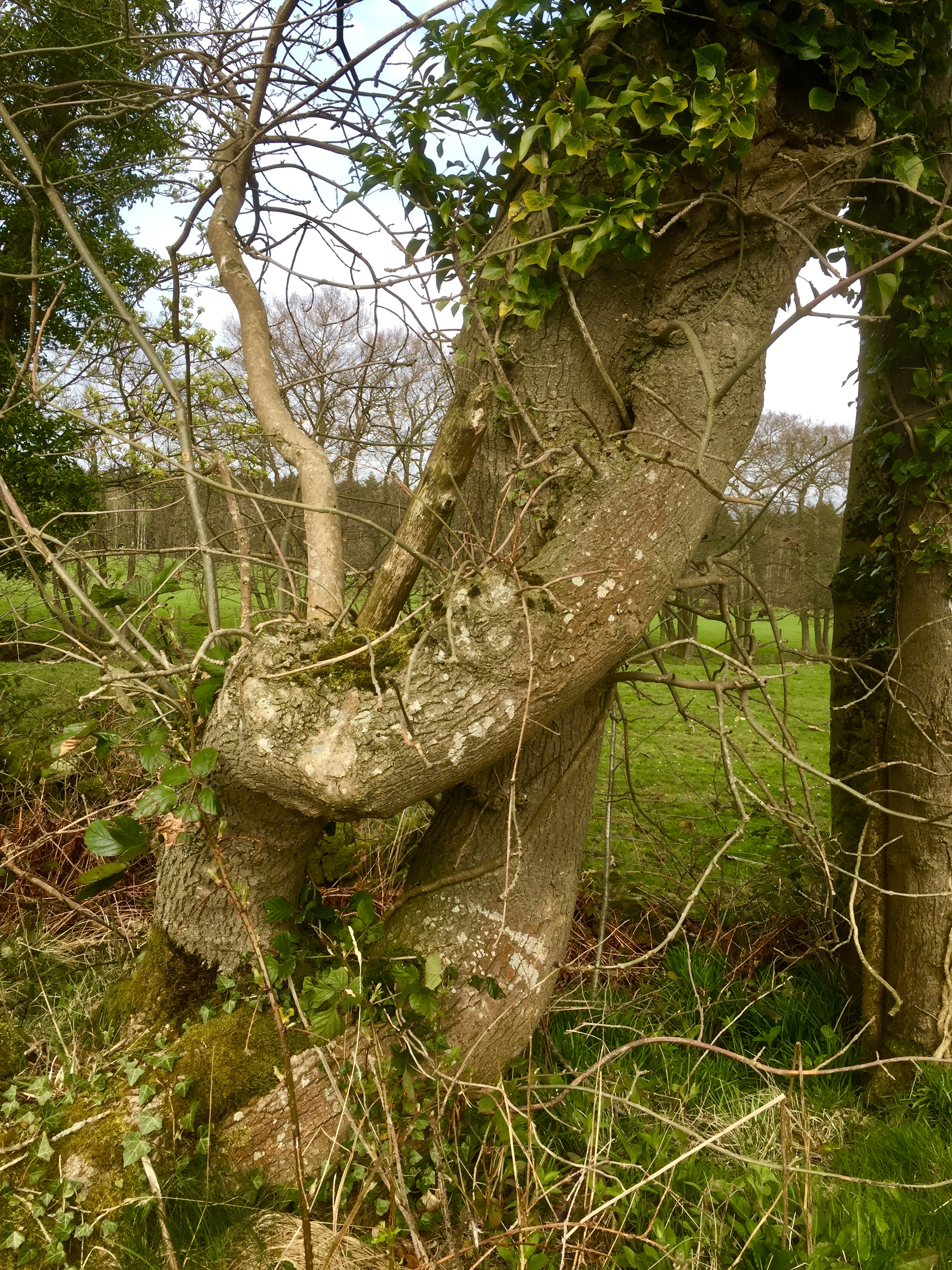
I’ve stumbled across trees like this a number of times. The first time I saw a tree trunk taking such a convoluted, twisting path I was quite astonished, but more than not I see such patterns not just in a single tree, but in a tree’s relationship to another tree.

It’s not that common to find trees entangling themselves in each other like this. Of course, there are other plants, for example, “climbers”, which have the ability to entwine themselves on whatever they can reach, as their core characteristic. But in trees, it’s not so obvious. You know why? Because they do most of their entanglement below ground….in their root systems, which we now know from forest studies, are vast entangled webs of connections between trees with microfibres and fungi creating most of the functional connections between them.

We humans are perhaps the most sociable creatures of all. We certainly have the most highly developed systems within our bodies and brains to enable us to pick up signals, make responses, create bonds and connections, and to co-operate with others.

A bit like with the trees, most of those connections go on underground. Well, not below the soil, as they do in tree world, but in the sub-conscious. I think we tend to forget that. Our oldest, most developed, most evolved systems of function are unconscious. From everything to do with maintaining a healthy living body, to the detection of information and energy, to the whole vast world of emotions. It mostly happens below the level of consciousness.

We don’t have to think about making our heart beat. We don’t have to think about releasing insulin or adrenaline. We don’t have to be conscious of our processes of digestion. Our emotions, like our dreams, emerge from our sub-conscious.

Neuroscientists have discovered that our conscious thought making processes are actually much slower than our unconscious ones. Much slower, and starting just a bit later than the unconscious ones.

That’s quite something. We tend to imagine that we are primarily conscious, reflective, analytic, critical, rational creatures. But actually our survival, and our maintenance of healthy life occurs below the level of conscious awareness. We interact with, form bonds with, relate to, and entwine ourselves with other humans and with the rest of the “more than human” world through ancient, highly evolved un- or sub- conscious processes. They work. They are highly refined and they are fast.

I think it’s a mistake to think of our conscious processes as “superior” or “higher”. Rather, they give us the ability to create spaces, to stand back, to pause, to see, hear, become aware and reflect, and then to make choices and express our will. They are wonderful processes and we wouldn’t be fully human without them.

But let’s not dismiss or belittle our processes of entanglement which connect us to all that is more than our individual selves. Let’s not dismiss them, because if we do, we delude ourselves into thinking we are completely separate, isolate individuals existing as if in a vacuum.

We aren’t. We emerge from, and exist within, all that exists. We are entwined.

Read Full Post »

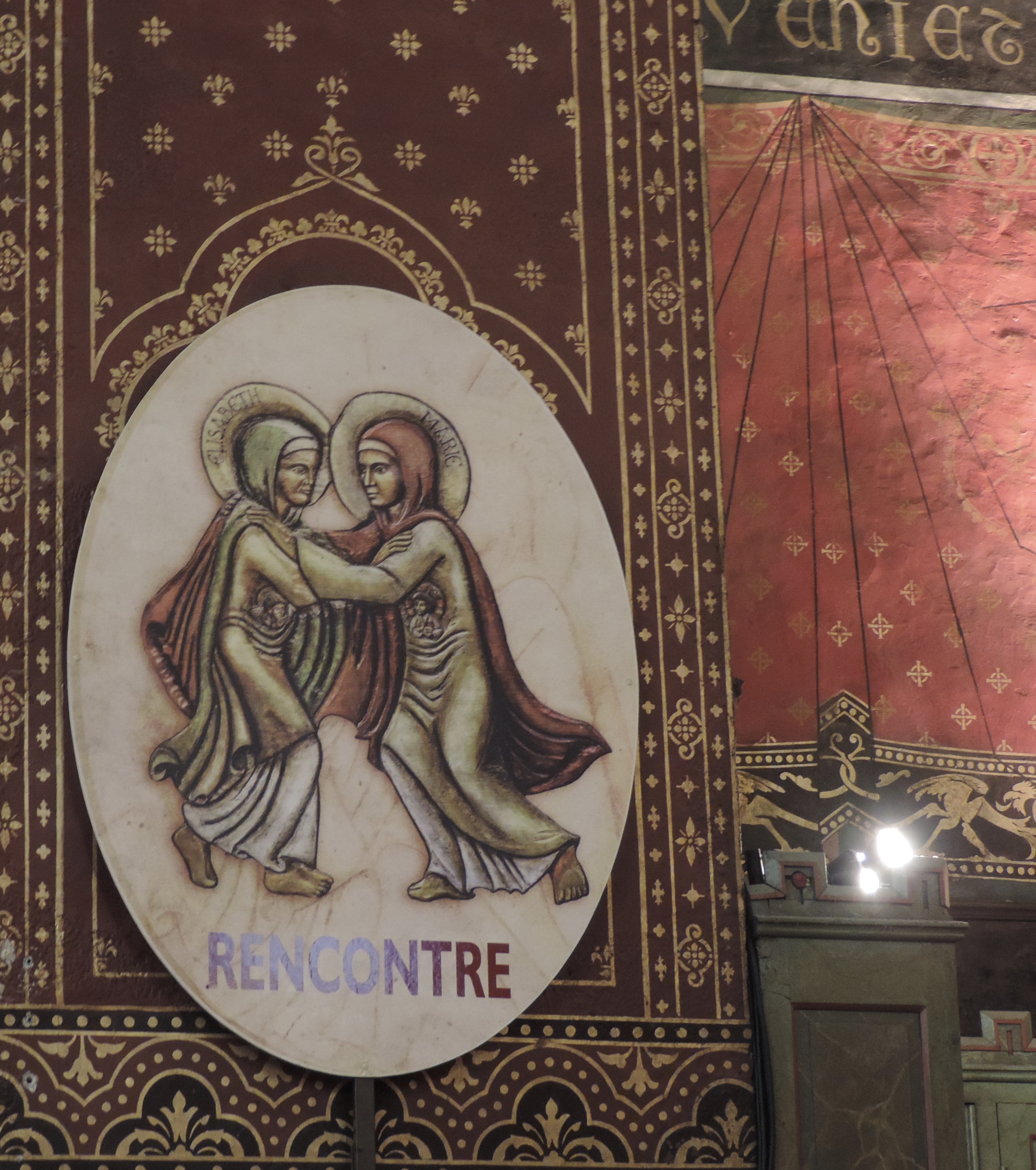
I saw this on the wall of a church in Saint-Jean-de-Luz in Southwest France. A “rencontre”, as you can probably tell from the drawing, is a meeting. I haven’t seen this portrayed in other churches but I really liked that it was displayed so prominently in this one.

For me, the key to understanding Life is revealed in connections, relationships, or bonds. In fact, it is revealed in a very special kind of connection – one which increases “integration”.

Integration is “the formation of mutually beneficial bonds between well differentiated parts”. I think this is easily understood when you think of the human body. We have several organs, from a heart, a liver, a pair of kidneys, a pair of lungs, a brain, and so on. All of these separate, distinct, structures have their own particular functions to carry out and they must carry them out in a way which is more than harmonious…..they must act to promote mutual benefit. The “integrative” connections exemplify collaboration and co-operation. Our organs do not compete with each other….not for energy, food, or protection. Not in a healthy state, anyway.

So, here is the basis of natural health – harmonious, well-integrated, collaborative relationships between distinctly different parts.

You can scale that up – so that a healthy society is a diverse one composed of unique individuals who relate to each other in mutually beneficial ways. You can scale it up further to consider whole ecosystems, or even the global biome, and see that this is the basis of Nature.

Much has been made of the role played by competition in Nature, and in particular in the story of evolution. But, competition has only ever been one part of the story. Without collaboration, without the creation of mutually beneficial bonds, Life would not exist, and it certainly wouldn’t evolve.

When I see this image of a “rencontre” I’m also reminded of the story of the Little Prince and the fox, as told by Saint-Exupery in his “The Little Prince”. In particular I remember the passage where the fox asks the Little Prince to “tame” him – by which he means to create a bond between them, and gives the example of rose which the Little Prince tended to in his home. The Little Prince claims that his rose, of all the roses in the world, is special to him. He cares for her, looks after her, and feels for her. What makes her special is the bond – the bond of care. The fox points out that if he and the Little Prince form such a bond, then they will be very upset when they have to part – because these bonds of care matter to us. They matter to us more than anything.

We can’t have too much of this type of connection in our world. In fact, we need a whole lot more of them – we need the bonds of “integration”, the “mutually beneficial” ones, the bonds of “care”.

Read Full Post »

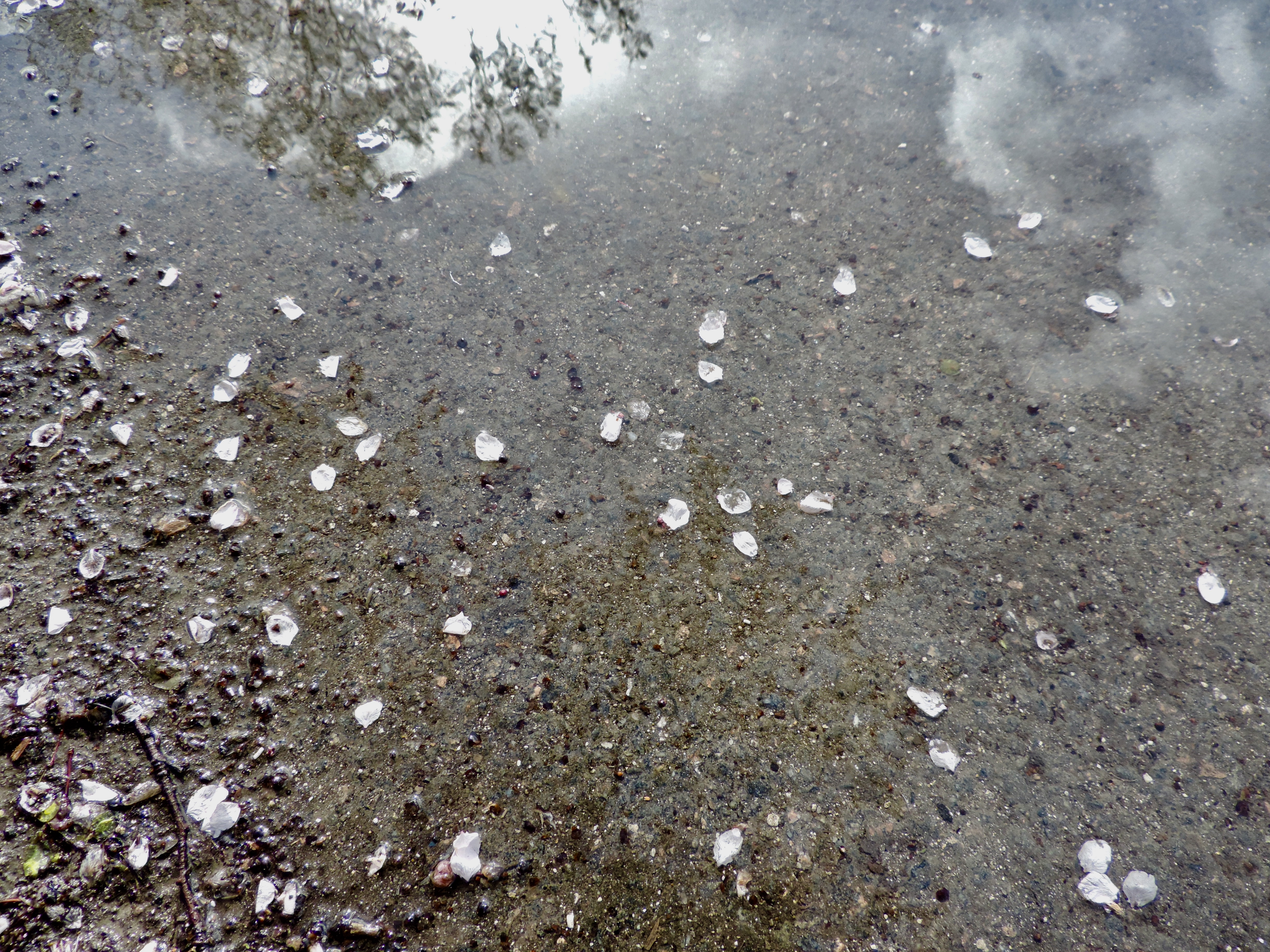
I like photos like this one. At first glance it’s a scattering of petals on the ground, but on closer inspection they are spread across both gravel and water, and when we look at the surface of the water we see more than the petals….we see the reflection of the sky, of clouds and of a tree.

Once we’ve taken that in we are able to see something of how those petals got there.

So what, you ask?

Well, I’m pretty sure none of us think petals just appear out of thin air, or out of the ground, do we? We know they came from a tree, and we know the wind was likely involved in blowing them to the ground, just as it blows the clouds across the sky. We know that the clouds dropped rain and the rain formed the puddles that now hold the delicate petals on its surface. We could follow any of threads in any direction. We could choose to explore the life story of the tree. We could follow water molecules through their global cycle between oceans, sky, mountains, rivers and sea again. We could explore the soil at the edge of the puddle, that same soil in which the tree is spreading its roots. And so on…..

In other words, petals are not the result of spontaneous combustion. They don’t appear “out of thin air”. And that’s the same for everything. Here we are in a middle of a pandemic and we are so focused on the virus that we are in danger of understanding why the pandemic is unfolding this way.

This virus seems to cause no symptoms in 80% of the people who it infects. But it makes some so sick they need to be treated in hospital, it kills a proportion of them, and it leaves another proportion with debilitating symptoms for months.

Why the difference? A number of factors have been identified so far….it hits hardest at the elderly, the frail, those with chronic health conditions such as diabetes, obesity, heart and lung diseases, and so on. It hits BAME groups harder. It hits the poor harder.

So, the widespread and severe disruption and damage occurring during this pandemic can only really be understood if we explore the contexts….if we follow the threads, study the environments in which it spreads. It’s not all about the specific potentials of a particular virus.

There are some things we can do as individuals to reduce our chances of suffering from this virus, but, ultimately, we’re going to have to act together to change the underlying vulnerabilities of our whole society.

It seems to me that this pandemic is shining a bright light on a whole number of weaknesses and failings in our current system – the effects of poverty and inequality; the effects of poor quality overcrowded housing; the effects of fragile work contracts in conditions which cause stress and harm; the effects of making schools too big, with class sizes too large; hospitals too big, with too little staff; of insufficient health care and long term care of the elderly; of discrimination and injustice; of poor diets and of societies built on consumption rather than creation.

I could go on……..

Do you agree? Shall we make a start together?

Read Full Post »

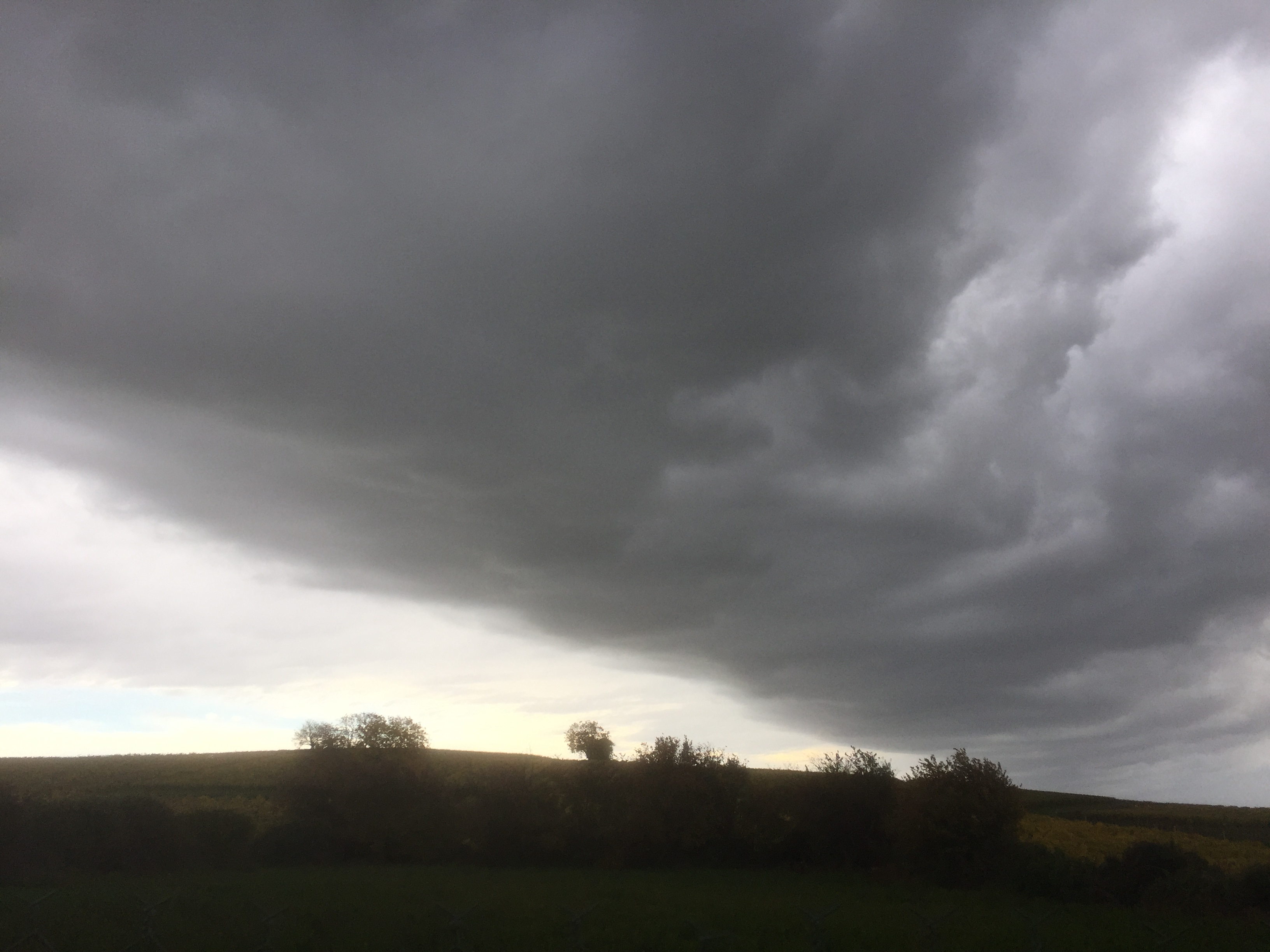
When you look at a sky like this you know a storm is coming. When it’s as dramatic as this it can be quite intimidating. At very least I know to prepare a little, unplugging my router and other equipment in case it gets fried by lightning (and, yes, it’s happened once since I came to live here). We also have an issue with heavy rain overwhelming the drains and then pouring down the driveway so another preparation is sandbags along the bottom of the garage door (and, yes, it’s happened more than once since I came to live here).

But sometimes, even a dramatic sky like this just passes over with hardly any rain, and no significant thunder and lightning. It seems impossible to predict at a local level. Even when the storm does come, it doesn’t last. Maybe just half an hour or so, or sometimes an hour or two, but usually it’s pretty brief.

I know that it’ll be different in different parts of the world, and I’m also aware of the absolutely catastrophic effects that dramatic, severe weather can have….most recently here down in the Valley of Roya just north of Nice where whole roads and parts of villages were washed away. Tragic.

I’ve also seen news coverage of the after effects of that storm, and as in other parts of the world when such calamities occur, what you see is dozens, if not hundreds, of people immediately appearing to do what they can to help….helping people to safety, cleaning up, making food, donating food, water and clothes. It is impressive. It is very impressive. You see it every time, no matter which country it happens in. You know some people don’t have a very good opinion of human beings and I know we can be an aggressive, exploitative species, but what impresses me so much more is this ordinary straightforward instinct to help and to work together to relieve the suffering of others.

Fundamentally, I believe that people are good. That’s my starting point. If things don’t turn out that way with an individual or a group then I adjust my attitude and behaviour to stay safe, to protect myself. But I start by believing in human goodness. In fact, I don’t know how I could have worked as a doctor for forty years without believing that. Everybody seems to be “worth saving”. Everybody who needs help “deserves” it. I know it’s complex and I’m not trying to be simplistic or naive here, but I really do believe that your experience of life changes when you start from a belief that people are fundamentally good.

I recently came across Rutger Bergman’s latest book, Human Kind, and he takes exactly this idea as his starting point….what if we believed that humans were basically good, instead of believing they are basically evil, or bad? I recommend it. It’s worth a read.

Read Full Post »

I saw this framed poster a couple of years ago in a shop in Copenhagen. I kinda wish I’d bought it! It’s a simple but elegant representation of something which has become my core model when I consider reality – networks.

When people say everything is connected to everything else they are right and the easiest way to both visualise and explore that is the network.

A picture of a network is simply some nodes connected by lines. The nodes might be people in your life, including you, with each line representing relationships. The nodes might be cells in your body, some more directly interconnected than others but all living in each other’s influences. The nodes might be neurones in your brain, each of which is connected to up to 50,000 other neurones! Can you imagine that? It’s literally mind boggling.

Networks can map thoughts, feelings and actions. They can help us trace the influences on any single moment cast by the past and the future if each node is an experience, real or imagined.

We have two halves to our cerebral cortex and it seems the left half is particularly good at noticing and exploring the nodes – the parts, the elements, the items, components or data. The right half, on the other hand, is particularly good at noticing the links, the bonds, connections and relationships.

Think of the constellations in the night sky, each twinkling star a node. When I look out now I see Orion has reappeared and makes his way each night across the winter sky from east to west. He’s been gone all summer and now he’s back I know winter is coming. But how do I see Orion? By tracing the invisible lines which connect the individual dots (stars).

When I first read about complexity science it was this model of networks which made it all clear to me, and, in particular, learning about the non-linear nature of the relationships between the nodes in living creatures helped me grasp the concept of the “complex adaptive system”…..which shone a bright light of understanding on everything from self-healing, to uniqueness.

If you’d like to explore this subject a bit more, here are some of the best books I’ve read about this concept of networks, connections and links.

Read Full Post »

There have been many epidemics in human history, and there will be many more. Some of those epidemics spread so much they become pandemics.

We discovered how to cope with these raging fires of infection many, many years ago…..

You have to isolate the infected from the rest of the population until they aren’t infectious any more. In the past that involved closing off whole walled towns, or sending the sick to isolated places.

That is still the basis of control – reduce the spread by reducing the opportunities for the virus to spread from one person to another.

In this current pandemic most countries have gone for “lockdowns” – which are more and more harmful the longer they go on. They are a desperate, short term measure. The other main policy has been to promote social distancing…..make people stay away from each other and touch each other less. This is also a pretty desperate, ultimately harmful, measure.

The most successful countries have gone for “Test, trace and isolate”.

No-one has been successful pursuing a “let it rip”, or “herd immunity” strategy. No wonder. It’s a bonkers, inhumane idea. Which infectious diseases have human beings ever successfully overcome by going to herd immunity? Not TB, not HIV, not malaria, not cholera, nope, not even smallpox, polio or measles (effective vaccines have played a significant role in these latter diseases)

This

Identify the infected and keep them at a distance from the non-infected is how to control an epidemic. It always has been, and it is now. The problem with Covid-19 is that over 80% of those infected, and able to spread it to others, are asymptomatic. That means the only way to identify those who are infected is by testing.

I know most western countries have really struggled to get their testing capacity up to speed quickly enough and some, like the UK, even abandoned testing for a while (apart from testing the sick in hospital). But that doesn’t mean it’s the wrong way to go. It’s intolerable to isolate whole populations and bring work and social life to a halt for long periods, or even repeatedly.

There’s only one way – “Test, trace and isolate” – do it intelligently, effectively and on a sufficient scale and fully support those who need to isolate for the period of their isolation.

Read Full Post »

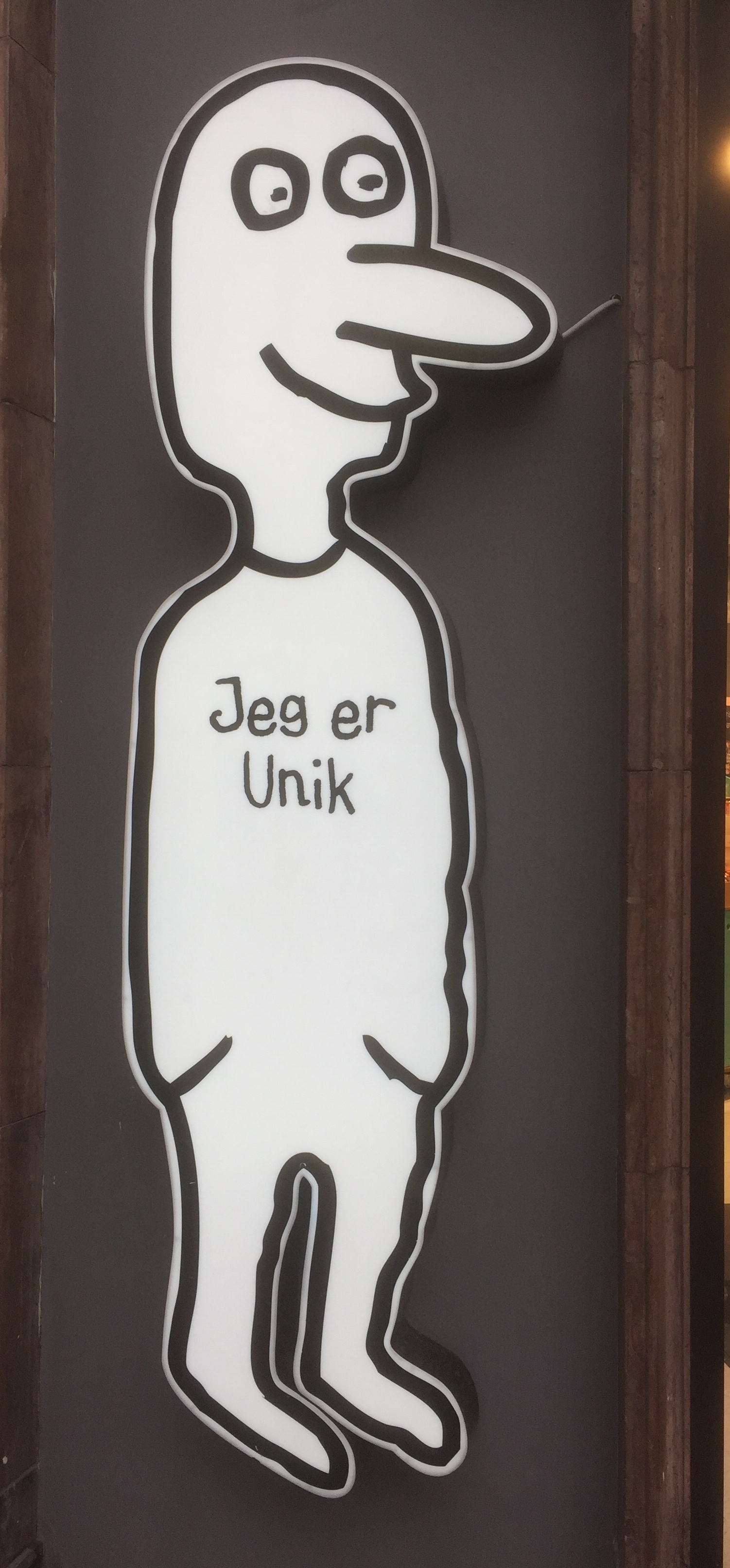
A couple of years ago I saw this image on the front of a shop in Copenhagen. Uniqueness is an important quality for me. Every single patient I ever treated was unique. Every single one had a unique story to tell me. I feel unique. I see you as unique.

So, what makes someone unique?

Is it your DNA? That’s part of it. There are no two human beings with identical genomes. Is it your face, your eyes, or your fingertips? That’s part of it too. There is scarily effective face recognition equipment already deployed everywhere from airports to security cameras. You can even get access to your phone by having it recognise your face. Iris recognition technologies have been around for some time allowing restricted access to closed spaces, and fingerprinting has a long history in detection work.

So, each of these characteristics can be said to be unique to you, but none of them captures your uniqueness, because YOU can’t be reduced to your fingertips, your eyes, your face, or your DNA. Maybe these features can help to name you….to tell others how to identify you from within a crowd, or a group.

But is this the same as “identity”?

I don’t think so. The reason why I don’t think so is that identification has spilled over from the capture of these physical features to encompass a whole person.

You are not reducible to any of these features, just as you are not reducible to any other “characteristics” such as country of birth, ethnicity, gender, religious belief, height and weight, or hair colour.

You are a person, and a person has a subjective reality, a life of memories, experiences, imaginings. A life of emotions, thoughts and beliefs. A unique, and singular story to tell, which is not, and never can be, the exact same as anyone else’s story, past, present or future.

Our uniqueness isn’t found in our characteristics or our features. It’s found in our connections….the connections which connect the past to the present, the present to future, our selves to other people, our unique set of experiences and life events, the contexts and environments of our existence. It’s found in the invisible nature of our subjective reality, with our own consciousness, our own unconscious being, and our ever changing, ever developing sense of self and person.

I abhor the reduction of a human being to a data set.

Because every human being is unique.

Read Full Post »

There’s a way of looking at history where you can trace the development of a theme over decades, or even centuries. One of the themes I’m aware of is control.

Maybe the control issue has become particularly apparent because of this pandemic……in two ways.

Firstly, there’s our inability to control the spread of the coronavirus. Yes, I know, governments around the world and thousands of scientists are trying to exactly that – control the spread of the virus. But they can’t really. They can bring in measures which enforce changes in personal and collective behaviour to try to reduce the opportunities for the virus to jump from one person to another, and some countries are managing that better than others. But we can’t get rid of the pesky thing from the whole planet and as we live in a hyperconnected age reducing the incidence to zero in one country doesn’t guarantee it won’t make its way back.

Secondly, we are now subject to more controls, more restrictions than most of us have ever known. We are being monitored, surveilled, documented and followed to unprecedented degrees.

This second kind of control is not specific to infections of course. In many walks of life we are now subjected to increased levels of control. I retired from clinical practice as a doctor almost six years ago now, but in the last few years of work the level of monitoring and control of my daily “performance” increased many fold. A combination of “annual appraisal”, “revalidation” and “job plans” with an emphasis on what can be measured eg patient numbers and consultation length, diminished professional autonomy and steady forced everyone to somebody’s declared “norms”.

A lot of the desire for control is extremely well intended, but a lot of it isn’t. I’m not sure where the balance lies these days, but I suspect most money and resources go into enabling those with power and influence to keep and increase what they have through the control of the rest of us. A lack of transparency creates the suspicion that extra controls “in your interest” aren’t really in our interest!

But all this goes a long way back doesn’t it? And I’ve been thinking this morning how one of the origins is the idea that Man is separate from Nature and that we are either chosen to, or that we are choosing to, dominate and control Nature. Nature is seen as something separate from us, something to be exploited, a resource to be tapped, and potentially damaging phenomena are to be fought and controlled.

But that’s not right is it?

We are not separate from Nature. We emerge within all that is. We exist within the existence of the whole world. We are unfathomably hyperconnected with the whole of Planet Earth.

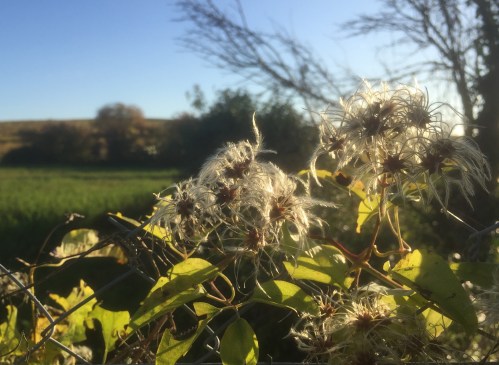
When you look around, you see that other forms of life thrive without having such an emphasis on control. Look at this photo I’ve shared today. It’s one plant which uses a particular form of seed dispersal – wind. It gambles the whole of the future existence of its species by letting go. It creates the forms and methods which give it the best chance of working well with the rest of the planet, from the wind, to the sun, to the soil, and holds its sons and daughters up to the heavens, then waits. Waits for the wind to blow, and to carry them to fertile lands.

OK, so we aren’t plants. And I’m not saying we can live the same way that they do, but there’s a lesson here, don’t you think? Something to reflect on. It’s in that action of “letting go”. Letting go in a way which maximises your ability to survive and to thrive.

How are we going to do that? How are we going to shift away from obsessive desires to control to learning to work with, to collaborate, to share, to learn with humility that we can’t control nearly as much as we’d like to?

Read Full Post »

From the perspective of complexity science an “attractor” is an area of organisation within what otherwise appears as a chaotic system. Think of the phenomenon of a “Black Hole”. It’s like a sink hole where everything, even light, disappears into it. It’s like a point in the universe which pulls everything within its reach into its centre. A “Black Hole” is a sort of attractor.

An attractor appears around a focus, and once it is there it exerts this kind of “gravitational” or “magnetic” pull on anything which comes close to it. But the simplest way to think about it is the emergence of a consistent pattern in the midst of chaos. If there weren’t these points of organisational focus in the universe then space would be even, smooth and featureless. But space isn’t like that. It’s full of features, full of phenomena, of areas and points of organisation.

You can see something similar happen in the brain where distinct networks of neurones which “fire together”, “wire together”. There are examples of brain imaging which show the thickening of neural pathways when something is repeated…for example, when practising the piano (where you can see a thickening of the brain nerves used to control the fingers). It’s sort of a neural equivalent to what happens to muscles when someone practices body building.

The same thing happens with our habits of thought and emotion. The loops which start to fire in relation to particular thoughts or emotions have a pulling power. Many years ago I read a book by the psychologist Edward de Bono, “Water Logic”, where he described this tendency for thought patterns to become embedded in our brains by likening them to the way water makes its way down towards the sea from the heights of a mountain. The rain falls pretty evenly over the high lands, but starts to run together to form streams, rivulets, rivers and finally estuaries into the oceans. The next rain which falls tends to follow the paths already carved out by the previous rain.

I thought that was a pretty powerful image and I shared it with many patients over the years. It helped explain phenomena like flash-backs, compulsions and addictions to some extent. But I always thought it was only part of the story, and it wasn’t until I discovered “attractors” that I realised what the other part was.

So, it seems to me, that events which are accompanied by strong emotions can make new attractors in our minds. They can be traumatic events, accompanied by fear, anger, shame, or pain. Or they can be life-enhancing events like joy, wonder, tranquility, or a sense of one-ness with the world.

When we recall one of those events we are drawn back into the same original pathways and loops. Or when something new happens which is pretty similar to one of those attractors, then the whole thing kicks off quickly and powerfully once more.

Once I understood this I realised we can actively create our own new attractors, by having, and/or re-creating, the kinds of experience which we want….the ones of love, joy, belonging, tranquillity, awe or transcendence.

Attractors, it seems, are not fixed entities. They need to be fed to keep them growing, and neglect makes them likely to wither away. The more attention we give them, the more powerful they become.

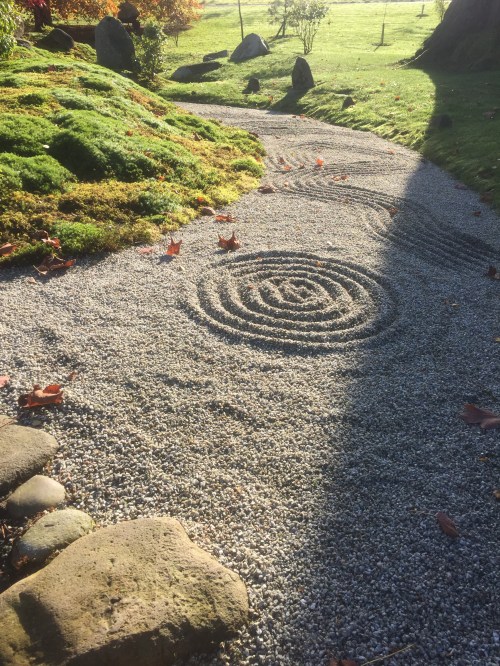
I was thinking about this today when I looked at this photo of mine, taken in a zen garden in Japan. What I like about this image is not just the spiral, which is indeed very attractive, but the wider scene – how there are different flows, paths, bends, loops and spirals across the whole expanse of the stones. Can’t we do this with our minds? Create our own unique inner landscapes of pattern by becoming aware of existing attractors, and actively creating new ones?

Read Full Post »

« Newer Posts - Older Posts »