Feeds:
Posts
Comments

Archive for the ‘from the consulting room’ Category

bridge

When medicine is practised in a fully human way, employing all parts of the doctor’s brain, not just the thinking/analytical knowledge-based functions, then something deeper and more powerful than mere symptom-relief can occur.

As far as I know there are no “artificial healing agents” in the world. Drug companies may claim their products can cure, but it’s only the individual human organism which can cure. As a complex adaptive system, like all other life forms, we have the ability to defend ourselves, to repair damage, to recover from illness and even to adapt and grow. All of those abilities are natural and innate. If a drug, an operation, or any other medical procedure helps it does so by supporting, or better, stimulating these natural mechanisms of self-healing.

But how does that happen?

One element is what Lewis and colleagues, in “A General Theory of Love”, describe as the limbic connections between two human beings. In their book they explore three aspects of this – limbic resonance, limbic regulation and limbic revision.

Every person broadcasts information about his inner world…..If a listener quiets his neocortical chatter and allows limbic sensing to range free, melodies begin to penetrate the static of anonymity. Individual tales of reactions, hopes, expectations, and dreams resolve into themes. Stories about lovers, teachers, friends, and pets echo back and forth and coalesce into a handful of motifs. As the listener’s resonance grows, he will catch sight of what the other sees inside that personal world, start to sense what it feels like to live there.

That’s a beautiful description of what I think is necessary in any good doctor-patient consultation. It’s not so much a matter of the doctor “getting out of the way”, but of “tuning in”. Quite literally. “Getting on the same wavelength”. Why? Not just to communicate effectively but to understand more fully. In an older fashioned way of expressing it, it’s about “putting yourself in the patient’s shoes”. And from a perspective of “heart rate variability” it’s about achieving not just limbic resonance, but heart and brain resonance too.

The first part of emotional healing is being limbically known – having someone with a keen ear catch your melodic essence.

I don’t know if there has to be emotional healing for their to be bodily healing too, but I suspect that to be true. Sure, suturing a laceration may be all that is required for the skin to be restored, but why do some apparently simple lesions heal quickly, and others fester and scar? Might that have something to do with the depth or breadth of the healing?

After resonance, comes regulation.

Our neural architecture places relationships at the crux of our lives, where, blazing and warm, they have the power to stabilise…..But people do not learn emotional modulation as they do geometry or the names of state capitals. They absorb the skill from living in the presence of an external modulator, and they learn it implicitly.

There’s something about a really good consultation which involves safety, confidence and hope. However, I do think all of those qualities are more likely to emerge from a place of love, care and compassion. Maybe those are the key “regulators” which calm, soothe and stabilise the patient’s limbic system.

People who need regulation often leave therapy sessions feeling calmer, stronger, safer, more able to handle the world.

How often have I had that feedback? Very often. Perhaps because that was a conscious aim of holistic, “integrative” practice.

The third element Lewis describes is “limbic revision” –

Knowing someone is the first goal of therapy. Modulating emotionality is the second. Therapy’s last and most ambitious aim is revising the neural code that directs an emotional life.

I think what he is referring to making lasting structural changes – in his, psychotherapeutic, context that’s about changing the patterns of neural connections in the brain to change the person’s emotional life. I didn’t work as a psychotherapist, but as a general practitioner with homeopathic and integrative skills. As such I didn’t separate problems into “mental” or “physical” categories, so while I see exactly what this “limbic revision” is and agree that it is important, I think a holistic doctor, whose patients are often seeking help with problems in different parts of their bodies, it was a broader “neurobiological revision” which was required.

Understanding the “limbic” aspect of medicine, is, however, an excellent place to start.

Read Full Post »

It strikes me that the practice of Medicine (I’m specifically referring to the world of Medicine for humans here), begins and ends with a relationship between human beings.

I’ll just focus on the doctor-patient relationship here, because that’s how I spent my working life. But I suspect that much of what is relevant to this relationship is also true for other health care workers, and perhaps even in other areas of human life.

When I say the practice of Medicine begins and ends with a relationship between human beings, I mean that the whole, unique person who is the patient has to be understood, cared about and attended to, by the whole unique person who is the doctor. Both individuals are important. I think this is partly why there are no doctors who are the best doctors for everyone, and I think it explains how in a group General Practice, each of the doctors in the partnership will have a specific loyal cohort of patients who always seek a consultation with that one particular doctor.

I also think this means that the whole person must always be considered. Anything less is reduced, and anything reduced is less than human.

In this context, I recently read “A General Theory of Love”, by Drs Thomas Lewis, Fari Amini and Richard Lannon. [ISBN 978-0-375-70922-7]. This book describes the model of the triune brain, which you might have come across elsewhere. (My introduction to that model was Dan Seigel, and later, Rick Hanson). It’s the observation that we have three brain regions – the brain stem, which is responsible for survival, and is found even in reptiles (henceforth to be known as the “reptilian brain”), the limbic system, which is responsible for memory processing and emotions (called the “mammalian brain”, because all mammals have this part), and the neocortex, which is massively developed in humans and seems to give us the capacities for abstract thought, conscious decision making and rational analysis.

In “A General Theory of Love”, Thomas Lewis and his colleagues focus on the limbic system – they describe in detail how this part of the brain helps us to “feel” other people’s feelings. It’s the kind of phenomenon that others call “heart feelings”. Without this part we’d have the reptilian survival strategies or the cold, analytic distancing of the neocortex. Let me be really clear here – this is a simplification and human beings are a lot more complicated than that. But this is a useful simplification which clarifies certain truths about what it is to be a human being.

In this post, I want to just bring to your attention some of the points the authors make when taking this perspective on the practice of Medicine, because I think health care is in a dire and degenerating situation in the world.

The last century saw a two-part transformation in the practice of medicine. First, an illness beset the relationship between doctor and patient, then radical restructuring attached the residual integrity of that attenuated tie.

I think the illness and the radical restructuring they refer to developed from a general reductive de-humanising of health care. Iain McGilchrist has shown how a “left hemisphere approach” has come to dominate society and I find that explanation helpful. Lewis says

American medicine has come to rely on intellect as the agency of cure. The neocortical brain has enjoyed a meteoric ascendancy within medicine even as the limbic star has fallen into disfavour.

Whilst this focus is a little different, the basic point is actually the same. By coming to rely on data, figures, statistics and techniques, we have reduced the human-ness of medicine. We’ve increasingly denigrated the patient’s narrative, the individual’s subjective experience, and the place of heart felt caring.

The limbic brain has a crucial role to play in attachment, and Lewis describes attachment theory along with the physical and social consequences of disordered attachment incredibly clearly. And here’s one of the most important points in this book – the physical reality and hence importance of relationships, emotions and attachment –

Medicine has lost sight of this truth: attachment is physiology

The radical restructuring they refer to is seen throughout Western Medicine – its the rise of bureaucracy. We see it in the proliferation of protocols and guidelines, of the prioritisation of measurement – what others have referred to as “Taylorism 2.0” (the modern equivalent of Taylor’s “scientific management”) – at the expense of what cannot be measured – the lived experiences of the patients and the health care workers.

Good physicians have always known that the relationship heals. Indeed good doctors existed before any modern therapeutic instruments did…

For many years, the medical community hasn’t believed that anything substantive travels between doctor and patient unless it goes down a tube or through a syringe.

They neatly sum up their thesis with

medicine was once mammalian and is now reptilian

Corporations and organisations have taken the high ground imposing their limits, their rules and regulations on those who try to care.

A corporation has customers, not patients; it has fiscal relationships not limbic ones.

The use of terms “customers”, “clients” and “consumers” in the area of health care has always disturbed me. Now I think I understand more clearly why!

I concur with this conclusion –

Before it is safe to go back to the doctor, a mammal will have to be in charge. And before that can happen, our physicians will have to recapture their belief in the substantive nature of emotional life and the determination to fight for it.

I’m not sure I’ve heard any politician, manager or profession leader say this so clearly – the problems facing health care are not ones of efficiency, targets and “better” guidelines. The problem is we need to make health care more human.

We need Medicine based on love, care and attention….where the heart is the keystone.


Read Full Post »

Swans

I bet there’s a good chance you will look at this photo and it will touch your heart.

Looking after wee ones is SO important.

I wonder if we really honour and respect that enough?

Are our societies structured in the way which allows the wee ones to grow and thrive, to reach their full potential?

I think the solutions will lie in developing our heart intelligence, but we need our brain intelligence too.

For a data-driven, brain-focused approach, here’s a video of a presentation by Sir Harry Burns who was Scotland’s Chief Medical Officer until last year. It’s almost half an hour long, and some of it is pretty technical, but Harry Burns is expert at delivering the messages in clear, simple ways. I think the first twenty minutes or so of this presentation will startle you if you haven’t seen this kind of analysis before. The takeaway message is that the way we structure our society, in particular in the physical, emotional and social environments we create, powerfully influences the health and illness paths of individuals right from conception (or earlier?) and the first few months of life. (The last ten minutes or so of this particular presentation goes off into the “patient safety programme” – which is a different issue – in my opinion)

Read Full Post »

Ducks!

For the best part of a century now there has been a huge emphasis on competitiveness in Nature. The story we have been sold is “survival of the fittest”, which some authors have taken to a whole new level – not just survival of the fittest organs but survival of the fittest DNA (see “The Selfish Gene”).

But my lifetime experience as a doctor has led me to see more clearly the importance of co-operation.

If a person’s cells or organs are all fighting each other for resources and energy then I’m not sure they’d be feeling that healthy.

Bodies work best when everything works together.

When our cells and our organs each do what they do best, and work in harmony with each other, then we have a healthy body. It’s a principle which, in recent years, has been called “integration” – where well differentiated parts build mutually enhancing bonds.

Same thing applies for a whole person (and by that I mean more than just the body) – where the different parts of a being hang together well, the person is healthy. Think of your personality for example. It’s likely you will be aware of having many different strands, facets or “modes” – how you are with your parents, how you are with friends, how you are at work and so on, are likely to be distinctly different. If each of those aspects of your personality are at war with each other you’re likely to feel disturbed. However, if there are mutually beneficial links between those parts of you, you’ll feel “whole”, “integrated” or “in harmony”.

Same thing applies for groups of us. Maybe what has made human beings so successful on this planet is not that we can compete against other creatures so successfully, but that we can co-operate so well.

I think that’s true of all of Nature. These little ducks heading off on an adventure down the Charente, seem a pretty well integrated little group to me!

I’m not saying competition doesn’t exist. Of course it does. I’m just wondering if we’ve over-blown its importance, and in the process, forgotten what might be more important – hanging together!


Read Full Post »

There’s an excellent collection of articles about health in this month’s “Philosophie” magazine in France.

The cover instantly reminded me of the great quote by the American physician, Oliver Wendell Holmes –

Throw out opium, which the Creator himself seems to prescribe, for we often see the scarlet poppy growing in the cornfields, as if it were foreseen that wherever there is hunger to be fed there must also be a pain to be soothed; throw out a few specifics which our art did not discover, and it is hardly needed to apply; throw out wine, which is a food, and the vapors which produce the miracle of anaesthesia, and I firmly believe that if the whole materia medica [medical drugs], as now used, could be sunk to the bottom of the sea, it would be all the better for mankind,—and all the worse for the fishes

Health is a much more complex and nuanced phenomenon than the simplistic ideas we are offered by the current dominant model of health care – that of Big Pharma and statistical medicine (drugs for every problem, protocols for every health care professional).

One of the central themes explored in this issue is summarised by the lead title of “Health, is it in your head?” There are those who promote the idea that all illness begins in the psyche and expresses itself in the body (Freud?), and others who promote the idea that all illness is physical, material change in the body whilst the psyche remains separate (Descartes?). There is a third option discussed, whose roots are traced to the philosophy of Spinoza – that the psyche and the body just express the same underlying disturbance, but each in their own language.

I like that third idea – it seems totally congruent with the core value of my lifetime of medical practice. I refused to divide a person into two parts – a mind and a body, and I used the philosophy that there is a system or a force within all life forms which produces growth, maintains health and repairs the organism when it is damaged. It’s interesting to see how the more recent discoveries of neurobiology are showing us more and more interconnectedness within a person – with amazing multitudes of connections and pathways between the different organs and tissues. It’s becoming increasingly untenable to hold one of the divided views.

One of the articles mentions an old essay by Kant, written in 1798 “Du pouvoir du mental d’être maître de ses sentimentsmaladifs par sa seule résolution”. In that essay he distinguishes between “la sensation” and “le savoir” of health – in English, perhaps, something like the difference between what health feels like and the knowledge of health. This strikes me as close to the nub of the issue.

We experience health. It’s something we can all assess and comment on. We can say when we feel well and when we feel ill. But we have also developed ways of knowing about organ or cellular functions, so we can discover what our blood pressure is, or what level of haemoglobin exists in our red blood cells (two things we could not know by “sensation”). The point is, both of these perspectives are real. We do not have the kind of nervous system which can make us aware of the moment to moment functions of the organs of our bodies at a conscious level. Indeed, how could any of us live that way? But the connections exist. A certain level of heart cell dysfunction may be experienced as palpitations, pain or breathlessness. However, the heart can malfunction without us being aware of it at all – the investigation known as an “ECG” (a cardiogram) can reveal a “silent infarct” – damage which occurred to the heart from a clot without the person having experienced any pain or breathlessness.

The connections which exist between “sensation” and “consciousness” are complex but clearly non-linear – in other words, a small change in one area can have either a large, or a negligible, effect on another.

Isn’t this why we can encounter a person who feels very ill, but whose investigations are all “normal”, and why we find people who have “abnormal” results in investigations, but who feel completely well?

Where modern medical practice goes wrong, I believe, is by attributing truth to “knowledge” whilst dismissing “experience” as unreliable and so, not useful. This has come about from our obsession with measurement. We can measure physical changes, but we can’t measure pain, breathless, dizziness, nausea, or any of the other “sensations” of illness.

But to attribute symptoms (sensations) to mental disorders when physical test results are all within the normal range is neither rational, nor clever.

I think we need, in every case, a person-specific synthesis of what the tests tell us and what the person is experiencing. A person’s experience can be communicated to us by their telling of their story – which has the additional benefit of allowing us, together, to make sense of what is happening – by which I mean to explore the meaning of the illness.

Keeping focused on the narrative which includes this synthesis also enables us to explore the individual’s values, hopes and fears, allowing us to make more relevant, more holistic, diagnoses and so, hopefully, to offer more appropriate choices for each patient.

Read Full Post »

ava charlie

I was recently sent a copy of an article published in Norway back in 2011. The article’s title is “The human biology – saturated with experience“. Here’s the summary –

SUMMARY

BackgroundHuman beings are reflective, meaning-seeking, relational and purposeful organisms. Although experiences associated with such traits are of paramount importance for the development of health and disease, medical science has so far failed to integrate these phenomena into a coherent theoretical framework.

Material and methodWe present a theory-driven synthesis of new scientific knowledge from a number of disciplines, including epigenetics, psycho-neuro-endocrino-immunology, stress research and systems biology, based on articles in recognised scientific journals and other academic works. The scientific sources have been deliberately chosen to provide insight into the interaction between existential conditions in the widest sense (biography) and biomolecular processes in the body (biology).

Results. The human organism literally incorporates biographical information which includes experienced meaning and relations. Knowledge from epigenetics illustrates the fundamental biological potential for contextual adaptation. Intriguingly, different types of existential stresses can enhance disease susceptibility through disturbances to human physiological adaptation systems, mediated in part through structural influences on the brain. Experiences of support, recognition and belonging, on the other hand, can help to strengthen or restore a state of health.

It’s a fascinating review of research literature on the links between “biography” – an individual’s unique story, and “biology” – the biomolecular processes of the body. It seems clearer to me than ever that talk of “mind and body” as if these are two separate entities is both unhelpful and misguided.

We are certainly “reflective, meaning-seeking, relational and purposeful organisms” and it’s long seemed to me that to practice medicine without that understanding demeans both patients and practitioners. Human beings are not objects which can be reduced to genes, molecules or cells. We are complex adaptive organisms with consciousness. As these authors say, we have  –

a capacity for self-reflection, for designing sophisticated symbolic structures, for attaching metaphorical concepts to experiences and for building models and categories with the aid of the imagination.

We create art, music, poetry and stories. We play. We make sense of our daily lives. (See my recent series of posts on re-enchanting life for more about these very human activities) We connect. We live embedded in a mesh of relationships. We use language, myths and symbols to interpret and experience the world.

Unfortunately, such experience does not lend itself easily to standardised interpretation; it is always an experience of something for someone, in a unique context

All of our experiences are personal and unique. To be fully human, to really understand another person, we must consider the personal and unique. My contention is that we must not only consider it, but must hold that focus as central come what may.

Yet, as these authors point out, contemporary “evidence based” approaches to medicine have failed to include the subjective –

Human subjectivity is not only absent from contemporary evidence-based medicine, it is in fact explicitly eliminated by the mathematical analyses performed during assembly of evidence.

Should we allow statistics and “controlled” de-humanised research (with the experiences of the human beings who are the subjects of the research removed) be our “gold standard”? We need the research which incorporates the subjective and the personal if we want the findings to be relevant to the real, everyday lives of human beings.

Right up in the “Results” section of this paper the authors say “Experiences of support, recognition and belonging, on the other hand, can help to strengthen or restore a state of health”. That is completely congruent with the clinical experience of my lifetime’s work as a doctor. The essential elements of healing are based on the relationship – as a doctor it is my role to recognise each patient – to see each one as a unique individual with a particular issue or problem to discuss – and to be able to say “I see you”, “I hear you” and “I understand what you are experiencing” (and that includes making a diagnosis and being aware of the natural history of diseases). It is also my role to support, not judge. To provide what help and care I can. And finally, at the base of it all, it is my role to create a relationship with each patient, a meaningful connection which reduces the feelings of isolation or alienation a person who is suffering can experience.

It is heartening to see the beginnings of a scientific method which will help us all in the future to create the conditions for health. And if the start of that is to create “Experiences of support, recognition and belonging”, then we will be starting from a good place.

Read Full Post »

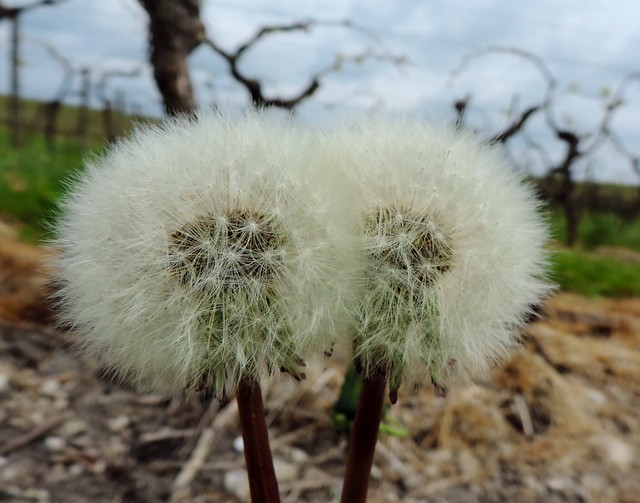
Twins dandelions

What might health care look like if we base it on the values which emerge out of a prioritisation of difference?

Uniqueness.

Whilst a knowledge of pathology and the natural history of diseases aid a good diagnosis, a focus on disease is not a focus on a person, or on health. Even when running a specialist clinic, such as an Asthma Clinic, every single patient who attends is unique. Their asthma symptoms will be specific to them – the circumstances where their asthma is most troublesome will be specific to them – the strategies they have found bring greatest ease will be specific to them – and, crucially, their narrative will be unique. Where asthma appeared in their lives, and when, will be part of that narrative. What impact it has made and how they have responded to that impact will be part of that narrative. How the asthma will progress will also be part of that narrative. This latter part is unknowable, as the future is always an emergent phenomenon in a complex living organism. It cannot be accurately predicted. Last, but not least, each individual has a personal world view created by their genes, their nurturing, their life experience, their connections to others and so on – everything which influences values, beliefs and attitudes. Understanding that world view will help the patient to make sense of the asthma in their life, and understanding that world view is essential in helping them to choose therapeutic interventions as well as adaptive strategies. Whatever the general, the shared, or the common, all the findings, test results and so on, need to be re-integrated into the context of this unique human being’s life.

Diversity

Because every patient is unique, the interventions which a particular patient finds beneficial will be specific to them. One-size-fits-all is a terrible approach to health care. Every single treatment protocol has an end point, and none of those end points can encompass benefit and a good outcome for each individual patient who goes through that protocol. So, what happens to the patients who make it all the way to the end of the protocol and are still suffering just as much? What does the doctor do with them? If we make only certain treatments available then there will always be patients who get no relief from their suffering. We need a diversity of treatment options, approaches and techniques available if we are to find the best, most effective treatment for every single patient.

Are protocols compatible with uniqueness and diversity? Can truly individualised health care be delivered by protocol? Can health care which actually relieves the suffering of every single patient be delivered by protocol? This might be extreme, but I’ve a feeling we should trash the protocols. Let’s get back to sound, clinical judgement which is flexible and focused ultimately on the needs of the individual who is in the consulting room here and now.

Tolerance

This goes with diversity. If there are a plurality of needs, and a plurality of solutions, with both being deeply affected by the world view of the individual, then we need to genuinely tolerate, in a non-judgemental way, those differences. There is no place in health care for rubbishing a patient’s experience and world view. Whose life is it anyway? Who is a professional to say that they know what the best life choices are for a patient? A professional should be caring, empathic, compassionate and supportive. Not judgemental, superior or authoritarian.

Integration

There is no such thing as a cure. Other than the cures which the body achieves. Human beings have the most incredible bodies. One way to think of a human body is to see it as a complex adaptive system. Complex adaptive systems have a number of characteristics but one of them is a self-healing capacity. The only healing which occurs in the natural repair, defence and growth of the living organism. It does this not least through integration – through the creation of mutually beneficial relationships between highly differentiated parts. All health care should be directed towards an increase in integration. Any treatment which impedes integration, impedes healing.

Flourishing

A lot of health care seems limited and disappointing to me. Sure, nobody wants to suffer, and a doctor’s duty is to relieve suffering. If we can do that by enabling a patient to get a handle on what’s happening, supporting them in the creation of a more meaningful narrative, whilst easing suffering and reducing difficult and limiting symptoms, then we are doing a good job. But is it enough? Is it enough to reduce the symptoms and stop there? Is it enough to support a patient through an acute illness but then stop when it comes to an end? Or if we really want HEALTH care, don’t we need to think beyond disease? Don’t we need to think about flourishing? About assisting an individual to grow, and, yes, to flourish – to feel well, to feel able to become whatever it is they have the potential to become?

If we begin to think about health in its fullest sense and in its greatest diversity, then we need to think beyond institutionalised health care systems. We need to think about what we can do to maximise the chances of people experiencing the best health they can – and that will take us into thinking about society, the environment, the economy, and indeed everything which is involved in creating the conditions for the health of human beings.

Read Full Post »

Redstart

For many weeks I’ve noticed a Robin in my garden, but recently this little guy has turned up.

At first I thought he was maybe a different Robin, or maybe a Bullfinch (I’m not an expert in birds!) but I’ve just discovered he is a “Redstart” with his red breast, black mask and white skull cap. I’d never even heard of a “Redstart” before but apparently they are from the Robin family – you can see similarities with the more common Robin, but he is clearly different.

We live in a society which prioritises sameness. Mass production, mass consumption, standardisation, health care by protocol, science based on abstraction and categorisation.

We do have a lot in common, and that’s partly how we connect to others – shared interests, preferences, values and so on.

I was aware throughout my practice as a doctor that every single person I saw had some things in common with others who I had seen, but who also was unique – different from every other person I had seen. I’d make a diagnosis – chest infection, diabetes, asthma, psoriasis etc by prioritising the signs and symptoms which I had learned were associated with those diseases, but then I had to pay attention to the person and ask who this was who had this disease, ask how it appeared in their particular life, how it affected them in their unique way.

What I’m wondering just now is what might the world be like if we prioritised difference instead of sameness?

What would health care look like if we prioritised the uniqueness of every patient AND every practitioner?

What would the economy be like if we prioritised the uniqueness of each member of the population?

What would education be like?

What would society be like?

Are there certain underlying principles which would come to the fore if we prioritised difference?

I’m going to explore those questions here over the next few days.

Read Full Post »

Over the course of my career as a doctor patients would frequently ask me about diet. I’m a great believer in the uniqueness of every individual human being and I’ve no doubt that just as we all have our own taste preferences, so we each have certain foodstuffs, or whole food groups, which suit us best (or certainly which disagree with us the most).

I’m not that keen on the word “diet” because it seems to be used most frequently for a pattern of eating which the person really doesn’t want to follow for the rest of their lives. Isn’t it much better to find a way to eat well for you? Not just for a week, a month, or even a year, but all the time?

The most important practice to follow is the combination of awareness and reflection. Then you can make your choices. Notice what you eat, when you eat and how you eat. Notice how you feel before, during and after eating certain foods. What are your real preferences? Which foods seem to give you a boost, or make you feel well? Which foods upset your system, make you tired, or unwell?

Not only are you likely to find that you are not the same as other people, but you are likely to find that you will change over time. When you are a child you may well handle food differently from when you are an adult in your 30s, 40s, or older. However, by practising awareness and reflection, you can alter your choices if need be.

I do think there are other basic principles however. I’m quite a fan of Michael Pollan’s “Food Rules” – “Eat food. Mainly plants. Not too much.” And time and time again the “Mediterranean diet” is found to be associated with good health. But if there is one single principle I would highlight it is about quality of food, and it seems to me that the shorter the distance from land to table the better.

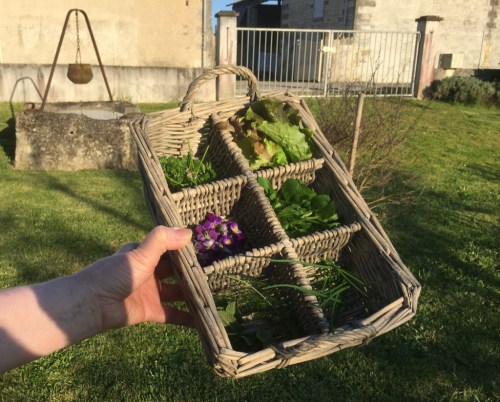
That applies not just physically, as with this photo of a selection of what is growing in our garden just now on its way to our lunch table. But it also applies to the number of stages of preparation.

The more processed and transported a food, the more I prefer to avoid it.

Read Full Post »

In my A to Z of Becoming, one of the verbs beginning with “I” is “imagine”.

As it happens, I’ve chose “imagination” as my keyword for this year. Do you do that? Do you choose a “word for the year”? 

I think I have a very active, very well developed imagination. My feeling is that I used my ability to imagine every day at work as a doctor to help me understand my patients. For me, good medical practice is dependant on the ability to empathise. Without empathy there is a diminished level of understanding. In fact, the complete lack of empathy, resulting from a failure of imagination, as a cause of cruelty, was highlighted by the author Ian McEwan, and others, after 9/11.

Since retiring and moving to France, I’ve begun to experiment with writing fiction as another way to use my imagination. What startles me, and repeatedly surprises me, when I write fiction is how my imagination comes up with things I hadn’t expected. 

Maybe that shouldn’t surprise me because every night when we dream our imaginations are producing the unexpected, aren’t they?

That got me thinking…..is there an off switch for imagination?

Are we ever not using our imagination?

When we fear something, we are imagining whatever it is we fear. When we worry about something, we imagine whatever it is we are worrying about. When we experience something we bring our imaginations into the experience as we create the subjective experience for ourselves. When we remember something we re-create the memories using our imaginations. When we plan to make something happen, we use our imaginations to create the plan.

Actually, I think, there is no off switch for the imagination.

However, when we are on auto-pilot, when we are in zombie mode rather than in hero mode, we are not aware of the activity of our imagination, and we are not making conscious choices.

Those are the two key elements to moving from zombie to hero mode, I reckon –

First, become aware.

Second, choose what to do.

So, here’s two things about imagining to explore this week.

What are you currently using your imagination for? And, what are you going to choose to use your imagination for?

Read Full Post »

« Newer Posts - Older Posts »