Feeds:
Posts
Comments

Archive for the ‘from the consulting room’ Category

One kelpie

The kelpies

A fairly recent development just off the Stirling/Edinburgh motorway is the installation of these “kelpies”. I visited them at the weekend for the first time. They’ve been installed in a newly created park area which has lots of common space for roller-blading, cycling, walking, feeding ducks at the duck pond, a children’s adventure playground and so on, but everyone comes to walk around, and be amazed by, the kelpies themselves. I visited on a Sunday which is probably a more busy day but there were hundreds and hundreds of people there.

Kelpies are part of the myths of Scotland – I suspect most people aren’t that particularly familiar with them, but I wonder how many go home and read a bit about them. Wikipedia is a good starting point (but it does strangely include paintings which depict kelpies as naked females, when, in folklore in Scotland, the kelpie was invariably male)

I loved that so many people were walking, sharing time with family or friends, and gaining such sheer pleasure from this open air art. What a fabulous combination of art, community and healthy activity. Made me wonder if we don’t pay enough attention to the way art in particular can be a central focus of influence on our quality of life.


Read Full Post »

image

That’s the statement I came across in an interview with a “new realist” philosopher the other day. I’m not going to get into what on earth is “new realist” here just now but when he was asked if science (or more precisely Physics) had proven that the universe had no purpose, that it made no sense?

Well that’s a claim we often hear from people who claim the only reality is physical, the universe is random, and evolution isn’t “going anywhere”. This isn’t a world view I’m attracted to.

My understanding is that human beings exist, and that we all have consciousness and subjective experience. Values are important to us. For example, you can look at that photo above and describe it according to its botanical classification. I look at it and see a beautiful image. It’s the beauty of the image which strikes me.

This philosopher said that science is the study of objects, whereas for human beings it was often something not at all like an object which brought meaning to life. The example he gave was democracy. He said what colour was democracy? What were its dimensions? Science has no answer to these questions. Because democracy is not an object, it’s something which gives lives meaning.

I don’t know about you but that certainly gets me thinking. What about the “sciences” which don’t deal with objects? Like economics, or psychology, or “social sciences”?

Then I got to thinking about health and how, as a doctor, I needed to understand the body in a scientific way. I needed to know what to measure when, and what to do with the results. But I also needed to understand the lived experience of a person. When they talked to me about pain, about an itch, about nausea or dizziness, they were not talking about objects which could be measured. And what about the narrative…..how a person experienced and made sense of their illness?

So, there is something helpful in this idea of science being the study of objects. It helps us see the relevance of science and the absurdity of scientism (which claims ultimate and absolute authority for the “truth” as revealed by science.

Objects are an important part of reality, but they sure aren’t everything that exists!


Read Full Post »

Healing first

tree repair

If you cut yourself, fall over and scrape your skin, or if you break a bone, your body’s healing response kicks in and makes a quick repair, then over a few days or weeks completely repairs the injury. Sometimes medical treatment is needed to support this process (cleaning the wound, applying a dressing, holding the broken bone in place with plaster, bandages, or even screws and plates), but the only way the damaged tissue recovers is through the body’s own healing system.

If you are infected with a virus or a bacteria, again your body’s healing response kicks in, attacking the offending organism, and repairing any tissues damaged by the infection. Antibiotics can kill some bacteria, and some viruses can be killed with drugs too, but we have no medication which heals the tissues or organs damaged by the infection.

There’s a third kind of disease/illness which isn’t caused by either trauma or organisms, and that’s the kind which is rising relentlessly, it seems, throughout the World. Everything from many cancers, to “inflammatory diseases” like asthma, “autoimmune diseases” like rheumatoid arthritis, chronic diseases like diabetes, multiple sclerosis, dementia and Parkinson’s disease, to genetic disorders, are understood best by us as pathologies, and whilst the body’s healing system constantly struggles with these disorders it never quite manages to throw them off. However, the healing response does try to limit damage, to repair what can be repaired, and to increase the over all resilience (defence and recovery) of the individual.

We seem to understand pathology better than we do healing. Maybe we need to invest more time, people and resources into changing that. 

And although people will always get sick or injured, and we will always need to find the ways to assist people with these illnesses, shouldn’t we also integrate actions and support which stimulate and enhance the healing response, not just in every therapeutic plan, but first of all, before we do anything else? (Well, of course, that depends on the urgency of the situation), but is there ever a case for ignoring the healing response?

Real healing is natural. But that doesn’t mean we can take it for granted.


Read Full Post »

Moonlight on water

I was struck today by this paragraph about Romanticism in Iain McGilchrist’s Master and His Emissary –

Romanticism in fact demonstrates, in a multitude of ways, its affinity for everything we know from the neuropsychological literature about the workings of the right hemisphere. This can be seen in its preferences for the individual over the general, for what is unique over what is typical, for apprehension of the ‘thisness’ of things – their particular way of being as ultima realitas entis, the final form of the thing exactly as it, and only it, is, or can be – over the emphasis on the ‘whatness’ of things; in its appreciation of the whole, as something different from the aggregate of the parts into which the left hemisphere analyses it in self-conscious awareness; in its preference for metaphor over simile, and for what is indirectly expressed over the literal; in its emphasis on the body and the senses; in its emphasis on the personal rather than the impersonal; in its passion for whatever is seen to be living; and its perception of the relation between what Wordsworth called ‘the life of the mind’ and the realm of the divine; in its accent on involvement rather than disinterested impartiality; in its preference for the betweenness which is felt across a three-dimensional world, rather than for a seeing what is distant as alien, lying in another plane; in its affinity for melancholy and sadness, rather than for optimism and cheerfulness; and in its attraction to whatever is provisional, uncertain, changing, evolving, partly hidden, obscure, dark, implicit and essentially unknowable in preference to what is final, certain, fixed, evolved, evident, clear, light and known.

Well, well….for those of you who are already familiar with Iain McGilchrist’s hypothesis about the differences between the left hemisphere and right hemisphere ways of approaching the world, I’m sure you’ll agree this is a terrific, comprehensive summary. He, of course, is at pains to point out, time and again, that he is not saying that the left approach is bad and the right is good, or vice versa…….that we need BOTH, and that we need to integrate the functions of the two hemispheres, not allow the left to dominate the right.

But take your time, and read through that paragraph carefully. He is highlighting what is consistent in the values of Romanticism with the tendencies, or preferences of the right hemisphere of the brain. 

I enjoy what the left hemisphere does for me, but I resonate SO strongly with ALL of these “right hemispheric” qualities he describes so beautifully in this paragraph. It captures my fascination for the personal, the particular, the transient, for “becoming not being…..”

Read Full Post »

It’s becoming increasingly clear that bacteria and human beings interact in profound and complex ways. I wrote recently about the way bacteria in our guts might affect our food choices and behaviour. Well, here’s an interesting study looking at the antidepressant effect of mycobacteria vaccae which are found in the soil.

Antidepressant microbes in soil cause cytokine levels to rise, which results in the production of higher levels of serotonin. The bacterium was tested both by injection and ingestion on rats and the results were increased cognitive ability, lower stress and better concentration to tasks than a control group. Gardeners inhale the bacteria, have topical contact with it and get it into their bloodstreams when there is a cut or other pathway for infection. The natural effects of the soil bacteria antidepressant can be felt for up to 3 weeks if the experiments with rats are any indication.


Read Full Post »

Here’s an interesting recent research study looking at how the micro-organisms which live in our bodies might influence our behaviour. The researchers

concluded from a review of the recent scientific literature that microbes influence human eating behavior and dietary choices to favor consumption of the particular nutrients they grow best on, rather than simply passively living off whatever nutrients we choose to send their way.

It seems that different organisms have different nutrient needs and that are able to send signals which will increase the chance of them getting what they want. Amazing, huh? The communication seems to be two way, because its also been found that changing your diet changes the “flora” (that’s the community of micro-organisms in your gut) within 24 hours.

Some of the signals apparently go through part of the autonomic nervous system.

“Microbes have the capacity to manipulate behavior and mood through altering the neural signals in the vagus nerve, changing taste receptors, producing toxins to make us feel bad, and releasing chemical rewards to make us feel good,” said Aktipis, who is currently in the Arizona State University Department of Psychology.

Given that there are about 100 micro-organisms to every human cell in the human body, the concept that each of us is a living community of highly diverse cells is a strong one. There must be an immense amount of inter-cellular communication going on that we totally unaware of as we live our lives.

Makes you wonder, doesn’t it? Gives “acting on your gut feelings” a whole other dimension!

Read Full Post »

rock weathering

sparkling water

stained glass light

tree ripples

It seems the way are brains are made we are predisposed to notice patterns.

The scientific method is based on noticing patterns, describing them, and, in particular spotting patterns which repeat. Patterns which repeat give us the ability to predict – not just what might happen next, but what might happen if we take a particular action. In other words we can use what we learn from pattern spotting to manipulate objects. But there are no patterns which ALWAYS repeat and none apply in ALL contexts of time and place. The danger of pattern spotting is to generalise and turn repeating patterns into “laws” or “rules”.

Science can easily go wrong when it hardens into arrogance…….the arrogance which often arises out of conviction.

A good doctor recognises a pattern of symptoms and signs, makes a diagnosis, takes an action known to be likely to produce a particular desired outcome, but retains their awareness and curiosity to seek new patterns, to reconsider their assessment of the patterns and tries different actions when the first one fails to achieve what the doctor was trying to achieve.

After all, even weather patterns are unpredictable…..


barometer

Read Full Post »

Just seeing – vision – amazes me. We know so little about how it happens.

At university I learned about the visual cortex – the area of the brain which processes the signals from our eyes and created the images we “see”. I remember being strangely surprised to think through what it meant that light waves hit the backs of our eyeballs and then that energy was transformed into electro-chemical signals which sent information back along the “optic nerve” and how the exit point from the eyeball where the nerve goes off to the brain received no light information at all so should always be present a gap in the image we see. But there is no gap to see! Our brains seamlessly, instantaneously and constantly process all the information from our eyeballs and creates this experience of moving images which never have any holes in them!

We now know that there is a lot more of the brain involved in creating images for us than we previously thought. Read this wikipedia article for starters.

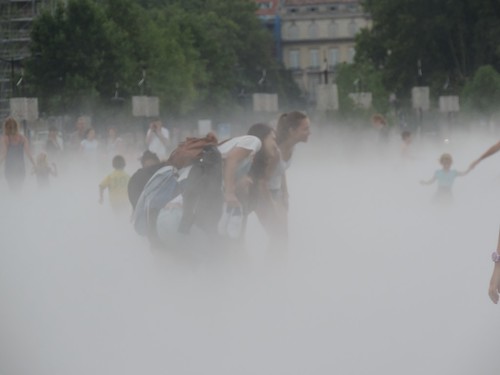
So, what amazes me is not just how we experience this seamless visual image, but how we instantly know what we are looking at. Take a look at these photos I took of people on the Miroir D’eau in Bordeaux. The first one is taken pointing the camera at a mirror which is reflecting the image from outside the building I’m in. People are in the mist created by the water spray. The second is outside with me actually on the Miroir and the people in the mist. The third is a shot taken after the mist has settled.


Through the window

Lost in the mist

miroir d'eau Bordeaux

In all three shots we know we are looking at people. Sure, as the images become more clear we can see more detail, but isn’t it interesting that we have a pretty good idea of what we are looking at right from the first image?

Wow! Isn’t the ability to SEE just amazing? And how wonderful that we continue to learn how we do that. We often forget that our level of understanding is just our current level. It’s never complete. It’s never the “full story”. What more will we learn even in my lifetime?

Read Full Post »

A recent study from the US has found that most people rate the doctor’s personality and the quality of their relationship with him or her as most important when choosing a doctor.

when asked what they thought was the most important factor in a “high quality doctor,” most people cited factors related to the doctor’s personality and the quality of the doctor-patient relationship, such as whether a doctor is attentive or caring or has a good bedside manner

Does this surprise you?

It doesn’t surprise me.

I think far too little weight is given to the human factors in health care – who the person is – both the individual, unique patient, and the individual, unique doctor.

Not only is every human being unique, but every relationship is unique and I learned early in my career that each partner in a GP Practice would attract a distinct cohort of patients. In fact, we noted that we could all tell exactly who was on holiday from the particular patients who came to see us in our colleague’s absence. There just is no such thing as any one doctor being the “best” doctor for every single patient.

Whilst the statistics-fanatics seem to prefer numbers and think numbers can be applied across the board as if human uniqueness didn’t exist, in the real world, human beings make choices in human ways (not computer/robot ways)

When it comes to competences, then all doctors should do their best to develop their skills and their knowledge continuously. That’s what good, reflective practice is about. Personalised feedback would certainly be useful, but reporting should be done according to the priorities which patients AND colleagues set – and that would include the relationship skills as well as competences in techniques.

Read Full Post »

There are something like 100 billion neurons in your brain – a literally mind boggling figure.  Are you really able to imagine what a 100 billion of anything looks like?

As if that weren’t challenging enough, each neuron has up to 50,000 connections with other neurons, and each connection (a synapse) is an electro-chemical switch of a sort – passing information and energy across the gap between two neurons. This makes the total number of states of the brain (number of “on” or “off” neurons) a figure which is……well, unimaginably huge!

I was taught at university that a synapse was a pretty simple connection between two cells where on neuron released a chemical, which then crossed the gap and stimulated the next neuron. This, of course, is a huge oversimplification.

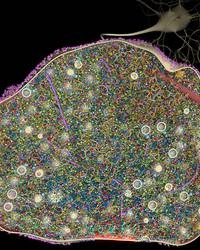
Researchers have recently managed to describe a single synapse much more accurately.

0f9996a3aecb308bd7182564925c857c


The researchers say


The new model shows, for the first time, that widely different numbers of proteins are needed for the different processes occurring in the synapse,” says Dr. Benjamin G. Wilhelm, first author of the publication. The new findings reveal: proteins involved in the release of messenger substances (neurotransmitters) from so called synaptic vesicles are present in up to 26,000 copies per synapse. Proteins involved in the opposite process, the recycling of synaptic vesicles, on the other hand, are present in only 1,000-4,000 copies per synapse. The most important insight the new model reveals, is however that the copy numbers of proteins involved in the same process scale to an astonishingly high degree. The building blocks of the cell are tightly coordinated to fit together in number, comparable to a highly efficient machinery. This is a very surprising finding and it remains entirely unclear how the cell manages to coordinate the copy numbers of proteins involved in the same process so closely.

It’s not just the numbers which are astonishing, its the complexity, and that last sentence particularly struck me – “it remains entirely unclear how the cell manages to coordinate the copy numbers of proteins involved in the same process so closely”

Just how much DO we know about how the human body works? How much DO we know about how it evolves to this level of complexity, both through an individual lifetime from the fertilisation of a single egg cell to a fully grown human being, and throughout history from single celled life forms to the multi celled human beings?

Humility. That’s what we need as scientists. Humility. Our ability to discover and understand is astonishing, but so far pales in comparison with the complexity of a single human being.

I’m amazed.

Read Full Post »

« Newer Posts - Older Posts »