Feeds:
Posts
Comments

Archive for the ‘from the consulting room’ Category

Tim Parks’ excellent “Teach Us to Sit Still: A Sceptic’s Search for Health and Healing” was recently reviewed by one of the British Medical Journal’s Associate Editors.

By now you must be as bored as I was. And we still haven’t reached the dénouement. I don’t think that I shall be spoiling anything for anyone if I say that eventually he found that learning to meditate brought an end to the pains, although he doesn’t say whether he can pee any better.
Obviously this book wasn’t written for doctors, and I’m doubtful whether they will enjoy it much. They will have heard versions of this story many times before from their own patients whom they tried hard, but failed, to help. Indeed at one level this particular narrative is little more than a long and self absorbed account of the inner journey of a man desperately seeking meaning in and relief from chronic (but not incapacitating) symptoms, who eventually manages to find both through visipanna meditation. Yet before dismissing it entirely it’s worth remembering that the author is a successful writer and academic—one of his novels was shortlisted for the Booker prize—and probably a lot cleverer than we are.

You can tell he didn’t like it.
Having just read the book myself and found it thoroughly engaging, and thought provoking, I thought the BMJ’s review showed just what’s gone wrong with medicine with these days – doctors shouldn’t find patients’ stories boring. They shouldn’t find them irrelevant, nor should they believe that their own take on illness or health is superior to that of the person they are trying to help. What happened to compassion? When did human beings become the boring part of medicine? Interestingly, there are clues in Parks’ own text. Consider these two statements –

What’s the point of speaking when you’ve arranged to do proper clinical tests? The tests will speak for you.

and

Without evidence of organic damage pains were perhaps unimportant. At least to doctors.

I’ve had junior doctors tell me they are being taught exactly these views – that only clinical tests show the “truth” and that patients’ stories don’t matter. This doesn’t bode well for the future practice of medicine.

In fact Parks predicts the BMJ editor’s response –

Doctors had never wanted to go into detail over this, as if afraid that an exhaustive description of symptoms would mean losing themselves in a labyrinth of highly nuanced but irrelevant sensation.

But the editor is right. This is not an uncommon story. That, however, certainly does not make it boring. This is a good read. It’s an engaging and thoroughly honest, open account of a chronic problem which the best of “evidence based medicine” could do nothing to help. That too, is not an uncommon story.

Given that Tim Parks describes himself as a “skeptic” (though I think that label is much misapplied these days….seems the average “skeptic” is actually someone arrogantly convinced of the rightness of their own personal view, only doubting everybody else’s!), it’s interesting to find him saying this (comparing his mother and father’s evangelical Christian fundamentalism to their belief in modern “scientific” medicine”) –

..like doctors’ syrups, divine healing required no effort or self-knowledge on the part of the sufferer; neither my father nor mother paid much attention to their bodies.

One of the most important points he makes is –

Wasn’t it weird, in fact, the way everybody imagined that when you were ill all you had to do was go to a doctor and get yourself prescribed a medicine? How did that happen?

He’s right. How did that happen? And isn’t it weird? Health isn’t about getting a pill, and doctors don’t always know best. Trust me. I’m a doctor.

Finally, referring to John Launer’s suggestion that “MUS” should mean “Medically Unexplored Stories”, instead of “Medically Unexplained Symptoms”, the reviewer concludes –

Perhaps he’s right. If so, the moral of the story told by Parks is that intelligent, educated, and apparently rational people may think about their health and illnesses in ways that hardly begin to overlap with ours.

You know, it’s not about intelligence, education or rationalism, it’s the biotechnical doctors who have lost the plot. It’s their way of thinking which hardly begins to overlap with that of their patients, and as health is a personal and individual experience, the most important story is the patient’s one.

Read Full Post »

the power of flowers

Seeing beauty in a flower could awaken humans, however briefly, to the beauty that is an essential part of their own innermost being, their true nature. The first recognition of beauty was one of the most significant events in the evolution of human consciousness. The feelings of joy and love are intrinsically connected to that recognition. Without our fully realizing it, flowers would become for us an expression in form of that which is most high, most sacred and ultimately formless within ourselves. Flowers, more fleeting, more ethereal, and more delicate than the plants out of which they emerged, would become like messengers from another realm, like a bridge between the world of physical forms and the formless. They not only had a scent that was delicate and pleasing to humans, but also brought a fragrance from the realm of the spirit. Using the word “enlightenment” in a wider sense than the conventionally accepted one, we could look upon flowers as the enlightenment of plants.

A New Earth. Eckhart Tolle. ISBN 978-0-141-03941-1

Read Full Post »

Here’s an interesting study. Apparently people who have a good social network of friends and neighbours are likely to live longer.

In their study, which looked at over 300,000 people from four continents over a period of seven years, those with the strongest social networks fared best in terms of health outcomes and lifespan. They were nearly twice (1.5 times) as likely to be alive at any given age than those who were lonely.

The protective benefit from good relationships applies at all ages. It’s not just something which is good for the elderly.

These findings shouldn’t be a surprise. Human beings are social creatures. We need to love and to be loved to really thrive. As Christakis shows well in his “Connected” our social networks powerfully influence our lives. This study shows that this influence can mean the difference between life and death.

The dominant health paradigm seems to be take drugs – drugs to keep you well, drugs to make you better, drugs to keep you alive. We need a better paradigm than that. We need one which instead emphasises the importance of living and living well. Just as a recent study showed the importance of the living environment on health, this study shows the importance of the social environment. These studies shift the emphasis away from a mechanistic understanding of health to one where networks, context, relationships and the environment take centre stage. But there’s not profit in that for drug companies, is there? –

Read Full Post »

There’s an interesting piece of research published recently studying the effect of living conditions on cancer. Jonah Lehrer has written about it here. It’s a study conducted on mice, not humans, but the results were pretty dramatic.

In short, the paper demonstrates that mice living in an enriched environments – those spaces filled with toys, running wheels and social interactions – are less likely to get tumors, and better able to fight off the tumors if they appear.

Having injected all the mice with melanoma cells, all the mice raised in the standard cages developed the cancer, but 17% of the ones in the better cages showed no cancer, and those which did had tumours 75% smaller than the other mice. These are hugely different outcomes. The researchers highlight a hormonal pathway in mice which could explain the connection between living conditions and tumour production. Jonah concludes –

It strikes me that we need a new metaphor for the interactions of the brain and body. They aren’t simply connected via some pipes and tubes. They are emulsified together, so hopelessly intertwined that everything that happens in one affects the other. Holism is the rule.

Hear, hear, yet again, Jonah Lehrer!

Read Full Post »

What’s your vision for health care?
I remember once hearing a spokesperson for WHO (the World Health Organisation) being asked that question and he said his dream would be that every child in the world was vaccinated against every known disease at birth. I wondered what planet he was living on.
One vision is based on “mapping the genome”. When I heard the idea that one day we’ll all be given a map of all the diseases we might expect to suffer AND a predicted age of death, I had this image in my head of some 30 year old walking out of the laboratory clutching his gene certificate telling him he would live to 102, so engrossed with the result that he doesn’t notice the bus heading towards him as he steps out into the road……
The main vision for health care currently doesn’t involve much in the way of direct interventions to improve health, but rather, is about “managing” diseases – which means drugs, and more drugs.
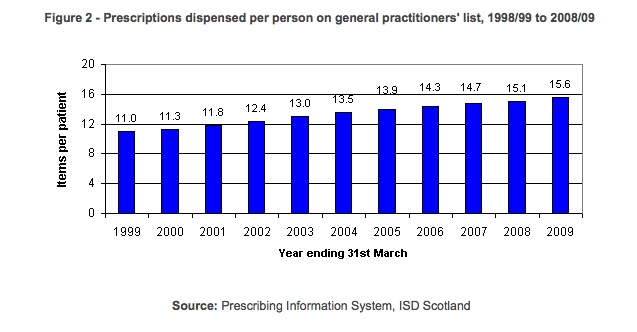
One in ten of over 15 year olds in Scotland now take daily antidepressants, and look how the number of prescriptions over all is rising……

Is this the big idea? More drugs?

Read Full Post »

Here’s a scenario to try with any health care professional you know –

Imagine a patient presents with an infection in their bladder (cystitis), with burning pain passing urine, frequent need to pass to urine and some blood in the urine. You send a sample of the urine to the lab and they grow “E Coli” (a commonly implicated bacteria) sensitive to “Trimethoprim” (an antibiotic). You prescribe the recommended “Trimethoprim”. What does it do?

The only correct answer is that it kills the bacteria.

So, how does the inflamed, swollen, bloody bladder wall return to normal?

Only through the body’s natural healing system.

Drugs have effects. Antibiotics in particular can kill bacteria which might otherwise cause us great harm. But prescribing a drug is only part of the job needing done. If we only prescribe a drug and do nothing to support or stimulate self-healing, then we leave healing to chance……as if healing isn’t part of a health care professional’s job.

So, here’s something I wonder about. Why don’t they teach how to heal people at medical school? Why do they only teach how to “manage” diseases, remove diseased tissue, or suppress symptoms?

There’s the BIG gap in biomedical practice – how do we encourage and develop healing?

Shouldn’t we be using approaches which focus on healing as well as those which focus on disease?

Read Full Post »

The first time I saw Antony Gormley’s “The Field“, I was transfixed. The room filled with those hundreds of small terracotta creatures all gazing at me gazing at them!

It’s an image which has stayed with me ever since and it’s one I think all health care professionals should expose themselves to.

Every patient I see has something in common with some other patients I’ve seen. That’s the basis of “diagnosis” in the way biomedicine considers disease. But every patient I meet is different. No two have the same experience of this disease. No two tell the same story. And here’s another aspect to that…….nobody stays the same, the story constantly evolves and changes. Without attention to the present, without an open-ness to difference, we fail to see what makes every single human being unique and special.

Read Full Post »

Myth 1

There are two kinds of treatments available – those which work, and those which don’t.

The real world isn’t so simple. There’s not a single treatment on the planet which “works” for every person who receives it. I’m sure the drug companies wish they did have such a product – it would have no competitors. Even treatments which work for most people, don’t work for ALL people.

Myth 2

The placebo effect is distinguishable from a pharmacological effect.

Randomised controlled trials typically have two groups. One group receives the study drug and the other, the placebo. If the improvements in the first group statistically exceed those in the second group, the drug is considered to be effective. However, the placebo effect occurs in both groups. It is impossible to know whether any individual in the first group has gained their improvements from the drug, and not from the placebo effect.

In clinical settings, with any individual patient, it is impossible to know whether the drug has “worked” or whether the improvement is due to placebo.

Myth 3

Giving a placebo is the same as doing nothing

This graph is from Irvin Kirsch’s “Emperor’s New Drugs“. It clearly shows that placebo and doing nothing are not the same.

Myth 4

The NHS only funds “evidence based” treatments.

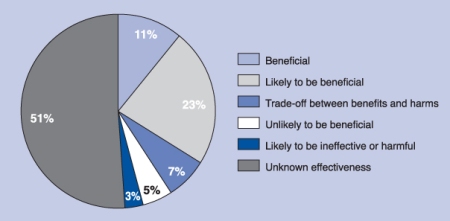
51% of treatments rated by the BMJ group’s “Clinical Evidence” are of “unknown effectiveness”

Myth 5

Objective findings are of value, and subjective reports are value-less

Health is a lived experience. Only a person can report that experience. To dismiss the patient’s narrative is bad medicine.

Read Full Post »

Here’s two reasons why I’m concerned about using “Evidence Based Medicine” to make decisions about what should not be available on the NHS.

The first reason is we actually don’t have good convincing evidence for most of the treatments we currently deliver. The BMJ’s “Clinical Evidence” highlights this on its front page.

They categorise treatments into “beneficial, likely to be beneficial, trade-off between benefits and harms, unlikely to be beneficial, likely to be ineffective or harmful, and, unknown effectiveness. This in itself is controversial –

Dividing treatments into categories is never easy hence our reliance on our large team of experienced information specialists, editors, peer reviewers and expert authors. Categorisation always involves a degree of subjective judgement and is sometimes controversial.

In other words, the categorisation process is a matter of opinion and the opinions will be influenced by the authors’ values, beliefs and personal experiences.

Actually, it gets worse, because earlier on the same page, “Clinical Evidence” says

we wish to highlight treatments that work and for which the benefits outweigh the harms, especially those treatments that may currently be underused. We also wish to highlight treatments that do not work or for which the harms outweigh the benefits.

The thing is, in the real world, you can’t divide treatments into two such categories – those which work and those which don’t. There are NO treatments which “work” for every single patient. We are all individuals. It would be much better to publish the spread of responses experienced, and to resist this simplistic and delusional two-value “works/doesn’t work” categorisation.

And here’s the stunning statistic – 51% of the treatments are rated as “unknown effectiveness” (sometimes referred to as “insufficient evidence”). Were we to remove ALL of these treatments from the NHS, not only would we throw out a lot of babies with the bathwater, but does anyone seriously think we’d have a better health service?

The second reason to worry is just how appallingly distorted the evidence base is by the failure of companies to publish research which does not demonstrate positive effects of their drugs.

The German Institute for Quality and Efficiency in Health Care has published a study in the journal Trials.

they assessed hundreds of articles from journals and other sources, which covered areas including treatment for psychiatric disorders, pain, heart and circulatory disease, skin disease, cancer, and infectious diseases. A wide range of interventions was affected: from drugs and vaccines to medical devices such as ultrasound or devices for wound care.

What did they find?

an analysis of 90 drugs that had been newly approved in the US showed that they had been tested in a total of 900 trials. However, even 5 years after approval, 60% of these studies were unpublished. On the second level only selected outcomes from studies are published

Comparisons of protocols and journal articles of studies showed that in 40% to 60% of studies, results had either been completely omitted or analyses changed.

This does not only affect studies sponsored by the pharmaceutical industry. In their paper, the IQWiG authors also cite an analysis in which 2000 studies on cancer topics were analysed according to sponsorship. The proportion of published studies was extremely low: of the industry-sponsored studies, 94% were unpublished; however, even 86% of university-sponsored studies were also unpublished.

Irving Kirsch found similar significant distortions of the evidence base when he got hold of unpublished trials of anti-depressants.

The claims to certainty by the advocates of those who seek to make decisions about health care solely based on published research are misguided.

What’s the answer? Well, first of all bringing the current advice up to date by doing what these researchers have done, getting hold of the unpublished research and seeing how that changes the picture. Secondly, a bit of humility would help! It’s delusional to claim certainty about treatments for individual patients. Human beings just aren’t that predictable. They’re not machines. Thirdly, developing a greater wariness about categorisation. It doesn’t make sense to pretend there are treatments “which work” when we know there are no treatments which work for everyone. As Dr Roses of Glaxo said –

The vast majority of drugs – more than 90 per cent – only work in 30 or 50 per cent of the people,” Dr Roses said. “I wouldn’t say that most drugs don’t work. I would say that most drugs work in 30 to 50 per cent of people. Drugs out there on the market work, but they don’t work in everybody.

Finally, let’s put people back at the heart of our decision making. Health care can only be individual. It’s a mistake to consider statistics more useful than a patient’s personal experience.

Read Full Post »

I like to read books which change my life. Lots of books do that for me. In fact, the books I enjoy most are those which do just that, the ones which open up new ways of thinking to me, new ways of seeing, expand my understanding, stimulate my creativity, books which, once I’ve read them, my world is not the same.
I’ve read a lot of books like that, and if you browse this blog reading the posts in the category “from the reading room” you’ll find reviews of several of them.
I’ve just read another. In fact, I can’t remember the last time I felt this excited reading a particular book. It’s Dan Siegel’s “The Mindful Therapist” [ISBN 978-0393706451]
Now, I haven’t come to this book cold. I’ve read, first of all, his “Mindsight” [ISBN 978-1851687619] (and if you’re inspired to explore this body of work I recommend you start with that), his “The Mindful Brain” [ISBN 978-0393704709], and “The Developing Mind” [ISBN 978-1572307407], before I got hold of this, his latest book, “The Mindful Therapist”.

I’m also well into his online course which I’m thoroughly enjoying.

So, a lot of the concepts in this “Mindful Therapist” were already familiar to me before I opened it up – the idea of the mind as “an embodied, relational process of regulation of energy and information flow”,  the idea of the triangle of wellness – mind, brain and relationships, the understandings from neuroscience of integrated function of differentiated parts, of the key roles of the midfrontal cortex, and of neuroplasticity,  and the practices of the wheel of awareness and other meditations
Despite my familiarity with all of that, and more, this particular book has blown me away. I’ve already begun to introduce patients to the idea of health as a flowing, adaptive, coherent, energised, stable river, with the opposite banks of chaos and rigidity which we end up on when we become unwell.

I’ve begun to share with some patients the deceptively simple wheel of awareness meditation. But now, I’ve got a whole new level of insight.
Into this familiar mix, which Dan expands and reinforces throughout “The Mindful Therapist”, he gives exercises in self-discovery, and models of personality and behaviour which I’ve never seen described elsewhere. I’ve said before I’ve got a synthetic brain – always making links, seeing patterns, associations, expanding through increasing connections – well, I’m pretty sure that’s how Dan’s brain works too. He draws on insights from a multiplicity of disciplines and together, (in a “consilient” way), they create a whole which is way greater than its parts.
If you’re a health professional of any kind, I urge you to read this book. You practice, your life, won’t be the same again. You’ll find new depths as well as new horizons.

Read Full Post »

« Newer Posts - Older Posts »