Feeds:
Posts
Comments

Archive for the ‘from the consulting room’ Category

When I worked as a GP in Edinburgh, my partner and I had two Practice premises (“surgeries” as we called them in Scotland), one up near the university, and the other down at the river front in Portobello. A typical day involved doing some work in both places, as well as visiting half a dozen to a dozen patients in their own homes (something which seems to have all but disappeared from the work of a GP). The working days were, as you imagine, busy days. There were many ways to travel between the two surgeries but one of my most favourite ways was to drive through Holyrood Park following the narrow road which snaked around the base of Arthur’s Seat. In the grass, at the roadside, I’d often spot someone sitting on a park bench, maybe reading, maybe drinking from a flask, maybe just looking around, and I’d think “Oh how I would LOVE to be sitting on that park bench!” But there was never time to do just that.

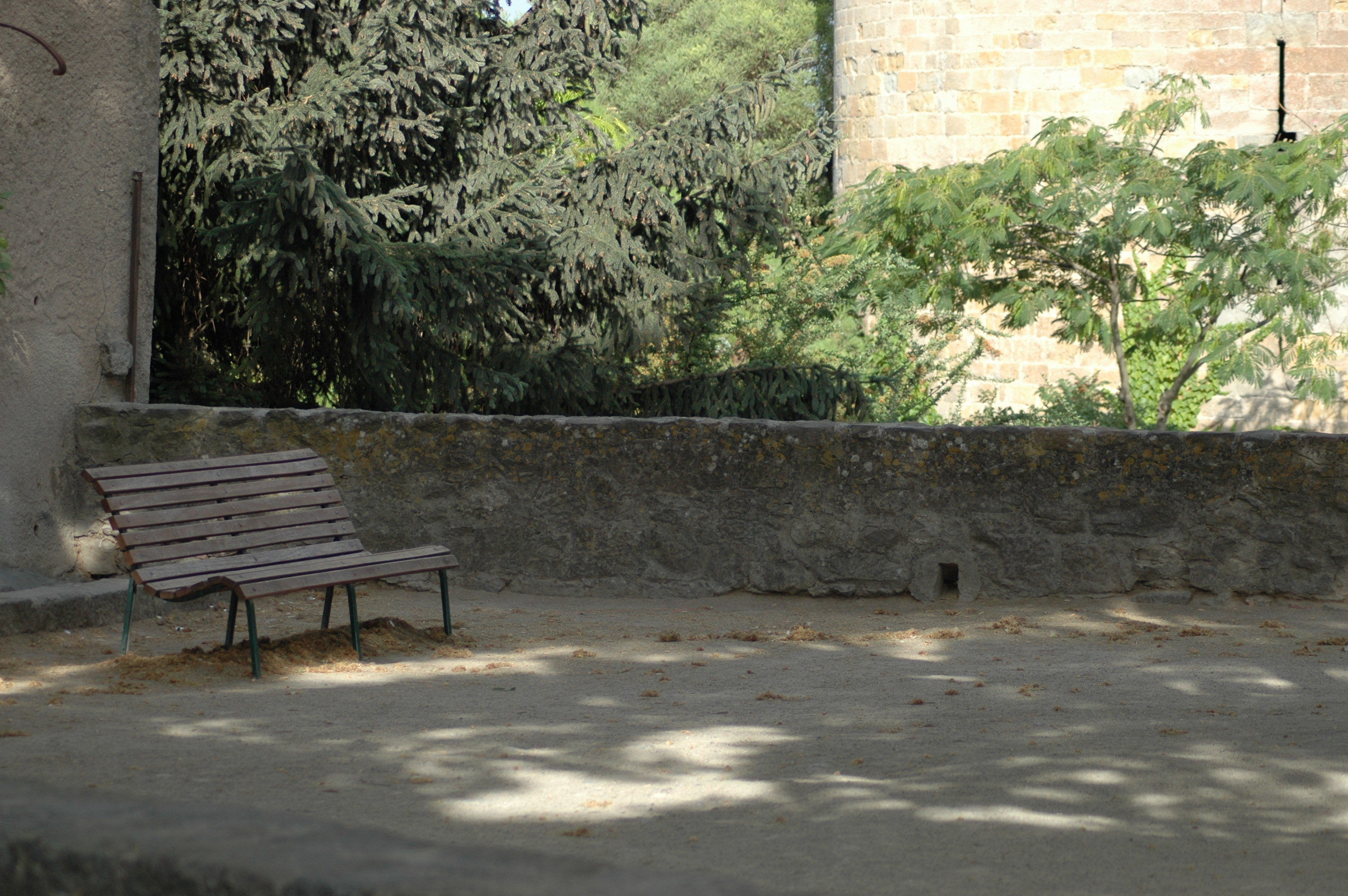
I’ve often wondered how much my work, and the busy-ness of the ordinary day, contributed to my love of park benches! Whatever the reasons, I know I’ve always had an eye out for them, and have several photos of seats in different parts of the world. The one in this photo was taken over 15 years ago in the Southern French town of Carcassonne. I still find it utterly beautiful. It pulls me towards it. I have a longing to be sitting there. Clearly it’s not about the super-comfortable shape or form of the seat, it’s what it represents – a pause, a moment of stillness, a quiet time to “do nothing”, or to contemplate, breathe, become aware of the here and now.

What this sets off for me today is reflection on the importance of slowing down from time to time, and the importance of deliberately breaking up the endless cycles of habits. We need to stop, take a breath (or several, conscious, slow deep breaths would be better), and allow ourselves to experience some moments of stillness. We need that even now in the midst of this pandemic and the total disruption of our “normal” lives (will “normal” need to be redefined after this? Probably)

So, take a moment today and ask yourself – where are your favourite seats? Best to consider a seat you can actually sit on today! Where can you take a moment, still your breathing and your mind, and return your clammer of anxieties, worries and fears to the here and now, and just notice. Just become aware. Just for a few minutes at least.

If that sets off a recollection of favourite memories of seats where you have experienced the greatest moments of calm, tranquillity and peace, then, go with that. Allow yourself to recreate those experiences as vividly as you can. What did you see there in that moment? What did you hear? What did you feel with your body? What did you taste and/or smell? Allow yourself to re-create the feelings which that moment engendered. Allow yourself to live it again for a couple of minutes.

You know what that will do? Well, what it might do anyway? It will produce a distinct harmony of the rhythms of your heart and your brain. It will set off a chain of reactions in your body which enhance your immunity, reduce harmful inflammation, and increase your resilience. It’s called “coherence“. And it’s good for you!
Read Full Post »

Can you think of any works of art which changed you? Any which changed your worldview? Changed how you understand yourself, your life, your world?

I was reading about Stendhal Syndrome the other day, which is the phenomenon of overwhelming emotions and physical symptoms experienced by some people in front of particular forms of art. Stendhal described it in relation to his visit to the Basilica of Santa Croce –

I was in a sort of ecstasy, from the idea of being in Florence, close to the great men whose tombs I had seen. Absorbed in the contemplation of sublime beauty … I reached the point where one encounters celestial sensations … Everything spoke so vividly to my soul. Ah, if I could only forget. I had palpitations of the heart, what in Berlin they call ‘nerves’. Life was drained from me. I walked with the fear of falling.

What grabbed me about this concept is how art can have a profound impact on us – not just on the way we think, the emotions we feel, but in changing our inner physical reality…..speeding up the heart, releasing a whole cascade of different hormones, causing us to feel a little breathless, a little light headed, to give us butterflies in the stomach, to make us weak at the knees…….but it actually does something else too….

Every experience we have sets off patterns of activity in the neurones in the brain. In neuroscience there is a phrase used which is “what fires together, wires together”. That’s a description of how these patterns of activity, when repeated, actually change the shape of the microstructures of the brain. Art, literally, can sculpt our brains. No wonder it can change us!

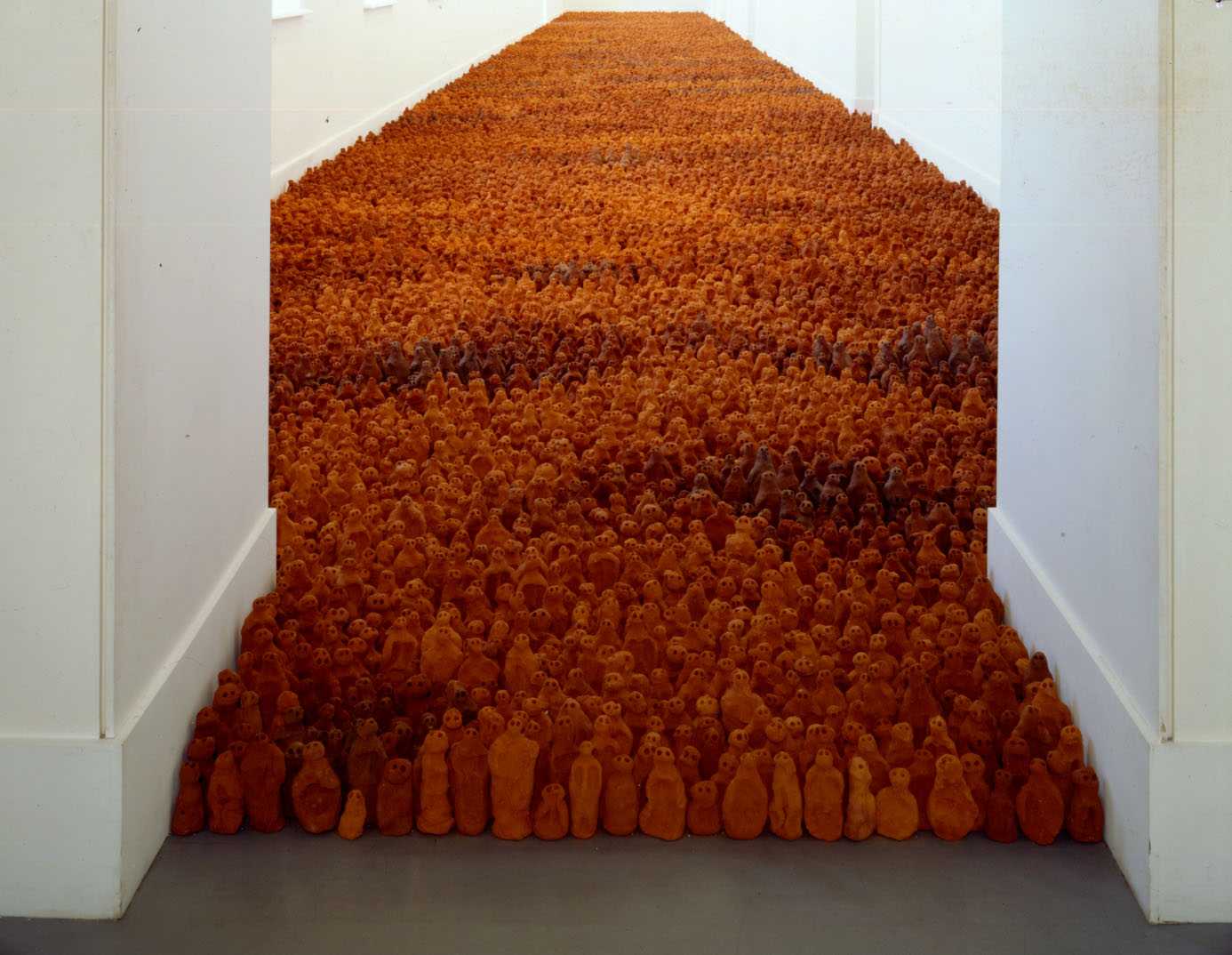
Well, this image here is of Anthony Gormley’s work entitled “The Field”. I saw this for the first time in Inverleith House, in the middle of the Royal Botanic Gardens in Edinburgh. I stood in the doorway and looked at these thousands of little creatures, all looking up at me, all the same. Then, as I looked a little more closely I realised that each and every model was different. Not only were they not all the same, but every one of them was unique.

That’s it, I thought! This is the paradox at the heart of my work as a doctor. Every single patient who I meet has some characteristics, some symptoms, some signs of change in their body, in common with other patients I’ve met before. That’s why I needed to learn anatomy, physiology, pathology, the natural history of disease. That’s why I had to learn how to make a diagnosis. But, at the very same time, every single patient who I meet is unique. Every single patient has a story to tell me which I’ve never heard before because nobody has lived an identical life to them. The diagnosis of the “pathology” or “disease” isn’t enough. I need to understand it in the context of a life story, and a present life. What exactly is this person, today, experiencing? How has this present experience and change come about? What sense do they make of this “illness”? What does this “illness” mean to them, mean in their life, mean to the others in their life?

Well, that became the core of my understanding of the Practice of Medicine.

But it went further than that, because I realised, just as quickly, that this insight wasn’t relevant only to my work as a doctor. This is the essence of what it is to be a human being. We share a lot, you and I. But we are also unique, you and I. We can’t be reduced to a single characteristic, demographic, or “data set”, but we can be gathered into those groups…..we can find some common values, beliefs, desires in those features and factors. But we can never, ever, stop there. We can never rest in our understanding of a person by summing up their data, by figuring out what group we want to put them into. We have to discover the individual. What makes this particular person different? What is distinct and different about this person’s life story?

Even as I write this today, I find this excites me. It delights me. It moves me. It activates my thinking, my feelings, even my body.

Art really can be that powerful.

Read Full Post »

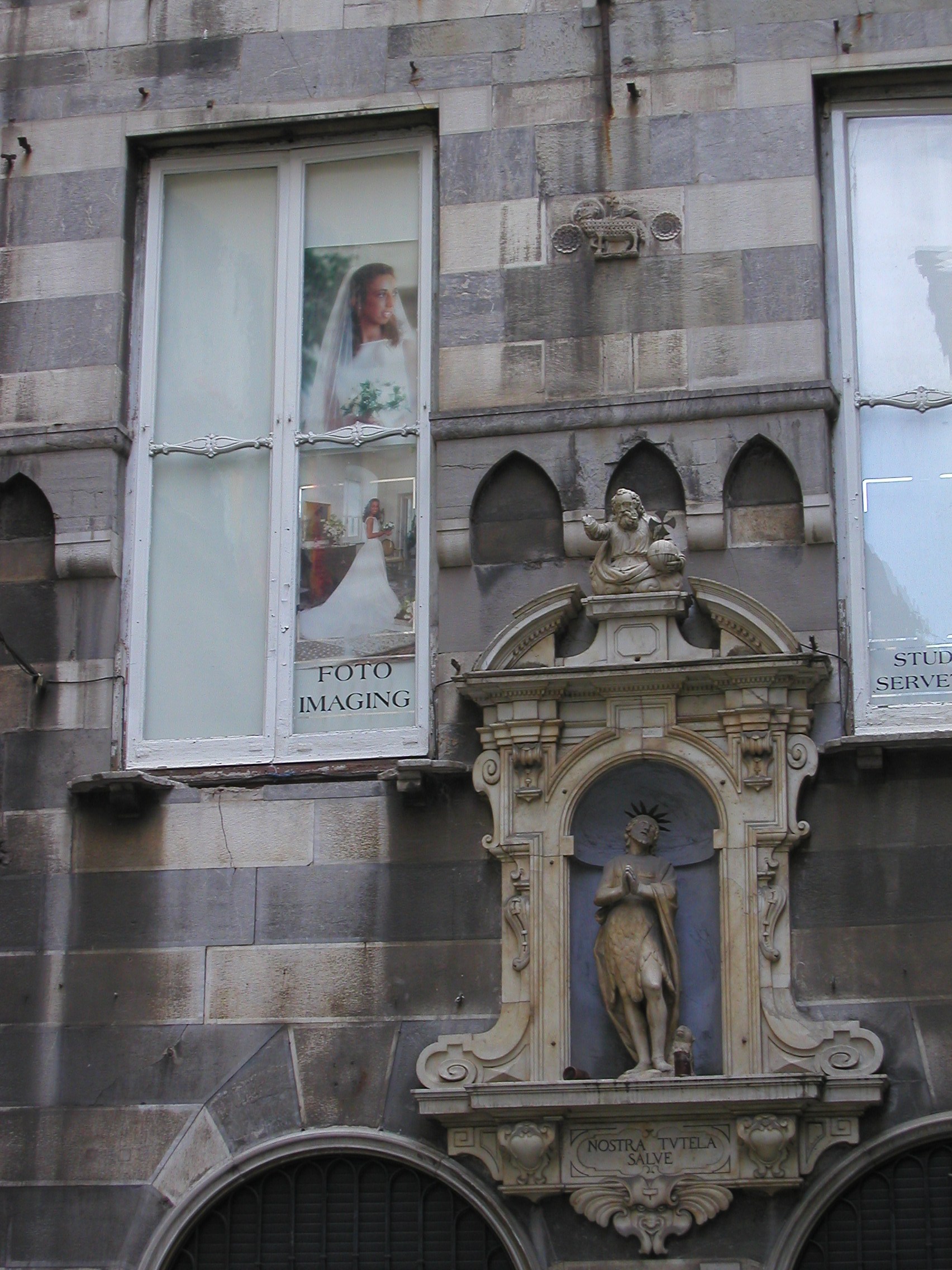
What caught my eye here was the juxtaposition of the advert for the photographer and the statue in the alcove.

The older work is the statue. It’s a representation of prayer. France, Italy and Spain are three of the countries I know best on the continent, and all three share a rich religious tradition. To be more exact, they share a Catholic tradition. Representations of the crucified Christ, of the Virgin Mary, and of various saints can be found everywhere…..not just in churches and cathedrals, but on street corners, city centres and in small villages. What struck me about this particular statue was the act it portrays – prayer.

I know there are many different kinds of prayer, not least prayers of intercession (asking for help), and prayers of gratitude, but the image of the wedding photos in the windows just next to it led me quickly onto thinking of dreams, of hopes and desires. So, that context drew me into the consideration of prayers of that type – prayers of hope.

I don’t think we can underestimate the importance and the power of hope. I don’t think people can live without it. I’ve seen that many times in my medical career. People with no hope slip into despair and decline. I once I had a patient I knew say to me that her husband had just been diagnosed with cancer and that the doctors had given him six months to live. I asked her how she felt about that and her response surprised me. “Angry”. I asked why, and then came the bigger surprise. “How come he gets to know how long he’s got and I don’t know how long I’ve got?” Well, I didn’t see that one coming. However, it did lead to an interesting discussion about prognosis and what we can, and can’t, predict. Too often predictions like that turned into self-fulfilling death sentences. Because the reality is that, in any individual, we cannot make such accurate predictions. I learned that the hard way as a young doctor.

But let me return to prayers and dreams. I’m sure you’ll have come across the idea of visualisation? Of creating “mood boards” or “vision boards”? Of creating “goals” and “targets” even? Well, those are psychological methods we can use to create the life we want to lead. And isn’t that one of the things which prayers and dreams can do?

Have you noticed how many athletes seem to say a short prayer before the start of their race? Have you noticed how many perform an act of gratitude to the heavens, or to their god, when they win? I’m sure in our more materialistic, so-called rational, times, that prayer, belief, faith and dreams are dismissed more than ever before, but I always wonder if that’s really a rational response?

Because without hope, without dreams, without prayers, without vision, then what kind of life can we co-create?

My answer would be – the kind of life other people create for us! “Heroes not zombies” folks! We human beings really are the co-creators of our own lives. A person cannot be reduced to molecules and random events if we want to understand them. More than that, I suspect that fear and resentment are powerful factors in creating the kind of world we live in, and that there are plenty of players out there who know exactly how to stoke up both.

So, I’m a fan of prayers and dreams. I’m a fan of dreams and visions. I think that what we imagine, what we put our energy into, what we pay attention to, all contribute to both our personal experiences of daily life and to the reality of the world that we share with every other living creature on this little planet.

What kind of life do you want to lead? What kind of world do you want to live in? One focused on fear and despair, or one focused on love and hope? I do think we have a choice. Not in an “either/or” way, but in what we give emphasis to, what influences our world view, what lenses we use to understand the world, and as an act of co-creation.

Read Full Post »

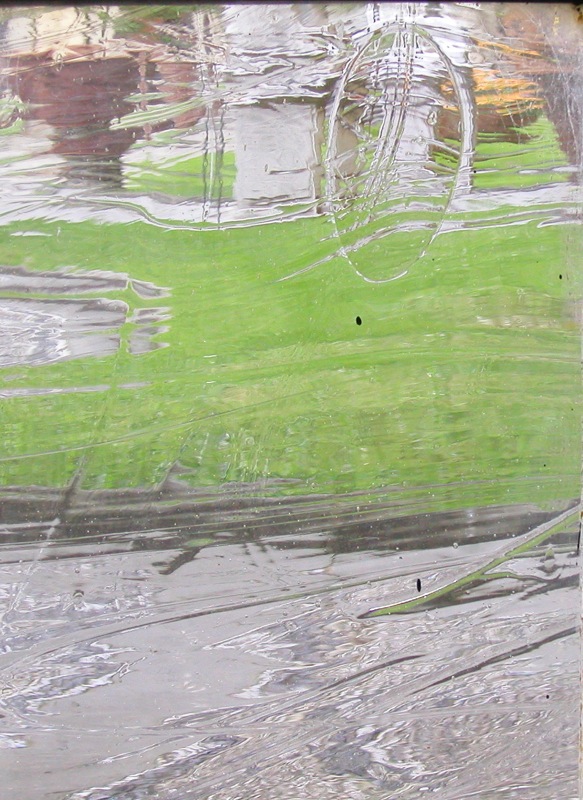
I don’t believe the past was a better place or a better time than the present. I just know it was different. But as I look at this image of the old glass in a window, I see how the patterns in that old glass act as a kind of lens on the present, and that makes me think about how it seems to me, that in many ways, we are too focussed now on the immediate, the instant gratifications, and always on what might come next.

But don’t we learn from the past? Isn’t how things were before, or what actions we took before, a useful lens through which to view the present?

Let me be clear, I am very, very keen on living with awareness of this present moment. I think that too often many of us are living on autopilot. That’s one of the big themes of this blog – “heroes not zombies” – encouraging us to wake up, become aware, and become the authors/heroes of our own stories, rather than living a life of semi-conscious manipulation by others. I’m also keen on looking forwards, though, to be frank, I’m not a big fan of predictions! But I also think that unless we pause, reflect, consider, and look back, then it is pretty difficult to learn. It seems true that if we keep doing what we are doing then we are going to keep on the same track. So, if we want to learn, want to grow, to improve, to develop, then we are going to have to learn something from how things were before.

I don’t think that means a romantic longing for an imaginary idyllic past when everything was wonderful. That’s not real. I mean learning what led up to this present moment, learning what it is we’ve been doing which might have contributed, at least, to our finding ourselves here, in this specific present, today.

I think about that as I watch this pandemic unfolding. I can’t help wondering about the countries of the world, like Australia, New Zealand, Taiwan, Vietnam, and others, where the case numbers and deaths are, frankly, tiny compared to those in Europe, America and Brazil. And, whilst there is no doubt something to be learned from each other, from comparing how each country tackled this pandemic, I think there is also something to be learned from how we humans have managed infectious disease, and epidemics in the past.

Time and again we see that there is a basic principle – separate the sick from the well. In times gone by that was done in what now seem pretty cruel and crude ways, expelling the sick, putting them in colonies outside of the towns. I don’t think we’d want to repeat that particular strategy, but the basic principle remains a key one. To control an infection you have to identify who has the infection and limit their contact with the rest of the community. We can do that now in much more humane ways. We can treat the sick in hospitals. Actually, there was a time when there were quite a number of specifically infectious disease hospitals (and “asylums”) but most of those seem to have been closed down. Maybe it would be a good idea to create new centres for the treatment of those who are suffering from infectious disease, and staffing them with doctors and nurses who can work in the community when there are no epidemics raging. That might be better than diverting the resources for treating cancer, heart disease, etc towards infectious disease, leaving those non-covid patients to suffer (which is what is increasingly the case).

Maybe it would a good idea to have a really effective, community based, human-centred system of testing, contact tracing and genuinely supported isolation – in isolation hotels, and in peoples own homes with daily visits from health care staff?

One of the things we are seeing with Covid is how many people get very, very slow recovery, relapses and lingering, debilitating symptoms. In the past we used to have convalescent hospitals, spas and rehabilitation centres. A lot of them got closed down too. Maybe it would a good idea to open those up again, to make new ones, to support and treat those who are in for the long haul.

Finally, in epidemics in the past, people controlled their borders. The countries which have the lowest case rates now did that too. The countries which didn’t bother, have the worst rates. Isn’t it time to do that? And not just to insist on a negative test and advise someone to quarantine for 10 or 14 days. But to insist upon supported isolation during mandatory, supervised quarantine periods for all those who cross borders? OK, I know, there will be those who need to keep traveling and who can’t keep doing those quarantines, but let’s vaccinate them, and monitor them more carefully.

Just some ideas I’ve been having about how we could better manage this pandemic, by looking at the present through the lens of the past.

Read Full Post »

Yesterday I wrote about “unfurling” and this morning I came across this photo in my library.

It’s another example of this process we see everywhere in Nature – the opening up of a bud as the flower expands itself at the end of a stalk. It’s an “unfolding”, a “revealing”, or even, a “revelation”.

Really at this stage of a flower you get a strong sense of what is to come…a strong sense of potential. But it’s not quite there yet. It’s in the process of getting there. I like images which capture that concept because I have long been taken by the primacy of “becoming” over “being” – see the phrase at the top of the blog “becoming not being”!

I first encountered the importance of the concept of becoming in the works of Giles Deleuze, but having seen it there I went on to see it everywhere. Really, as I understand it, it involves a significant, and important shift of focus from looking at objects with fixed dimensions to looking at experiences and events which literally unfold before your very eyes. When you shift away from seeing, or trying to see, reality as composed of discrete, separate, bounded parts…..like marbles in a sac……to seeing reality as composed of flows and connections, then you stop wanting to pin things down and fix them. You delight, instead, in the dynamic, living, changing, nature of the universe.

This thinking helped me understand my patients and their illnesses, because instead of looking for discrete pathologies, I became more interested in how those pathologies arose, how they were affecting the person in their everyday life, and trying to understand how to influence the direction and nature of their development into the future. I became less interested in “outcomes” because every “outcome” is an arbitrary point, and more interested in a “life” and a “life story”, and therefore far more interested in following that patient over many years, rather than seeing Medicine as a tool applied to a thing at a particular time – not “getting it done” but “understanding, supporting, encouraging and teaching” instead.

I don’t know if that brief summary is enough to help you see what a radically different way this is to live and to make sense of the every day, but I suggest you try it…….try to notice the processes of becoming, the unfolding, the revelations, the unfurling today, and then let your curiosity follow the threads back to the past and origins, as well as forwards, to potentials and maturity.

Read Full Post »

When I lived in Scotland the first snowdrops to appear each year always caught my attention. These small white flowers hang like little bonnets, which gives them the appearance of being discrete. They aren’t showy, or majestic, but they are obvious all the same. I think it would be hard not to notice them.

Here in France we don’t have snowdrops. Well, not in this part of France anyway. I’ve never seen them growing wild, and I’ve looked many times in nurseries and garden centres for the little bulbs so I could try growing some in my own garden, but I’ve never found them. Somehow, that makes them even more precious, and, perhaps, somewhat obviously, it gives them a new significance for me. I see them now as emblematic of the country of my birth.

Snowdrops don’t appear for long but they are one of those flowers which marks the cycle of the seasons. There are many other flowers which do that, of course, but the snowdrops seem to manage to break through the winter soil, push up their thin, delicate, green stalks, and unfold their beautiful white petals before most of the other flowers do. In that sense, they are like the beginning of something for me. I know that after I see the first snowdrops, the crocus flowers won’t be far behind, and already I find I’m starting to look forward to the daffodils and tulips.

Every flower is new, of course.

No individual flower repeats itself. Every year each unique, particular bulb wakes up, pushes upwards and shares the beauty of its own petals in its own time, its own place, and its own way. That reminds me of the classical spiritual practice of approaching every day as if for the first time……because that’s the truth…..this day has never been lived before. Everything you see, everything you hear, everything you smell, taste and touch, everything you feel, everything you do, will be for the first time today. It might be a lot like yesterday, but, actually, it’s different.

Starting your day with the knowledge that this day is a new day, and that every experience and event which occurs will happen for the very first time, opens up your potential to wonder and to learn. It opens up your curiosity and your consciousness, filling your day with discoveries, delights, and wonder.

All of that is good for the health of your right cerebral hemisphere – this is the part of the brain we use to discover novelty, to see things in their singularity, to appreciate the holistic nature of reality. And just as we develop muscles by exercising them, so we develop mental functions and neurological structures by exercising them.

New every time – a great way to increase the quality of your life, a great way to encourage growth, a great way to become enchanted again by this world we live in.

Read Full Post »

Stone circles, dolmens, single standing stones, cairns and burial mounds…….I have a fascination for all of these objects. There are a lot of them in Scotland (like this one at Lundin Farm) and there are a lot in France.

I was born, grew up in, lived and worked in Scotland. I emigrated after I retired from the NHS in 2014. I now live in the Charente, near the town of Cognac….a small town with a big reputation, not least due to the spirits made and exported around the world from here.

I had an intention to come and live in France for a long, long time. I wanted to live at least a part of my life in a different culture, a culture fashioned in a different language. I feel this move has widened and deepened my experience of life. But I don’t feel I’ve lost my Scottishness. It’s fascinating to live that weave of two languages, and two cultures. It really does give me the sense of an enriched, enhanced life.

I think we humans all share the same small planet. We all breathe the same air, drink water from the same water cycles, eat food grown in the same biosphere. Frontiers are artificially drawn lines on the globe. We all came from the same nomadic first tribes. We are all descended from the same first humans. When I come across these ancient neolithic structures I feel connected…..connected vertically back down a family tree to the past, and horizontally around me to everyone, and everything, else currently sharing planet Earth with me.

There’s an old classical spiritual exercise about standing back from your immediate surroundings. You can think of it in the same way as looking at the world once you’ve climbed a hill. You can think of it in the same way as those images from space which show our blue and green planet spinning slowly. When you look “from on high” then you get a different perspective. You see something whole. You see something inter-connected. You see the flows of clouds in the atmosphere, the flows of water in the oceans, and you realise you are a small, but unique, individual in a much greater whole.

Well, I think something similar happens when you encounter a stone circle. I’ve often had the sensation that I feel different inside the circle from what I do on the outside. I don’t mean that in any spooky way, but I just mean that the action of stepping inside one of these ancient structures, created surely with immense effort by men and women with rudimentary tools, lets you have a different perspective. You can feel connected, not just to multiple generations of ancestors, but to those deep currents which run through every human being – the desire to create, to interact with what is around you, to make something new, something special, to make a work of art, a work of the spirit, a work of quality.

We human beings don’t just survive. We change the world as we live in it. We create the world as we live in it. We discover and we make meaning. We create experiences, and the opportunities to have experiences, for ourselves and for others.

What kind of world are we creating now? What experiences are we making for ourselves and for others? What opportunities to enhance and enlarge life are we making and seizing?

Read Full Post »

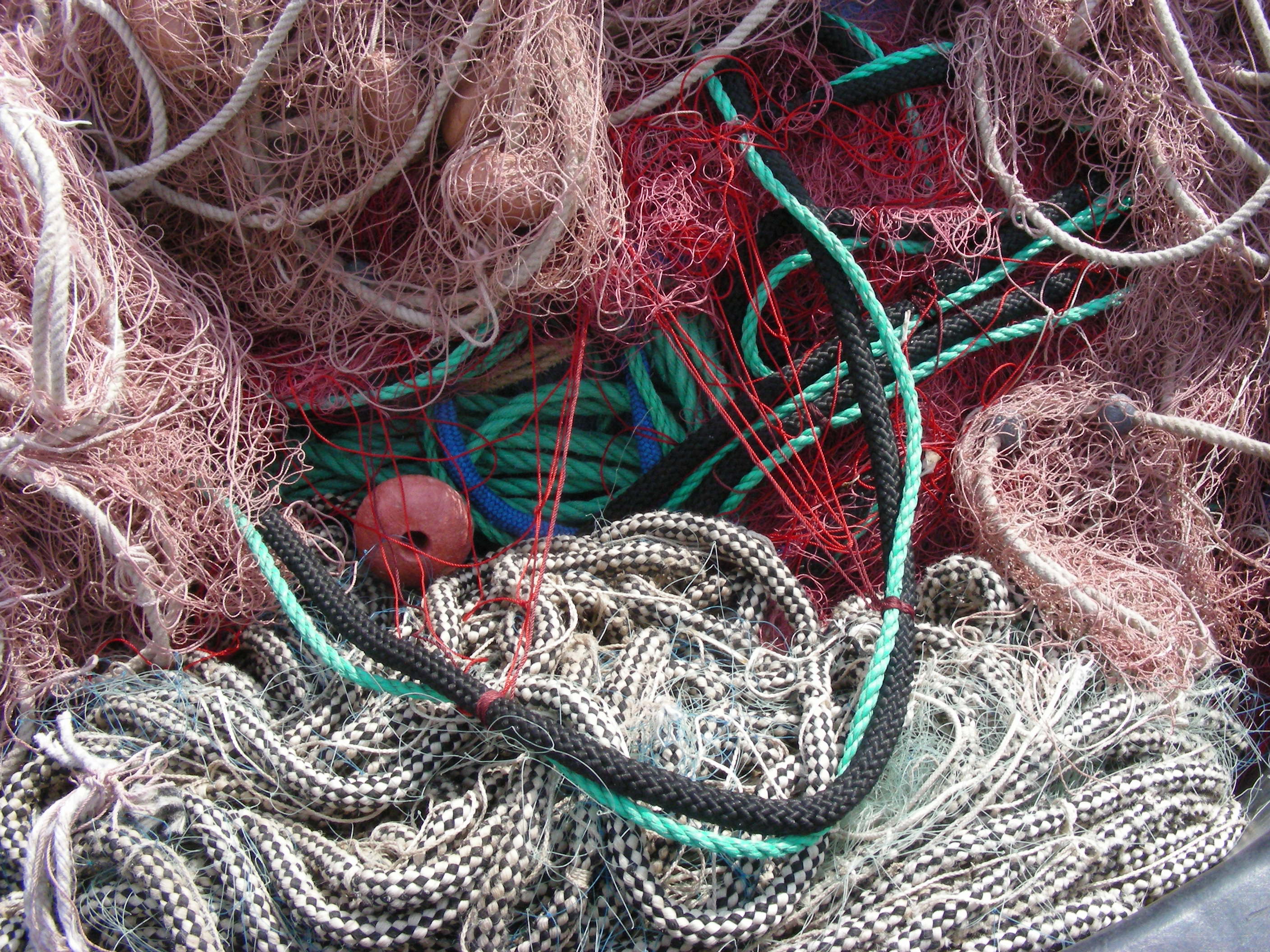
It’s not hard to find a pile of nets and ropes on the dockside at any little fishing village or port. I often find them quite fascinating and sometimes, like this one, quite beautiful. Look at the gorgeous palette of colours in this photo!

Without fail these images make me hear the word “entangled” in my head, and that’s one of my favourite words. It captures both the idea that everything is connected, and the fact that you can’t touch, or interact, with any single “element” without affecting everything else. It’s like the “butterfly effect”, where a small change in a complex system cascades throughout the entire network and has unpredictable significant over all changes – in the case of the butterfly effect linking the changes in air pressure and movement in one part of the world to storm and hurricane systems in other parts.

Well, that’s sure something we’ve had proven to us during the last year isn’t it? Even now, we hear of a “mutation” in the coronavirus, in one country and within a few days we’re hearing of it turning up around the entire planet. We sure are all “entangled” with each other, aren’t we?

There’s an aspect of this entanglement which has bothered me during this pandemic, and it comes up in the way that politicians and, also, many experts, are dealing with it.

It seems pretty clear that the present emerges out of the past. In other words we find ourselves in this current predicament because we’ve been living in a certain way. Yet, repeatedly, governments don’t want to admit “mistakes” or to look back and understand how our societies became so vulnerable. Probably because they don’t want to admit responsibility, but sometimes because it doesn’t fit with their favourite set of beliefs.

Would the health services in Western Europe be under such stress if they had been better resourced and organised over the last couple of decades? Of course, we can’t know for certain, but if the present really is entangled with the past, then can’t we try to understand how we became so vulnerable?

And if the present is also entangled with the future, which surely it is, then if we are to become more resilient then we need to create healthier societies. This virus has made it absolutely clear that those who will be hit hardest are those who are already the most frail and vulnerable.

I’d like to see politicians begin to lay out plans for our “exit strategy” from this pandemic which don’t rely entirely on technological fixes, but which, instead, firstly, develop and deploy better health and social care, to be better able to help and heal when help and healing is needed, but, secondly, to reduce poverty, poor housing, poor education, poor nutrition, inequality and environmental damage.

That would seem like a good place to start.

Read Full Post »

Did you ever come across an ancient Chinese philosophical concept, “Li”? I’m no scholar of Chinese philosophy but the sense I make of this idea is that there are invisible patterns, structures and forces throughout the universe which shape the forms that we see. (If you understand this better than me, and you think I’m mis-representing “li” please explain in the comments section)

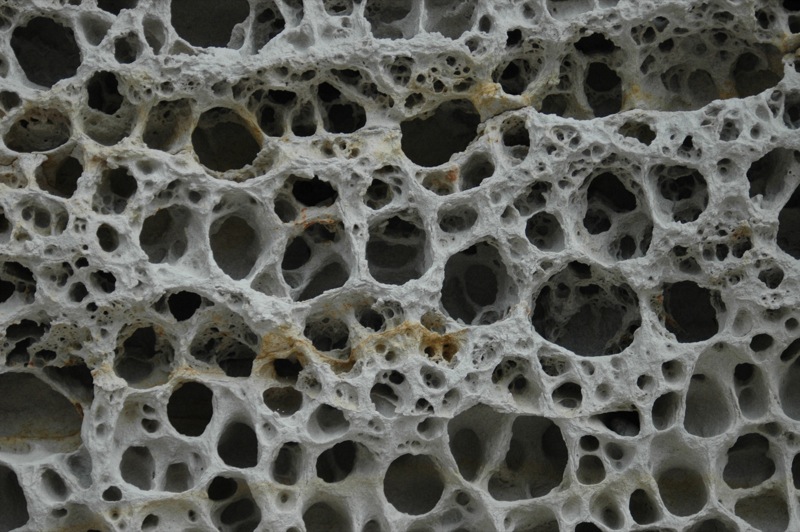
It does seem to me that there are certain patterns in Nature which seem pretty widespread. This one which is a “honeycomb” pattern in rock in the West of Scotland is one of these, and, for me, it’s one of the most fundamental.

It’s a bit like a web, or a net, and really it’s simply connections and points of connections. The connections are the thin almost thread like pieces and the points of connection are where two or more of these pieces meet. This is the basis of all networks – we call the points of connection, “nodes”, and the lines represent the ways in which nodes influence each other.

Simple nodes receive information, energy or materials from other nodes, and pass them on. More complex nodes do some processing, so that the exact information, energy or materials which it receives, leave it in somewhat different form.

One of the places we see this structure is in our brains – we have billions (yes, billions) of special cells in our brain. We call them “neurones” and their main purpose is to transfer information from one place to another. The neurones all meet up with other neurones at specialised junction points called “synapses”. Every single neurone is connected this way to several thousand (yes, several thousand) other neurones. You can imagine pretty easily that the permutations of firing, communicating neurones, neuronal pathways and neural networks in the brain might not be infinite, but it’s so gobsmackingly (is that a word?) large that we literally can’t actually envision it in its totality. I’m sure I once read someone say that the number of whole brain states, determined by which neurones are firing is greater than the number of visible stars in the universe. Well, don’t know if that’s quite right, but it sure gives you a way of imagining the immensity of it.

Another place we see this structure is in the human body. Think of each of your several billion cells as a node, and once you realise that every single one of those cells lives in constant relationship with all the others (either directly or indirectly, cos that’s the way a network works) then you get a good understanding of why we need to think of our health and wellbeing holistically. None of our parts live in isolation. In fact all our cells, all our tissues and all our organs, are continuously, dynamically relating to others by establishing and maintaining “integrative” relationships – that is “Mutually beneficial bonds between well differentiated parts”. There’s a key point to see here – the most fundamental kind of relationship in the universe is collaborative, integrative and co-operative.

Yes, competition exists. Of course it does. But we have been duped into believing that competition is THE key relationship in the universe…….THE driver of evolution. It’s important and it’s real, but by itself competition could not produce evolution, could not produce Life, cannot describe reality. We need relationships which are essentially integrative, fundamentally well-meaning, mutually supportive, collaborative, to do that.

I don’t know about you, but I think we could all benefit from this simple shift of understanding – we need to put “collaborative, integrative, co-operative” relationships at the heart of our decision making.

Read Full Post »

I’m pretty keen on taking photos of webs, especially on a misty morning or after it’s been raining.

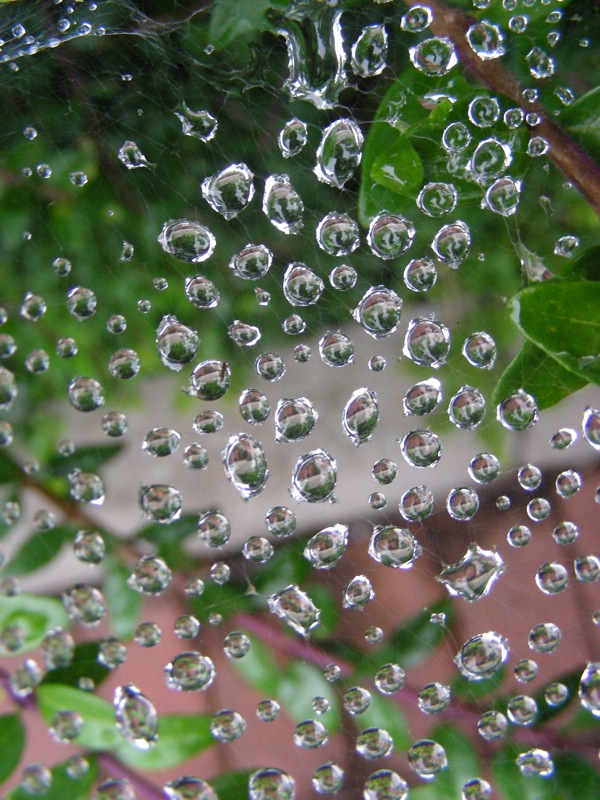
This is one of my most favourite photos of a web. Actually you can hardly see the strands of the web itself, which makes it even more interesting……it’s like the underlying structure which gives shape to the whole image is invisible, or almost so. And I think life is like that. There are underlying structures, forms and shaping forces to everything, but mostly that’s all invisible!

What we see most in this photo is a myriad of water droplets – each one of them acting as a prism or a lens. Look closely at any of them and you can see that they are showing you an upside down image of the surrounding world. Isn’t that fascinating as well as beautiful?

Because what that makes me think is how each of us is like one of these droplets. Each of us has our own unique perspective upon the world. Every single one of us sees and experiences the world from our individual and different subjective point of view.

But we are all connected. And we are all living in the same world. So most of what we see in any of these little lenses is the same. We live shared lives. We experience shared phenomena.

That takes me back to my favourite – “and not or” – we are at the one and the same time having unique, individual experiences, AND shared, common, connected ones.

It’s not a matter of choice.

If we forget either one of these apparent polarities then we fail to grasp reality. Reality is a vast, inter-connected, largely invisible web of unique, individual events and experiences, constantly changing, constantly interacting, always astonishing and, utterly beautiful.

Read Full Post »

« Newer Posts - Older Posts »