Feeds:
Posts
Comments

Archive for the ‘from the consulting room’ Category

I’m convinced the images we encounter daily influence what we feel, what we think and how we behave. In fact, I don’t just mean images such as artworks, adverts or photos. I mean how things look – including the shapes and sizes of buildings, the presence of trees, flowers and bushes, the colours of walls, the landscape or the cityscape, depending on where we live, and the decor, light and shapes of the rooms we live in, as well as the objects which surround us.

All of these images influence us deeply, and, largely unconsciously, creating moods, emotions and feelings which stimulate or inhibit well-being, and which change the course of our lives.

One dramatic example of that is in hospital design. There is a lot of research about this, but, to give one example, it was found that patients who had a view of nature from their hospital bed recovered more quickly, needed less painkillers, and had less complications than those who only had a view of a wall.

Of course the advertising industry is well aware of the power of the image. These days there is even a specialist area of knowledge and advised described as “neuro-marketing” which seeks to employ the findings from neuroscience to persuade customers to buy certain products. These things work at the level of image, sound and smell. Mostly, they work unconsciously.

So, I think it’s good to notice our here and now, our everyday reality. I think it’s good to be aware of the images we absorb as we work, play and relax in our home and shared environments.

Taking photos is a good way to become aware. When you look around, or go out somewhere with a conscious intention of photographing what you notice, then your awareness is automatically heightened. These days most of us have smartphones which are more than ably equipped to take photos. You don’t have to have a fancy camera.

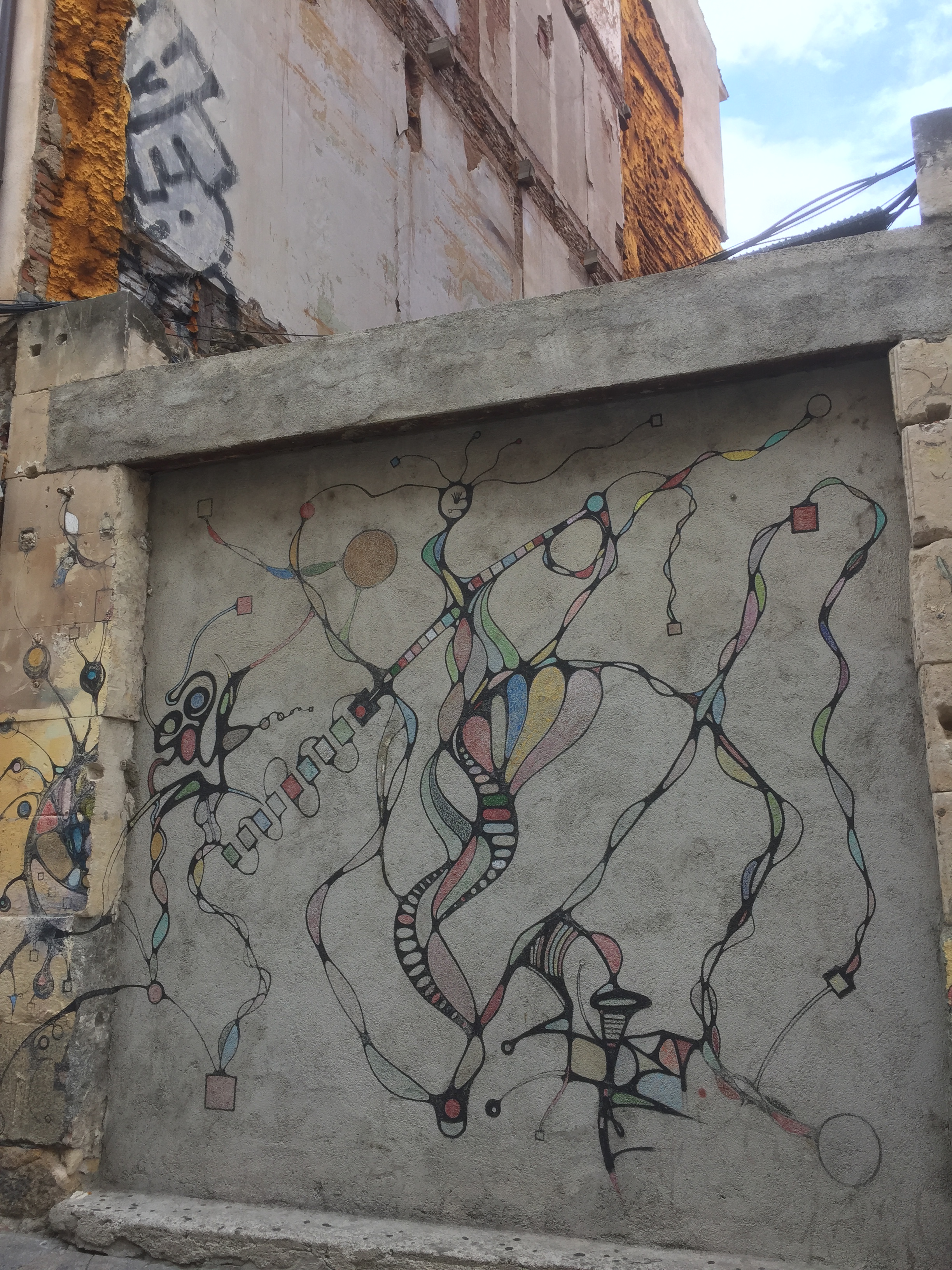
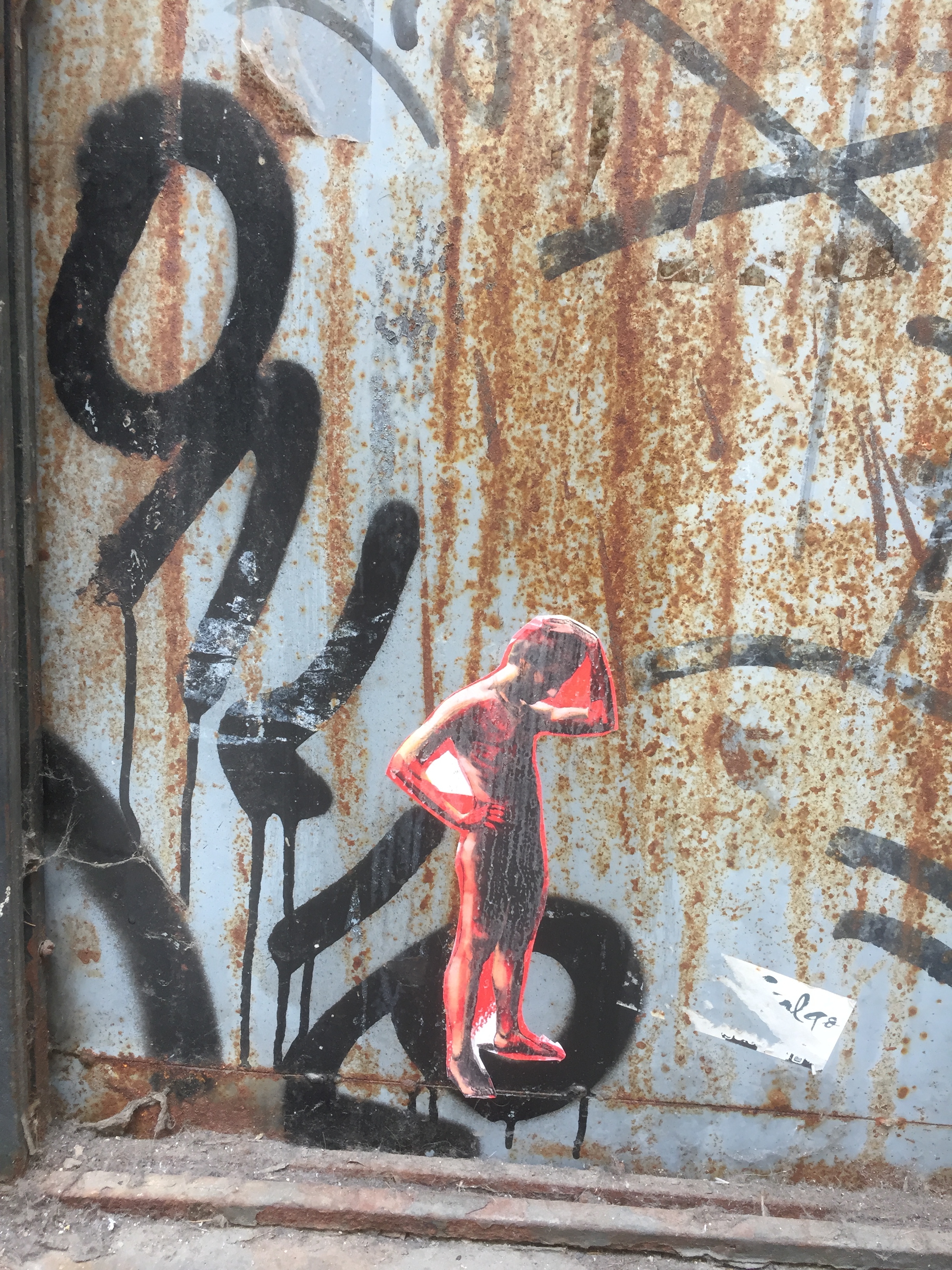
These two photos I’m sharing today are of street art I noticed as I walked around the streets of Salamanca one day last year. The image on the left is like a work of modern art. It looks a bit “Miro” to me! What I really notice about it is how the artist has used the walled off entrance as a frame, using the concrete filling the space as a canvas, but, he or she hasn’t stopped there. They’ve spread their artwork beyond the bounds of that frame….reaching out to cover the left hand pillar. I like that. I like how it demonstrates how creativity can be opportunistic, inspired by what is already there (the walled-in entrance way), and how that inspiration can come from the most unlikely places. Would you have thought that entrance way represented a canvas? I like how the artist isn’t bound by that either. How they kept creating outside of the frame – thinking and creating “outside of the box”. This work inspires me to be creative, to see opportunities for creative work, and to refuse to be constrained by other people’s frames.

The second photo shows the power of stencil. I mean just look at this person holding their head. Are they in despair, or are they trying to figure something out? I can see both. So it’s an image of hopelessness which reflects something we all feel from time to time, but, instantly, it’s also an image of someone thinking, someone deep in thought, trying to come up with a solution. At least, that’s what I see there. How about you?

I know, with every interpretation we bring our own standpoint, our own sets of values and beliefs, our own moods and preoccupations. But that’s one of the great things about art, isn’t it? It isn’t just the power of the work to convey “percept and affect” (as Deleuze would say). It offers us the chance to wake up and change by engaging with it. And even if we don’t wake it, it influences us without us realising. It interacts with us, and we interact with it. It’s a relationship.
Read Full Post »

The Boston Ivy plant which grew over the entire enormous ancient wall which ran along one side of my garden has continued to thrive even though the wall fell down dramatically just before Christmas almost a whole year ago. In that time the stones have been left where they fell and what was left of the vine continued to grow and, even, thrive.

This is an amazing plant which goes through extremely distinct phases. There are little beak-like buds on the ends of the woody stems which open up in the Spring. The glorious green leaves which unfurl are so dense that many birds make their nests in them and in the Summer the whole plant buzzes loudly to the sound of thousands of bees collecting pollen. It produces seeds which pop out of their shells once the Sun passes towards the Western horizon beyond the wall each day, and they cascade down in the millions, sounding for all the world like a fountain. The first time I heard it I actually went looking for the water pouring down the wall, but, of course, there was none. Then in the autumn the leaves turn yellows, golds and reds, then fall off, revealing foot long bright yellow stalks, one for each leaf. These fall next. As each layer is shed other structures and colours appear….dark purple berries, and bright red stalks.

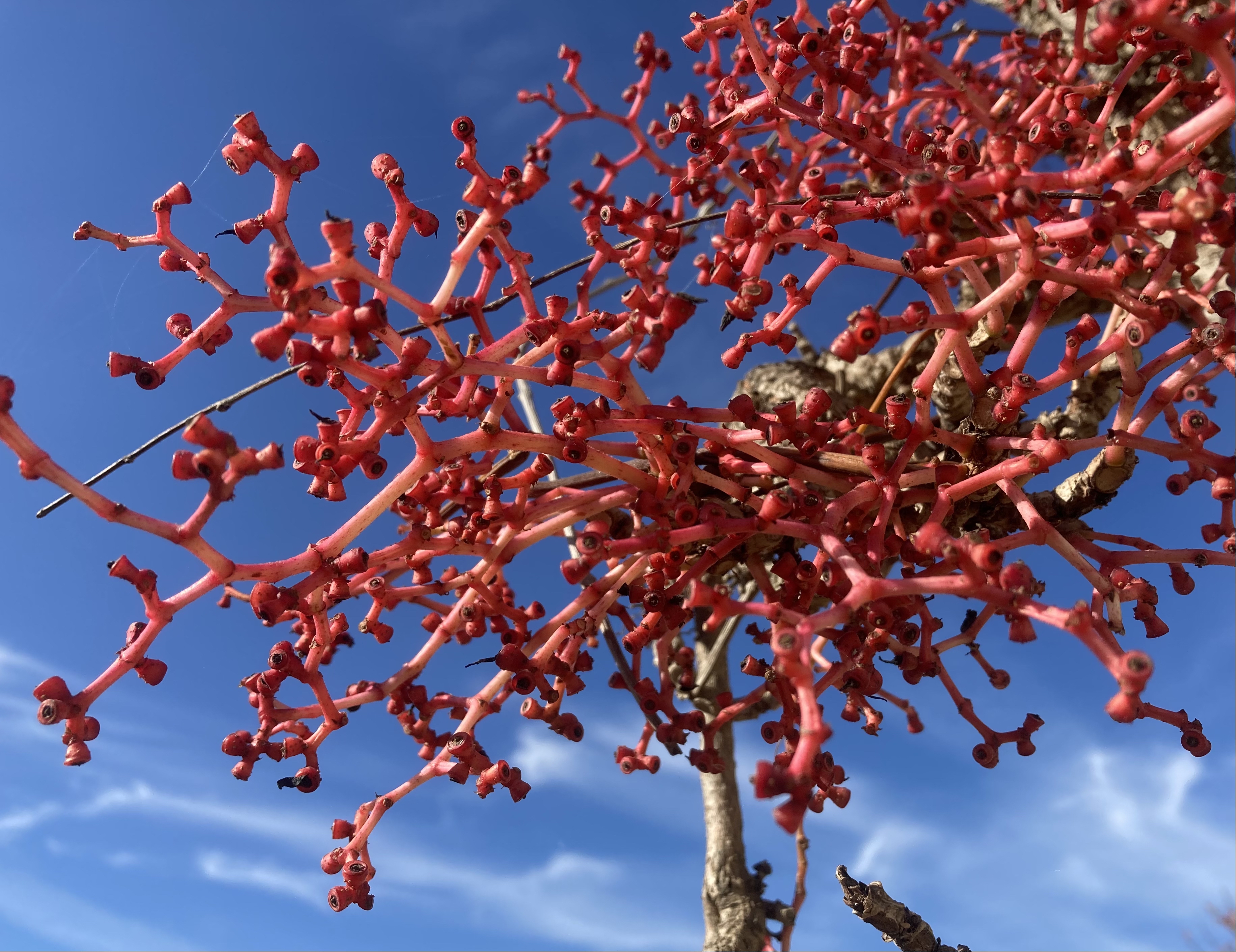
This photo, which I took a couple of days ago, shows the pattern of red stalks, now that the berries and leaves have now gone. This is a distinctive form – I recognise it from my days of anatomy study at university. The human body uses this form a lot….this structure of ever branching pathways, from large trunks to a myriad of small stalks. You can see that in our lungs. Air passes down from our noses and mouths via the trachea which branches into two – one for each lung. Then in each lung there are many further branchings, creating ever smaller, narrower passageways until finally they end in little swellings like bunches of grapes – the alveoli. You can look at how blood circulates around our bodies, through arteries, veins and capillaries and you see this same continuously branching structure. You can see similar pathways in our kidneys but the direction of branching seems reversed, starting with a myriad of small tubules, which collect together to form bigger ones, all of them ultimately draining into the ureters, one for each kidney – just like we see streams joining to form rivers which flow down the mountains to the sea. I could go on….you see this sort of structure everywhere in the body and you see it everywhere in plants as well.

At first glance it looks complex, but in fact it’s a pretty simple, straightforward form. It looks like there is more of it than necessary….wouldn’t it be better to channel all the flows down major routes instead? After all when you fall your SatNav doesn’t it tell you the quickest way to get from A to B is to avoid all the small, branching, “side” roads?

But Nature knows better. Not only does this pattern allow for the greatest interaction of, say, the plant, or the human, with the air, by creating the greatest surface area contained within a relatively compact space, but it is incredibly resilient, robust and flexible. If the flow were to be obstructed in one small section, it would soon be re-established, or increased through the myriad of other passageways.

This is what is called “redundancy” and Nature loves “redundancy” – it’s the opposite of modern management systems of “efficiency”. The idea is to always have more options, more resources, than you think you need. We design aircraft this way – they have so many backup systems, so much “redundancy”, more engines than it needs to fly, so that even if there is a failure, other systems and resources will immediately kick in so that the plane continues to fly – planes aren’t “resilient” – they aren’t designed to recover quickly from damage – they are “robust” – they are designed not to fail in the first place.

If there is one thing this pandemic has revealed, it’s the wisdom of Nature and natural systems. We have pared back our Health Services and Care Services to the bone. We have closed hospitals, beds and facilities, and failed to employ enough staff to deal with any more than the basic needs of the population – and even that not very well.

Surely it’s time to resource these services much much better. We need vastly more trained doctors, nurses and other staff. We need more facilities, more equipment and more flexible to systems. We need different, diversified, localised and devolved structures of power and organisation.

That’s the way Nature works. That’s the way the human body works. Why not design our organisations and societies on the same principles?

Read Full Post »

Picking up on yesterday’s post about threads and weaving life stories, I thought I’d share this photo I took in an old weaving factory in Aubusson. Isn’t this a fabulous stock of yarns? Look at the colours!

Probably because I was thinking about the metaphor of threads and weaving in the way we create our reality through our stories, I looked at this image again today and thought “Well, that’s what they have to work with. That store of colours and shades” So what if we think about how that idea might apply to how we create our daily experiences?

What is there in your palette? What can you select to weave together to create your unique, singular experience of today?

What if these yarns are like beliefs, ideas, thoughts and emotions? Which ones do we have to draw on, and which do we keep going back to, perhaps over-using, when we could be shifting our attention and using a different section of the palette if we want today to be really different?

I remember reading about a theory, which seemed to be validated by studies and observations, that when a baby is born, at the moment when the umbilical cord is cut, they experience their first existential threat. In those first few seconds if the baby doesn’t take their first breath, they won’t live. Perhaps, in those few seconds, the baby experiences certain strong emotions. We don’t have access to those memories because in our early years, our consciousness and memory functions haven’t formed to allow us to access them, but that doesn’t mean to say they aren’t happening, all the same. After all, most emotions occur below the level of consciousness, and becoming aware of them takes time, attention and practice.

So, what emotions might a baby experience in the midst of this first existential crisis? The theory proposes three – fear, anger or separation anxiety. Makes sense to me. So, the idea is that maybe which of the three dominates is genetically determined, but, whether it is or not, that particular pattern of those three emotions sets itself up as a core as we continue through life and try to make sense of our experiences.

So, some people have fear at the core, and that’s the main colour they use in their daily palette. For others, it is anger, and for yet others it is separation anxiety. You can try this for yourself. See if you can think back to your very earliest memory. Preferably one form before the age of five, from before you started school. When you recall that event, what emotions do you associate with it? Is it fear, anger or separation anxiety? I found with patients that some would identify one of these very clearly, some would identify a mix, or find more than one strong early memory, each with a different dominant emotion. Others would find none. They either couldn’t access any early memories at all, or they wouldn’t be able to say which emotions they associated with any they could remember.

For people who can find one, it is interesting to then follow that thread through life. To what extent does that emotion seem a foundation to other significant life events? Remember that with each emotion, we might suppress it, express it, or deal with in some hybrid way. So, if it is fear, then both fear and courage might appear. If it’s anger, both temper and avoidance of conflict might appear. And so on…..

Well, that’s one way to start to think about what palette you have, and what section of the palette you draw upon most frequently to create your daily reality.

You can also become aware of your dominant emotions, thoughts and beliefs by journaling….for example by doing “morning pages”. In fact, there are many ways to become aware of our habitual patterns of emotion, thought and belief.

I think it’s good to explore this, but we can take it a stage further by deliberately choosing certain part of the palette, or even adding new sections. We can decide we want to colour each day with more joy, more wonder, more love. We can decide we want to see each day through more half full glasses than half empty ones. We can do that with affirmations, with visualisations, with making more conscious choices about where to focus our attention, our time and our energies.

But all that is maybe for another day. Today, I’m just suggesting an exercise in awareness. Can you become more aware of what your personal palette looks like? Can you become more aware of which sections of that palette you keep going back to again, and again, and again? Finally, which underused sections of your palette would you like to pay more attention to? Or as you look at the vast range available, which colours of yarn would you like to add now?

Read Full Post »

I love stories. I always looked forward to hearing the stories patients would tell me, and I’m sure a significant part of my work was to be an active co-creator of stories. It would be common for a patient to sit down next to me for the first time, and I’d begin “Tell me your story”. Quite often that opening would be met with surprise or even some puzzlement, but I’d just stay quiet, maintain eye contact, and show I was waiting with undivided attention. Sometimes people would ask “Where will I start? How I am now, or what went wrong first?” I’d suggest there wasn’t a right or wrong place to start so just choose to start wherever they like.

The first part of the story would be up to the patient, but then I’d ask certain questions to explore particular aspects of the story, or to open up other areas which hadn’t been covered. So, together, we’d enable the telling of a unique story, a life story, with a certain focus – health and disease. Because, I am a doctor after all.

Now when I see this photo of threads beginning to be woven into a tapestry I think that rather than “focus” in that last paragraph, maybe I’d be better using the word “thread”. Because often the life story of health and disease is a story which needs unravelled, untangled, to identify the important threads, colours, textures, and images, or the important events, themes, experiences and patterns.

Maybe, in fact, the life story of health and disease is just one of the tapestries we create from all the threads and colours which allow us to create and experience our one, unique, and singular life.

So, threads, tapestries and images turn out to be as important for me as stories.

Where do the threads come from? The ones we weave into our personal experience? Some come from our genes. There are threads of lineage which run through each of us. Some come from our birth experience, and our response in those first few seconds to the cutting of the umbilical cord. Others come from our experiences, from the events of our lives and both our reactions and responses to those events. Yet others come from our relationships and from the physical environments in which we live.

Then there are other kinds of threads which we pick up and make our own. The threads of myths and legends. The threads of other peoples’ stories, beliefs and values. The threads of culture, music and art. In other words, the threads of our collective imagination.

Finally, as well as threads, the weaver has to have some idea of what they want to create. They have to have a vision, have imagination, maybe even have a pattern or a plan to follow.

I wonder what threads you can find in your life. I wonder what visions, thought patterns, feeling patterns, behaviours and influences create what you do with those threads…..

Read Full Post »

How much do you think love motivates you to do what you do, to say what you say, to think what you think?

Are there serious arguments against making love our priority, our touchstone, our foundation, our core?

What couldn’t be improved by bringing a loving attitude to bear?

I think good health care requires love….love in the form of caring about, caring for, and wanting the best for, every patient. Love in the form of non-judgemental listening and attending. Love in the form of respect for the unique individual. Love which values personal relationships above techniques, tools and processes.

I think good education requires love…..love for children, love for knowledge, love for wisdom, love for growth, development and maturity. Actually, education isn’t something we should restrict to children, we could all do with learning all our lives. We could all benefit from life long education based on loving each person and wanting to try to help them realise their potentials.

I think good work requires love….love for craft, for skill, for quality, for service to our fellow workers, our families and our communities.

So how about a politics of love and an economics of love ….. love of Nature, of Planet Earth, of our fellow creatures, and of other people? What would that look like?

Maybe it’s time for us to be less shy about love. Maybe it’s time for us to speak up and say it’s important. More than important….essential.

Can we learn from this pandemic and move towards a society based more on creativity and care, than the present model which is based on consumption and competition? Can we move towards a society based more on qualities than on quantities, challenging the current dominance of figures, statistics and “data”, and insisting instead on loving, caring relationships, on experiences, on individual uniqueness, and on diversity?

I’d like to see that. How about you?

Read Full Post »

This is a machine. It is manufactured by human beings. It has a number of solid, pretty unchanging parts (ok, they all gradually wear out with use), which are assembled into fixed relationships with each other by other parts…. nuts, bolts, springs, cogs and hinges.

These parts don’t grow. They don’t develop or mature. They don’t develop new ways of connecting to each other and they don’t change their function. Their relationships are linear. A always leads to B.

This machine looks a bit complicated but everything can be taken to pieces and understood. We can learn how it works and predict how it is going to work. It does what it was designed to do and if it stops doing that we can find the parts which are “defective” and replace them with new parts.

Living creatures are not like this. Human beings are not like this. We are not manufactured by human beings. Every cell, every tissue, every organ within the body changes all the time. The massive network of inter-connected feedback loops create relationships in the human body between cells, tissues and organs. These relationships are non-linear. A influences B in the presence C, D, and a host of others, whilst B, in turn influences A. These relationships are not fixed. They are not predictable.

Living creatures, like human beings, are “Complex” not “Complicated”. You can’t take them to pieces and understand the whole.

We are all “complex adaptive systems”, constantly bathed in flows of molecules, energies and information, which we transform within ourselves before contributing to their onward flow into others.

Machines can exist in isolation. Human beings cannot. We live only because we are embedded in the complex biosphere of Nature, dependent on the lives of a myriad of other forms of life, dependent on our relationships with others.

Machines are not unique. You can produce millions of identical machines. Human beings are unique. There has never been “YOU” before in the whole history of the universe, and there will never by “YOU” again, once you die.

The truth is every one of us is special, and every one of us deserves to be treated as unique. Every one of us deserves to be understood within our individual web of connections, relationships and life story.

Read Full Post »

It strikes me there is a paradox at the heart of what it is to be human. We each have a sense of being different from other people. We experience what Freud termed “the ego”. It’s a sense of “self”, of a kind of centre of the universe from which we observe and interact with everyone and everything else. Our immune system is finely tuned to quickly recognise anything that is “not me”, to identify it as a potential threat and to mount inflammatory and/or allergic responses to contain and/or expel it. We need to know that we matter, that we have value and worth, and whilst some of that comes self-referentially as “self-belief” and “self-worth”, a lot of it comes from that other, somewhat paradoxical theme – the fact that we are social creatures.

We need to belong. Complete isolation is a punishment – we call it “solitary confinement”. We need to find common ground with others, to be accepted by a family, a group, or a community. We need to find and express what connects us to others so that we can share our experiences with them.

This paradox of separateness and belonging is never “resolved” if we see them both as opposite, unconnected poles. Although they are undoubtedly difficult to reconcile, they need to be “integrated” – in other words we need to find how we can connect them to each other in ways which will enhance and develop both.

It’s important to grow and mature as an individual. It’s important to feel free, to have personal autonomy. It’s also important to grow as communities, as a species, (if we want to evolve), and even as an integral part of all Life on Planet Earth. We share the same air, the same water, the same limited “resources”. We create waste which cannot be contained. What I do affects others. There’s no getting away from that.

If an individual takes a strong exclusive position on one of these two needs, they lose their necessary connection to the other one. That results on the one hand in selfishness and narcissism, and on the other, as auto-pilot, group-thinking, which sets them up for domination and manipulation by others.

These things make us sick. They set in train the forces of dis-ease.

To be healthy and fully human we need self-belief and self-knowledge. We need freedom and autonomy. We need to belong, to form loving, caring and mutually beneficial relationships. We need to find common ground with others. And we need to see ourselves as inseparable individuals emerging from, and embedded within, the whole – the whole species, the whole living planet, the whole universe.

Read Full Post »

Reflecting – I’ve long since thought this is a vital tool in life. There are two main modes of being – reactive and responsive. When some information, some energy or a substance evokes something within us our default is to react.

For example, when we see something threatening our “fight or flight” system kicks in fast and prepares us to do one of those two things…..fight or flee! It’s a complex system involving nerve pathways like the “autonomic nervous system”, certain nodes within the brain, like the “amygdala”, and a release of chemicals such as adrenaline and cortisol. Accompanying all that are the organising influences of the emotions. It happens fast.

The energy of heat makes us react too. When we get too hot our body re-routes the blood flow towards the surface of our skin, and we start to sweat, to try to maintain a steady body temperature in the face of the environmental change. There are many such reactive feedback systems in our bodies to enable us to react to environmental changes. All without requiring any conscious, active role, ourselves.

When we inhale an allergen, such as pollen, then, if we have the potential to be “allergic” to it, we react instantly with sneezing, runny nose, itchy eyes, or whatever, all provoked by an automatic activation of part of our defence system.

All of these are reactions.

But we humans can also respond. We don’t need to be 100% on auto-pilot. We respond, rather than react, by creating what the psychiatrist and author, Iain McGilchrist refers to as “the necessary distance”. We have this remarkable super-power to create a pause, a bardo, or a gap, between the stimulus and the response. We can stand back, stand apart, and change our perspective. This gives us our chance to reflect and it is a major factor in enabling us to move beyond an auto-pilot way of living.

Meditation practices of all types help us to step out of auto-pilot mode too. They strengthen our ability to become more aware in the present moment, and so open up the opportunity for us to play a more active role in our own lives. But reflection, I think, brings an additional benefit.

If a major benefit of meditation is heightened awareness and a breaking of the automatic stimulus-reaction loops, then reflection allows us to bring both our analytic functions of reasoning and our ability to imagine to bear. We can look back, unpick and unpack an experience and use the benefit of hindsight. We can “figure out” what happened and why and choose to act differently on any similar future occasion. We can think through a series of “what if”s to become aware of different potential outcomes.

As a doctor, I was encouraged to do this all the time. It is a common practice for doctors to reflect on their clinical work. That’s how we learn. That’s how we improve. But it’s the same in all walks of life. Stopping regularly to reflect frees us up – you could say it turns us from “zombies” into “heroes” (hero in the narrative sense – the main character of our own story).

There are many ways to build habits of reflection into your everyday. I think the top three are “Morning Pages” – where you write continuously to fill three pages of a notebook, preferably before you do anything else in the day; “Gratitude Journals” – where you end the day by thinking back and noting anything today for which you feel grateful; “Journaling” – whether in diary form, sketching, painting, whatever you prefer, but some regular time spent reflecting and then turning that reflection into something creative – a short essay, a poem, a letter to an imaginary friend, a letter to your older, or younger self, a cartoon, a drawing…..it’s up to you.

Oh, I should add, that it’s essential that all reflection is as non-judgemental as possible. It’s not about beating yourself up, or finding people to blame. It’s about learning and growing and a judgemental attitude isn’t going to help that.

What works best for you? How do you encourage yourself to reflect?

Read Full Post »

What protects us from infection?

The immune system.

What supports, encourages and maintains a healthy immune system?

The answer is lots of things, and no one thing by itself. There isn’t a magic pill or single technique which will keep your immune system healthy, but I thought it might be worthwhile just summarising some of the things which have a good chance of helping.

Nature

My first one is Nature. Japanese scientists have shown that “forest bathing” boosts immune activity. It seems that trees actually send out certain chemical which boost particular immune defence chemicals in the human body. But there’s probably a holistic, experiential element active as well. In other words, it’s probably not all down to particular molecules in the atmosphere. Because we also know that just spending time in natural environments boosts health….to the extent that Richard Louv describes Nature as “Vitamin N” and hypothesises that most of us are suffering from “NDD” – “Nature Deficit Disorder”. It seems that whether we are in a forest, in a garden, up in the hills, walking along the sea shore….all of these places are probably positive for our health and our natural defences.

Physical activity

There seems to be ample evidence that physical activity and many forms of exercise can both boost positive moods, and reduce unhealthy levels of inflammation which damage the immune defences. The bottom line is the more inactive your are, the worst it is for your whole system. Physical activity can include walking, jogging, gardening, sports, swimming, cycling – there’s a wide enough range there for pretty much everyone to find some kind of physical activity they can enjoy.

Diet

There are gazillions of articles about so-called healthy diets, or “anti-inflammatory” diets, or whatever. It’s mind-bogglingly confusing! But I think there are certain well established themes which run through every single “healthy diet”. It starts with eating mainly plants. Diets high in fruit and veg turn up again and again in research which identifies what seems to help to reduce chronic diseases, boost immune defences, and even encourage longevity. The second part is minimising what damages us – and that comes down to refined sugars and artificial chemicals more than anything else. How do you do that? Well, most simply by eating what is prepared by hand at home. The more processed, the more industrialised the “food” we eat, the more we are exposed to the harms. Ideally the more you can eat locally produced, seasonal foods, the better. And the more you can eat food from farms which don’t use artificial chemicals or industrialised techniques, the better. But the bottom line is “the less processed the better”. The third part is not eating too much – of anything! Whether you do that through an “intermittent fasting” diet, or simply by stopping snacking between meals, limiting consumption to what we need is good for us.

Supplements

I’m not a fan of supplements. Probably because I’m one of those weird people who finds it nearly impossible to swallow capsules and most pills! I also think we evolved to get what we need from Nature. However, again and again we are finding that Vitamin D deficiency makes us vulnerable. I’ve read a number of studies showing that vitamin D deficiency is most prevalent in patients who get the most severe forms of COVID. But vitamin D deficiency has been implicated in a host of chronic illnesses. So I do recommend it.

Other supplements? I’m pretty convinced about the value of two others when it comes to viral immune defence – Vitamin C and Zinc.

So, that’s what I take, and that’s what I’ve recommended my whole family takes. Vitamin D (4000 iu), Vitamin C (1G) and Zinc (15mg) every day just now. But you should find out for yourself, because we are all different sizes and ages and the amounts to take vary. So, be clear, I’m not prescribing these supplements for you….do your own research and ask health care professionals who trust, and, especially, ask your doctor if you are already taking medication. Immune defence is certainly not all down to supplements but they are worth some consideration.

Stress

There are undoubted, unavoidable links between the immune system, the nervous system and the endocrine system. Stress and emotional distress undermine the body’s defences. How you manage stress, and what practices work best for you, will differ from person to person, but it’s likely to involve some form of mental practice such as Meditation, Cognitive Behavioural Therapy, Heartmath, Visualisation, keeping a Gratitude Diary, or something like that. That’s in addition to spending time in Nature and taking exercise, both of which also reduce stress.

Maybe you already know what you can do to reduce stress, it’s just you find it hard to set aside the time to do it. Well, now is the time! Start today!

Emotional intelligence – there’s a link between stress and emotional intelligence – by that, I mean that learning to handle our emotions lowers stress, and that stress makes emotional turmoil worse. This is way too big a subject to tackle in a single blog post but I thoroughly recommend learning about your emotions, and how to handle them.

Love

I’ve left this one to last because I guess it’s the least “scientific” factor, but whether it’s longevity studies or studies of well-being, again and again human relationships are shown to be important. We need to be engaged, we need to love and to feel loved. We need that in relation to other people, to other creatures, to Nature, to Life. And that’s pretty tough in times when were are forced into social distancing, or even worse, social isolation. That’s why it’s so important for societies to make sure that whilst physical distancing might reduce the chances of spreading the virus, people are not isolated. We need contact, communication, simple checking in to see if we are ok, or if we need any particular help. We need to know that we are valuable, appreciated, even loved. Without that we are likely to suffer from more stress and less effective defences.

I am sure there’s a lot more you could add to this subject, but my bottom line is that I think we don’t pay enough attention to consciously, actively improving our well-being and our immune defences. If there was ever a time to do that, it must be now.

Read Full Post »

Every living organism has the capacity to stay healthy and to repair any damage it incurs. In other words, they all share the ability to survive. Plants, micro-organisms, animals, humans…..every creature which lives has the ability to survive. Otherwise it wouldn’t exist.

We’ve discovered a fair number of the processes which enable us to survive and to repair when we are damaged. A whole bunch of these are called “homeostatic” processes – they are complexes of cells, chemicals and feedback loops which maintain a certain stability of the “internal environment”. They keep the working relationships between all the cells, tissues and organs in balance. Things tip too much one way or another, the homeostatic system kicks in and returns the organism to a more balanced state. When we are damaged, for instance, when we break the surface of our skin, or break a bone, then the body mobilises “inflammatory” processes to pour cells and chemicals into the damaged area, seal off any breaches in the defences, and start to lay down repair tissue.

Isn’t it amazing how the body does this?

There’s a huge tree just behind my neighbour’s house. One day about three years ago, in a storm, a large cluster of branches were broken off at the top of the tree, turning it from a pretty symmetrical plant into something that looked like a giant had taken a big bite out of it. Now that gap has gone. The tree has repaired the damage and has, almost, become symmetrical again.

Survival and repair. These are the fundamentals of life aren’t they? But they aren’t enough to fully describe Life. There’s a third element in every living creature – growth.

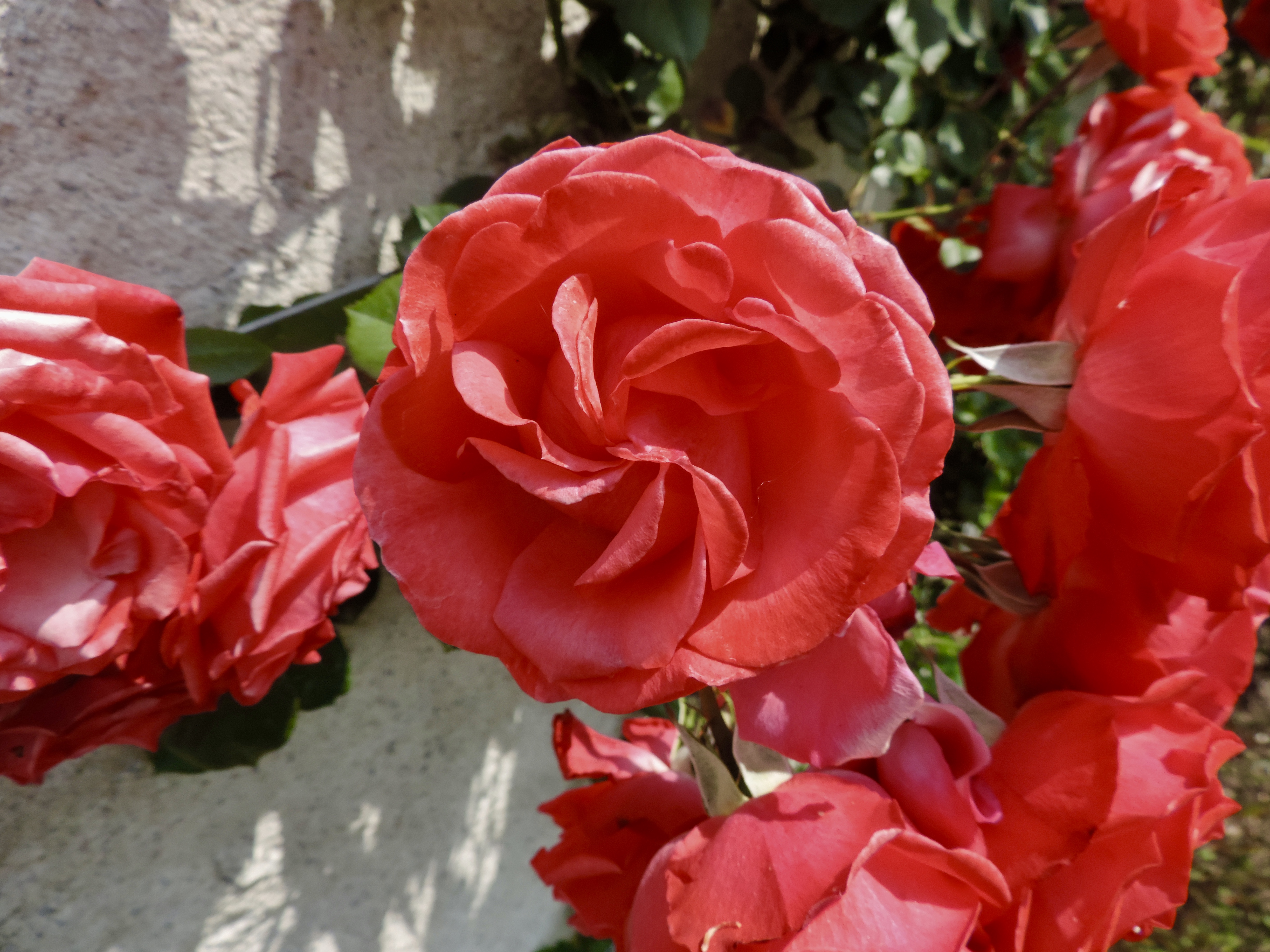
This rose in the image above is unfolding the petals from one of its buds. The unfolding is like a spiral, like one of those paper windmills you used to play with as a child. It’s utterly beautiful. This unfolding is an expansion, an opening up, a revealing and a stretching out to manifest itself. This rose is declaring “Here I am!” This rose is showing the world she exists by performing the third element of Life – growth.

Not just growth which is about becoming bigger, taller, thicker. Not just growth which expands the reach of the plant into the surrounding territory. But growth which reveals a whole new aspect of the rose. Before the flowers open up like this, the rose looks quite different. Green, leafy, thorny. But without flowers.

My littlest grandson is just seven months old now and seeing him start to “flourish”, start to “unfold” and “reveal” himself is like watching a miracle. Those first new behaviours and sounds are such a thrill, that emergence of interaction, of recognition and connection…..it’s breath-taking.

I used to find a similar awe and wonder when witnessing the unfolding and revealing of a patient as they moved beyond survival and repair into the fullness of health……seeing in that process the revelation of their uniqueness.

I think we tend to take these things for granted, because they happen all the time….these processes of survival, of repair and of growth.

But it’s worthwhile pausing from time to time and becoming aware of them….in the flowers, the trees, the birds, the other animals which share your world……in people you meet, people you love and in yourself.

It’s beautiful.

It’s inspiring.

Read Full Post »

« Newer Posts - Older Posts »