Light catches my eye, especially when whatever is lit seems to glow as if the light emerges from within….

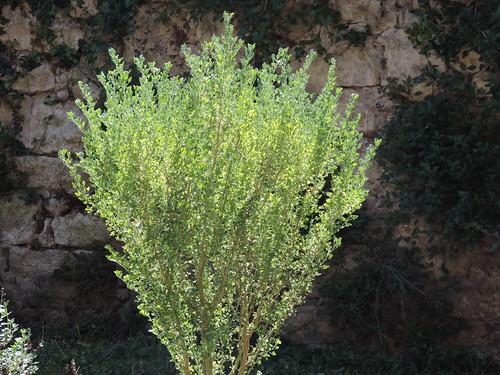
and sometimes, the light seems to lead you somewhere
Posted in from the dark room, life, perception, photography on April 22, 2014| Leave a Comment »
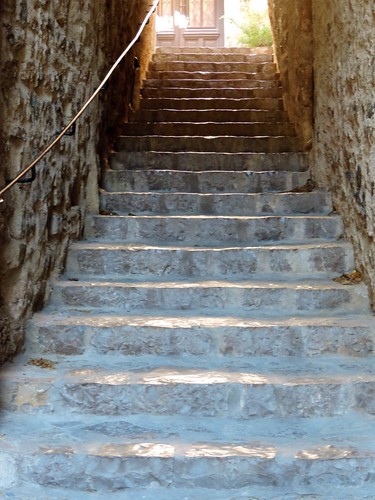
Light catches my eye, especially when whatever is lit seems to glow as if the light emerges from within….
and sometimes, the light seems to lead you somewhere
Posted in from the dark room, from the living room, life, personal growth, philosophy, photography, psychology on April 20, 2014| 3 Comments »

In the A to Z of Becoming, P is for Pause.
A pause is a break, a temporary stopping. I first encountered the concept of the “bardo” in the Tibetan Book of Living and Dying, where it was helpfully described as a space where enlightenment could emerge. The meditation teaching in that book is to become aware of the space between two thoughts, and gradually to practice increasing that space. In daily life the suggestion is to become aware of the space (or bardo) which occurs before an emotion arises eg anger or fear.
So, let’s look at two types of pausing.
The “pause of now” and “the long pause”.
The “pause of now”. One way to consider what goes on in our minds is to think of two default brain states – “reactive mode” and “responsive mode”. In reactive mode our minds work almost like reflexes. Someone or something “touches our buttons” and off we go, into a real state of anger, anxiety, fear or some other learned pattern of thought, feeling and behaviour. In this reactive mode we can feel entirely the victim of other people and of circumstances. It can feel as if we have no choices, that our happiness is entirely at the mercy of others. We are on automatic. We are in “zombie” mode. The responsive mode arises as we become aware of the early changes, recognise them, understand what is happening, and then make a choice about how we want to respond. So if we frequently find ourselves becoming angry or anxious when a certain person speaks to us, then if we can become aware of the reaction starting to happen, we can pause, then choose how to respond – sometimes we will choose to respond angrily, or anxiously, but sometimes we won’t. We will be doing the choosing as we open up this “necessary gap” and in the “pause of now” we gain flexibility, confidence, tolerance, autonomy, and move away from a victim or zombie way of living.
One of the easiest practices I know to begin to develop the skill of creating this pause to shift from reactive mode to responsive mode is Heartmath (see a simple introduction here). The first two steps of “quick coherence” in Heartmath are known as “getting neutral”. It’s a variant of “count to ten”, and it works. The more you practice it, the more quickly and powerfully it works.
There’s another kind of pause though, and it’s not the kind of pause which happens just over a few seconds, or at best few minutes. I got this idea from reading about the concept of “the long now“. We hear a lot about “living in the moment”. Maybe you’ve read “The Power of Now” by Eckhart Tolle? If not, then maybe you’ve read elsewhere about the idea of being present, instead of spending your time on the past or the future (which might focus your thoughts on grief or anxiety). But when you stop to think about it, “now” hardly exists. This present moment has become the past by the time you’ve said “this present moment”. Henri Bergson, the French philosopher introduced the concept of “duration” to allow us to think differently about time (instead of splitting it up into moments, like frames of a movie), but his work can be quite hard to understand. Here’s a short summary of his duration idea –
Instead, let us imagine an infinitely small piece of elastic, contracted, if that were possible, to a mathematical point. Let us draw it out gradually in such a way as to bring out of the point a line which will grow progressively longer. Let us fix our attention not on the line as line, but on the action which traces it. Let us consider that this action, in spite of its duration, is indivisible if one supposes that it goes on without stopping; that, if we intercalate a stop in it, we make two actions of it instead of one and that each of these actions will then be the indivisible of which we speak; that it is not the moving act itself which is never indivisible, but the motionless line it lays down beneath it like a track in space. Let us take our mind off the space subtending the movement and concentrate solely on the movement itself, on the act of tension or extension, in short, on pure mobility. This time we shall have a more exact image of our development in duration.
One other concept I found easier to grasp was the idea of the “long now” – which, I suppose, in even simpler terms could be thought of as “now-ish” (reminds me of how Italian friends would often use the term “15 minutes” which if you used your watch to measure would produce huge frustration because they didn’t mean a number of minutes, they just meant a “piece of time” (of around 15 minutes in size!).
Drawing on these ideas of time, I think we can usefully propose “the long pause”
The long pause is a space, a few minutes, hours, days, or even weeks. I think a holiday often is a kind of a pause. It lets you step off the treadmill, get some distance between your working life and the rest of your life and provide a vantage point from which to see things more clearly, or a place from which to allow a new pattern of thinking, a new set of decisions, some new habits, or, yes, even enlightenment, to emerge.
So, here’s your verb for this week – pause.
Practice pausing in the moment to move from reactive mode to responsive mode, and build into your life some long pauses, some “time out” – daily, weekly, monthly, annually.
Posted in from the dark room, from the living room, life, perception, personal growth, photography, psychology on April 19, 2014| 1 Comment »


When you look at these two photos, do you think, like I do, that the first one looks “soft” and the second one looks “spiky” or “sharp”?
I don’t mean in terms of photographic quality, I mean, in terms of sensations.
When I look at that feather, I think it looks soft. When I look at the burr, I think it looks prickly.
But isn’t that odd?
These are photos. I’m using my eyesight to perceive them, not much touch sensory organs. I cannot feel their softness or their sharpness. But that’s the first thing that comes to my mind when I look at them.
This is what we do all the time.
We are constantly bathed in information, some of which we detect with our sensory systems of vision, hearing, smell, taste or touch. We use our brains somehow to direct attention towards some of those inputs and away from others. So sometimes what we notice is a sound, and at other times, a colour, or a light.
But we are not unidirectional. We don’t process only one type of information at a time. We use all our ways of knowing and we put the results together to create a unified, whole perception. So I can look at this feather, and think “soft”, or at the burr and think “spiky”, even though my eyes cannot experience those qualities.
The one way of knowing cannot be reduced to another. There are always multiple ways of knowing. What we are really great at is synthesising those ways to gain a greater understanding of what we perceive than we could ever achieve by using only one way.
On a different level, this is what Iain McGilchrist has highlighted in the different ways our two cerebral hemispheres approach the world. Our two hemispheres allow us different ways of knowing. How much more fruitful, however, to synthesise their activity, and to use our whole brains?!
Posted in from the dark room, from the living room, health, life, personal growth, photography on April 18, 2014| 2 Comments »

Connections are important – whether we think if links, bonds, or relationships – we can understand nothing if we ignore the connections.
Christakis describes the importance of social connections in “Connected”
Barabasi describes this beautifully in “Linked” where he shows the usefulness of thinking about “nodes” and “links”.
Bloom describes the essential “social” nature of the universe by focusing on connections in “The God Problem“.
McTaggart comprehensively focuses on connections in “The Bond”
But, you know, there is a special kind of link, bond or connection which lies at the heart of all healthy, flourishing, growing organisms, all forms of Life, and all aspects of Nature – its the kind we see when we look at “integration”
Here’s a definition of “integration” – the creation of mutually beneficial bonds between well-differentiated parts.
There’s the key – “mutually beneficial bonds” (or links, or relationships)
I’m thinking this might be THE touchstone value – if you want something to grow, create mutually beneficial links between whatever it is and the rest of the world. If you want a relationship to thrive, create mutually beneficial links. If you want to know how to choose between different possible actions, ask yourself, do these actions create, or enhance, mutually beneficial links?
Posted in from the dark room, from the living room, life, perception, photography on April 17, 2014| 2 Comments »
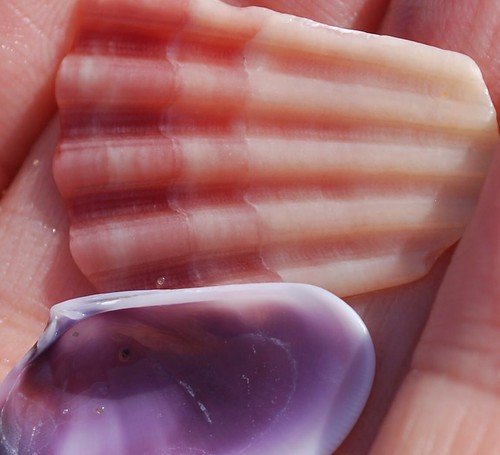
I’m a great fan of living every day with a sense of wonder (l’émerveillement du quotidien) and I must admit that colour often catches my eye.



Posted in from the dark room, from the living room, life, perception, photography on April 16, 2014| Leave a Comment »
Posted in from the dark room, from the living room, life, perception, photography on April 15, 2014| Leave a Comment »

We seek out difference all the time. We look for the edges of things, for their boundaries, in order to see them clearly.
But nothing exists in a vacuum.
Every”thing” we see we have abstracted from its context. We focus on only some of what we see in order to see what we are focusing on.
I’ve read there are no foregrounds without backgrounds.
If it’s true that every”thing” is inextricably linked to its environment and is constantly changing or evolving, then we should be wary of this whole process of separating and labelling.
The beauty in the above image is, I think, in the interplay between the wall and the cross, each of which would be diminished by the removal of the other.
Posted in from the dark room, from the living room, life, photography on April 14, 2014| Leave a Comment »


There is something special about cloisters. I love these open, covered, arched passageways around a garden. The light, the temperature, the silence….they slow life down and draw you deep into the present moment.
Posted in from the dark room, from the living room, life, personal growth, photography on April 13, 2014| 1 Comment »

In the A to Z of Becoming, O is for “open”.
One of the most beautiful sights in Nature is the opening up of a flower (just like these poppies I photographed yesterday). So, in what ways can we “open” this week?
Open your mind. Many, many years ago I noticed graffiti on a wall in San Francisco, which said “Minds are like parachutes, they work best when they are open”. The General Semanticists say that “judgement stops thought”. When we “make up our minds” we often close them. I’m not saying you shouldn’t decide anything but it might be a good experiment now and again to keep an open mind, instead of coming down with certainty one way or another. We can also open our minds by opening ourselves up to new opportunities, new sights, new music, new tastes….in other words why not try something different this week, and see what it opens up for you?
Open your hands. Don’t grasp. Don’t cling. Can you let go? Accept? Just try this little experiment – make a fist with your hand, scrunch it up tightly. What feelings come with that gesture? Now, relax your fingers, and turn your hand palm upwards. What feelings arise now?
Open your heart. Approach people this week with an open heart, prepared to be kind, to be loving and accepting. What flows when you open your heart? (Another take on opening your heart to someone is to express your true feelings to them)
Let me tell you a strange story. I’m having a short holiday in Pézenas in the South of France. As the weekend approached I started to think about my Sunday blog post, the one about the A to Z of Becoming. This week it was to be “O for open” so I got to wondering about opening minds, opening hands and opening hearts. I wandered into the bookshop in Pézenas and browsed. The bookshop here is mainly a newsagent and stationers. They don’t have a lot of books, but there was a pile on a table. One caught my eye “L’Âme du monde” by Frédéric Lenoir. I’d never seen or heard of this book before but the “soul of the world” title caught my fancy. I picked it up and flicked it open to a random place, which turned out to be the start of a chapter. The chapter title? “Ouvre ton coeur” – “open your heart”.
I don’t know. You explain it!
Posted in from the dark room, from the living room, humour, life, photography on April 12, 2014| Leave a Comment »
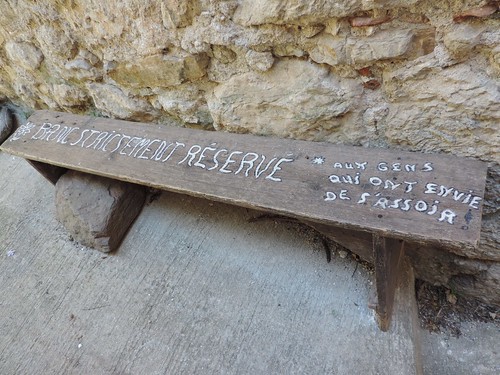
Translated, the message is “This bench is strictly reserved…..for people who really need to sit down”
I like it!


 Heroes Not Zombies