
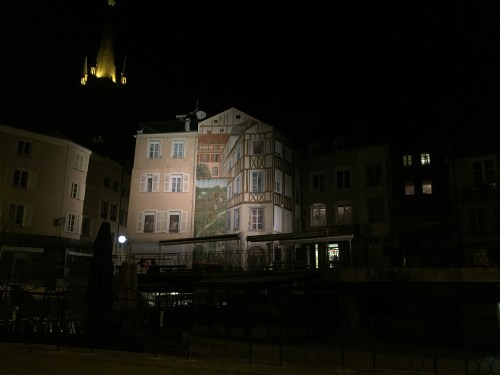
I take a lot more photos in the countryside than I do in towns, but I took this one recently while out in Limoges. Like so many French towns and villages there remains a medieval heart which can give you feeling of stepping back into the past. But it’s not like visiting a museum. Oh well, yes, there are dying and almost dead villages in France where it’s hard to get in touch with any sign that you are in the living present. Those places are not so comfortable to visit. Move along now, nothing to see, keep on going. But in places like Limoges the old is inhabited. It’s alive. What I like most about a place like this is a certain character. This isn’t a “high street” of chain stores, replicated like some kind of parasitical virus which replaces individuality and diversity with monotony and sameness. It’s alive with small restaurants, bistros, boutiques, and shops selling art materials or hand crafted works.
This second photo, also taken at night (just for the atmosphere, you see) shows a huge mural covering the gable ends of two buildings near the covered market (‘Les Halles’). This is one of the best examples of this kind of art I’ve ever seen. I love not just its scope and size but the playfulness of the details. Look carefully at the two windows, bottom left, and you’ll see both a model, and an artist painting her.
Why am I thinking about these images of a town at night? Well, in ‘Le Monde’ at the end of last week there was an article about cities. Right at the start of the article they mentioned Wellington Webb, former Mayor of Denver, Colorado, who apparently once said
“The 19th century was a century of empires, the 20th century, a century of nation states. The 21st century will be a century of cities.”
The Huffington post has an article which takes the same quote but talks about “the decade of the city”.
I thought that this idea was pretty interesting, not least because I’ve become increasingly troubled by the rise of inward-looking populist “patriotism” recently. The constant barrage of hatred and negativity towards “the Other”, especially “immigrants”, “asylum seekers” and “foreigners”. The kind of narrative which seems particularly strong in England now as it walks away from its neighbours and colleagues in the rest of Europe. Indeed, some commentators who try to explain how the Leave voters won, suggest it was a particularly English issue. After all Scotland, Northern Ireland and Gibraltar all voted strongly to Remain, but the English and Welsh went for leave. This particular take on the issue which is focused on issues of England suggest there is a strong sentiment of patriotism in England which has still to heal their loss of Empire. Whatever you own take is on the Brexit issue, it was this particular thesis which came to my mind when I read Wellington Webb’s analysis.
Yes, indeed, the 19th century was a century of empire for the English (portrayed as the British), and the 20th saw two World Wars of nation state against nation state. But isn’t it true that as the 20th century came to a close and the 21st began, the multicultural, innovate hubs of development and power increasingly became the cities? In fact, isn’t that one of the other critiques of Brexit, and populism….that the populations who live outside of the great cities feel ignored and forgotten by an urban elite? London, for example, voted to Remain, whilst most of the rest of England voted to Leave. Why was that? Was that something to do with the multicultural nature of a big city?
The other thing that popped into my head while thinking of cities, was this poem –
T S Eliot in his “Choruses from ‘The Rock’ 1934” wrote
When the Stranger says: ‘What is the meaning of this city?
Do you huddle close together because you love each other?’
What will you answer? ‘We all dwell together
To make money from each other?’ or ‘This is a community’?
Well, yes, some people are attracted to a city to make money from other people, but for many it does indeed become “a community”. But aren’t all towns “communities” in the same way? What makes a city any different?
Early in my career I worked as a GP in a small village in Scotland. There were three villages in one valley. The one I worked in, the next one a mile away, and the third one at the top of the valley about three further miles away. All very close in other words. I’ll always remember an old lady telling me that she came from the village a mile away, but when she got married she came to live in my village. “But I couldn’t stand it. I had to move back”. And she did. A mile away, but a BIG difference. And when I left that village to move to Edinburgh to live and work a young woman patient asked me what Edinburgh was like. I was surprised at the question because she was almost thirty years old. Then I remembered that many in the West of Scotland stick with the West of Scotland, so I said, oh you don’t know Edinburgh, maybe you know Glasgow better (about half an hour away)? She said, no, she’d never been there either. I asked her if she’d been to any big towns in her life and she replied that she’d been to one on the coast once for a day trip. (It was a town, not a city).
So I’ve known for a long time that people identify with the places where they are born and many are fiercely loyal to them. People, like Londoners, or Parisiens, or Edinburgers (???) might be intensely loyal to their cities, but are they any more so than those who live in towns and villages?
Well, that’s not really what I got to thinking about actually. What I got to thinking about was the idea that their was something potentially progressive about the idea of an era of empires, then nation states, and now, the cities. What I wonder is whether or not the cities offer us an opportunity to shake off the “patriotism” of “nation states”, many of which in the world are just lines drawn on maps. We don’t put lines around our cities in the same way we do our nations. We don’t give rights to certain citizens in a city but not to others on the basis of whether or not they began their lives in this particular city. Isn’t there something to learn from that? Can’t we all just be human beings living together in a particular place instead of dividing us up arbitrarily into “immigrants”, “expats”, and “citizens”? Couldn’t we say that everyone who lives in the same part of the world is an equal? With the same rights and responsibilities as the others? Do we need to divide the world into “us” and “them”?
Because it’s not that cities are the best way for people to live together, not at all. But maybe there are principles from city living which are distinctly different from those of empire-living or nationstate-living which might help us find ways for us all to share the whole planet in less divided ways?
I don’t know. I’m not proposing any answers here……just wondering.












 Heroes Not Zombies