Feeds:
Posts
Comments

Archive for the ‘from the dark room’ Category

fig

What is good or bad for me?

Let me ask “what is good or bad for you?”

Are the answers to those questions going to be identical?

I don’t think so. We could get into a big discussion about what “good” and “bad” even mean, but without disappearing down that rabbit hole I’d just like to express the opinion that no-one can know you better than you can. No-one is better placed to know how you should live than you are.

We forget that in our increasingly controlling autocratic societies.

Here’s Montaigne

Tiberius used to say that whoever had lived twenty years should be responsible to himself for the things that were harmful or beneficial to him, and know how to take care of himself without medical aid. And he might have learned this from Socrates who, advising his disciples, carefully and as a principal study, the study of their health, used to add that it was difficult for an intelligent man who was careful about his exercise, his drinking, and his eating not to know better than any doctor what was good or bad for him.

Socrates who lived almost 2500 years ago……his teaching on health?

Take care about exercise, your drinking and your eating.

Wow! Public Health advice has come such a long way! (hmm….)

But the main point Montaigne is making is one I agree with.

I’d be astonished if anyone claimed they knew better than I did what was good for me, or bad for me. Take the relatively common place circumstance of pain. Can anyone tell me better than I can whether or not a treatment I take for pain reduces my pain? No, they can’t. Only my personal experience will tell.

What better advice than to be aware, to be reflective and to learn about yourself?

Without that you end up swallowing the advice of someone who isn’t living your life.

(Oh, and what about today’s photo? It’s a fig. It’s a fig which grew and ripened on the tree we planted in our garden and it tasted….mmmmm….words fail me…delicious! Like no fig I’ve ever tasted before. Are figs good for me? Well that one certainly contributed towards my pleasure in being alive that day, and I’m looking forward to more figs growing next season. Are figs good for you? You’re the better judge of that one!)

Read Full Post »

bubbles

I’ve recently pulled my copy of Montaigne’s “Essais” off my shelf and dived in again. The stimulus was a special edition of a literary magazine which I found in the local “librairie” (a common confusion for the English speakers in France is that a “librairie” is a bookshop and a library is a “bibliothèque”). The focus of the special edition is Montaigne so I’ve been reading a few writers and thinkers perspectives on the man and his writing.

Given that he lived almost 500 years ago his writing seems astonishingly modern. According to the articles I read he was the first French writer to write as “je” (“I”) – his essays are reflective and he made no claims for them to be anything other than an exploration of what it was like to be Michel de Montaigne. One of the writers called him “patron de bloggeurs” – the “boss/leader of the bloggers” – which made me smile.

I’d say that this blog, and many other blogs I’ve seen, are exactly that. They are one person’s unique reflections and expressions of what it is like to be [insert blogger’s name here]

I reckon I only have each day once, and nobody can tell what this day was like for me. That’s up to me. And it’s up to you to share your unique experience of the everyday too.

Because when we do that, not only do we enrich ourselves with the sharing, but we find that we learn what it is to be human.

I’m going to share a few of the gems I uncover in Montaigne’s “Essais” with you and I’ll start with this, (which I read yesterday)

Men do not know the natural infirmity of their mind: it does nothing but ferret and quest, and keeps incessantly whirling around, building up and becoming entangled in its own work, like our silkworms, and is suffocated in it.

It thinks it notices from a distance some sort of glimmer of imaginary light and truth; but while running toward it, it is crossed by so many difficulties and obstacles, and diverted by so many new quests, that it strays from the road, bewildered.

Isn’t that so true? Thoughts never seem to stop, do they? I remember reading about the Tibetan Buddhist concept of the “bardo” many years ago. A bardo is a kind of gap. The author of the book I read suggested a good meditation technique was to become aware of the bardos, or gaps, between our thoughts – the spaces between the ending of one thought and the start of the next.

Good luck with that!

It’s not a skill I’ve ever managed to achieve.

Most meditation techniques seem to involve gently, patiently and repeatedly bringing the focus of the mind back to something specific, be that a mantra, an image or an awareness.

I do think it’s good to practice some form of meditation. It can help to counter that incessant “whirling around”.

There’s a second aspect to that passage of Montaigne’s – how difficult it is to stay on track. Isn’t it true that we often set off with a new insight, a new goal or a new intention, only to stumble when the going gets tough or something else interesting comes along – and there we go again, off the road, “bewildered”.

I think it’s good to read these reflections from five hundred years ago. They are insights into the natural condition of the human mind. If we are aware of these features we can begin to learn how to work with them, rather than beating ourselves over the head for having minds like this in the first place, or trying to wrestle ourselves into submission.

The photo I chose for this piece is one I took a couple of weeks ago. One day I noticed these little blobs of bubbles in the grass. I’ve no idea what they are, what kind of creature made them, or why, but I thought they were pretty wonderful!

Busy, busy, busy….busy blowing bubbles….oops, there I go again – that’s interesting. What is it? Yep, there’s a certain pleasure in following your mind as it “strays from the road”….

Read Full Post »

moon sky

The Guardian has published 15 quotes from Saint-Exupéry’s Little Prince (one of those books which has so many quotable sentences in it) and it seemed appropriate to me to post this in this week when the world’s thoughts are turned to Paris.

One of my own personal favourites is this –

It is only with the heart that one can see clearly. What is essential is invisible to the eye.

We can all quite easily take a moment to reflect on something – anything – it can be a choice which has presented itself to us, a decision to be made, a person, a relationship or an event. The way I like to do this is to sit somewhere quietly, take three slow, deep and even breaths, call whatever it is I want to reflect on to my mind, place my hand over the area of my heart, and ask myself the question “What does my heart say about this?”

Give it a few moments and see what, if anything, emerges. It won’t always, but sometimes, suddenly, something seems crystal clear.

I like the second sentence in that quote too – “what is essential is invisible to the eye”. I’m a big fan of that one.

As I looked down through the list of quotes I was remembered this one –

Grown-ups love figures… When you tell them you’ve made a new friend they never ask you any questions about essential matters. They never say to you “What does his voice sound like? What games does he love best? Does he collect butterflies? “ Instead they demand ‘How old is he? How much does he weigh? How much money does his father make?’ Only from these figures do they think they have learned anything about him.

….which is some ways is a continuation of the “what is essential is invisible to the eye”.

Why do we put such emphasis on numbers, when what is most important to each of us is the personal, the subjective, the invisible?

This little scene from “Gregory’s Girl” (from a LONG time ago!) popped into my head –

In particular the line which Claire Grogan says about a minute into the scene.


Read Full Post »

circle

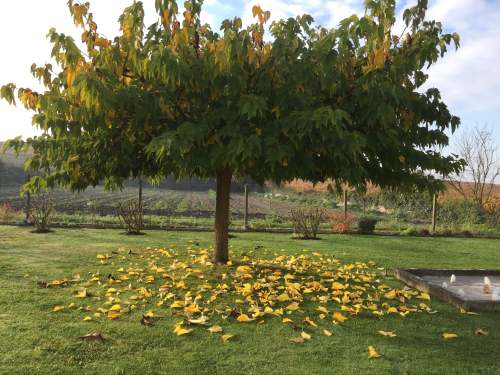
The other morning I was thinking how lovely the mulberry tree leaves are as they fall onto the ground forming such a beautiful circle. It reminded me of Andy Goldsworthy’s art.

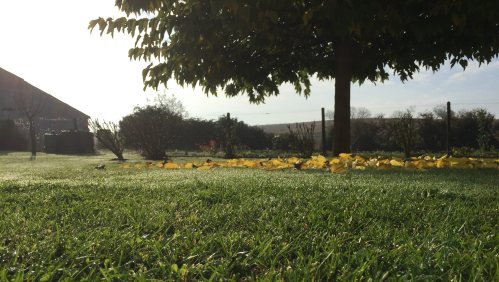
Then I got down on the ground to photograph the morning sunlight on the dew-bejewelled grass…

line

…and the circle turned into a line!

Interesting that, huh? And it worked the other way too – turning back into a circle when I stood up 😉

How different the world looks when you change your perspective!

Read Full Post »

robin

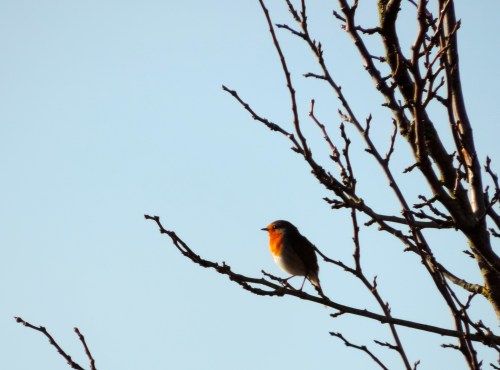
He’s back. The robin who hangs around my garden. Here is up taking up position in the most-favoured tree at the south-western corner of the garden. He’s looking east as the sun rises and the warming rays are making both his red feathers and his eyes shine.

Bright eyed, and looking to the dawn of a new day. Watching over his familiar ground  and singing loud and long.

I don’t know where prayers go,
or what they do.
Do cats pray, while they sleep
half-asleep in the sun?
Does the opossum pray as it
crosses the street?
The sunflowers? The old black oak
growing older every year?
I know I can walk through the world,
along the shore or under the trees,
with my mind filled with things
of little importance, in full
self-attendance. A condition I can’t really
call being alive
Is a prayer a gift, or a petition,
or does it matter?
The sunflowers blaze, maybe that’s their way.
Maybe the cats are sound asleep. Maybe not.

While I was thinking this I happened to be standing
just outside my door, with my notebook open,
which is the way I begin every morning.
Then a wren in the privet began to sing.
He was positively drenched in enthusiasm,
I don’t know why. And yet, why not.
I wouldn’t persuade you from whatever you believe
or whatever you don’t. That’s your business.
But I thought, of the wren’s singing, what could this be
if it isn’t a prayer?
So I just listened, my pen in the air.

Mary Oliver. I Happened to be Standing.

Whether it’s a wren or a robin or another species of bird entirely, we need to hear these prayers, these hymns, to Life.


Read Full Post »

from the moon

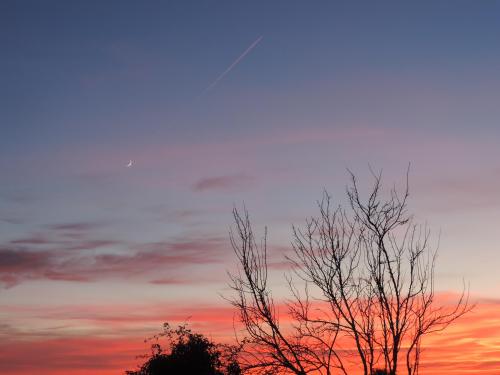
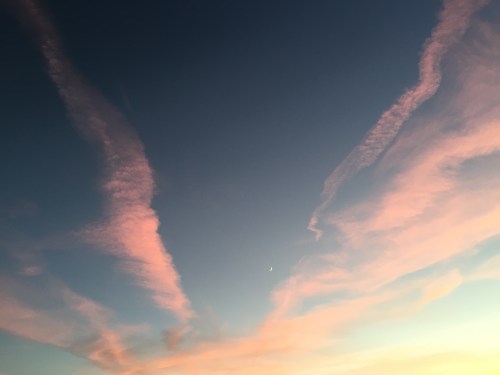
The sunset last night was glorious again, and the crescent moon hanging up there just added to my delight.

As I pointed my camera to capture moon above the setting sun I saw a jet stream glowing pink and giving the impression that the plane might have recently left the moon! (Ok, my imagination at work on that one!)

As I quickly tried out different compositional frames the silhouettes of the trees at the bottom of my garden seemed to provide a pleasing base and I clicked.

I love this image.

I love the glow of the sun, the sliver of moon, the pink trail from the plane, and I love the bare branches of the trees stretching upwards. That almost scraggy tree might not look like much but I can’t tell you just how much the birds around here like it. It is by far and away the most popular place to hang out for passing flocks of goldfinches, blue tits, blackcaps, thrushes, starling, sparrows….

Red sky at night, shepherds (or sailors) delight.

An image of hope in this weekend of sadness and distress…..

Read Full Post »

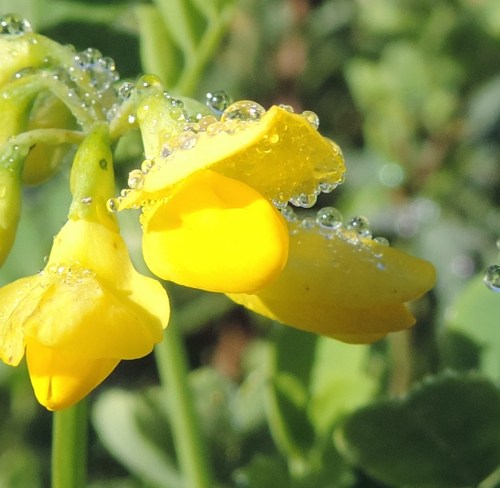
yellow drops drops

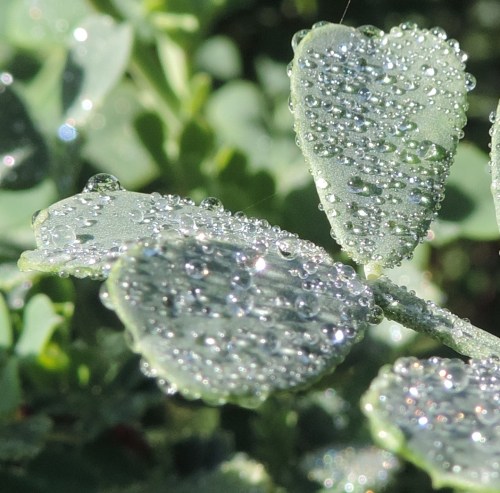
This bush in my garden looks pretty nondescript at this time of year, but look what happens early in the morning. Whether this is dew, or the traces of nocturnal rainfall, when the rays of the rising sun catch these drops, this bush is transformed.

What is it about water droplets that makes them so beautiful?

Do we have a gene which drives us towards what sparkles? (diamonds or eyes!)

Are we drawn to the light?

Tiny little jewels. Impossible not to notice. Impossible to ignore.

I’ll tell you what – beauty is important to us. It amplifies our lives. (to take a word from Big Magic).


Read Full Post »

the edge

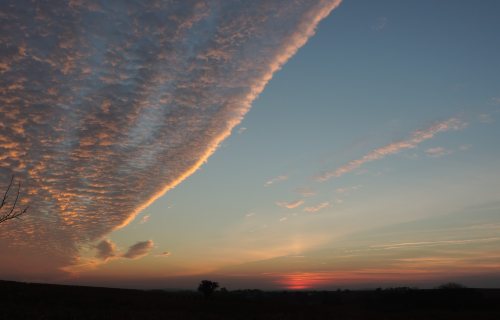
The most amazing weather system built up in the sky over the course of yesterday and as the sun set I saw this fabulous sight.

Transience and flow. These two phenomena are closely connected and lie at the heart of what I see everywhere in life. Life is a dynamic flow of energy, information and materials. In fact, not only “Life”, but Nature. All natural phenomena are dynamic, moving, changing, developing from one form into another.

I love this sense of flow. It invigorates me!

Transience is appreciated in the changing of the seasons. The most intense celebration of transience I’ve witnessed is in Japan when the cherry blossom appears. I remember seeing charts on the TV in Tokyo, like weather charts, but instead of showing the development of the rain or the sun over the country, they showed the spreading of the cherry blossom from the south to the north. I’ve seen cherry blossom photographs on the front pages of the national newspapers in Japan and I’ve milled around with crowds of picnickers, photographers and wanderers amongst groves of cherry blossoms. It’s a delight.

But there’s something else which comes with transience and flow and I think this weather system I saw yesterday really captures it. Dynamic change shows us how difficult it is to split our reality into pieces, pieces with clear boundaries or edges.

There are two edges which catch my eye in this photo. The edge of the cloud and the somewhat more metaphorical edge of the sunlight.

Clouds don’t have distinct edges of course, as you’ll have seen for yourself if you’ve ever looked out the window of a plane as it flies into, or out of, a cloud. The closer you look, the harder it is to see an edge. It’s that old “becoming not being” thing I have at the top of my blog. That constant becoming makes it pretty tricky to separate any one thing from another….from the cloud, and the “not-cloud”!

Have you ever just stood, or sat, and watched as the sunlight fades?

I don’t just mean watching the sun sink beneath the horizon (or, form another perspective, watching the Earth rise). I mean watching the light fade, the shades of colour change…..you can’t really separate it out into pieces can you? It’s a beautiful way to experience flow.

So we can get close to the edge can’t we? But the closer we get, the harder it is to pin it down!

I love that.

Read Full Post »

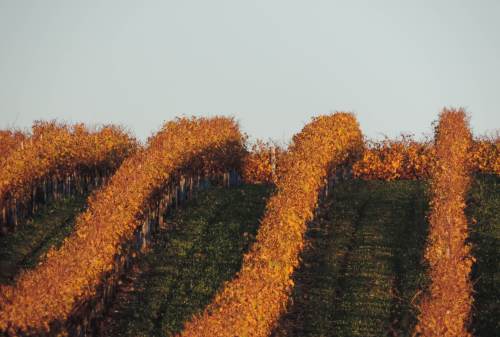
lines of vines

Habits.

We all have habits – LOTS of them! People often talk about habits as if they are bad things, and they can be, but we have them for a reason and don’t we all classify habits into two types anyway – “good” and “bad”?

Before I go any further let me just reiterate that I’m really not a fan of what is referred to as “two value thinking” – categorising whatever we are thinking about into boxes – “good” or “bad”, “black” or “white”, “right” or “wrong”. So often what we put into one category doesn’t look like it fits there very well after a while. However, for the purposes of this reflection let’s think about what’s “good” about habits and what’s “bad” about them.

Habits are good in at least a couple of ways I can think of – they bring us comfort, and so, ease, security and familiarity. We all want those feelings. And they allow us to turn our attention to other things. For example, if I have a routine way of making a cup of coffee, I don’t have to start from scratch every time and figure out how to make a cup of coffee. If I have a habitual path I take to get from home to work (whether walking, driving or taking public transport) I can just set off each day and not have to figure out how to get to my destination.

Why do we think of habits as bad then? Either because they are behaviours which we’d rather not have – for health reasons, or because they are particular patterns which always make us sad or fearful. Or because they restrict us. Because, let’s face it, habits can be very hard to break.

I think there are two ways to change habits –

First, become aware. If I become conscious of my habit then I can choose to repeat it. For example, if there is a particular route I like to take I can consciously choose to go that way, instead of just finding myself following it unthinkingly – that’s the heroes not zombies thing – it’s moving from autopilot to conscious living. Becoming aware and actively choosing doesn’t mean we have to do everything differently. Choosing changes how we experience a routine or a habit.

The second is to create new habits. When discussing how to get out of the same old ruts and loops, I used to talk to patients about “making better dents” – read about that here if you like. The idea though stems from the fact that it is much easier to create a new habit, which can then replace an old one, than it is to try to wrestle an existing one into submission! People talk about the 30 day rule for new habits – start doing something differently, and do it each day for 30 days – that seems to make it more likely to stick!

So instead of beating yourself about the head about bad habits, or struggling to “break” them, why not try first becoming aware of what they are, then either consciously choosing to continue them, to using your imagination to create a new, potential replacement?

Read Full Post »

vine leaf stalks

Wow! Look what the vine on my wall is doing now!

These strange stick-like stalks are what the vine produces to grow a leaf. The leaves grow on the ends of these foot long stalks and each one produces a single leaf. That means the vine has a real depth. It’s quite a way from the leaves to the wall! But not that autumn has come the stalks pop off the leaf at the end once it turns red and yellow, then some time after it pops off its attachment to the rest of the vine.

Isn’t that an amazing process?

Janine Benyus describes the fabulous harmony between form and function that we find everywhere in Nature. She’s a scientist who specialised in trees and forestry and began to wonder why we don’t look to Nature for our solutions. Her thought was that instead of thinking we can invent technologies which can “conquer” or “control” Nature maybe we can learn from some of the adaptive strategies of other species which have actually lived on this planet for a lot longer than we have.

She’s coined the term “biomimicry” to describe this concept.

I like this idea, and it seems consistent with my own experience of wonder, amazement and, frankly, humility, in my every day life.

The potential for sustainable solutions if we take this approach is exciting. I’ve just started reading her book. I suspect I’ll be posting a few thoughts which that stimulates but let me start today with a passage right from the start.

Nature has answers. Its strategies are wildly successful – collaborating, innovating, resilient, adapting to change and leveraging diversity.

Isn’t that a great list?

  • Collaborating
  • Innovating
  • Resilient
  • Adapting to change
  • Leveraging diversity

Think how applying those principles could improve the way we deliver health care, organise towns, influence a new approach to politics and economics even?


Read Full Post »

« Newer Posts - Older Posts »