Feeds:
Posts
Comments

Archive for the ‘from the dark room’ Category

image


The diversity and complexity of life never ceases to amaze me.

Look at this beetle – it’s not just that it’s body shape, wings and limbs are so striking, but look at the intensity of its colour, of its deep, shining blackness. And look carefully and see the flecks of iridescent blue.

I find it utterly mesmerising!


Read Full Post »

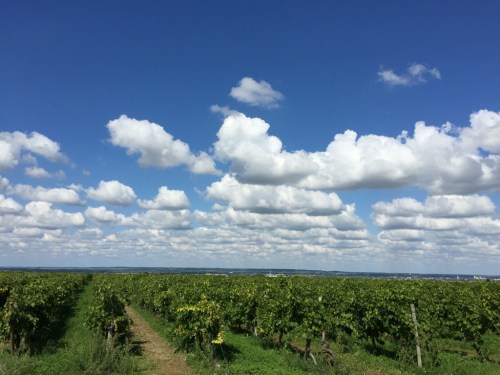
Rows of vines and rows of clouds.

This caught my eye while out walking yesterday. The clouds seem to be traveling in rows. That’s what caught my eye.

But now I see the image on the screen I’ve noticed that not only are the clouds crossing the sky in parallel rows, but they are doing that above the vines which are growing in rows on the land below them.

There’s something very pleasing about this pattern with rows above and below, running at right angles to each other…

Read Full Post »

DSCN4180

The thing that’s always bothered me about reductionist science is how quickly it becomes so abstracted from the world that it no longer usefully models the world.

Human beings, as living organisms, are complex adaptive systems. We are inextricably embedded in multiple contexts, physical, social, and cultural. You can’t truly understand a human being when you consider them isolated from the air they breathe, the food and water they eat and drink, the extensive web of relationships they live in, from family, friends and colleagues, to the networks of production of goods and services.

We are dynamic, open systems. That is, change is the constant of our nature, and there is a permanent flow of energy, information and substances between ourselves and the world in which we live.

A team of researchers in Montpellier has just published an interesting study beginning to try to examine and understand how chemicals in our environment bring about changes in our bodies.

They examined forty common chemicals which are found in the environment and in human bodies. Each of these chemicals has been tested on its own as part of state regulatory processes. Each one on its own has effects on the body, but not large effects (according to the studies). But of course, in the real world they don’t exist in isolation, so what happens when more than one of them is present at the same time?

As the researchers said, one and one normally make two, but when they studied the effects of the different pairs of these forty chemicals (780 variations of pairs in total) they found that sometimes one and one made fifty, or even a hundred. What they mean by that is that as they work together two chemicals don’t have a simple additive effect. Instead their combined effect can be many, many times greater than simple addition would suggest.

There’s an obvious reason for this. As complex adaptive systems, the cells in a human body are connected in a non-linear way, not a simple, linear one.

This study examines the effects of these particular chemicals on a particular receptor in a cell, (“pregnane X” receptor). They looked at this because chemicals have been shown to affect hormone systems within the human body causing widespread changes in the immune and inflammatory systems by interacting with such receptors, potentially setting off chronic metabolic and physiological disturbances in a person.

There study showed that one particular pairing of chemicals worked together as a kind of double key i.e. neither chemical could fit the receptor site, but when the two types of molecule combined they made the shape of a key which resulted in a much better fit to the receptor. So, singly, they produced little activity in the cell, but together their effect was multiplied 50 to a hundred fold. (The two they highlight are a pesticide and chemical from the contraceptive pill)

This is a small study only looking at the effects of pairs of chemicals in a set of forty, and only looking at the effect on a single receptor site. They point out that there are over 150,000 man made chemicals in our environment.

I’ll say that again.

There are over 150,000 chemicals in our environment.

Not just 40.

How many combinations can there be? How many combination effects might there be? Besides this particular one they have demonstrated. And the receptor site they studied is only one of many such sites in human cells.

A bit scary, huh?

They say they would now like to study the effects of pairs of 1600 prescribed drugs.

Are you a little surprised that we know so little about the real world effects of the presence of combinations of chemicals and medicines in the human body?

Well, thank goodness, we are beginning at least to explore real life complexity and stop pretending that single agents can be sufficiently studies in isolation.

Read Full Post »

I was out walking through the vines the other day and I noticed this.

I was immediately attracted to the colours, contrasts and patterns.

I find this image quite absorbing. Almost like a completed jigsaw puzzle or something! It draws my eye in and encourages me to explore the view.

But then I had another thought. I don’t expect vines are supposed to look like this! Maybe this is a sign of disease or disorder of some kind? But then look at the grapes! They are abundant and they look pretty good too. So if the plant isn’t well, it’s still creating and producing well.

I’m not knowledgeable about vine health so I’ll need to let those thoughts rest, and in doing so I’ll return to sheer beauty and compulsive fascination of the image.

Read Full Post »

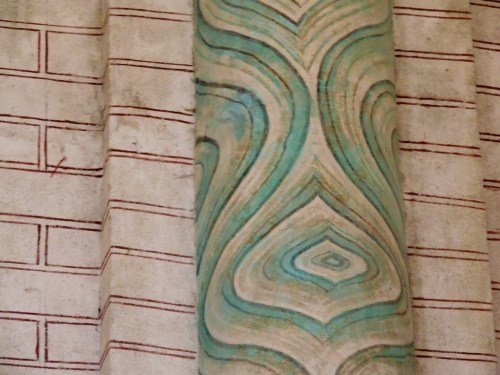
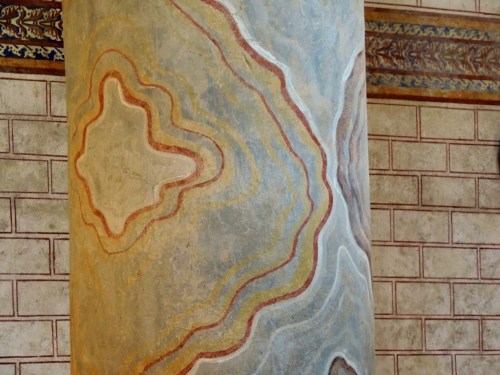
I read somewhere that there are no straight lines in Nature (well, unless you look over very short distances)

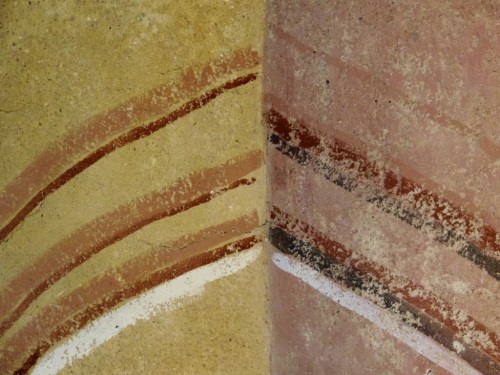
The church in Saint-Savin in France has really unusual wavy and curvy patterns painted on its pillars.

I rather liked it. What do you think?

Read Full Post »

I moved to France last November, so this has been my first summer in the Charente. Before moving here I lived for many years in a top floor apartment on the edge of Stirling in Scotland. We had fabulous views of the mountains and the volume and light in the flat, created in an 1830s textile mill, was fantastic.

Moving to France gave us the chance to live in a traditional Charentaise “long house” with a garden and a “potager” (a vegetable plot).

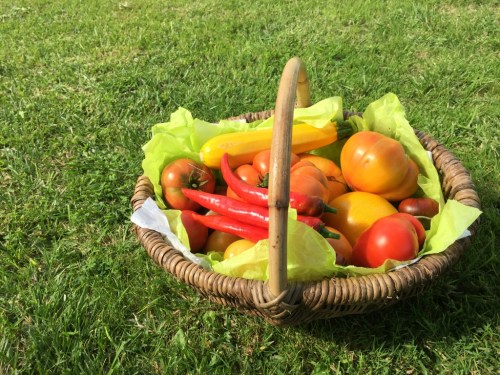
Here’s a photo of yesterday’s harvest. We don’t have a large potager, but look at this!

What a photo can’t convey however is taste. The taste of vegetables straight out of the garden is something else. The yellow courgettes are a relevation to me. I could really take or leave courgettes up till now. These fresh yellow ones are like something I’ve never tasted before.

We’ve tried a range of varieties of tomatoes this year and they sure would all fail the supermarket standards of shape and size but, wow, what the supermarkets are missing out on! Turns out flavour trumps size and shape by a long, long way. I didn’t know tomatoes could taste this good. I didn’t know tomatoes could taste this different!

Finally, look at the huge, red chilli peppers. For some reason, fresh chilli peppers are not easy to find in this part of the world, and we were advised that whilst they might grow outside here, they wouldn’t have much taste. The advice was correct in that they sure do grow outside here. Our chilli pepper pland has produced these beauties in abundance, and there are many, many more just waiting for a bit more sun to turn this glorious red. But the advice was definitely wrong about taste. They could blow your head off! Zinging with spice!

My general theory of a good diet has been pretty similar to Michael Pollan’s food rules – “eat food, mainly plants, not too much”. But one of the things he misses in those rules is flavour. And is there any better reason to eat something than that it delights your palate?

So, what I’d add in is, try to eat food which has traveled as short a distance as possible from where it grew to your plate. When you do that, you get the following –

  • food which is the freshest it can be
  • food which has had the least amount of processing
  • food which has the greatest variety of sizes and shapes
  • food which is most likely to be seasonal

I reckon that, depending where you live, you might not manage this “rule” – let’s call it “advice” – too often, but you know what they say – “every little helps”.

Oh, the other thing I think that Michael Pollan’s food rules miss out on is where you eat and who you eat it with. There’s more to food than “fuel” or measurements of constituents – so much vitamin whatever, such a percentage of protein, fat, carbohydrate, and so on – food’s to be enjoyed, savoured and shared, as well as digested!

Read Full Post »

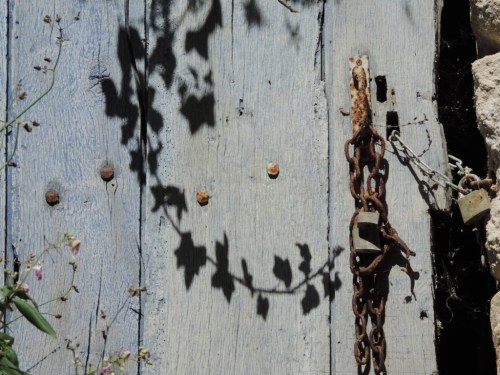
Two of the things which catch my eye when I’m walking in towns and villages are windows and doors. Here’s a very old door I noticed recently.

Look how the sun has faded the blue paint to such a delightful and delicate shade.

Look how the shadow of the plant arches down over the front of the door (but we can’t see the plant itself).

Look at the chains and the locks. The rustiest one has two locks on it and I can’t even see what it’s supposed to be securing any more and the other one looks wholly inadequate to prevent someone from forcing the door open.

But nobody has passed through this door in a long, long, time, have they? Which, somehow, makes it all the more interesting… what lies on the other side?

Read Full Post »

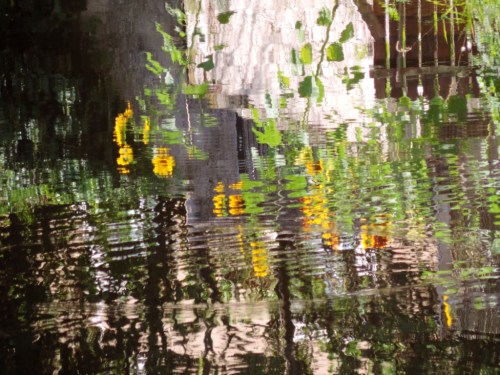
I enjoy taking photos of reflections. There’s something incredibly appealig about the world reflected in water.

This got me thinking though about how we reflect. After all when we are reflecting on something we don’t turn it upside down!

I think reflecting on something is more than just looking again. It’s more than remembering. It does involve looking at whatever it is from a new viewpoint.

That viewpoint either comes from time or distance or both. Or it comes from the way we develop new ways of seeing the world all the time, as we are affected by our every day events.

How often do you take time to reflect? And when you do reflect, are you aware of trying to see from different angles, different viewpoints, or through the new lens of the present?

Read Full Post »

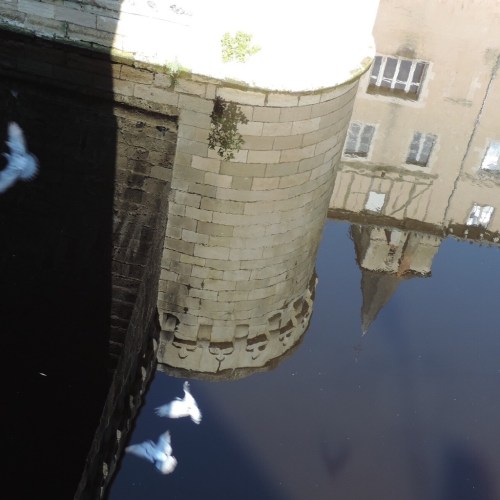
I took this shot leaning over a bridge just as some birds flew over the water.

I love the quite disorientating nature of this image. It takes a moment to figure out what you’re looking at. Which way is up? What is this?

When we drift through life on autopilot (in full zombie not hero mode!) then we stop noticing.

The unfamiliar, the unusual, the unexpected then has great powers to wake us up and see (in full hero not zombie mode!)

Why not set out to encounter something different today?

Read Full Post »

passageway Angles-sur-l'Anglin

There are a lot of medieval villages in France and this passageway in Angles-sur-l’Anglin is typical.

Here’s what appeals to me about this view. I love the archway first of all. There’s something very appealing about the arch of a bridge or a passageway. I love the tunnel-like nature of the passageway too. You know the phrase about “light at the end of the tunnel”? Well, there’s light at the end of that tunnel and draws you towards it. You feel like you want to go that way, to follow the light.

Then there are the plants. Both the flowers up close (down on the bottom left of the photo), and those in front of the houses we can see in the light.

There’s an extra appeal from the easel someone has placed at the entrance. It stimulates my thoughts about creativity and about art, and so tunes me in to the aesthetic qualities of the scene. And it’s facing the other way! So there’s a mystery there. What is on the easel? You have to use your imagination to get the answer.

I also like the cobbles. I know it’s not much fun walking or cycling over cobbles but there’s something very pleasing about them and that got me wondering about the Japanese “wabi sabi” aesthetic which doesn’t try to make something “perfect”….or at least only perfect in the way that Nature is perfect. There’s something of that in the appearance of most of the buildings in these old villages. There’s nothing shiny or sparkly or gleaming about them, and that gives them a greater quality of age and having been lived in.

Finally, I like the contrasts of the light and shade. The one needs the other and together they make something that feels very whole and appealing.

Read Full Post »

« Newer Posts - Older Posts »