Feeds:
Posts
Comments

Archive for the ‘from the dark room’ Category

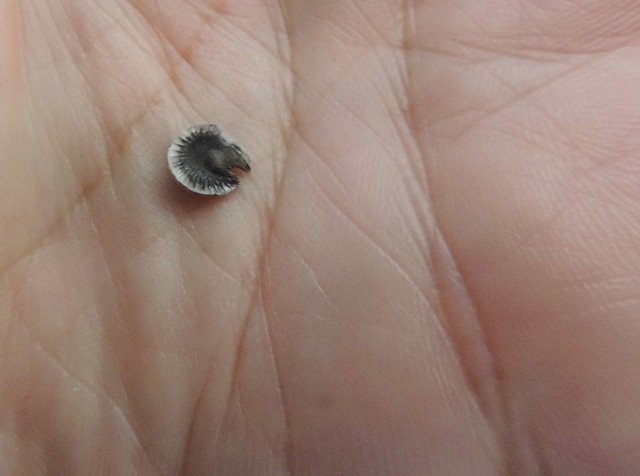
single hollyhock seed

Let’s start here. This is a single seed. It looks like a little shell, or a fossil. Look closely and you’ll see a wee notch which makes it look almost as if it has a mouth, or a beak. Where did this come from?   Hollyhock seed head

It came from here. When you peel back the covers of this seed head, the little seeds spill out very easily.

Look carefully at the middle. Can you see that ring of little hooks? Well each hook holds a single seed – right where that little notch was that we saw in the previous photo. Isn’t that incredible? How delicate, and how exact!

Would you like to see what it looks like before all the seeds spill out?
full hollyhock seed head

There you are. Wow! It’s like a bracelet, or a necklace. Densely packed seeds just bursting with life. What will they be when they grow up?

  tall hollyhock

A flower as big as a house!

These hollyhocks, or “rose trémière” as they are called around here (I think I prefer the sound of the French name) are everywhere in this part of the world. And look how high they grow! They are really stunning.

We’ve gathered a few of the seeds this week and we’ll see if we can have even more flowers next year.
Hollyhock seed harvest

Could you have imagined such a tall, beautiful flower could grow from one of these tiny seeds?

Read Full Post »

What’s better?

To look up close……
IMG_2922

Or to look far away……

clouds   

Ok, so it’s a trick question. 

It’s great to look at something like that mulberry leaf really close up – I mean, look at the veins and the structure of the leaf! Look at the stomata! What an incredible pattern! Then look at the colours, the shades of green….

But then, look up at the sky and see the clouds, layer upon layer with such rich shades of grey and blue….

The thing it, its best just to LOOK. 

We spend so much of our lives on autopilot (zombie mode), that the world can literally pass us by, and in so doing we miss all these opportunities to be amazed at just how incredible it is to be alive, here and now, on this Earth.


Read Full Post »

hollyhock

It would be easy to get lost in the petals of this flower.

Isn’t it just astonishing?

The curving shapes, the layers, the shades and tones of colour, the light and the shadows.

Sometimes, in our busy, bustling lives, it’s good to stop for a moment. Still the mind by focusing on just one small part of the world – in this case a single flower, close up. Just let yourself take the time to gaze, to explore, to wonder.

Flower meditations are easy to practice – you can do them just for a few seconds, or you can take a few minutes. It’s up to you.

Try it and see how you feel. Because as well as the flower itself being a great wonder, the engagement of your focus and attention changes what’s happening inside you as well…..and that’s the extra bonus of a flower meditation….becoming aware of what’s changing inside you.

Read Full Post »

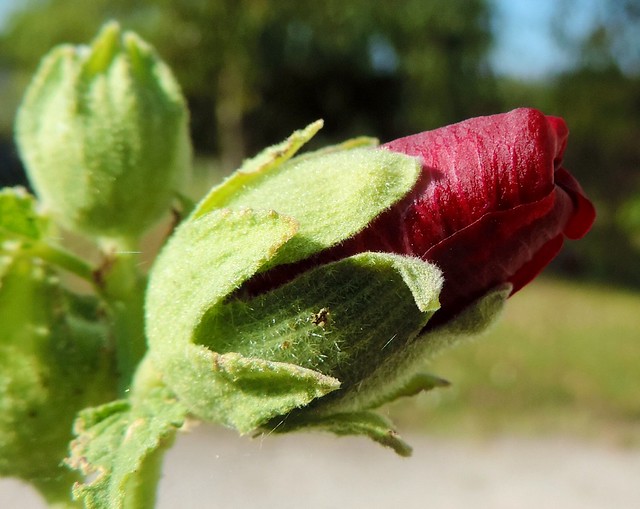
hollyhock

What makes this rose special? (Ah, some of you will be looking at this saying, “that isn’t a rose, it’s a hollyhock!” But a hollyhock in France, and there are masses of them here in the Charente, is a “rose trémière”).

Well, it’s special to me, because it’s growing in my garden and I’ve become pretty fond of all these incredible flowers in this garden.

When I think of roses now I think of the story of the Little Prince, and in particular, the section of the story where he meets the fox, and learns the secret the fox has to tell him.

The secret, apart from the much quoted “what is essential is invisible to the eye”, is that we make individuals special to us by creating relationships with them. In the story, the fox asks the Little Prince to “tame” him, and I tripped up over that word a few times (even checked out all the possible means of the original French word “apprivoiser” that I could find). I don’t really like the word “tame” as it seems to include changing the creature which is “tamed” to make them docile, and subjugated in some way. However, in the context of the story, it is clear that what is meant is how we create special bonds by paying attention, caring for and looking after another, and that when we do that, that person, or animal, or plant, becomes special to us. He, she or it becomes unique.

That might not seem that comfortable a thought at first. After all don’t we like to think of ourselves as compassionate and caring, so we should be able to “care for” or “care about” pretty much anyone? Well, that may be true, but any potential we have to do that remains just that – a potential – until we create actual, real bonds with actual, real individuals.

In the story, the fox explains to the Little Prince that the garden full of roses shouldn’t make him sad that his rose is not as unique as he thought. His rose, in fact, is still unique, and how the Little Prince feels (or doesn’t feel) about all the roses in the garden even emphasises that point.

Here’s a nice reflection on this whole issue.

So, as we create a relationship with the particular – with this rose, with this creature, or with this person – we reveal their uniqueness. And as we continue and develop that relationship, they become even more unique, even more special to us. That’s one of the essential kinds of bonds we have to make to deepen our experience of living in this world.

And it takes nothing away from the fact that, potentially, any person, any flower, any creature can become special to us.

Read Full Post »

I live in a typical Charnetaise house –

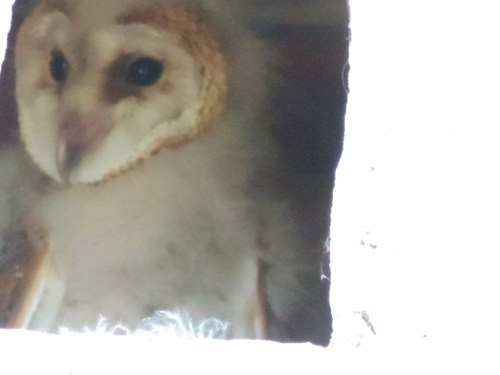
Can you see those two little arch-shaped holes/windows up on the top left? Well, there’s been such a lot of hissing coming from there in recent nights, and a bit of research revealed that the noise is the sound of barn owl chicks (barn owls don’t hoot, they hiss!)

Today I thought I could just make them out when I stood under the mulberry tree, and with a lot of patience, a camera on full zoom maxed up to a 3200 ISO setting, I managed to get these photos –

and

Wow!

I mean – wow!

OK, not exactly nature photographer of the year material but WOW!

This is just the kind of thing which makes an ordinary day an extraordinary day!

Read Full Post »

DSCN4108

In my twelve monthly themes, August is the month of travel.

I came up with this as the theme for this month because in France every August is the month of the “grand depart” – it’s the beginning of the annual holidays for thousands and the roads, airports and ports become very, very busy this month (starting this weekend)

I am a great believer in travel. I love to visit other places, encountering other cultures, traditions, foods, architecture, art and history, as well as other natural environments from the one I happen to live in. Where I live now is vine country and to visit a forested area, a mountainous region or the coast can be a stimulating change.

I think most of us also need a break now and again. We need to step out of the routines and habits and demands of our daily lives to be able to see them from “on high“. And we also need to rest.

I was taking photos of clouds the other day (as I do!) and I noticed this plane’s trail with a strange and clear break right in the middle of it and I thought – what a brilliant visual metaphor for August – travel AND taking a break!

So, where are you going to go? When are you going to take a break? Even if it’s just for a day, or a weekend, I think it’s important.

Read Full Post »

I read an article yesterday about the spread of sharing technologies and how they were beginning to challenge what we think about work.

It’s a hot topic here in France with authorities acting against the company, Uber, which was letting anyone with a car and the Uber app get paid for giving lifts to strangers. French taxi drivers protested vehemently (and sometimes violently) against this service which they saw as undermining their way of making a living. Taxi driving is a highly regulated job and the drivers have to pay a lot of money to get and keep their licences. It’s no wonder that technologies which underpin the likes of Uber are called “disruptive technologies”!

Whatever you think about the struggle between Uber, the taxi drivers and the State authorities, the service is a good example of how the nature of work might change.

The article I read (in a French magazine) pointed out that someone might earn some money driving their car using “Uber” in the morning, trade some antiques online using “leboncoin” in the afternoon, and welcome guests to sleep in a spare room using “AirBnB” in the evening. None of this makes the person a taxi driver, an antiquarian trader, or a hotelier.

So, maybe in such an example, this person would not define themselves by their work. They would also be experiencing a lot more freedom than any employee of a company, choosing not just their working hours each week, but the nature of their work, almost task by task.

Will this kind of working spread? Is this the new kind of “portfolio” work? What does that mean for regulators, tax inspectors and the State? And what does it mean for established tradesmen and professionals who are currently subject to the bureaucracy of employment and licenses etc?

In some ways this is a very libertarian version of utopia – each individual working for themselves without huge barriers in the form of regulations and the powerful interventions of the state. But this article referred to quite another interesting version of utopia – that of communism described by Karl Marx in “German Ideology” –

In communist society, where nobody has one exclusive sphere of activity … society regulates production and thus makes it possible for me to do one thing today and another tomorrow, to hunt in the morning, fish in the afternoon, rear cattle in the evening, criticise after dinner, just as I have a mind, without ever becoming hunter, fisherman, shepherd or critic.

I don’t think there are apps for hunting, fishing, or looking after sheep yet, but there are certainly lots of opportunities for critics!

So, what do you think? Are these new technologies the vanguard of change in the nature of work? Are they the place where libertarians and communists find something to agree about? In fact, are they challenging not only the nature of work, but the role of the State and the old labels we applied to political groupings?

Read Full Post »

Sunlit raindrops on hollyhock
Ever since I was a child I’ve had a fascination with science. For me, science was, and still is, a form of exploration. It’s about learning and knowledge. Finding out how something works, how a creature lives, or learning the names of clouds, constellations, trees and birds. I’d say science is about wonder and curiosity.

Many, many years later I came across the writings of the French philosopher, Gilles Deleuze, who wrote that there were three ways to think – science, philosophy and art. I was a bit surprised when I first read that, but the more I came to understand it, not only the more it made sense, but it became, for me, a basic tool.

Briefly, he said that science was thinking about function – how something worked; philosophy was thinking about concepts – our frameworks and our world views; and art was thinking about percepts and affects – what we perceive and what we feel. I took all of that into my daily medical practice, figuring out what wasn’t working in somebody’s body, mind or life; developing my concepts of health, illness and disease; and working with both what I perceived and what I felt in a consultation.

A couple of years ago I had an experience on my daily commuter train which really woke me up – you can read about it here – but, let me just rehearse it for those of you who don’t want to diverge off down a link – I was sitting next to a student who seemed to be revising notes (I presume for an exam. Her subject was “clinical research” and what struck me was her key points about the “scientific method” – they were – Observation, Description, Explanation, Prediction and Control.

Well, I am very, very keen on observation and I like to describe what I observe. I’m also very keen on finding explanations for things (I think one of the definitions of a doctor’s job is “a person who tries to understand” – but that’s another story!). I also know that I was taught how to diagnose (which I see as a level of understanding) and to prognose (predict).

To be honest, neither diagnosis nor prognosis are nearly as simple as they are often taught. The older and more experienced I became the more I came to realise that diagnosis is never complete (you can always understand more deeply and/or more widely), and that prognosis is about possibilities and probabilities not about certainty.

So I was particularly surprised to find the student’s notes on “clinical” research describing the final step of the “scientific method” as “control”.

Since then, I’ve come to see that for many science is exactly about this – control. Scientism, the belief that everything can be explained using science, seems to be about power. This way of understanding and approaching science seems to be what has been adopted, not only by the industrial-commercial-military complexes, but by all those who seek control over others and over the world. It seems to be based on an understanding that if we take enough measurements, collect enough data, analyse it with statistical and computing tools, then we will be able to make accurate predictions which allow us a high degree of power to control.

Well, for some reason, I woke up this morning with this phrase in my mind – “The Power OR the Glory – two approaches to science” – and so, this post!

I’d like to re-state the case for a science based on wonder and curiosity instead of one based on power and control. For me, the joy of that scientific method is the revelation of, and the revelling in, the GLORY of this Universe and of our lives.

I was looking for some paper to start to jot down some thoughts about this and stumbled across an old notebook where I’d made some notes about the book “Planet Narnia” by Michael Ward (haven’t even thought about that book for a long, long time) – and here’s what I read –

The glory of science is to progress as new facts are discovered to be true, and such progress meanest that ‘factual truth’ is a provisional human construct. Which is why the wise man does not think only in the category of truth; the category of beauty is also worth thinking in.

Wow! How does that happen? How do I stumble across exactly the phrase “the glory of science” in a notebook stuffed away in a drawer full of scrap paper on exactly the morning I wake up with the phrase “The Power OR the Glory – two approaches to science”? In fact, who on earth wakes up with a phrase like that in their heads anyway? OK, I do!

Seriously, there’s way too much to explore there than I can write a post about this morning, so let me just finish with what I wanted to say in the first place –

There are two approaches to science – power (what I’d say is our current dominant model) OR glory – based on a humble curiosity and a joy in the awe and wonder of this life.

My hunch is, we could do with cultivating more of the latter, and less of the former!


Read Full Post »
butterflyLooking up from my book I saw this butterfly and captured a photo of it with my iPhone. The sky looks pretty grey but it was actually just some clouds passing by as I was relaxing with a book out in the garden. Within a few moments there was blue sky again. I’m struck by how the sky changes so quickly. Clouds are a great reminder of the transience of Life with their constant making and unmaking of themselves, their constant appearing from apparently nowhere and disappearing apparently into nothing. The fact the sky looks so grey in this shot also reminded me of how often we take a moment in time and react to it, then the reaction can live for a long time afterwards. There’s no doubt that the ability to expand our focus of attention, stretching it in time and/or in space, can radically change our inner experience and hence our mood. I suspect that the relationship between moods and emotions is a bit like the ripples which spread out over the surface of a pond after a stone lands in the water. The moment the stone lands creates a condition – just like a word, a gesture or an action might trigger an emotional state in us – but that the state spreads out to become our longer lasting state of mind (a mood) – in much the same way that the ripples can be seen long after the stone has disappeared, or the wake can wash onto the shore long after the boat which caused it has sailed by.

the Charente

Butterflies can be a trigger for us to think of transience (but also of metamorphosis – I think I’ll return to that in another post) so, the butterfly against the changing sky worked as a strong prompt for me.

Sometimes we just need to place events into their larger contexts in order to alter the impact they can have on us. It’s great to be focused on the present moment, but it’s also important to be able to set the present moment into our larger story.

Read Full Post »

The Mission

I recently received my first “Discover Weekly Playlist” from Spotify and so far, I’ve really enjoyed every single track. So, does Spotify “know” me?

We have more and more services like this around us – Amazon telling us what other people who bought “this” also bought (or even looked at!), Apple telling us what other apps other people bought who bought this particular one….and so on. This is something which Maria Popova has written about in her excellent Brain Pickings

I recently found myself in an intense conversation with a friend about privacy — why it matters; how much of it we’re relinquishing and what for; whether it is even possible to maintain even a modicum of control over our own privacy at this point…….It suddenly struck me that our cultural narrative about privacy is completely backward: What we really fear is not that the internet — or a prospective employer, or a nosy lover, or Big Brother — knows too much about us, but that it knows too little; that it fails to encompass Whitman’s multitudes which each of contains; that it reduces the larger, complex truth of who we are to a few fragmented facts about what we do; that it hijacks our rich, ever-evolving personal stories and replaces them with disjointed anecdotal data.

I hadn’t thought of it that way around when it comes to the internet, but she is definitely onto something. The underlying truth of what she is referring to is similar to what I read years ago in Mary Midgley’s “Wisdom, Information and Wonder” where she wrote –

One cannot claim to know somebody merely because one has collected a pile of printed information about them

That observation seemed absolutely true to me in the domain of health care where sadly, far, far too often, “data” or “information” is ALL that is known about a particular patient as individual narratives are dismissed as “anecdotes” or “unscientific subjectivity”. That dominant way of practising Medicine always seemed to me to be just the opposite of how it should be done. Information, or data, can tell you something about some aspect of a person’s disease but it’s a long way from the person’s own narrative.

One of the dangers of substituting data for narrative is the presumption of knowing – I used to say to patients that each of us spends a lifetime trying to really know ourselves (and I’m not sure any of ever complete that task!) so how can I presume to know them from hearing just a little of their story over the course of an hour or so? Frankly, reducing their stories to a few data points just takes doctors and nurses even further away from knowing their patients.

Maria Popova’s recommendation to counter this is to “master the art of personal narrative” –

Perhaps the most potent antidote to this increasingly disempowering cultural shift is to grow ever more thoughtful and deliberate about how we tell our own stories

Thought provoking, huh?

Even when someone uses the personal data we’ve shared to offer us more music, books, restaurants etc, that we may like, I think its best to keep these things as hints. That’s why “discover weekly” works for me – it doesn’t assume the impossible – they don’t know me – but I’m happy to have them help me discover new music. And I’ll use some of their suggestions to continue to make my own playlists.

Where are you with this issue of information, privacy and how we make ourselves known to the world?


Read Full Post »

« Newer Posts - Older Posts »