Feeds:
Posts
Comments

Archive for the ‘from the living room’ Category

I’m of an age where I can say that one of the first “singles” I bought in a record shop was “I want to hold your hand” by the Beatles. Feels a long, long time ago (“though she was born a long, long time ago, your mother should know“)

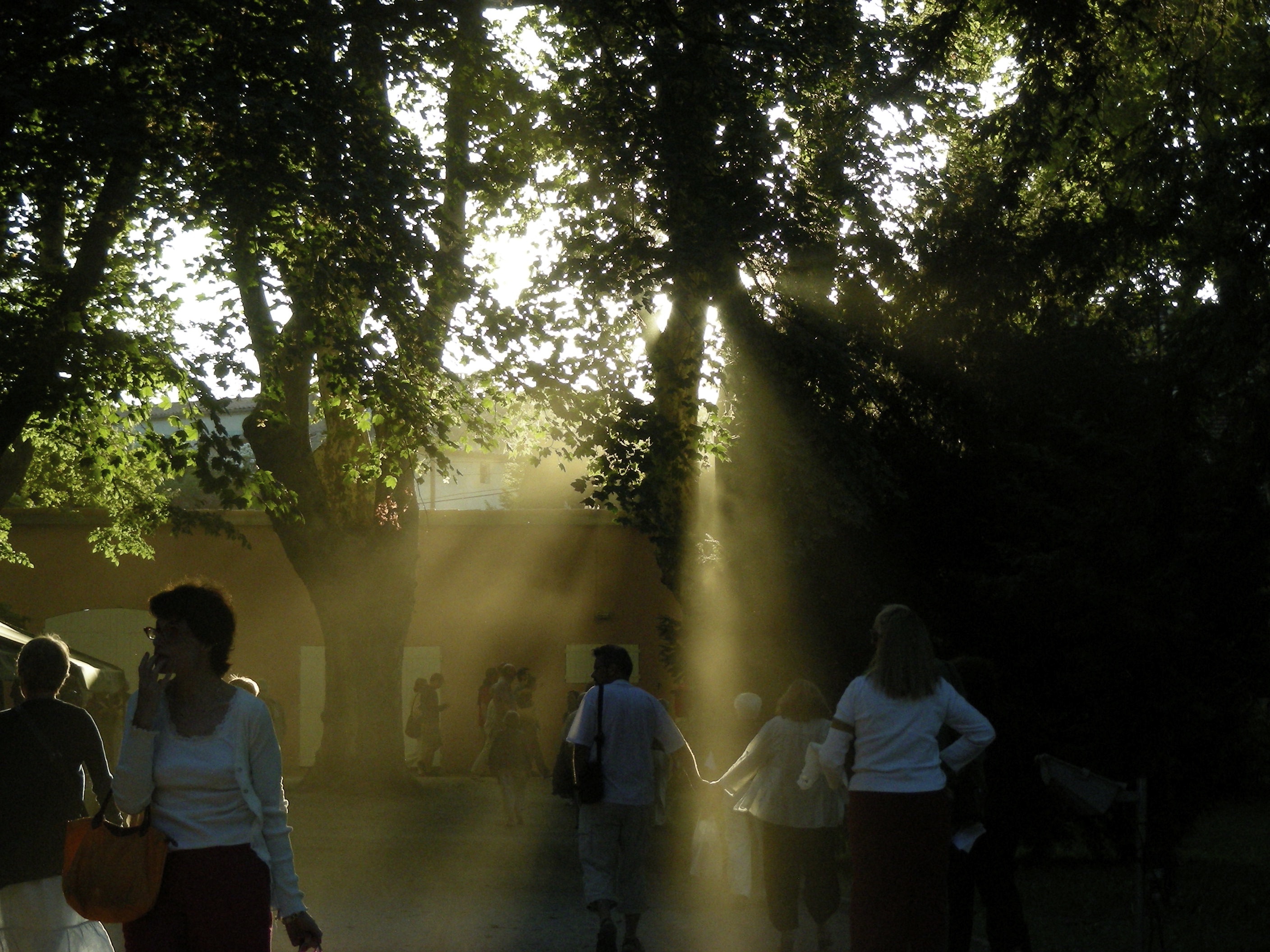
I took this photo at a festival in Provence many years ago. As we were all leaving the venue (it was a piano recital in a forest), the sun was sinking a bit lower and the shafts of light streaming through the trees caught my attention. It’s one of those photos which only revealed a whole other dimension once I looked at it on my computer. See how the brightest sunbeam is illuminating a couple who are holding hands. Actually, it is illuminating their hands, drawing our attention to exactly this – holding hands.

So, when I came across this again this morning, yet again, it inspired a train of thought about holding hands. I know that since this pandemic began we’ve been forced into way more social isolation and distancing than most of us are happy with, and a lot of the focus has been about holding loved ones again…..about having a hug. Well, I share that, and look forward to hugging some loved ones soon. But in addition to the desire for hugs, I think there is this important part of human, physical contact which is about holding hands.

Maybe holding hands isn’t as passionate as hugging, but it is such an important part of the way we connect. It’s an important part of our personal lives and physical hand holding is something which almost casually, almost unconsciously connects us with others to whom we feel close. It’s a longer term connection than a hug too. You can go for a walk and hold hands all the way. You can stroll along a beach, through a forest, along a city street, or sit quietly on a park bench, or in a cafe, holding hands.

Most hand-holding occurs side by side. It’s that connection which embodies and symbolises having “someone by my side” and “someone who stands with me”, or someone who is sharing a part of life’s journey with me. We all need people, not just to “have my back”, but to “be by my side”.

But we can hold hands across a table too. You can look into someone’s eyes, raise a glass, tell them you love them, whilst holding hands across a table.

There are other situations too where hand holding is important and powerful……I’m thinking of the shared times between patients and carers. Holding someone’s hand as an act of compassionate connection is a terrifically powerful thing to do. We can connect, you and I, through words, through talking and listening, but touch magnifies the connection enormously. I don’t know if you know about the work of the Heartmath Institute, but they have shown that our heart beat rhythm radiates an electromagnetic field which can interact with that of another who is metre or so away from us. If my heart rhythm is in a state of “coherence” I can induce a similarly coherent state in the heart of someone standing next to me. If we hold hands, that harmony increases several fold, producing coherence in both of us, more quickly and more powerfully, than when we are standing apart.

So, this is my salute to hand holding. Maybe it doesn’t get much publicity or promotion but I honestly feel that the more we hold hands, the better our relationships are going to be…..and vice versa.
Read Full Post »

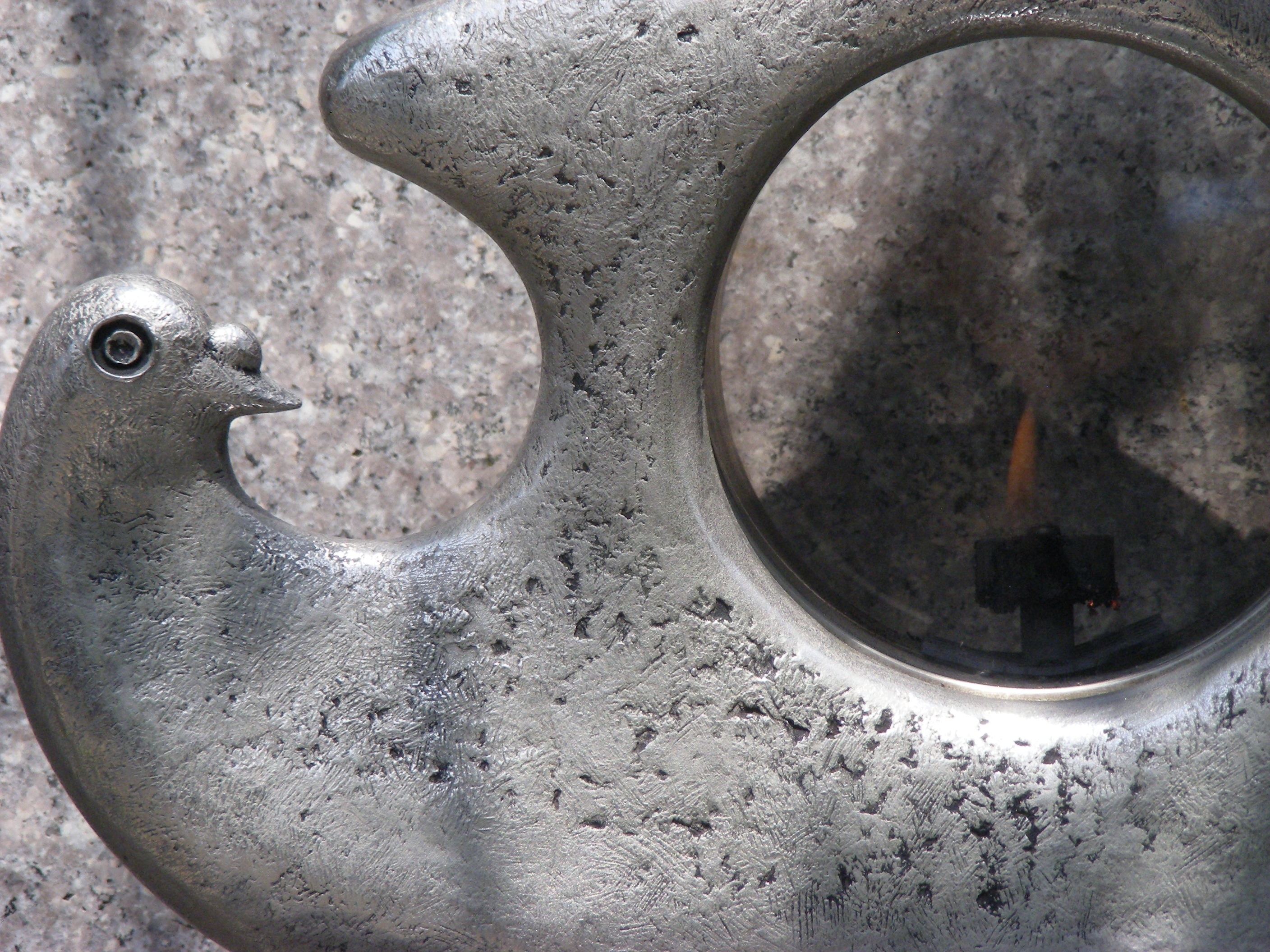
I took this photo in Ueno Gardens in Tokyo. It’s the centrepiece of a peace memorial and I think it’s utterly beautiful. I love the design of the dove whose curves suggest the flowing shapes of the yin yang symbol and the little flame flickering in its heart, or soul, is very moving. Isn’t it wonderful?

When I look at it, it stirs feelings of peace in me, but there’s more than that, which I think comes down to the nature of the little flame. It looks vulnerable. It’s not a raging fire. It’s a flickering light. It looks as if it could be blown out by not too strong a gust of wind. That moves me too.

That small, flickering flame, contains two polar opposites for me…….the energy which is at the heart of all Life, in other words the power of Life, and, on the other hand, the vulnerability and transient nature of every individual life.

When my daughter was small and had an illness which seemed to flatten her I told her to imagine a small candle flame inside her which would grow in brightness and strength as she paid it attention. That helped her to recover and it’s a practice we’ve used at other times as we’ve needed it.

There used to be a belief in an entity called “the Vital Force” which was an invisible spirit-like force which kept us healthy and restored us when we were ill. “Vitalism” fell out of favour a long time ago, even if it is kept alive in certain healing traditions. As far as I know there is no such entity, but the concept remains a good one. As I understand it now, human beings are “complex adaptive systems” which have the capacity to be “autopoietic” – what all that means is that biologically our systems and responses enable us to protect ourselves on a daily basis…..our immune systems are a part of this natural defence. And we have systems which enable us to repair any damage which occurs….our inflammatory systems are part of that. We also have the abilities to learn, change and adapt. Putting all that together, we have something which isn’t a “thing”, something which we can’t see, can’t measure and can’t pin down which is like an inner flame – it’s the flow of Life energy which pulses through our whole being from conception to death.

In short, we have the capacity to self-heal, and all “treatments”, in every stream of healing tradition, work, only if they support and/or stimulate that capacity. There is no artificial healing. There is only the ability of the living organism to heal itself. We can learn to nurture that, to support that and to stimulate that. That, for me, is what Medicine should be about.

Some philosophers have described human beings as “symbolic beings” – because we are only the creatures which seem to create and handle symbols. Symbols are a powerful tool for us. They help us to connect with each other, to communicate and to learn. They can help us to thrive. In fact, I believe, they can help us to survive.

So this work of art, in Ueno Gardens, works for me as a powerful combination of symbols – ones which activate the forces of both Peace and Life.

I hope this works for you too.

Read Full Post »

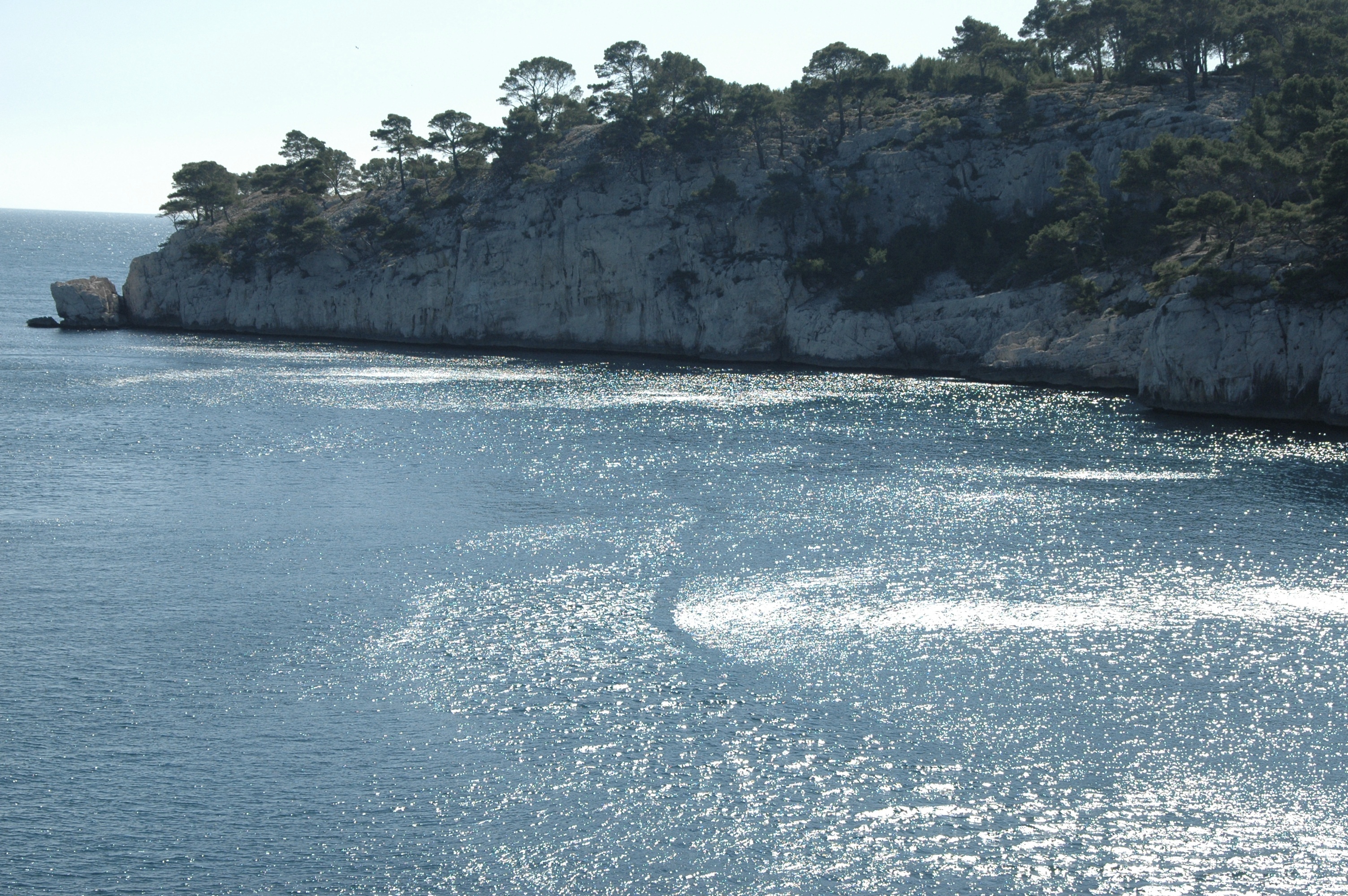
This photo has always fascinated me. At the time I took it the sunlight reflecting on the blue waters as they nestled at the foot of the wooded cliffs was what caught my attention. The whole scene is beautiful and it evokes a sense of peace and contentment in me. But from the first time I looked at it on my computer, what has struck me most has been that line on the surface of the water. Do you see it? It’s pretty much right in the middle of the image. It’s like a path, a blue path cut through the glistening white of the sunlit waters on either side of it. It is shaped like a bow, curving round from just over half way along its length to head towards the cliffs. The surface of the water in the path seems calmer than that on either side….it’s smoother somehow.

Clearly this is the trace left by a boat, but there is no sign of the boat. So when did the boat sail this way? A few minutes ago? An hour ago? Longer?

I suppose it could be caused by something which lies beneath the surface rather than by a boat, but what would run a length like that and have such straight parallel edges? No, I think it’s a trace, not something sitting below the surface.

I find that pretty amazing. If there was a boat at the leading edge of it I might not be so impressed, because all boats leave a wake, don’t they? But this is like a wake without a boat…..or a visible wake left by an invisible boat!

I always think of how we humans change the planet by living in it when I look at this photo. Just by moving from one place to another we change the surface, leaving a trail, leaving a trace. It reminds me of Robinson Crusoe finding a human footprint in the sand on what he thought was a deserted island. These traces say “you are not alone”, and that can be both a reassurance and somewhat unsettling.

Of course, this particular trace won’t last very long. It won’t be there tomorrow, or probably not even later today. But other traces we leave change the landscape for decades. Whether through deforestation, through mining, agriculture, or be the creation of living spaces, we change whole landscapes forever…..well, if not forever, then at least for generations. I’d argue it’s forever, because the changes don’t go away.

Changes don’t go away? Surely they do? Well, I’m not so sure. It seems to me that changes just change into something else. Time doesn’t reverse and we don’t return anything in the world to how it was before…….how it was before has gone, so the changes, if they do disappear, only do so by changing into something else. You know what I mean? Landscape changes produce biosphere changes, which cause further changes in the landscape. I see change as more a ripple than an event. I don’t see changes with definite beginnings and endings, but as emerging differences which cascade outwards through the infinite web of inter-connectedness.

Not all changes are as visible as the ones we see on surfaces, or in landscapes, of course. I know I change all the time. My consciousness changes all the time. My emotional state changes all the time. I think, I act, I communicate, I respond and react. Those waves of change ripple out through my connections. Like the one I have with you. When you stop by to read this today, some of what I’ve been thinking, some of what I’ve been feeling, or something that I’ve seen and shared with you today induces some change in you. Maybe a different thought, maybe the start of a different feeling, or the deepening of an existing one. Maybe this experience you are having reading this post, will ripple out into conversations you have today, or into what you choose to do, or, maybe even what you notice as you live your own life in the days ahead.

Of course, I don’t know.

But I’m aware of the possibility. And that awareness is at the heart of why I create these posts. My intention is to share some of my wonder, my amazement and my delight in daily living. To share from my heart with positivity. I hope this leaves a trace, or sets off some waves to ripple out into our shared and wonderful life together.

Read Full Post »

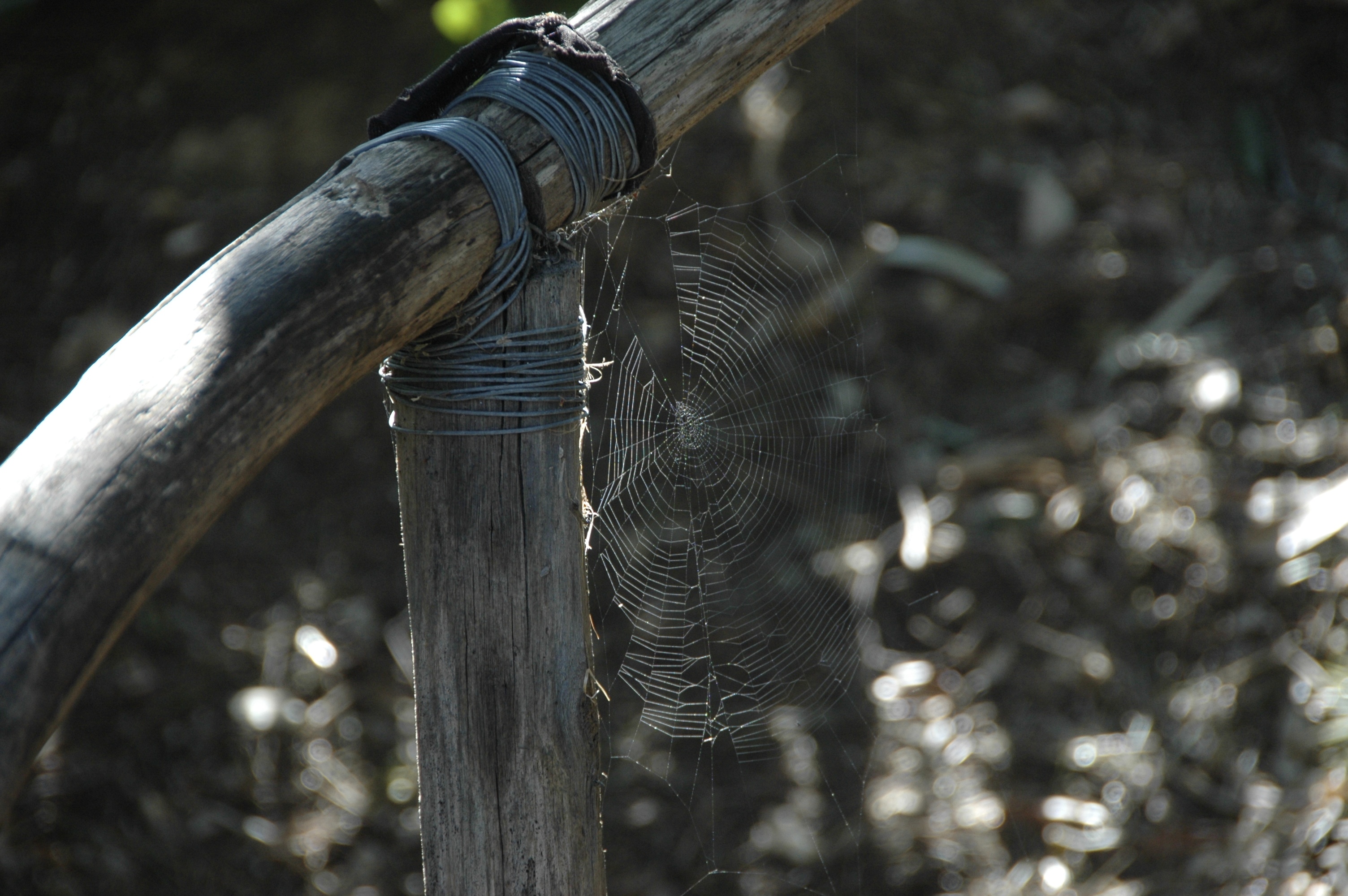
What strikes me about this photo is that I can see two completely different kinds of threads which bind. There is the wire wound round and round the wooden poles to create a fence, holding the cross posts tight to the upright. And there is the web.

I like the words entwined and entangled, because I think they highlight an often invisible aspect of reality. We are, all of us, inter-connected. We all exist in vast webs of relationships. You can’t really see a relationship. It isn’t measurable, but it is still the basis of reality. We are constantly exchanging materials, energy and information with others. Our relationships are between us and other humans, between us and other creatures, and between us and the planet.

Perhaps the most fundamental characteristic of our relationships is that they change us, and we change the others. It’s never one way. We absorb, are stimulated by, penetrated by, elements, molecules, and organisms. We exist in energy waves which penetrate us, changing our own energy patterns as they do so. We live in a continuous flow of information, picking up signals, responding to signs, symbols and stimuli, moment by moment. At the same time we send out molecules in our breath, in our body fluids, from our skin. We emit energies produced by the beating of our heart, by the activity of our brain, and by the rhythms of our cells. We send out information, signals, and signs all the time.

This reality of inter-connectedness underpins our inter-dependency. Not one of us could exist without the entangled webs and ecosystems in which we live. There’s a strange fantasy about space travel…..that you could take a human being, build them a house on the Moon, or on Mars, and start to create a new place to live. But human beings live as only one of hundreds of inter-dependent species on planet Earth, and take one species out (if such a thing were possible – it’s not – you exist with more micro-organisms than you do with ancestral cells), and then see how it can survive, let alone thrive. It’s a fantasy.

We don’t choose most of our entanglements. Not consciously. We are born into many of them, nurtured within them, and live within them. We are so unaware of the rest of Nature that we think of ourselves as outside, apart from, separate from, all of existence. We aren’t. We all exist inside, a part of, integrated within Nature, and Nature is a vast, complex, interconnected web of ties, of bonds, of connections and relationships. We are so unaware of Society that we think of ourselves as separate individuals, as if nothing others do could affect us, as if nothing we do could affect others. But we exist socially, culturally, economically, in one vast, interconnected system.

But we can choose some of our entanglements. We can become more aware of our day to day reality, and, then, when we pause to reflect, and observe, we can learn, see, hear and know more. Only then does conscious choice have a chance. Only then can we develop responses on top of all our reactions. (reactions being automatic)

There’s something to think about – what are my entanglements? How and with whom am I entwined? How do those connections and relationships change me, influence me, move me? And how do I change, influence and move them?

Read Full Post »

Have you ever thought “What the world could do with is a bit more love in it?”

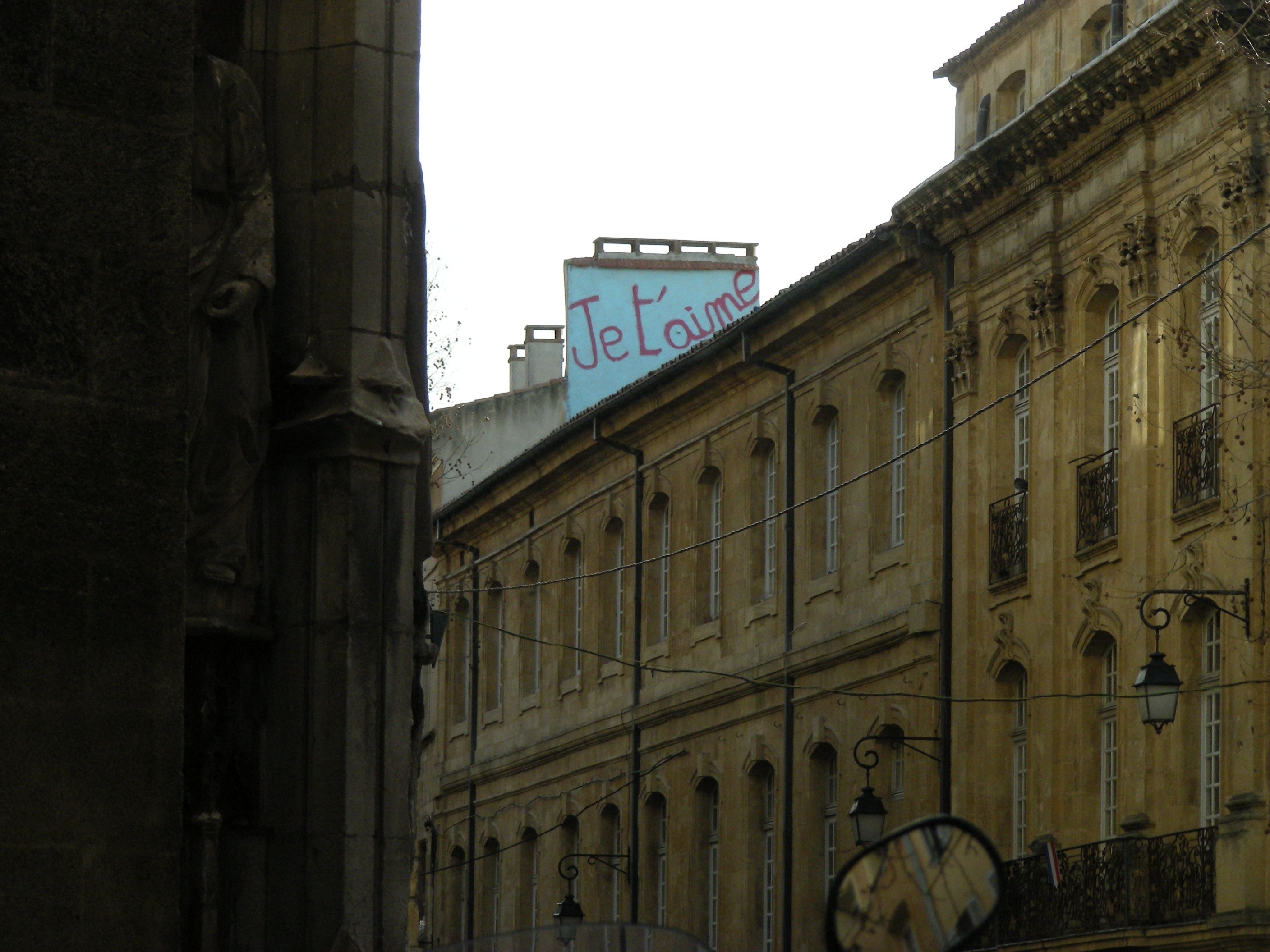
When I saw this graffiti a few years ago it reminded me of the late, great John Peel, whose radio show I used to listen to regularly in my teens. I remember him one year saying he enjoyed picking up autumn leaves, writing “Hello” on them, and dropping them back down on the ground, because he could imagine the joy and surprise it would bring people who came across them.

Well, how about, today, you say “I love you”?

Say it to someone you love. Or say it to your cat, your dog, or any other animal you love. Or say it to your favourite tree, or a beautiful flower which is blooming in your garden.

Or say I love you to the Earth or to the Universe.

You choose.

Whoever, or whatever, you choose to say “I love you” to, really mean it. Don’t just throw the words away. Feel the love in your heart, and visualise radiating that love outwards. Unconditionally.

Write it down if you want. This graffiti artist certainly wrote it big, but you can write it any size…..in an email, a message, on a leaf, a piece of paper…..you decide.

If we all do this today, there will be more love in the world. Not one day, not just sometime, but today.

And you know what? Nobody can stop you. Nobody can prevent it. It’s up to you to become aware of the love in your heart, and to choose to radiate that love outwards.

Read Full Post »

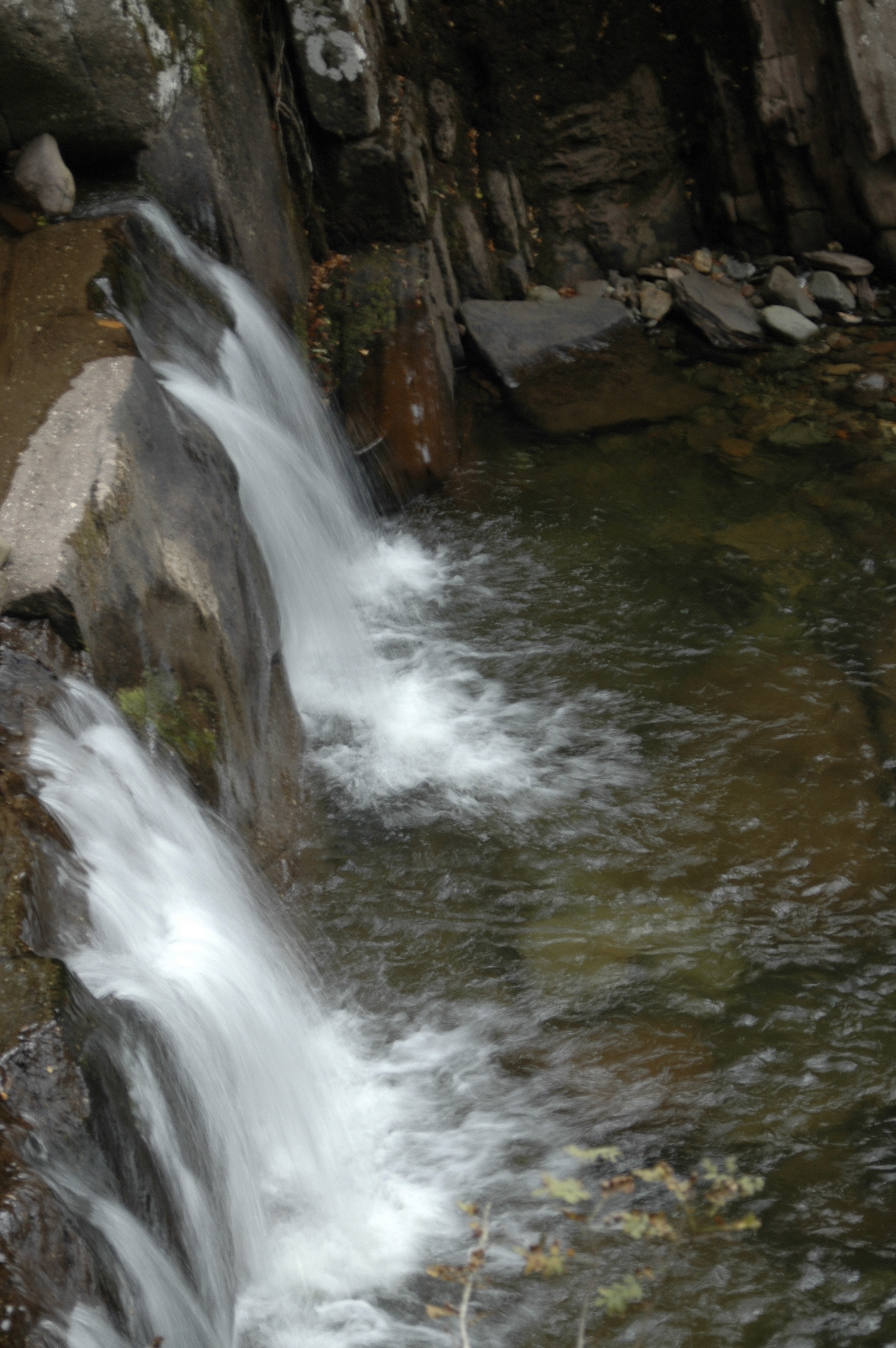
In my photo library I’ve named this “waterfalls”. Yep, plural. And when I looked at it again this morning I thought it seemed a great image to stimulate thought about working together…..in fact, “flowing together” was the phrase which popped into my mind. I slowed down the shutter speed for this photo so the water would blur like this. I think the whole sense of movement and flow is captured better that way. There’s a power in this scene, and that power lies in the water itself. Or, at least, that’s how it seems at first.

So I look at this and think, this is what we are like together…..when we flow together…..when our energies, our focus and our direction all align. Isn’t that beautiful?

I’d almost be happy to leave it at that. Just to put this image in front of you and hope that you’ll think of the power and the beauty of harmony, resonance and alignment.

But, then I wondered why I’d called the photo “waterfalls”, plural. Isn’t it just one waterfall? After all most waterfalls don’t have a single stream of water falling over a specific rock. Rather, most waterfalls are made up of multiple paths where different amounts of water channel through particular spaces, and tumble over specific rocks. We don’t look at a waterfall which has six streams of water falling and think, oh look at those six waterfalls, do we? Or maybe we do.

So that’s where my mind went next. It went off to reflect on our very human capacity to separate out whatever we are looking at. To break the whole down into parts. There are a number of words for that – abstraction is one. Abstraction is where we abstract, or remove, something from its context. Our left hemisphere is brilliant at doing that. Indeed it seems that’s the normal process……the whole flows into the right hemisphere which hands off some of that flow to the left so it can abstract the components, the parts, the pieces……abstract them, label them, categorise them. And, yes, what’s supposed to happen next is that the left passes the results of that analysis back to the right for it to re-contextualise it. It’s just, if Iain McGilchrist is right, that this process has broken down and we have developed the habit of giving priority to the work of the left hemisphere…….too often we see only the parts, and forget to re-contextualise them.

If we don’t allow ourselves to use our whole brain, then we see two waterfalls here, where, seeing the whole would mean we see just one.

I don’t know what works best for you, but I’ve had a lifetime of work refusing to rest with reductionist abstractions, and always striving to see and hear the unique whole person every time. Yes, I’ve had to focus down onto parts, perhaps listening to someone’s lungs or heart, perhaps measuring the level of a component in their blood, but, I’ve always preferred to re-contextualise whatever those abstractions reveal.

I think we need to do more of that.

I think we need to see the whole, to see the contexts, to seek the connections and relationships, and to realise that every experience we have changes us…..just as this beautiful waterfall constantly changes, moment by moment, month by month, year by year.

Read Full Post »

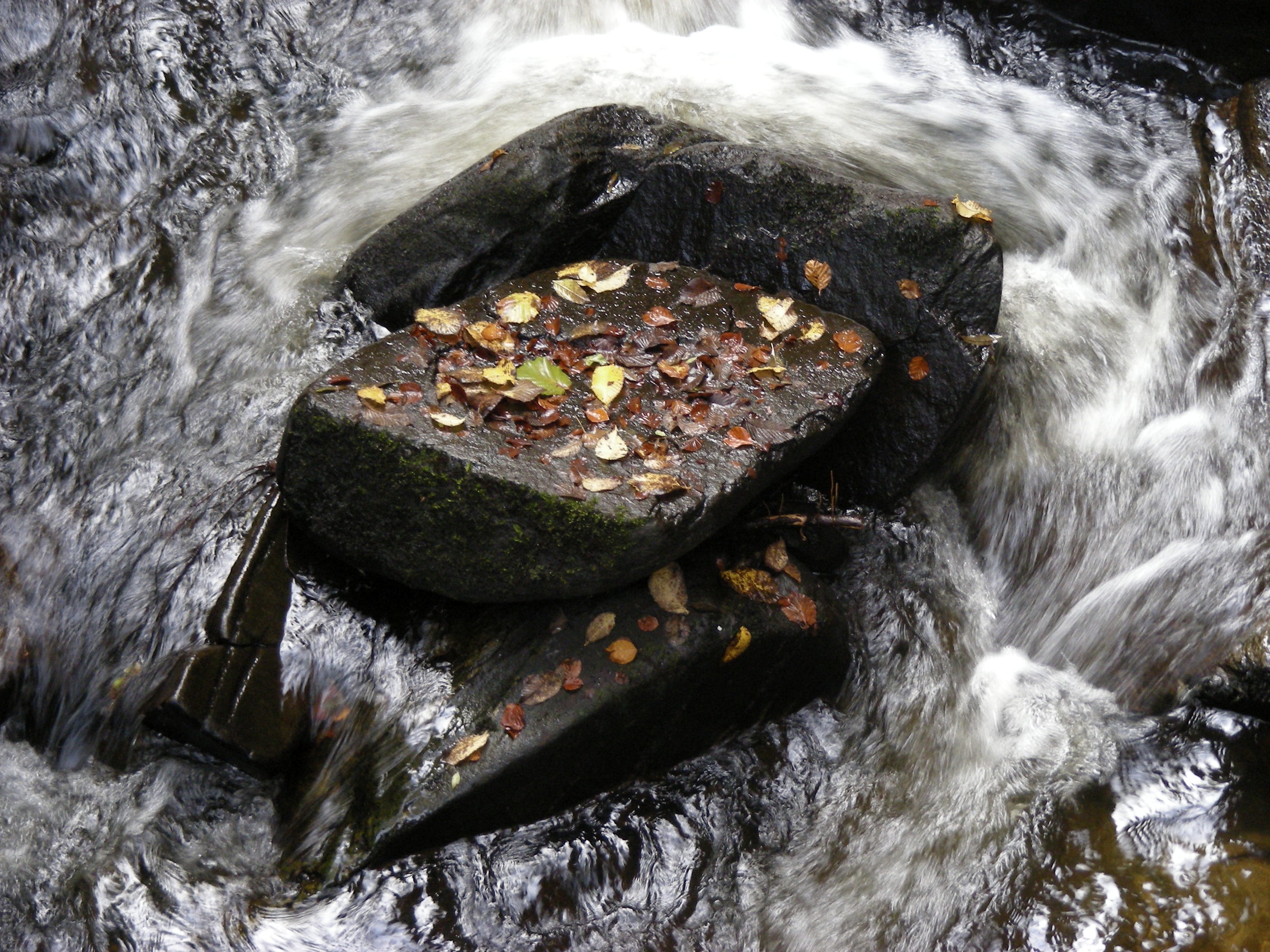
When I look at this photo the leaves seem like pieces of gold at first. Perhaps golden coins. But then I quickly see that they are fallen autumn leaves, with gold, brown, yellow and even green ones. The rock they have landed on, or stuck onto, seems like a collecting point, or a resting point. Maybe the leaves fell here from overhanging trees, but, in fact there weren’t any trees directly overhanging this rock, so maybe they were blown onto this rock. Alternatively, maybe they were swept downstream on the fast flowing water. Whatever their origin and mode of transport, they stuck to this wet rock.

Here’s what comes up for me as I reflect on this image……

Life flows past fast. It rushes by, moment by moment, day by day, even year by year. It never stops. Life is continuous and full of movement, just like this tumbling highland stream. There are places, however, where we can pause. Places or moments where we can step out of the rush and flow of things for a moment and take a breather. It’s important to do that.

When we do step onto the rock, which represents the time out moment, we find that there is some gold there. We find that stuck onto that place of rest there are some golden moments, and some of the gifts from golden moments, from the past. This reminds me of gratitude practice. Many people have demonstrated the benefits to our mental health and wellbeing of doing regular gratitude practice.

Quite simply, there is much to gain from taking a pause, a few moments, and either writing down some of the experiences, events, relationships, gifts for which we are grateful, or even calling them to mind, re-creating them in our imagination, and stirring the benefits of those special times all over again.

The rock, in these musings, becomes a place in the mind. A place where I rest, stand apart for a moment, create what Iain McGilchrist calls “the necessary distance” which allows us to reflect, to set new perspectives, and to see the whole. It’s a place of integration……where I reinforce the mutually beneficial bonds between me and “the other”.

Then I step off into the stream again, and flow off onto the next part of the journey.

Read Full Post »

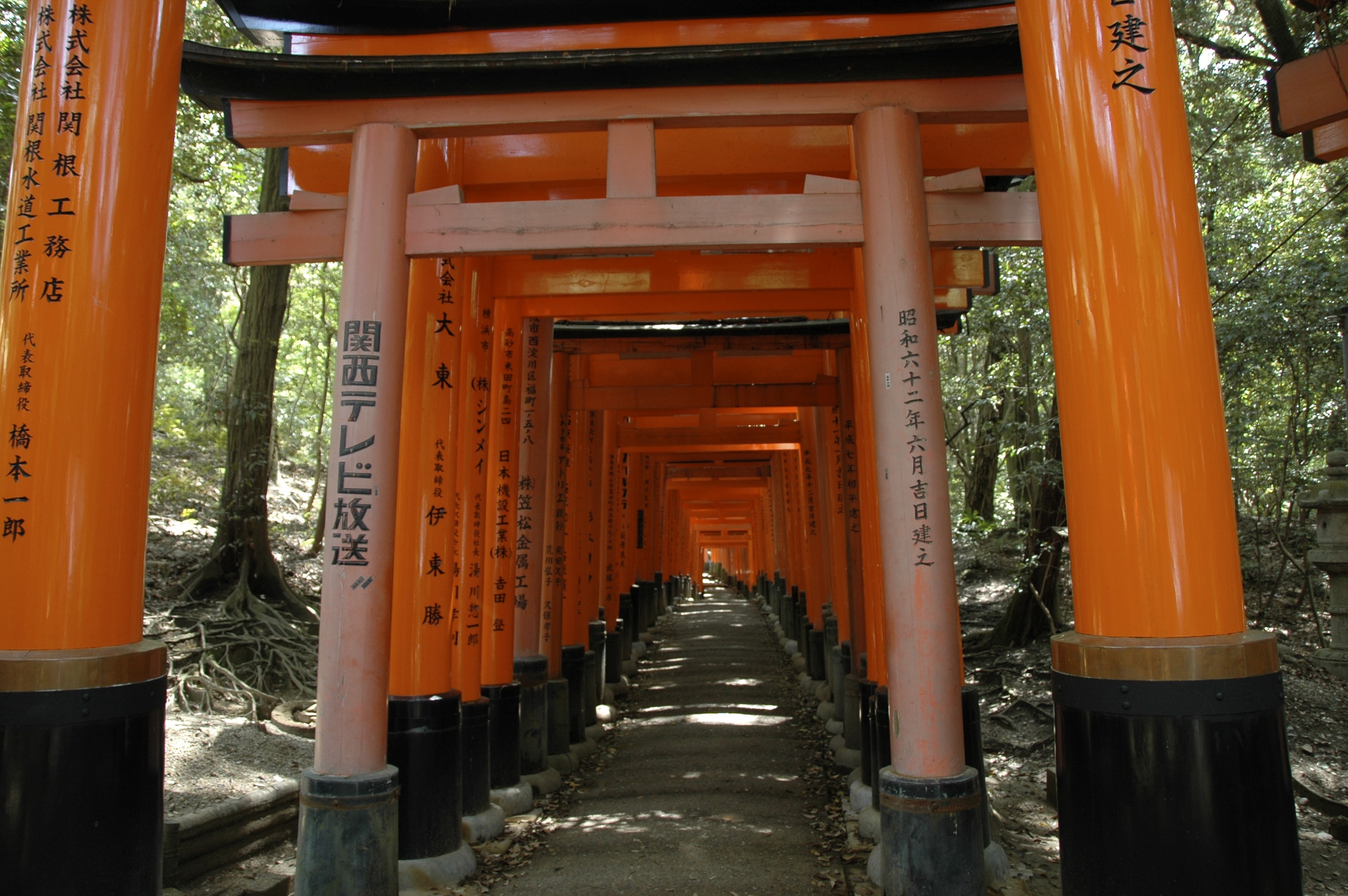
The Fushimi Inari temple just outside Kyoto is quite unlike any other place I’ve visited. It’s an experience which was unique and which remains vivid in my psyche many years later. You follow a path through a forest, up a hill until you get to the top. The path has hundreds of these “Torii” gates enclosing much of it.

You’ve probably seen photos of these types of brightly coloured gateways from Japan. I think they are amazing. They are simple, beautiful and magical.

As you walk up the path you pass under one gate after another, and it never becomes “same-y”. It seems that you can experience the uniqueness of each gate, one at a time, and, of course, if you stop, look ahead, turn round and look back, then you see these long snaking tunnels…..because although the gates are clearly separate from each other, as you look at a number of them extending into the distance, the spaces disappear and they seem to form a continuous arch.

Maybe the closest thing to this in Europe would be a cloister with multiple arches, but, even that is not quite the same.

If I stand here and look back, I see a trail of events and experiences represented by each of the gates. Each event was unique, every experience changed me. Some of them stand out in my memory and I can see them clearly, others have fused with the ones around them to create a longer period of my life which I remember with only some representative details.

If I stand here and look forward, I see a cascade of events and experiences lying before me. Not fully formed, and not realised until I reach that point in my path. The ones closer to me lie in my immediate future and I see them fairly clearly. The further out ones are hard to distinguish, hard to know in their details.

Both of those orientations seem right to me. Both of them influence and inform the point where I have reached, the present time and place, under this one torii gate we call this moment.

As I reflect on my life this way, I realise that every event has its unique context, every experience comes into being as I live it, and transforms me, and my life. I realise I can’t see very far into the future, that the future is not lying fully formed ahead of me, but that some aspects of the future are already in place, waiting to create my next, singular, and special experiences of what will become “now” when I reach them.

I can reflect on the larger scale this way too, looking back over the last 18 months of this pandemic, remembering some of the events which changed me, and straining to look ahead, having, yet again, that feeling of uncertainty, of doubt, and wonder……knowing that none of us know, but that we have a pretty good idea of how the near future will look, all the same.

Perhaps this is not the most creative way to think about the past and the future, but I like it. It brings together the connectedness of events and experiences. It reminds me how every one of them changes me. And it reinforces my understanding that I need to be humble, flexible, and adaptable, responding to each gate as I reach it.

Read Full Post »

I have a life long love affair with books. My grandpa used to read to me when I was young, working his way through books like “Tales of a Grandfather” by Walter Scott, and collections of myths and fairy tales. I’ve always been intensely curious and had a fascination for both the local “reference library” and for story books from the “lending library”. Goodness knows how many books I’ve bought in my life, and I really don’t know how many I still have. I do know that most people who have come to my house seem surprised by just how many books there are, so I guess I have more than most people do.

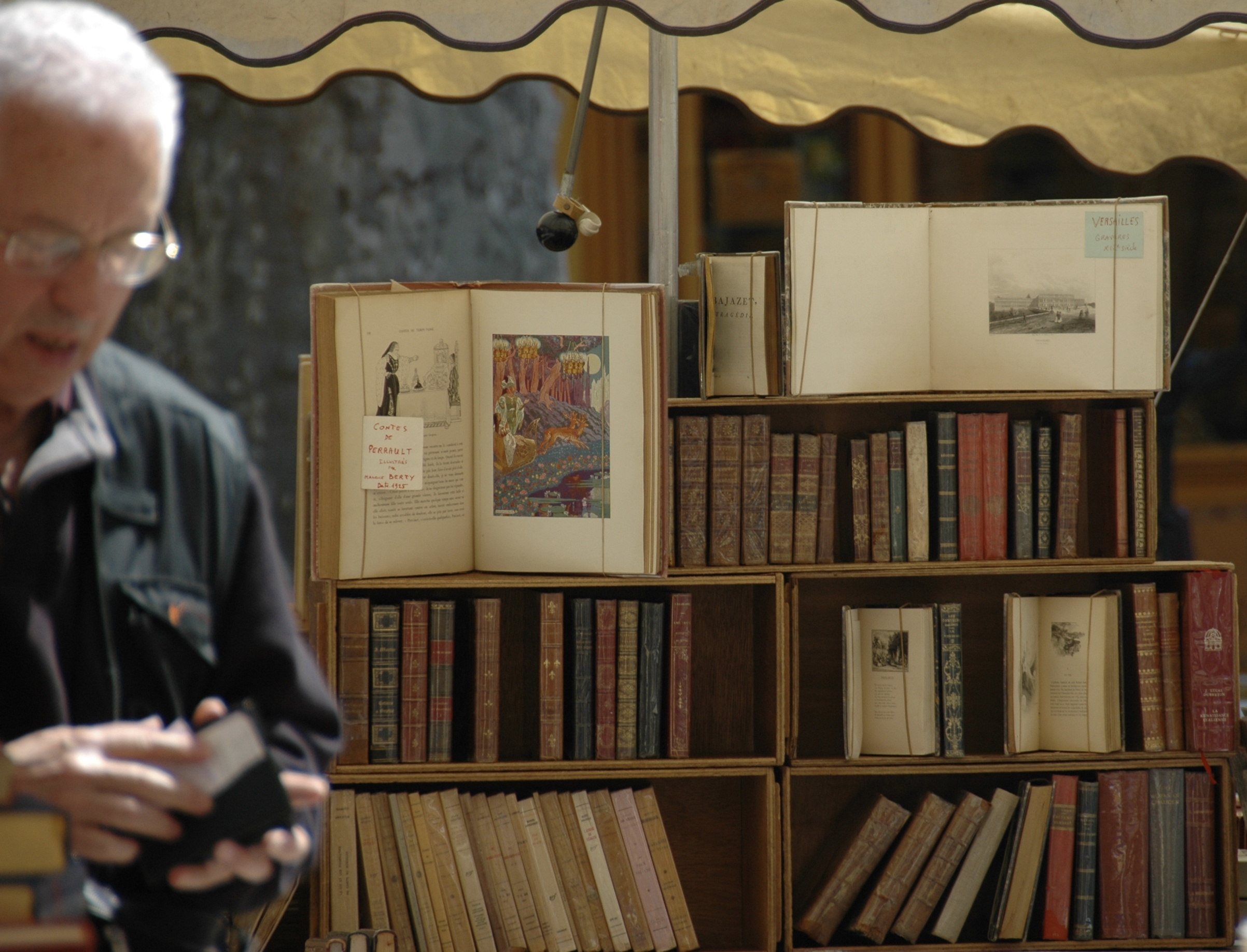
I love bookshops, old and new, and I adore browsing around the booksellers at fairs and markets. It was a market like the one in this photo which caught my imagination whilst on holiday in France many years ago, and probably seeded my idea to retire when I did, and come to live in France. I had decided I wanted to live part of my life not just in another physical part of the world with a different geography, climate and history, but I wanted to live in a different culture. In particular I wanted to immerse myself in the language and literature of France…..it seemed to offer both different ways of seeing and understanding the world, and to open up whole areas of thought and observation which was unknown to me.

But I didn’t switch away from English to French. I still read a lot more English than I do French. I’ve been here just over six years now and it’s fulfilling all I’d hoped for. Of course, with the pandemic even bookshops were closed, and certainly markets and fairs were cancelled, but that hasn’t slowed down my reading.

There are a couple of very famous French books I’d recommend to anyone – they are so famous that they’ve been translated into many languages so chances are you won’t need to learn French to be able to read them. They are “The Little Prince” by Saint Exupery. It’s a brilliant, thought provoking story, beautifully illustrated. Many, many years ago I found a book in a bookshop in Aix en Provence. It’s called “Donner un sens à l’existence” by Jean-Philippe Ravoux. He’s a professor of philosophy in Aix, and the subtitle is “ou pourquoi Le Petit Prince est le plus grand traité de métaphysique du XXe siècle” – so, it’s, roughly, “Making sense of existence” – “or why The Little Prince is the greatest work of metaphysics in the 20th century”. It’s a brilliant little book, which draws on Saint Exupery’s story to enable the reader to explore a philosophy of life. I love it. Sadly, I don’t think it’s ever been translated into any other languages. However, don’t despair, just read The Little Prince. I really, really recommend it.

The second very famous French book which I recommend is Montaigne’s Essays. OK, the full collection is HUGE, and the original in Old French, beyond me. But I have copies in both French and English. However, what I’d recommend to absolutely anyone is Sarah Bakewell’s “How to Live. A Life of Montaigne in one question and twenty attempts at an answer”. It’s brilliant. It’s really an easy read and I think it makes an utterly fabulous introduction to the life and work of Montaigne. The man was a genius and his essays have been translated into many languages and still stand the test of time.

If I really get into recommending books I’ll never stop! But I thought I’d just share these two works with you today – because they continue to be my favourites, I have never stopped re-reading them, and you are likely to be able to find translations into your own language.

Read Full Post »

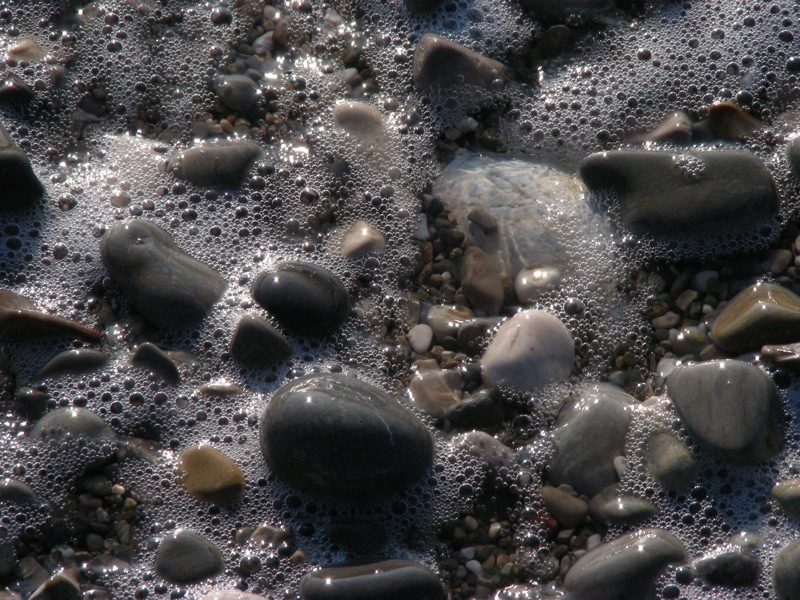
At the edge of the sea where the waves break onto the sad, sometimes you find an area like this, filled with pebbles and bubbling, foaming water. The hissing sound of the water as thousands of bubbles burst, and the clattering sound of the pebbles as they are tumbled back and forth by the waves is a beautiful sound.

When I look at this image I see the contrast between the foam and the stone. The foam lasts seconds, maybe a couple of minutes at most. The stones look permanent. They seem unchanging. But of course, they’re not. The reason that they are so smooth and rounded and glistening is due to the fact that they are undergoing constant transformation by the water. As they are washed and soaked by the water and rattled over each other by the waves, they change all the time, losing atoms to the sea, having their rough surfaces smoothed, and gradually, gradually, being reduced to sand.

The big difference between the foam and the stone is one of duration. Both are impermanent. Both are constantly changing. It’s just that the water does all that much more quickly than the stone does. In fact, the stone does it so slowly that we are mislead into thinking that the pebbles are permanent, eternal, unchanging. They’re not.

The other thing which strikes me when I look at this photo is how it reveals the fundamental truth that everything that exists is constantly being transformed by the encounters it makes with other things. We tend to think of the world as being made up of separate, easily identifiable, different objects – whether they are stones, trees, lakes or creatures.

But what about thinking about the world as made up of subjects, not objects? If everything (I really need to find another word for “thing” because just by using that I turn the world into a collection of objects!) which exists is in constant relationships with others….similar others, and totally different others…..and if those relationships change each of the partners through their encounters and experiences then maybe its better to think of the world as a community of subjects.

The world – not a collection of disconnected objects which can be standardised and replicated, but a community of subjects who co-inhabit the same planet and who resist standardisation through the perpetual transformations of being which emerge from their encounters.

Becoming, not being.

A finite, temporal world of encounters and experiences.

When I think of life this way I find a feeling of resistance arise in me – a resistance in the face of commodification, objectification, standardisation and control. It drives my desire for freedom, feeds my curiosity and opens me to the formation of new relationships and the experience of new encounters, every, single, day.

Read Full Post »

« Newer Posts - Older Posts »